COMPENSATION
ADMINISTRATION

Group Memebers•Ashrana Parween
•Aswani Gupta
•Avanish Singh
•Ayush Vaish
1
What is Compensation ?
INTRODUCTION
Compensation is what employees receive in exchange for their
contribution to the organization. Generally speaking, employees offer
their services for three types of rewards
Base pay:- It is the basic compensation an employee gets,
usually as a wage or salary.

 Variable pay:-It is the compensation that is linked directly to
performance accomplishments (bonuses, incentives, stock option)

 Benefits:-Theses are indirect rewards given to an employee or
group of employee as a part of organizational membership (health
2
insurance, vacation pay, retirement pension etc.)
Objectives of Compensation Planning
The most important objective of any pay system is fairness or equity,
generally expressed in three forms•

Internal equity: This ensure that more difficult jobs are paid more.

•

External equity: Where jobs are fairly compensated in comparison
to similar jobs in labour market.

•

Individual equity: It ensures equal pay is ensured for equal work.

3
Other Objectives of compensation
planning


Attract talent

 Retain talent
 Ensure equity
 New and

desired behaviors

 Control costs
 Comply with legal rules
 Ease of operation
4
Equity And Pay Rates
Equity in pay rates could be achieved through five steps –

1. Job Evaluation:- Job analysis offers valuable information for
developing a compensation system in terms of what duties and
responsibilities need to be undertaken.

2. Wage and Salary Surveys :- Conduct as salary survey to
find what other employers are paying for comparable jobs.
Published sources also provide valuable information regarding
industry wise trends in salary structure in and around the country.
The published sources in India include: reports published by the
Ministry of Labour, pay commission reports, reports of employees
and employers’ organisation, Trade journals etc.
5
Equity And Pay Rates (cont)
•

Conduct a salary survey through the following methods
•
•
•
•
•

Key job matching
Key class matching
Occupational method
Job evaluation method
Broad classification method

3. Group Similar Jobs into Pay Grades:- In this step, similar
jobs (in terms of their ranking or number points as ascertained by
the job evaluation committee) are grouped into grades for pay
purpose. The organisation can now focus on, say 10 to 12 pay
grades, instead of hundreds of pay rates.
6
Equity And Pay Rates (cont)
4.Price each Pay Grade-

7
Equity And Pay Rates (cont)

5.Fine Tune Pay Rates:-

Fix a pay rage for each grade (like
pay for officer category I, II, III etc) for example, in Banking industry.
The wage structure of a company is nothing but a pay scale showing
ranges of pay within each grade.

8
Components of Pay Structure
The two essential components of pay structure are:-

1. Basic wages:-the basic wage rate is fixed taking the skill needs of
the job, experience needed, difficulty of work, training required,
responsibilities involved and the hazardous nature of the job.

2. Dearness allowance:- it paid to employees in order to
compensate them for the occasional or regular rise in the price of
essential commodities. DA is linked to three factors
• All India consumer price index (AICPI)
• Time factor
• Point factor
9
Components of pay structure in
India
•

Under the Workmen's Compensation Act 1923
– Wages for leave period, holiday pay, overtime pay, bonus,
attendance bonus and good conduct bonus.

•

Under the Payment of Wages Act 1948

- Retrenchment compensation, payment in lieu of notice , gratuity
payable on discharge constitute wage.

10
Components of Pay Structure
The following, however, do not come under the term wages
 Bonus
 Payments made under a profit sharing scheme
 Value of house accommodation
 Medical allowances
 Travelling allowances
 Any other sum paid to defray special expenses incurred by
the worker
 Contribution to pension, provident fund
 Any amenity or service excluded from the computation of
wages
11
Wage And Salary Administration
Employee compensation may be classified into two types1. Base compensation, here, refers to monetary payments to
employees in the form of wages and salaries. It is a fixed, nonincentive kind of payment calculated on the basis of time spent
by an employee on the job.
2. Supplementary compensation signifies incentive payments
based on the actual performance of an employee.

12
Wage And Salary Administration
Objectives


To establish a fair and equitable remuneration



To attract competent personnel



To retain present employees



To control labour cost



To improve motivation and morale of employees



To project a good image of the company

13
Wage And Salary Administration
•

Principles
•

Wage and salary plans be sufficiently flexible.

•

Job evaluation being done scientifically.

• Wage and salary plans be always consistent with
overall
plans.
• Wage and salary plans being responsive to
changing conditions.
14
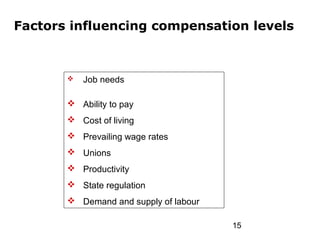
Factors influencing compensation levels



Job needs

 Ability to pay
 Cost of living
 Prevailing wage rates
 Unions
 Productivity
 State regulation
 Demand and supply of labour
15
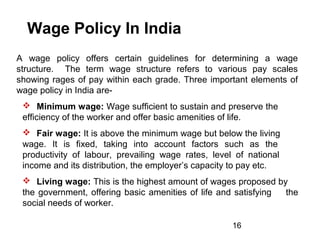
Wage Policy In India
A wage policy offers certain guidelines for determining a wage
structure. The term wage structure refers to various pay scales
showing rages of pay within each grade. Three important elements of
wage policy in India are Minimum wage: Wage sufficient to sustain and preserve the
efficiency of the worker and offer basic amenities of life.
 Fair wage: It is above the minimum wage but below the living
wage. It is fixed, taking into account factors such as the
productivity of labour, prevailing wage rates, level of national
income and its distribution, the employer’s capacity to pay etc.
 Living wage: This is the highest amount of wages proposed by
the government, offering basic amenities of life and satisfying
the
social needs of worker.
16
Reference
• http://business.gov.in/legal_aspects/comp
ensation_1923.php
• http://en.wikipedia.org/wiki/The_Minimum_
Wages_Act,_1948
• Human Resource Management by V.S.P
Rao.

17
18

Compensation

  • 1.
  • 2.
    What is Compensation? INTRODUCTION Compensation is what employees receive in exchange for their contribution to the organization. Generally speaking, employees offer their services for three types of rewards Base pay:- It is the basic compensation an employee gets, usually as a wage or salary.  Variable pay:-It is the compensation that is linked directly to performance accomplishments (bonuses, incentives, stock option)  Benefits:-Theses are indirect rewards given to an employee or group of employee as a part of organizational membership (health 2 insurance, vacation pay, retirement pension etc.)
  • 3.
    Objectives of CompensationPlanning The most important objective of any pay system is fairness or equity, generally expressed in three forms• Internal equity: This ensure that more difficult jobs are paid more. • External equity: Where jobs are fairly compensated in comparison to similar jobs in labour market. • Individual equity: It ensures equal pay is ensured for equal work. 3
  • 4.
    Other Objectives ofcompensation planning  Attract talent  Retain talent  Ensure equity  New and desired behaviors  Control costs  Comply with legal rules  Ease of operation 4
  • 5.
    Equity And PayRates Equity in pay rates could be achieved through five steps – 1. Job Evaluation:- Job analysis offers valuable information for developing a compensation system in terms of what duties and responsibilities need to be undertaken. 2. Wage and Salary Surveys :- Conduct as salary survey to find what other employers are paying for comparable jobs. Published sources also provide valuable information regarding industry wise trends in salary structure in and around the country. The published sources in India include: reports published by the Ministry of Labour, pay commission reports, reports of employees and employers’ organisation, Trade journals etc. 5
  • 6.
    Equity And PayRates (cont) • Conduct a salary survey through the following methods • • • • • Key job matching Key class matching Occupational method Job evaluation method Broad classification method 3. Group Similar Jobs into Pay Grades:- In this step, similar jobs (in terms of their ranking or number points as ascertained by the job evaluation committee) are grouped into grades for pay purpose. The organisation can now focus on, say 10 to 12 pay grades, instead of hundreds of pay rates. 6
  • 7.
    Equity And PayRates (cont) 4.Price each Pay Grade- 7
  • 8.
    Equity And PayRates (cont) 5.Fine Tune Pay Rates:- Fix a pay rage for each grade (like pay for officer category I, II, III etc) for example, in Banking industry. The wage structure of a company is nothing but a pay scale showing ranges of pay within each grade. 8
  • 9.
    Components of PayStructure The two essential components of pay structure are:- 1. Basic wages:-the basic wage rate is fixed taking the skill needs of the job, experience needed, difficulty of work, training required, responsibilities involved and the hazardous nature of the job. 2. Dearness allowance:- it paid to employees in order to compensate them for the occasional or regular rise in the price of essential commodities. DA is linked to three factors • All India consumer price index (AICPI) • Time factor • Point factor 9
  • 10.
    Components of paystructure in India • Under the Workmen's Compensation Act 1923 – Wages for leave period, holiday pay, overtime pay, bonus, attendance bonus and good conduct bonus. • Under the Payment of Wages Act 1948 - Retrenchment compensation, payment in lieu of notice , gratuity payable on discharge constitute wage. 10
  • 11.
    Components of PayStructure The following, however, do not come under the term wages  Bonus  Payments made under a profit sharing scheme  Value of house accommodation  Medical allowances  Travelling allowances  Any other sum paid to defray special expenses incurred by the worker  Contribution to pension, provident fund  Any amenity or service excluded from the computation of wages 11
  • 12.
    Wage And SalaryAdministration Employee compensation may be classified into two types1. Base compensation, here, refers to monetary payments to employees in the form of wages and salaries. It is a fixed, nonincentive kind of payment calculated on the basis of time spent by an employee on the job. 2. Supplementary compensation signifies incentive payments based on the actual performance of an employee. 12
  • 13.
    Wage And SalaryAdministration Objectives  To establish a fair and equitable remuneration  To attract competent personnel  To retain present employees  To control labour cost  To improve motivation and morale of employees  To project a good image of the company 13
  • 14.
    Wage And SalaryAdministration • Principles • Wage and salary plans be sufficiently flexible. • Job evaluation being done scientifically. • Wage and salary plans be always consistent with overall plans. • Wage and salary plans being responsive to changing conditions. 14
  • 15.
    Factors influencing compensationlevels  Job needs  Ability to pay  Cost of living  Prevailing wage rates  Unions  Productivity  State regulation  Demand and supply of labour 15
  • 16.
    Wage Policy InIndia A wage policy offers certain guidelines for determining a wage structure. The term wage structure refers to various pay scales showing rages of pay within each grade. Three important elements of wage policy in India are Minimum wage: Wage sufficient to sustain and preserve the efficiency of the worker and offer basic amenities of life.  Fair wage: It is above the minimum wage but below the living wage. It is fixed, taking into account factors such as the productivity of labour, prevailing wage rates, level of national income and its distribution, the employer’s capacity to pay etc.  Living wage: This is the highest amount of wages proposed by the government, offering basic amenities of life and satisfying the social needs of worker. 16
  • 17.
  • 18.