Compensation Management & Job
          Evaluation
Group Members
•   Agicha Pankaj
•   Madhura Kadam
•   Neelam Dalvi
•   Sheetal Gadhari
•   Bhagyashree Kotwani
•   Yash Adukia
Compensation Management
        An Introduction
•   Employees work in the production units for eight hours a day
    and against such work, they are paid certain amount of money
    called “wage or Compensation Payment”
•   Compensation Management is concerned with compensation
    payment and other aspects relating to such payment.
•   Workers are very much interested in the compensation payment
    as their welfare is directly linked with such compensation
    payment.
•   There is a Tug- of - War between employer and workers as
    regards to compensation payment.
•   HRM is concerned with fair compensation payment to
    employees as such payment avoids industrial disputes and
    ensures cordial industrial relations.
Meaning of Compensation Payment

• Normally, compensation payable to the employees include
  the following three components:
   – Basic compensation for the job(Wage/Salary)
   – Supplementary compensation paid to employees (Fringe
     Benefits)
   – Incentive compensation for the employee on the job.
Definition of Compensation

Compensation may be defined as money
received in the performance of work, plus
many kinds of benefits and services that
organizations provide to their employees.
Compensation Package/ Salary Slip

 • An employee is given full details of
   compensation payment on a printed
   small slip called Salary Slip.
 • The salary slip is given to every worker
   along with full details of Salary Payment
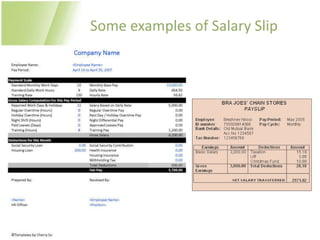
Some examples of Salary Slip
Fringe Benefits
Meaning
• In addition to regular
  wages, allowance, and bonus
  payment, employees are given other
  benefits and services called Fringe
  Benefits.
• They are supplementary to regular wages
• They are indirect compensation
Definition

According to William. B . Werther and Keith Davis,
“Fringes embrace a broad range of benefits and services that
employees receive as a part of their total compensation
package… Pay or Direct compensation… is based on critical job
factors and performance. Benefits and Services, however, are
indirect compensation because they are usually extended as a
condition of employment and are not directly related to
performance.
Features
•   Different from regular wages.
•   Useful but avoidable expenditure.
•   Not directly linked with efforts.
•   Beneficial to all employees.
•   Voluntary in character.
Objectives of Fringe Benefits

•   To supplement direct remuneration.
•   Employers prefer fringe benefits.
•   To retain competent employees.
•   To develop good corporate image.
•   To raise employee morale.
•   To motivate employees.
Types of Fringe Benefits
• Payment for Timeout worked by
  employees.
• Contingent and Deferred Benefits.
• Legally required payments.
• Miscellaneous Benefits.
Advantages

•   Support employee remuneration.
•   Raise employee efficiency and productivity.
•   Added employee attraction.
•   Reduce employee fatigue.
•   Raise employee morale.
•   Develop good corporate image.
•   Act as motivating force.
Disadvantages
• Unhealthy competition among
  employees in the organization.
• Not adequately attractive to employees.
• Motivation of employees may not be as
  per expectation.
Fringe Benefits in India

• Statutory Fringe Benefits.
• Voluntary Fringe Benefits.
Wage Incentive Plans
Definition
According to the National Comission on
Labour,
‘wage incentives are extra financial
motivation. They are designed to stimulate
human effort by rewarding the person, over
and above the time rated remuneration, for
improvements in the present or targeted
results’
Types of Incentive Plan

• Individual Incentive Plan
• Group Incentive Plan
Halsey Premium Plan

• In this plan, a worker is given gurantee of
minimum wage as per the time rate.
• For example- Extra payment made for
extra production done.
Advantages of Incentive Plan

•   Inducement and motivation for higher efficiency.
•   Enhanced employee earning.
•   Reduction in Production Cost.
•   Increased production capacity.
•   Attraction for management.
Disadvantages

• Quality determination.
• Problem in introduction of new machines
  or method.
• Demand for higher minimum wages.
• Jealousy among workers.
• Disregard security regulation.
• Problem in determining the standard
  performance.
Requisites of a Good Incentive Plan

•   Simplicity.
•   Encourages initiatives.
•   Prompt Payment.
•   Properly communicate to employees.
•   Definiteness & Flexibility.
•   Justice to employer and employee.
•   Acceptable to workers.
Perquisites

• Perquisites may be defined as any casual
  emolument or benefit attached to an office or
  position in addition to salary or wages. In
  essence, these are usually non-cash benefits
  given by an employer to employees in addition
  to cash salary or wages.
Non Monetary Incentives
Job Evaluation
Definition

     According to Edwin. B. Flippo, Job
Evaluation is a systematic and orderly process of
determining the worth of a job in relation to
other jobs.
Features
• Determines the relative worth of the
  job.
• Based on the analysis of the facts
  about the job.
• To bring a balanced wage structure.
• Needs to be differentiated from Job
  Analysis and Performance Analysis.
Objectives

• To establish by impartial judgement.
• To establish satisfactory wage.
• To select employees more accurately.
• To promote employee goodwill.
• To provide management with a basis of proper
  control.
• To determine the rate of pay for each job.
• Miscellaneous purpose.
Importance
• Indicates the relative worth of different jobs.
• Establishing a hierarchy of jobs.
• Useful for introducing a satisfactory, rational & balanced
  wage structure.
• Promotes employees’ goodwill.
• Provides scientific base for promotion and transfers.
• Avoids injustice to workers.
• Vague feelings and suspicious of unfairness.
• Makes promotions and transfers more easily acceptable.
• Simplifies wage administration.
• Facilitates adjustment of existing job within the existing
  wage structure.
• Removes grievances and disputes among employees.
METHODS OF JOB EVALUATION

1. Quantitative Method
2. Non Quantitative Method.
Quantitative Method
•   Point rating method.
•   Factor comparison method.
Non Quantitative Method

•   Ranking or Job comparison method.
•   Grading or Job classification method.
PROCESS OF JOB EVALUATION
1. Securing acceptance from employees.
2. Creating/forming job evaluation
   committee.
3. Finding/ deciding the jobs to be
   evaluated.
4. Analyzing and preparing job description.
5. Selecting the method of evaluation.
6. Classifying jobs.
7. Installing the program.
8. Periodical review.
Compensation management & job evaluation

Compensation management & job evaluation

  • 1.
  • 2.
    Group Members • Agicha Pankaj • Madhura Kadam • Neelam Dalvi • Sheetal Gadhari • Bhagyashree Kotwani • Yash Adukia
  • 3.
    Compensation Management An Introduction • Employees work in the production units for eight hours a day and against such work, they are paid certain amount of money called “wage or Compensation Payment” • Compensation Management is concerned with compensation payment and other aspects relating to such payment. • Workers are very much interested in the compensation payment as their welfare is directly linked with such compensation payment. • There is a Tug- of - War between employer and workers as regards to compensation payment. • HRM is concerned with fair compensation payment to employees as such payment avoids industrial disputes and ensures cordial industrial relations.
  • 4.
    Meaning of CompensationPayment • Normally, compensation payable to the employees include the following three components: – Basic compensation for the job(Wage/Salary) – Supplementary compensation paid to employees (Fringe Benefits) – Incentive compensation for the employee on the job.
  • 5.
    Definition of Compensation Compensationmay be defined as money received in the performance of work, plus many kinds of benefits and services that organizations provide to their employees.
  • 6.
    Compensation Package/ SalarySlip • An employee is given full details of compensation payment on a printed small slip called Salary Slip. • The salary slip is given to every worker along with full details of Salary Payment
  • 7.
    Some examples ofSalary Slip
  • 8.
  • 9.
    Meaning • In additionto regular wages, allowance, and bonus payment, employees are given other benefits and services called Fringe Benefits. • They are supplementary to regular wages • They are indirect compensation
  • 10.
    Definition According to William.B . Werther and Keith Davis, “Fringes embrace a broad range of benefits and services that employees receive as a part of their total compensation package… Pay or Direct compensation… is based on critical job factors and performance. Benefits and Services, however, are indirect compensation because they are usually extended as a condition of employment and are not directly related to performance.
  • 11.
    Features • Different from regular wages. • Useful but avoidable expenditure. • Not directly linked with efforts. • Beneficial to all employees. • Voluntary in character.
  • 12.
    Objectives of FringeBenefits • To supplement direct remuneration. • Employers prefer fringe benefits. • To retain competent employees. • To develop good corporate image. • To raise employee morale. • To motivate employees.
  • 13.
    Types of FringeBenefits • Payment for Timeout worked by employees. • Contingent and Deferred Benefits. • Legally required payments. • Miscellaneous Benefits.
  • 14.
    Advantages • Support employee remuneration. • Raise employee efficiency and productivity. • Added employee attraction. • Reduce employee fatigue. • Raise employee morale. • Develop good corporate image. • Act as motivating force.
  • 15.
    Disadvantages • Unhealthy competitionamong employees in the organization. • Not adequately attractive to employees. • Motivation of employees may not be as per expectation.
  • 16.
    Fringe Benefits inIndia • Statutory Fringe Benefits. • Voluntary Fringe Benefits.
  • 17.
  • 18.
    Definition According to theNational Comission on Labour, ‘wage incentives are extra financial motivation. They are designed to stimulate human effort by rewarding the person, over and above the time rated remuneration, for improvements in the present or targeted results’
  • 19.
    Types of IncentivePlan • Individual Incentive Plan • Group Incentive Plan
  • 20.
    Halsey Premium Plan •In this plan, a worker is given gurantee of minimum wage as per the time rate. • For example- Extra payment made for extra production done.
  • 21.
    Advantages of IncentivePlan • Inducement and motivation for higher efficiency. • Enhanced employee earning. • Reduction in Production Cost. • Increased production capacity. • Attraction for management.
  • 22.
    Disadvantages • Quality determination. •Problem in introduction of new machines or method. • Demand for higher minimum wages. • Jealousy among workers. • Disregard security regulation. • Problem in determining the standard performance.
  • 23.
    Requisites of aGood Incentive Plan • Simplicity. • Encourages initiatives. • Prompt Payment. • Properly communicate to employees. • Definiteness & Flexibility. • Justice to employer and employee. • Acceptable to workers.
  • 24.
    Perquisites • Perquisites maybe defined as any casual emolument or benefit attached to an office or position in addition to salary or wages. In essence, these are usually non-cash benefits given by an employer to employees in addition to cash salary or wages.
  • 25.
  • 26.
  • 27.
    Definition According to Edwin. B. Flippo, Job Evaluation is a systematic and orderly process of determining the worth of a job in relation to other jobs.
  • 28.
    Features • Determines therelative worth of the job. • Based on the analysis of the facts about the job. • To bring a balanced wage structure. • Needs to be differentiated from Job Analysis and Performance Analysis.
  • 29.
    Objectives • To establishby impartial judgement. • To establish satisfactory wage. • To select employees more accurately. • To promote employee goodwill. • To provide management with a basis of proper control. • To determine the rate of pay for each job. • Miscellaneous purpose.
  • 30.
    Importance • Indicates therelative worth of different jobs. • Establishing a hierarchy of jobs. • Useful for introducing a satisfactory, rational & balanced wage structure. • Promotes employees’ goodwill. • Provides scientific base for promotion and transfers. • Avoids injustice to workers. • Vague feelings and suspicious of unfairness. • Makes promotions and transfers more easily acceptable. • Simplifies wage administration. • Facilitates adjustment of existing job within the existing wage structure. • Removes grievances and disputes among employees.
  • 31.
    METHODS OF JOBEVALUATION 1. Quantitative Method 2. Non Quantitative Method.
  • 32.
    Quantitative Method • Point rating method. • Factor comparison method.
  • 33.
    Non Quantitative Method • Ranking or Job comparison method. • Grading or Job classification method.
  • 34.
    PROCESS OF JOBEVALUATION 1. Securing acceptance from employees. 2. Creating/forming job evaluation committee. 3. Finding/ deciding the jobs to be evaluated. 4. Analyzing and preparing job description. 5. Selecting the method of evaluation. 6. Classifying jobs. 7. Installing the program. 8. Periodical review.