


ANNUAL COMPENSATION
INTRODUCTION TO COMPENSATION 
 Compensation is the Human Resource Management 
function that deals with every type of reward individual 
receive in exchange for performing organizational task. 
 Employees trade their labor and loyalty for financial and 
non-financial compensation. 
 It provides tangible rewards for their services as well as 
source of recognition and livelihood.
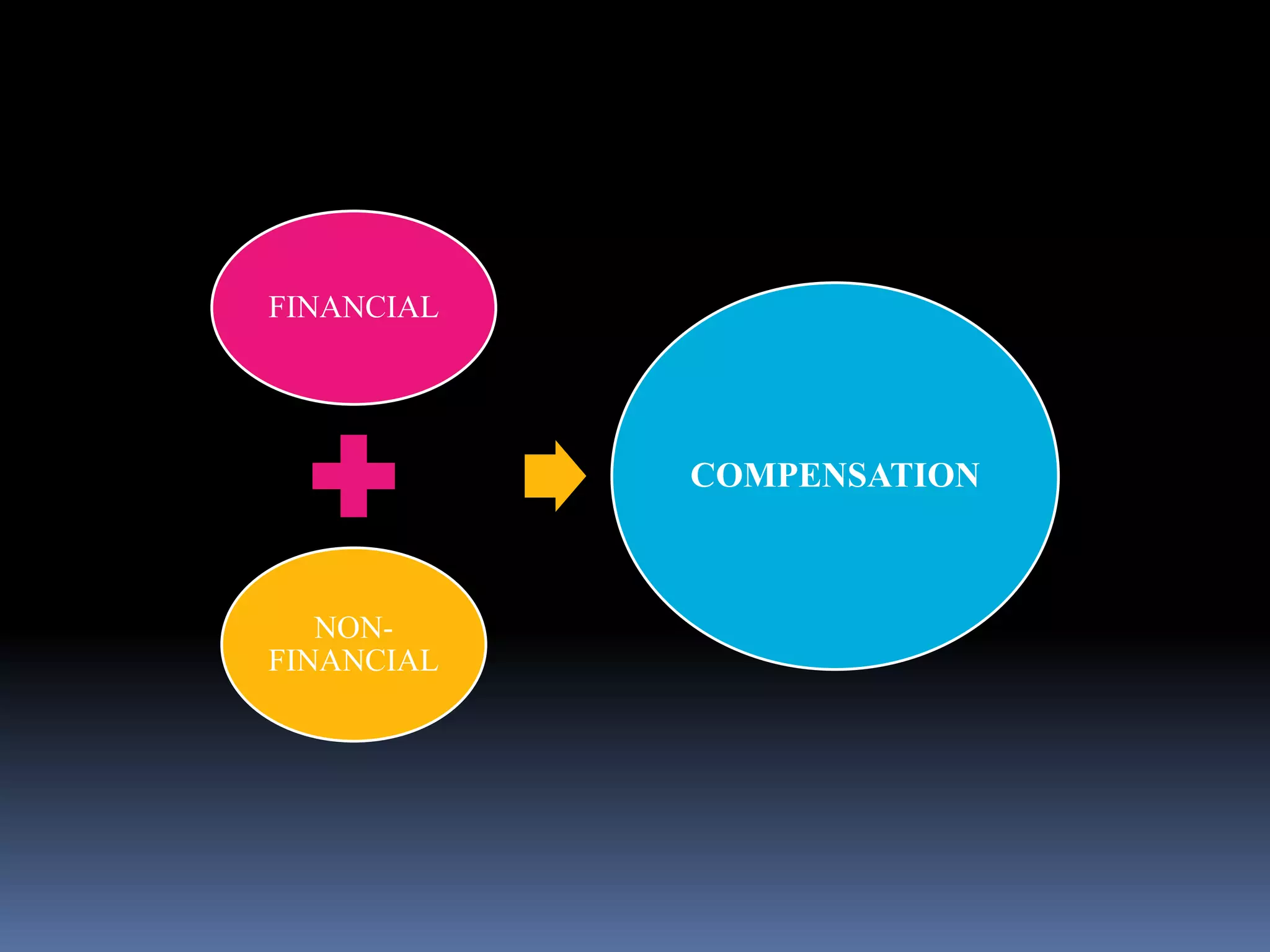
FINANCIAL 
NON-FINANCIAL 
COMPENSATION
FINANCIAL COMPENSATION 
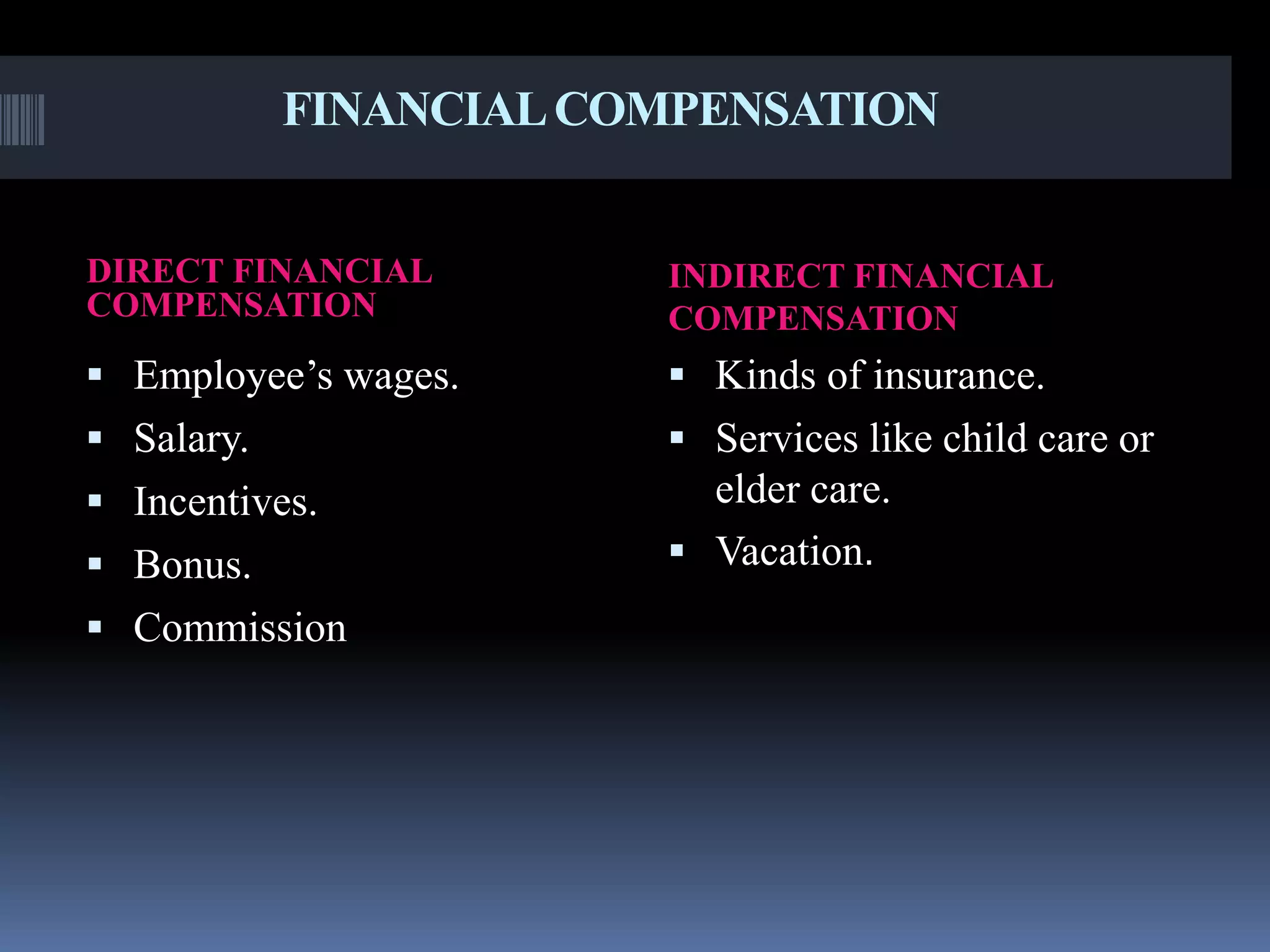
DIRECT FINANCIAL 
COMPENSATION 
INDIRECT FINANCIAL 
COMPENSATION 
 Employee’s wages. 
 Salary. 
 Incentives. 
 Bonus. 
 Commission 
 Kinds of insurance. 
 Services like child care or 
elder care. 
 Vacation.
NON-FINANCIAL COMPENSATION 
 Employee recognition program. 
 Rewarding jobs. 
 Organizational support. 
 Work environment. 
 Flexible work hours to accommodate personal needs.
PURPOSE O WAGES AND SALARY: 
According to Beach, wage and salary administration have 
four major purposes: 
1. To recruit persons for the firm. 
2. To control overall costs. 
3. To satisfy workers, to reduce the incidence of quitting 
grievances and friction over pay. 
4. To motivate people to perform better.
OBJECTIVES 
For Employee: Employees are paid according to the 
requirements of their jobs. The highly skilled work is paid 
more compensation than low skilled work. 
 To establish a fair and equitable remuneration offering 
similar pay for similar work. 
 Chances for favouritism are minimised. 
 Job sequence and lines of promotion are established 
wherever they are applicable. 
 To improve motivation and morale of employees and to 
improve union management relations.
For Employer: To project a good image of the company 
and to comply with the legal needs relating to wages and 
salaries. 
 To control labour and administrative costs in line with the 
ability of the organisation to pay. 
 To retain the present employees by keeping wage levels in 
tune with competing units. 
 In dealing with trade union, they can explain the basis of 
their wage programme because it is based on systematic 
analysis of job and wage facts. 
 To attract qualified and competent personnel. 
 To project a good image of the company. 
 To raise the morale of the workers.
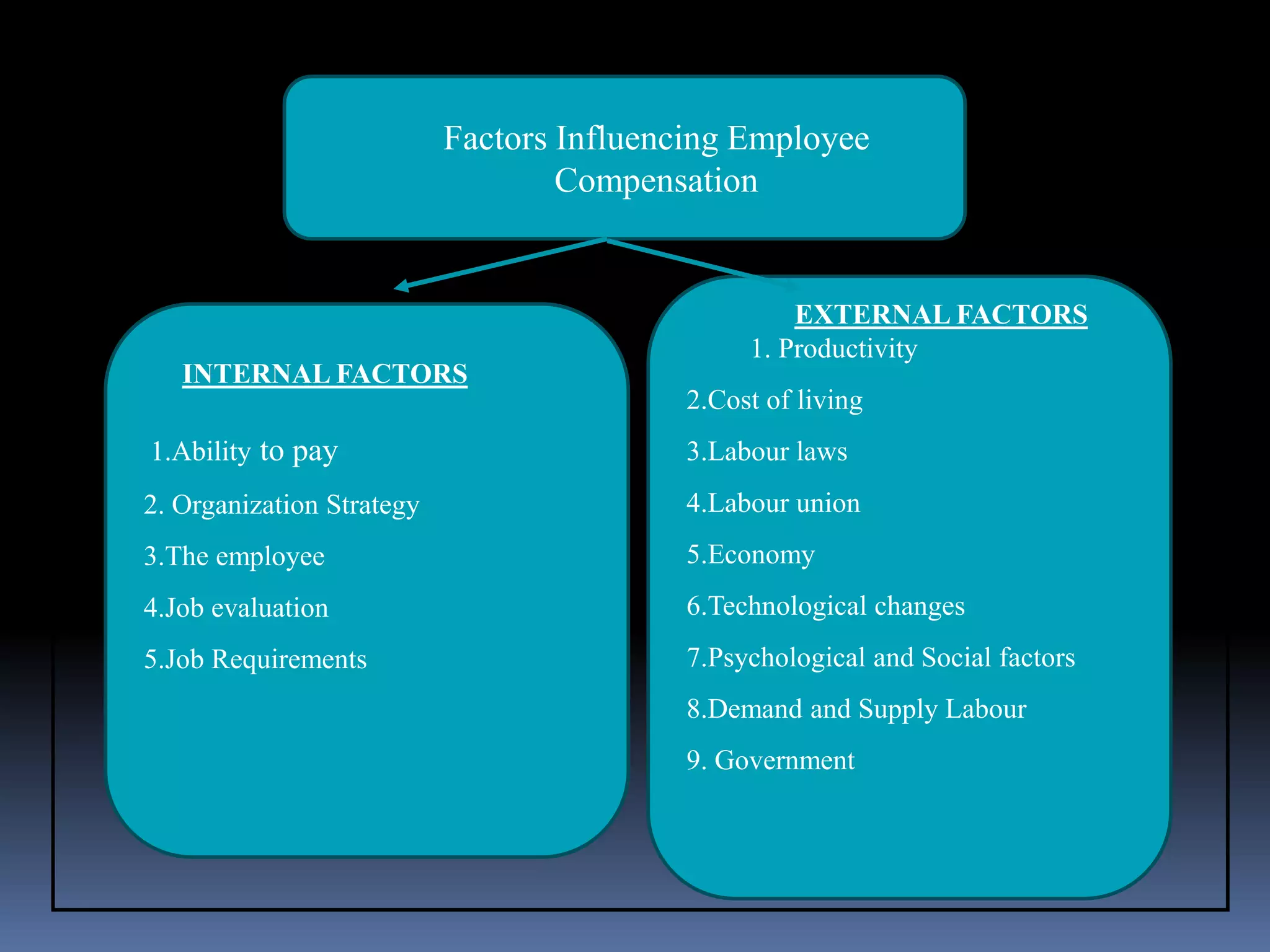
Factors Influencing Employee 
Compensation 
2. Organization Strategy 
3.The employee 
4.Job evaluation 
5.Job Requirements 
EXTERNAL FACTORS 
1. Productivity 
2.Cost of living 
3.Labour laws 
4.Labour union 
5.Economy 
6.Technological changes 
7.Psychological and Social factors 
8.Demand and Supply Labour 
9. Government 
INTERNAL FACTORS 
1.Ability to pay
INTERNAL FACTORS 
 Ability to pay: Generally, a firm which is prosperous and 
successful has the ability to pay more than the competitive 
rate. This way it can attract a superior caliber of personnel. 
 The Employee: Numerous employees related factors also 
influence his or her compensation. These include the 
following; 
Performance, Experience, Seniority and Potential. 
 Job requirements: Wages are also influenced by the 
requirement of a job such as physical and mental 
requirements. Jobs, which demand more skill, 
responsibility, efforts and are of hazardous in nature, will 
carry high wage tag with them.
 Job evaluation: It establishes a consistent and systematic 
relationship among base compensation rates for all jobs. 
In other words, it establishes the satisfactory wage 
differentials. 
 Organisation’s strategy: The organisation’s strategy 
regarding wages also influences employee compensation. 
For example, an organisation which wants rapid growth 
will set higher wages than competitors. On the other hand, 
organisations that want smooth going and just maintain 
the current earning will pay average or below average.
EXTERNAL FACTORS 
 Demand and Supply of labour: The conditions of labour 
market, i.e. demand and supply of labour influence the 
fixation of compensation. In case the supply exceeds the 
demand then wages may be fixed at lower levels. 
 Labour unions: Labour unions influence wages by 
controlling the supply of labour. Often there are strikes by 
labour unions for higher wages. 
 Government: Government influence compensation 
through various legislations, policies regarding wages, 
wage differentials and dearness allowance, etc. 
Government has enacted a number of labour legislations, 
which have a bearing on employee compensation.
 Prevailing Market Rates:Going rate of pay or comparable 
rates also influence the employee compensation. 
Prevailing market rates are those, which are paid by 
different organizations in an industry every organization 
tries to conform to the wage rates being paid by the 
industry, community and the adjoining organizations. 
 Cost of living: The present cost of living also influences 
the wage rates considerably. This matters during the 
periods of rising process. It immediately calls for wages 
adjustments based on increase in the cost of living index. 
 Economy: The state of economy also influences the wage 
and salary fixation. Wage rates will be different in a stable 
economy than in a depressed economy. In case of 
depressed economy there is increase in supply of labour 
and fixation of lower wage rates.
 Technological changes: Technological changes also 
influence the fixation of wage levels. Due to the 
advancement in the technology, there may be shortage of 
skilled manpower in that area. So, the organization will 
provide high wages for skilled personnel. 
 Productivity: It refers to output per man-hour. Increase in 
productivity depends upon the contributions of all the 
resources, i.e. men, machines, materials, methods and 
management. Improvement in technology, better 
management, latest machines and equipment, efficient 
methods of production, etc. can raise the productivity.
 Psychological and social factors: Both the psychological 
and social factors have a great influence on employee’s 
perception regarding their job and success in life. An 
organisation cannot ignore these factors. Psychological 
needs of employees should be taken into consideration 
before fixing wages as security. Sociologically and 
ethically, people feel that “equal work should carry equal 
wages”.
CASE STUDY 
 The Cost of Living Adjustment (COLA) is an annual adjustment in 
wages to account for a change in purchasing power as measured 
by the Consumer Price Index. The Consumer Price Index is an 
inflationary indicator calculated monthly by the U.S. Department 
of Labor that measures the change in the cost of a fixed basket of 
products and services, including housing, electricity, food, and 
transportation. 
(Moscow is the most expensive city in the world, according to a 
survey compiled by Mercer Human Resource Consulting. The 
survey ranked 144 cities around the world in terms of costs of 
such things as housing, transportation and food. Moscow moved 
up three spots in the latest survey and surpassed perennial cost 
leader Tokyo.) 
 To set the COLA rates, the Office of Personnel Management 
(OPM) surveys the prices of over 300 items, including goods and 
services, housing, transportation, and miscellaneous expenses. 
OPM conducts these surveys in each of the COLA areas and in 
the Washington, DC, area.
THANK YOU!! 
R.KEJAL

Annual Compensation and Factors

  • 1.
  • 2.
    INTRODUCTION TO COMPENSATION  Compensation is the Human Resource Management function that deals with every type of reward individual receive in exchange for performing organizational task.  Employees trade their labor and loyalty for financial and non-financial compensation.  It provides tangible rewards for their services as well as source of recognition and livelihood.
  • 3.
  • 4.
    FINANCIAL COMPENSATION DIRECTFINANCIAL COMPENSATION INDIRECT FINANCIAL COMPENSATION  Employee’s wages.  Salary.  Incentives.  Bonus.  Commission  Kinds of insurance.  Services like child care or elder care.  Vacation.
  • 5.
    NON-FINANCIAL COMPENSATION Employee recognition program.  Rewarding jobs.  Organizational support.  Work environment.  Flexible work hours to accommodate personal needs.
  • 6.
    PURPOSE O WAGESAND SALARY: According to Beach, wage and salary administration have four major purposes: 1. To recruit persons for the firm. 2. To control overall costs. 3. To satisfy workers, to reduce the incidence of quitting grievances and friction over pay. 4. To motivate people to perform better.
  • 7.
    OBJECTIVES For Employee:Employees are paid according to the requirements of their jobs. The highly skilled work is paid more compensation than low skilled work.  To establish a fair and equitable remuneration offering similar pay for similar work.  Chances for favouritism are minimised.  Job sequence and lines of promotion are established wherever they are applicable.  To improve motivation and morale of employees and to improve union management relations.
  • 8.
    For Employer: Toproject a good image of the company and to comply with the legal needs relating to wages and salaries.  To control labour and administrative costs in line with the ability of the organisation to pay.  To retain the present employees by keeping wage levels in tune with competing units.  In dealing with trade union, they can explain the basis of their wage programme because it is based on systematic analysis of job and wage facts.  To attract qualified and competent personnel.  To project a good image of the company.  To raise the morale of the workers.
  • 9.
    Factors Influencing Employee Compensation 2. Organization Strategy 3.The employee 4.Job evaluation 5.Job Requirements EXTERNAL FACTORS 1. Productivity 2.Cost of living 3.Labour laws 4.Labour union 5.Economy 6.Technological changes 7.Psychological and Social factors 8.Demand and Supply Labour 9. Government INTERNAL FACTORS 1.Ability to pay
  • 10.
    INTERNAL FACTORS Ability to pay: Generally, a firm which is prosperous and successful has the ability to pay more than the competitive rate. This way it can attract a superior caliber of personnel.  The Employee: Numerous employees related factors also influence his or her compensation. These include the following; Performance, Experience, Seniority and Potential.  Job requirements: Wages are also influenced by the requirement of a job such as physical and mental requirements. Jobs, which demand more skill, responsibility, efforts and are of hazardous in nature, will carry high wage tag with them.
  • 11.
     Job evaluation:It establishes a consistent and systematic relationship among base compensation rates for all jobs. In other words, it establishes the satisfactory wage differentials.  Organisation’s strategy: The organisation’s strategy regarding wages also influences employee compensation. For example, an organisation which wants rapid growth will set higher wages than competitors. On the other hand, organisations that want smooth going and just maintain the current earning will pay average or below average.
  • 12.
    EXTERNAL FACTORS Demand and Supply of labour: The conditions of labour market, i.e. demand and supply of labour influence the fixation of compensation. In case the supply exceeds the demand then wages may be fixed at lower levels.  Labour unions: Labour unions influence wages by controlling the supply of labour. Often there are strikes by labour unions for higher wages.  Government: Government influence compensation through various legislations, policies regarding wages, wage differentials and dearness allowance, etc. Government has enacted a number of labour legislations, which have a bearing on employee compensation.
  • 13.
     Prevailing MarketRates:Going rate of pay or comparable rates also influence the employee compensation. Prevailing market rates are those, which are paid by different organizations in an industry every organization tries to conform to the wage rates being paid by the industry, community and the adjoining organizations.  Cost of living: The present cost of living also influences the wage rates considerably. This matters during the periods of rising process. It immediately calls for wages adjustments based on increase in the cost of living index.  Economy: The state of economy also influences the wage and salary fixation. Wage rates will be different in a stable economy than in a depressed economy. In case of depressed economy there is increase in supply of labour and fixation of lower wage rates.
  • 14.
     Technological changes:Technological changes also influence the fixation of wage levels. Due to the advancement in the technology, there may be shortage of skilled manpower in that area. So, the organization will provide high wages for skilled personnel.  Productivity: It refers to output per man-hour. Increase in productivity depends upon the contributions of all the resources, i.e. men, machines, materials, methods and management. Improvement in technology, better management, latest machines and equipment, efficient methods of production, etc. can raise the productivity.
  • 15.
     Psychological andsocial factors: Both the psychological and social factors have a great influence on employee’s perception regarding their job and success in life. An organisation cannot ignore these factors. Psychological needs of employees should be taken into consideration before fixing wages as security. Sociologically and ethically, people feel that “equal work should carry equal wages”.
  • 16.
    CASE STUDY The Cost of Living Adjustment (COLA) is an annual adjustment in wages to account for a change in purchasing power as measured by the Consumer Price Index. The Consumer Price Index is an inflationary indicator calculated monthly by the U.S. Department of Labor that measures the change in the cost of a fixed basket of products and services, including housing, electricity, food, and transportation. (Moscow is the most expensive city in the world, according to a survey compiled by Mercer Human Resource Consulting. The survey ranked 144 cities around the world in terms of costs of such things as housing, transportation and food. Moscow moved up three spots in the latest survey and surpassed perennial cost leader Tokyo.)  To set the COLA rates, the Office of Personnel Management (OPM) surveys the prices of over 300 items, including goods and services, housing, transportation, and miscellaneous expenses. OPM conducts these surveys in each of the COLA areas and in the Washington, DC, area.
  • 17.