Managing Compensation
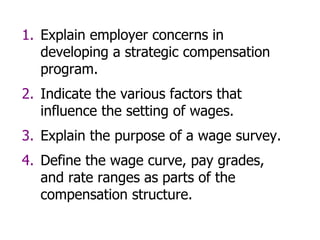
1. Explain employer concerns in
developing a strategic compensation
program.
2. Indicate the various factors that
influence the setting of wages.
3. Explain the purpose of a wage survey.
4. Define the wage curve, pay grades,
and rate ranges as parts of the
compensation structure.
Compensation
• Pay is a statement of an employee’s
worth by an employer.
• Pay is a perception of worth by an
employee.
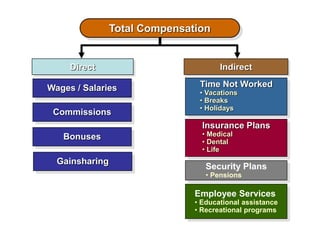
Total Compensation
Direct Indirect
Bonuses
Gainsharing
Security Plans
• Pensions
Employee Services
• Educational assistance
• Recreational programs
Commissions
Wages / Salaries
Insurance Plans
• Medical
• Dental
• Life
Time Not Worked
• Vacations
• Breaks
• Holidays
Common Strategic
Compensation Goals
1. To reward employees’ past performance
2. To remain competitive in the labor market
3. To maintain salary equity among employees
4. To link employees’ future performance with
organizational goals
5. To control the compensation budget
6. To attract new employees
7. To reduce unnecessary turnover
Strategic Compensation Policy
Concerns
1. The rate of pay within the organization and whether it is to be
above, below, or at the prevailing community rate.
2. The ability of the pay program to gain employee acceptance
while motivating employees to perform to the best of their
abilities.
3. The pay level at which employees may be recruited and the pay
differential between new and more senior employees.
4. The intervals at which pay raises are to be granted and the
extent to which merit and/or seniority will influence the raises.
Designing a Pay-for-Performance
System
• How will performance be measured?
• How will allocation be done for
compensation increases.
• Which employees will be eligible?
• How will payouts be made?
• How often will payouts occur?
• How large will the payouts be?
• Will employees perceive the rewards as
valued?
The Bases for Compensation
• Hourly Work
Work paid on an hourly basis.
• Piecework
Work paid according to the number of units
produced.
• Salary Workers
Employees whose compensation is computed
on the basis of weekly, biweekly, or monthly
pay periods.
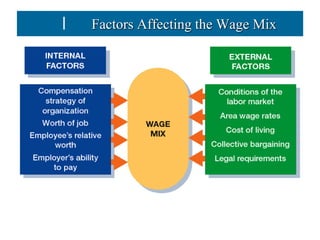
Factors Affecting the Wage Mix
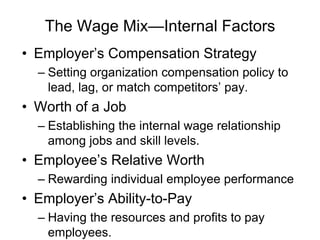
The Wage Mix—Internal Factors
• Employer’s Compensation Strategy
– Setting organization compensation policy to
lead, lag, or match competitors’ pay.
• Worth of a Job
– Establishing the internal wage relationship
among jobs and skill levels.
• Employee’s Relative Worth
– Rewarding individual employee performance
• Employer’s Ability-to-Pay
– Having the resources and profits to pay
employees.
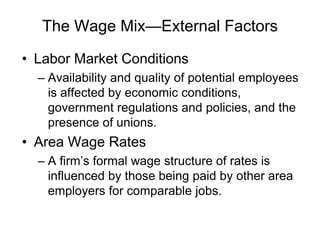
The Wage Mix—External Factors
• Labor Market Conditions
– Availability and quality of potential employees
is affected by economic conditions,
government regulations and policies, and the
presence of unions.
• Area Wage Rates
– A firm’s formal wage structure of rates is
influenced by those being paid by other area
employers for comparable jobs.
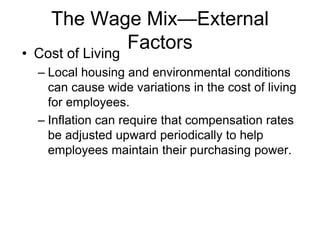
The Wage Mix—External
Factors
• Cost of Living
– Local housing and environmental conditions
can cause wide variations in the cost of living
for employees.
– Inflation can require that compensation rates
be adjusted upward periodically to help
employees maintain their purchasing power.
Job Evaluation Systems
• Job Evaluation
– The systematic process of determining the
relative worth of jobs in order to establish
which jobs should be paid more than others
within an organization.
Job Evaluation Systems
• Job Ranking System
– Oldest system of job evaluation by which
jobs are arranged on the basis of their
relative worth.
– Disadvantages
• Does not provide a precise measure of each job’s
worth.
• Final job rankings indicate the relative importance
of jobs, not extent of differences between jobs.
• Method can used to consider only a reasonably
small number of jobs.
Job Evaluation Systems
• Job Classification system
– A system of job evaluation in which jobs are
classified and grouped according to a series
of predetermined wage grades.
– Successive grades require increasing
amounts of job responsibility, skill, knowledge,
ability, or other factors selected to compare
jobs.
Point System
• Point System
– A quantitative job evaluation procedure that
determines the relative value of a job by the
total points assigned to it.
– Permits jobs to be evaluated quantitatively on
the basis of factors or elements—
compensable factors—that constitute the job.
The Compensation Structure
• Wage and Salary survey
– A survey of the wages paid to employees of
other employers in the surveying
organization’s relevant labor market.
– Helps maintain internal and external pay
equity for employees.
• Labor Market
– The area from which employers obtain certain
types of workers.
Collecting Survey Data
Conducting Employer-initiated Surveys
– Select key jobs.
– Determine relevant labor market.
– Select organizations.
– Decide on information to collect: wages/
benefits/ pay policies.
– Compile data received.
– Determine wage structure and benefits to pay.
Characteristics of Key Jobs
• Key Jobs
– Jobs that are important for wage-setting
purposes and are widely known in the labor
market.
• Characteristics of Key Jobs
1. They are important to employees and the
organization.
2. They contain a large number of positions.
3. They have relatively stable job content.
4. They have the same job content across many
organizations.
The Wage Curve
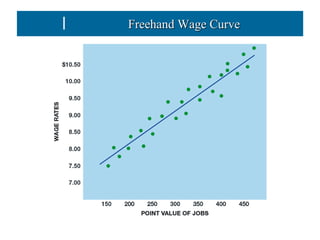
• Wage Curve
– A curve in a scatter gram representing the relationship
between relative worth of jobs and wage rates.
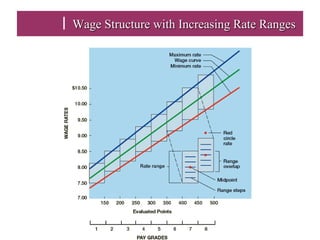
• Pay Grades
– Groups of jobs within a particular class that are paid the
same rate.
• Rate Ranges
– A range of rates for each pay grade that may be the same
for each grade or proportionately greater for each
successive grade.
• Red Circle Rates
– Payment rates above the maximum of the pay range.
Freehand Wage Curve
Wage Structure with Increasing Rate Ranges
The Wage Curve (cont’d)
• Competence-based Pay, (also skill-based pay or knowledge-based
pay)
Compensation for the different skills or increased knowledge
employees possess rather than for the job they hold in a
designated job category.
• Greater productivity, increased employee learning and
commitment to work, improved staffing flexibility to meet
production or service demands, and the reduced effects of
absenteeism and turnover,
• Broadbanding
Collapses many traditional salary grades into a few wide salary
bands.
Approaches of compensation
management
• There are 3P approach of developing a
compensation policy centered on the
fundamentals of paying for
• Position,
• Person and
• Performance.
• The management of any organization considers
three parameters while deciding the salary as
well as incentives
• Pay for position
• Broad banding
• Through broad banding the traditional narrowly
structured pay grades generally determined
through job evaluation are replaced by fewer
and wider bands, and a grading structure is
created.
Broad Banding
• It is a compensation technique that reduces
many different compensation categories to
several broad compensation bands. A banding
procedure takes place when jobs are grouped
together by common characteristics
• On recruitment or promotion, employee
compensation may be set at levels in the
broadband deemed to be appropriate to an
employee’s qualifications, education,
training and experience. Employees typically
progress up through the broad band if their
performance ratings are good, rather than
progressing up through a grade by steps based
on time in the grade.
Broad Banding
Pay for Person
• Pay for person takes into account a person’s
capabilities and experience in setting a pay
level that is both equitable and competitive. It
also considers the market demand of a
person’s unique skills and experience.
• Pay for person is associated with competency
based pay. It also incorporates market based
pay approach.
• Pay for performance
• An individual’s performance is managed through
a performance contract which comprises the
clarification of the role, the setting up of
objectives, and the review of performance. As an
outcome a measure of performance at the
corporate, unit and individual level becomes the
basis for setting the performance pay.
• DA forms a variable component of pay
packet since rate of dearness increases
more than once every year, whereas the
basic pay scales are revised after long
spells of time.
• Perquisites:
• These are normally provided to managerial
personnel either to facilitate their job
performance or to retain them in the
organization.
• Such perquisites include company car, club
membership, free residential accommodation,
paid holiday trips, stock
options, etc.
• Incentives:-
• Incentives are paid in addition to wages and
salaries and are also called ‘payments by
results’. Incentives depend upon productivity,
sales, profit, or cost reduction efforts. There are:
(a) Individual incentive schemes, and (b) Group
incentive programs.
• Individual incentives are applicable to specific
employee performance. Where a given task
demands group efforts for completion, incentives
are paid to the group as a whole. The amount is
later divided among group members on an
equitable basis.
• Bonus:-
• The bonus can be paid in different ways. It
can be fixed percentage on the basic
wage paid annually or in proportion to the
profitability. The Government also
prescribes a minimum statutory bonus for
all employees and workers. There is also a
bonus plan which compensates the
Managers and employees based on the
sales revenue or Profit margin achieved.
Separation
Employee Separation is the termination of
service agreement between the employee
and the employer when either of them
decides to put an end to the service.
Resignation Layoff
Retirement Retrenchment
VRS
Death
VRS
Rule 48 A of Pension Rule-1972
--- Any time after completing 20 years of
service
-- By giving notice of not less than 3 months
in writing to the appointing authority
-- 25 days salary(B+DA) for the remaining
days of service until retirement

compensation 3P Compensation concept for salary

  • 1.
  • 2.
    1. Explain employerconcerns in developing a strategic compensation program. 2. Indicate the various factors that influence the setting of wages. 3. Explain the purpose of a wage survey. 4. Define the wage curve, pay grades, and rate ranges as parts of the compensation structure.
  • 3.
    Compensation • Pay isa statement of an employee’s worth by an employer. • Pay is a perception of worth by an employee.
  • 4.
    Total Compensation Direct Indirect Bonuses Gainsharing SecurityPlans • Pensions Employee Services • Educational assistance • Recreational programs Commissions Wages / Salaries Insurance Plans • Medical • Dental • Life Time Not Worked • Vacations • Breaks • Holidays
  • 5.
    Common Strategic Compensation Goals 1.To reward employees’ past performance 2. To remain competitive in the labor market 3. To maintain salary equity among employees 4. To link employees’ future performance with organizational goals 5. To control the compensation budget 6. To attract new employees 7. To reduce unnecessary turnover
  • 6.
    Strategic Compensation Policy Concerns 1.The rate of pay within the organization and whether it is to be above, below, or at the prevailing community rate. 2. The ability of the pay program to gain employee acceptance while motivating employees to perform to the best of their abilities. 3. The pay level at which employees may be recruited and the pay differential between new and more senior employees. 4. The intervals at which pay raises are to be granted and the extent to which merit and/or seniority will influence the raises.
  • 7.
    Designing a Pay-for-Performance System •How will performance be measured? • How will allocation be done for compensation increases. • Which employees will be eligible? • How will payouts be made? • How often will payouts occur? • How large will the payouts be? • Will employees perceive the rewards as valued?
  • 8.
    The Bases forCompensation • Hourly Work Work paid on an hourly basis. • Piecework Work paid according to the number of units produced. • Salary Workers Employees whose compensation is computed on the basis of weekly, biweekly, or monthly pay periods.
  • 9.
  • 10.
    The Wage Mix—InternalFactors • Employer’s Compensation Strategy – Setting organization compensation policy to lead, lag, or match competitors’ pay. • Worth of a Job – Establishing the internal wage relationship among jobs and skill levels. • Employee’s Relative Worth – Rewarding individual employee performance • Employer’s Ability-to-Pay – Having the resources and profits to pay employees.
  • 11.
    The Wage Mix—ExternalFactors • Labor Market Conditions – Availability and quality of potential employees is affected by economic conditions, government regulations and policies, and the presence of unions. • Area Wage Rates – A firm’s formal wage structure of rates is influenced by those being paid by other area employers for comparable jobs.
  • 12.
    The Wage Mix—External Factors •Cost of Living – Local housing and environmental conditions can cause wide variations in the cost of living for employees. – Inflation can require that compensation rates be adjusted upward periodically to help employees maintain their purchasing power.
  • 13.
    Job Evaluation Systems •Job Evaluation – The systematic process of determining the relative worth of jobs in order to establish which jobs should be paid more than others within an organization.
  • 14.
    Job Evaluation Systems •Job Ranking System – Oldest system of job evaluation by which jobs are arranged on the basis of their relative worth. – Disadvantages • Does not provide a precise measure of each job’s worth. • Final job rankings indicate the relative importance of jobs, not extent of differences between jobs. • Method can used to consider only a reasonably small number of jobs.
  • 15.
    Job Evaluation Systems •Job Classification system – A system of job evaluation in which jobs are classified and grouped according to a series of predetermined wage grades. – Successive grades require increasing amounts of job responsibility, skill, knowledge, ability, or other factors selected to compare jobs.
  • 16.
    Point System • PointSystem – A quantitative job evaluation procedure that determines the relative value of a job by the total points assigned to it. – Permits jobs to be evaluated quantitatively on the basis of factors or elements— compensable factors—that constitute the job.
  • 17.
    The Compensation Structure •Wage and Salary survey – A survey of the wages paid to employees of other employers in the surveying organization’s relevant labor market. – Helps maintain internal and external pay equity for employees. • Labor Market – The area from which employers obtain certain types of workers.
  • 18.
    Collecting Survey Data ConductingEmployer-initiated Surveys – Select key jobs. – Determine relevant labor market. – Select organizations. – Decide on information to collect: wages/ benefits/ pay policies. – Compile data received. – Determine wage structure and benefits to pay.
  • 19.
    Characteristics of KeyJobs • Key Jobs – Jobs that are important for wage-setting purposes and are widely known in the labor market. • Characteristics of Key Jobs 1. They are important to employees and the organization. 2. They contain a large number of positions. 3. They have relatively stable job content. 4. They have the same job content across many organizations.
  • 20.
    The Wage Curve •Wage Curve – A curve in a scatter gram representing the relationship between relative worth of jobs and wage rates. • Pay Grades – Groups of jobs within a particular class that are paid the same rate. • Rate Ranges – A range of rates for each pay grade that may be the same for each grade or proportionately greater for each successive grade. • Red Circle Rates – Payment rates above the maximum of the pay range.
  • 21.
  • 22.
    Wage Structure withIncreasing Rate Ranges
  • 23.
    The Wage Curve(cont’d) • Competence-based Pay, (also skill-based pay or knowledge-based pay) Compensation for the different skills or increased knowledge employees possess rather than for the job they hold in a designated job category. • Greater productivity, increased employee learning and commitment to work, improved staffing flexibility to meet production or service demands, and the reduced effects of absenteeism and turnover, • Broadbanding Collapses many traditional salary grades into a few wide salary bands.
  • 24.
    Approaches of compensation management •There are 3P approach of developing a compensation policy centered on the fundamentals of paying for • Position, • Person and • Performance.
  • 25.
    • The managementof any organization considers three parameters while deciding the salary as well as incentives • Pay for position • Broad banding • Through broad banding the traditional narrowly structured pay grades generally determined through job evaluation are replaced by fewer and wider bands, and a grading structure is created.
  • 26.
    Broad Banding • Itis a compensation technique that reduces many different compensation categories to several broad compensation bands. A banding procedure takes place when jobs are grouped together by common characteristics
  • 27.
    • On recruitmentor promotion, employee compensation may be set at levels in the broadband deemed to be appropriate to an employee’s qualifications, education, training and experience. Employees typically progress up through the broad band if their performance ratings are good, rather than progressing up through a grade by steps based on time in the grade. Broad Banding
  • 28.
    Pay for Person •Pay for person takes into account a person’s capabilities and experience in setting a pay level that is both equitable and competitive. It also considers the market demand of a person’s unique skills and experience. • Pay for person is associated with competency based pay. It also incorporates market based pay approach.
  • 29.
    • Pay forperformance • An individual’s performance is managed through a performance contract which comprises the clarification of the role, the setting up of objectives, and the review of performance. As an outcome a measure of performance at the corporate, unit and individual level becomes the basis for setting the performance pay.
  • 30.
    • DA formsa variable component of pay packet since rate of dearness increases more than once every year, whereas the basic pay scales are revised after long spells of time.
  • 31.
    • Perquisites: • Theseare normally provided to managerial personnel either to facilitate their job performance or to retain them in the organization. • Such perquisites include company car, club membership, free residential accommodation, paid holiday trips, stock options, etc.
  • 32.
    • Incentives:- • Incentivesare paid in addition to wages and salaries and are also called ‘payments by results’. Incentives depend upon productivity, sales, profit, or cost reduction efforts. There are: (a) Individual incentive schemes, and (b) Group incentive programs. • Individual incentives are applicable to specific employee performance. Where a given task demands group efforts for completion, incentives are paid to the group as a whole. The amount is later divided among group members on an equitable basis.
  • 33.
    • Bonus:- • Thebonus can be paid in different ways. It can be fixed percentage on the basic wage paid annually or in proportion to the profitability. The Government also prescribes a minimum statutory bonus for all employees and workers. There is also a bonus plan which compensates the Managers and employees based on the sales revenue or Profit margin achieved.
  • 34.
    Separation Employee Separation isthe termination of service agreement between the employee and the employer when either of them decides to put an end to the service. Resignation Layoff Retirement Retrenchment VRS Death
  • 35.
    VRS Rule 48 Aof Pension Rule-1972 --- Any time after completing 20 years of service -- By giving notice of not less than 3 months in writing to the appointing authority -- 25 days salary(B+DA) for the remaining days of service until retirement