FORMULATION OF WAGE POLICY - FACTORS TO BE
CONSIDERED OVERVIEW
JYOTI RAMESH KATARIYA
ADMISSION NO. : HPGD/JA 14/0199
SPECIALIZATION: HUMAN RESOURCE
PRIN. L. N. WELINGAKR INSTITUTE OF MANAGEMENT & DEVELOPMENT RESEARCH
YEAR OF SUBMISSION : DECEMBER 2015
: I N T R O D U C T I O N :
In all countries, wage policy is a complex and sensitive area of public policy. This is because the relative status of workers in the
society, their commitment to industry and attitude towards management, their morale and motivation towards productivity, their
living standards an in fact their way of life are all conditioned by wages, Hence a policy dealing with this crucial problems cannot
be simply economic, as it has to reckon with the realities of multi-dimensional social phenomenon, in which besides the workers
and the management, the consumer and the society at large, and in consequences the state, are all vitally interested. Wage policy
is a determinant of the shares of the rival claimants to the product of industry and national dividend, but there may often be a
conflicts between private and social interest, There are, of course, theoretical generalisations or principles that may provide
scientific guidelines for framing wage policy. Equally important in this context are the concrete social facts that must be taken
into account in its formulation at any given time. NO principles of wage policy can ever be applied in vacuum and in disregard of
the realities of a situation. Wage policy has to be pragmatic though it does not follow that it has to be unscientific and remain
simply a matter of expediency.
Wage policies are principles acting as guidelines for determining a wage structure
Wage policy refers to all systematic efforts of the government in relation to national wage and salary system
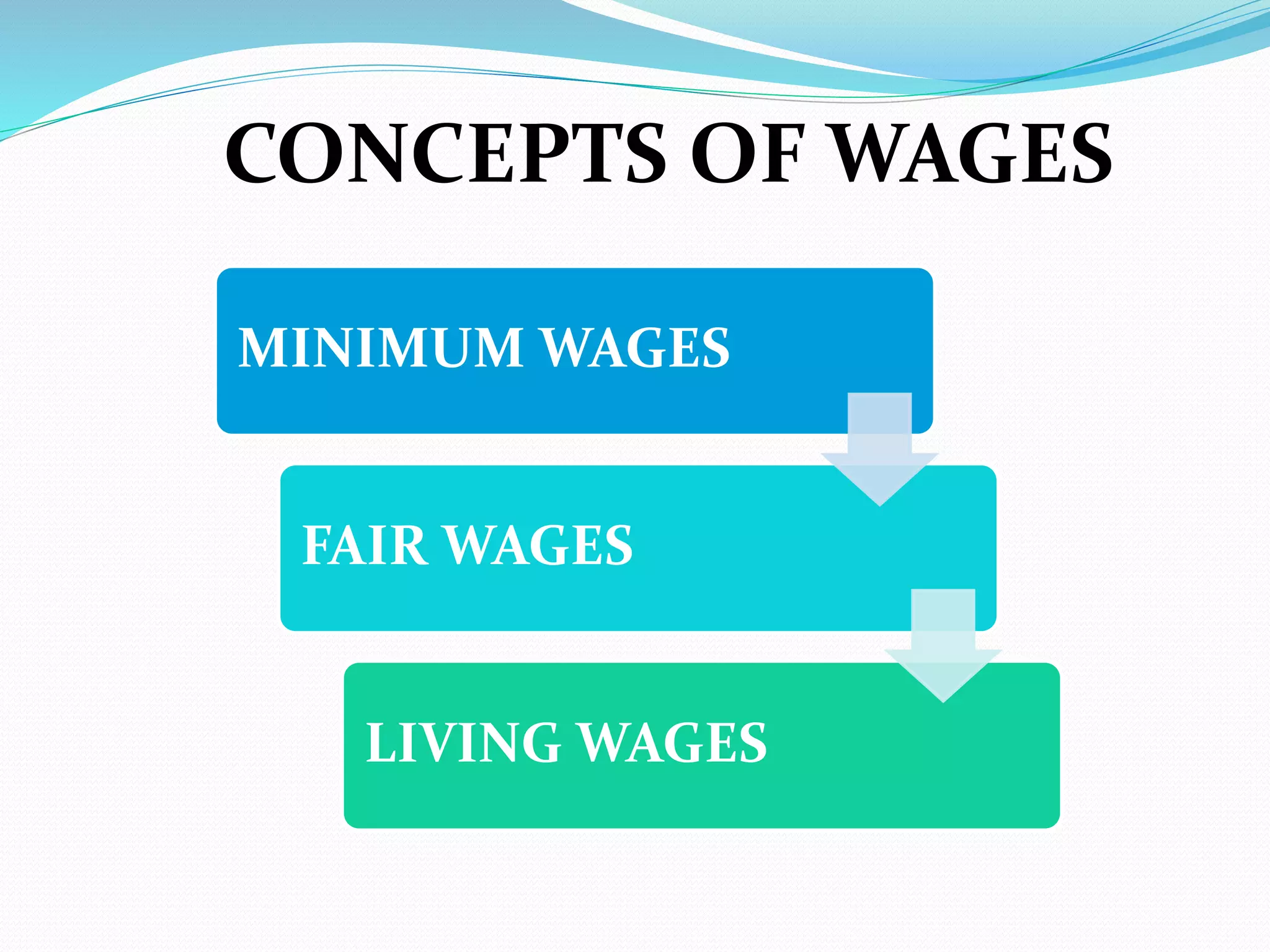
CONCEPTS OF WAGES
MINIMUM WAGES
FAIR WAGES
LIVING WAGES
WAGE :
Wage is paid to the assembly line workers or worker at
operational level. It is paid hourly/daily/weekly
MINIMUM WAGE:
It must provide not only for the bare sustenance of life but for the
preservation of the efficiency of the workers by providing some measures of
education , medical care etc.
LIVING WAGE:
It is not only for the bare essentials for the worker and his family but also for
comfort protection against ill-insurance for old-age .
FAIR WAGE:
It is in between minimum wages and living wages but below the living wage
COMPENSATION MANAGEMENT
COMPENSATION:
Compensation is what employees receive in exchange for
their contribution to the organisation.
Total compensation =
Direct + Indirect Compensation
Base Pay Incentives Benefits
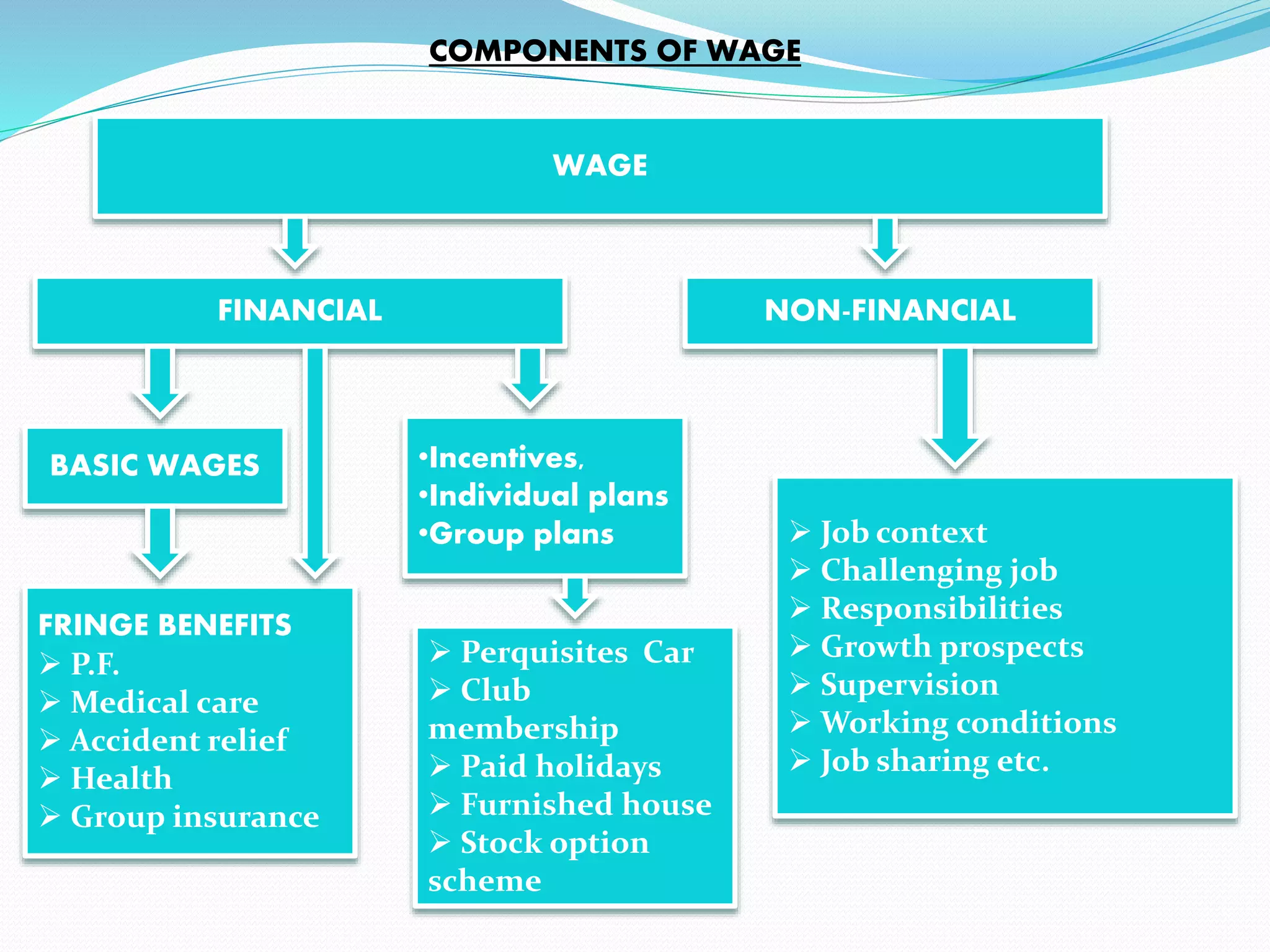
WAGE
FINANCIAL NON-FINANCIAL
BASIC WAGES •Incentives,
•Individual plans
•Group plans
FRINGE BENEFITS
 P.F.
 Medical care
 Accident relief
 Health
 Group insurance
 Perquisites Car
 Club
membership
 Paid holidays
 Furnished house
 Stock option
scheme
 Job context
 Challenging job
 Responsibilities
 Growth prospects
 Supervision
 Working conditions
 Job sharing etc.
COMPONENTS OF WAGE
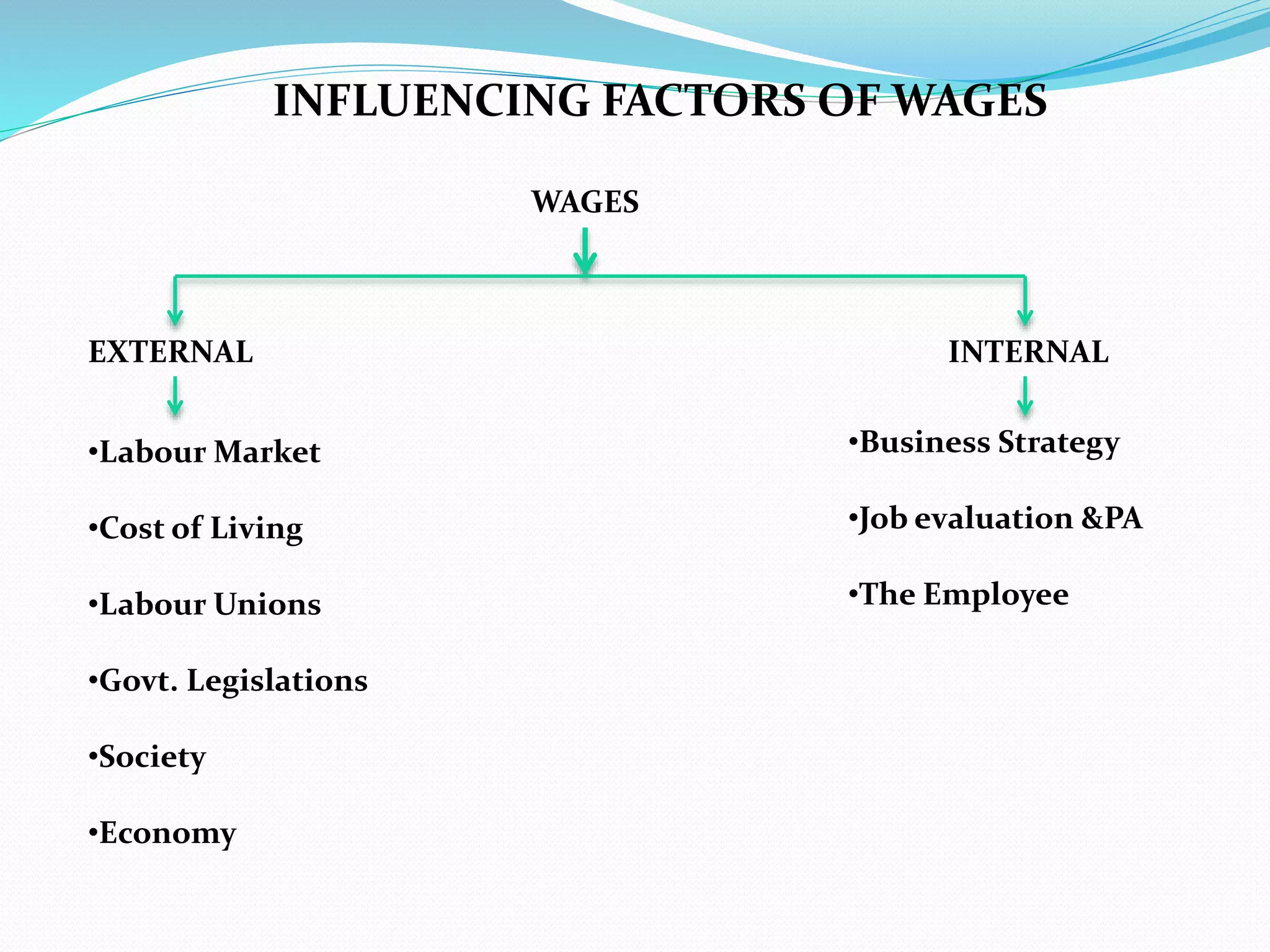
INFLUENCING FACTORS OF WAGES
WAGES
EXTERNAL INTERNAL
•Labour Market
•Cost of Living
•Labour Unions
•Govt. Legislations
•Society
•Economy
•Business Strategy
•Job evaluation &PA
•The Employee
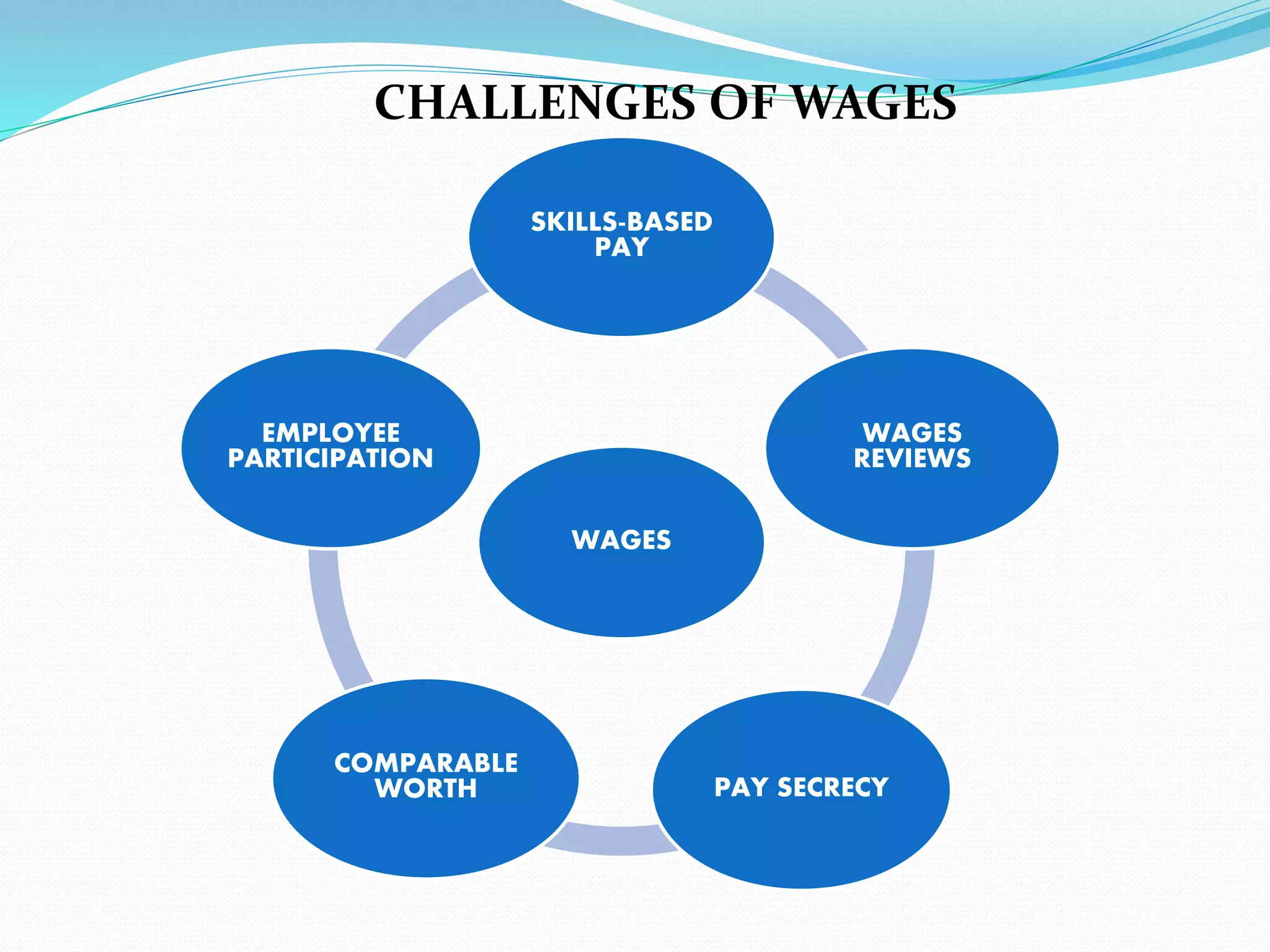
CHALLENGES OF WAGES
WAGES
SKILLS-BASED
PAY
WAGES
REVIEWS
PAY SECRECY
COMPARABLE
WORTH
EMPLOYEE
PARTICIPATION
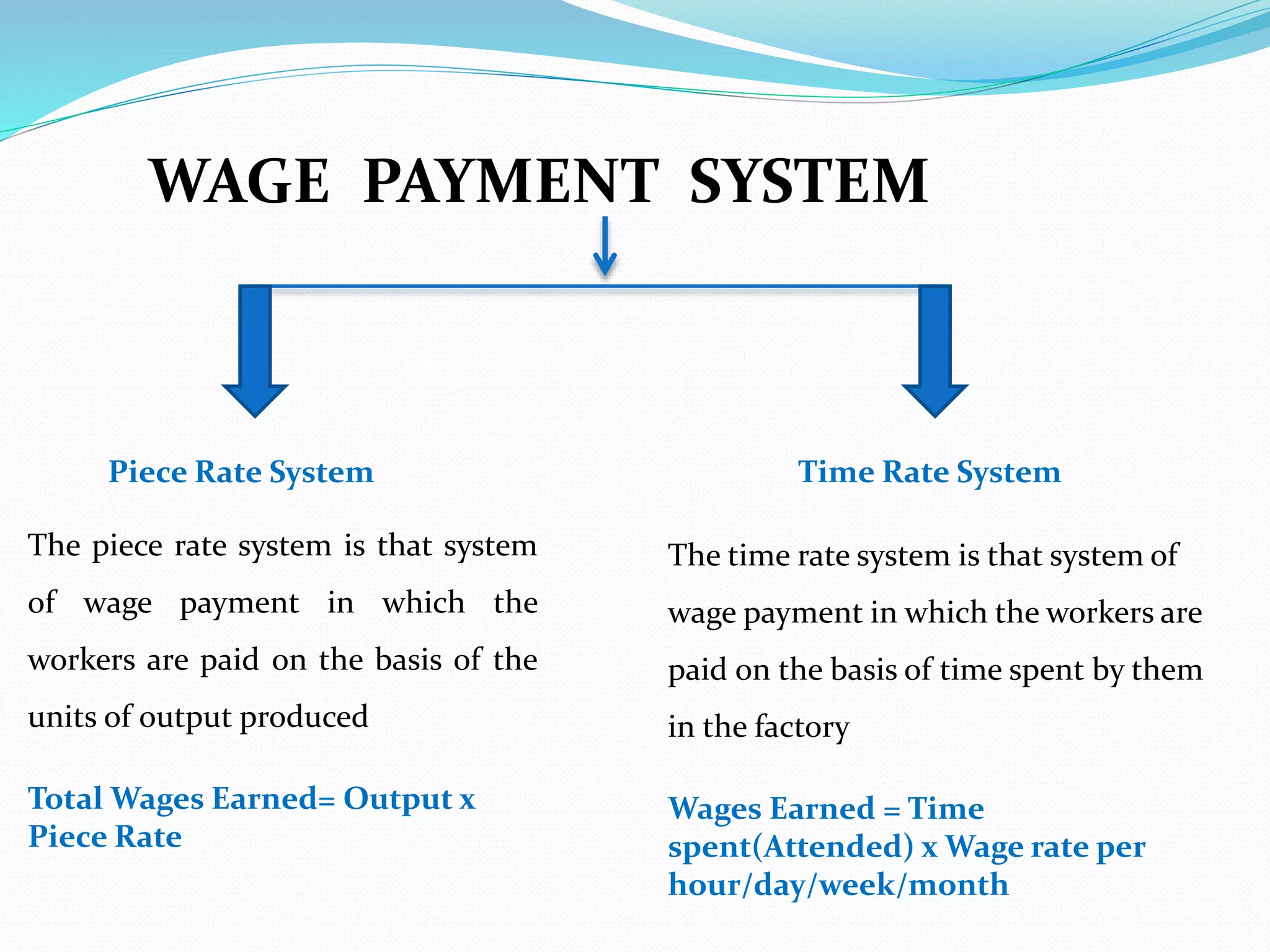
WAGE PAYMENT SYSTEM
Piece Rate System Time Rate System
The piece rate system is that system
of wage payment in which the
workers are paid on the basis of the
units of output produced
Total Wages Earned= Output x
Piece Rate
The time rate system is that system of
wage payment in which the workers are
paid on the basis of time spent by them
in the factory
Wages Earned = Time
spent(Attended) x Wage rate per
hour/day/week/month
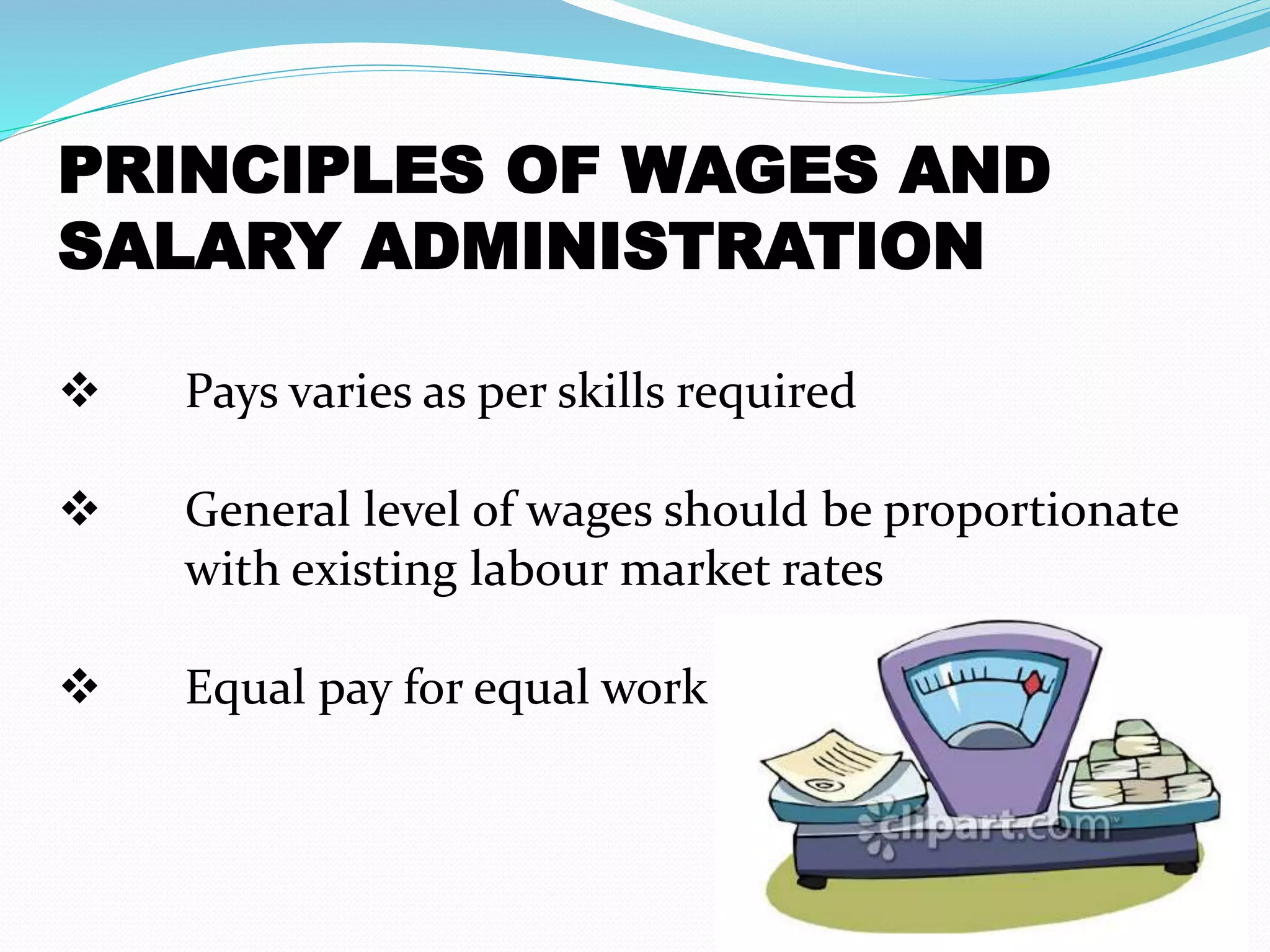
PRINCIPLES OF WAGES AND
SALARY ADMINISTRATION
 Pays varies as per skills required
 General level of wages should be proportionate
with existing labour market rates
 Equal pay for equal work
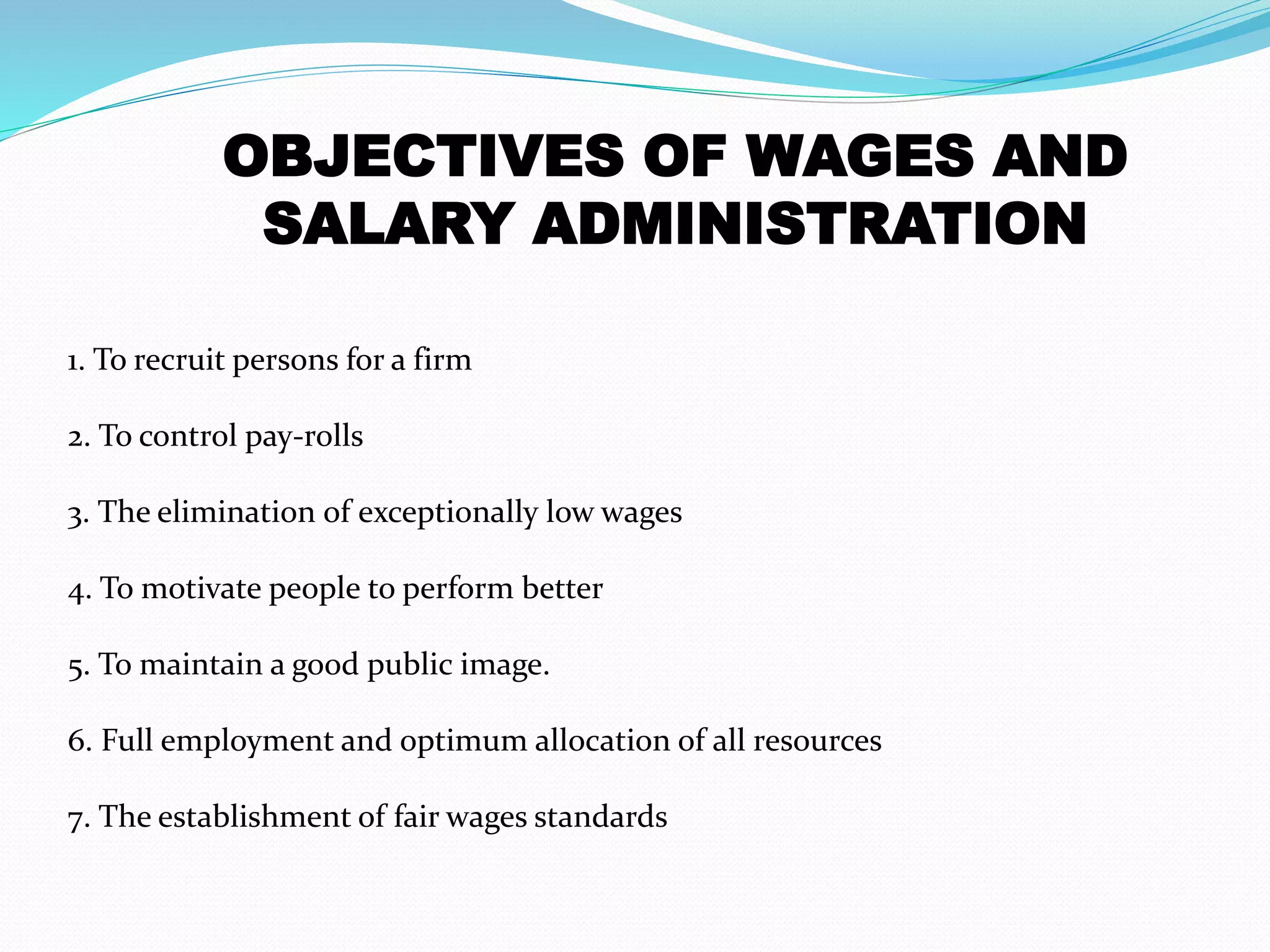
1. To recruit persons for a firm
2. To control pay-rolls
3. The elimination of exceptionally low wages
4. To motivate people to perform better
5. To maintain a good public image.
6. Full employment and optimum allocation of all resources
7. The establishment of fair wages standards
OBJECTIVES OF WAGES AND
SALARY ADMINISTRATION
Administration of Wages and Salaries
Handled by:-
 Personnel department – Or committee who’s major functions are
 Approval to management on job evaluation methods
 Review of basic wage and salary structure
 Help in the formulation of wage policies
 Co-ordination of relative departmental
 Review of budget estimates
HORROR STORIES IN INDIA
• Bharat Ophthalmic Glasses
• National Textile Corporation
• Hindustan Fertilizer Corporation Ltd.Haldia
• Heavy Engineering Corporation
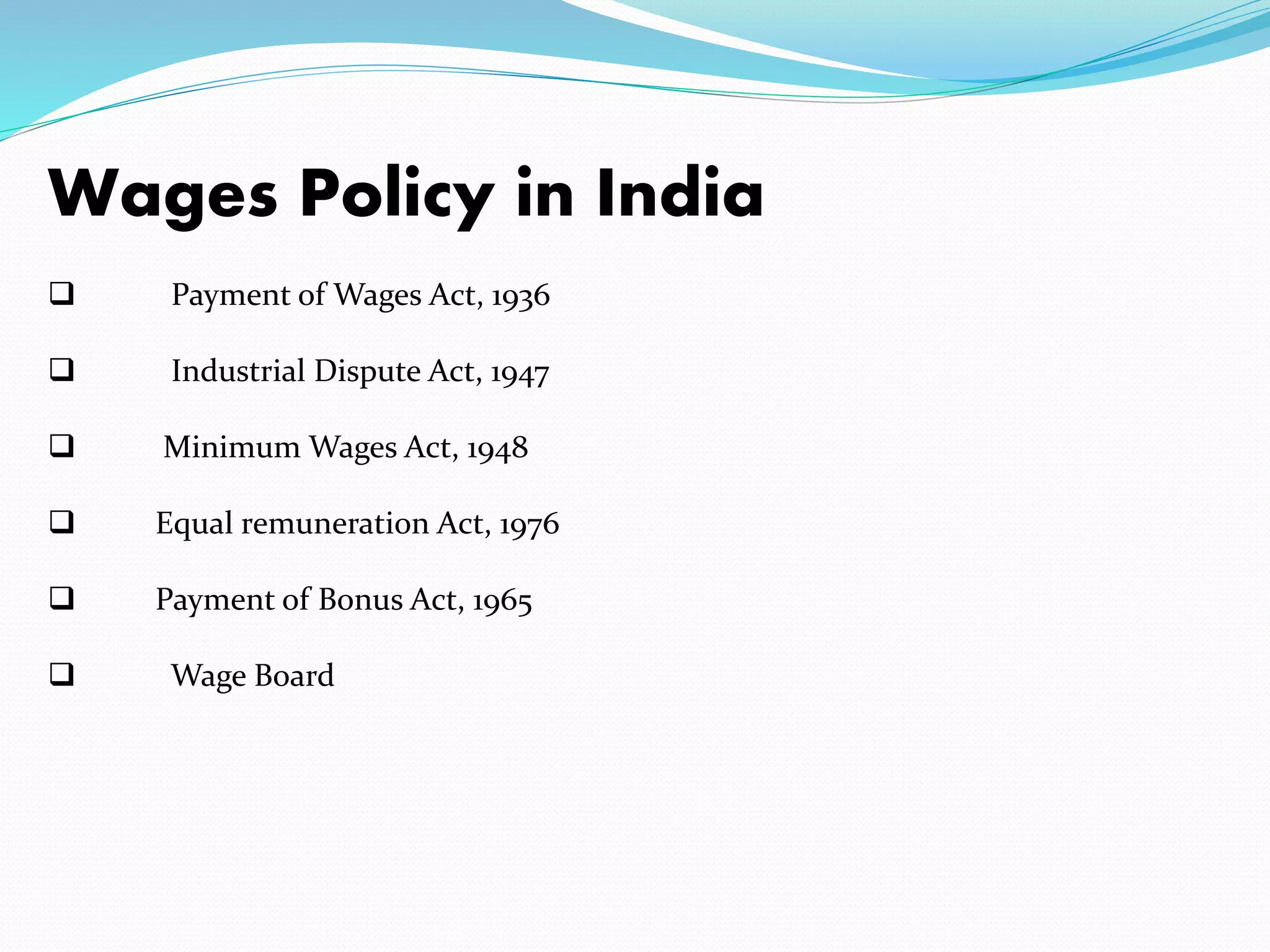
Wages Policy in India
 Payment of Wages Act, 1936
 Industrial Dispute Act, 1947
 Minimum Wages Act, 1948
 Equal remuneration Act, 1976
 Payment of Bonus Act, 1965
 Wage Board
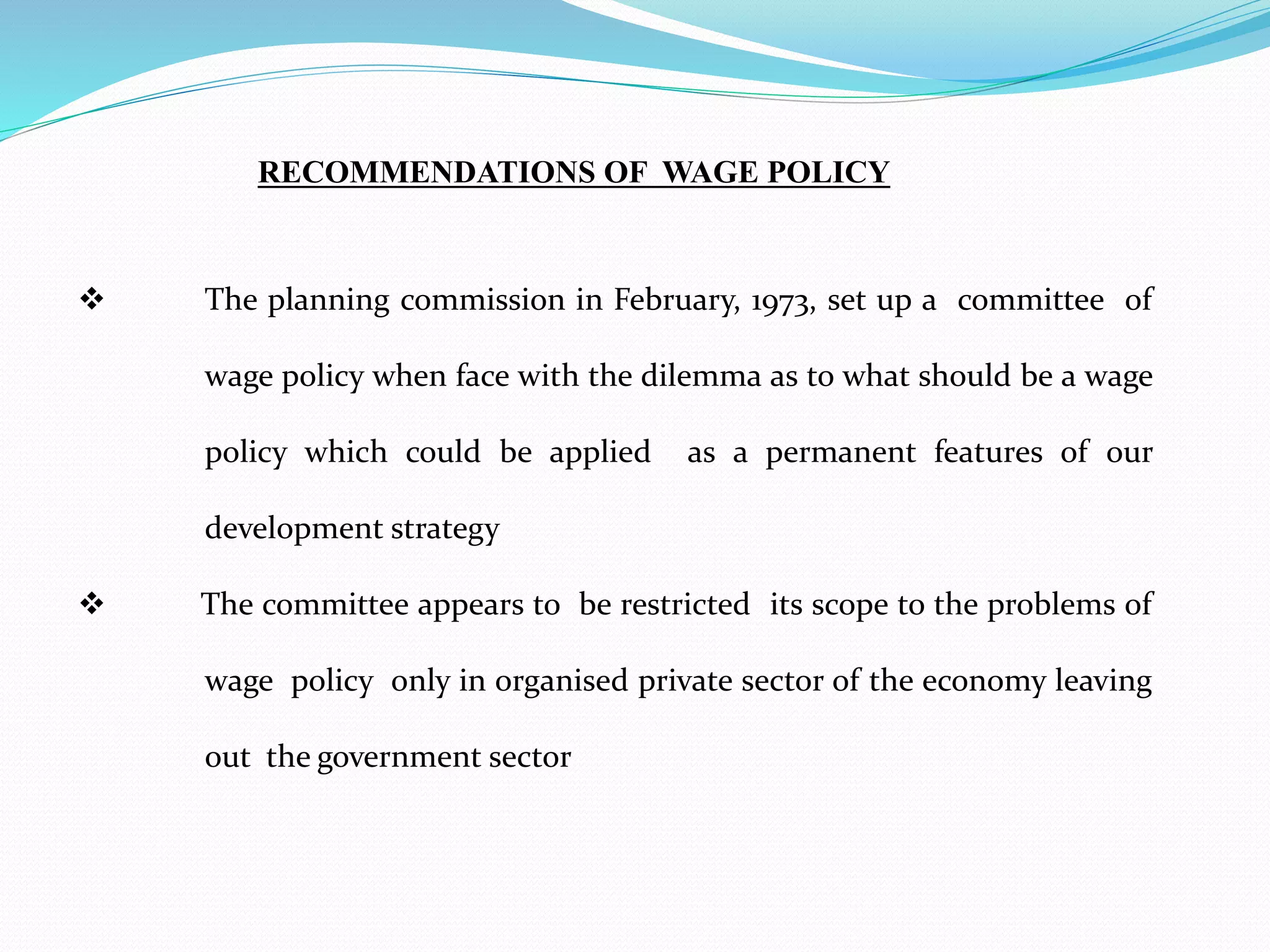
 The planning commission in February, 1973, set up a committee of
wage policy when face with the dilemma as to what should be a wage
policy which could be applied as a permanent features of our
development strategy
 The committee appears to be restricted its scope to the problems of
wage policy only in organised private sector of the economy leaving
out the government sector
RECOMMENDATIONS OF WAGE POLICY
THANK YOU

Ppt of wage policy

  • 1.
    FORMULATION OF WAGEPOLICY - FACTORS TO BE CONSIDERED OVERVIEW JYOTI RAMESH KATARIYA ADMISSION NO. : HPGD/JA 14/0199 SPECIALIZATION: HUMAN RESOURCE PRIN. L. N. WELINGAKR INSTITUTE OF MANAGEMENT & DEVELOPMENT RESEARCH YEAR OF SUBMISSION : DECEMBER 2015
  • 2.
    : I NT R O D U C T I O N : In all countries, wage policy is a complex and sensitive area of public policy. This is because the relative status of workers in the society, their commitment to industry and attitude towards management, their morale and motivation towards productivity, their living standards an in fact their way of life are all conditioned by wages, Hence a policy dealing with this crucial problems cannot be simply economic, as it has to reckon with the realities of multi-dimensional social phenomenon, in which besides the workers and the management, the consumer and the society at large, and in consequences the state, are all vitally interested. Wage policy is a determinant of the shares of the rival claimants to the product of industry and national dividend, but there may often be a conflicts between private and social interest, There are, of course, theoretical generalisations or principles that may provide scientific guidelines for framing wage policy. Equally important in this context are the concrete social facts that must be taken into account in its formulation at any given time. NO principles of wage policy can ever be applied in vacuum and in disregard of the realities of a situation. Wage policy has to be pragmatic though it does not follow that it has to be unscientific and remain simply a matter of expediency. Wage policies are principles acting as guidelines for determining a wage structure Wage policy refers to all systematic efforts of the government in relation to national wage and salary system
  • 3.
    CONCEPTS OF WAGES MINIMUMWAGES FAIR WAGES LIVING WAGES
  • 4.
    WAGE : Wage ispaid to the assembly line workers or worker at operational level. It is paid hourly/daily/weekly MINIMUM WAGE: It must provide not only for the bare sustenance of life but for the preservation of the efficiency of the workers by providing some measures of education , medical care etc. LIVING WAGE: It is not only for the bare essentials for the worker and his family but also for comfort protection against ill-insurance for old-age . FAIR WAGE: It is in between minimum wages and living wages but below the living wage
  • 5.
    COMPENSATION MANAGEMENT COMPENSATION: Compensation iswhat employees receive in exchange for their contribution to the organisation. Total compensation = Direct + Indirect Compensation Base Pay Incentives Benefits
  • 7.
    WAGE FINANCIAL NON-FINANCIAL BASIC WAGES•Incentives, •Individual plans •Group plans FRINGE BENEFITS  P.F.  Medical care  Accident relief  Health  Group insurance  Perquisites Car  Club membership  Paid holidays  Furnished house  Stock option scheme  Job context  Challenging job  Responsibilities  Growth prospects  Supervision  Working conditions  Job sharing etc. COMPONENTS OF WAGE
  • 8.
    INFLUENCING FACTORS OFWAGES WAGES EXTERNAL INTERNAL •Labour Market •Cost of Living •Labour Unions •Govt. Legislations •Society •Economy •Business Strategy •Job evaluation &PA •The Employee
  • 9.
    CHALLENGES OF WAGES WAGES SKILLS-BASED PAY WAGES REVIEWS PAYSECRECY COMPARABLE WORTH EMPLOYEE PARTICIPATION
  • 11.
    WAGE PAYMENT SYSTEM PieceRate System Time Rate System The piece rate system is that system of wage payment in which the workers are paid on the basis of the units of output produced Total Wages Earned= Output x Piece Rate The time rate system is that system of wage payment in which the workers are paid on the basis of time spent by them in the factory Wages Earned = Time spent(Attended) x Wage rate per hour/day/week/month
  • 12.
    PRINCIPLES OF WAGESAND SALARY ADMINISTRATION  Pays varies as per skills required  General level of wages should be proportionate with existing labour market rates  Equal pay for equal work
  • 13.
    1. To recruitpersons for a firm 2. To control pay-rolls 3. The elimination of exceptionally low wages 4. To motivate people to perform better 5. To maintain a good public image. 6. Full employment and optimum allocation of all resources 7. The establishment of fair wages standards OBJECTIVES OF WAGES AND SALARY ADMINISTRATION
  • 14.
    Administration of Wagesand Salaries Handled by:-  Personnel department – Or committee who’s major functions are  Approval to management on job evaluation methods  Review of basic wage and salary structure  Help in the formulation of wage policies  Co-ordination of relative departmental  Review of budget estimates
  • 15.
    HORROR STORIES ININDIA • Bharat Ophthalmic Glasses • National Textile Corporation • Hindustan Fertilizer Corporation Ltd.Haldia • Heavy Engineering Corporation
  • 16.
    Wages Policy inIndia  Payment of Wages Act, 1936  Industrial Dispute Act, 1947  Minimum Wages Act, 1948  Equal remuneration Act, 1976  Payment of Bonus Act, 1965  Wage Board
  • 17.
     The planningcommission in February, 1973, set up a committee of wage policy when face with the dilemma as to what should be a wage policy which could be applied as a permanent features of our development strategy  The committee appears to be restricted its scope to the problems of wage policy only in organised private sector of the economy leaving out the government sector RECOMMENDATIONS OF WAGE POLICY
  • 18.