Contents:-
Lesson 1 :Conceptual Dimension of Wage, Compensation and Rewards
Lesson 2 : Job Evaluation
Lesson 3 : Performance and Compensation
Lesson 4 : Wage and Benefits
Lesson 5 : Rewards and Incentives
Lesson 6 : Recent Trends in Rewards Benefits and Services
3.
Conceptual Dimension ofWage,
Compensation and Rewards:
STRUCTURE
1.1 Learning Objectives
1.2 Introduction
1.3 Wages
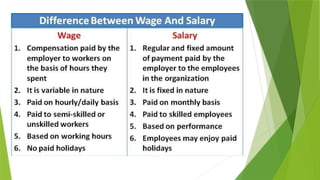
1.4 Difference Between Wages and Compensation
1.5 Wage Components
1.6 Objectives of Compensation
1.7 Factors Influencing Compensation
1.8 Theories of Wage Determination
4.
1.9 Typesof Wages
1.10 Wage Policies
1.11 3P of Compensation
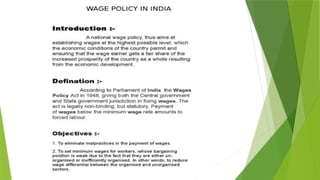
1.12 Compensation Trends in India
1.13 Meaning of Compensation Management
1.14 Total Rewards
1.15 Types of Total Rewards
1.16 Employee Rewards System in India
1.17 Elements of Employee Rewards in India
1.18 Objectives of Rewards in India
1.19 External Labour Markets
1.20 Organizational Strategy
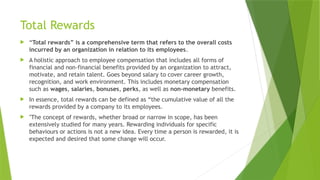
5.
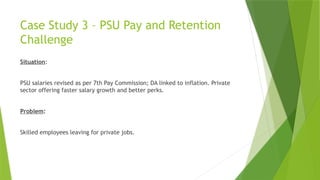
1.21 InternalLabour Markets
1.22 Understanding Inter and Intra-Industry Compensation
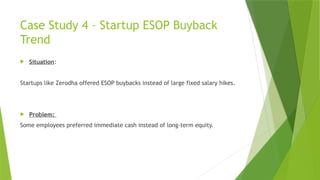
Differential
1.23 Summary
1.24 Self-Assessment Questions
6.
Learning Objectives
Understandthe term compensation from various dimensions
Differentiate between wages and compensation
Learn principles of compensation
Examine economic and behavioural theories of wage determination
Understand the basic dynamics of wage policy in India and its objectives
Comprehend the various principles of compensation
Understand the concept of Total Rewards
Learn about types of rewards
Assess various components of Indian reward system
Comprehend the terms Labour markets
Learn about determinants of intra-inter industry differences in wage and compensation
7.
Introduction
I
n thecompetitive global economy, wage, compensation, and rewards are not just
financial terms — they are strategic tools that influence employee motivation,
productivity, and retention. For MBA students, understanding the conceptual and
practical aspects of these terms is critical for effective HR and organizational
leadership.
8.
Key Concepts
Wage
Definition:A wage is the monetary compensation paid by an employer to an
employee for work performed, usually calculated on an hourly, daily, or piece-rate
basis.
Features: Direct cash payment , Short-term, immediate exchange for labor
Governed by laws such as the Minimum Wages Act (India)
9.
Types of Wages:
1. Nominal Wage – Money paid without adjusting for inflation
2. Real Wage – Purchasing power of the nominal wage
3. Minimum Wage – Legally mandated floor rate
4. Fair Wage – Above minimum wage, based on industry standards
5. Living Wage – Sufficient to maintain a reasonable standard of living
10.
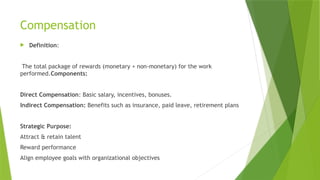
Compensation
Definition:
The totalpackage of rewards (monetary + non-monetary) for the work
performed.Components:
Direct Compensation: Basic salary, incentives, bonuses.
Indirect Compensation: Benefits such as insurance, paid leave, retirement plans
Strategic Purpose:
Attract & retain talent
Reward performance
Align employee goals with organizational objectives
11.
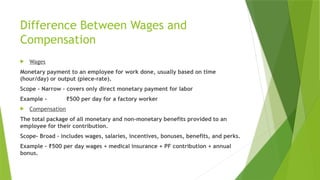
Difference Between Wagesand
Compensation
Wages
Monetary payment to an employee for work done, usually based on time
(hour/day) or output (piece-rate).
Scope - Narrow – covers only direct monetary payment for labor
Example - 500 per day for a factory worker
₹
Compensation
The total package of all monetary and non-monetary benefits provided to an
employee for their contribution.
Scope- Broad – includes wages, salaries, incentives, bonuses, benefits, and perks.
Example - 500 per day wages + medical insurance + PF contribution + annual
₹
bonus.
12.
Rewards
Rewards
Definition: Rewardsare benefits provided in recognition of
performance, effort, or achievement, and can be financial or non-
financial.
Types:
1. Intrinsic Rewards – Sense of achievement, recognition, job
satisfaction2. 2. Extrinsic Rewards – Monetary incentives,
promotions, perks
13.
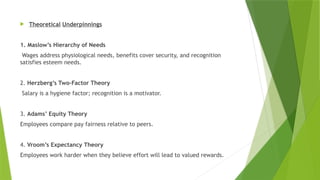
Theoretical Underpinnings
1.Maslow’s Hierarchy of Needs
Wages address physiological needs, benefits cover security, and recognition
satisfies esteem needs.
2. Herzberg’s Two-Factor Theory
Salary is a hygiene factor; recognition is a motivator.
3. Adams’ Equity Theory
Employees compare pay fairness relative to peers.
4. Vroom’s Expectancy Theory
Employees work harder when they believe effort will lead to valued rewards.
14.
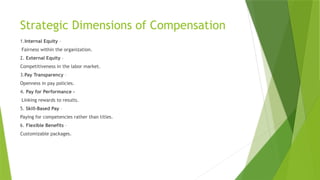
Strategic Dimensions ofCompensation
1.Internal Equity –
Fairness within the organization.
2. External Equity –
Competitiveness in the labor market.
3.Pay Transparency –
Openness in pay policies.
4. Pay for Performance –
Linking rewards to results.
5. Skill-Based Pay –
Paying for competencies rather than titles.
6. Flexible Benefits –
Customizable packages.
15.
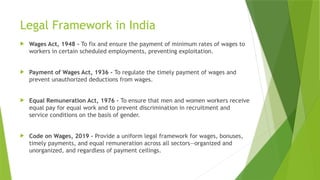
Legal Framework inIndia
Wages Act, 1948 - To fix and ensure the payment of minimum rates of wages to
workers in certain scheduled employments, preventing exploitation.
Payment of Wages Act, 1936 - To regulate the timely payment of wages and
prevent unauthorized deductions from wages.
Equal Remuneration Act, 1976 - To ensure that men and women workers receive
equal pay for equal work and to prevent discrimination in recruitment and
service conditions on the basis of gender.
Code on Wages, 2019 - Provide a uniform legal framework for wages, bonuses,
timely payments, and equal remuneration across all sectors—organized and
unorganized, and regardless of payment ceilings.
16.
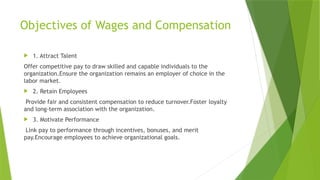
Objectives of Wagesand Compensation
1. Attract Talent
Offer competitive pay to draw skilled and capable individuals to the
organization.Ensure the organization remains an employer of choice in the
labor market.
2. Retain Employees
Provide fair and consistent compensation to reduce turnover.Foster loyalty
and long-term association with the organization.
3. Motivate Performance
Link pay to performance through incentives, bonuses, and merit
pay.Encourage employees to achieve organizational goals.
17.
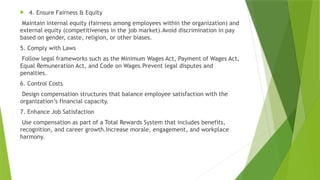
4. EnsureFairness & Equity
Maintain internal equity (fairness among employees within the organization) and
external equity (competitiveness in the job market).Avoid discrimination in pay
based on gender, caste, religion, or other biases.
5. Comply with Laws
Follow legal frameworks such as the Minimum Wages Act, Payment of Wages Act,
Equal Remuneration Act, and Code on Wages.Prevent legal disputes and
penalties.
6. Control Costs
Design compensation structures that balance employee satisfaction with the
organization’s financial capacity.
7. Enhance Job Satisfaction
Use compensation as part of a Total Rewards System that includes benefits,
recognition, and career growth.Increase morale, engagement, and workplace
harmony.
18.
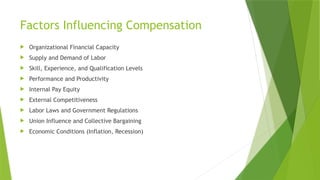
Factors Influencing Compensation
Organizational Financial Capacity
Supply and Demand of Labor
Skill, Experience, and Qualification Levels
Performance and Productivity
Internal Pay Equity
External Competitiveness
Labor Laws and Government Regulations
Union Influence and Collective Bargaining
Economic Conditions (Inflation, Recession)
19.
Case Study 1:Retaining Talent in a
Competitive Industry
Background:
XYZ Tech Pvt. Ltd. was facing high attrition as competitors offered 20%
higher pay packages.
Challenge:
Retain top talent without exceeding the budget.
20.
Solution:
Introduced flexiblebenefits
(work-from-home, wellness programs)
Implemented skill-based pay
for employees who acquired certifications
Strengthened recognition programs
(monthly awards, public appreciation)
Outcome:
Attrition reduced by 35% within 9 months, even without matching competitors’
salaries.
21.
Case Study 2:Performance-Linked Bonus
Backfires
Background:
LMN Bank linked bonuses purely to sales numbers. Employees focused on
quantity, not quality, leading to customer complaints.
Challenge:
Maintain performance incentives without compromising service quality.
22.
Solution:
Revised performancemetrics to include customer satisfaction scores
Balanced quantitative and qualitative KPIs
Introduced team-based rewards to promote collaboration
Outcome:
Customer satisfaction improved by 40% while sales remained steady.
23.
Key Considerations inWage Policy
Important factors to be considered in public policy regarding wages and
salaries include:
1. Ending Exploitation: Putting an end to exploitation and ensuring fair
remuneration for both capital and Labour, where excessive profits
are prevented through suitable measures of taxation while ensuring
fair wages, a reasonable return on invested capital, and appropriate
reserves for the maintenance and expansion of the enterprise.
2. Wage Differentials: Addressing wage differentials among different
job roles or industries.
3. Wage Regulation: Regulating wages and salaries to reduce or
eliminate unjustifiable disparities.
24.
4. LinkingRemuneration to Productivity: Establishing a link between
compensation and productivity to incentivize improved performance.
5. Cost of Living Compensation: Providing adjustments in wages to
compensate for increases in the cost of living.
6. Minimum Wage Fixation: Setting statutory minimum wages
selected industries and promoting fair wage agreements in organized
sectors.
7. Equality: Ensuring equal pay for equal work, as mandated by the
constitution of India.
8. Determining Fair Wages: Considering factors such as labour
productivity, prevailing wage levels, national income and its
distribution, and the industry’s role in the country’s economy when
determining fair wages beyond the minimum wage.
25.
9. BasicNeeds: Addressing the basic needs of workers in wage policies.
11. Living Wages: Striving to secure living wages for workers, ensuring
their income is sufficient for a decent standard of living.
These objectives and considerations help guide the development of a
comprehensive and equitable wage policy that promotes economic and
social well-being.
26.
3P of Compensation
Compensation refers to payment given to an employee in exchange for their
contributions to the organization and for performing their job responsibilities.
Compensation typically includes fixed pay and/or variable pay. Fixed pay is
determined based on the employee’s position within the organization and the
market value associated with the expertise required for successful performance in
that role. On the other hand, variable pay is contingent upon the individual’s
performance in their role, such as the extent to which they have achieved their
goals during a given period. Variable pay can take the form of incentive plans or
bonuses.
There are three approaches, or strategies, for providing compensation:
pay for the position,
pay for the person,
pay for performance.
27.
Pay for Position
compensates employees based on the attributes an challenges associated with
their specific position.
This model features a substantial initial compensation with minimum variable
benefits.
The motivation of employees in a fixed pay model is expected to emerge from the high
level of compensation they receive, with the “carrot” being given before performance.
Job classification is employed to establish various grades and pay rates contingent
on the hierarchical level, job nature, qualifications, experience, and overall skills
and abilities.
Employees are then rewarded based on their placement within the appropriate
position, focusing on compensating the position rather than the individual/job
holder.
28.
Pay for Person
entails compensating individuals based on their personal and professional
characteristics vital for effective performance, as well as factors necessary for
recruiting and maintain competent employees in the organization.
This approach to compensation management is extremely subjective and challenging.
Compensation for the person includes remuneration for knowledge of job, skills, and
experience, taking into account the organization’s compensation structures to
maintain equilibrium with existing employees, affordability, and prevailing market
rates.
The person-based model operates on the principle that compensation should be linked
to an individual’s personal capabilities, skills, and competencies used in the job, or
their acquisition and application of additional skills.
Employees are expected to be motivated by their high level of skills and
competencies, which result in higher compensation. Paying for an individual’s
knowledge, skills, and experience means that the organization rewards the person’s
capabilities more than their performance.
29.
Pay for Performance:
Pay for performance models link an employee 'compensation to their job
performance.
Employees are expected to perform well, and their rewards are based on the
outcomes of their work. The “carrot” of compensation is provided after the
performance. Pay varies based on individual, team, or organizational
performance measures.
Pay for performance is a common practice in modern organizations as it
positively impacts productivity and helps address the moral hazard
problem. However, factors affecting the subjective nature of performance
standards are important to consider, as employees may be skeptical of
announced criteria.
30.
Compensation Trends inIndia
Large disparity in gross compensation between managers and subordinates.
Customized salary packages for senior-level executives.
Increase in basic salary rise in deferred benefits.
→
Non-tax perks mostly limited to top management; provided as
reimbursements.
Higher increments (50–100%) for different management levels.Shift from
individual to group/team incentives.
Shift from individual to group/team incentives.
Removal of non-tax-exempt components (e.g., servants’ wages, utility
allowance).
Medical benefits via insurance companies & hospitals.
31.
Loans fortwo-wheelers/four-wheelers, housing, or interest subsidies.
Support for employees’ education and sabbaticals.
Reimbursement of travel/holiday expenses (guest houses, transit flats).
More components now made direct and taxable.
Profit-sharing for senior executives beyond fixed levels.
Stock options (ESOPs) offered to employees.
32.
Total Rewards
“Totalrewards” is a comprehensive term that refers to the overall costs
incurred by an organization in relation to its employees.
A holistic approach to employee compensation that includes all forms of
financial and non-financial benefits provided by an organization to attract,
motivate, and retain talent. Goes beyond salary to cover career growth,
recognition, and work environment. This includes monetary compensation
such as wages, salaries, bonuses, perks, as well as non-monetary benefits.
In essence, total rewards can be defined as “the cumulative value of all the
rewards provided by a company to its employees.
"The concept of rewards, whether broad or narrow in scope, has been
extensively studied for many years. Rewarding individuals for specific
behaviours or actions is not a new idea. Every time a person is rewarded, it is
expected and desired that some change will occur.
33.
Case Study 3– PSU Pay and Retention
Challenge
Situation:
PSU salaries revised as per 7th Pay Commission; DA linked to inflation. Private
sector offering faster salary growth and better perks.
Problem:
Skilled employees leaving for private jobs.
34.
Solution
Add performance-linkedpay, skill-based allowances, and career growth
training.
Introduce housing, education, and health benefits as retention tools.
35.
Case Study 4– Startup ESOP Buyback
Trend
Situation:
Startups like Zerodha offered ESOP buybacks instead of large fixed salary hikes.
Problem:
Some employees preferred immediate cash instead of long-term equity.
36.
Solution:
Give employeesa choice between ESOPs and cash bonuses.
Offer partial ESOP liquidation every year for liquidity.
37.
Case Study 5– Gender Pay Gap Dispute
Situation:
A female employee discovered she earned less than a male colleague in the same
role.
Filed a complaint citing Equal Remuneration provisions under Code on Wages,
2019.
Problem:
Pay discrimination damaging company reputation.
38.
Solution
Conduct annualpay equity audits.
Revise salaries to remove gaps and comply with the law.
Communicate policy on equal pay to all employees.
Ensure Legal ComplianceCase study:6
Situation:
A Delhi-based media company faced scrutiny over salary disparities.
Problem:
Violation of Equal Remuneration Act due to unequal pay for the same role.
46.
Solution
Performed payaudits,
adjusted salaries to meet Code on Wages norms, and implemented yearly
compliance checks.
47.
Communicate the RewardSystem
Clearly Case study:7
Situation:
TCS faced unrest after delaying salary hikes during 2025 economic slowdown.
Problem:
Lack of transparency created mistrust and rumours among staff.
48.
Solution
Introduced clearcommunication channels,
shared timelines for hikes/bonuses,
held Q&A sessions with HR leaders.