BY:-SHWETA SRIVASTAVA
      M.B.A 272
The literal meaning of compensation is to counter balance. In the case of human resource
management. Compensation is refereed to as money and other benefits received by an employee
For providing services to his employer . Money and benefits received may be in different forms-base compensation in
money form and various benefits, which may be associated with employee's service to the employer like provident fund ,
gratuity and insurance scheme, and any other payment which the employee receives or benefits he enjoys in lieu of such
payments.
   Attracting the talent:- It is widely accepted that human resources of an organization give it an
    edge over its competitors. By offering a well designed pay package.

   Retaining the talent:- Now a days employee do not hitch leaving one job and joining other if they
    offered better pay package. Therefore organization have to design compensation systems that talent and skill
    not only get attracted but also stay with the organization.

   Motivating the employee:- The employees may have talent but they will not be motivated to
    use their talent unless they know that they will be rewarded duly for their contribution towards the
    organizational objectives.
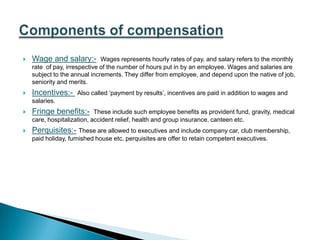
   Wage and salary:-         Wages represents hourly rates of pay, and salary refers to the monthly
    rate of pay, irrespective of the number of hours put in by an employee. Wages and salaries are
    subject to the annual increments. They differ from employee, and depend upon the native of job,
    seniority and merits.
   Incentives:-    Also called „payment by results‟, incentives are paid in addition to wages and
    salaries.
   Fringe benefits:-       These include such employee benefits as provident fund, gravity, medical
    care, hospitalization, accident relief, health and group insurance, canteen etc.
   Perquisites:- These are allowed to executives and include company car, club membership,
    paid holiday, furnished house etc. perquisites are offer to retain competent executives.
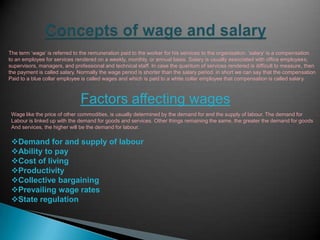
The term „wage‟ is referred to the remuneration paid to the worker for his services to the organisation. „salary‟ is a compensation
to an employee for services rendered on a weekly, monthly, or annual basis. Salary is usually associated with office employees,
supervisors, managers, and professional and technical staff. In case the quantum of services rendered is difficult to measure, then
the payment is called salary. Normally the wage period is shorter than the salary period. in short we can say that the compensation
Paid to a blue collar employee is called wages and which is paid to a white collar employee that compensation is called salary.


                              Factors affecting wages
 Wage like the price of other commodities, is usually determined by the demand for and the supply of labour. The demand for
 Labour is linked up with the demand for goods and services. Other things remaining the same, the greater the demand for goods
 And services, the higher will be the demand for labour.

 Demand for and supply of labour
 Ability to pay
 Cost of living
 Productivity
 Collective bargaining
 Prevailing wage rates
 State regulation
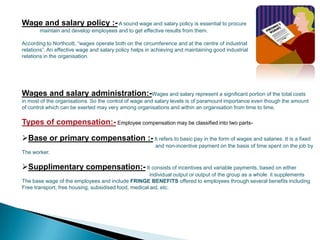
Wage and salary policy :- A sound wage and salary policy is essential to procure
       maintain and develop employees and to get effective results from them.

According to Northcott, “wages operate both on the circumference and at the centre of industrial
relations”. An effective wage and salary policy helps in achieving and maintaining good industrial
relations in the organisation.


Wages and salary administration:-Wages and salary represent a significant portion of the total costs
in most of the organisations. So the control of wage and salary levels is of paramount importance even though the amount
of control which can be exerted may very among organisations and within an organisation from time to time.

Types of compensation:- Employee compensation may be classified into two parts-

Base or primary compensation :- It refers to basic pay in the form of wages and salaries. It is a fixed
                                                         and non-incentive payment on the basis of time spent on the job by
The worker.

Supplimentary compensation:- It consists of incentives and variable payments, based on either
                                                      individual output or output of the group as a whole. it supplements
The base wage of the employees and include FRINGE BENEFITS offered to employees through several benefits including
Free transport, free housing, subsidised food, medical aid, etc.
The basic objectives of fringe benefits or perks are:-

a) To create and maintain sound industrial relations.
b) To boost up employee morale and to motivate the employee by identifying and satisfying their unsatisfied needs.
c) To create a sense of belongingness among employees and to retain them. Fringe benefits are also called golden hand cuffs.
d) To meet the requirements of various legislation relating to fringe benefits.
e) To improve the quality of work life of the employees.
f) To provide security to the employees against social risks like old age.
g) To protect the health of the employees and to provide safety to the employees against accidents.
h) To promote employee‟s welfare by providing welfare measures like recreation facilities.
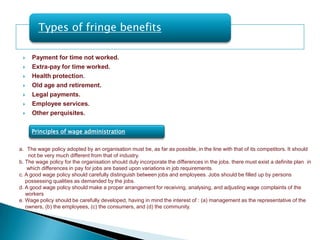
Types of fringe benefits

    Payment for time not worked.
    Extra-pay for time worked.
    Health protection.
    Old age and retirement.
    Legal payments.
    Employee services.
    Other perquisites.

     Principles of wage administration


a. The wage policy adopted by an organisation must be, as far as possible, in the line with that of its competitors. It should
    not be very much different from that of industry.
b. The wage policy for the organisation should duly incorporate the differences in the jobs. there must exist a definite plan in
    which differences in pay for jobs are based upon variations in job requirements.
c. A good wage policy should carefully distinguish between jobs and employees. Jobs should be filled up by persons
   possessing qualities as demanded by the jobs.
d. A good wage policy should make a proper arrangement for receiving, analysing, and adjusting wage complaints of the
   workers
e. Wage policy should be carefully developed, having in mind the interest of : (a) management as the representative of the
   owners, (b) the employees, (c) the consumers, and (d) the community.
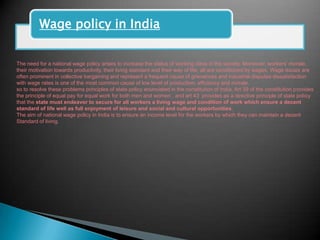
Wage policy in India


The need for a national wage policy arises to increase the status of working class in the society. Moreover, workers‟ morale,
their motivation towards productivity, their living standard and their way of life, all are conditioned by wages. Wage issues are
often prominent in collective bargaining and represent a frequent cause of grievances and industrial disputes dissatisfaction
with wage rates is one of the most common cause of low level of production, efficiency and morale.
so to resolve these problems principles of state policy enunciated in the constitution of India. Art 39 of the constitution provides
the principle of equal pay for equal work for both men and women , and art 43 provides as a directive principle of state policy
that the state must endeavor to secure for all workers a living wage and condition of work which ensure a decent
standard of life well as full enjoyment of leisure and social and cultural opportunities.
The aim of national wage policy in India is to ensure an income level for the workers by which they can maintain a decent
Standard of living.
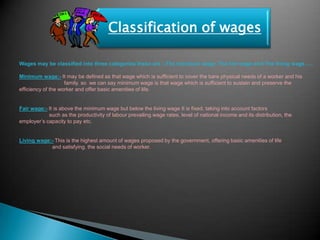
Classification of wages

Wages may be classified into three categories these are :-The minimum wage, The fair wage and The living wage…..

Minimum wage:- It may be defined as that wage which is sufficient to cover the bare physical needs of a worker and his
                    family. so we can say minimum wage is that wage which is sufficient to sustain and preserve the
efficiency of the worker and offer basic amenities of life.


Fair wage:- It is above the minimum wage but below the living wage It is fixed, taking into account factors
            such as the productivity of labour prevailing wage rates, level of national income and its distribution, the
employer‟s capacity to pay etc.


Living wage:- This is the highest amount of wages proposed by the government, offering basic amenities of life
            and satisfying. the social needs of worker.
Thank you

Compensation administration

  • 1.
  • 2.
    The literal meaningof compensation is to counter balance. In the case of human resource management. Compensation is refereed to as money and other benefits received by an employee For providing services to his employer . Money and benefits received may be in different forms-base compensation in money form and various benefits, which may be associated with employee's service to the employer like provident fund , gratuity and insurance scheme, and any other payment which the employee receives or benefits he enjoys in lieu of such payments.
  • 3.
    Attracting the talent:- It is widely accepted that human resources of an organization give it an edge over its competitors. By offering a well designed pay package.  Retaining the talent:- Now a days employee do not hitch leaving one job and joining other if they offered better pay package. Therefore organization have to design compensation systems that talent and skill not only get attracted but also stay with the organization.  Motivating the employee:- The employees may have talent but they will not be motivated to use their talent unless they know that they will be rewarded duly for their contribution towards the organizational objectives.
  • 4.
    Wage and salary:- Wages represents hourly rates of pay, and salary refers to the monthly rate of pay, irrespective of the number of hours put in by an employee. Wages and salaries are subject to the annual increments. They differ from employee, and depend upon the native of job, seniority and merits.  Incentives:- Also called „payment by results‟, incentives are paid in addition to wages and salaries.  Fringe benefits:- These include such employee benefits as provident fund, gravity, medical care, hospitalization, accident relief, health and group insurance, canteen etc.  Perquisites:- These are allowed to executives and include company car, club membership, paid holiday, furnished house etc. perquisites are offer to retain competent executives.
  • 5.
    The term „wage‟is referred to the remuneration paid to the worker for his services to the organisation. „salary‟ is a compensation to an employee for services rendered on a weekly, monthly, or annual basis. Salary is usually associated with office employees, supervisors, managers, and professional and technical staff. In case the quantum of services rendered is difficult to measure, then the payment is called salary. Normally the wage period is shorter than the salary period. in short we can say that the compensation Paid to a blue collar employee is called wages and which is paid to a white collar employee that compensation is called salary. Factors affecting wages Wage like the price of other commodities, is usually determined by the demand for and the supply of labour. The demand for Labour is linked up with the demand for goods and services. Other things remaining the same, the greater the demand for goods And services, the higher will be the demand for labour. Demand for and supply of labour Ability to pay Cost of living Productivity Collective bargaining Prevailing wage rates State regulation
  • 6.
    Wage and salarypolicy :- A sound wage and salary policy is essential to procure maintain and develop employees and to get effective results from them. According to Northcott, “wages operate both on the circumference and at the centre of industrial relations”. An effective wage and salary policy helps in achieving and maintaining good industrial relations in the organisation. Wages and salary administration:-Wages and salary represent a significant portion of the total costs in most of the organisations. So the control of wage and salary levels is of paramount importance even though the amount of control which can be exerted may very among organisations and within an organisation from time to time. Types of compensation:- Employee compensation may be classified into two parts- Base or primary compensation :- It refers to basic pay in the form of wages and salaries. It is a fixed and non-incentive payment on the basis of time spent on the job by The worker. Supplimentary compensation:- It consists of incentives and variable payments, based on either individual output or output of the group as a whole. it supplements The base wage of the employees and include FRINGE BENEFITS offered to employees through several benefits including Free transport, free housing, subsidised food, medical aid, etc.
  • 7.
    The basic objectivesof fringe benefits or perks are:- a) To create and maintain sound industrial relations. b) To boost up employee morale and to motivate the employee by identifying and satisfying their unsatisfied needs. c) To create a sense of belongingness among employees and to retain them. Fringe benefits are also called golden hand cuffs. d) To meet the requirements of various legislation relating to fringe benefits. e) To improve the quality of work life of the employees. f) To provide security to the employees against social risks like old age. g) To protect the health of the employees and to provide safety to the employees against accidents. h) To promote employee‟s welfare by providing welfare measures like recreation facilities.
  • 8.
    Types of fringebenefits  Payment for time not worked.  Extra-pay for time worked.  Health protection.  Old age and retirement.  Legal payments.  Employee services.  Other perquisites. Principles of wage administration a. The wage policy adopted by an organisation must be, as far as possible, in the line with that of its competitors. It should not be very much different from that of industry. b. The wage policy for the organisation should duly incorporate the differences in the jobs. there must exist a definite plan in which differences in pay for jobs are based upon variations in job requirements. c. A good wage policy should carefully distinguish between jobs and employees. Jobs should be filled up by persons possessing qualities as demanded by the jobs. d. A good wage policy should make a proper arrangement for receiving, analysing, and adjusting wage complaints of the workers e. Wage policy should be carefully developed, having in mind the interest of : (a) management as the representative of the owners, (b) the employees, (c) the consumers, and (d) the community.
  • 9.
    Wage policy inIndia The need for a national wage policy arises to increase the status of working class in the society. Moreover, workers‟ morale, their motivation towards productivity, their living standard and their way of life, all are conditioned by wages. Wage issues are often prominent in collective bargaining and represent a frequent cause of grievances and industrial disputes dissatisfaction with wage rates is one of the most common cause of low level of production, efficiency and morale. so to resolve these problems principles of state policy enunciated in the constitution of India. Art 39 of the constitution provides the principle of equal pay for equal work for both men and women , and art 43 provides as a directive principle of state policy that the state must endeavor to secure for all workers a living wage and condition of work which ensure a decent standard of life well as full enjoyment of leisure and social and cultural opportunities. The aim of national wage policy in India is to ensure an income level for the workers by which they can maintain a decent Standard of living.
  • 10.
    Classification of wages Wagesmay be classified into three categories these are :-The minimum wage, The fair wage and The living wage….. Minimum wage:- It may be defined as that wage which is sufficient to cover the bare physical needs of a worker and his family. so we can say minimum wage is that wage which is sufficient to sustain and preserve the efficiency of the worker and offer basic amenities of life. Fair wage:- It is above the minimum wage but below the living wage It is fixed, taking into account factors such as the productivity of labour prevailing wage rates, level of national income and its distribution, the employer‟s capacity to pay etc. Living wage:- This is the highest amount of wages proposed by the government, offering basic amenities of life and satisfying. the social needs of worker.
  • 11.