Compensation Management
• Employee compensation is a vital part of
human resource management.
• Wages or salaries and other forms constitute a
very large component of operating costs.
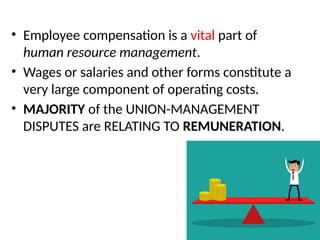
• MAJORITY of the UNION-MANAGEMENT
DISPUTES are RELATING TO REMUNERATION.
• No organization can expect to attract and
retain talent unless it pays them fair
compensation.
• Compensation
– Is a motivational factor
– It helps to satisfy their physical needs
– It also determines their social status
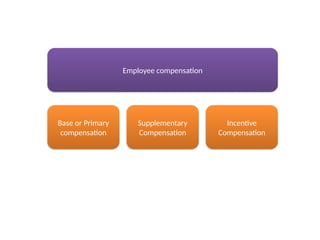
Employee compensation
Base or Primary
compensation
Supplementary
Compensation
Incentive
Compensation
Base or primary compensation
• It refers to basic pay in the form of wages and
salaries.
• It is fixed and paid on the basis of time
expended on the job.
• It is usually paid in the form of cash
• The main purpose is to compensate
employees for their services.
• It is determined on the basis of job evaluation.
Supplementary Compensation
• It means fringe benefits paid in addition to
wages and salaries.
• The main purpose is to retain employees and
to increase their efficiency.
• It depend mainly on the company policies and
needs.
Incentive compensation
• It refers to monetary compensation paid to
employees to motivate them for their
performance.
• It is based on either individual performance or
the performance of a group as a whole.
Objectives
• The main objective of compensation is to
ensure fairness or equity.
• The term equity has 3 dimensions:-
– Internal equity:- this ensures that more difficult
jobs are paid more
– External equity:- this ensures that jobs are fiarly
compensated in comparison to similar jobs in the
labour market.
– Individual Equity:- it ensures equal pay for equal
work
• Attract talent:- compensation needs to be high
enough to attract talented people.
• Retain talent:- if the compensation levels falls
below the expectations of employees or are
not competitive employees may quit in
frustration.
• New and desired behavior:- Pay should reward
loyalty, commitment, experience, risk taking
etc . If the company fails to do so employees
may go in search for greener pastures outside
• Control costs:- it ensures that employees are
neither overpaid nor underpaid
• Comply with legal rules:- it must invariably
satisfy governmental rules regarding minimum
wages, bonus, allowances etc
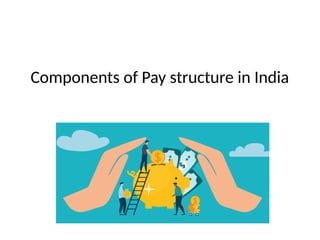
Components of Pay structure in India
Monetary compensation package of employees
generally consists of the following:-
1. Base pay
2. Allowances
3. Incentives
4. Fringe benefits
Base Pay
• Base pay :- It is the first and foremost part of
pay, package, which is determined through
JOB EVALUATION.
• The fair wages committee gave 3 concepts
relations to basic wages
– Minimum Wage
– Fair Wage
– Living wage
Minimum Wages
• The minimum wage may be defined as the
lowest wage necessary to maintain a worker
and his family at the minimum level of
subsistence, which includes food, clothing and
shelter.
• Minimum wage in a country is fixed by the
government in consultation with business
organisations and trade unions
Fair wage
• A fair wage is something more than the
minimum wages. Fair wage is a mean between
the living wage and the minimum wage.
• While the lower limit of the fair wage must
obviously be the minimum wage, the upper
limit is the capacity of the industry to pay
• Fair wage depends on the present economic
position as well as on its future prospects.
Living wage
• According to Fair Wages Committee Report: "The
living wage should enable the male earner to provide
himself and his family not merely the basic essentials of
food, clothing and shelter but a measure of frugal
comfort including education for the children, protection
against ill-health, requirement of essential social needs
and measures of insurance against old age.“
• It is the amount that not only fulfills the basic needs but
in addition provides certain amenities, necessary for
the well being of the worker.
Allowances
• An allowance is an amount received by the
employee for meeting service requirements.
Allowances are provided in addition to the basic
salary and vary from company to company. Some
common types of allowances are discussed below:
– Dearness Allowances
– House Rent Allowance
– Leave travel allowance (LTA)
– Medical Allowance
– Conveyance Allowance
– Child Education Allowance
Dearness Allowance
• Dearness Allowance (DA) paid by the government to
its employees as well as a pensioner to offset the
impact of inflation.
• introduced as part of the salary as a means to reduce
the burden of inflation on salaried employees. This
amount is usually set to about 5% of the total CTC.
• DA varies from employee to employee based on
their presence in the urban, semi-urban or rural
sector.
House Rent Allowance (HRA)
• House Rent Allowance (HRA) is a special allowance
granted to employees by companies to meet expenditures
they incur on residential accommodation. This allowance
varies based on the area of residence and is usually tax-
exempt.
• Hence, depending on where your workplace is located,
this salary component will usually be set at 40% or 50% of
the basic salary.
• Difference: HRA applies to both private and public sector
employees, while only public sector employees are
entitled to DA.
Leave travel allowance (LTA)
• Leave travel allowance (LTA) remunerates employees for their
travel within the country. This component is widely used by
employers due to the tax benefits associated with it. An
employee can claim tax benefits for the fare expenses paid for
his/her family when they take a holiday. However, there are
restrictions to what you can claim as tax benefits:
• Only fare expenses are covered: Only the travel fare expenses
can be claimed. Stay and food on your trip aren’t covered.
• Travel must be within India: If you travel to a foreign country,
the expenses aren’t tax deductible. Only travel within the
country is covered.
• What counts as family: Immediate family that are mainly
dependant on the employee are covered under LTA.
Child Education Allowance
• This component is paid out towards tuition
fees of employees’ children and is tax
deductible up to Rs. 100 every month for a
maximum of two children. Hence, this amount
is usually set to not more than Rs. 2,400 a year
for an employee.
Incentives
• Bonus, profit sharing, commission on sales etc are the
various forms of incentives and basically they are
PERFORMANCE based.
• Star performers are found out and incentives are given to
them.
• a. Financial Incentives are:
• (i) Pay and allowances, (ii) Productivity linked wage incentive,
(iii) Bonus, (iv) Co-partnership/stock option, (v) Retirement
benefits, (vi) Perquisites
• b. Non-Financial Incentives are:
• (i) Employee recognition programmes, (ii) Employee
empowerment, (iii) Job security, (iv) Status,
(v) Employee participation, (vi) Organisational climate
Fringe Benefits
• Extra perks that employees receive on top of
their usual pay.
• These may come in non-monetary forms and are
meant to supplement their regular wages or
salaries.
• Examples of optional fringe benefits include free
breakfast and lunch, gym membership, employee
stock options, transportation benefits, retirement
planning services, childcare, education assistance
Wage and Salary Administration
Objectives
A sound plan of compensation administration
seeks to achieve the following objectives:-
• To establish a fair and equitable remuneration
offering similar pay for similar work.
• To attract qualified and competent personnel
• To retain the present employees by keeping
wage levels in tune with competing units
• To control labour and administrative costs in
line with the ability of the organisation to pay
• To improve motivation and morale of
employees and to improve union-
management relations.
• To project a good image of the company and
to comply with legal needs relating to wages
and salaries
Principles of Wage and Salary Administration
1. Wage and salary plans should be sufficiently
flexible
2. Job evaluation must be done scientifically
3. Wage and Salary Administration plans must
always be consistent with overall organisational
plans and programmes
4. Wage and Salary Administration plans and
programmes should be responsive to the
changing local and national conditions
Elements of Wage and Salary Administration
1. Identifying the available salary opportunities,
their costs, estimating the worth of its
members, of their salary opportunities and
communicating them to employees.
2. Relating salary to needs and goals
3. Developing quality, quantity and time standards
related to work and goals
4. Determining the effort necessary to achieve
standards
5. Measuring actual performance
6. Comparing the performance with the salary
received
7. Measuring the job satisfaction of the employees
8. Evaluating the unsatisfied wants and unrealised
goals aspirations of the employees.
9. Finding out the dissatisfaction arising from
unfulfilled needs and unattained goals
10.Adjusting the salary levels accordingly with a
view to enabling the employees to reach
unreached goals and fulfill the unfulfilled needs
and aspirations.
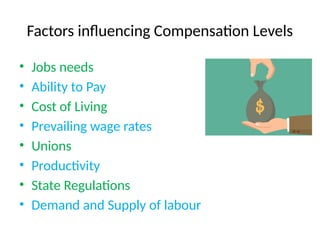
Factors influencing Compensation Levels
• Jobs needs
• Ability to Pay
• Cost of Living
• Prevailing wage rates
• Unions
• Productivity
• State Regulations
• Demand and Supply of labour
Choices in Designing a compensation
system
• The compensation system that is followed by a
firm should be in tune with its own unique
character and culture and allow the firm to
achieve its strategic objectives
• A wide variety of options confront a firm while
designing such a system…
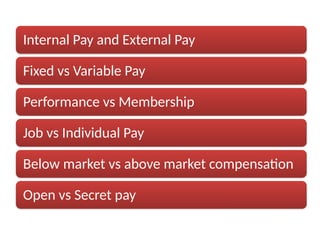
Internal Pay and External Pay
Fixed vs Variable Pay
Performance vs Membership
Job vs Individual Pay
Below market vs above market compensation
Open vs Secret pay
Compensation-Management for recruitment.

Compensation-Management for recruitment.

  • 1.
  • 2.
    • Employee compensationis a vital part of human resource management. • Wages or salaries and other forms constitute a very large component of operating costs. • MAJORITY of the UNION-MANAGEMENT DISPUTES are RELATING TO REMUNERATION.
  • 3.
    • No organizationcan expect to attract and retain talent unless it pays them fair compensation. • Compensation – Is a motivational factor – It helps to satisfy their physical needs – It also determines their social status
  • 4.
    Employee compensation Base orPrimary compensation Supplementary Compensation Incentive Compensation
  • 5.
    Base or primarycompensation • It refers to basic pay in the form of wages and salaries. • It is fixed and paid on the basis of time expended on the job. • It is usually paid in the form of cash • The main purpose is to compensate employees for their services. • It is determined on the basis of job evaluation.
  • 6.
    Supplementary Compensation • Itmeans fringe benefits paid in addition to wages and salaries. • The main purpose is to retain employees and to increase their efficiency. • It depend mainly on the company policies and needs.
  • 7.
    Incentive compensation • Itrefers to monetary compensation paid to employees to motivate them for their performance. • It is based on either individual performance or the performance of a group as a whole.
  • 8.
    Objectives • The mainobjective of compensation is to ensure fairness or equity.
  • 9.
    • The termequity has 3 dimensions:- – Internal equity:- this ensures that more difficult jobs are paid more – External equity:- this ensures that jobs are fiarly compensated in comparison to similar jobs in the labour market. – Individual Equity:- it ensures equal pay for equal work
  • 10.
    • Attract talent:-compensation needs to be high enough to attract talented people. • Retain talent:- if the compensation levels falls below the expectations of employees or are not competitive employees may quit in frustration. • New and desired behavior:- Pay should reward loyalty, commitment, experience, risk taking etc . If the company fails to do so employees may go in search for greener pastures outside
  • 11.
    • Control costs:-it ensures that employees are neither overpaid nor underpaid • Comply with legal rules:- it must invariably satisfy governmental rules regarding minimum wages, bonus, allowances etc
  • 12.
    Components of Paystructure in India
  • 13.
    Monetary compensation packageof employees generally consists of the following:- 1. Base pay 2. Allowances 3. Incentives 4. Fringe benefits
  • 14.
    Base Pay • Basepay :- It is the first and foremost part of pay, package, which is determined through JOB EVALUATION. • The fair wages committee gave 3 concepts relations to basic wages – Minimum Wage – Fair Wage – Living wage
  • 15.
    Minimum Wages • Theminimum wage may be defined as the lowest wage necessary to maintain a worker and his family at the minimum level of subsistence, which includes food, clothing and shelter. • Minimum wage in a country is fixed by the government in consultation with business organisations and trade unions
  • 16.
    Fair wage • Afair wage is something more than the minimum wages. Fair wage is a mean between the living wage and the minimum wage. • While the lower limit of the fair wage must obviously be the minimum wage, the upper limit is the capacity of the industry to pay • Fair wage depends on the present economic position as well as on its future prospects.
  • 17.
    Living wage • Accordingto Fair Wages Committee Report: "The living wage should enable the male earner to provide himself and his family not merely the basic essentials of food, clothing and shelter but a measure of frugal comfort including education for the children, protection against ill-health, requirement of essential social needs and measures of insurance against old age.“ • It is the amount that not only fulfills the basic needs but in addition provides certain amenities, necessary for the well being of the worker.
  • 18.
    Allowances • An allowanceis an amount received by the employee for meeting service requirements. Allowances are provided in addition to the basic salary and vary from company to company. Some common types of allowances are discussed below: – Dearness Allowances – House Rent Allowance – Leave travel allowance (LTA) – Medical Allowance – Conveyance Allowance – Child Education Allowance
  • 19.
    Dearness Allowance • DearnessAllowance (DA) paid by the government to its employees as well as a pensioner to offset the impact of inflation. • introduced as part of the salary as a means to reduce the burden of inflation on salaried employees. This amount is usually set to about 5% of the total CTC. • DA varies from employee to employee based on their presence in the urban, semi-urban or rural sector.
  • 20.
    House Rent Allowance(HRA) • House Rent Allowance (HRA) is a special allowance granted to employees by companies to meet expenditures they incur on residential accommodation. This allowance varies based on the area of residence and is usually tax- exempt. • Hence, depending on where your workplace is located, this salary component will usually be set at 40% or 50% of the basic salary. • Difference: HRA applies to both private and public sector employees, while only public sector employees are entitled to DA.
  • 21.
    Leave travel allowance(LTA) • Leave travel allowance (LTA) remunerates employees for their travel within the country. This component is widely used by employers due to the tax benefits associated with it. An employee can claim tax benefits for the fare expenses paid for his/her family when they take a holiday. However, there are restrictions to what you can claim as tax benefits: • Only fare expenses are covered: Only the travel fare expenses can be claimed. Stay and food on your trip aren’t covered. • Travel must be within India: If you travel to a foreign country, the expenses aren’t tax deductible. Only travel within the country is covered. • What counts as family: Immediate family that are mainly dependant on the employee are covered under LTA.
  • 22.
    Child Education Allowance •This component is paid out towards tuition fees of employees’ children and is tax deductible up to Rs. 100 every month for a maximum of two children. Hence, this amount is usually set to not more than Rs. 2,400 a year for an employee.
  • 23.
    Incentives • Bonus, profitsharing, commission on sales etc are the various forms of incentives and basically they are PERFORMANCE based. • Star performers are found out and incentives are given to them. • a. Financial Incentives are: • (i) Pay and allowances, (ii) Productivity linked wage incentive, (iii) Bonus, (iv) Co-partnership/stock option, (v) Retirement benefits, (vi) Perquisites • b. Non-Financial Incentives are: • (i) Employee recognition programmes, (ii) Employee empowerment, (iii) Job security, (iv) Status, (v) Employee participation, (vi) Organisational climate
  • 24.
    Fringe Benefits • Extraperks that employees receive on top of their usual pay. • These may come in non-monetary forms and are meant to supplement their regular wages or salaries. • Examples of optional fringe benefits include free breakfast and lunch, gym membership, employee stock options, transportation benefits, retirement planning services, childcare, education assistance
  • 25.
    Wage and SalaryAdministration
  • 26.
    Objectives A sound planof compensation administration seeks to achieve the following objectives:- • To establish a fair and equitable remuneration offering similar pay for similar work. • To attract qualified and competent personnel • To retain the present employees by keeping wage levels in tune with competing units
  • 27.
    • To controllabour and administrative costs in line with the ability of the organisation to pay • To improve motivation and morale of employees and to improve union- management relations. • To project a good image of the company and to comply with legal needs relating to wages and salaries
  • 28.
    Principles of Wageand Salary Administration 1. Wage and salary plans should be sufficiently flexible 2. Job evaluation must be done scientifically 3. Wage and Salary Administration plans must always be consistent with overall organisational plans and programmes 4. Wage and Salary Administration plans and programmes should be responsive to the changing local and national conditions
  • 29.
    Elements of Wageand Salary Administration 1. Identifying the available salary opportunities, their costs, estimating the worth of its members, of their salary opportunities and communicating them to employees. 2. Relating salary to needs and goals 3. Developing quality, quantity and time standards related to work and goals 4. Determining the effort necessary to achieve standards
  • 30.
    5. Measuring actualperformance 6. Comparing the performance with the salary received 7. Measuring the job satisfaction of the employees 8. Evaluating the unsatisfied wants and unrealised goals aspirations of the employees. 9. Finding out the dissatisfaction arising from unfulfilled needs and unattained goals 10.Adjusting the salary levels accordingly with a view to enabling the employees to reach unreached goals and fulfill the unfulfilled needs and aspirations.
  • 31.
  • 32.
    Factors influencing CompensationLevels • Jobs needs • Ability to Pay • Cost of Living • Prevailing wage rates • Unions • Productivity • State Regulations • Demand and Supply of labour
  • 33.
    Choices in Designinga compensation system
  • 34.
    • The compensationsystem that is followed by a firm should be in tune with its own unique character and culture and allow the firm to achieve its strategic objectives • A wide variety of options confront a firm while designing such a system…
  • 35.
    Internal Pay andExternal Pay Fixed vs Variable Pay Performance vs Membership Job vs Individual Pay Below market vs above market compensation Open vs Secret pay

Editor's Notes

  • #14 To achieve this in its first session during November 1948, the Central Advisory Council appointed a Tripartite Committee of Fair Wage.