
USING BAYESIAN OPTIMIZATION
TO TUNE MACHINE LEARNING MODELS
Scott Clark
Co-founder and CEO of SigOpt
scott@sigopt.com @DrScottClark
TRIAL AND ERROR WASTES EXPERT TIME
Machine Learning is extremely
powerful
Tuning Machine Learning systems
is extremely non-intuitive
UNRESOLVED PROBLEM IN ML
https://www.quora.com/What-is-the-most-important-unresolved-problem-in-machine-learning-3
What is the most important unresolved problem in machine learning?
“...we still don't really know why some configurations of deep neural networks work
in some case and not others, let alone having a more or less automatic approach
to determining the architectures and the hyperparameters.”
Xavier Amatriain, VP Engineering at Quora
(former Director of Research at Netflix)
LOTS OF TUNABLE PARAMETERS
COMMON APPROACH
Random Search for Hyper-Parameter Optimization, James Bergstra et al., 2012
1. Random search or grid search
2. Expert defined grid search near “good” points
3. Refine domain and repeat steps - “grad student descent”
COMMON APPROACH
● Expert intensive
● Computationally intensive
● Finds potentially local optima
● Does not fully exploit useful information
Random Search for Hyper-Parameter Optimization, James Bergstra et al., 2012
1. Random search or grid search
2. Expert defined grid search near “good” points
3. Refine domain and repeat steps - “grad student descent”
… the challenge of how to collect information as efficiently
as possible, primarily for settings where collecting information
is time consuming and expensive.
Prof. Warren Powell - Princeton
What is the most efficient way to collect information?
Prof. Peter Frazier - Cornell
How do we make the most money, as fast as possible?
Me - @DrScottClark
OPTIMAL LEARNING
● Optimize some Overall Evaluation Criterion (OEC)
○ Loss, Accuracy, Likelihood, Revenue
● Given tunable parameters
○ Hyperparameters, feature parameters
● In an efficient way
○ Sample function as few times as possible
○ Training on big data is expensive
BAYESIAN GLOBAL OPTIMIZATION
Details at https://sigopt.com/research
Grid Search Random Search
...
...
...
...
...
...
GRID SEARCH SCALES EXPONENTIALLY
4D
...
...
...
...
...
...
...
...
...
...
...
...
...
...
...
...
...
...
...
...
...
...
...
...
BAYESIAN OPT SCALES LINEARLY
6D
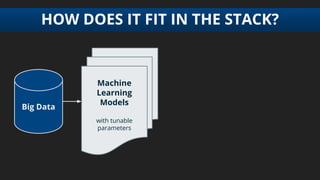
HOW DOES IT FIT IN THE STACK?
Big Data
Machine
Learning
Models
with tunable
parameters
Optimally suggests
new parameters
HOW DOES IT FIT IN THE STACK?
Objective Metric
New parameters
Big Data
Machine
Learning
Models
with tunable
parameters
Optimally suggests
new parameters
HOW DOES IT FIT IN THE STACK?
Objective Metric
New parameters
Better
Models
Big Data
Machine
Learning
Models
with tunable
parameters
QUICK EXAMPLES
Optimally suggests
new parameters
Ex: LOAN CLASSIFICATION (xgboost)
Prediction Accuracy
New parameters
Better
AccuracyLoan
Applications
Default
Prediction
with tunable
ML parameters
● Income
● Credit Score
● Loan Amount
COMPARATIVE PERFORMANCE
● 8.2% Better
Accuracy than
baseline
● 100x faster
than standard
tuning methods
Accuracy
Cost
Grid Search
Random Search
Iterations
AUC
.698
.690
.683
.675
1,00010,000100,000
EXAMPLE: ALGORITHMIC TRADING
Expected Revenue
New parameters
Higher
Returns
Market Data
Trading
Strategy
with tunable
weights and
thresholds
● Closing Prices
● Day of Week
● Market Volatility
Optimally suggests
new parameters
COMPARATIVE PERFORMANCE
Standard Method
Expert
● 200% Higher
model returns
than expert
● 10x faster
than standard
methods
HOW BAYESIAN OPTIMIZATION WORKS
1. Build Gaussian Process (GP) with points
sampled so far
2. Optimize the fit of the GP (covariance
hyperparameters)
3. Find the point(s) of highest Expected
Improvement within parameter domain
4. Return optimal next best point(s) to sample
HOW DOES IT WORK?
HOW DOES IT WORK?
1. User reports data
2. SigOpt builds statistical model
(Gaussian Process)
3. SigOpt finds the points of
highest Expected Improvement
4. SigOpt suggests best
parameters to test next
5. User tests those parameters
and reports results to SigOpt
6. Repeat
HOW DOES IT WORK?
1. User reports data
2. SigOpt builds statistical model
(Gaussian Process)
3. SigOpt finds the points of
highest Expected Improvement
4. SigOpt suggests best
parameters to test next
5. User tests those parameters
and reports results to SigOpt
6. Repeat
HOW DOES IT WORK?
1. User reports data
2. SigOpt builds statistical model
(Gaussian Process)
3. SigOpt finds the points of
highest Expected Improvement
4. SigOpt suggests best
parameters to test next
5. User tests those parameters
and reports results to SigOpt
6. Repeat
HOW DOES IT WORK?
1. User reports data
2. SigOpt builds statistical model
(Gaussian Process)
3. SigOpt finds the points of
highest Expected Improvement
4. SigOpt suggests best
parameters to test next
5. User tests those parameters
and reports results to SigOpt
6. Repeat
HOW DOES IT WORK?
1. User reports data
2. SigOpt builds statistical model
(Gaussian Process)
3. SigOpt finds the points of
highest Expected Improvement
4. SigOpt suggests best
parameters to test next
5. User tests those parameters
and reports results to SigOpt
6. Repeat
HOW DOES IT WORK?
1. User reports data
2. SigOpt builds statistical model
(Gaussian Process)
3. SigOpt finds the points of
highest Expected Improvement
4. SigOpt suggests best
parameters to test next
5. User tests those parameters
and reports results to SigOpt
6. Repeat
EXTENDED EXAMPLE:
EFFICIENTLY BUILDING CONVNETS
● Classify house numbers
with more training data and
more sophisticated model
PROBLEM
● TensorFlow makes it easier to design DNN architectures,
but what structure works best on a given dataset?
CONVNET STRUCTURE
● Per parameter
adaptive SGD variants
like RMSProp and
Adagrad seem to
work best
● Still require careful
selection of learning
rate (α), momentum
(β), decay (γ) terms
STOCHASTIC GRADIENT DESCENT
● Comparison of several RMSProp SGD parametrizations
● Not obvious which configurations will work best on a
given dataset without experimentation
STOCHASTIC GRADIENT DESCENT
RESULTS
● Avg Hold out accuracy after 5 optimization runs
consisting of 80 objective evaluations
● Optimized single 80/20 CV fold on training set, ACC
reported on test set as hold out
PERFORMANCE
SigOpt
(TensorFlow CNN)
Rnd Search
(TensorFlow CNN)
No Tuning
(sklearn RF)
No Tuning
(TensorFlow CNN)
Hold Out
ACC
0.8130 (+315.2%) 0.5690 0.5278 0.1958
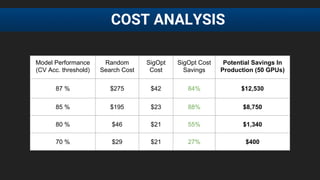
COST ANALYSIS
Model Performance
(CV Acc. threshold)
Random
Search Cost
SigOpt
Cost
SigOpt Cost
Savings
Potential Savings In
Production (50 GPUs)
87 % $275 $42 84% $12,530
85 % $195 $23 88% $8,750
80 % $46 $21 55% $1,340
70 % $29 $21 27% $400
EXAMPLE: TUNING DNN CLASSIFIERS
CIFAR10 Dataset
● Photos of objects
● 10 classes
● Metric: Accuracy
○ [0.1, 1.0]
Learning Multiple Layers of Features from Tiny Images, Alex Krizhevsky, 2009.
● All convolutional neural network
● Multiple convolutional and dropout layers
● Hyperparameter optimization mixture of
domain expertise and grid search (brute force)
USE CASE: ALL CONVOLUTIONAL
http://arxiv.org/pdf/1412.6806.pdf
MANY TUNABALE PARAMETERS...
● epochs: “number of epochs to run fit” - int [1,∞]
● learning rate: influence on current value of weights at each step - double (0, 1]
● momentum coefficient: “the coefficient of momentum” - double (0, 1]
● weight decay: parameter affecting how quickly weight decays - double (0, 1]
● depth: parameter affecting number of layers in net - int [1, 20(?)]
● gaussian scale: standard deviation of initialization normal dist. - double (0,∞]
● momentum step change: mul. amount to decrease momentum - double (0, 1]
● momentum step schedule start: epoch to start decreasing momentum - int [1,∞]
● momentum schedule width: epoch stride for decreasing momentum - int [1,∞]
...optimal values non-intuitive
COMPARATIVE PERFORMANCE
● Expert baseline: 0.8995
○ (using neon)
● SigOpt best: 0.9011
○ 1.6% reduction in
error rate
○ No expert time
wasted in tuning
USE CASE: DEEP RESIDUAL
http://arxiv.org/pdf/1512.03385v1.pdf
● Explicitly reformulate the layers as learning residual functions with
reference to the layer inputs, instead of learning unreferenced functions
● Variable depth
● Hyperparameter optimization mixture of domain expertise and grid
search (brute force)
COMPARATIVE PERFORMANCE
Standard Method
● Expert baseline: 0.9339
○ (from paper)
● SigOpt best: 0.9436
○ 15% relative error
rate reduction
○ No expert time
wasted in tuning
Questions?
scott@sigopt.com
@DrScottClark
https://sigopt.com
@SigOpt
TRY OUT SIGOPT FOR FREE
https://sigopt.com/getstarted
● Quick example and intro to SigOpt
● No signup required
● Visual and code examples
MORE EXAMPLES
https://github.com/sigopt/sigopt-examples
Examples of using SigOpt in a variety of languages and contexts.
Tuning Machine Learning Models (with code)
A comparison of different hyperparameter optimization methods.
Using Model Tuning to Beat Vegas (with code)
Using SigOpt to tune a model for predicting basketball scores.
Learn more about the technology behind SigOpt at
https://sigopt.com/research
GPs: FUNCTIONAL VIEW
overfit good fit underfit
GPs: FITTING THE GP
USE CASE: CLASSIFICATION MODELS
Machine Learning models have many
non-intuitive tunable hyperparameters
Problem:
Before
Standard methods use high
resources for low performance
After
SigOpt finds better parameters
with 10x fewer evaluations
than standard methods
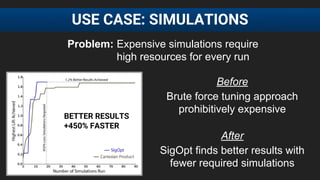
USE CASE: SIMULATIONS
BETTER RESULTS
+450% FASTER
Expensive simulations require
high resources for every run
Problem:
Before
Brute force tuning approach
prohibitively expensive
After
SigOpt finds better results with
fewer required simulations

Using Bayesian Optimization to Tune Machine Learning Models

  • 1.
    USING BAYESIAN OPTIMIZATION TOTUNE MACHINE LEARNING MODELS Scott Clark Co-founder and CEO of SigOpt scott@sigopt.com @DrScottClark
  • 2.
    TRIAL AND ERRORWASTES EXPERT TIME Machine Learning is extremely powerful Tuning Machine Learning systems is extremely non-intuitive
  • 3.
    UNRESOLVED PROBLEM INML https://www.quora.com/What-is-the-most-important-unresolved-problem-in-machine-learning-3 What is the most important unresolved problem in machine learning? “...we still don't really know why some configurations of deep neural networks work in some case and not others, let alone having a more or less automatic approach to determining the architectures and the hyperparameters.” Xavier Amatriain, VP Engineering at Quora (former Director of Research at Netflix)
  • 4.
    LOTS OF TUNABLEPARAMETERS
  • 5.
    COMMON APPROACH Random Searchfor Hyper-Parameter Optimization, James Bergstra et al., 2012 1. Random search or grid search 2. Expert defined grid search near “good” points 3. Refine domain and repeat steps - “grad student descent”
  • 6.
    COMMON APPROACH ● Expertintensive ● Computationally intensive ● Finds potentially local optima ● Does not fully exploit useful information Random Search for Hyper-Parameter Optimization, James Bergstra et al., 2012 1. Random search or grid search 2. Expert defined grid search near “good” points 3. Refine domain and repeat steps - “grad student descent”
  • 7.
    … the challengeof how to collect information as efficiently as possible, primarily for settings where collecting information is time consuming and expensive. Prof. Warren Powell - Princeton What is the most efficient way to collect information? Prof. Peter Frazier - Cornell How do we make the most money, as fast as possible? Me - @DrScottClark OPTIMAL LEARNING
  • 8.
    ● Optimize someOverall Evaluation Criterion (OEC) ○ Loss, Accuracy, Likelihood, Revenue ● Given tunable parameters ○ Hyperparameters, feature parameters ● In an efficient way ○ Sample function as few times as possible ○ Training on big data is expensive BAYESIAN GLOBAL OPTIMIZATION Details at https://sigopt.com/research
  • 10.
  • 11.
  • 12.
  • 13.
    HOW DOES ITFIT IN THE STACK? Big Data Machine Learning Models with tunable parameters
  • 14.
    Optimally suggests new parameters HOWDOES IT FIT IN THE STACK? Objective Metric New parameters Big Data Machine Learning Models with tunable parameters
  • 15.
    Optimally suggests new parameters HOWDOES IT FIT IN THE STACK? Objective Metric New parameters Better Models Big Data Machine Learning Models with tunable parameters
  • 16.
  • 17.
    Optimally suggests new parameters Ex:LOAN CLASSIFICATION (xgboost) Prediction Accuracy New parameters Better AccuracyLoan Applications Default Prediction with tunable ML parameters ● Income ● Credit Score ● Loan Amount
  • 18.
    COMPARATIVE PERFORMANCE ● 8.2%Better Accuracy than baseline ● 100x faster than standard tuning methods Accuracy Cost Grid Search Random Search Iterations AUC .698 .690 .683 .675 1,00010,000100,000
  • 19.
    EXAMPLE: ALGORITHMIC TRADING ExpectedRevenue New parameters Higher Returns Market Data Trading Strategy with tunable weights and thresholds ● Closing Prices ● Day of Week ● Market Volatility Optimally suggests new parameters
  • 20.
    COMPARATIVE PERFORMANCE Standard Method Expert ●200% Higher model returns than expert ● 10x faster than standard methods
  • 21.
  • 22.
    1. Build GaussianProcess (GP) with points sampled so far 2. Optimize the fit of the GP (covariance hyperparameters) 3. Find the point(s) of highest Expected Improvement within parameter domain 4. Return optimal next best point(s) to sample HOW DOES IT WORK?
  • 23.
    HOW DOES ITWORK? 1. User reports data 2. SigOpt builds statistical model (Gaussian Process) 3. SigOpt finds the points of highest Expected Improvement 4. SigOpt suggests best parameters to test next 5. User tests those parameters and reports results to SigOpt 6. Repeat
  • 24.
    HOW DOES ITWORK? 1. User reports data 2. SigOpt builds statistical model (Gaussian Process) 3. SigOpt finds the points of highest Expected Improvement 4. SigOpt suggests best parameters to test next 5. User tests those parameters and reports results to SigOpt 6. Repeat
  • 25.
    HOW DOES ITWORK? 1. User reports data 2. SigOpt builds statistical model (Gaussian Process) 3. SigOpt finds the points of highest Expected Improvement 4. SigOpt suggests best parameters to test next 5. User tests those parameters and reports results to SigOpt 6. Repeat
  • 26.
    HOW DOES ITWORK? 1. User reports data 2. SigOpt builds statistical model (Gaussian Process) 3. SigOpt finds the points of highest Expected Improvement 4. SigOpt suggests best parameters to test next 5. User tests those parameters and reports results to SigOpt 6. Repeat
  • 27.
    HOW DOES ITWORK? 1. User reports data 2. SigOpt builds statistical model (Gaussian Process) 3. SigOpt finds the points of highest Expected Improvement 4. SigOpt suggests best parameters to test next 5. User tests those parameters and reports results to SigOpt 6. Repeat
  • 28.
    HOW DOES ITWORK? 1. User reports data 2. SigOpt builds statistical model (Gaussian Process) 3. SigOpt finds the points of highest Expected Improvement 4. SigOpt suggests best parameters to test next 5. User tests those parameters and reports results to SigOpt 6. Repeat
  • 29.
  • 30.
    ● Classify housenumbers with more training data and more sophisticated model PROBLEM
  • 31.
    ● TensorFlow makesit easier to design DNN architectures, but what structure works best on a given dataset? CONVNET STRUCTURE
  • 32.
    ● Per parameter adaptiveSGD variants like RMSProp and Adagrad seem to work best ● Still require careful selection of learning rate (α), momentum (β), decay (γ) terms STOCHASTIC GRADIENT DESCENT
  • 33.
    ● Comparison ofseveral RMSProp SGD parametrizations ● Not obvious which configurations will work best on a given dataset without experimentation STOCHASTIC GRADIENT DESCENT
  • 34.
  • 35.
    ● Avg Holdout accuracy after 5 optimization runs consisting of 80 objective evaluations ● Optimized single 80/20 CV fold on training set, ACC reported on test set as hold out PERFORMANCE SigOpt (TensorFlow CNN) Rnd Search (TensorFlow CNN) No Tuning (sklearn RF) No Tuning (TensorFlow CNN) Hold Out ACC 0.8130 (+315.2%) 0.5690 0.5278 0.1958
  • 36.
    COST ANALYSIS Model Performance (CVAcc. threshold) Random Search Cost SigOpt Cost SigOpt Cost Savings Potential Savings In Production (50 GPUs) 87 % $275 $42 84% $12,530 85 % $195 $23 88% $8,750 80 % $46 $21 55% $1,340 70 % $29 $21 27% $400
  • 37.
    EXAMPLE: TUNING DNNCLASSIFIERS CIFAR10 Dataset ● Photos of objects ● 10 classes ● Metric: Accuracy ○ [0.1, 1.0] Learning Multiple Layers of Features from Tiny Images, Alex Krizhevsky, 2009.
  • 38.
    ● All convolutionalneural network ● Multiple convolutional and dropout layers ● Hyperparameter optimization mixture of domain expertise and grid search (brute force) USE CASE: ALL CONVOLUTIONAL http://arxiv.org/pdf/1412.6806.pdf
  • 39.
    MANY TUNABALE PARAMETERS... ●epochs: “number of epochs to run fit” - int [1,∞] ● learning rate: influence on current value of weights at each step - double (0, 1] ● momentum coefficient: “the coefficient of momentum” - double (0, 1] ● weight decay: parameter affecting how quickly weight decays - double (0, 1] ● depth: parameter affecting number of layers in net - int [1, 20(?)] ● gaussian scale: standard deviation of initialization normal dist. - double (0,∞] ● momentum step change: mul. amount to decrease momentum - double (0, 1] ● momentum step schedule start: epoch to start decreasing momentum - int [1,∞] ● momentum schedule width: epoch stride for decreasing momentum - int [1,∞] ...optimal values non-intuitive
  • 40.
    COMPARATIVE PERFORMANCE ● Expertbaseline: 0.8995 ○ (using neon) ● SigOpt best: 0.9011 ○ 1.6% reduction in error rate ○ No expert time wasted in tuning
  • 41.
    USE CASE: DEEPRESIDUAL http://arxiv.org/pdf/1512.03385v1.pdf ● Explicitly reformulate the layers as learning residual functions with reference to the layer inputs, instead of learning unreferenced functions ● Variable depth ● Hyperparameter optimization mixture of domain expertise and grid search (brute force)
  • 42.
    COMPARATIVE PERFORMANCE Standard Method ●Expert baseline: 0.9339 ○ (from paper) ● SigOpt best: 0.9436 ○ 15% relative error rate reduction ○ No expert time wasted in tuning
  • 43.
  • 44.
    TRY OUT SIGOPTFOR FREE https://sigopt.com/getstarted ● Quick example and intro to SigOpt ● No signup required ● Visual and code examples
  • 45.
    MORE EXAMPLES https://github.com/sigopt/sigopt-examples Examples ofusing SigOpt in a variety of languages and contexts. Tuning Machine Learning Models (with code) A comparison of different hyperparameter optimization methods. Using Model Tuning to Beat Vegas (with code) Using SigOpt to tune a model for predicting basketball scores. Learn more about the technology behind SigOpt at https://sigopt.com/research
  • 46.
  • 47.
    overfit good fitunderfit GPs: FITTING THE GP
  • 48.
    USE CASE: CLASSIFICATIONMODELS Machine Learning models have many non-intuitive tunable hyperparameters Problem: Before Standard methods use high resources for low performance After SigOpt finds better parameters with 10x fewer evaluations than standard methods
  • 49.
    USE CASE: SIMULATIONS BETTERRESULTS +450% FASTER Expensive simulations require high resources for every run Problem: Before Brute force tuning approach prohibitively expensive After SigOpt finds better results with fewer required simulations