Tree models with Scikit-Learn
Great learners with little assumptions
Material: https://github.com/glouppe/talk-pydata2015
Gilles Louppe (@glouppe)
CERN
PyData, April 3, 2015
Outline
1 Motivation
2 Growing decision trees
3 Random forests
4 Boosting
5 Reading tree leaves
6 Summary
2 / 26
Motivation
3 / 26
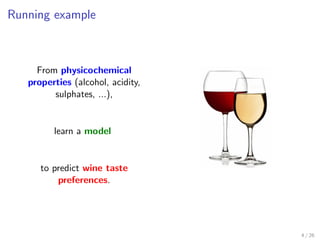
Running example
From physicochemical
properties (alcohol, acidity,
sulphates, ...),
learn a model
to predict wine taste
preferences.
4 / 26
Outline
1 Motivation
2 Growing decision trees
3 Random Forests
4 Boosting
5 Reading tree leaves
6 Summary
Supervised learning
• Data comes as a finite learning set L = (X, y) where
Input samples are given as an array of shape (n samples,
n features)
E.g., feature values for wine physicochemical properties:
# fixed acidity, volatile acidity, ...
X = [[ 7.4 0. ... 0.56 9.4 0. ]
[ 7.8 0. ... 0.68 9.8 0. ]
...
[ 7.8 0.04 ... 0.65 9.8 0. ]]
Output values are given as an array of shape (n samples,)
E.g., wine taste preferences (from 0 to 10):
y = [5 5 5 ... 6 7 6]
• The goal is to build an estimator ϕL : X → Y minimizing
Err(ϕL) = EX,Y {L(Y , ϕL.predict(X))}.
5 / 26
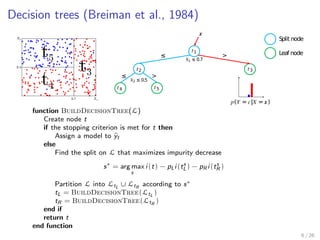
Decision trees (Breiman et al., 1984)
0.7
0.5
X1
X2
t5
t3
t4
𝑡2
𝑋1 ≤ 0.7
𝑡1
𝑡3
𝑡4 𝑡5
𝒙
𝑝(𝑌 = 𝑐|𝑋 = 𝒙)
Split node
Leaf node≤ >
𝑋2 ≤ 0.5
≤ >
function BuildDecisionTree(L)
Create node t
if the stopping criterion is met for t then
Assign a model to yt
else
Find the split on L that maximizes impurity decrease
s∗
= arg max
s
i(t) − pLi(ts
L) − pR i(ts
R )
Partition L into LtL
∪ LtR
according to s∗
tL = BuildDecisionTree(LtL
)
tR = BuildDecisionTree(LtR
)
end if
return t
end function
6 / 26
Composability of decision trees
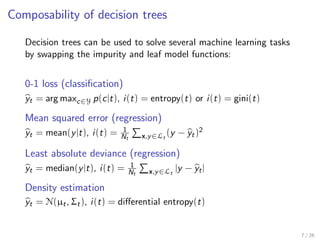
Decision trees can be used to solve several machine learning tasks
by swapping the impurity and leaf model functions:
0-1 loss (classification)
yt = arg maxc∈Y p(c|t), i(t) = entropy(t) or i(t) = gini(t)
Mean squared error (regression)
yt = mean(y|t), i(t) = 1
Nt x,y∈Lt
(y − yt)2
Least absolute deviance (regression)
yt = median(y|t), i(t) = 1
Nt x,y∈Lt
|y − yt|
Density estimation
yt = N(µt, Σt), i(t) = differential entropy(t)
7 / 26
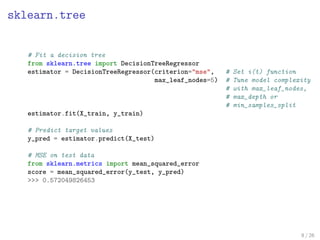
sklearn.tree
# Fit a decision tree
from sklearn.tree import DecisionTreeRegressor
estimator = DecisionTreeRegressor(criterion="mse", # Set i(t) function
max_leaf_nodes=5) # Tune model complexity
# with max_leaf_nodes,
# max_depth or
# min_samples_split
estimator.fit(X_train, y_train)
# Predict target values
y_pred = estimator.predict(X_test)
# MSE on test data
from sklearn.metrics import mean_squared_error
score = mean_squared_error(y_test, y_pred)
>>> 0.572049826453
8 / 26
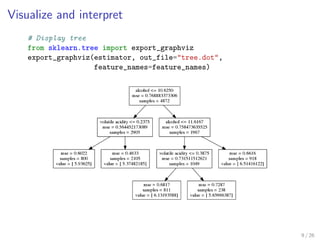
Visualize and interpret
# Display tree
from sklearn.tree import export_graphviz
export_graphviz(estimator, out_file="tree.dot",
feature_names=feature_names)
9 / 26
Strengths and weaknesses of decision trees
• Non-parametric model, proved to be consistent.
• Support heterogeneous data (continuous, ordered or
categorical variables).
• Flexibility in loss functions (but choice is limited).
• Fast to train, fast to predict.
In the average case, complexity of training is Θ(pN log2
N).
• Easily interpretable.
• Low bias, but usually high variance
Solution: Combine the predictions of several randomized trees
into a single model.
10 / 26
Outline
1 Motivation
2 Growing decision trees
3 Random Forests
4 Boosting
5 Reading tree leaves
6 Summary
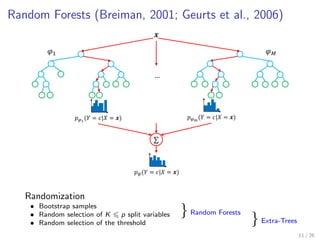
Random Forests (Breiman, 2001; Geurts et al., 2006)
𝒙
𝑝 𝜑1
(𝑌 = 𝑐|𝑋 = 𝒙)
𝜑1 𝜑 𝑀
…
𝑝 𝜑 𝑚
(𝑌 = 𝑐|𝑋 = 𝒙)
∑
𝑝 𝜓(𝑌 = 𝑐|𝑋 = 𝒙)
Randomization
• Bootstrap samples
} Random Forests• Random selection of K p split variables
} Extra-Trees• Random selection of the threshold
11 / 26
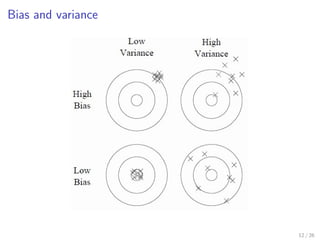
Bias and variance
12 / 26
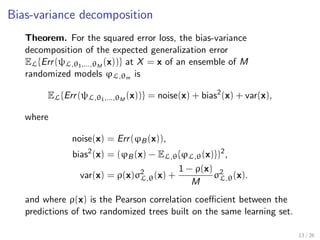
Bias-variance decomposition
Theorem. For the squared error loss, the bias-variance
decomposition of the expected generalization error
EL{Err(ψL,θ1,...,θM
(x))} at X = x of an ensemble of M
randomized models ϕL,θm
is
EL{Err(ψL,θ1,...,θM
(x))} = noise(x) + bias2
(x) + var(x),
where
noise(x) = Err(ϕB(x)),
bias2
(x) = (ϕB(x) − EL,θ{ϕL,θ(x)})2
,
var(x) = ρ(x)σ2
L,θ(x) +
1 − ρ(x)
M
σ2
L,θ(x).
and where ρ(x) is the Pearson correlation coefficient between the
predictions of two randomized trees built on the same learning set.
13 / 26
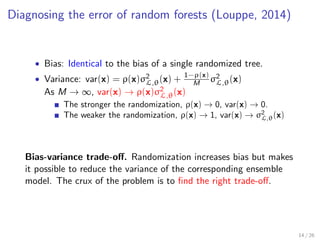
Diagnosing the error of random forests (Louppe, 2014)
• Bias: Identical to the bias of a single randomized tree.
• Variance: var(x) = ρ(x)σ2
L,θ(x) + 1−ρ(x)
M σ2
L,θ(x)
As M → ∞, var(x) → ρ(x)σ2
L,θ(x)
The stronger the randomization, ρ(x) → 0, var(x) → 0.
The weaker the randomization, ρ(x) → 1, var(x) → σ2
L,θ(x)
Bias-variance trade-off. Randomization increases bias but makes
it possible to reduce the variance of the corresponding ensemble
model. The crux of the problem is to find the right trade-off.
14 / 26
Tuning randomization in sklearn.ensemble
from sklearn.ensemble import RandomForestRegressor, ExtraTreesRegressor
from sklearn.cross_validation import ShuffleSplit
from sklearn.learning_curve import validation_curve
# Validation of max_features, controlling randomness in forests
param_name = "max_features"
param_range = range(1, X.shape[1]+1)
for Forest, color, label in [(RandomForestRegressor, "g", "RF"),
(ExtraTreesRegressor, "r", "ETs")]:
_, test_scores = validation_curve(
Forest(n_estimators=100, n_jobs=-1), X, y,
cv=ShuffleSplit(n=len(X), n_iter=10, test_size=0.25),
param_name=param_name, param_range=param_range,
scoring="mean_squared_error")
test_scores_mean = np.mean(-test_scores, axis=1)
plt.plot(param_range, test_scores_mean, label=label, color=color)
plt.xlabel(param_name)
plt.xlim(1, max(param_range))
plt.ylabel("MSE")
plt.legend(loc="best")
plt.show()
15 / 26
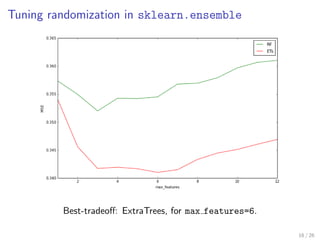
Tuning randomization in sklearn.ensemble
Best-tradeoff: ExtraTrees, for max features=6.
16 / 26
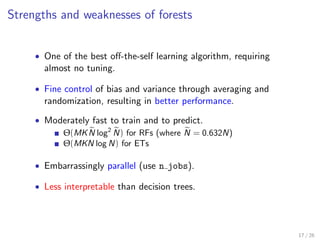
Strengths and weaknesses of forests
• One of the best off-the-self learning algorithm, requiring
almost no tuning.
• Fine control of bias and variance through averaging and
randomization, resulting in better performance.
• Moderately fast to train and to predict.
Θ(MKN log2
N) for RFs (where N = 0.632N)
Θ(MKN log N) for ETs
• Embarrassingly parallel (use n jobs).
• Less interpretable than decision trees.
17 / 26
Outline
1 Motivation
2 Growing decision trees
3 Random Forests
4 Boosting
5 Reading tree leaves
6 Summary
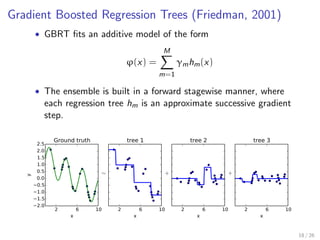
Gradient Boosted Regression Trees (Friedman, 2001)
• GBRT fits an additive model of the form
ϕ(x) =
M
m=1
γmhm(x)
• The ensemble is built in a forward stagewise manner, where
each regression tree hm is an approximate successive gradient
step.
2 6 10
x
2.0
1.5
1.0
0.5
0.0
0.5
1.0
1.5
2.0
2.5
y
Ground truth
2 6 10
x
∼
tree 1
2 6 10
x
+
tree 2
2 6 10
x
+
tree 3
18 / 26
Careful tuning required
from sklearn.ensemble import GradientBoostingRegressor
from sklearn.cross_validation import ShuffleSplit
from sklearn.grid_search import GridSearchCV
# Careful tuning is required to obtained good results
param_grid = {"learning_rate": [0.1, 0.01, 0.001],
"subsample": [1.0, 0.9, 0.8],
"max_depth": [3, 5, 7],
"min_samples_leaf": [1, 3, 5]}
est = GradientBoostingRegressor(n_estimators=1000)
grid = GridSearchCV(est, param_grid,
cv=ShuffleSplit(n=len(X), n_iter=10, test_size=0.25),
scoring="mean_squared_error",
n_jobs=-1).fit(X, y)
gbrt = grid.best_estimator_
See our PyData 2014 tutorial for further guidance
https://github.com/pprett/pydata-gbrt-tutorial
19 / 26
Strengths and weaknesses of GBRT
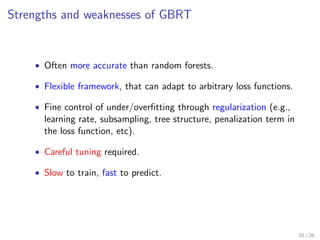
• Often more accurate than random forests.
• Flexible framework, that can adapt to arbitrary loss functions.
• Fine control of under/overfitting through regularization (e.g.,
learning rate, subsampling, tree structure, penalization term in
the loss function, etc).
• Careful tuning required.
• Slow to train, fast to predict.
20 / 26
Outline
1 Motivation
2 Growing decision trees
3 Random Forests
4 Boosting
5 Reading tree leaves
6 Summary
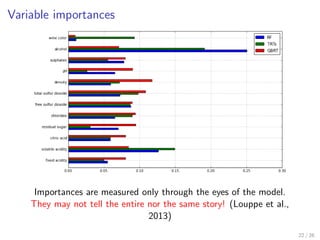
Variable importances
importances = pd.DataFrame()
# Variable importances with Random Forest, default parameters
est = RandomForestRegressor(n_estimators=10000, n_jobs=-1).fit(X, y)
importances["RF"] = pd.Series(est.feature_importances_,
index=feature_names)
# Variable importances with Totally Randomized Trees
est = ExtraTreesRegressor(max_features=1, max_depth=3,
n_estimators=10000, n_jobs=-1).fit(X, y)
importances["TRTs"] = pd.Series(est.feature_importances_,
index=feature_names)
# Variable importances with GBRT
importances["GBRT"] = pd.Series(gbrt.feature_importances_,
index=feature_names)
importances.plot(kind="barh")
21 / 26
Variable importances
Importances are measured only through the eyes of the model.
They may not tell the entire nor the same story! (Louppe et al.,
2013)
22 / 26
Partial dependence plots
Relation between the response Y and a subset of features,
marginalized over all other features.
from sklearn.ensemble.partial_dependence import plot_partial_dependence
plot_partial_dependence(gbrt, X,
features=[1, 10], feature_names=feature_names)
23 / 26
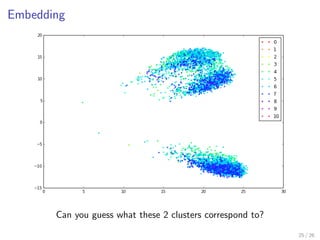
Embedding
from sklearn.ensemble import RandomTreesEmbedding
from sklearn.decomposition import TruncatedSVD
# Project wines through a forest of totally randomized trees
# and use the leafs the samples end into as a high-dimensional representation
hasher = RandomTreesEmbedding(n_estimators=1000)
X_transformed = hasher.fit_transform(X)
# Plot wines on a plane using the 2 principal components
svd = TruncatedSVD(n_components=2)
coords = svd.fit_transform(X_transformed)
n_values = 10 + 1 # Wine preferences are from 0 to 10
cm = plt.get_cmap("hsv")
colors = (cm(1. * i / n_values) for i in range(n_values))
for k, c in zip(range(n_values), colors):
plt.plot(coords[y == k, 0], coords[y == k, 1], ’.’, label=k, color=c)
plt.legend()
plt.show()
24 / 26
Embedding
Can you guess what these 2 clusters correspond to?
25 / 26
Outline
1 Motivation
2 Growing decision trees
3 Random Forests
4 Boosting
5 Reading tree leaves
6 Summary
Summary
• Tree-based methods offer a flexible and efficient
non-parametric framework for classification and regression.
• Applicable to a wide variety of problems, with a fine control
over the model that is learned.
• Assume a good feature representation – i.e., tree-based
methods are often not that good on very raw input data, like
pixels, speech signals, etc.
• Insights on the problem under study (variable importances,
dependence plots, embedding, ...).
• Efficient implementation in Scikit-Learn.
26 / 26
Join us on
https://github.com/
scikit-learn/scikit-learn
References
Breiman, L. (2001). Random Forests. Machine learning, 45(1):5–32.
Breiman, L., Friedman, J. H., Olshen, R. A., and Stone, C. J. (1984).
Classification and regression trees.
Friedman, J. H. (2001). Greedy function approximation: a gradient boosting
machine. Annals of Statistics, pages 1189–1232.
Geurts, P., Ernst, D., and Wehenkel, L. (2006). Extremely randomized trees.
Machine Learning, 63(1):3–42.
Louppe, G. (2014). Understanding random forests: From theory to practice.
arXiv preprint arXiv:1407.7502.
Louppe, G., Wehenkel, L., Sutera, A., and Geurts, P. (2013). Understanding
variable importances in forests of randomized trees. In Advances in Neural
Information Processing Systems, pages 431–439.

Tree models with Scikit-Learn: Great models with little assumptions

  • 1.
    Tree models withScikit-Learn Great learners with little assumptions Material: https://github.com/glouppe/talk-pydata2015 Gilles Louppe (@glouppe) CERN PyData, April 3, 2015
  • 2.
    Outline 1 Motivation 2 Growingdecision trees 3 Random forests 4 Boosting 5 Reading tree leaves 6 Summary 2 / 26
  • 3.
  • 4.
    Running example From physicochemical properties(alcohol, acidity, sulphates, ...), learn a model to predict wine taste preferences. 4 / 26
  • 5.
    Outline 1 Motivation 2 Growingdecision trees 3 Random Forests 4 Boosting 5 Reading tree leaves 6 Summary
  • 6.
    Supervised learning • Datacomes as a finite learning set L = (X, y) where Input samples are given as an array of shape (n samples, n features) E.g., feature values for wine physicochemical properties: # fixed acidity, volatile acidity, ... X = [[ 7.4 0. ... 0.56 9.4 0. ] [ 7.8 0. ... 0.68 9.8 0. ] ... [ 7.8 0.04 ... 0.65 9.8 0. ]] Output values are given as an array of shape (n samples,) E.g., wine taste preferences (from 0 to 10): y = [5 5 5 ... 6 7 6] • The goal is to build an estimator ϕL : X → Y minimizing Err(ϕL) = EX,Y {L(Y , ϕL.predict(X))}. 5 / 26
  • 7.
    Decision trees (Breimanet al., 1984) 0.7 0.5 X1 X2 t5 t3 t4 𝑡2 𝑋1 ≤ 0.7 𝑡1 𝑡3 𝑡4 𝑡5 𝒙 𝑝(𝑌 = 𝑐|𝑋 = 𝒙) Split node Leaf node≤ > 𝑋2 ≤ 0.5 ≤ > function BuildDecisionTree(L) Create node t if the stopping criterion is met for t then Assign a model to yt else Find the split on L that maximizes impurity decrease s∗ = arg max s i(t) − pLi(ts L) − pR i(ts R ) Partition L into LtL ∪ LtR according to s∗ tL = BuildDecisionTree(LtL ) tR = BuildDecisionTree(LtR ) end if return t end function 6 / 26
  • 8.
    Composability of decisiontrees Decision trees can be used to solve several machine learning tasks by swapping the impurity and leaf model functions: 0-1 loss (classification) yt = arg maxc∈Y p(c|t), i(t) = entropy(t) or i(t) = gini(t) Mean squared error (regression) yt = mean(y|t), i(t) = 1 Nt x,y∈Lt (y − yt)2 Least absolute deviance (regression) yt = median(y|t), i(t) = 1 Nt x,y∈Lt |y − yt| Density estimation yt = N(µt, Σt), i(t) = differential entropy(t) 7 / 26
  • 9.
    sklearn.tree # Fit adecision tree from sklearn.tree import DecisionTreeRegressor estimator = DecisionTreeRegressor(criterion="mse", # Set i(t) function max_leaf_nodes=5) # Tune model complexity # with max_leaf_nodes, # max_depth or # min_samples_split estimator.fit(X_train, y_train) # Predict target values y_pred = estimator.predict(X_test) # MSE on test data from sklearn.metrics import mean_squared_error score = mean_squared_error(y_test, y_pred) >>> 0.572049826453 8 / 26
  • 10.
    Visualize and interpret #Display tree from sklearn.tree import export_graphviz export_graphviz(estimator, out_file="tree.dot", feature_names=feature_names) 9 / 26
  • 11.
    Strengths and weaknessesof decision trees • Non-parametric model, proved to be consistent. • Support heterogeneous data (continuous, ordered or categorical variables). • Flexibility in loss functions (but choice is limited). • Fast to train, fast to predict. In the average case, complexity of training is Θ(pN log2 N). • Easily interpretable. • Low bias, but usually high variance Solution: Combine the predictions of several randomized trees into a single model. 10 / 26
  • 12.
    Outline 1 Motivation 2 Growingdecision trees 3 Random Forests 4 Boosting 5 Reading tree leaves 6 Summary
  • 13.
    Random Forests (Breiman,2001; Geurts et al., 2006) 𝒙 𝑝 𝜑1 (𝑌 = 𝑐|𝑋 = 𝒙) 𝜑1 𝜑 𝑀 … 𝑝 𝜑 𝑚 (𝑌 = 𝑐|𝑋 = 𝒙) ∑ 𝑝 𝜓(𝑌 = 𝑐|𝑋 = 𝒙) Randomization • Bootstrap samples } Random Forests• Random selection of K p split variables } Extra-Trees• Random selection of the threshold 11 / 26
  • 14.
  • 15.
    Bias-variance decomposition Theorem. Forthe squared error loss, the bias-variance decomposition of the expected generalization error EL{Err(ψL,θ1,...,θM (x))} at X = x of an ensemble of M randomized models ϕL,θm is EL{Err(ψL,θ1,...,θM (x))} = noise(x) + bias2 (x) + var(x), where noise(x) = Err(ϕB(x)), bias2 (x) = (ϕB(x) − EL,θ{ϕL,θ(x)})2 , var(x) = ρ(x)σ2 L,θ(x) + 1 − ρ(x) M σ2 L,θ(x). and where ρ(x) is the Pearson correlation coefficient between the predictions of two randomized trees built on the same learning set. 13 / 26
  • 16.
    Diagnosing the errorof random forests (Louppe, 2014) • Bias: Identical to the bias of a single randomized tree. • Variance: var(x) = ρ(x)σ2 L,θ(x) + 1−ρ(x) M σ2 L,θ(x) As M → ∞, var(x) → ρ(x)σ2 L,θ(x) The stronger the randomization, ρ(x) → 0, var(x) → 0. The weaker the randomization, ρ(x) → 1, var(x) → σ2 L,θ(x) Bias-variance trade-off. Randomization increases bias but makes it possible to reduce the variance of the corresponding ensemble model. The crux of the problem is to find the right trade-off. 14 / 26
  • 17.
    Tuning randomization insklearn.ensemble from sklearn.ensemble import RandomForestRegressor, ExtraTreesRegressor from sklearn.cross_validation import ShuffleSplit from sklearn.learning_curve import validation_curve # Validation of max_features, controlling randomness in forests param_name = "max_features" param_range = range(1, X.shape[1]+1) for Forest, color, label in [(RandomForestRegressor, "g", "RF"), (ExtraTreesRegressor, "r", "ETs")]: _, test_scores = validation_curve( Forest(n_estimators=100, n_jobs=-1), X, y, cv=ShuffleSplit(n=len(X), n_iter=10, test_size=0.25), param_name=param_name, param_range=param_range, scoring="mean_squared_error") test_scores_mean = np.mean(-test_scores, axis=1) plt.plot(param_range, test_scores_mean, label=label, color=color) plt.xlabel(param_name) plt.xlim(1, max(param_range)) plt.ylabel("MSE") plt.legend(loc="best") plt.show() 15 / 26
  • 18.
    Tuning randomization insklearn.ensemble Best-tradeoff: ExtraTrees, for max features=6. 16 / 26
  • 19.
    Strengths and weaknessesof forests • One of the best off-the-self learning algorithm, requiring almost no tuning. • Fine control of bias and variance through averaging and randomization, resulting in better performance. • Moderately fast to train and to predict. Θ(MKN log2 N) for RFs (where N = 0.632N) Θ(MKN log N) for ETs • Embarrassingly parallel (use n jobs). • Less interpretable than decision trees. 17 / 26
  • 20.
    Outline 1 Motivation 2 Growingdecision trees 3 Random Forests 4 Boosting 5 Reading tree leaves 6 Summary
  • 21.
    Gradient Boosted RegressionTrees (Friedman, 2001) • GBRT fits an additive model of the form ϕ(x) = M m=1 γmhm(x) • The ensemble is built in a forward stagewise manner, where each regression tree hm is an approximate successive gradient step. 2 6 10 x 2.0 1.5 1.0 0.5 0.0 0.5 1.0 1.5 2.0 2.5 y Ground truth 2 6 10 x ∼ tree 1 2 6 10 x + tree 2 2 6 10 x + tree 3 18 / 26
  • 22.
    Careful tuning required fromsklearn.ensemble import GradientBoostingRegressor from sklearn.cross_validation import ShuffleSplit from sklearn.grid_search import GridSearchCV # Careful tuning is required to obtained good results param_grid = {"learning_rate": [0.1, 0.01, 0.001], "subsample": [1.0, 0.9, 0.8], "max_depth": [3, 5, 7], "min_samples_leaf": [1, 3, 5]} est = GradientBoostingRegressor(n_estimators=1000) grid = GridSearchCV(est, param_grid, cv=ShuffleSplit(n=len(X), n_iter=10, test_size=0.25), scoring="mean_squared_error", n_jobs=-1).fit(X, y) gbrt = grid.best_estimator_ See our PyData 2014 tutorial for further guidance https://github.com/pprett/pydata-gbrt-tutorial 19 / 26
  • 23.
    Strengths and weaknessesof GBRT • Often more accurate than random forests. • Flexible framework, that can adapt to arbitrary loss functions. • Fine control of under/overfitting through regularization (e.g., learning rate, subsampling, tree structure, penalization term in the loss function, etc). • Careful tuning required. • Slow to train, fast to predict. 20 / 26
  • 24.
    Outline 1 Motivation 2 Growingdecision trees 3 Random Forests 4 Boosting 5 Reading tree leaves 6 Summary
  • 25.
    Variable importances importances =pd.DataFrame() # Variable importances with Random Forest, default parameters est = RandomForestRegressor(n_estimators=10000, n_jobs=-1).fit(X, y) importances["RF"] = pd.Series(est.feature_importances_, index=feature_names) # Variable importances with Totally Randomized Trees est = ExtraTreesRegressor(max_features=1, max_depth=3, n_estimators=10000, n_jobs=-1).fit(X, y) importances["TRTs"] = pd.Series(est.feature_importances_, index=feature_names) # Variable importances with GBRT importances["GBRT"] = pd.Series(gbrt.feature_importances_, index=feature_names) importances.plot(kind="barh") 21 / 26
  • 26.
    Variable importances Importances aremeasured only through the eyes of the model. They may not tell the entire nor the same story! (Louppe et al., 2013) 22 / 26
  • 27.
    Partial dependence plots Relationbetween the response Y and a subset of features, marginalized over all other features. from sklearn.ensemble.partial_dependence import plot_partial_dependence plot_partial_dependence(gbrt, X, features=[1, 10], feature_names=feature_names) 23 / 26
  • 28.
    Embedding from sklearn.ensemble importRandomTreesEmbedding from sklearn.decomposition import TruncatedSVD # Project wines through a forest of totally randomized trees # and use the leafs the samples end into as a high-dimensional representation hasher = RandomTreesEmbedding(n_estimators=1000) X_transformed = hasher.fit_transform(X) # Plot wines on a plane using the 2 principal components svd = TruncatedSVD(n_components=2) coords = svd.fit_transform(X_transformed) n_values = 10 + 1 # Wine preferences are from 0 to 10 cm = plt.get_cmap("hsv") colors = (cm(1. * i / n_values) for i in range(n_values)) for k, c in zip(range(n_values), colors): plt.plot(coords[y == k, 0], coords[y == k, 1], ’.’, label=k, color=c) plt.legend() plt.show() 24 / 26
  • 29.
    Embedding Can you guesswhat these 2 clusters correspond to? 25 / 26
  • 30.
    Outline 1 Motivation 2 Growingdecision trees 3 Random Forests 4 Boosting 5 Reading tree leaves 6 Summary
  • 31.
    Summary • Tree-based methodsoffer a flexible and efficient non-parametric framework for classification and regression. • Applicable to a wide variety of problems, with a fine control over the model that is learned. • Assume a good feature representation – i.e., tree-based methods are often not that good on very raw input data, like pixels, speech signals, etc. • Insights on the problem under study (variable importances, dependence plots, embedding, ...). • Efficient implementation in Scikit-Learn. 26 / 26
  • 32.
  • 33.
    References Breiman, L. (2001).Random Forests. Machine learning, 45(1):5–32. Breiman, L., Friedman, J. H., Olshen, R. A., and Stone, C. J. (1984). Classification and regression trees. Friedman, J. H. (2001). Greedy function approximation: a gradient boosting machine. Annals of Statistics, pages 1189–1232. Geurts, P., Ernst, D., and Wehenkel, L. (2006). Extremely randomized trees. Machine Learning, 63(1):3–42. Louppe, G. (2014). Understanding random forests: From theory to practice. arXiv preprint arXiv:1407.7502. Louppe, G., Wehenkel, L., Sutera, A., and Geurts, P. (2013). Understanding variable importances in forests of randomized trees. In Advances in Neural Information Processing Systems, pages 431–439.