Downloaded 112 times

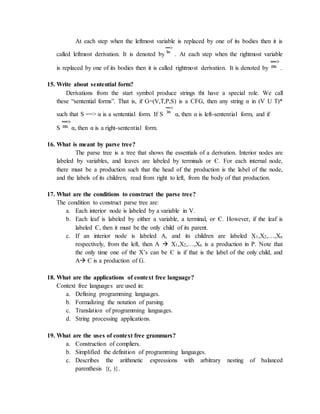
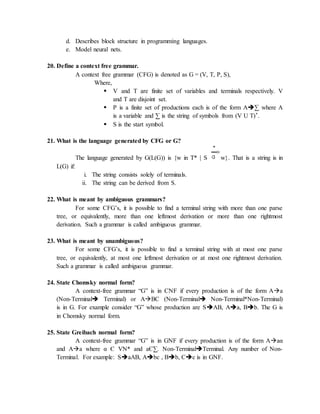
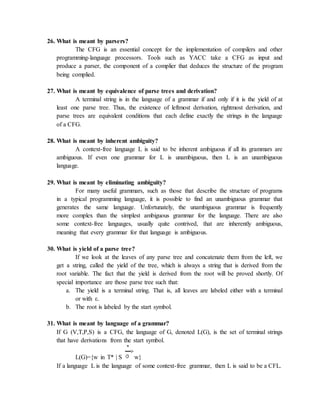
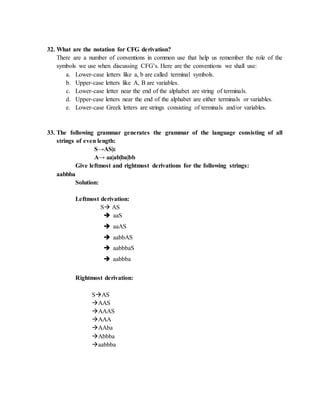
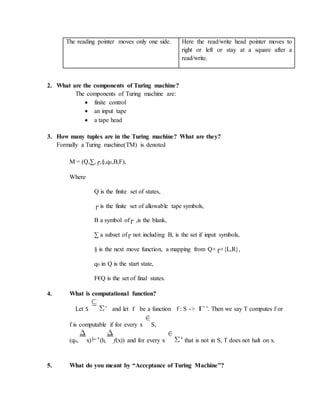
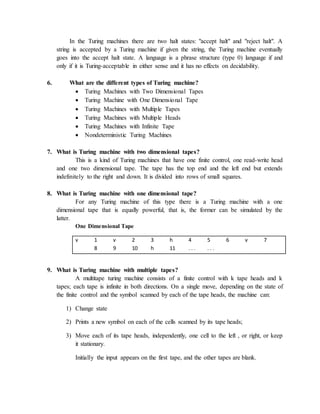
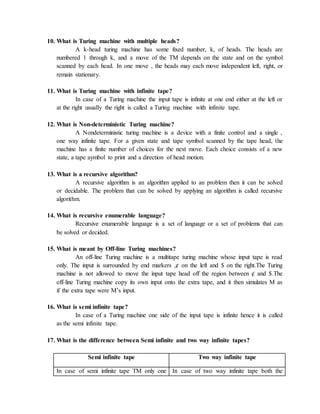
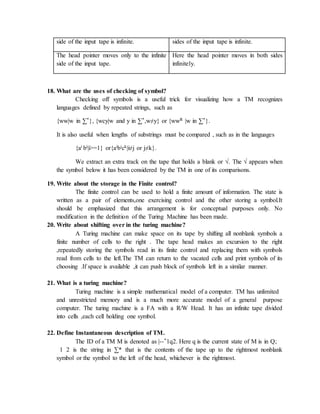
![{ w | w in ∑ * and q0w |--- α pβ for some p in F and α, β is in ∑ * }.
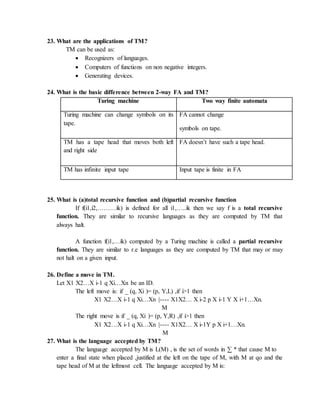
28. Give examples of total recursive functions.
All common arithmetic functions on integers such as multiplication , n!, [log2n]
and 22n are total recursive functions.
29. What are(a) recursively enumerable languages (b) recursive sets?
The languages that is accepted by TM is said to be recursively enumerable (r. e )
languages. Enumerable means that the strings in the language can be enumerated by the
TM. The class of r. e languages include CFL’s.
The recursive sets include languages accepted by at least one TM that halts on all
inputs.
30. What are the various representation of TM?
We can describe TM using:
Instantaneous description.
Transition table.
Transition diagram.
31. What are the possibilities of a TM when processing an input string?
TM can accept the string by entering accepting state.
It can reject the string by entering non-accepting state.
It can enter an infinite loop so that it never halts.
32. What are the techniques for Turing machine construction?
Storage in finite control.
Multiple tracks.
Checking off symbols.
Shifting over
Subroutines.
33. Differentiate PDA and TM.
PDA TM
1. PDA uses a stack for storage. 1. TM uses a tape that is infinite .
2.The language accepted by PDA is CFL. 2. Tm recognizes recursively enumerable
languages.](https://image.slidesharecdn.com/alc-191026143958/85/AUTOMATA-THEORY-SHORT-NOTES-38-320.jpg)
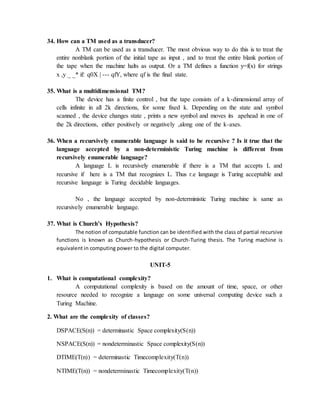
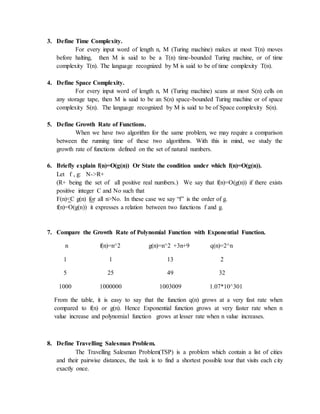
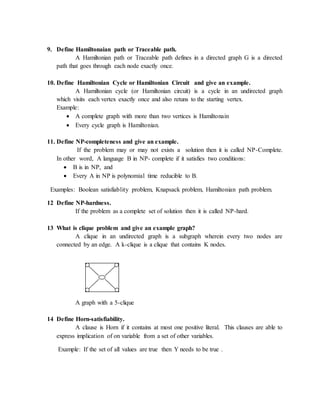

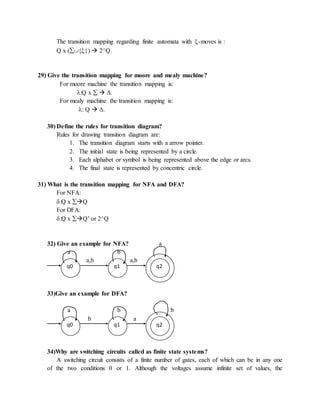
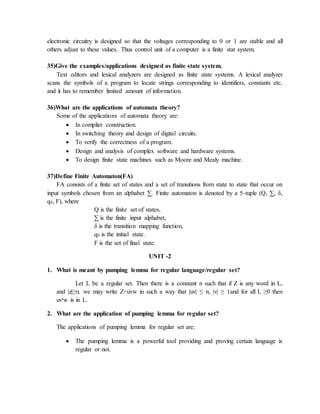
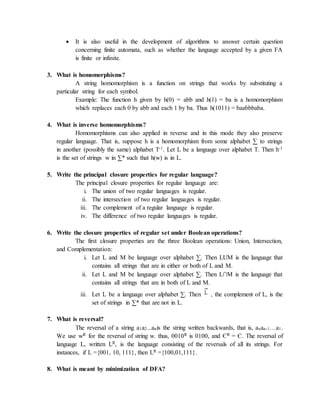
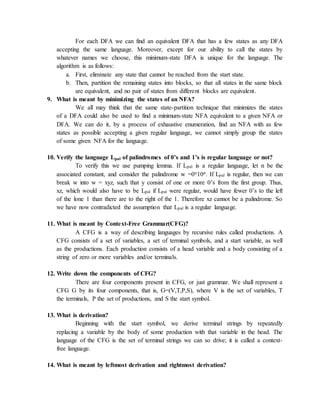
The document discusses various concepts related to finite automata. It begins by defining a finite automaton as a mathematical model of a system with discrete inputs and outputs that can be in a finite number of states. A finite automaton consists of a finite set of states and transitions between states based on input symbols. The document then discusses formal languages, the functions of a head pointer and finite control, the two main types of finite automata (DFA and NFA), ways to represent automata, definitions of languages and transitions, regular expressions and languages, two-way finite automata, epsilon closure, equivalence of NFAs and DFAs, Moore and Mealy machines, and applications of finite automata such as lexical analysis.


