This presentation is compiled by ― Drug Regulations‖ a
non profit organization which provides free online
resource to the Pharmaceutical Professional.
Visit http://www.drugregulations.org for latest
information from the world of Pharmaceuticals.
3/13/2014 1
 This presentation is compiled from freely
available resources like the websites of
FDA, EMA, WHO.
 ―Drug Regulations‖ is a non profit
organization which provides free online
resource to the Pharmaceutical Professional.
 Visit http://www.drugregulations.org for
latest information from the world of
Pharmaceuticals.
3/13/2014 2Drug Regulations : Online Resource for Latest Information
3Drug Regulations : Online Resource for Latest Information
4
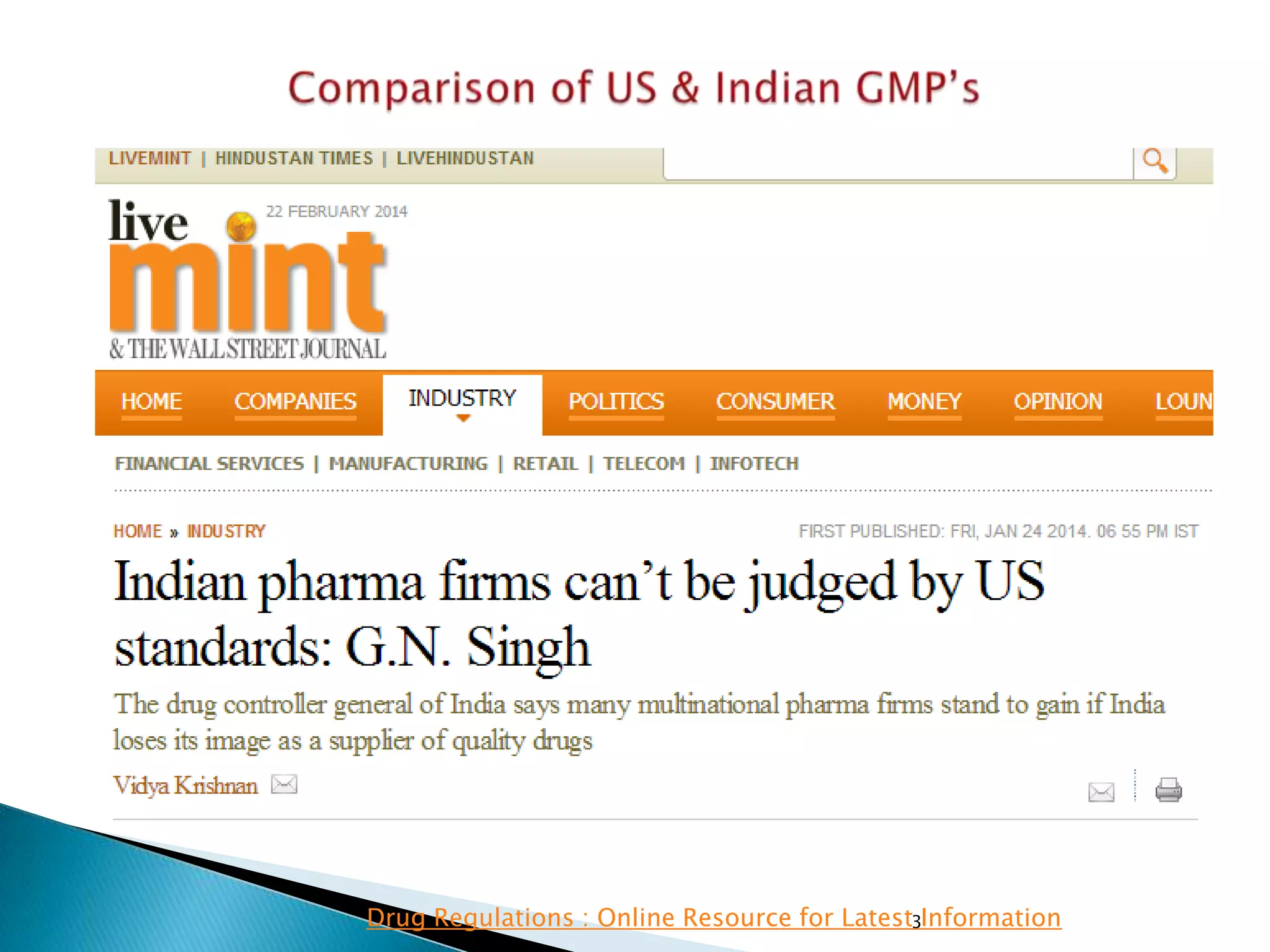
 The recent ban on Ranbaxy‘s 4th plant in India & the visit
of US FDA commissioner created a debate about US &
Indian GMP‘s standards.
 This presentation compares & highlights the differences.
 The GMP‘s in the Indian Act is specified under Schedule
M I Part I for Drug products.
 The number referred in the comparison for US GMP‘s are
from 21 CFR part 210 and 211 ; those for the Indian
GMP‘s are from Schedule M Part I
Drug Regulations : Online Resource for Latest Information
5
 PART 210—CURRENT GOOD MANUFACTURING PRACTICE
IN MANUFACTURING, PROCESSING, PACKING, OR
HOLDING OF DRUGS; GENERAL
1. Product is not classified as Adulterated if GMP‘s are not followed.
( 210.1 c )
2. No separate license or GMP‘s for biological products (210.2 a )
3. Investigational drug has not been defined ( 210.2 c )
4. There are no specific requirements for Investigational drugs.
( 210.2 c )
5. Experimental drugs are completely exempted from GMP‘s
Drug Regulations : Online Resource for Latest Information
6
6. Following terms are not defined ( 210.3 b )
◦ Component
◦ Non fiber
◦ Fiber
◦ In process material
◦ Manufacture, processing , Holding Packing
◦ Medical Feed , Medical premix
◦ Quality Control Unit
◦ Strength
◦ Theoretical Yield , Actual Yield ,Percentage Theoretical Yield
◦ Acceptance Criteria
◦ Representative Sample
◦ Gang Printed Labeling
Drug Regulations : Online Resource for Latest Information
7
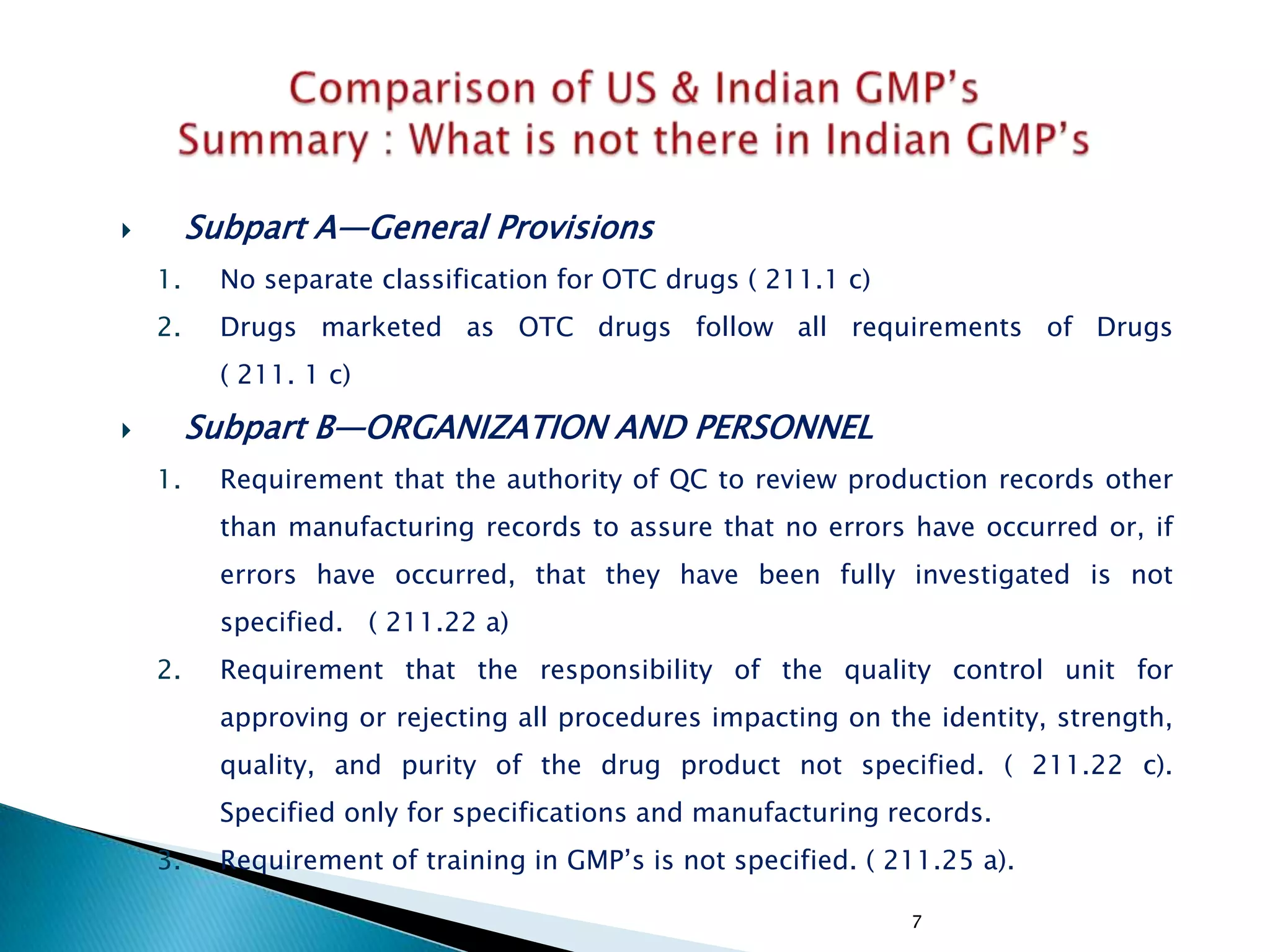
 Subpart A—General Provisions
1. No separate classification for OTC drugs ( 211.1 c)
2. Drugs marketed as OTC drugs follow all requirements of Drugs
( 211. 1 c)
 Subpart B—ORGANIZATION AND PERSONNEL
1. Requirement that the authority of QC to review production records other
than manufacturing records to assure that no errors have occurred or, if
errors have occurred, that they have been fully investigated is not
specified. ( 211.22 a)
2. Requirement that the responsibility of the quality control unit for
approving or rejecting all procedures impacting on the identity, strength,
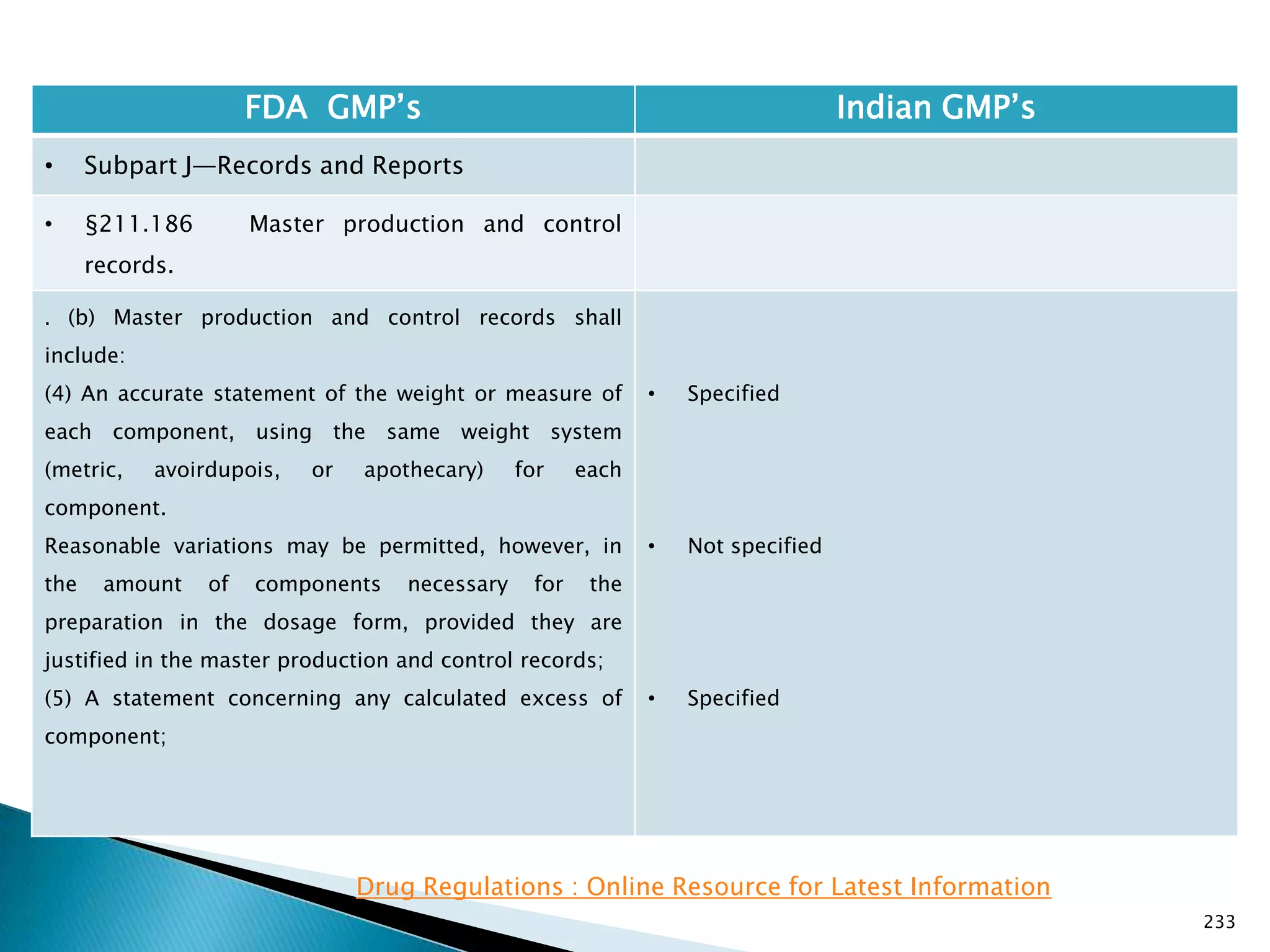
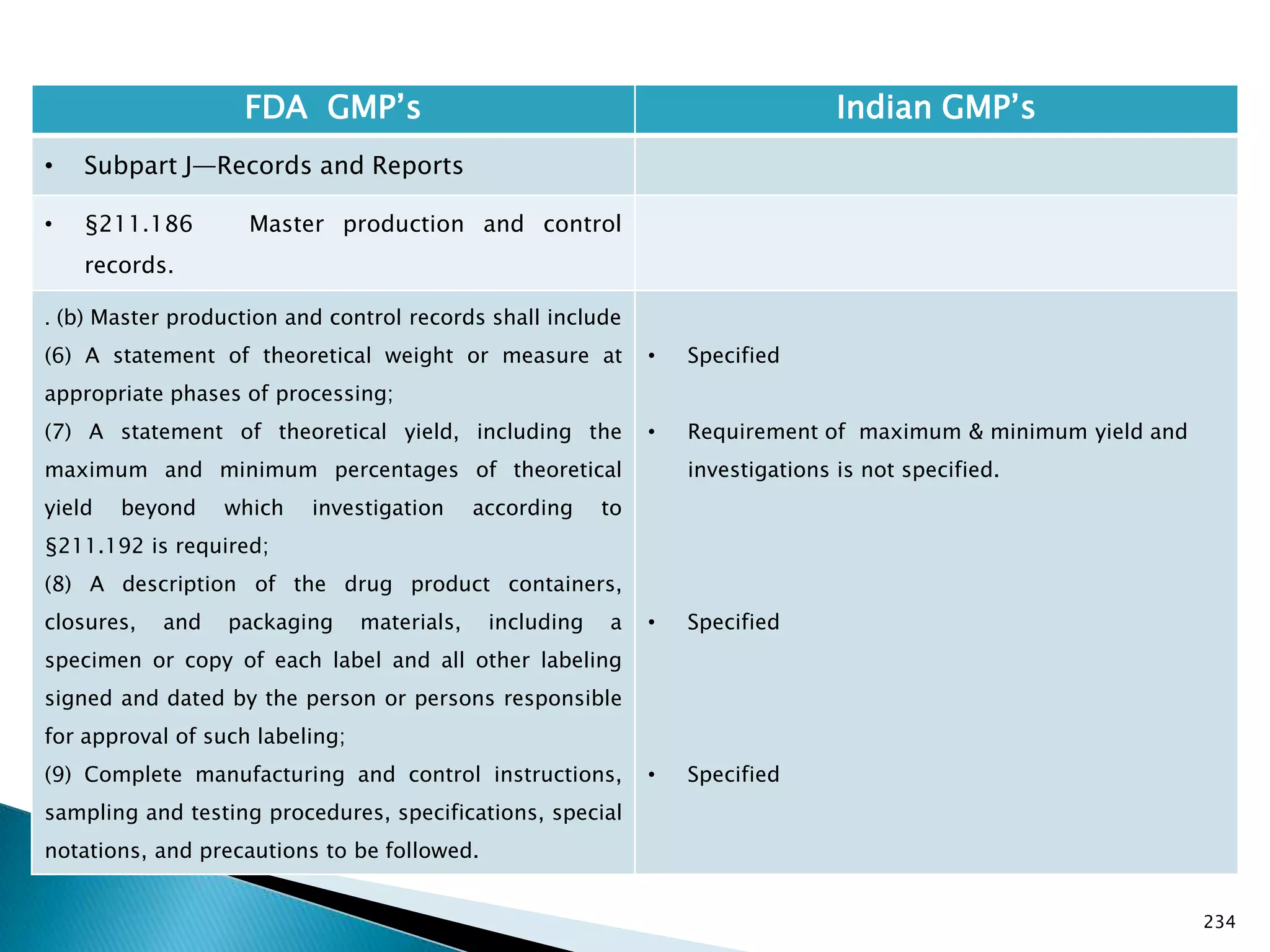
quality, and purity of the drug product not specified. ( 211.22 c).
Specified only for specifications and manufacturing records.
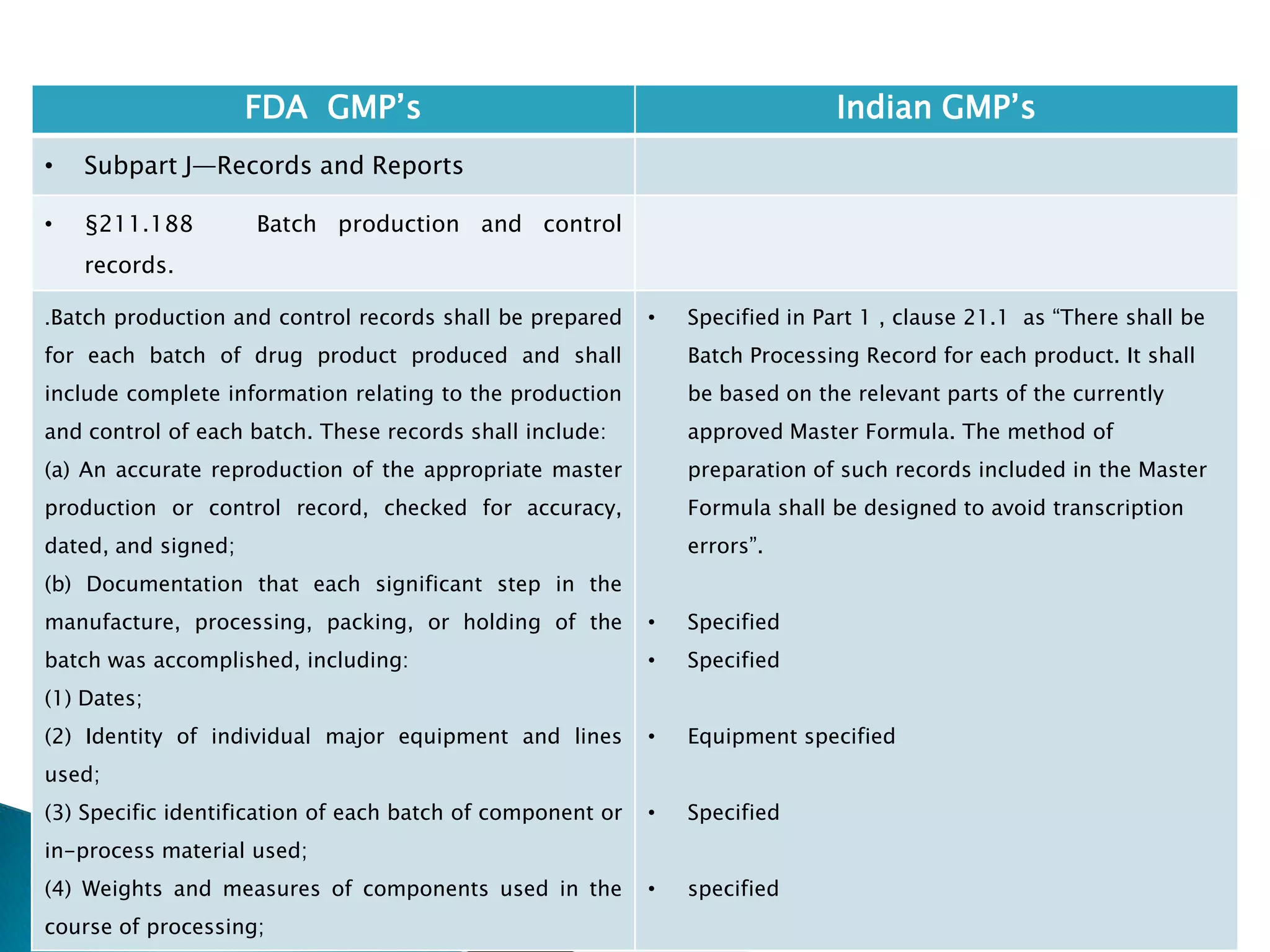
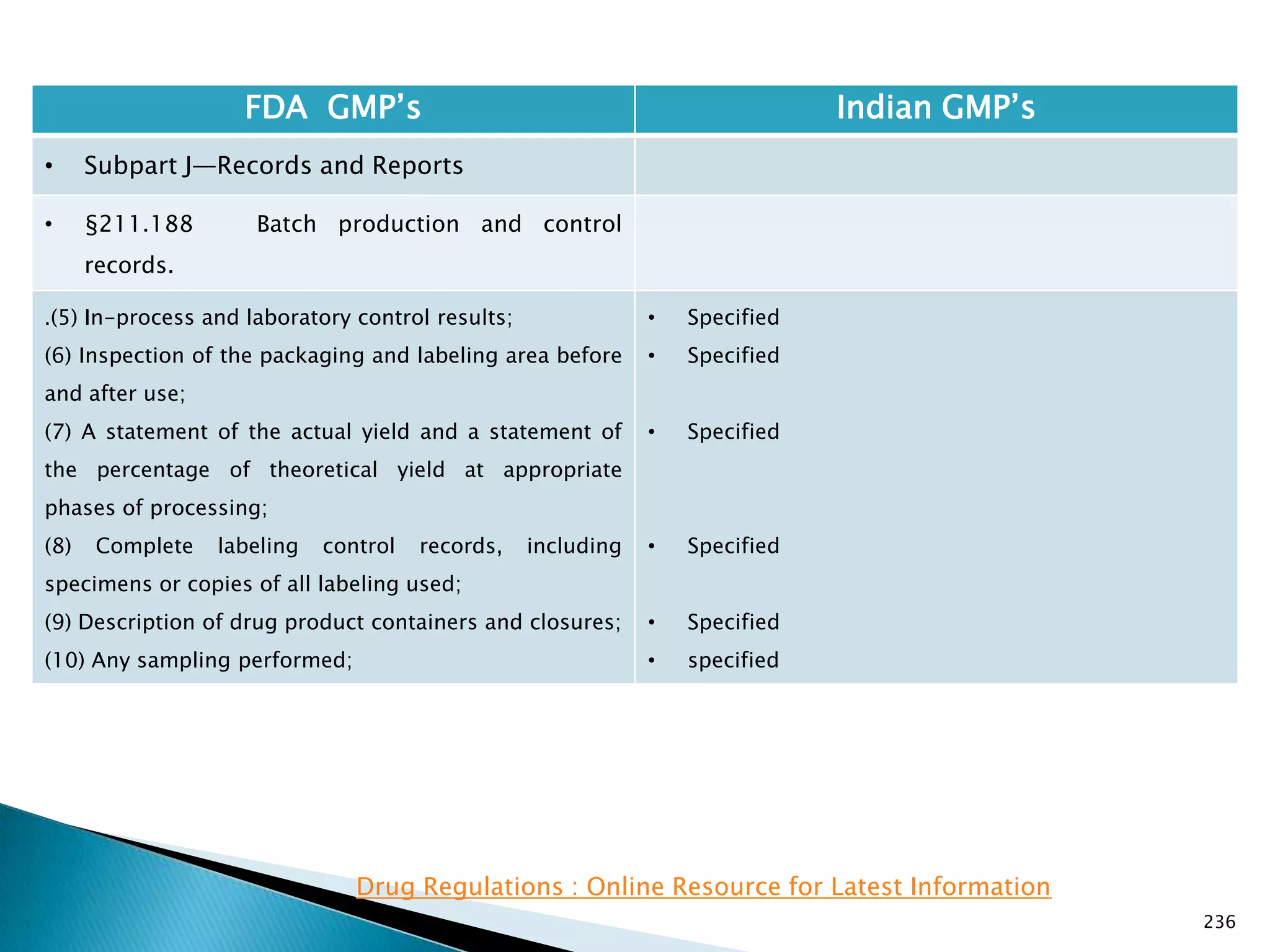
3. Requirement of training in GMP‘s is not specified. ( 211.25 a).
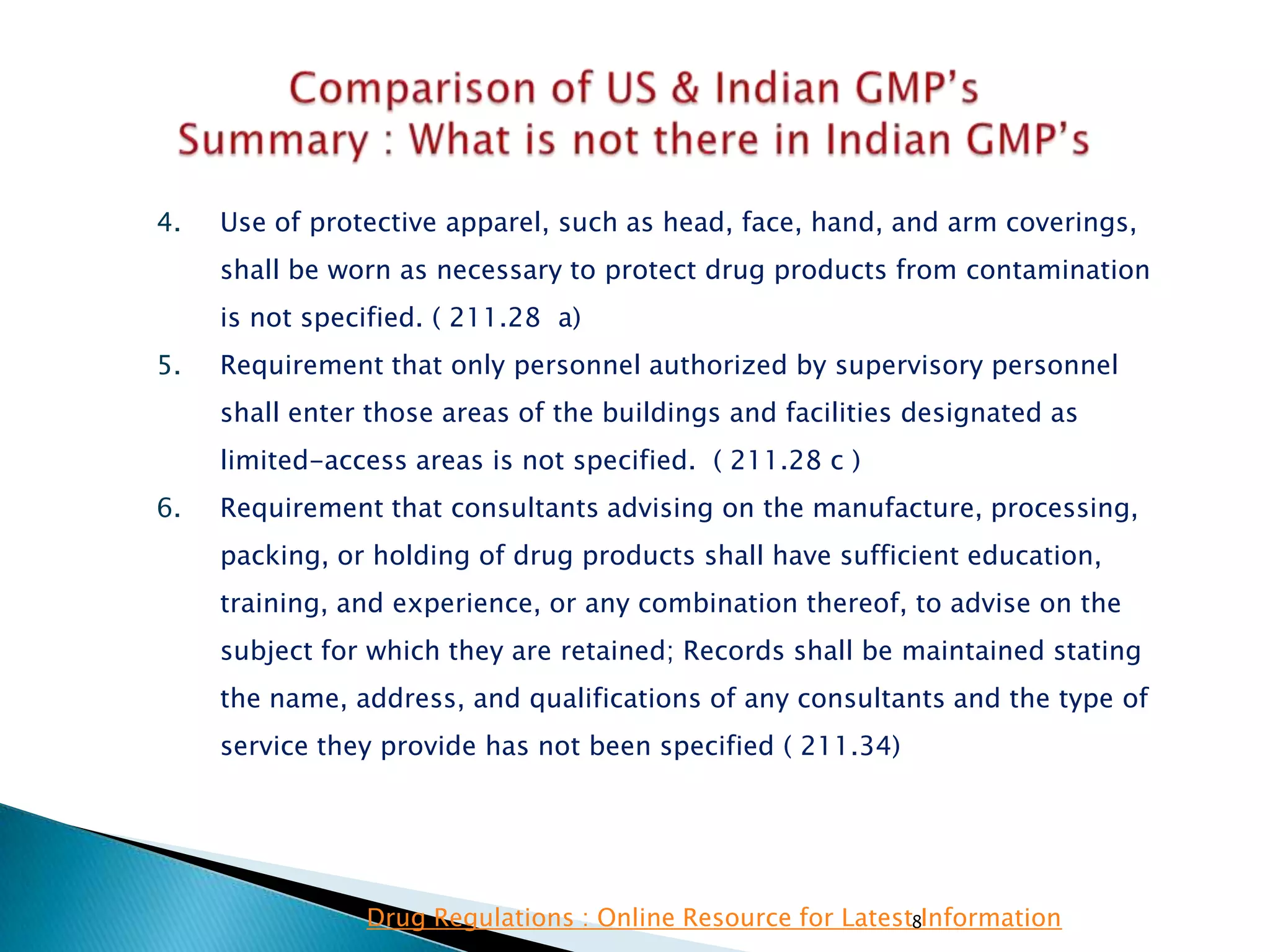
8
4. Use of protective apparel, such as head, face, hand, and arm coverings,
shall be worn as necessary to protect drug products from contamination
is not specified. ( 211.28 a)
5. Requirement that only personnel authorized by supervisory personnel
shall enter those areas of the buildings and facilities designated as
limited-access areas is not specified. ( 211.28 c )
6. Requirement that consultants advising on the manufacture, processing,
packing, or holding of drug products shall have sufficient education,
training, and experience, or any combination thereof, to advise on the
subject for which they are retained; Records shall be maintained stating
the name, address, and qualifications of any consultants and the type of
service they provide has not been specified ( 211.34)
Drug Regulations : Online Resource for Latest Information
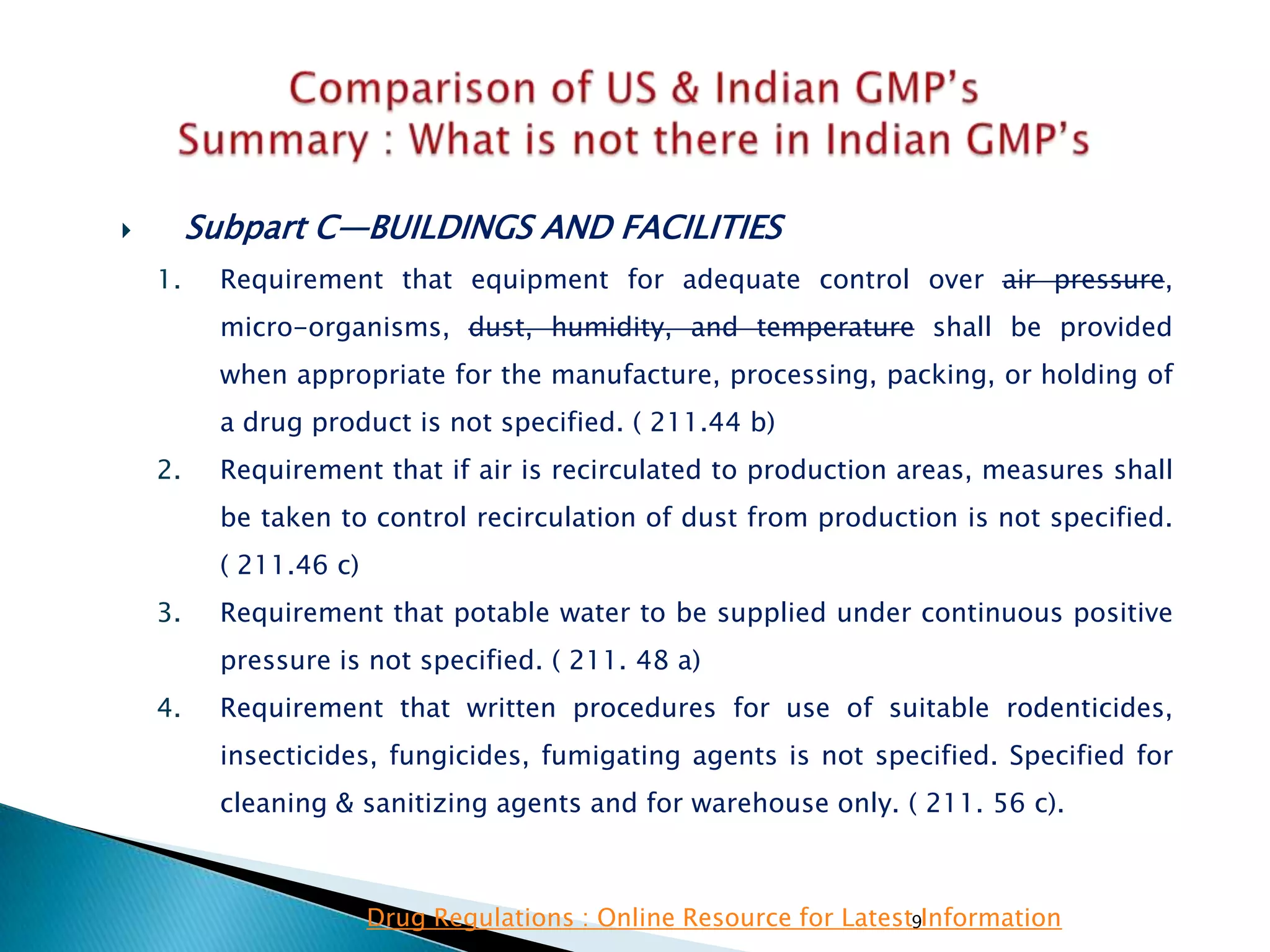
9
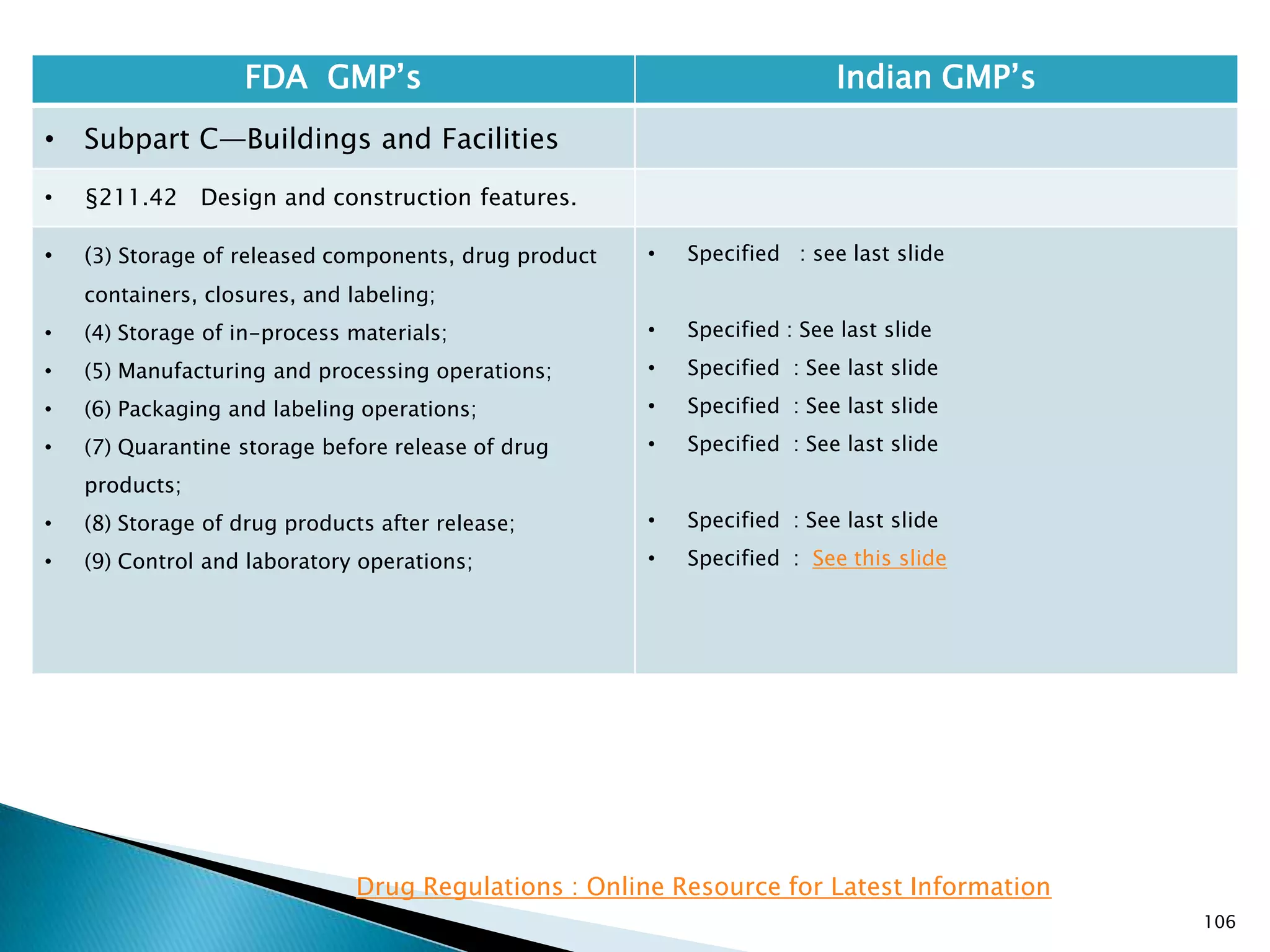
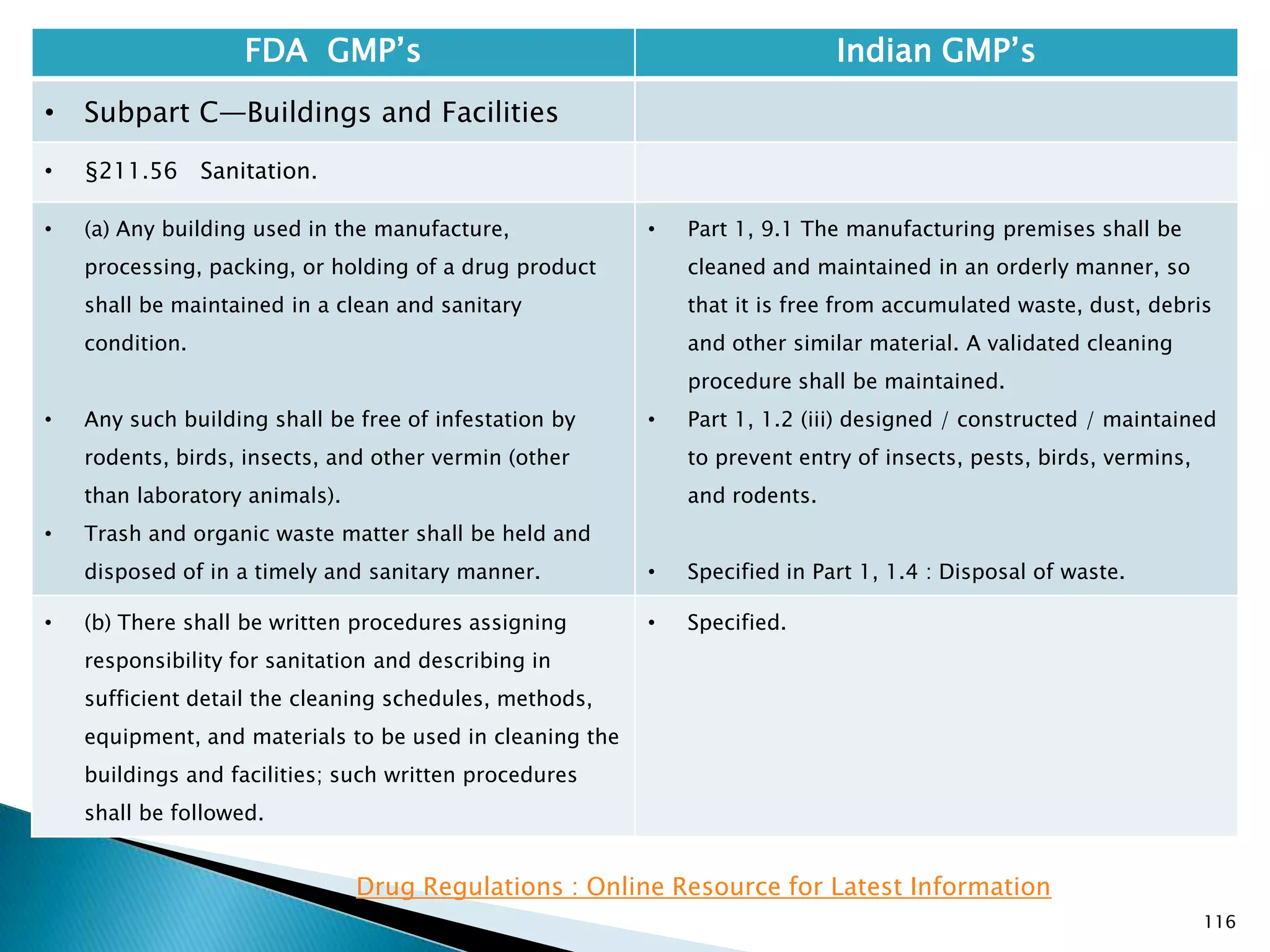
 Subpart C—BUILDINGS AND FACILITIES
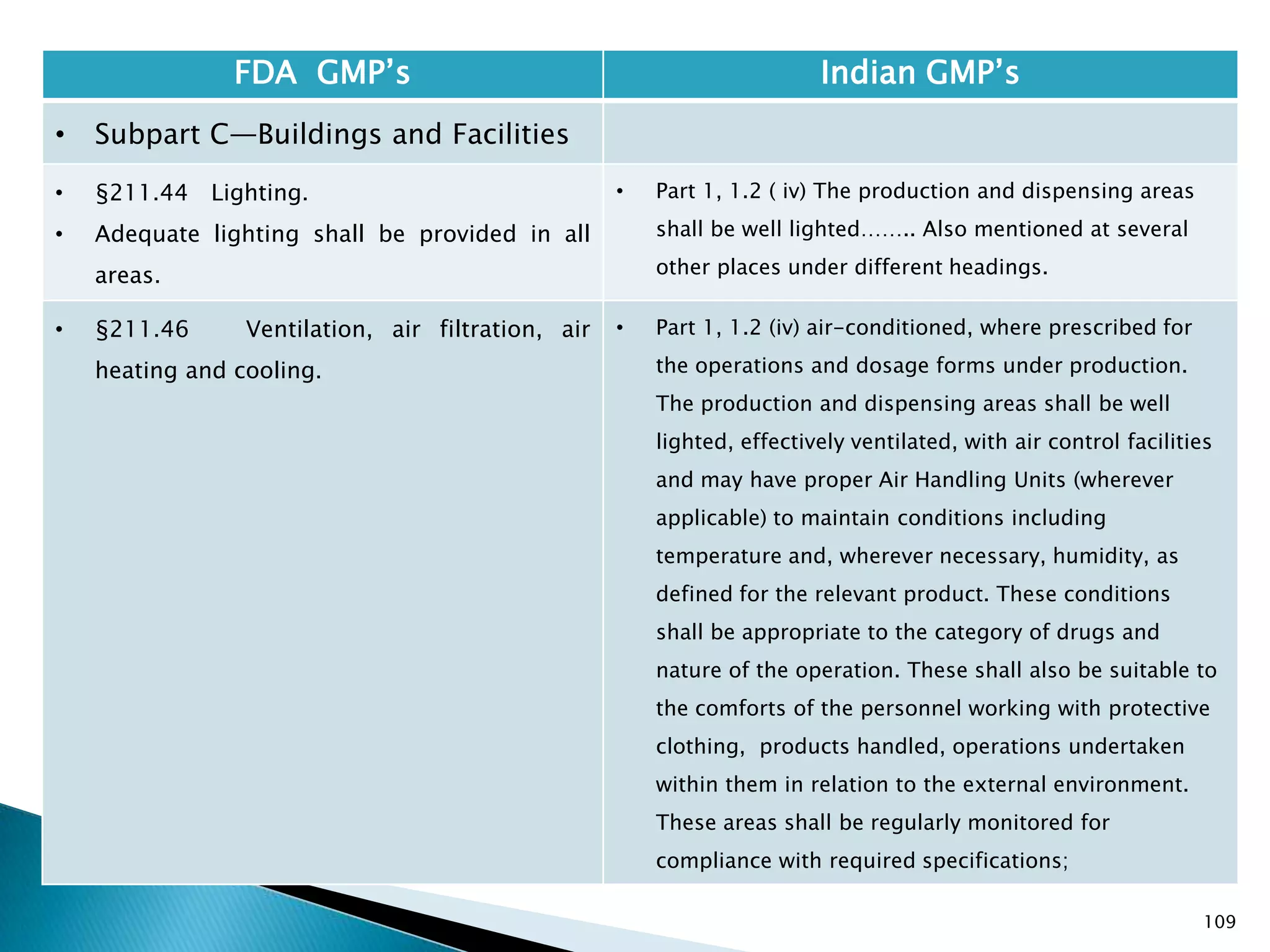
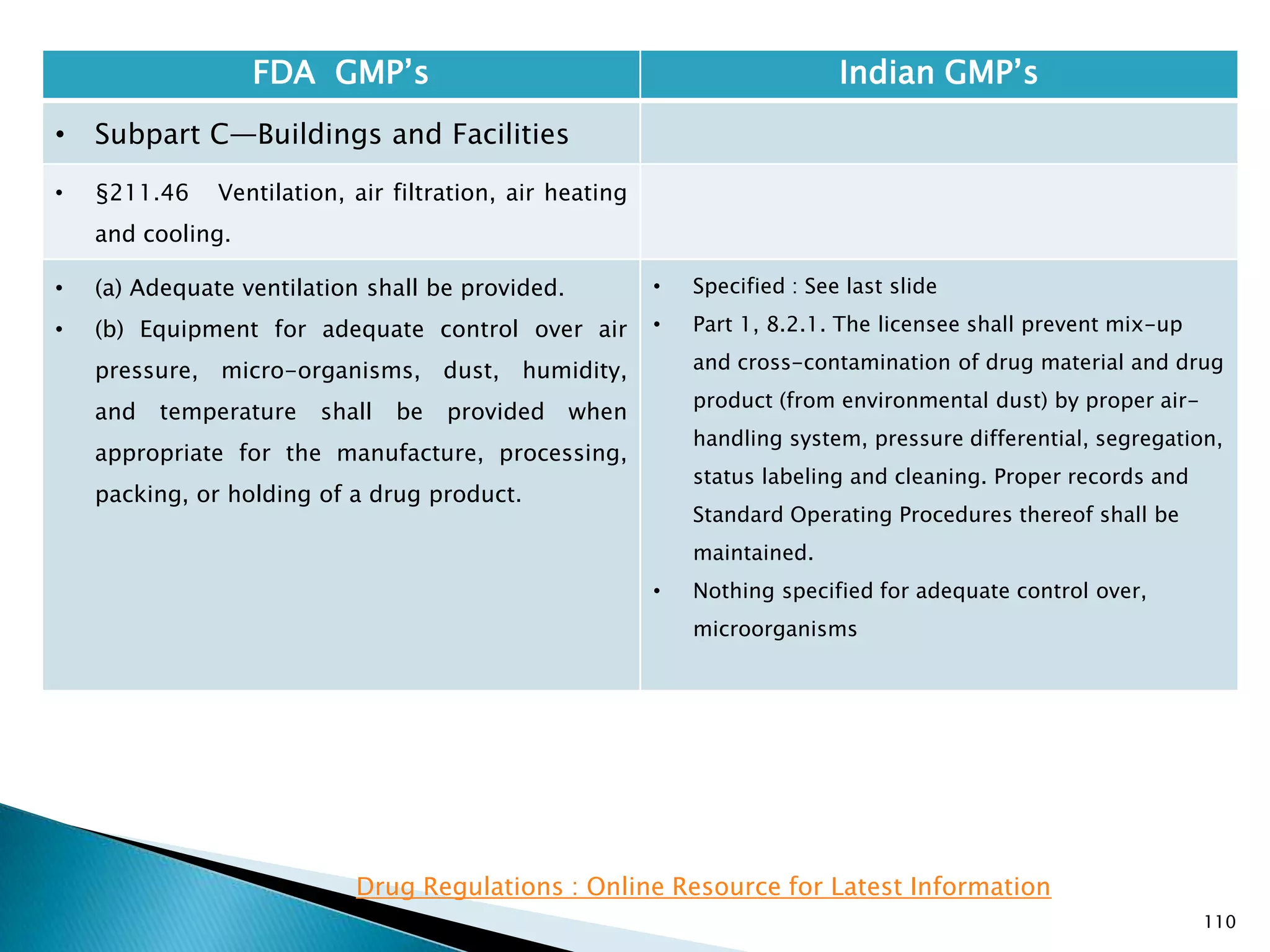
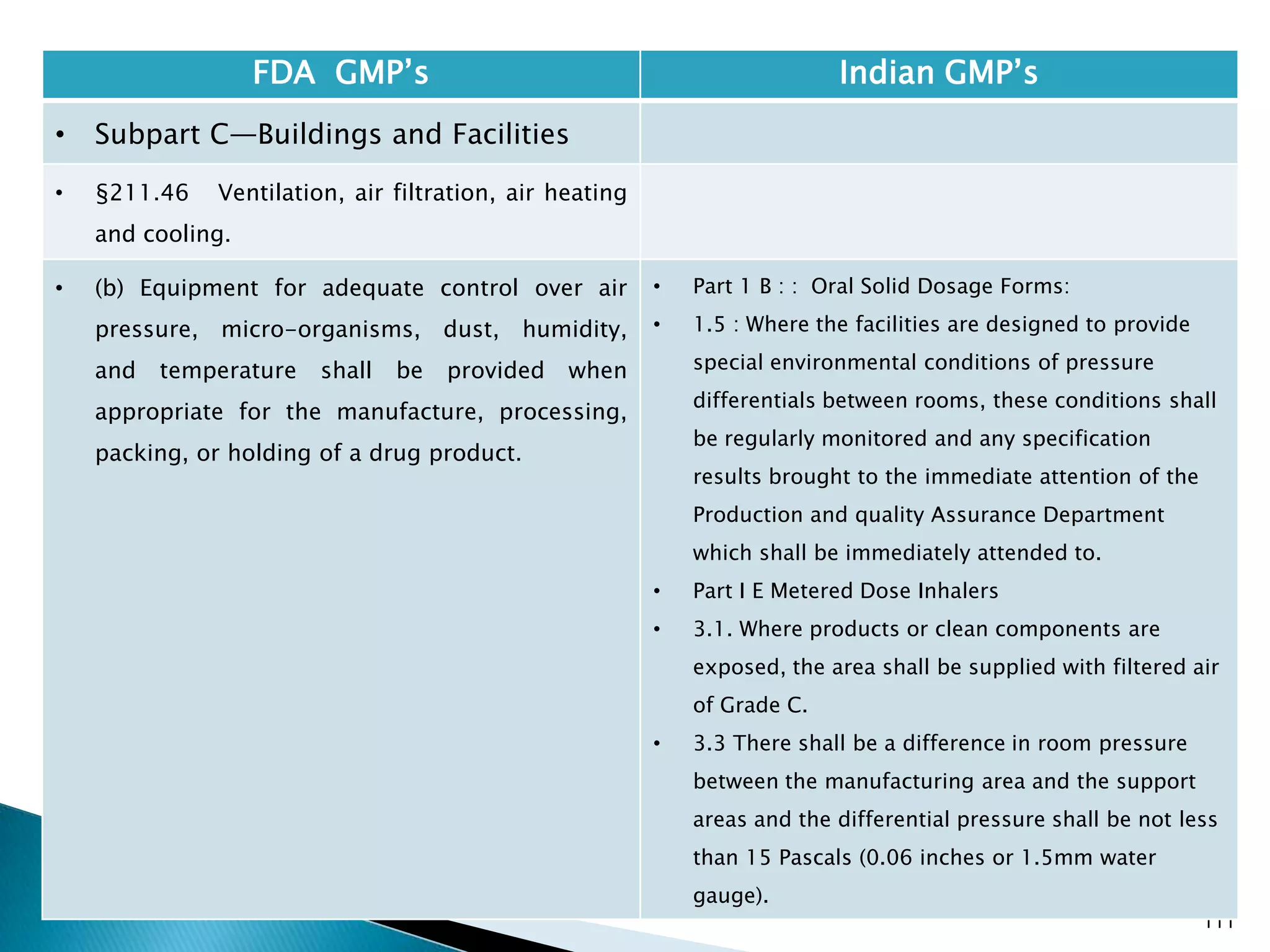
1. Requirement that equipment for adequate control over air pressure,
micro-organisms, dust, humidity, and temperature shall be provided
when appropriate for the manufacture, processing, packing, or holding of
a drug product is not specified. ( 211.44 b)
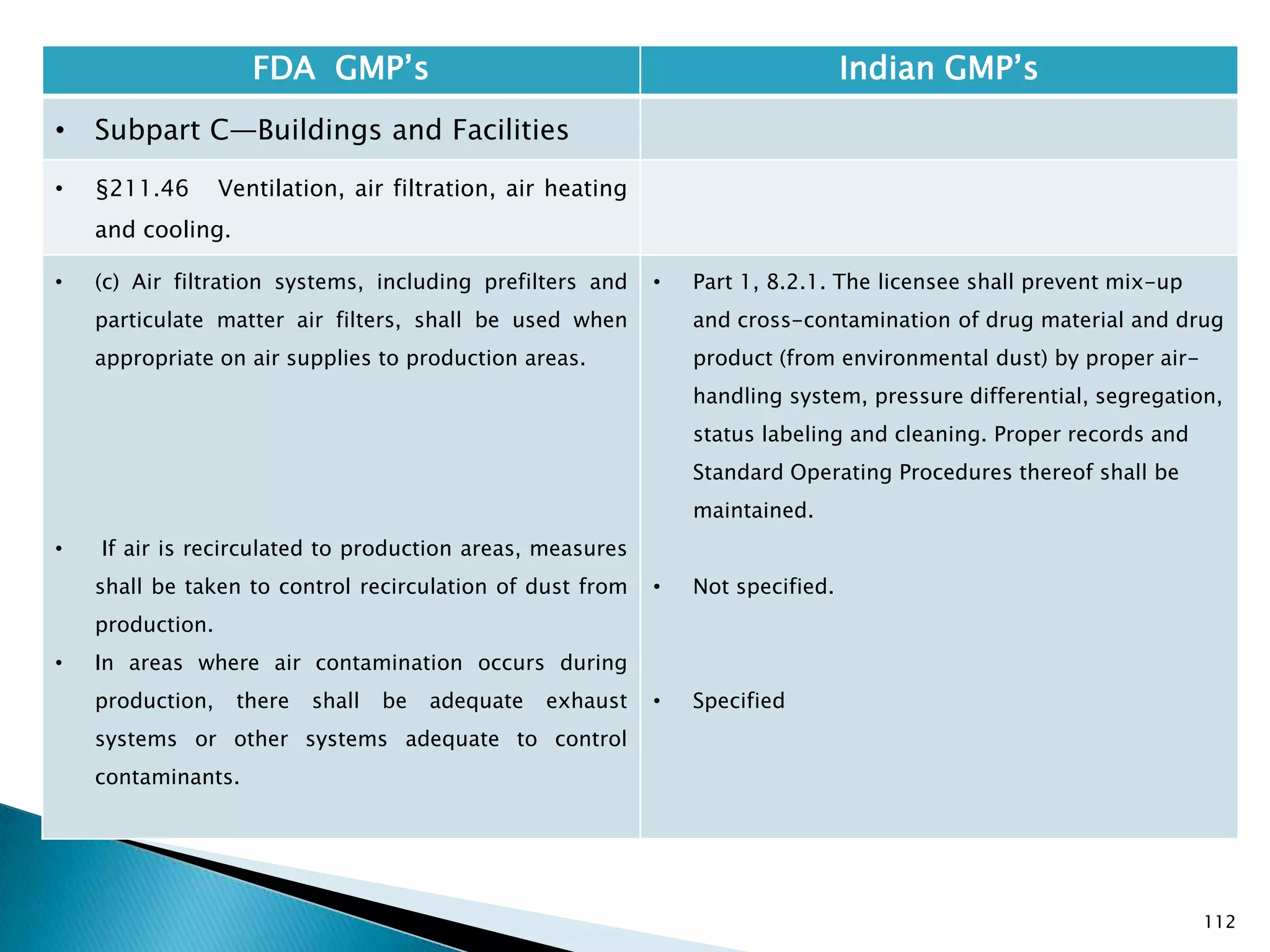
2. Requirement that if air is recirculated to production areas, measures shall
be taken to control recirculation of dust from production is not specified.
( 211.46 c)
3. Requirement that potable water to be supplied under continuous positive
pressure is not specified. ( 211. 48 a)
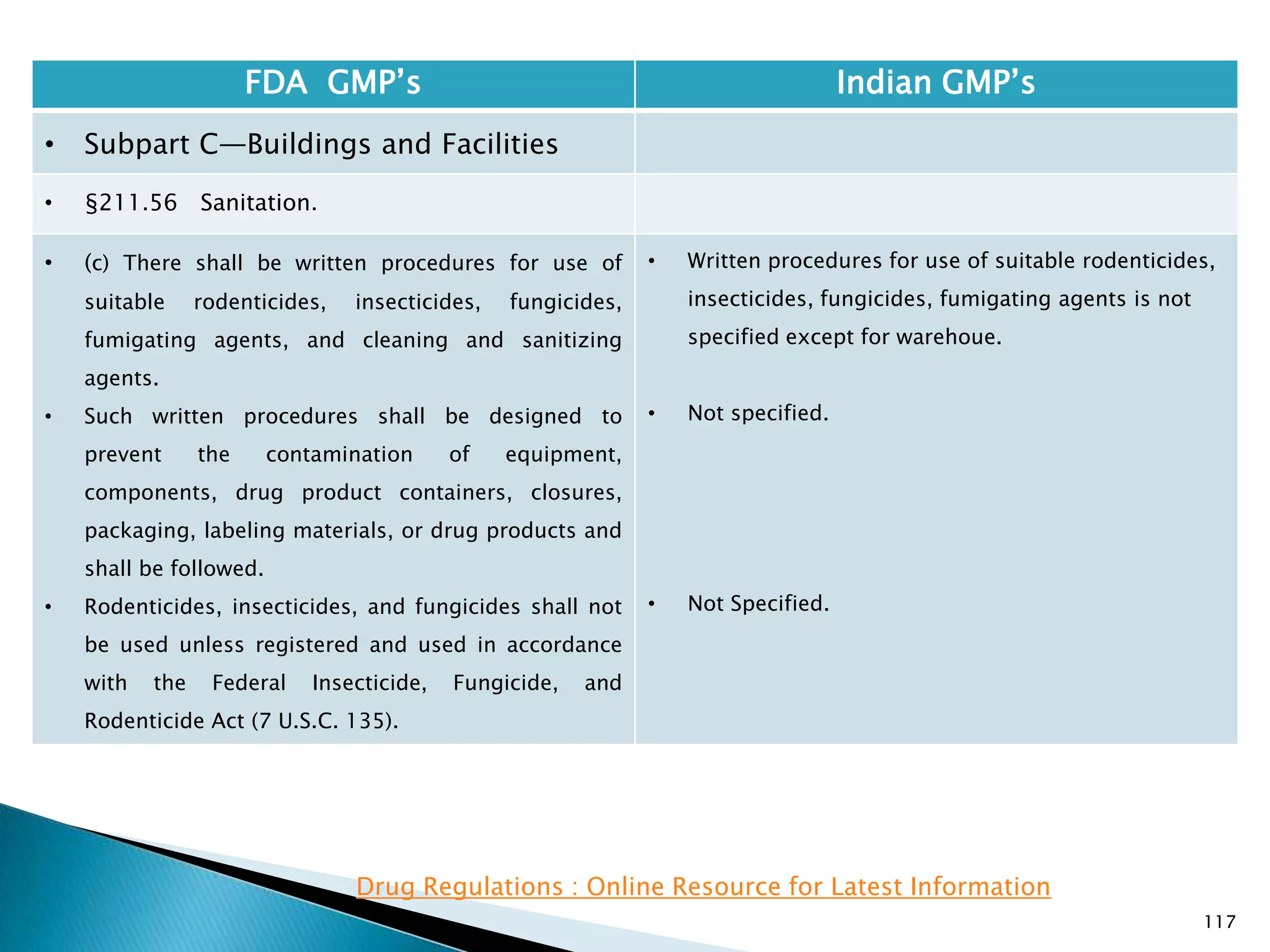
4. Requirement that written procedures for use of suitable rodenticides,
insecticides, fungicides, fumigating agents is not specified. Specified for
cleaning & sanitizing agents and for warehouse only. ( 211. 56 c).
Drug Regulations : Online Resource for Latest Information
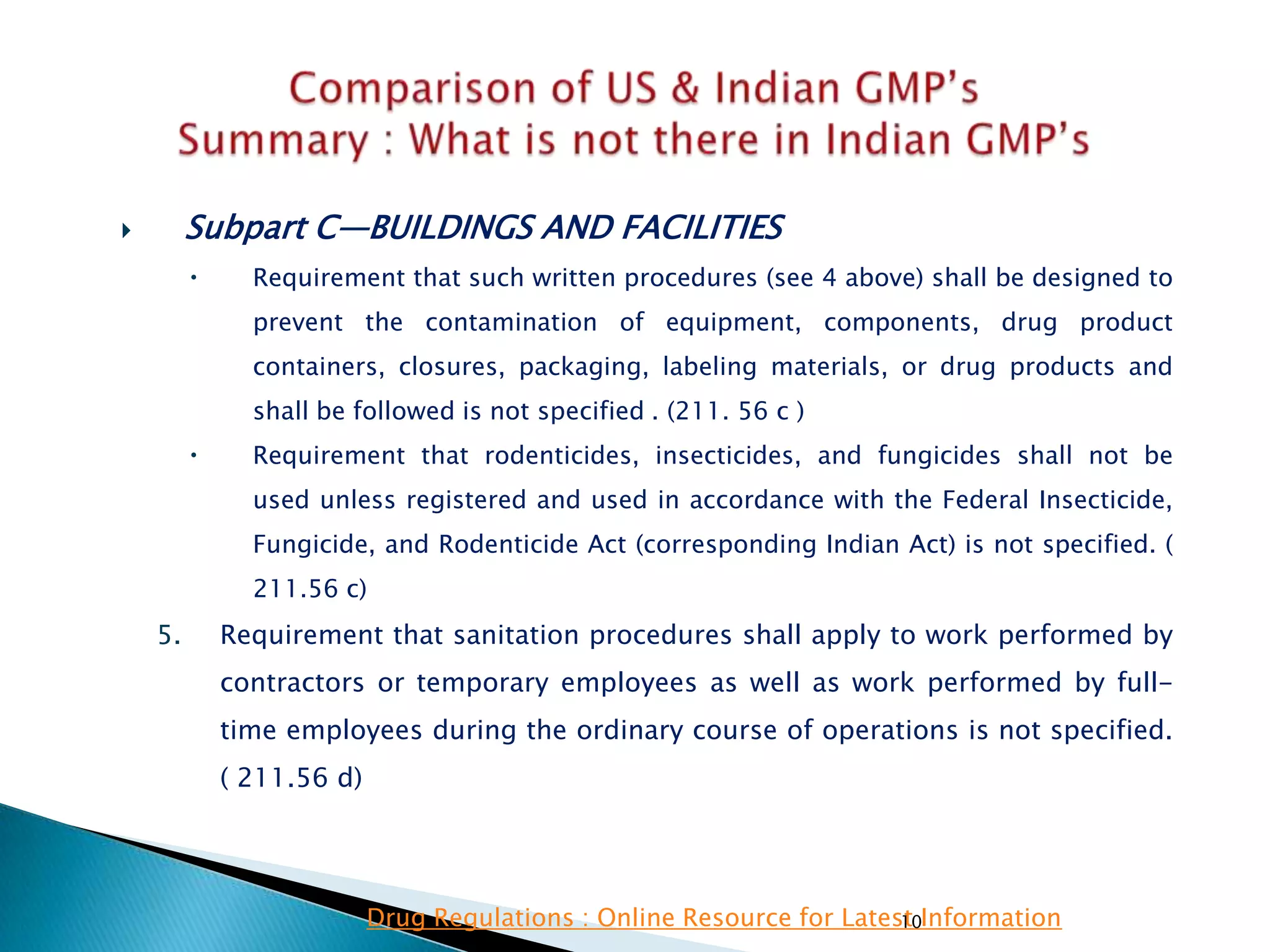
10
 Subpart C—BUILDINGS AND FACILITIES
 Requirement that such written procedures (see 4 above) shall be designed to
prevent the contamination of equipment, components, drug product
containers, closures, packaging, labeling materials, or drug products and
shall be followed is not specified . (211. 56 c )
 Requirement that rodenticides, insecticides, and fungicides shall not be
used unless registered and used in accordance with the Federal Insecticide,
Fungicide, and Rodenticide Act (corresponding Indian Act) is not specified. (
211.56 c)
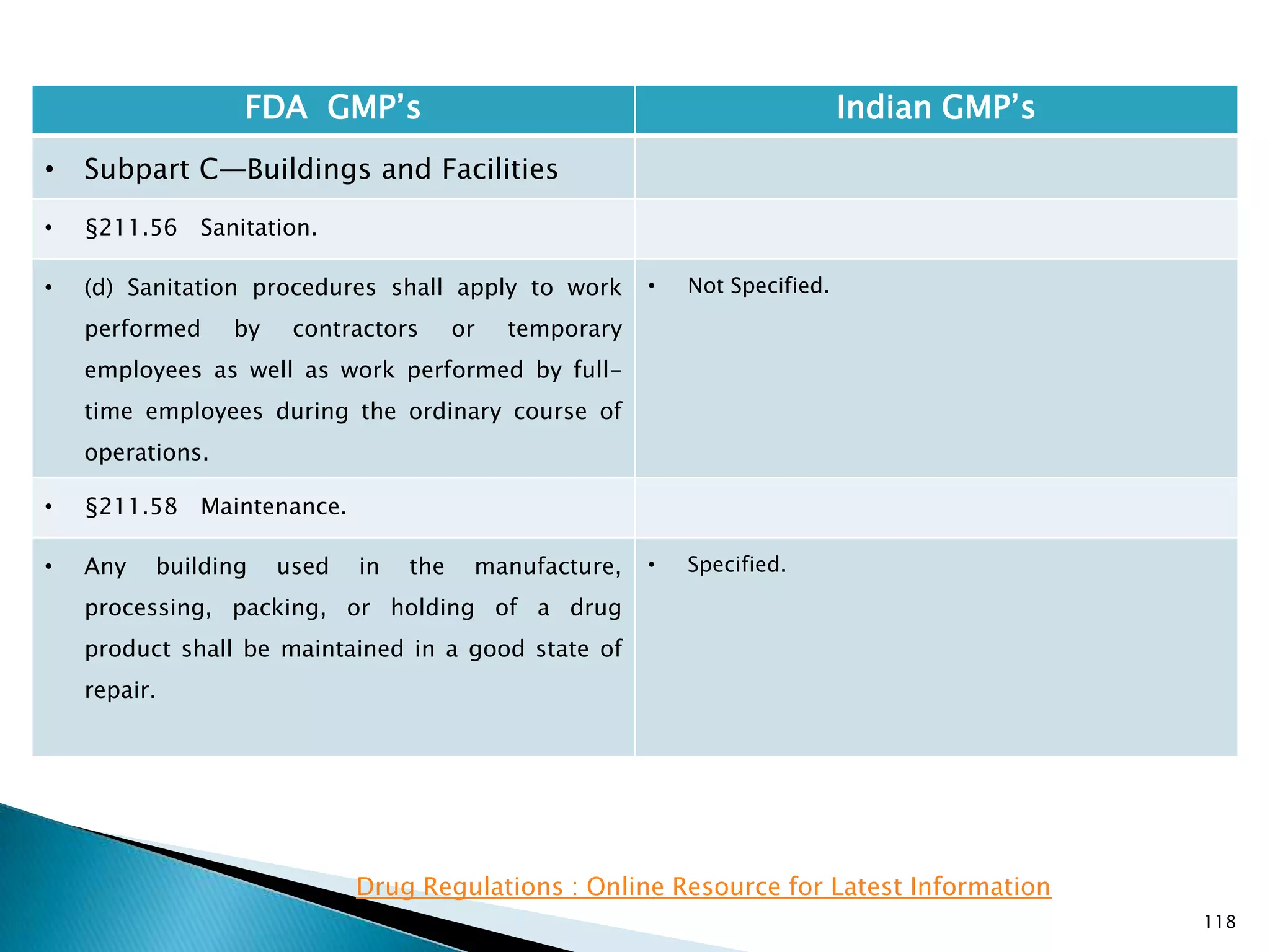
5. Requirement that sanitation procedures shall apply to work performed by
contractors or temporary employees as well as work performed by full-
time employees during the ordinary course of operations is not specified.
( 211.56 d)
Drug Regulations : Online Resource for Latest Information
11
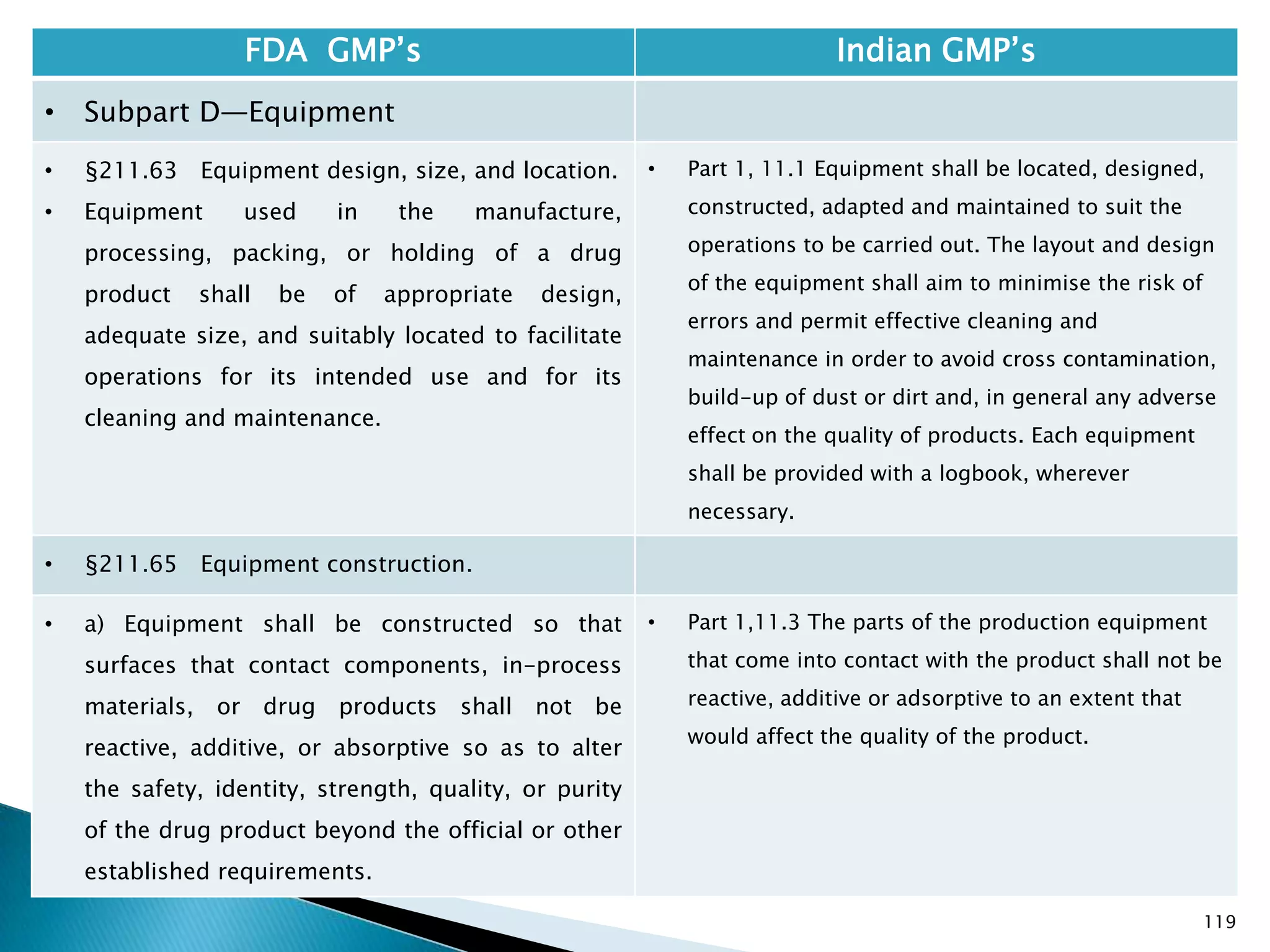
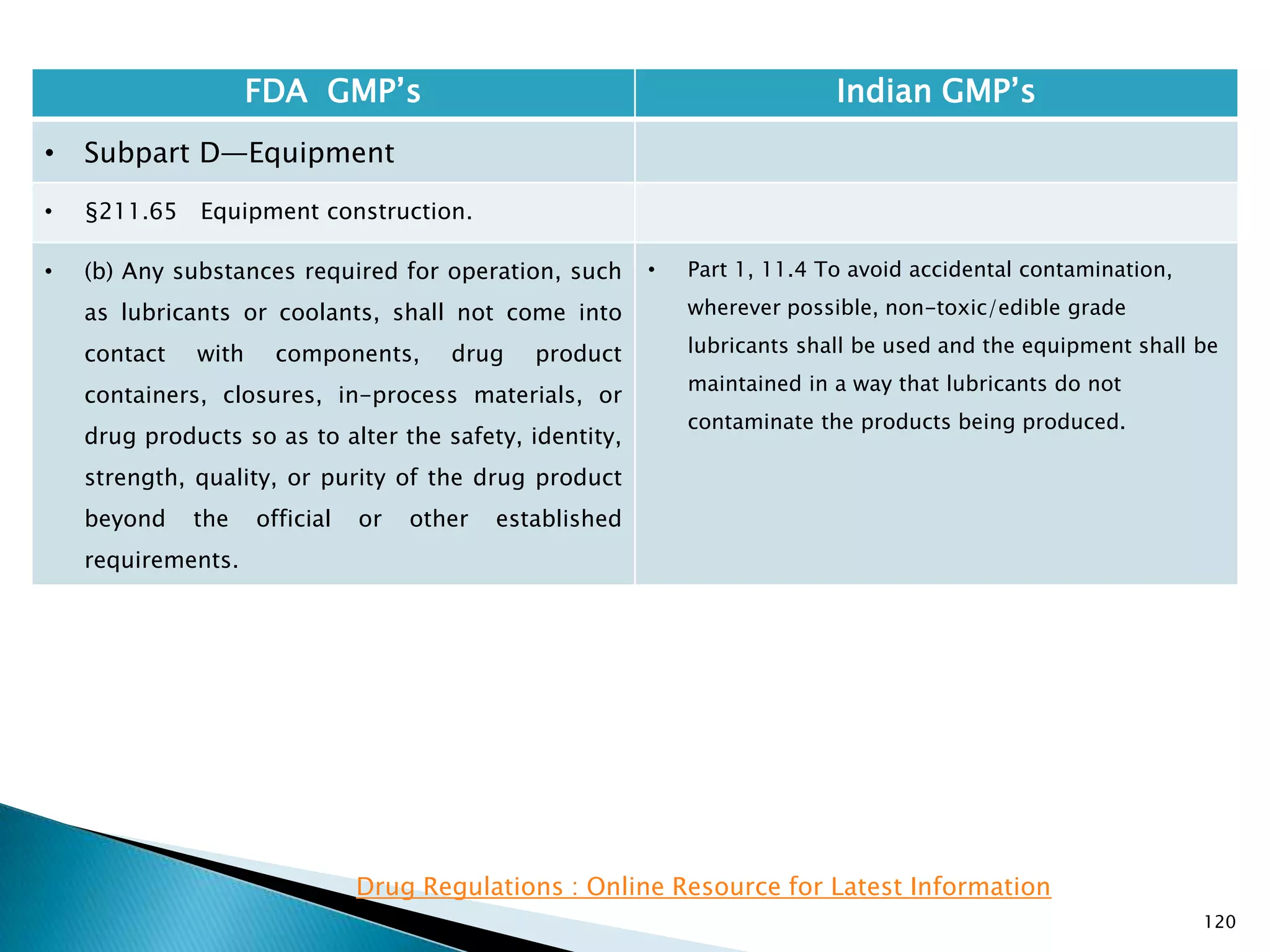
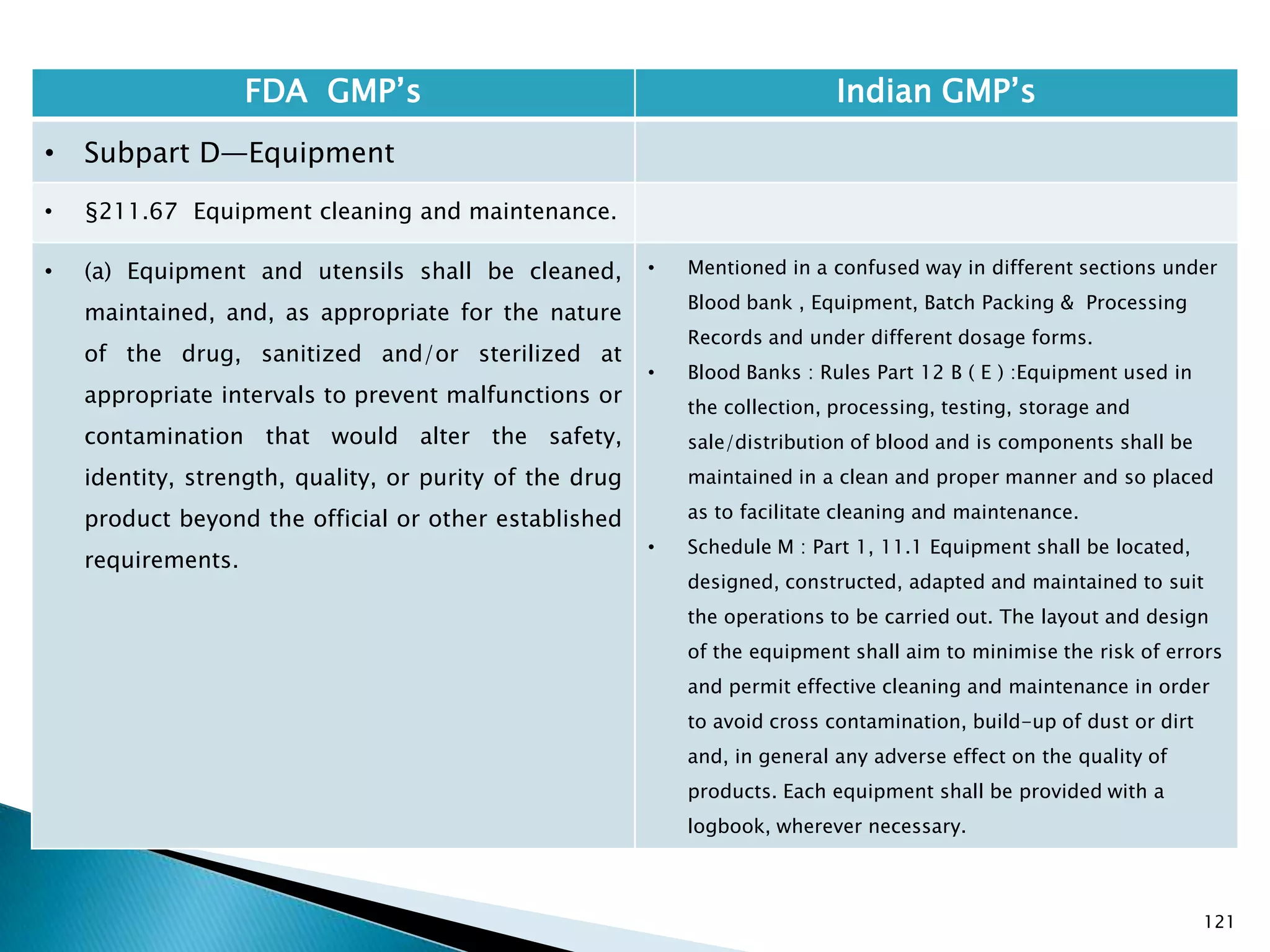
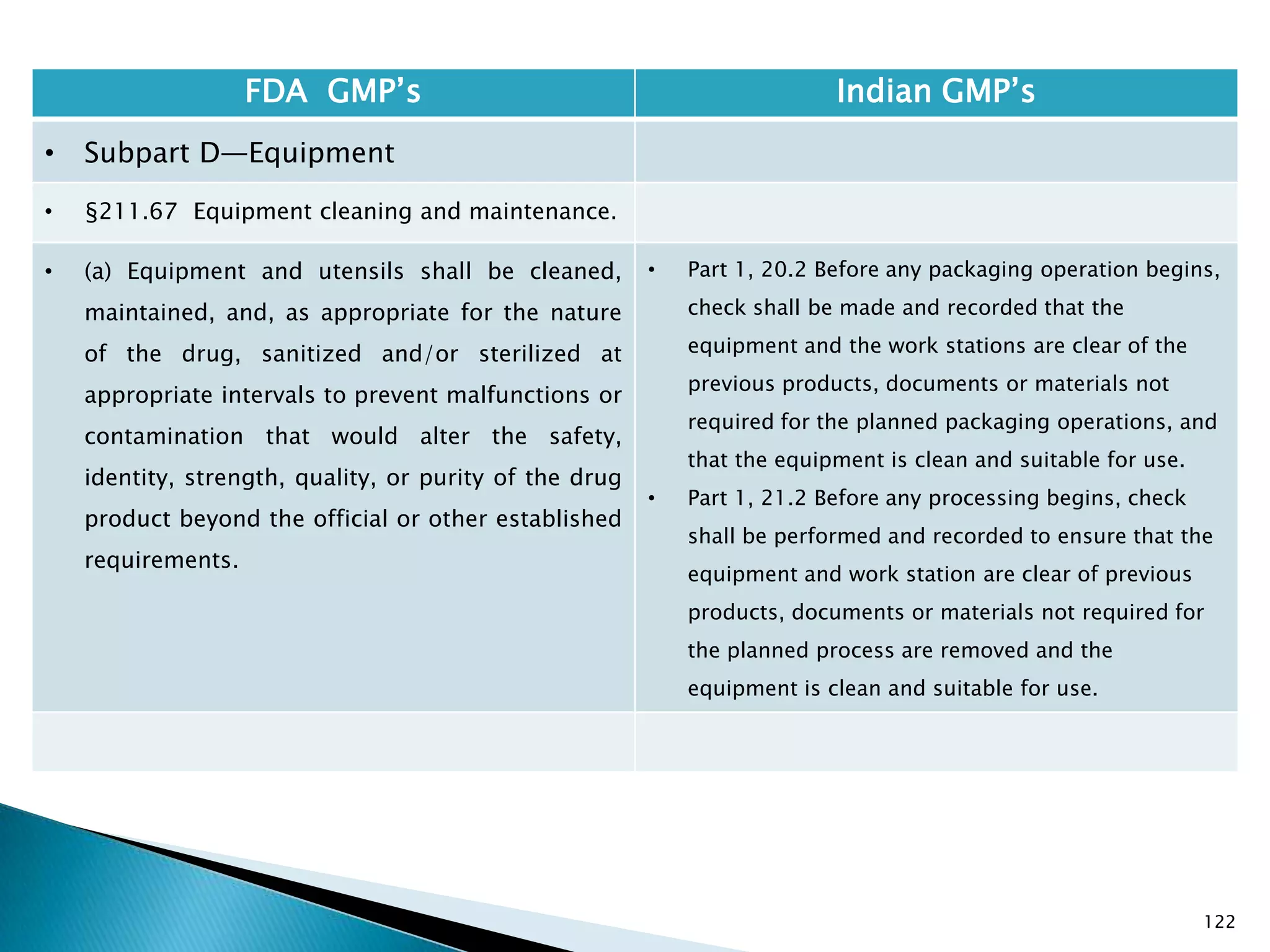
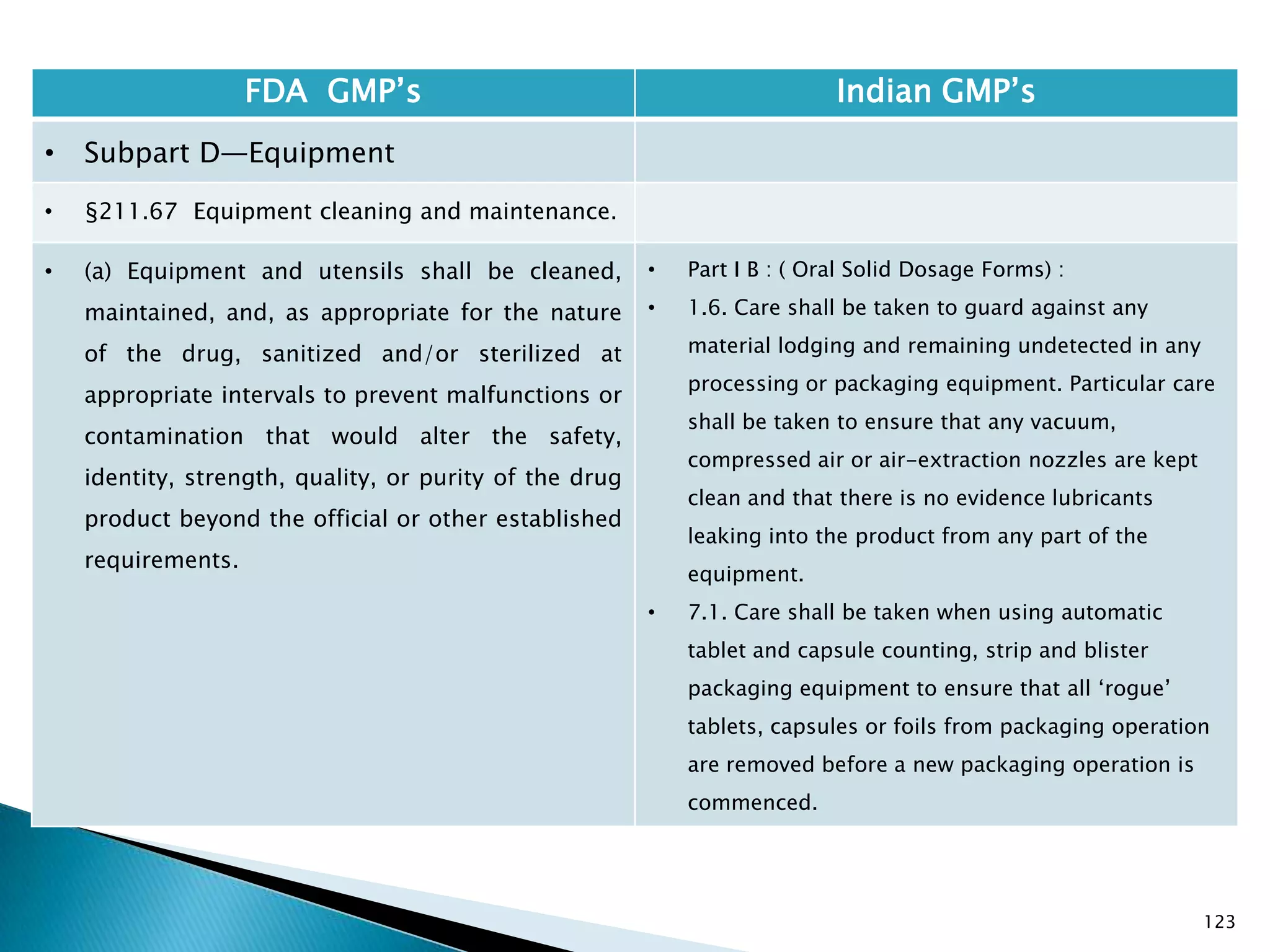
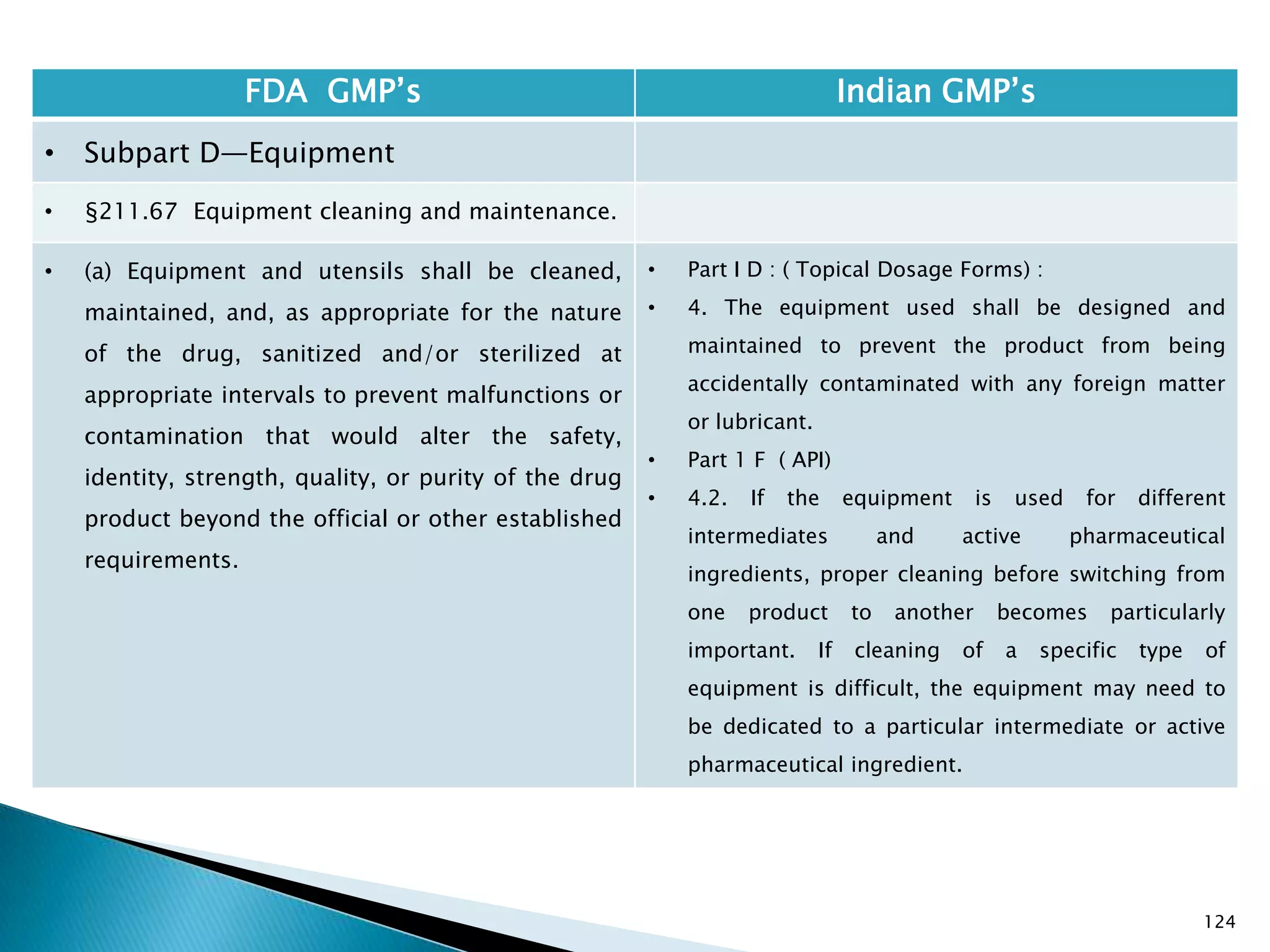
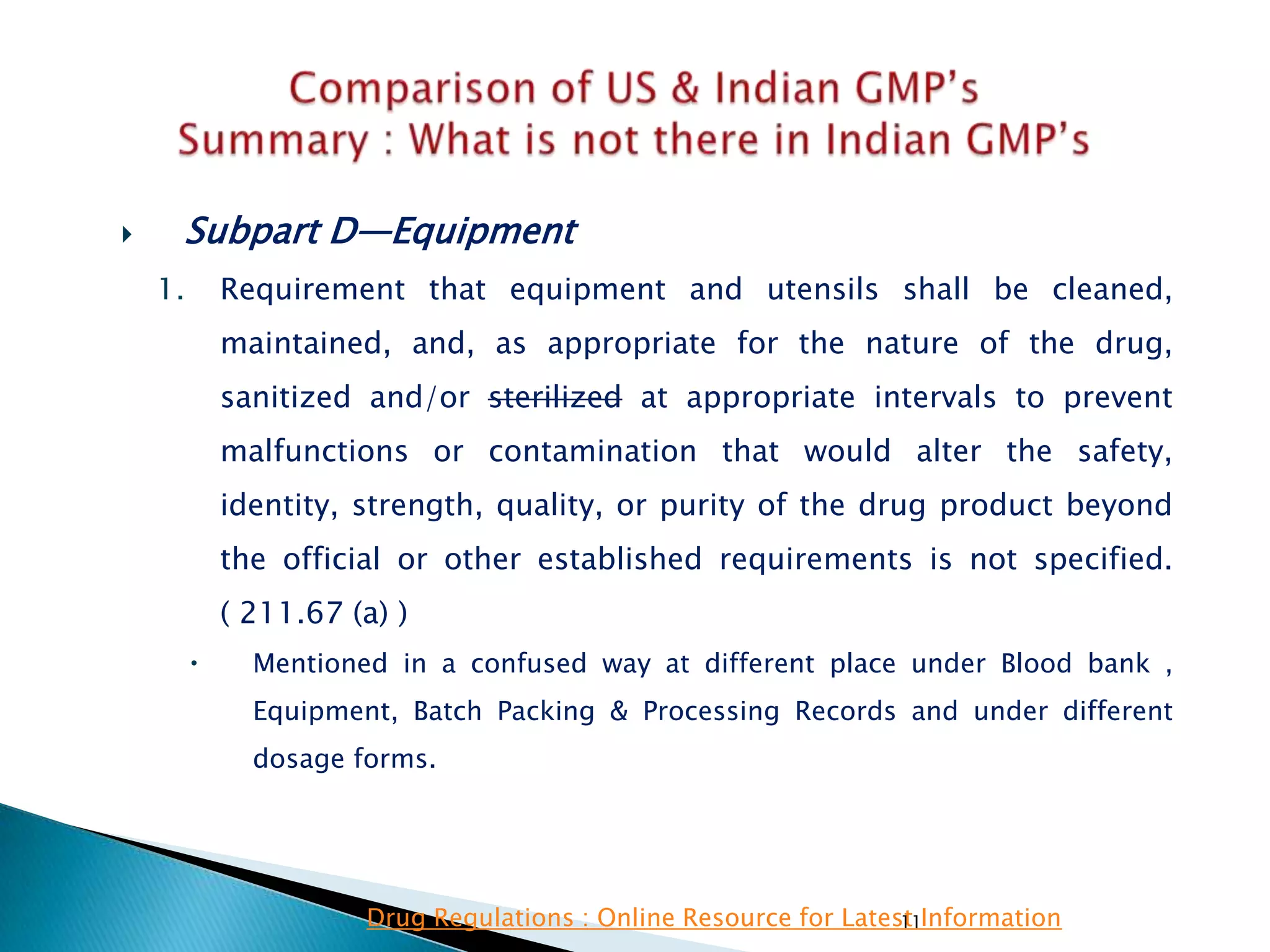
 Subpart D—Equipment
1. Requirement that equipment and utensils shall be cleaned,
maintained, and, as appropriate for the nature of the drug,
sanitized and/or sterilized at appropriate intervals to prevent
malfunctions or contamination that would alter the safety,
identity, strength, quality, or purity of the drug product beyond
the official or other established requirements is not specified.
( 211.67 (a) )
 Mentioned in a confused way at different place under Blood bank ,
Equipment, Batch Packing & Processing Records and under different
dosage forms.
Drug Regulations : Online Resource for Latest Information
12
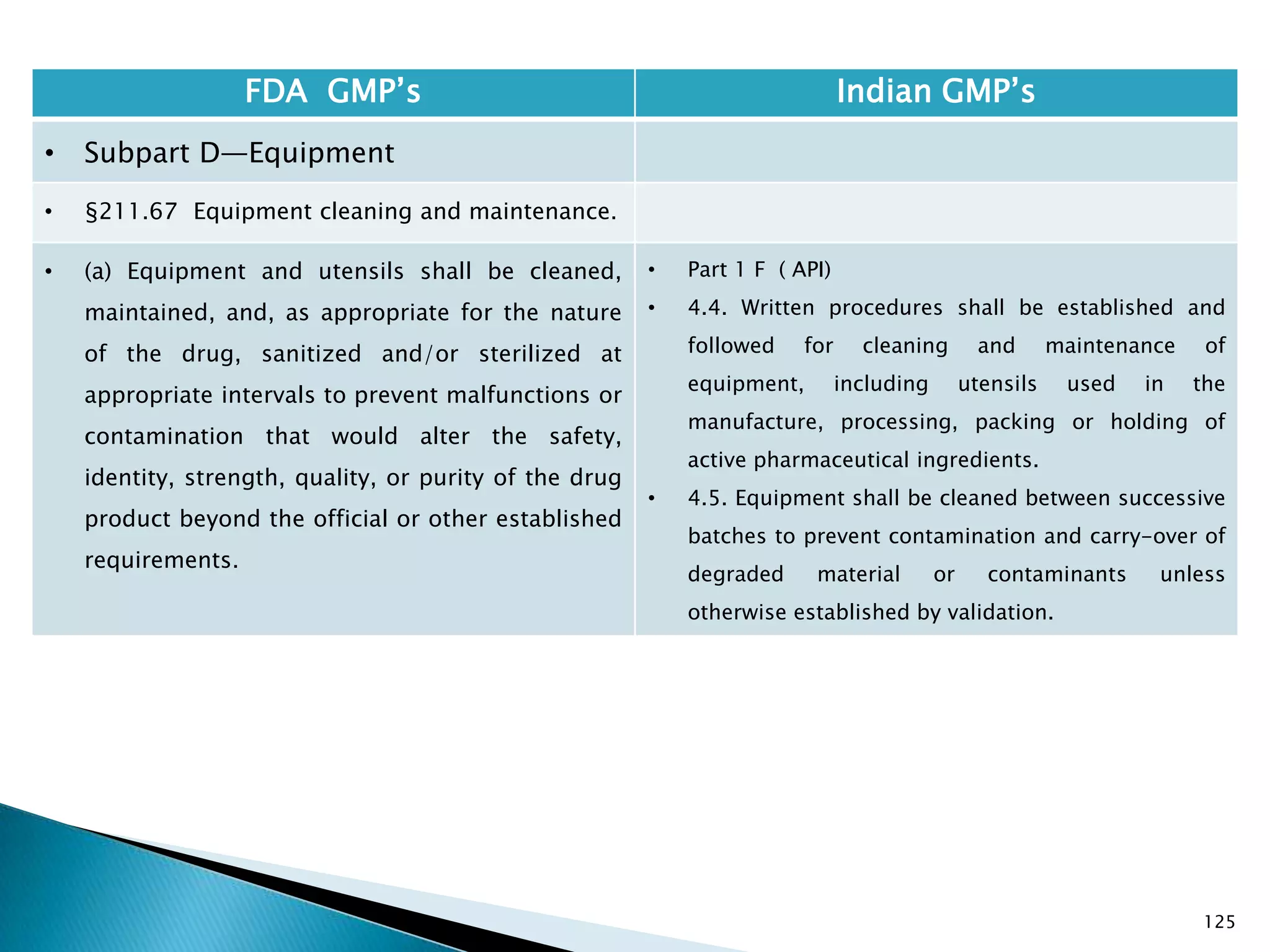
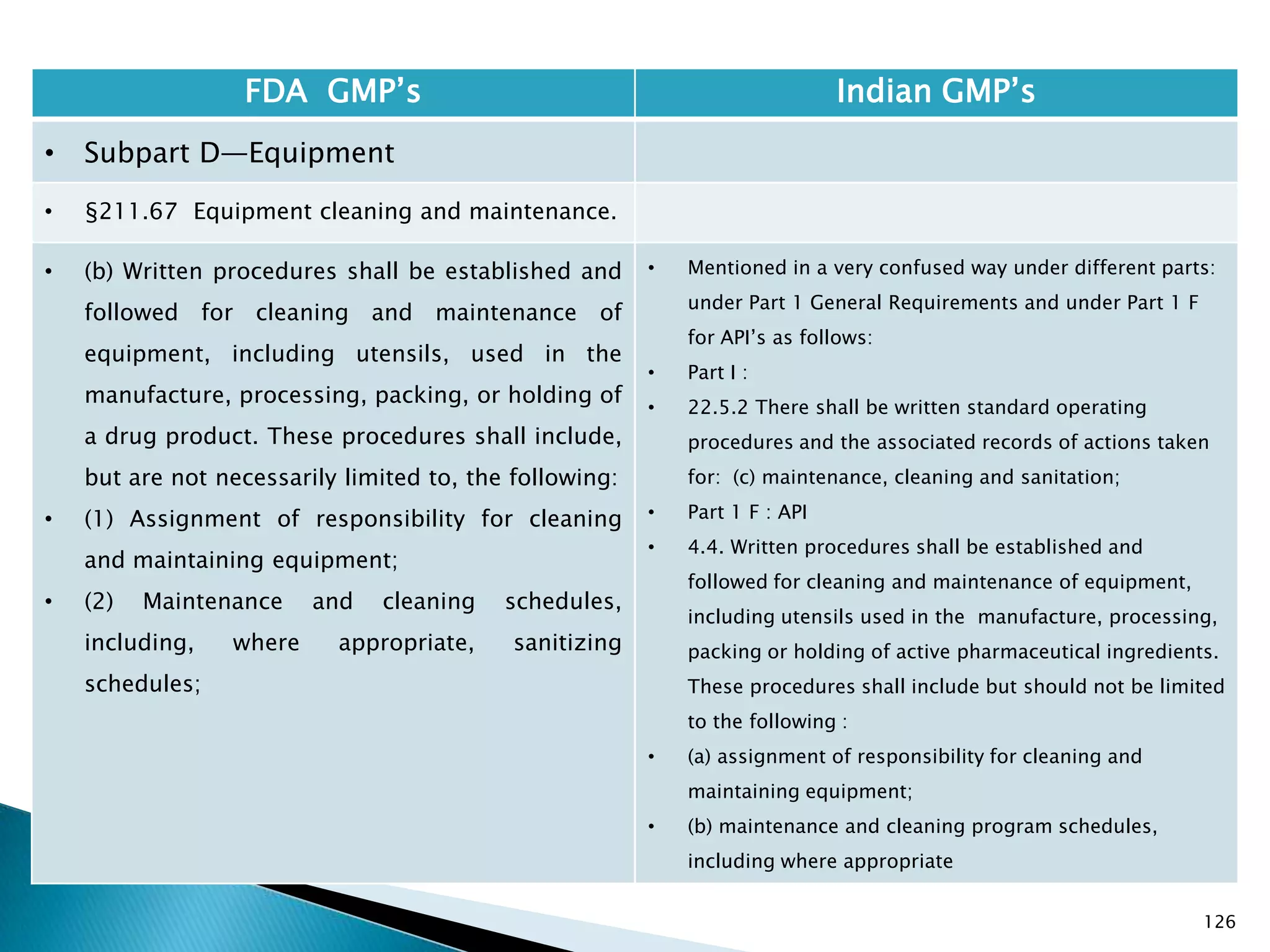
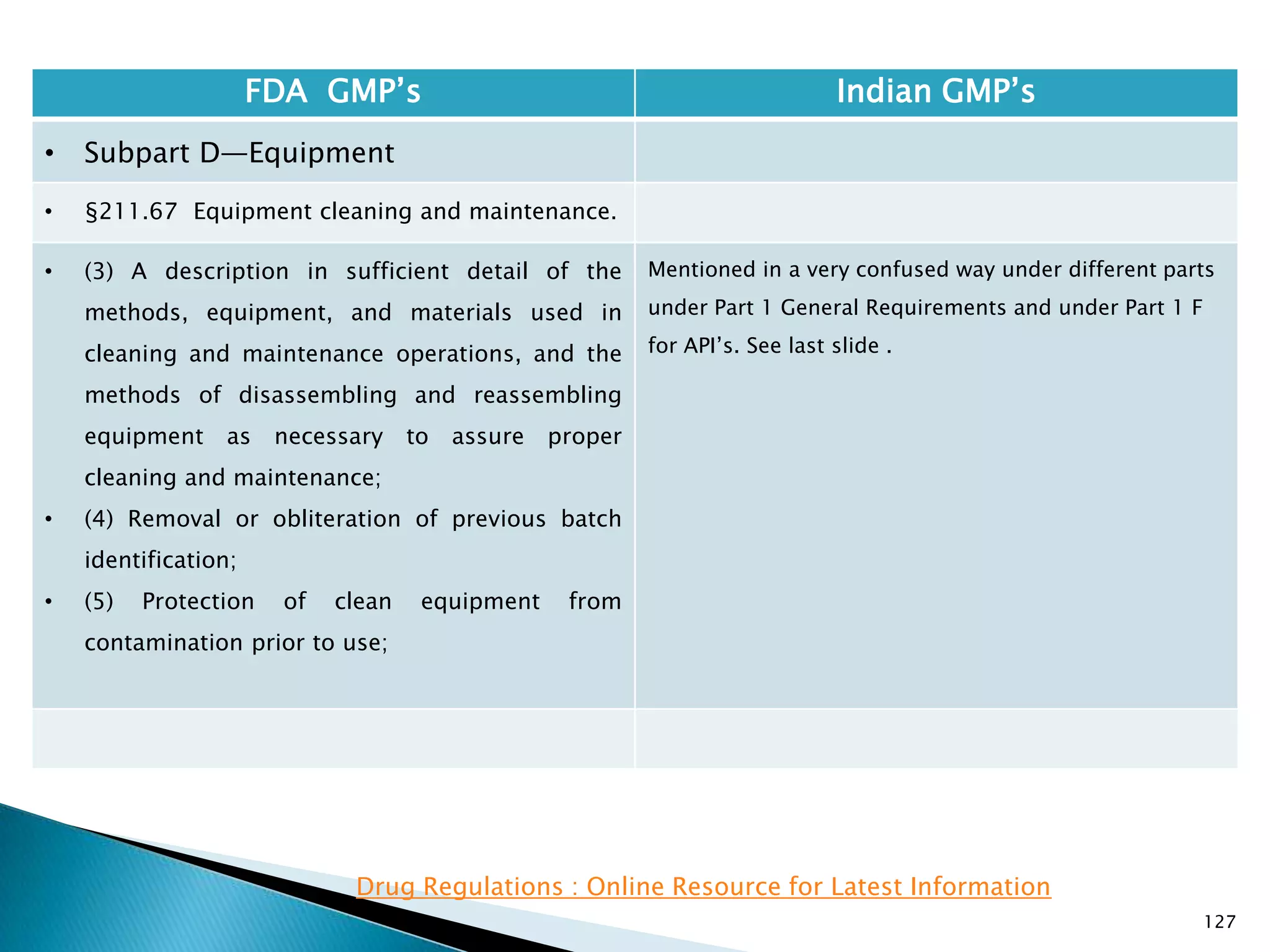
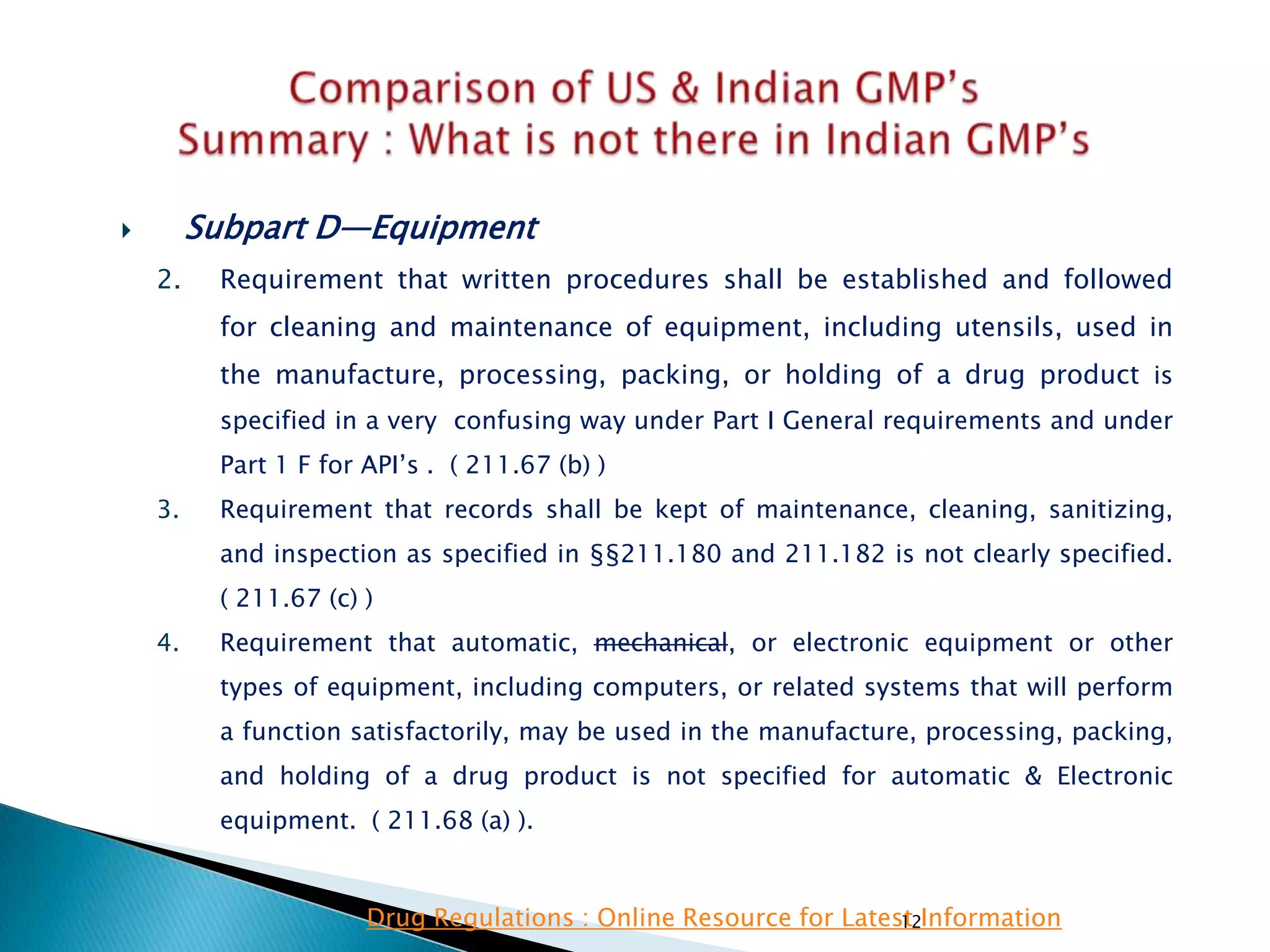
 Subpart D—Equipment
2. Requirement that written procedures shall be established and followed
for cleaning and maintenance of equipment, including utensils, used in
the manufacture, processing, packing, or holding of a drug product is
specified in a very confusing way under Part I General requirements and under
Part 1 F for API‘s . ( 211.67 (b) )
3. Requirement that records shall be kept of maintenance, cleaning, sanitizing,
and inspection as specified in §§211.180 and 211.182 is not clearly specified.
( 211.67 (c) )
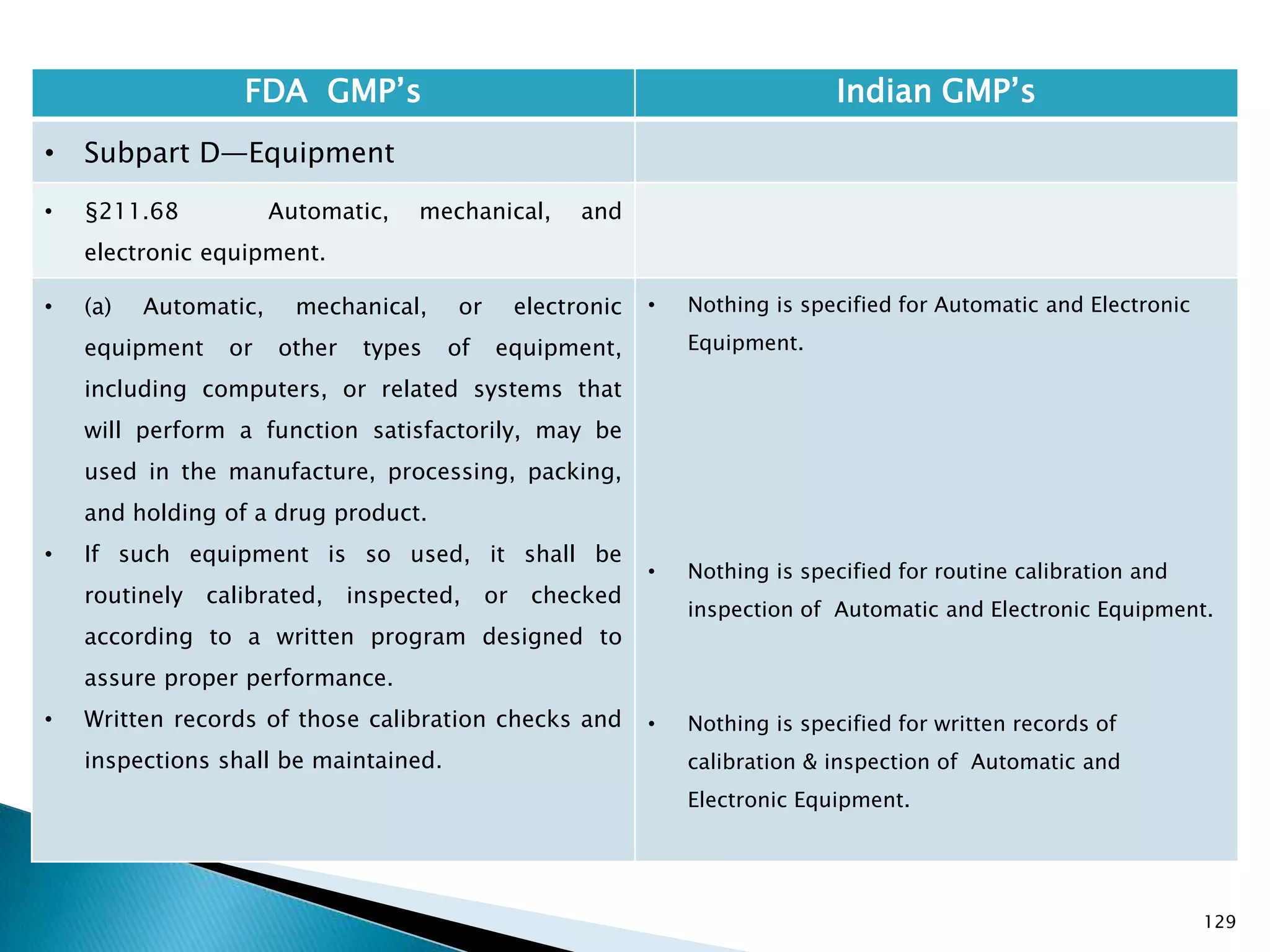
4. Requirement that automatic, mechanical, or electronic equipment or other
types of equipment, including computers, or related systems that will perform
a function satisfactorily, may be used in the manufacture, processing, packing,
and holding of a drug product is not specified for automatic & Electronic
equipment. ( 211.68 (a) ).
Drug Regulations : Online Resource for Latest Information
13
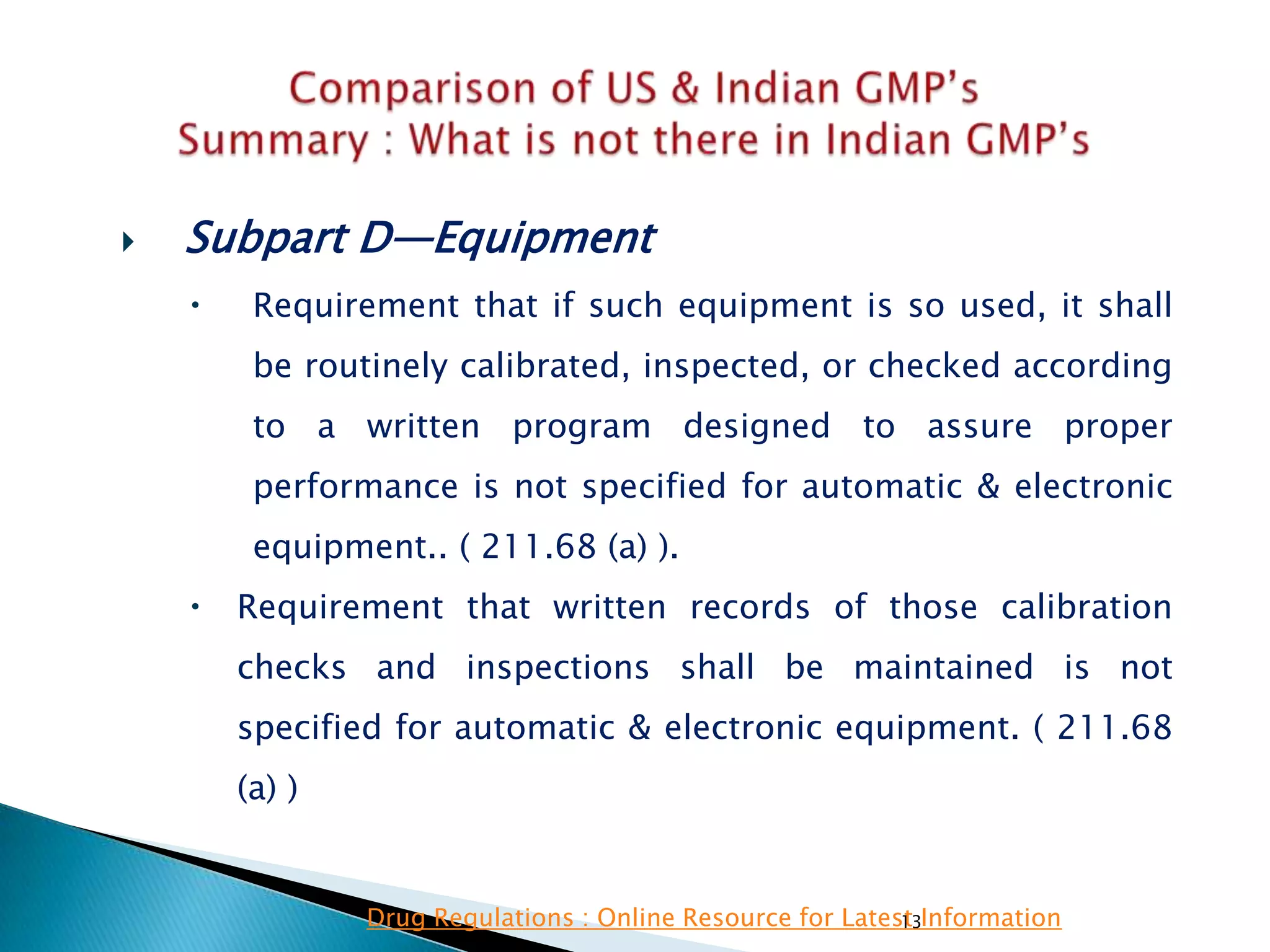
 Subpart D—Equipment
 Requirement that if such equipment is so used, it shall
be routinely calibrated, inspected, or checked according
to a written program designed to assure proper
performance is not specified for automatic & electronic
equipment.. ( 211.68 (a) ).
 Requirement that written records of those calibration
checks and inspections shall be maintained is not
specified for automatic & electronic equipment. ( 211.68
(a) )
Drug Regulations : Online Resource for Latest Information
14
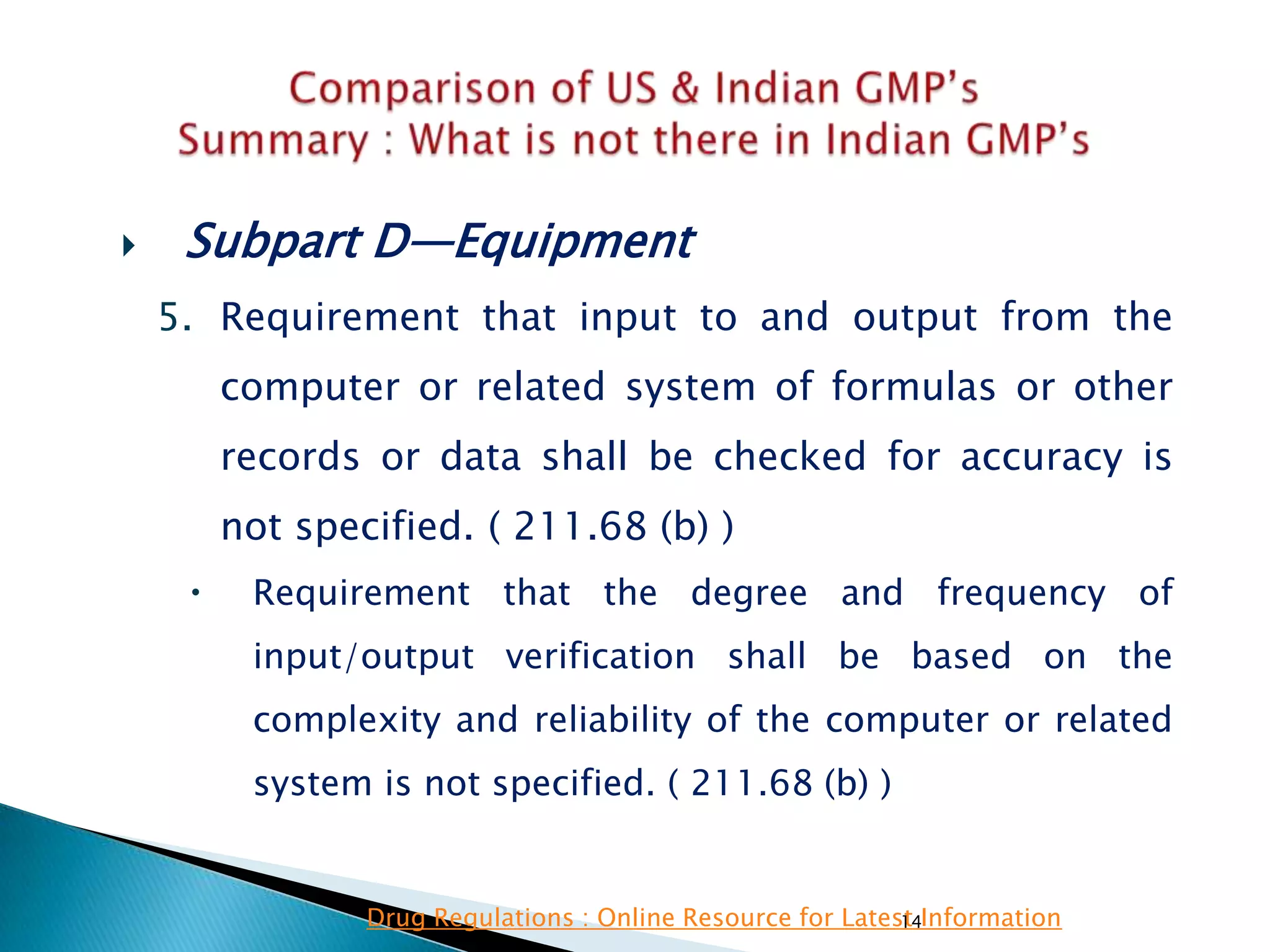
 Subpart D—Equipment
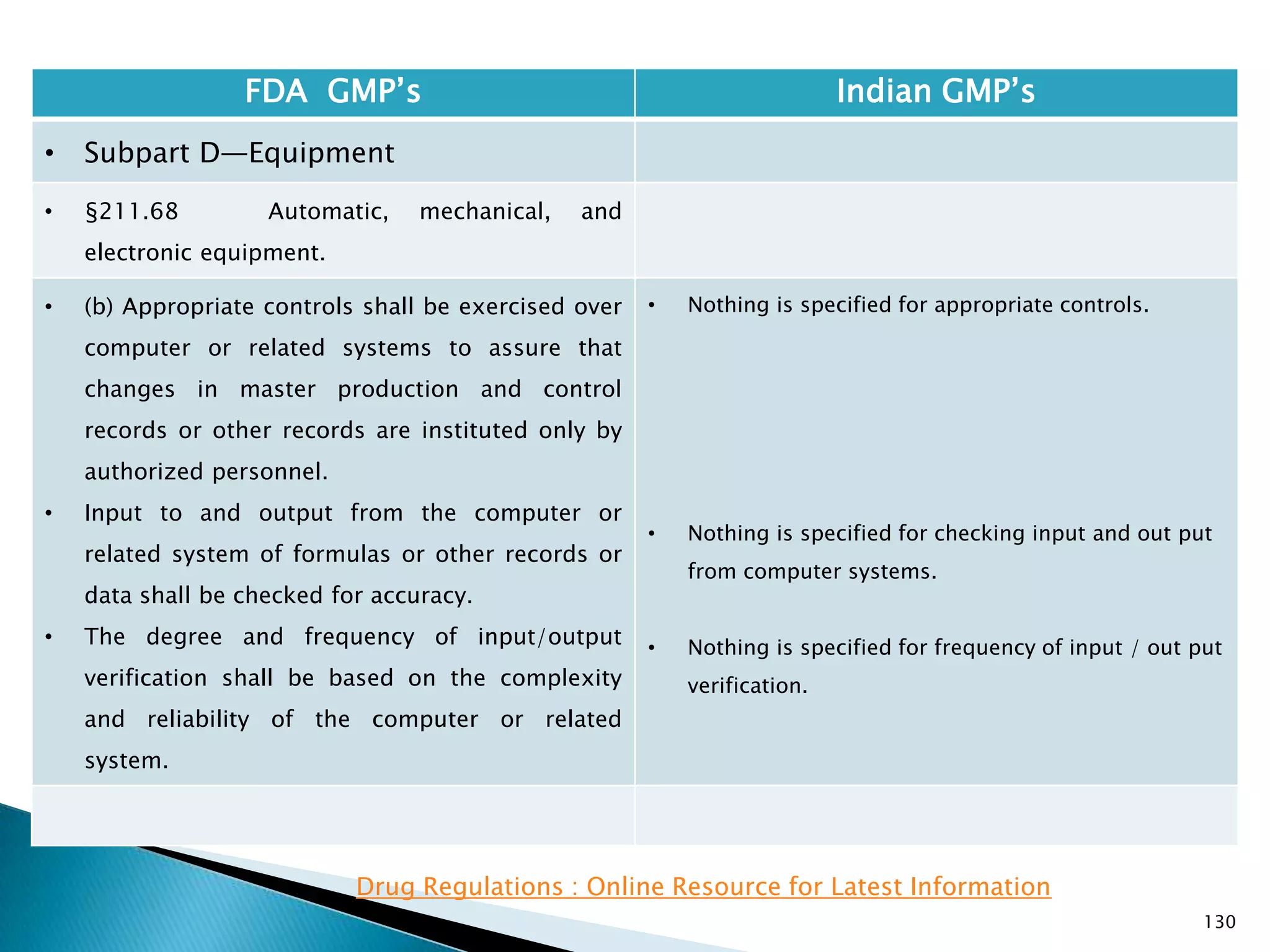
5. Requirement that input to and output from the
computer or related system of formulas or other
records or data shall be checked for accuracy is
not specified. ( 211.68 (b) )
 Requirement that the degree and frequency of
input/output verification shall be based on the
complexity and reliability of the computer or related
system is not specified. ( 211.68 (b) )
Drug Regulations : Online Resource for Latest Information
15
 Subpart D—Equipment
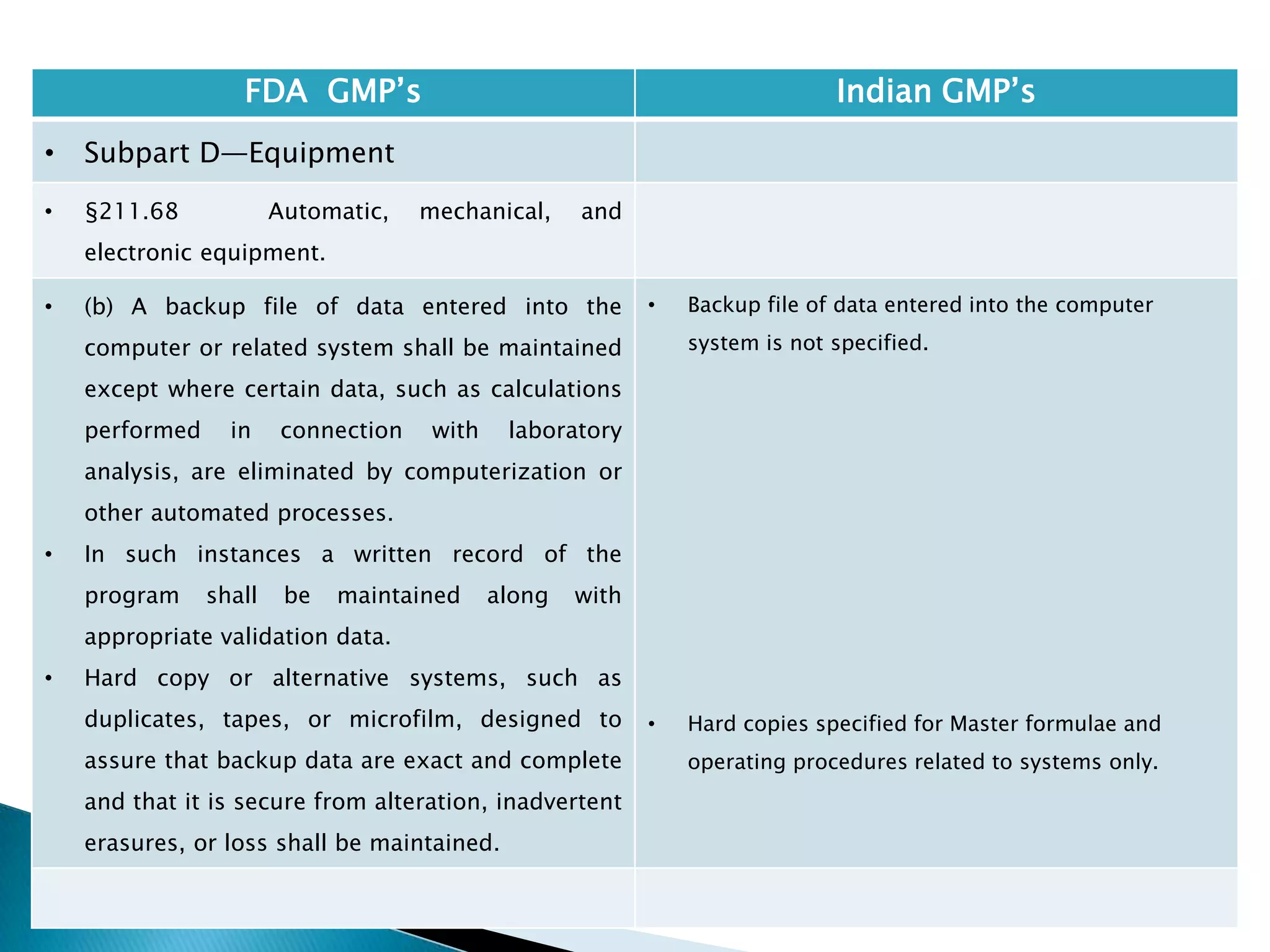
 Requirement that a backup file of data entered into the computer or related
system shall be maintained except where certain data, such as calculations
performed in connection with laboratory analysis, are eliminated by
computerization or other automated processes is not specified except for
batch records. (211.68 (b) )
 Requirement that in such instances a written record of the program shall be
maintained along with appropriate validation data is not specified.
(211.68 (b) )
 Requirement that hard copy or alternative systems, such as duplicates,
tapes, or microfilm, designed to assure that backup data are exact and
complete and that it is secure from alteration, inadvertent erasures, or loss
shall be maintained is not specified. (211.68 (b) )
Drug Regulations : Online Resource for Latest Information
16
 Subpart D—Equipment
6. Requirement that fiber-releasing filters may be used when it is
not possible to manufacture such products without the use of
these filters is not specified. ( 211.72)
 Requirement that if use of a fiber-releasing filter is necessary, an
additional nonfiber-releasing filter having a maximum nominal pore
size rating of 0.2 micron (0.45 micron if the manufacturing conditions
so dictate) shall subsequently be used to reduce the content of
particles in the injectable drug product is not specified. ( 211.72)
 Prohibition of asbestos containing filter is not specified. ( 211.72)
Drug Regulations : Online Resource for Latest Information
17
 Subpart E—Control of Components and Drug Product
Containers and Closures
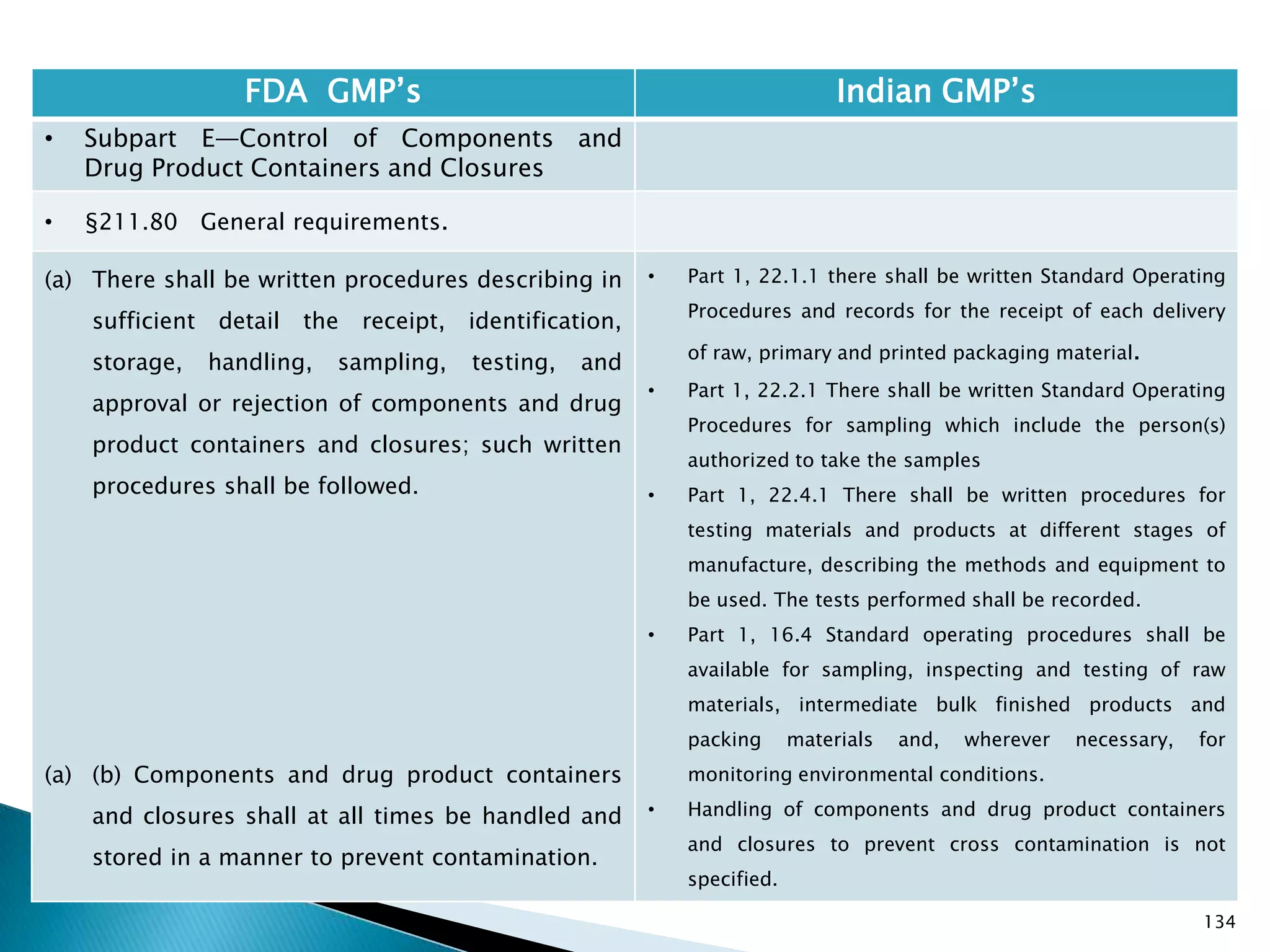
1. Handling of components and drug product
containers and closures to prevent cross
contamination is not specified. ( 211.80 (b) )
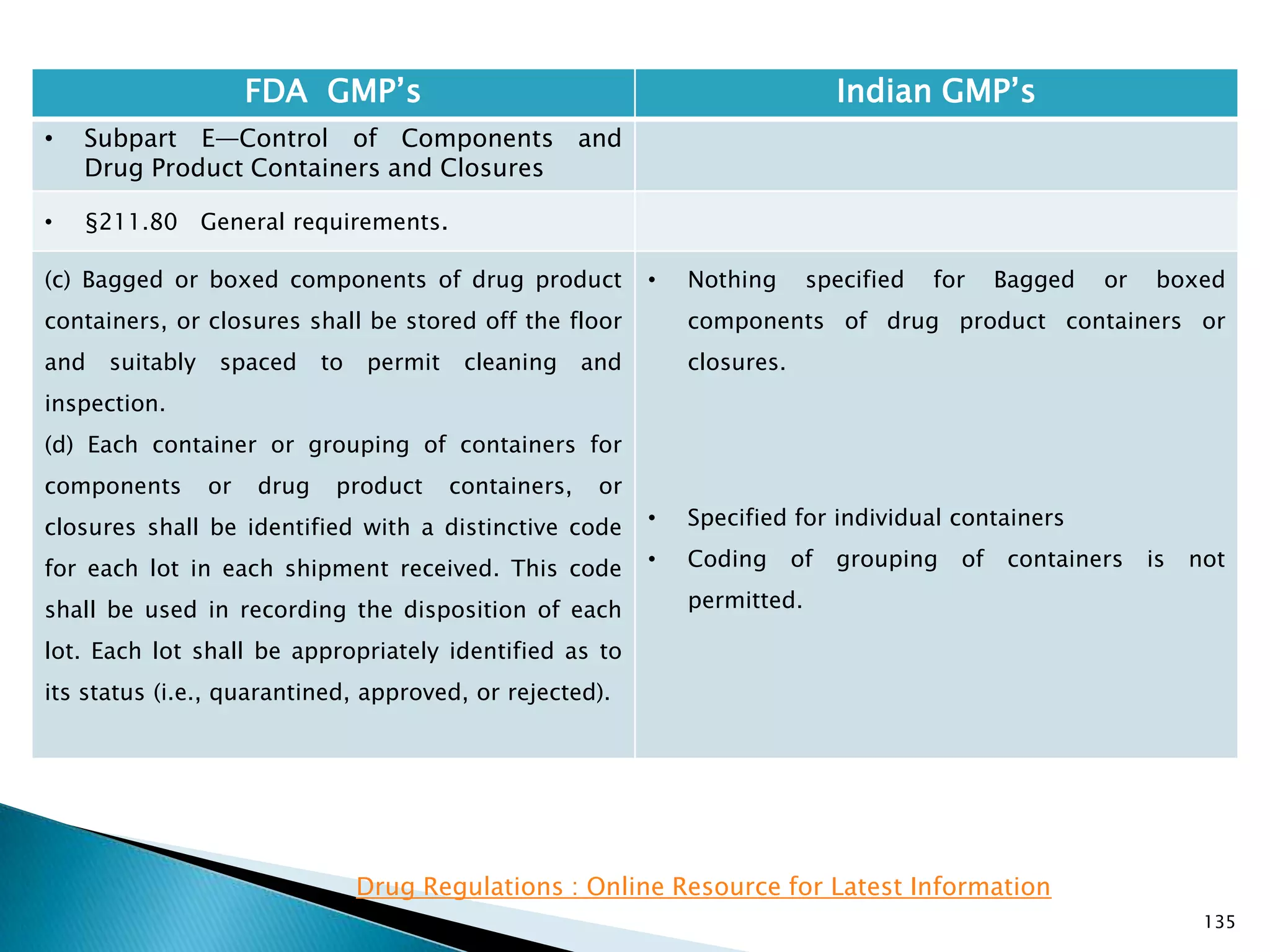
2. Coding of grouping of containers is not
permitted. ( 211.80 (d) )
Drug Regulations : Online Resource for Latest Information
18
 Subpart E—Control of Components and Drug Product Containers
and Closures
3. Requirement of checking appropriate labeling as to
contents and contaminations as well checking of
grouping of containers is not specified. Checking is
specified for the integrity of the package and seal only
and that too for individual containers only. (211.82 ( a)
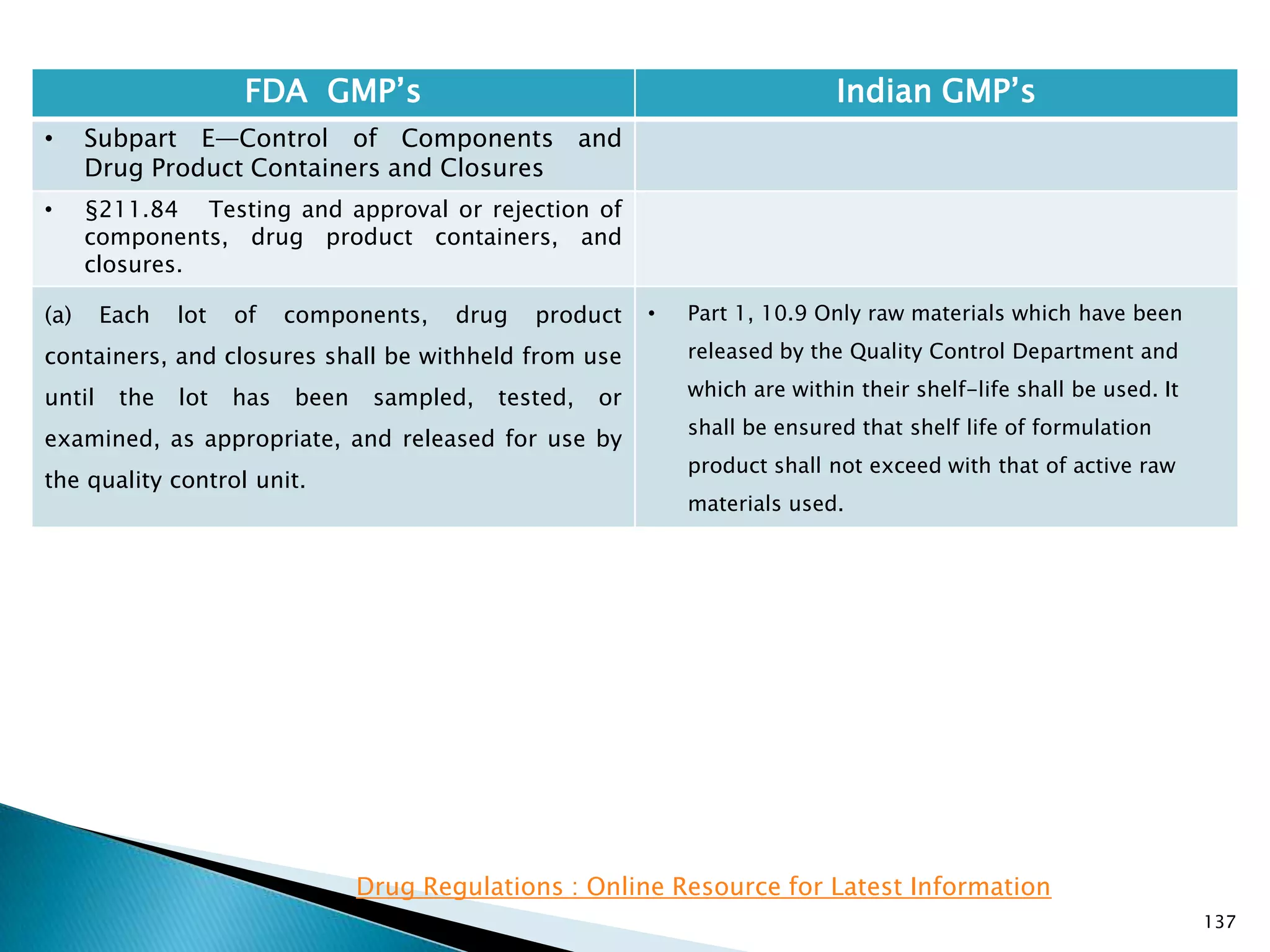
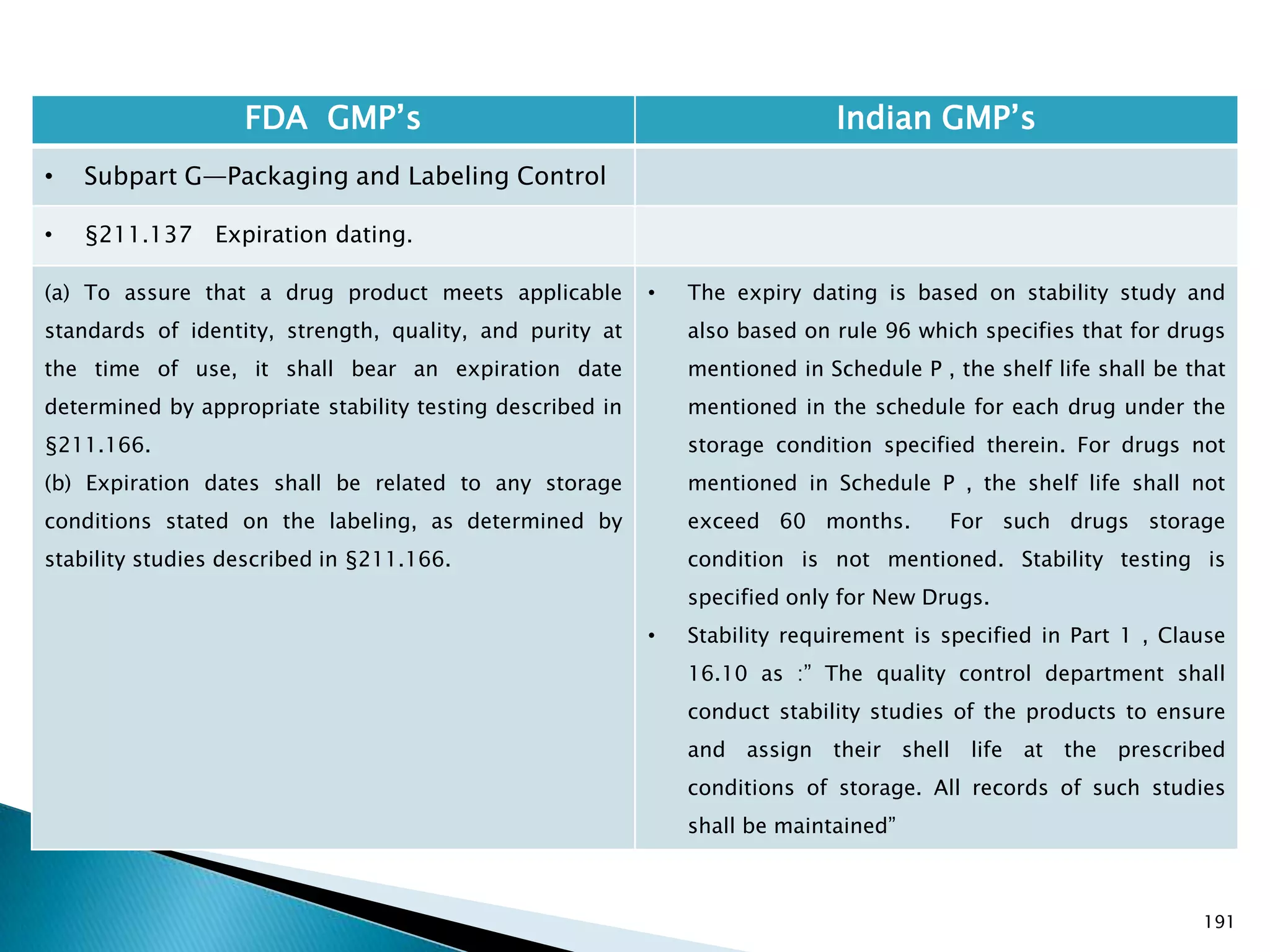
4. The finished product shelf life can not exceed the shelf
life of the starting or input materials ( Both Active &
Inactive) is specified. ( 211.84 (a) )
Drug Regulations : Online Resource for Latest Information
19
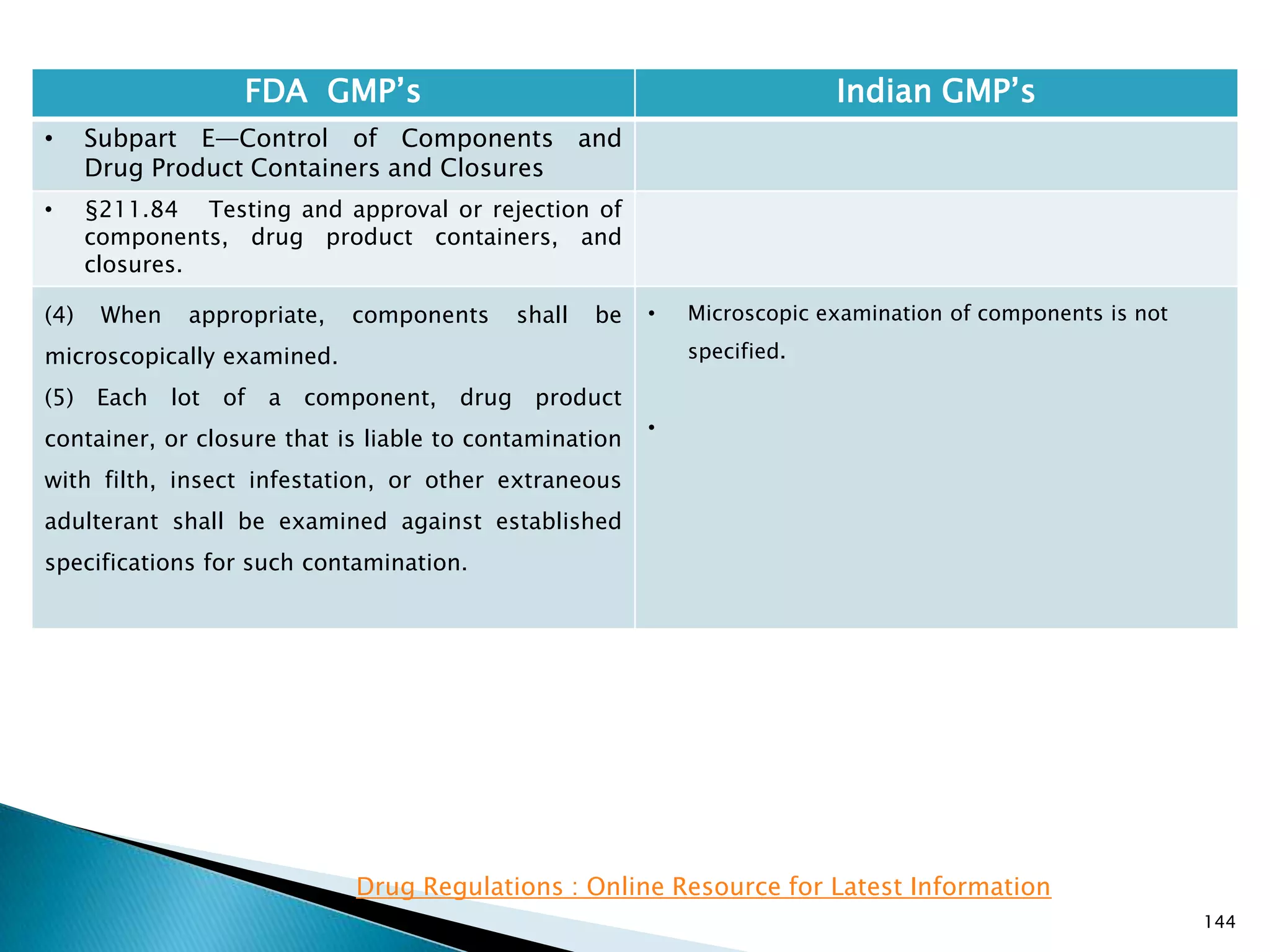
 Subpart E—Control of Components and Drug Product Containers and Closures
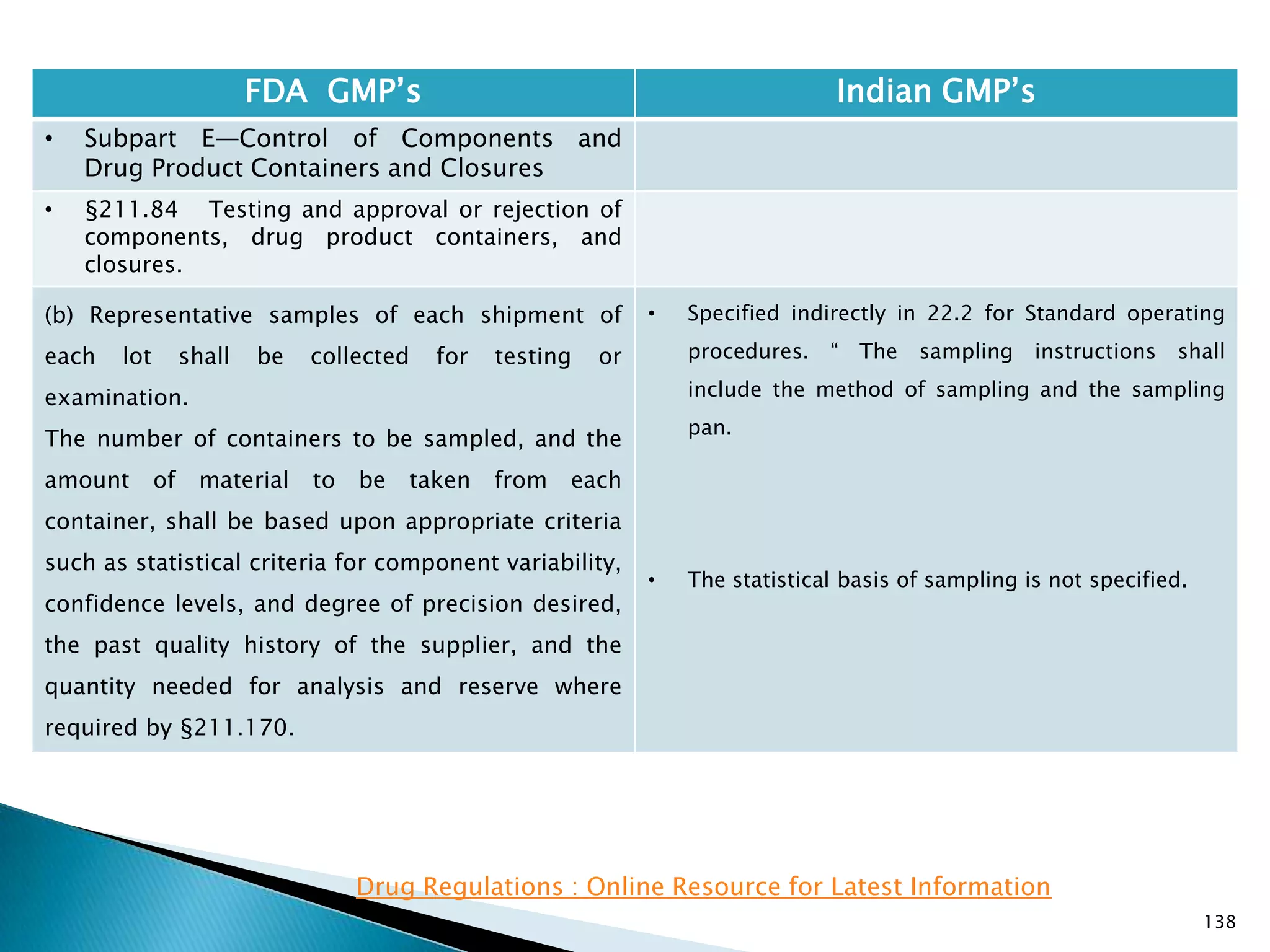
6. Requirement that the number of containers to be sampled, and the
amount of material to be taken from each container, shall be based upon
appropriate criteria such as statistical criteria for component variability,
confidence levels, and degree of precision desired, the past quality
history of the supplier, and the quantity needed for analysis and reserve
where required is not specified. ( 211.84 ( b) ).
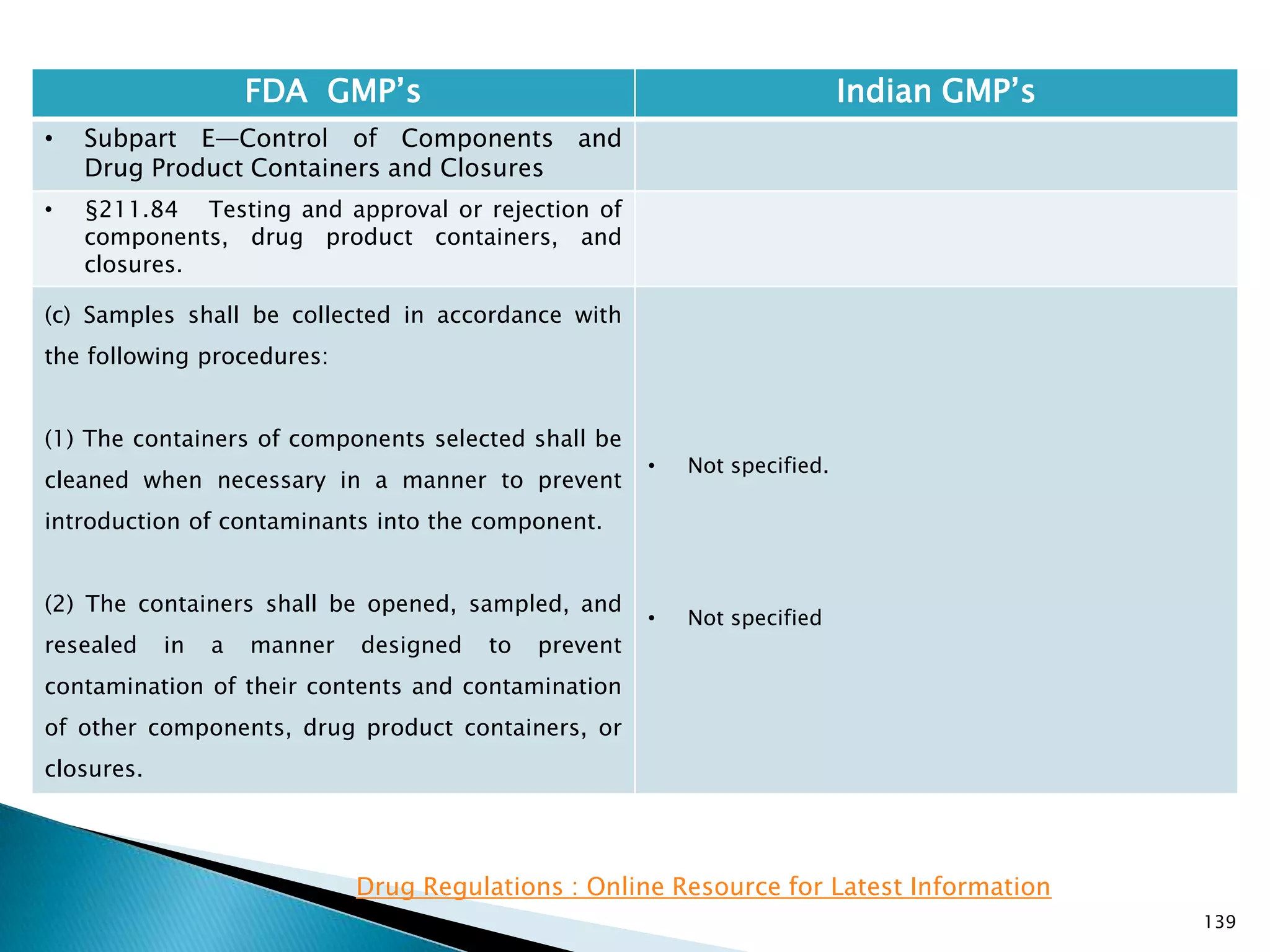
7. Requirement that samples shall be collected in accordance with the
following procedures is not specified: ( 211.84 ( c) )
◦ (1) The containers of components selected shall be cleaned when
necessary in a manner to prevent introduction of contaminants into the
component is not specified.
Drug Regulations : Online Resource for Latest Information
20
 Subpart E—Control of Components and Drug Product Containers and Closures
7. (c) Samples shall be collected in accordance with the following
procedures is not specified: ( 211.84 ( c) )
◦ (2) The containers shall be opened, sampled, and resealed in a
manner designed to prevent contamination of their contents and
contamination of other components, drug product containers, or
closures is not specifed.
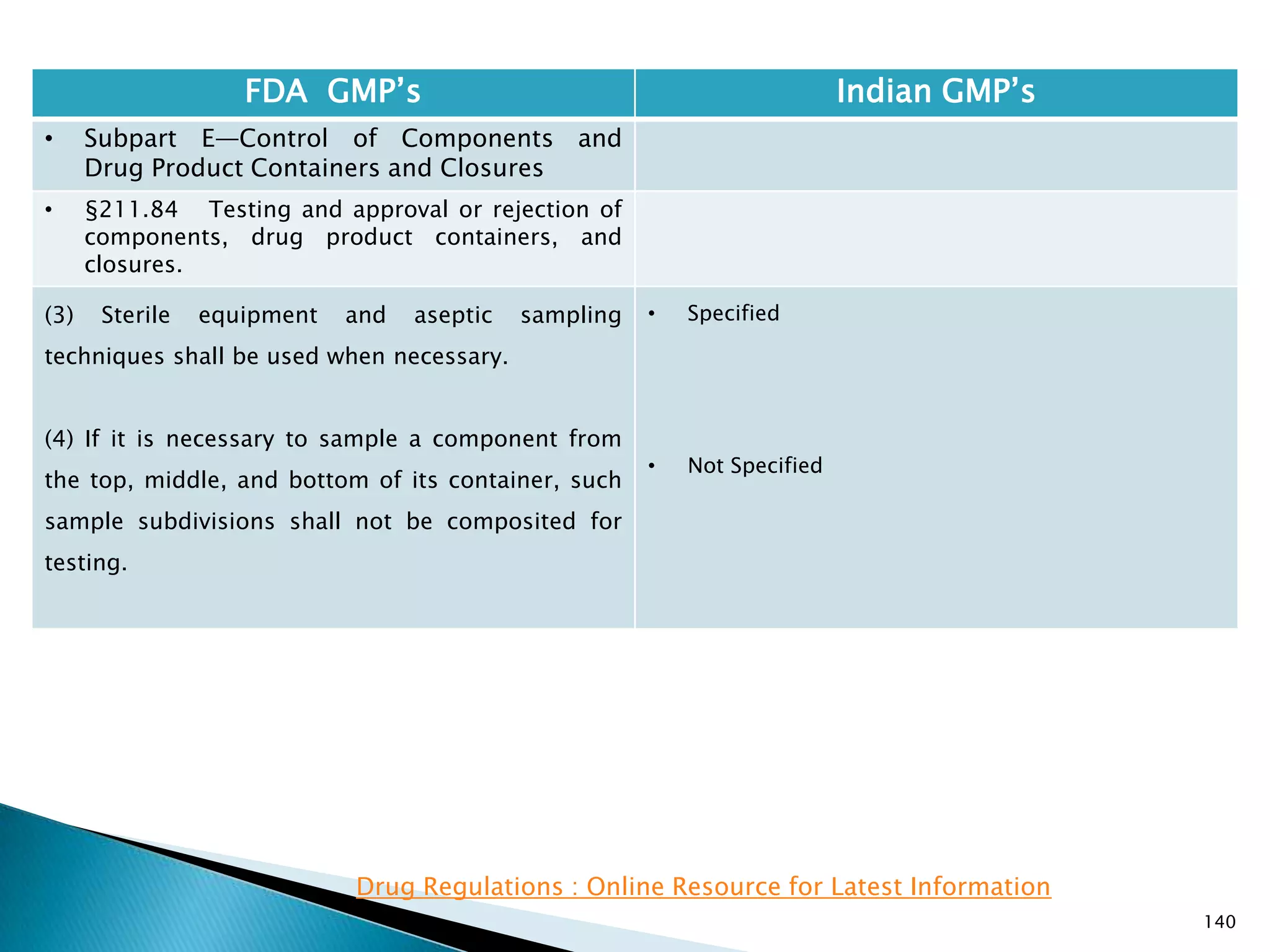
◦ (3) If it is necessary to sample a component from the top,
middle, and bottom of its container, such sample subdivisions
shall not be composited for testing is not specified.
Drug Regulations : Online Resource for Latest Information
21
 Subpart E—Control of Components and Drug Product Containers
and Closures
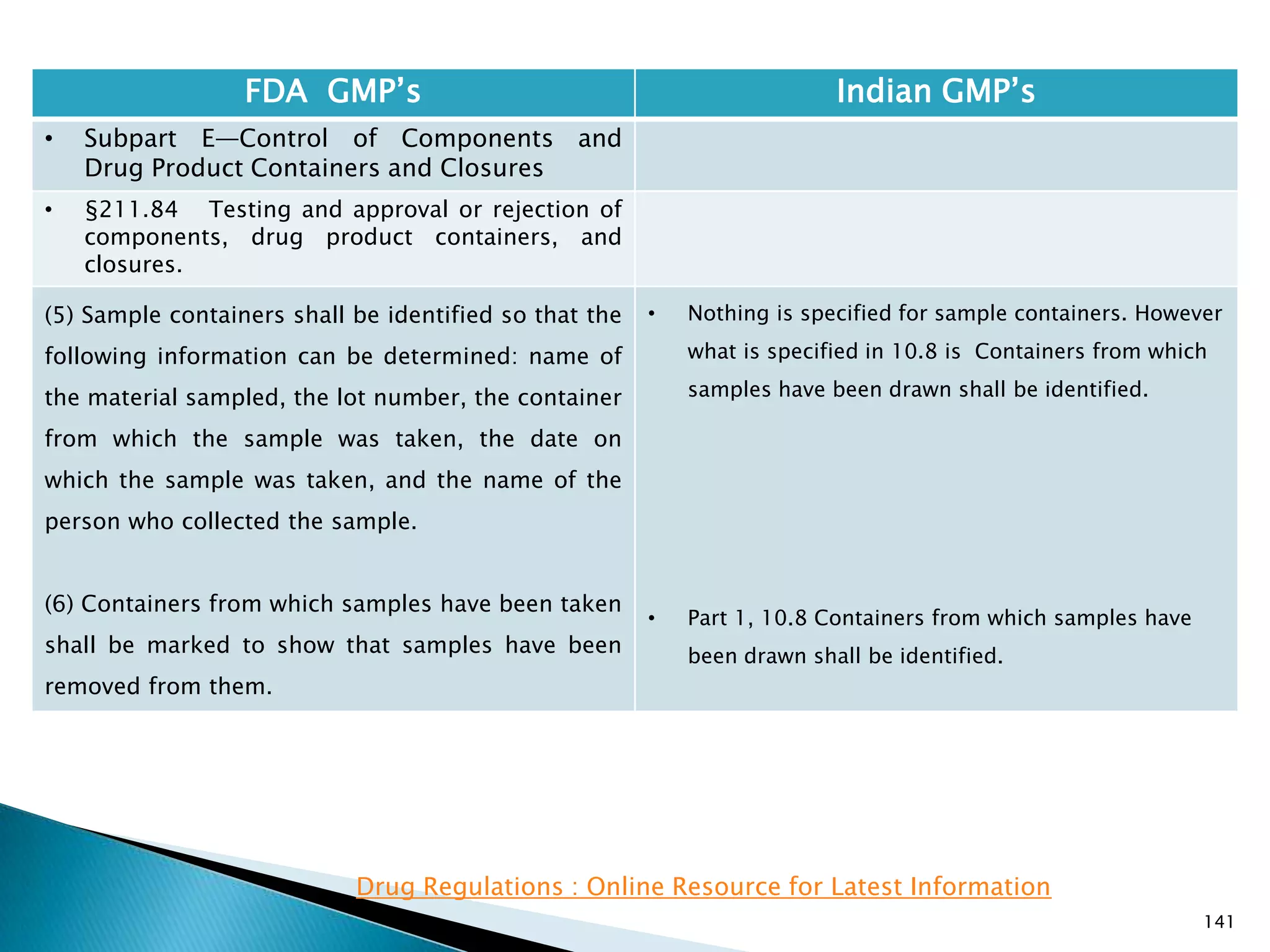
7. (c) Samples shall be collected in accordance with the
following procedures is not specified:
◦ (4) Sample containers shall be identified so that the
following information can be determined: name of the
material sampled, the lot number, the container from
which the sample was taken, the date on which the
sample was taken, and the name of the person who
collected the sample is not specified.
Drug Regulations : Online Resource for Latest Information
22
 Subpart E—Control of Components and Drug Product Containers and Closures
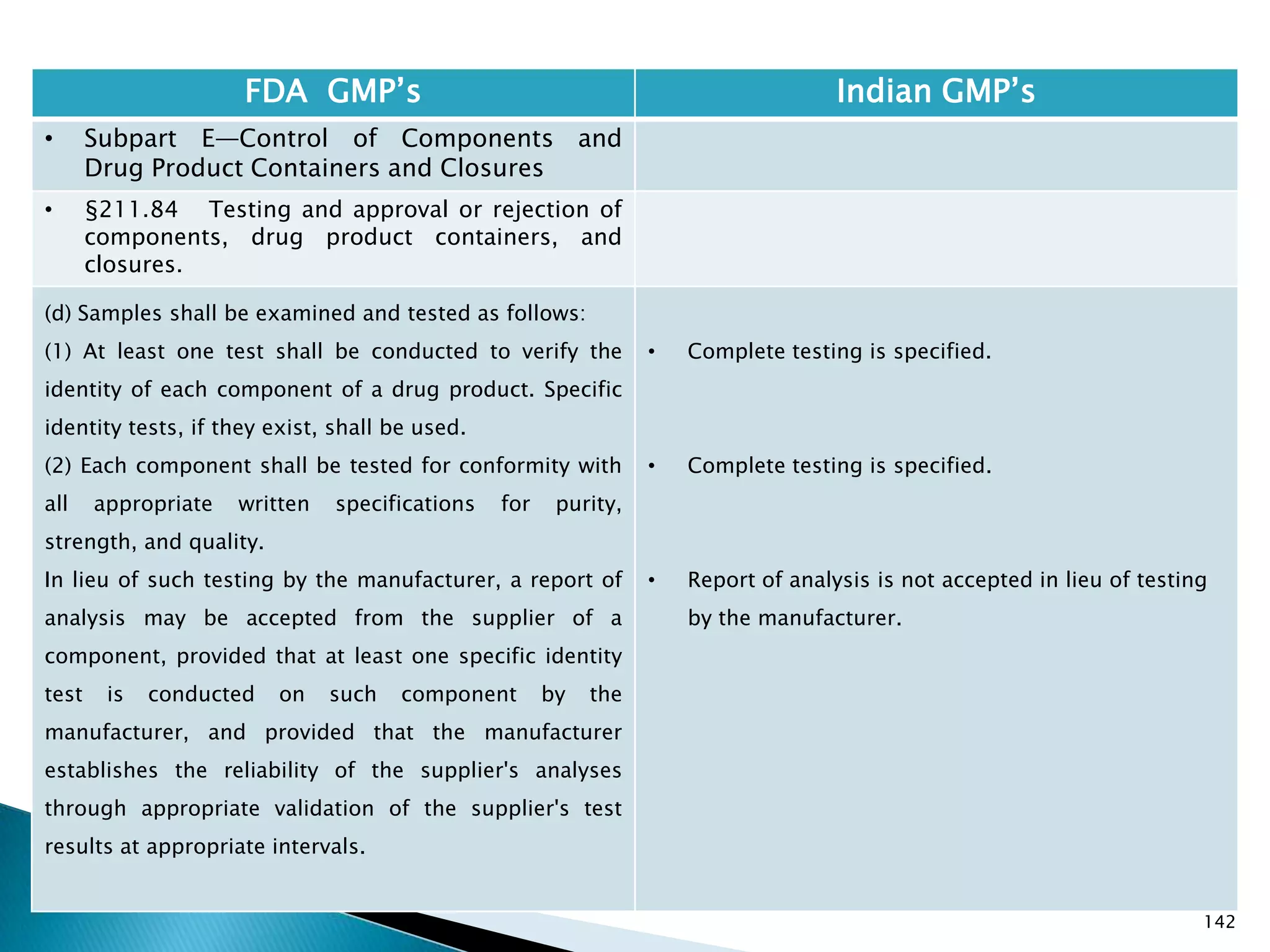
8. In lieu of testing of components by the manufacturer, a report of analysis
may be accepted from the supplier of a component, provided that at least
one specific identity test is conducted on such component by the
manufacturer, and provided that the manufacturer establishes the
reliability of the supplier's analyses through appropriate validation of the
supplier's test results at appropriate intervals is not specified. ( 211.84
(d) (2))
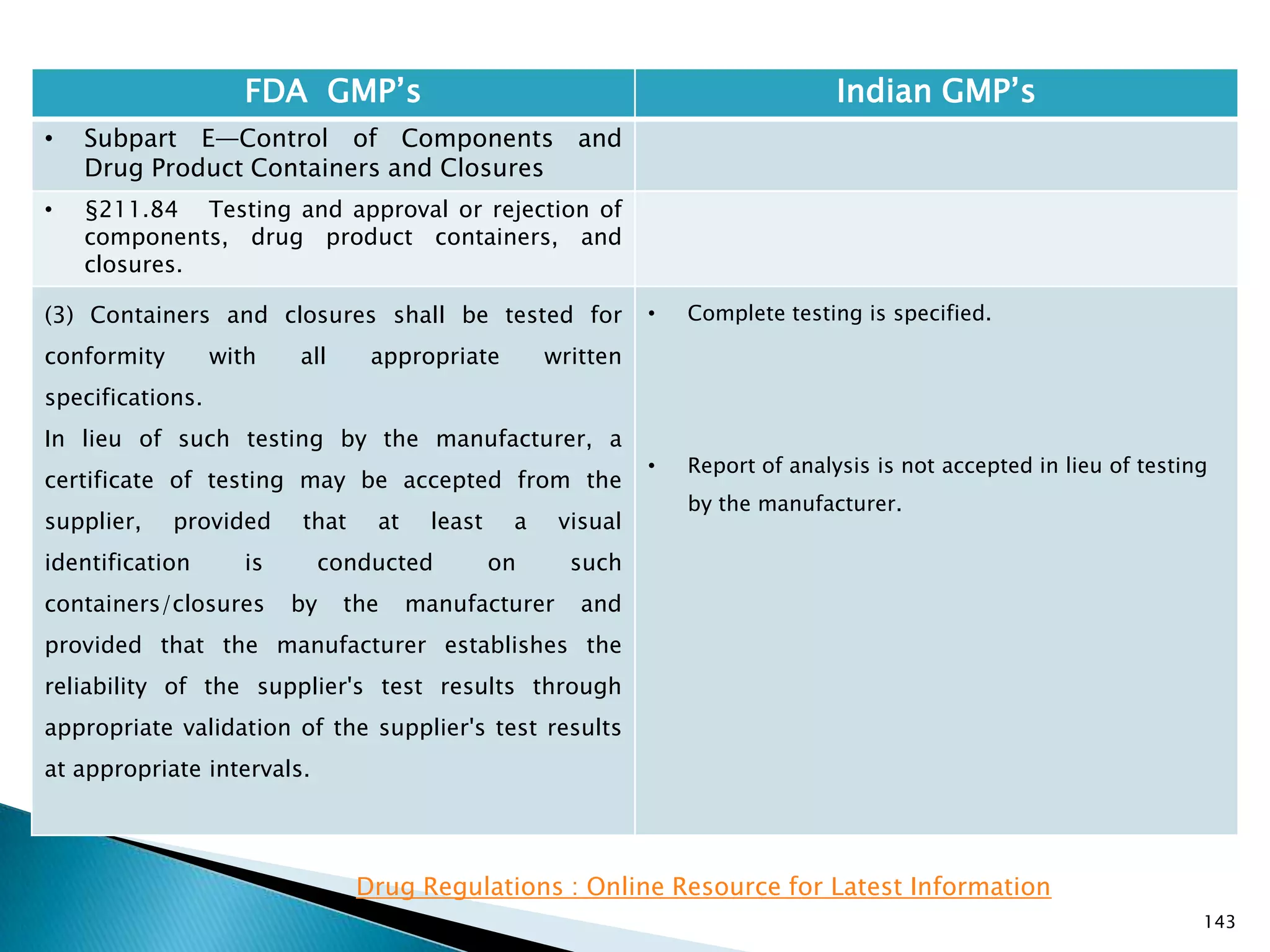
9. In lieu of such testing by the manufacturer, a certificate of testing may be
accepted from the supplier, provided that at least a visual identification is
conducted on such containers/closures by the manufacturer and provided
that the manufacturer establishes the reliability of the supplier's test
results through appropriate validation of the supplier's test results at
appropriate intervals is not specified. ( 211.84 (d) (3))
23
 Subpart E—Control of Components and Drug Product Containers
and Closures
10. When appropriate, components shall be
microscopically examined is not specified
( 211.84 (d) (4))
11. Each lot of a component, drug product container, or
closure that is liable to contamination with filth, insect
infestation, or other extraneous adulterant shall be
examined against established specifications for such
contamination is not specified. ( 211.84 (d) (5))
24
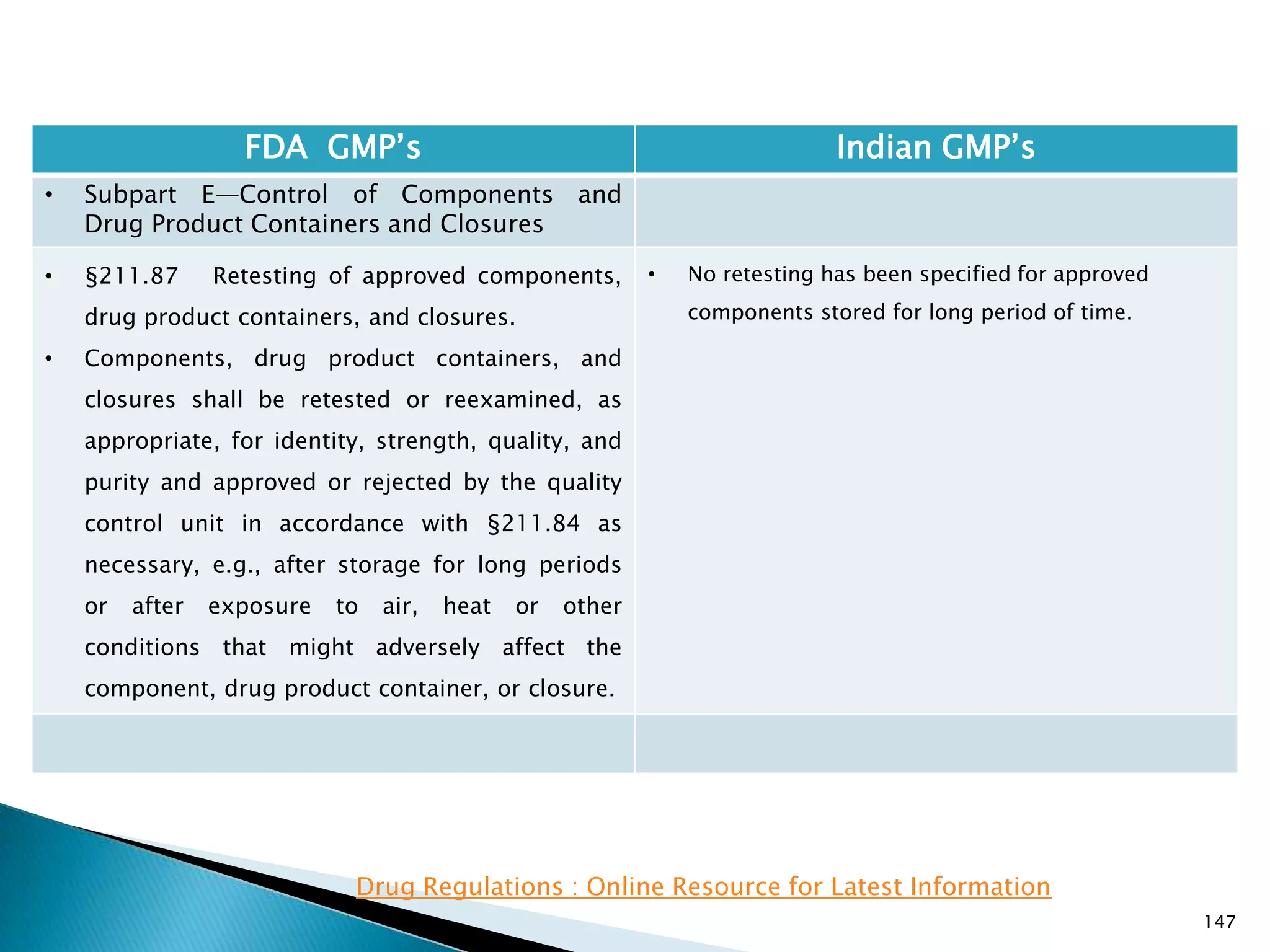
 Subpart E—Control of Components and Drug Product Containers
and Closures
12. Retesting or re examination of components, drug
product containers, and closures as appropriate, for
identity, strength, quality, and purity and approved or
rejected by the quality control unit in accordance with
§211.84 as necessary, e.g., after storage for long
periods or after exposure to air, heat or other
conditions that might adversely affect the component,
drug product container, or closure is not
specified.(211.87)
25
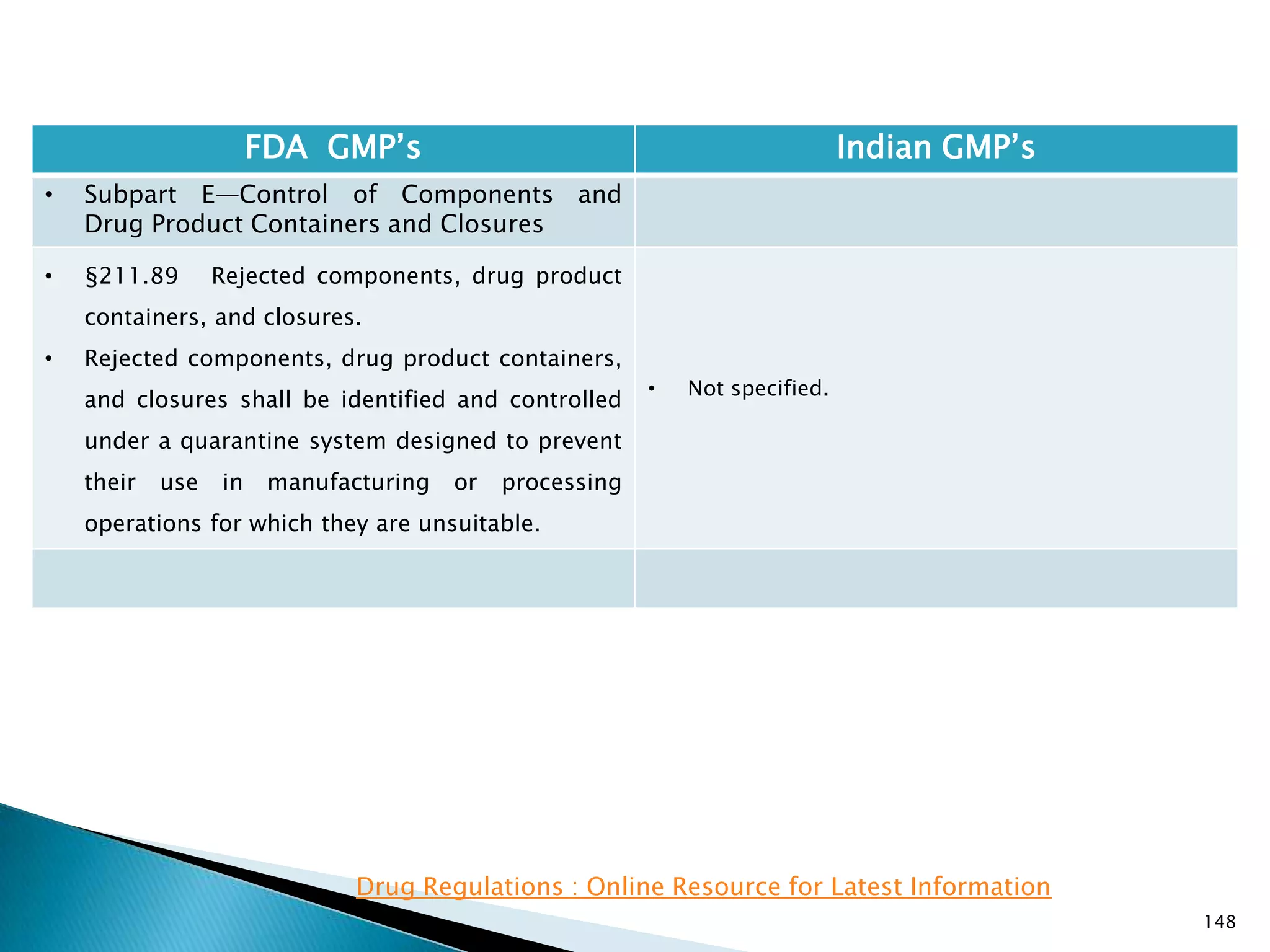
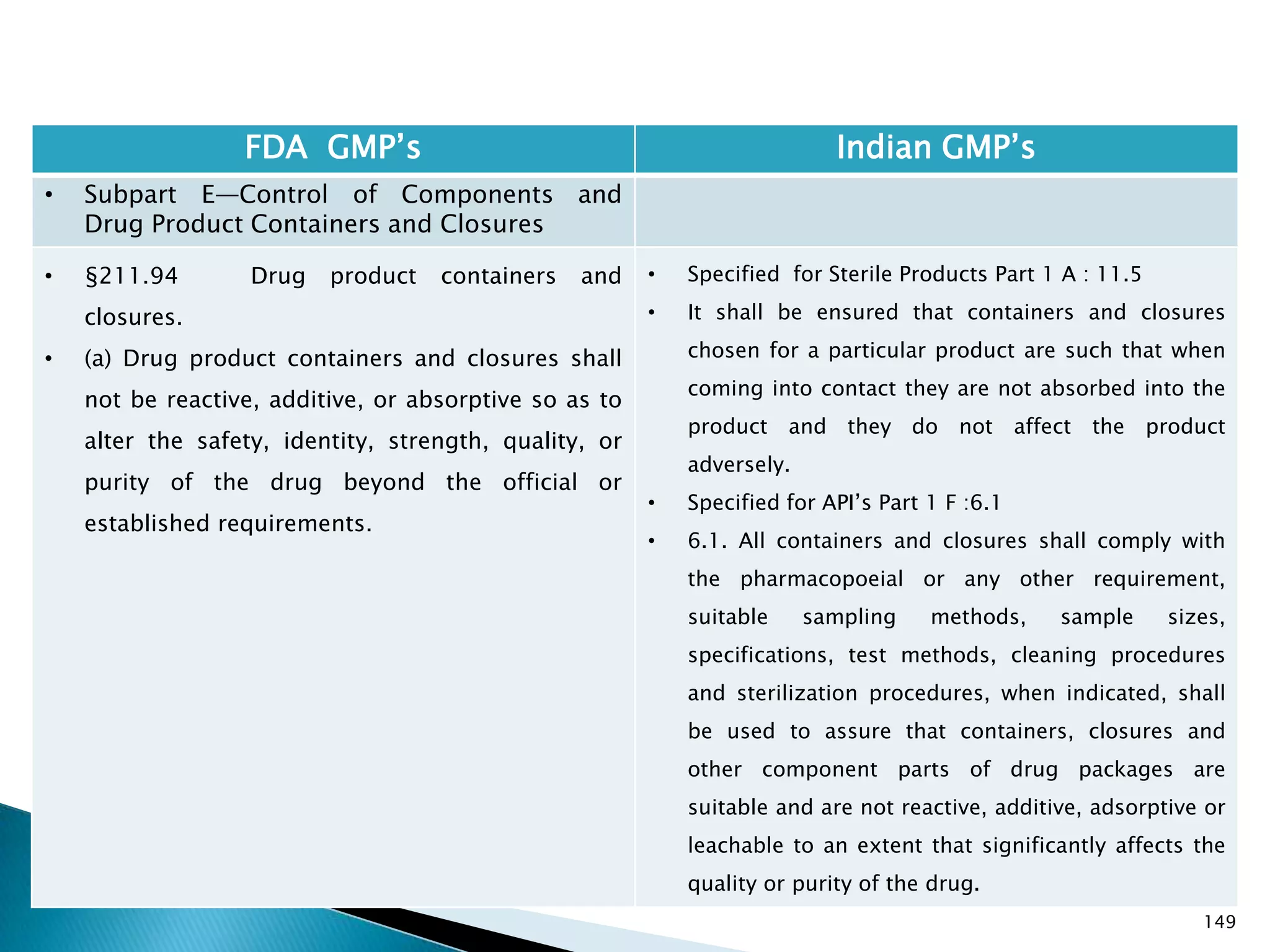
 Subpart E—Control of Components and Drug Product Containers and Closures
13. Rejected components, drug product containers, and closures
shall be identified and controlled under a quarantine system
designed to prevent their use in manufacturing or processing
operations for which they are unsuitable is not specified though
a separate rejected area has been specified. (211.89)
14. Drug product containers and closures shall not be reactive,
additive, or absorptive so as to alter the safety, identity,
strength, quality, or purity of the drug beyond the official or
established requirements is specified only for Sterile products &
API‘s and for no other products. ( 211.94 ( a) )
26
 Subpart E—Control of Components and Drug Product
Containers and Closures
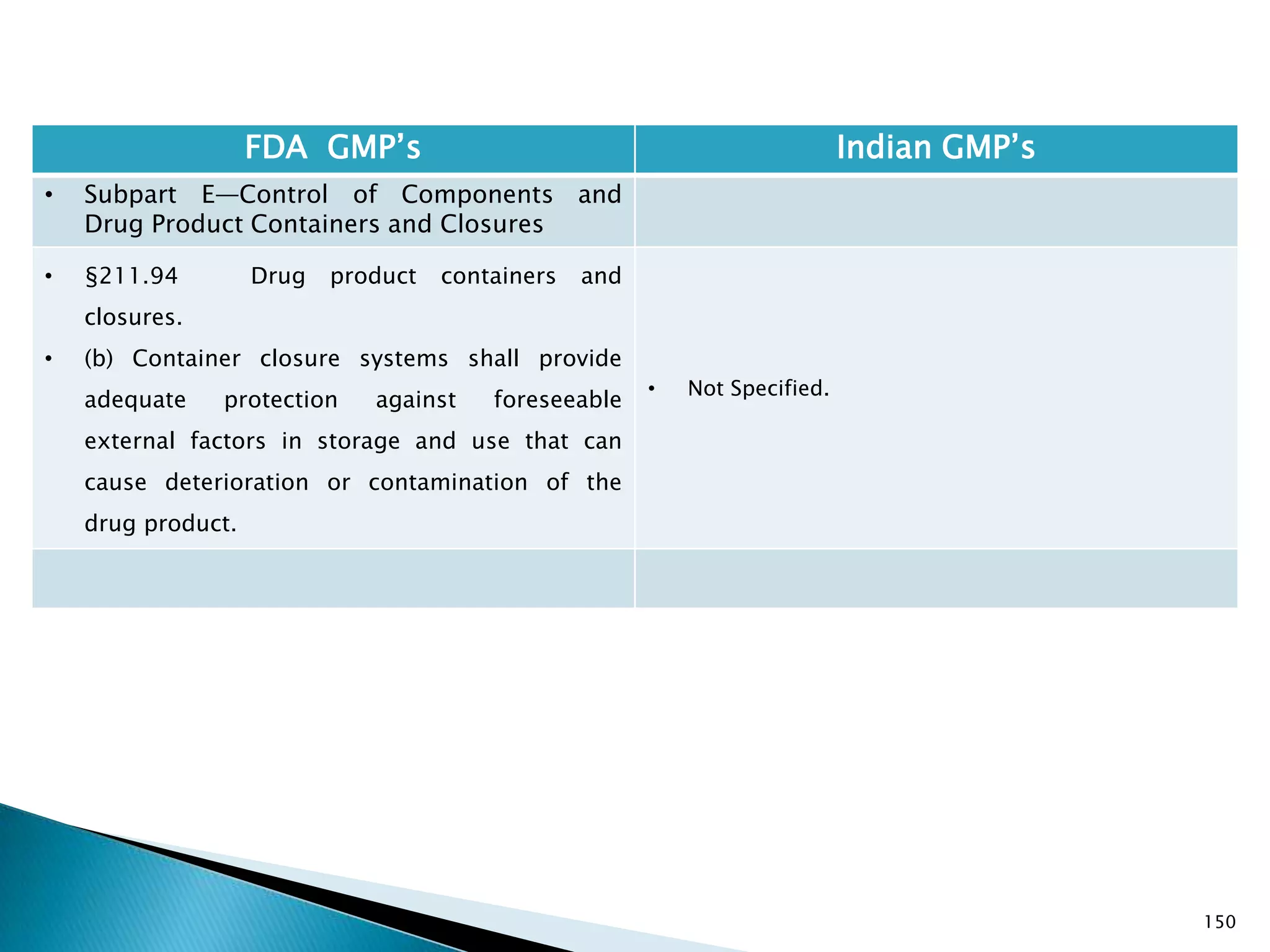
15. Requirement that container closure systems
shall provide adequate protection against
foreseeable external factors in storage and
use that can cause deterioration or
contamination of the drug product is not
specified.( 211.94 (b) )
27
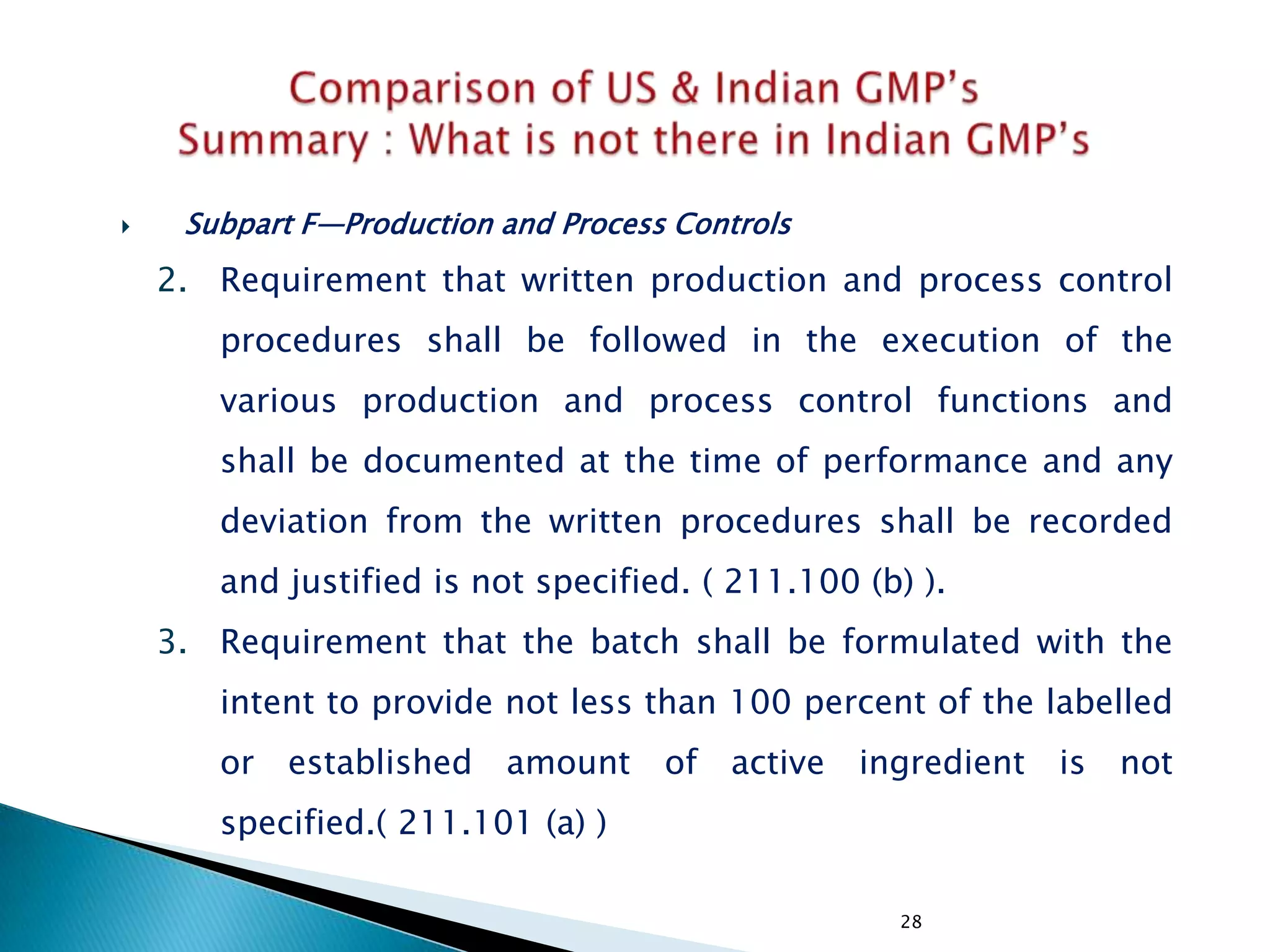
 Subpart F—Production and Process Controls
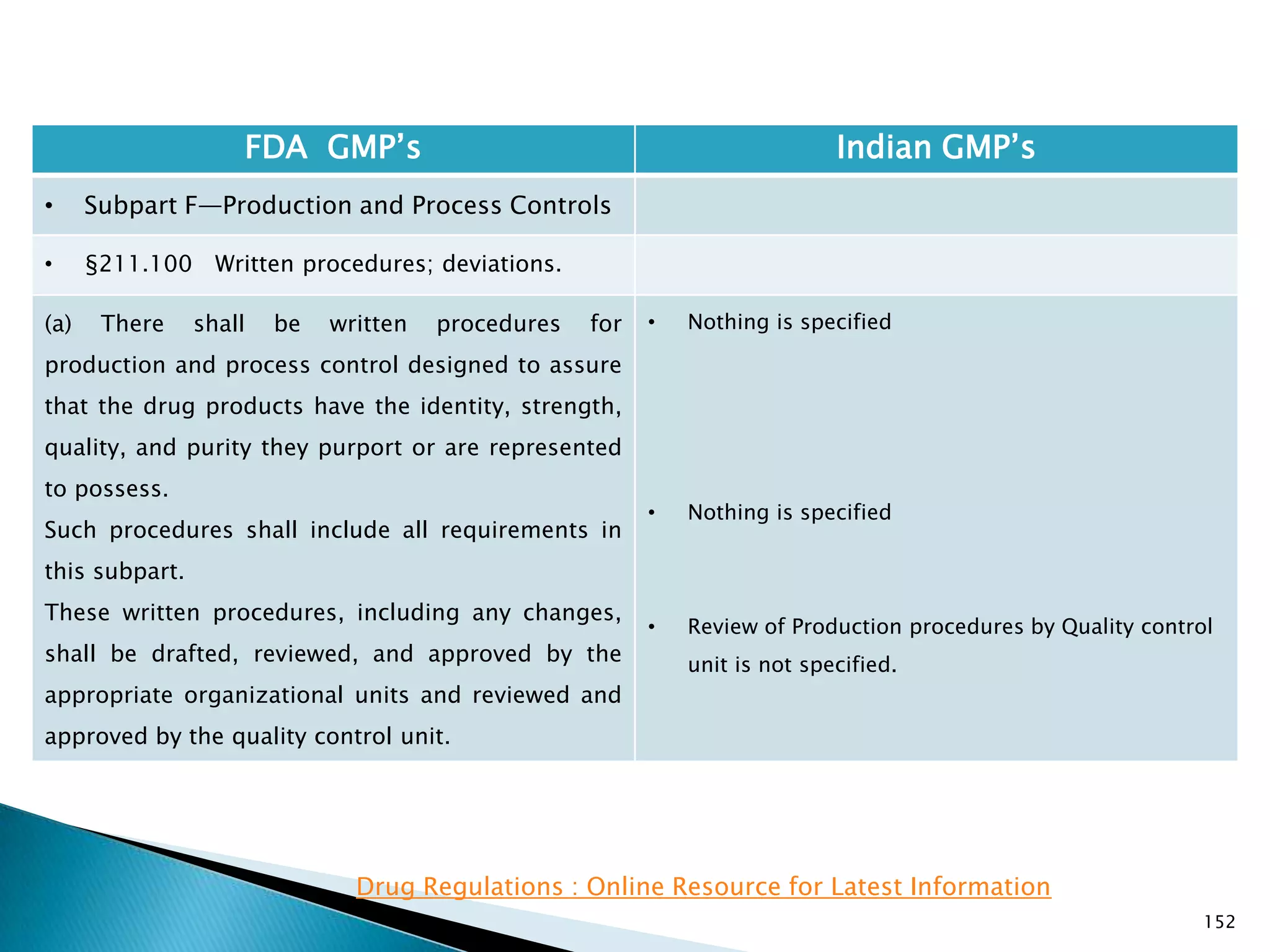
1. Requirement that there shall be written procedures for
production and process control designed to assure that
the drug products have the identity, strength, quality, and
purity they purport or are represented to possess is not
specified. ( 211.100 (a) )
 Requirement that these written procedures, including any
changes, shall be drafted, reviewed, and approved by the
appropriate organizational units and reviewed and approved
by the quality control unit is not specified.
28
 Subpart F—Production and Process Controls
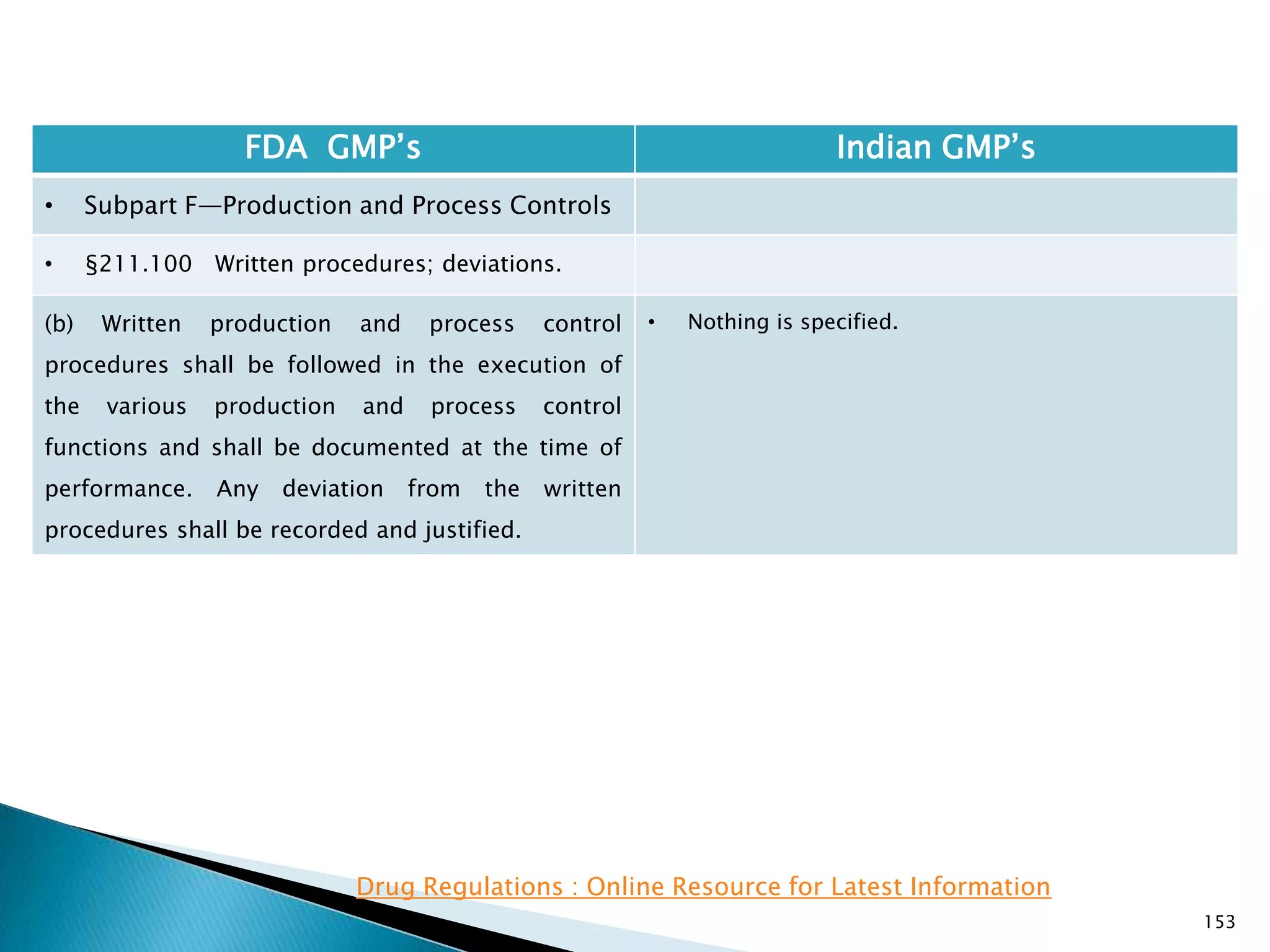
2. Requirement that written production and process control
procedures shall be followed in the execution of the
various production and process control functions and
shall be documented at the time of performance and any
deviation from the written procedures shall be recorded
and justified is not specified. ( 211.100 (b) ).
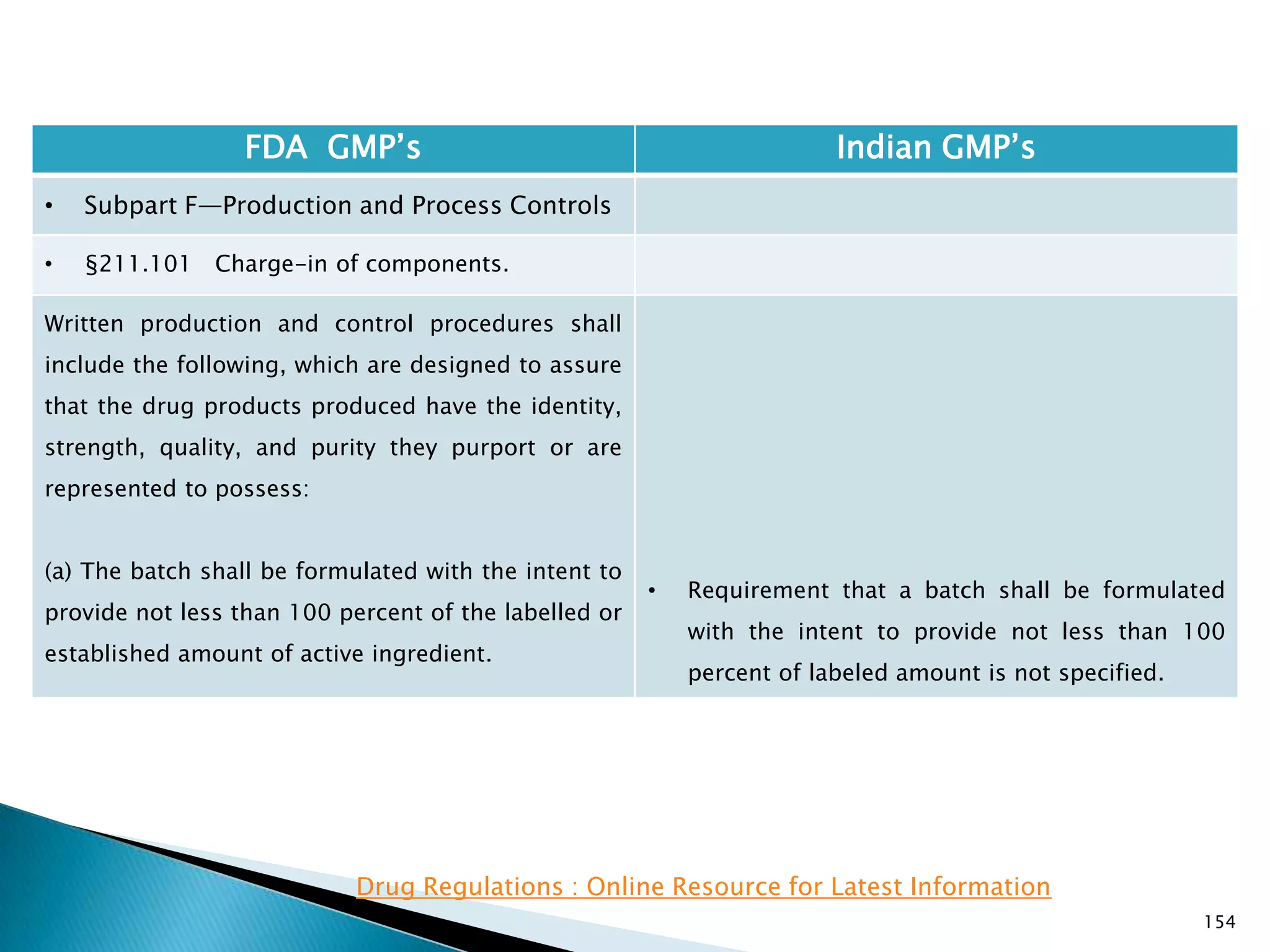
3. Requirement that the batch shall be formulated with the
intent to provide not less than 100 percent of the labelled
or established amount of active ingredient is not
specified.( 211.101 (a) )
29
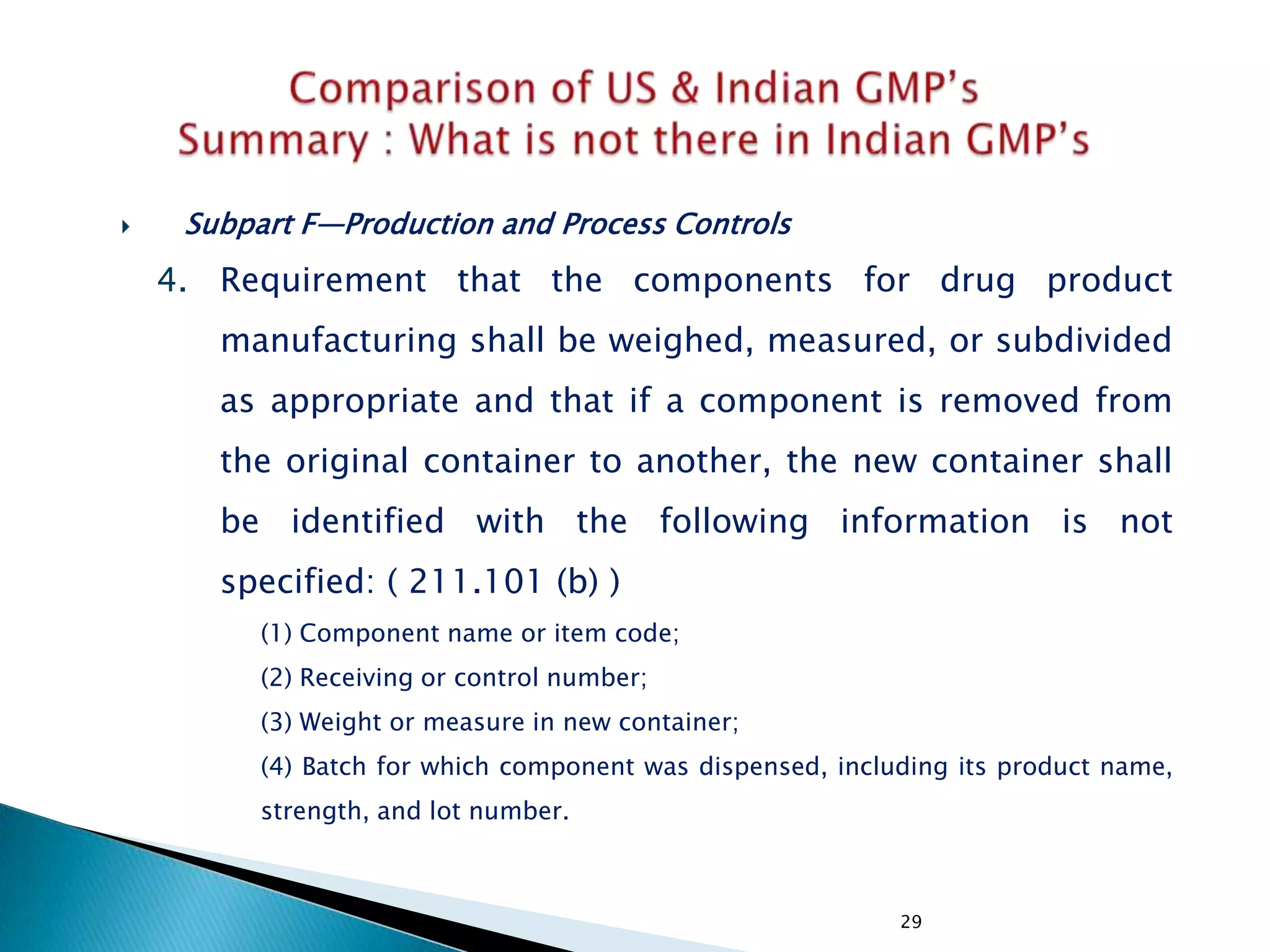
 Subpart F—Production and Process Controls
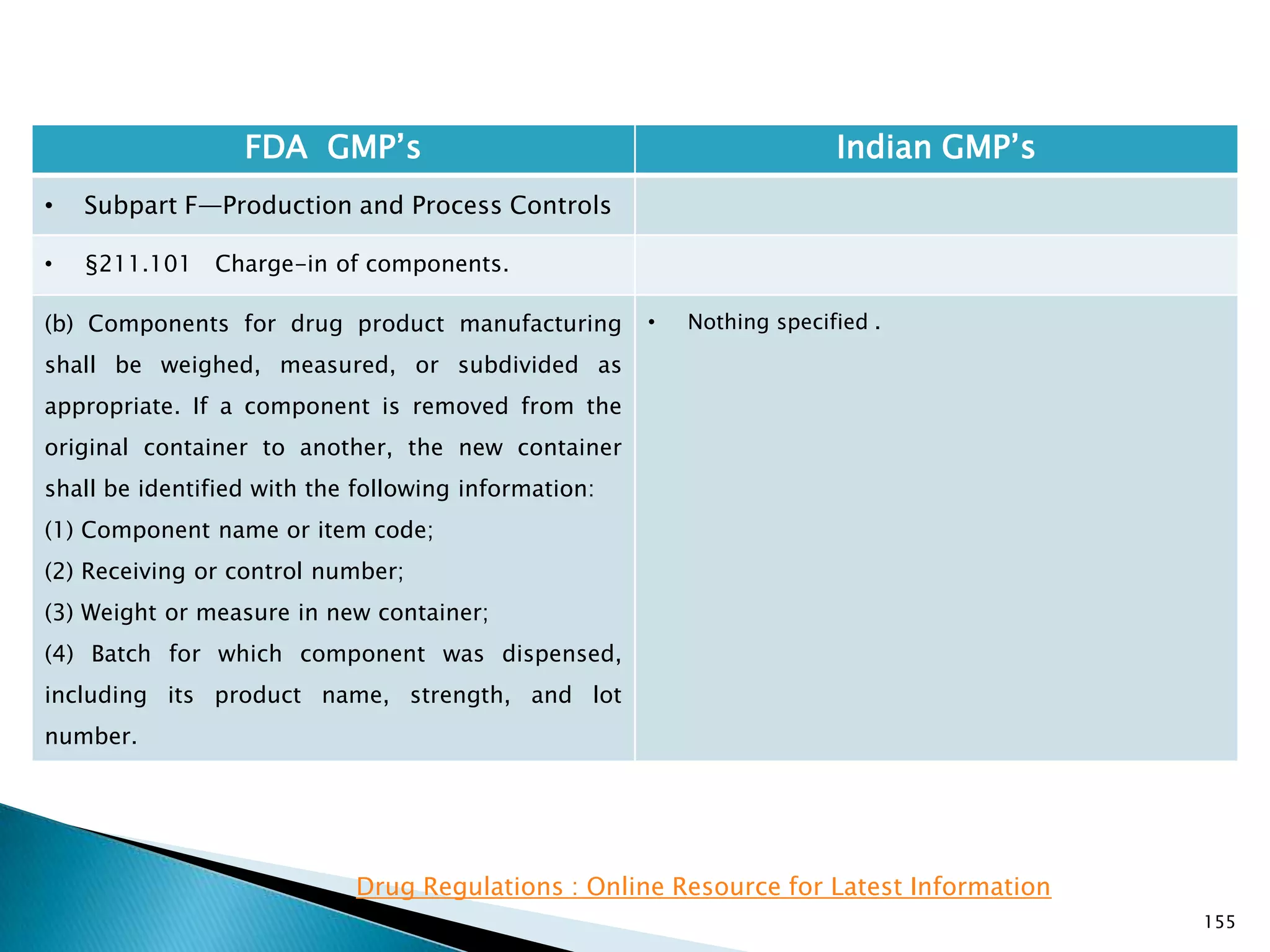
4. Requirement that the components for drug product
manufacturing shall be weighed, measured, or subdivided
as appropriate and that if a component is removed from
the original container to another, the new container shall
be identified with the following information is not
specified: ( 211.101 (b) )
(1) Component name or item code;
(2) Receiving or control number;
(3) Weight or measure in new container;
(4) Batch for which component was dispensed, including its product name,
strength, and lot number.
30
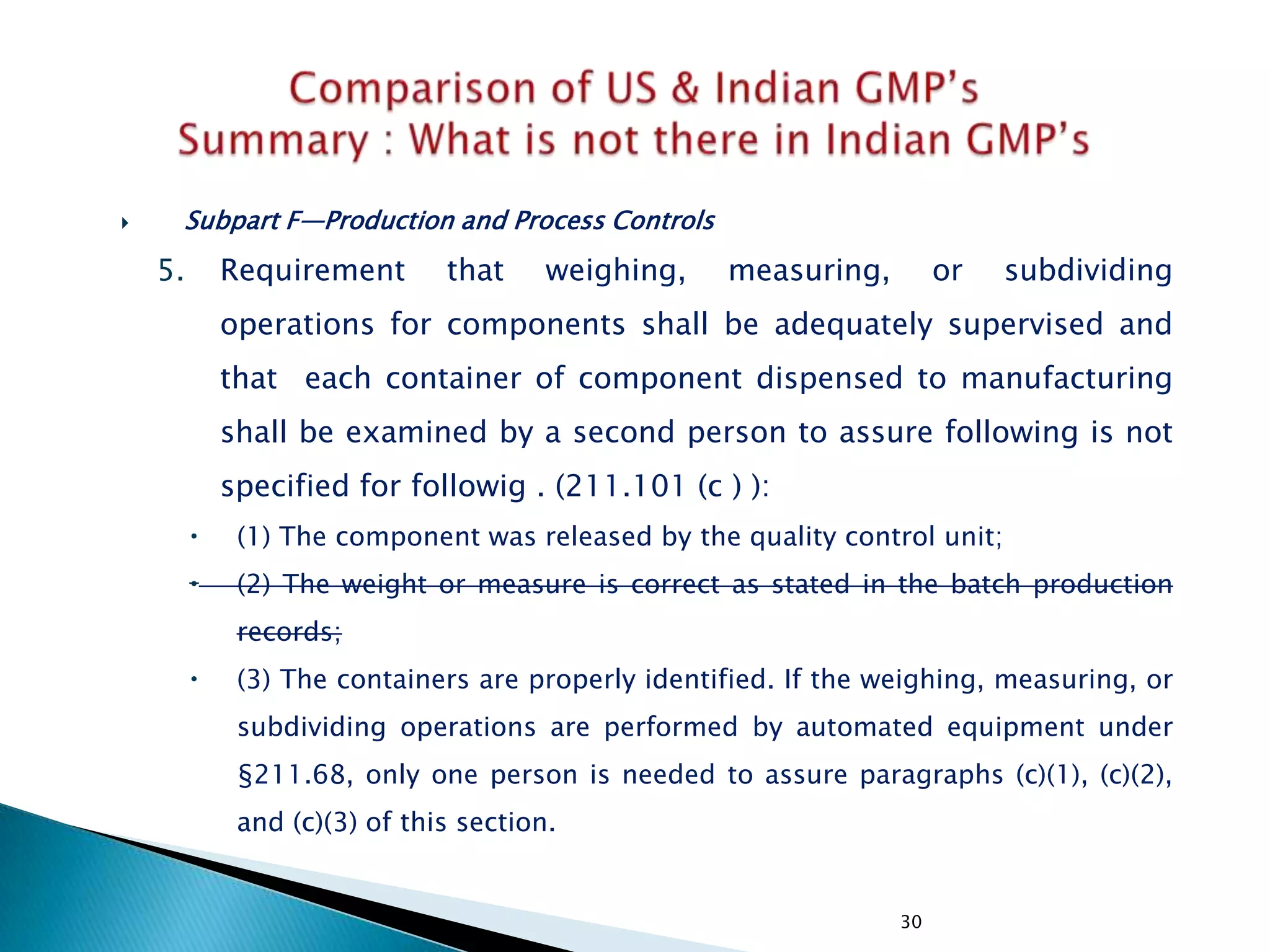
 Subpart F—Production and Process Controls
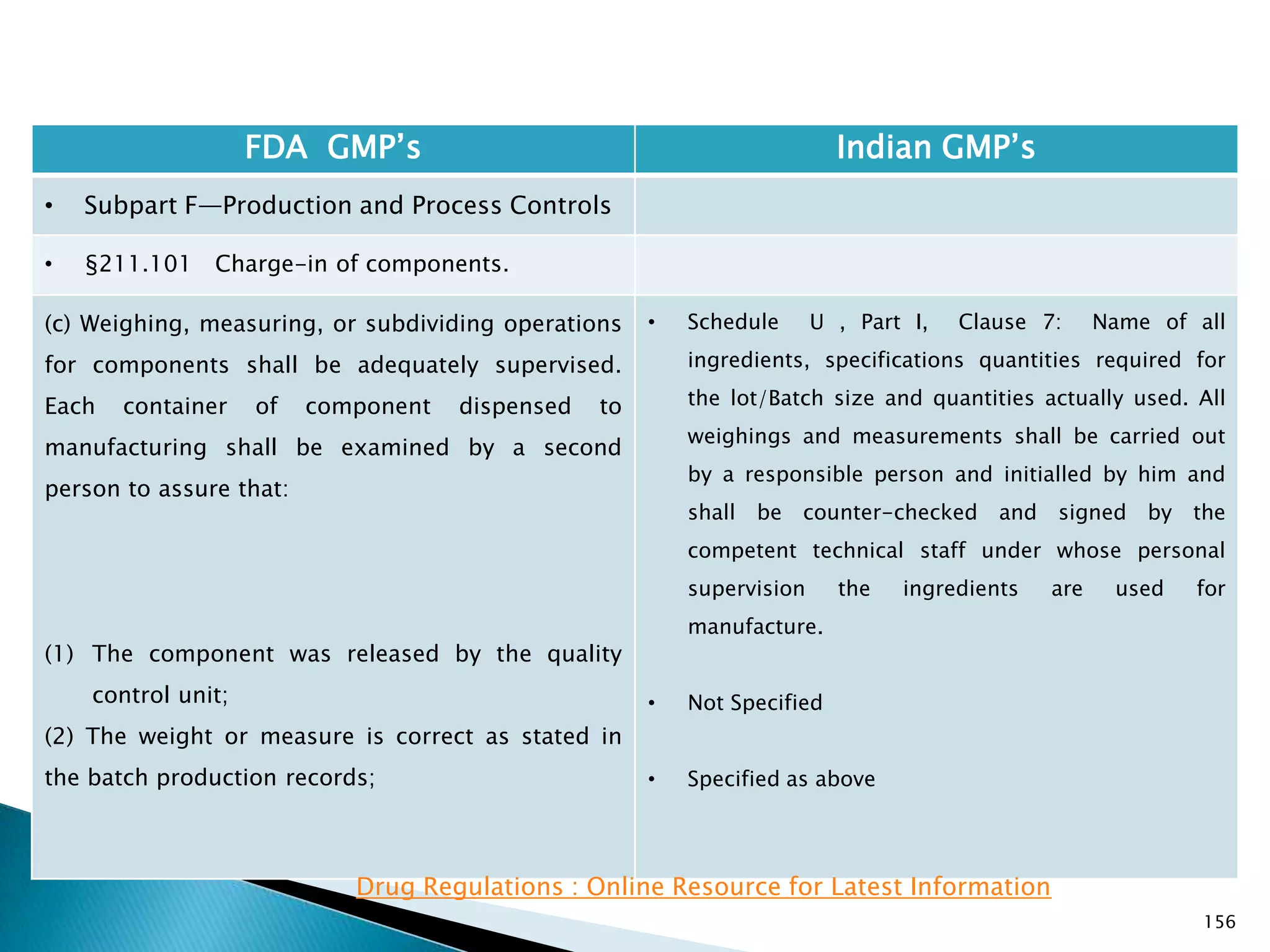
5. Requirement that weighing, measuring, or subdividing
operations for components shall be adequately supervised and
that each container of component dispensed to manufacturing
shall be examined by a second person to assure following is not
specified for followig . (211.101 (c ) ):
 (1) The component was released by the quality control unit;
 (2) The weight or measure is correct as stated in the batch production
records;
 (3) The containers are properly identified. If the weighing, measuring, or
subdividing operations are performed by automated equipment under
§211.68, only one person is needed to assure paragraphs (c)(1), (c)(2),
and (c)(3) of this section.
31
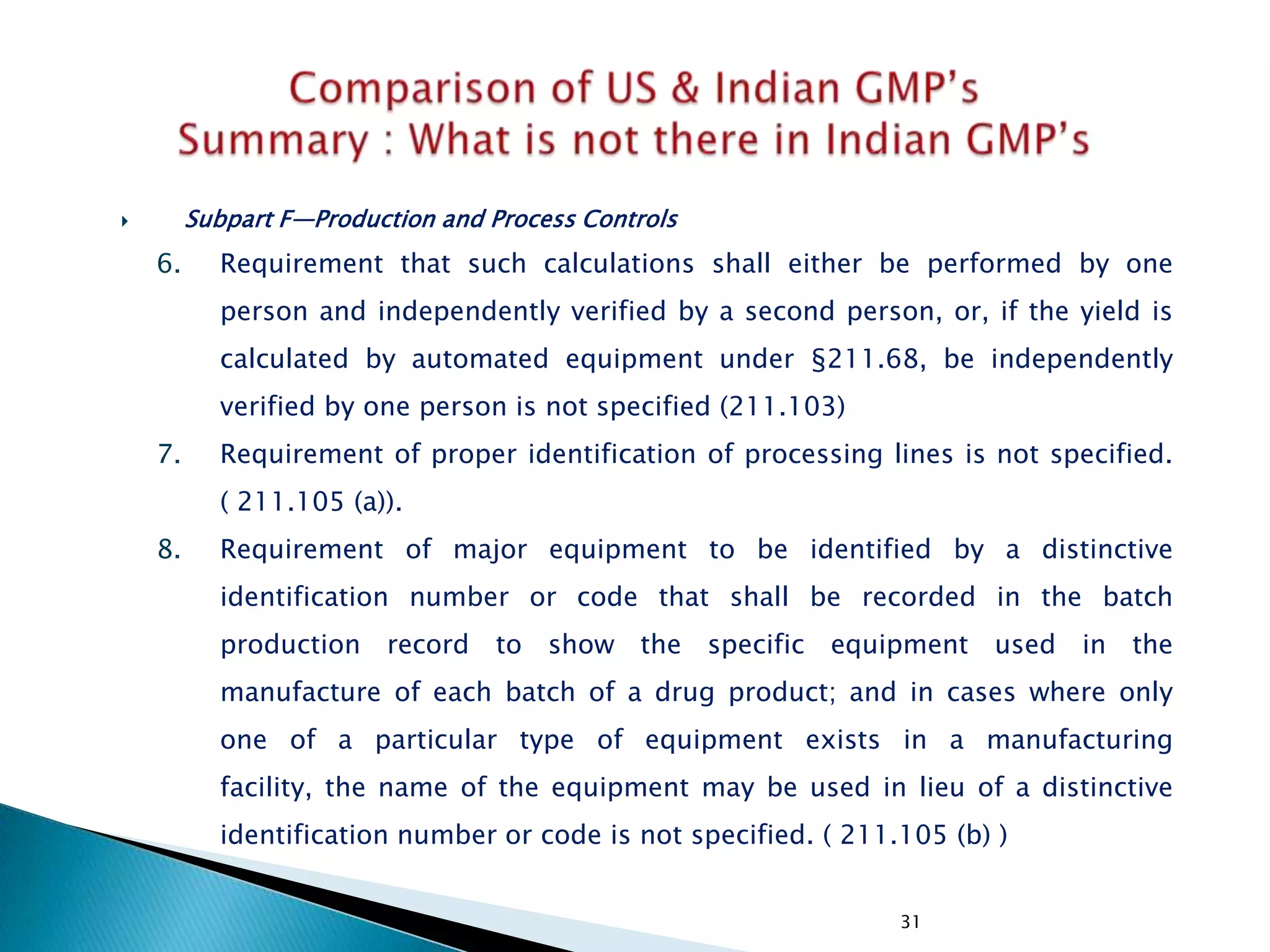
 Subpart F—Production and Process Controls
6. Requirement that such calculations shall either be performed by one
person and independently verified by a second person, or, if the yield is
calculated by automated equipment under §211.68, be independently
verified by one person is not specified (211.103)
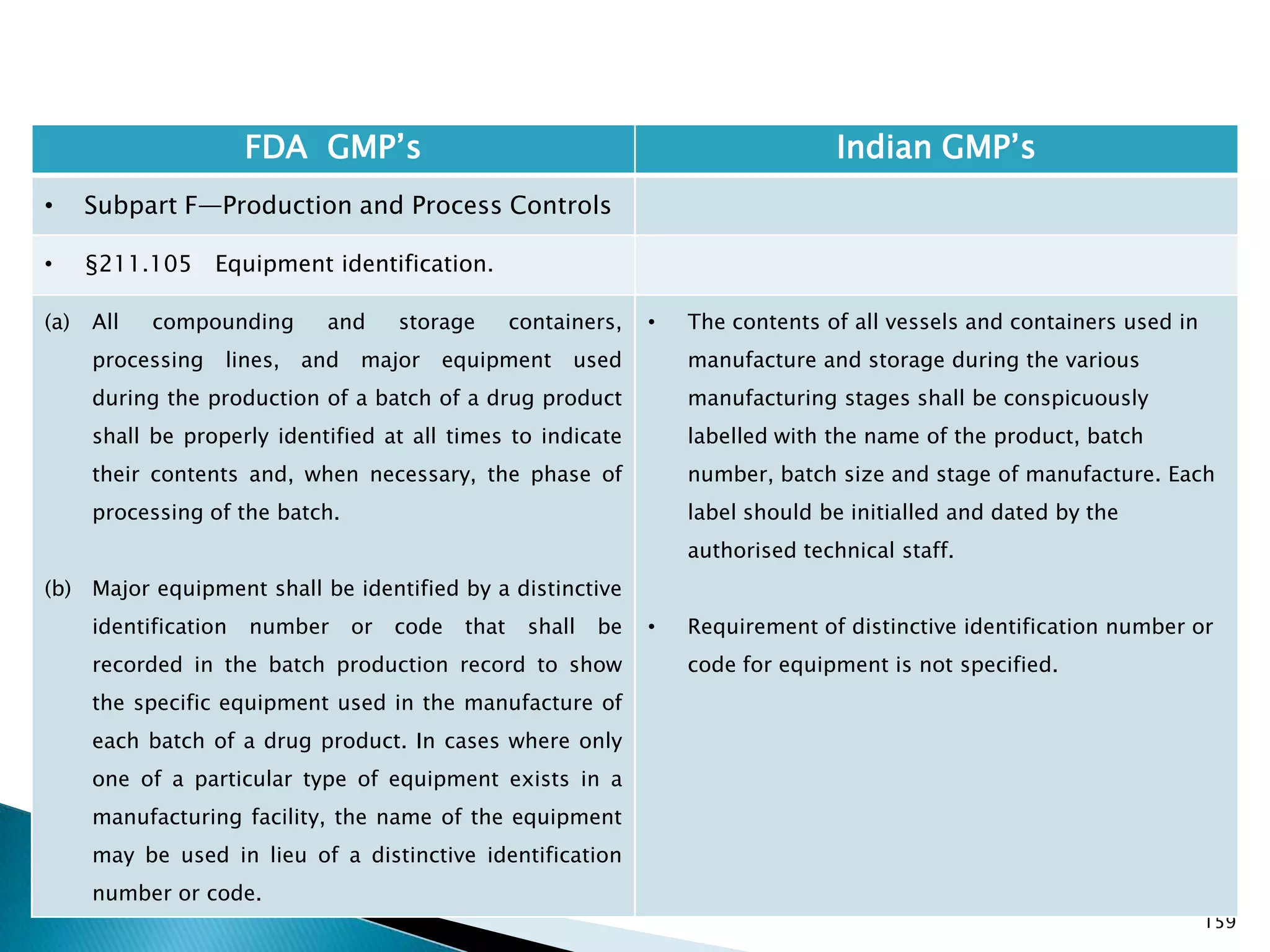
7. Requirement of proper identification of processing lines is not specified.
( 211.105 (a)).
8. Requirement of major equipment to be identified by a distinctive
identification number or code that shall be recorded in the batch
production record to show the specific equipment used in the
manufacture of each batch of a drug product; and in cases where only
one of a particular type of equipment exists in a manufacturing
facility, the name of the equipment may be used in lieu of a distinctive
identification number or code is not specified. ( 211.105 (b) )
32
 Subpart F—Production and Process Controls
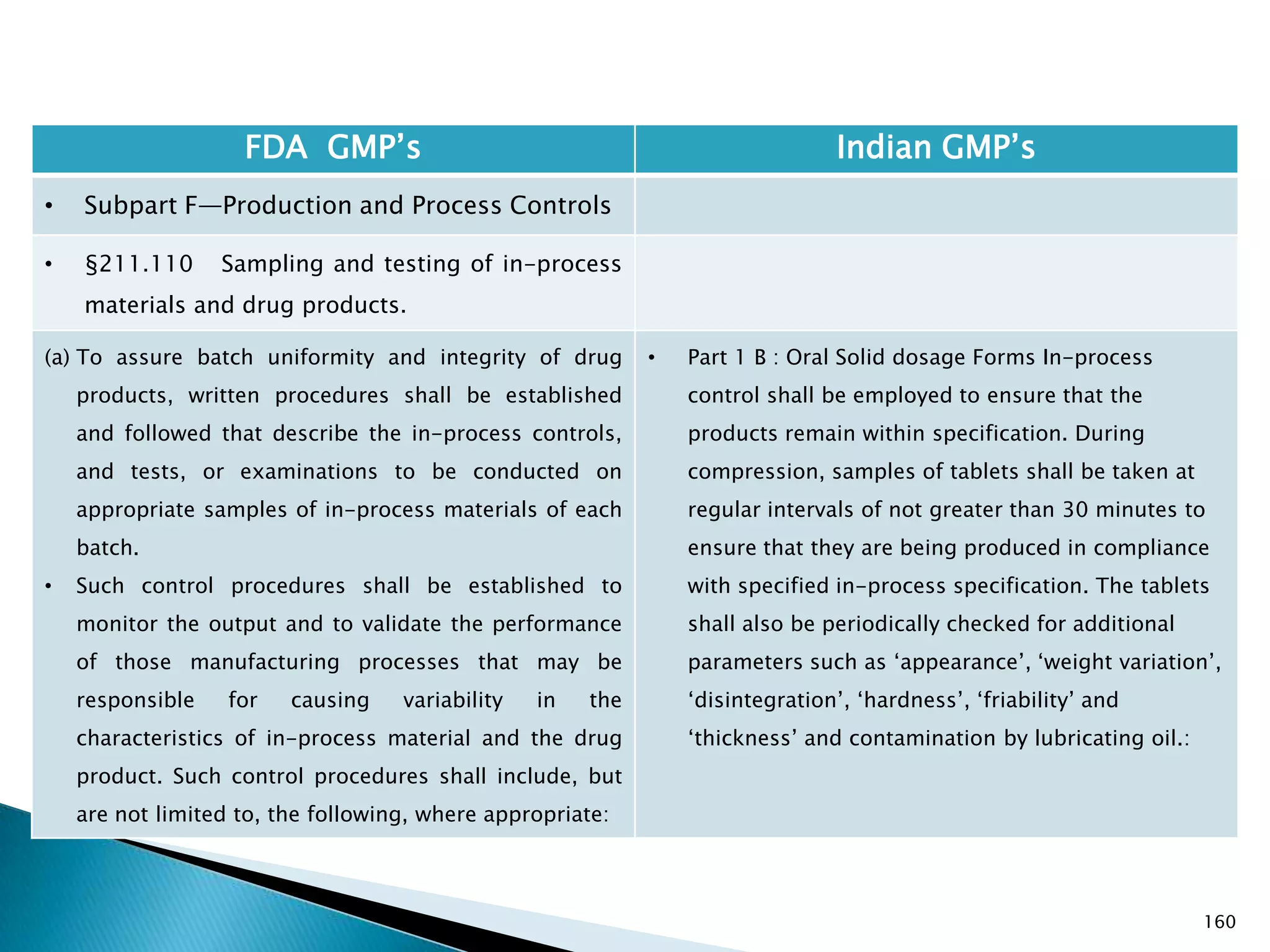
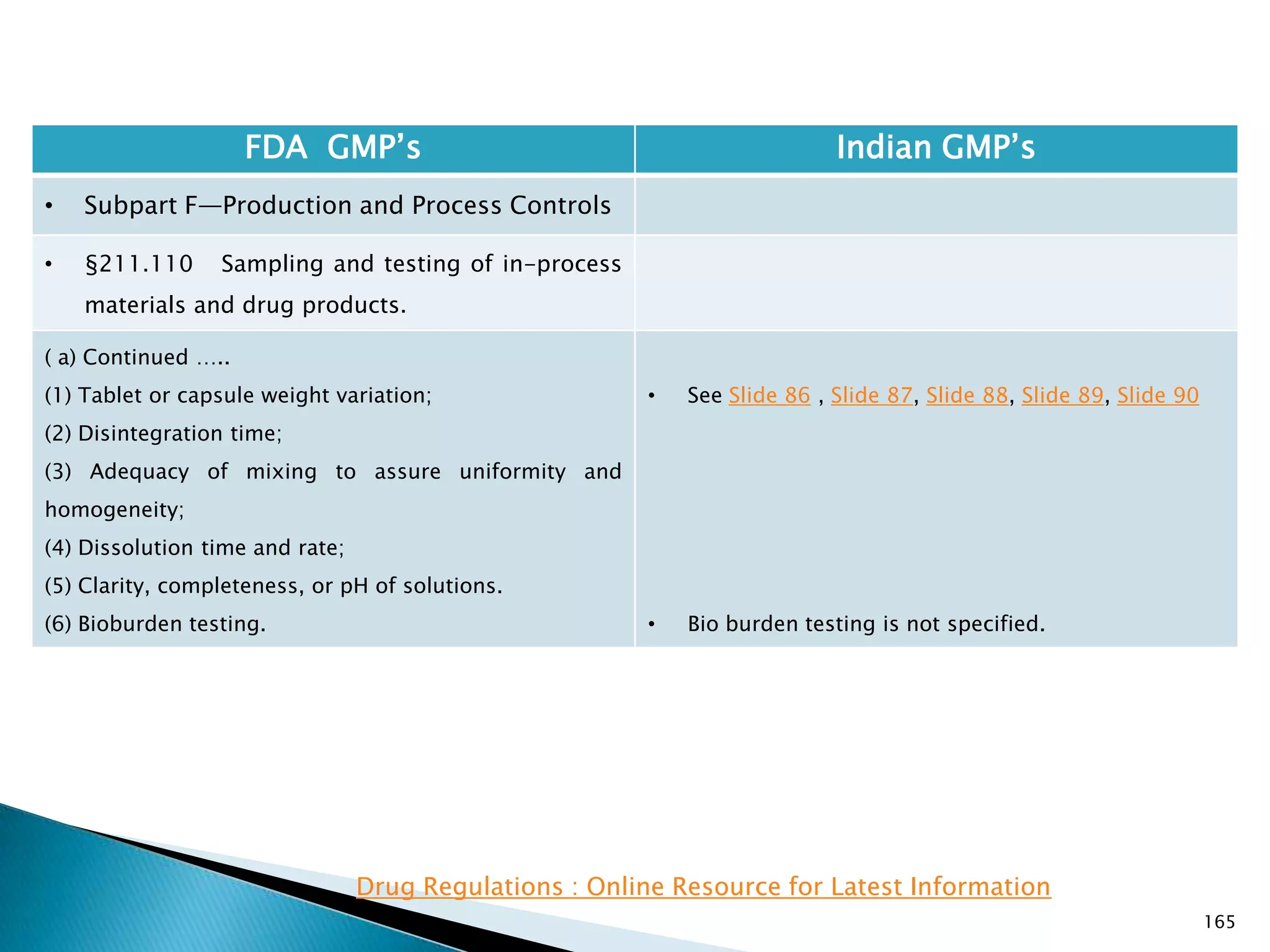
9. Requirement of demonstrating adequacy of
mixing to assure uniformity and homogeneity is
not specified unambiguously but mentioned
indirectly under requirement of batch records.
( 211.110 (a) (3) )
10. Requirement of bioburden testing as an
in-process test is not specified. ( 211.110 (a) (5) )
33
 Subpart F—Production and Process Controls
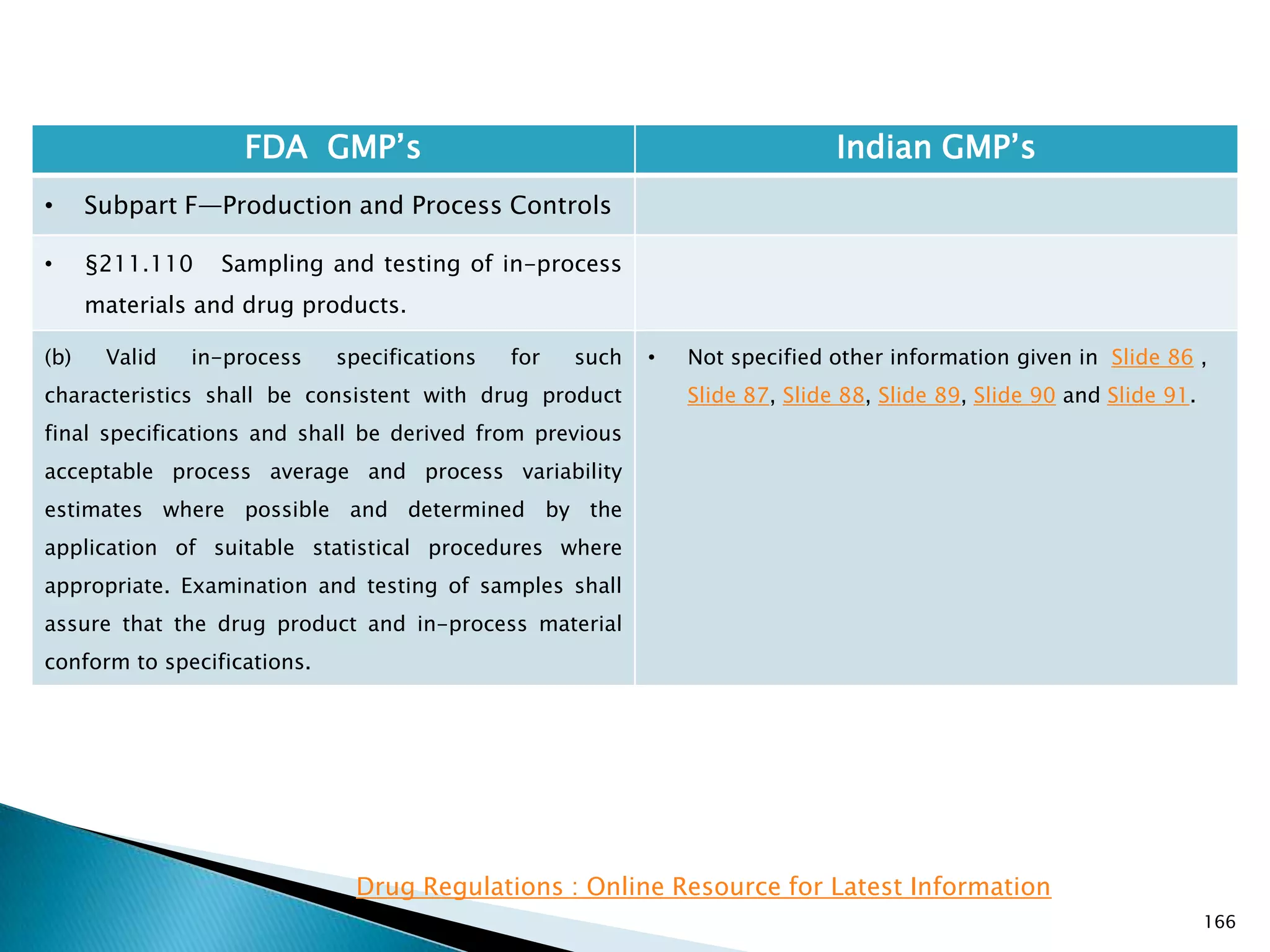
11. Requirement of valid in-process specifications for such
characteristics to be consistent with drug product final
specifications and shall be derived from previous acceptable
process average and process variability estimates where possible
and determined by the application of suitable statistical
procedures where appropriate is not specified. ( 211.110 (b))
12. Requirement of rejected in-process materials to be identified
and controlled under a quarantine system designed to prevent
their use in manufacturing or processing operations for which
they are unsuitable is not specified except for tablets.
34
 Subpart F—Production and Process Controls
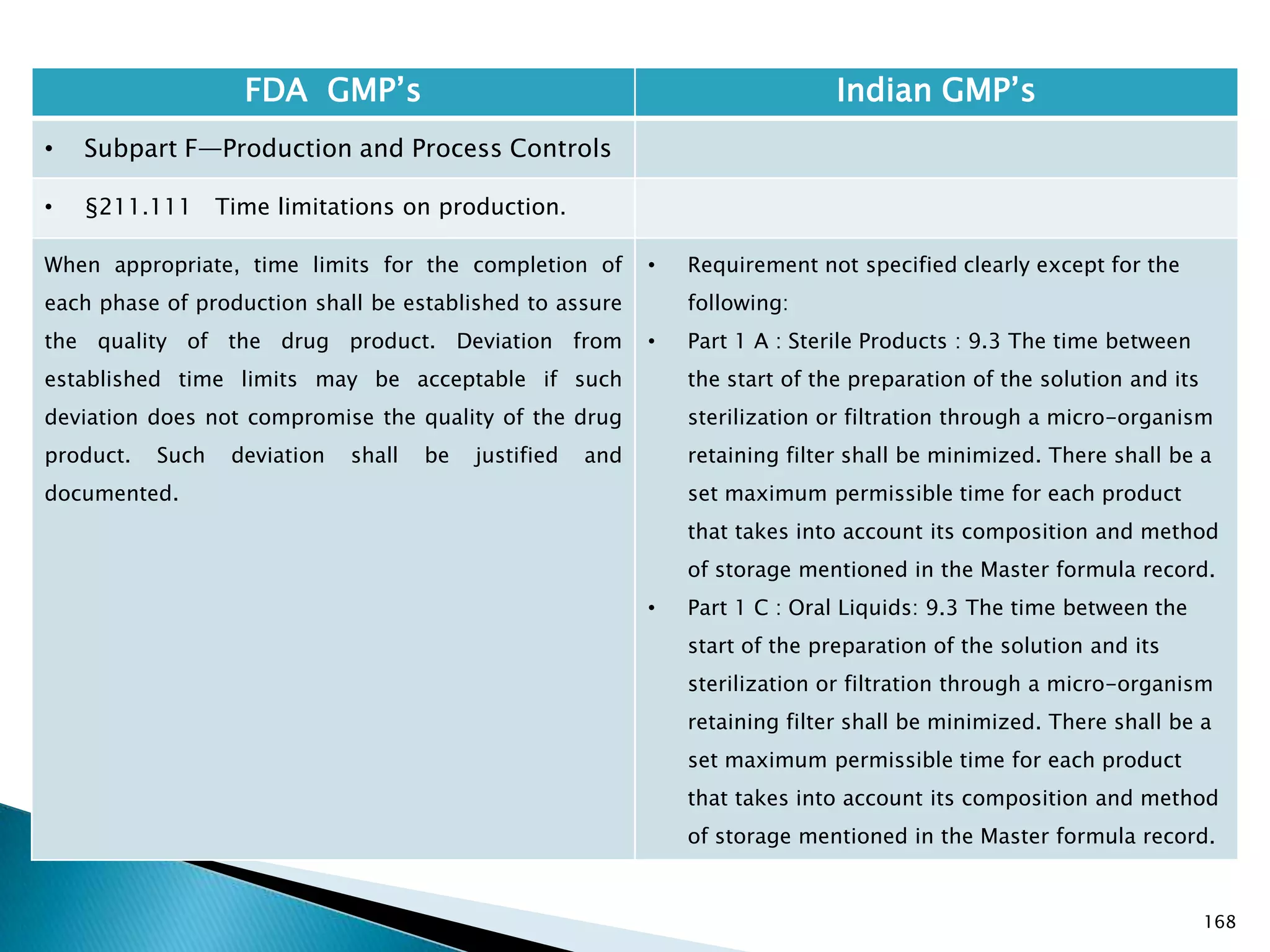
13. Requirement of time limits, when appropriate ,
for the completion of each phase of production
shall be established to assure the quality of the
drug products is not specified except for sterile &
Liquid orals. ( 211.111)
 Requirement of justifying & documenting deviations
from established time limits may be acceptable if
such deviation does not compromise the quality of
the drug product is not specified.
35
 Subpart F—Production and Process Controls
14. Requirement to establish & follow
appropriate written procedures, designed to
prevent objectionable microorganisms in drug
products not required to be sterile is not
specified. ( 211.113 (a) )
36
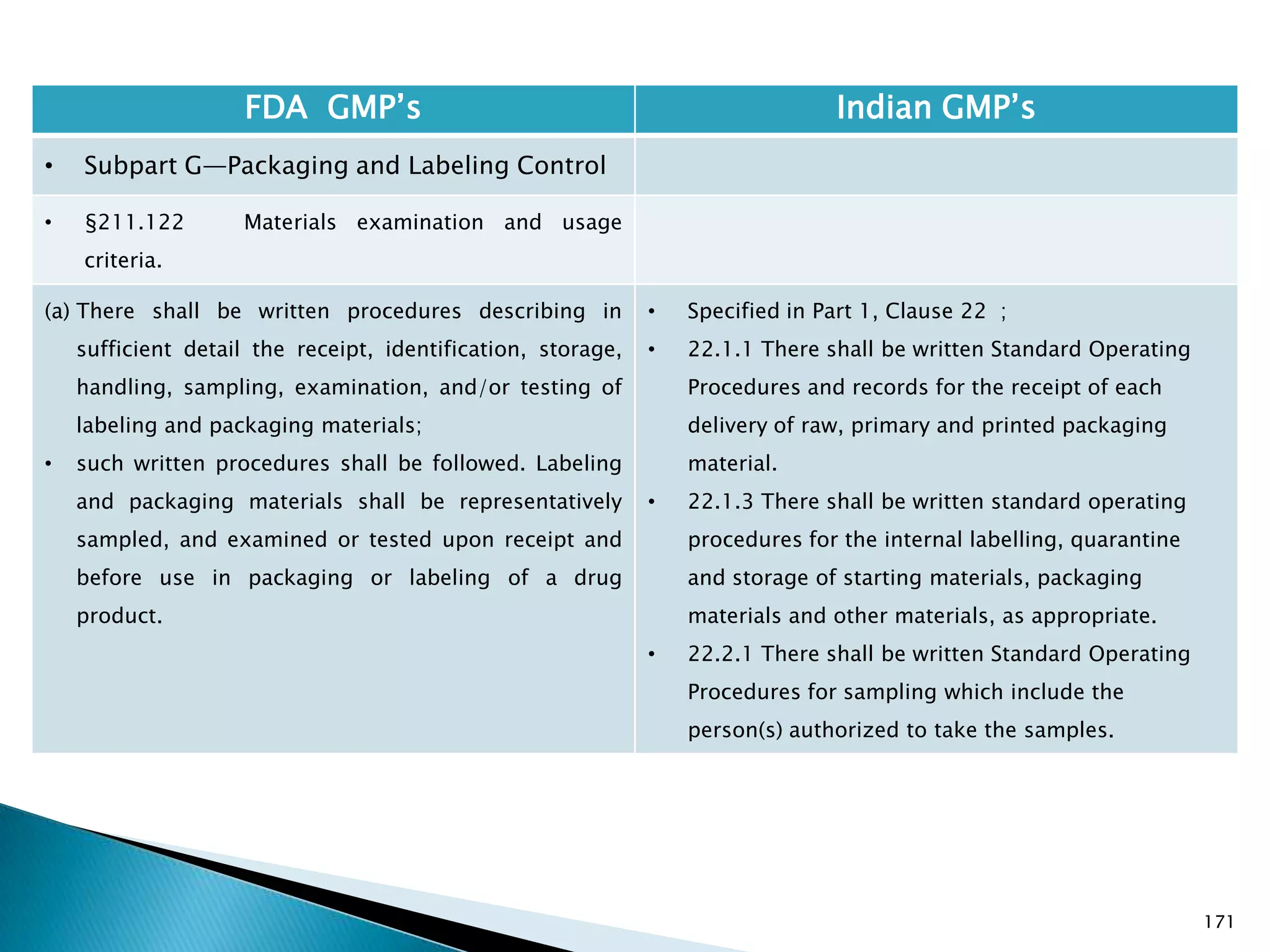
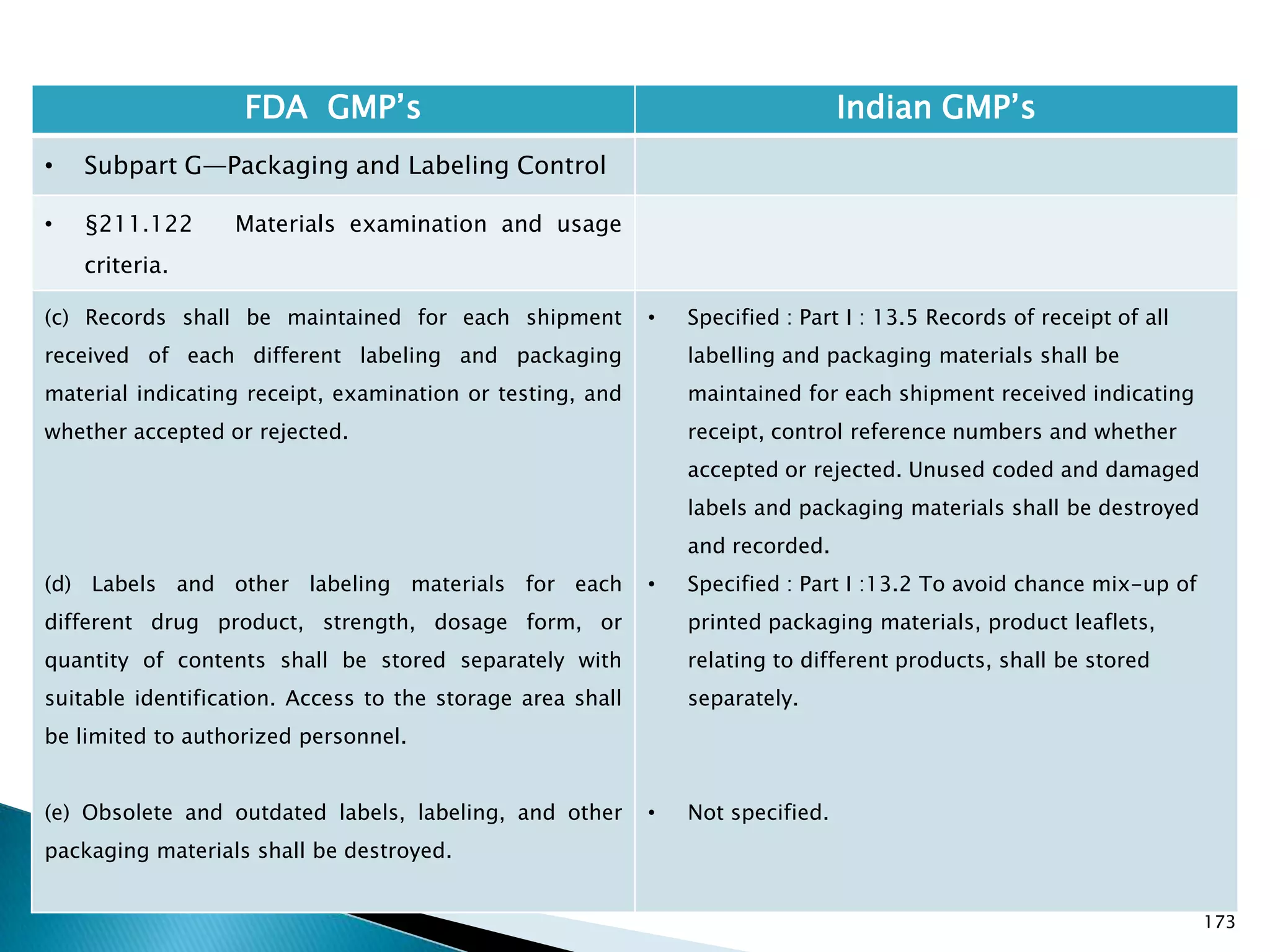
 Subpart G—Packaging and Labeling Control
1. Requirement of destroying obsolete and
outdated labels, labeling, and other
packaging materials is not specified. (
211.122 ( e ).
37
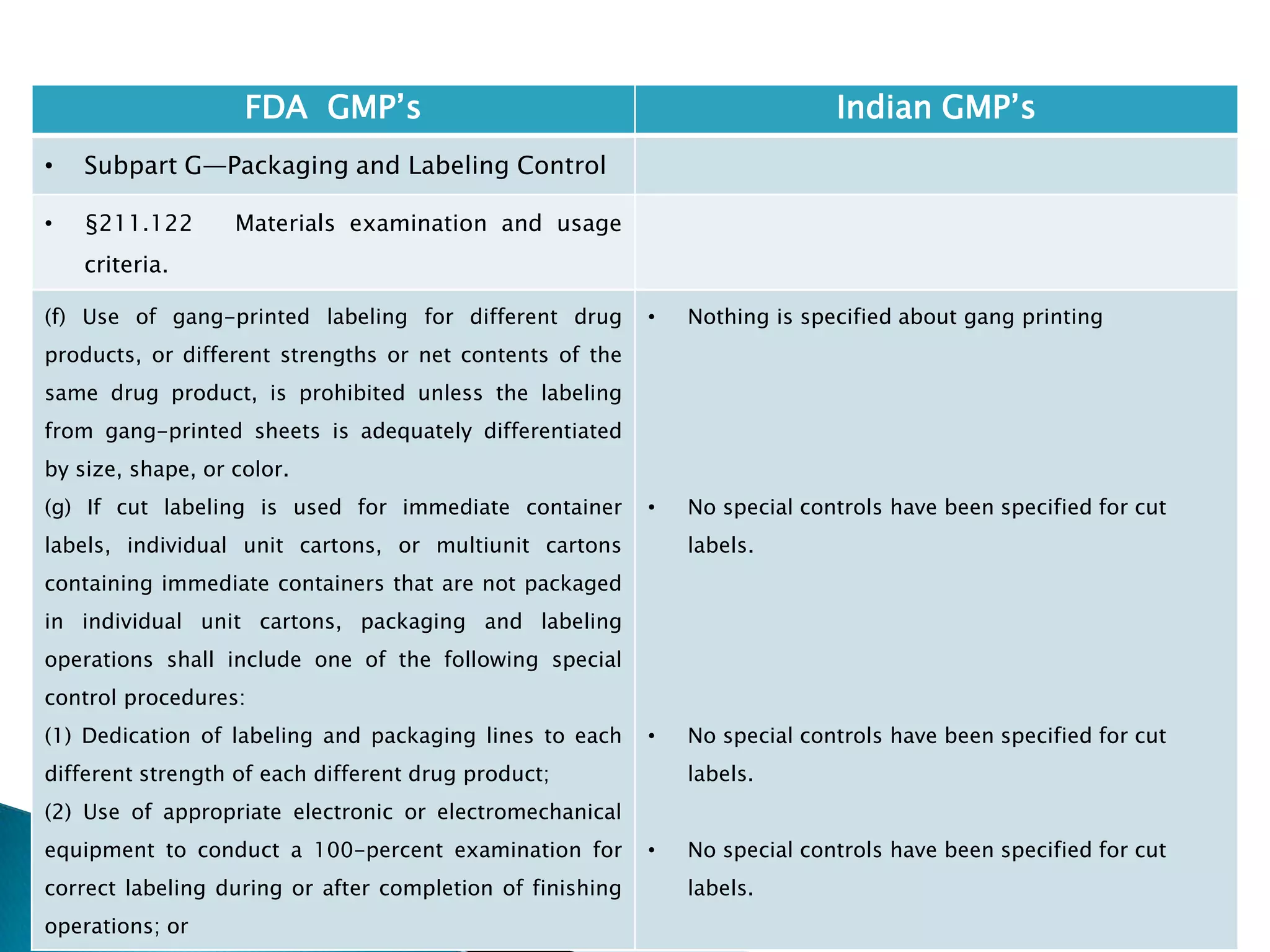
 Subpart G—Packaging and Labeling Control
2. Prohibition of gang-printed labeling for different drug products, or
different strengths or net contents of the same drug product unless the
labeling from gang-printed sheets is adequately differentiated by size,
shape, or color is not specified. ( 211.122 (f) ).
3. Requirement of special control procedures for packaging and labeling
operations if cut labeling is used for immediate container labels,
individual unit cartons, or multiunit cartons containing immediate
containers that are not packaged in individual unit cartons is not
specified. ( 211.122 (g) )
◦ (1) Requirement of dedication of labeling and packaging lines to each
different strength of each different drug product is not specified;
38
 Subpart G—Packaging and Labeling Control
◦ (2) Use of appropriate electronic or electromechanical equipment to
conduct a 100-percent examination for correct labeling during or after
completion of finishing operations is not specified; or
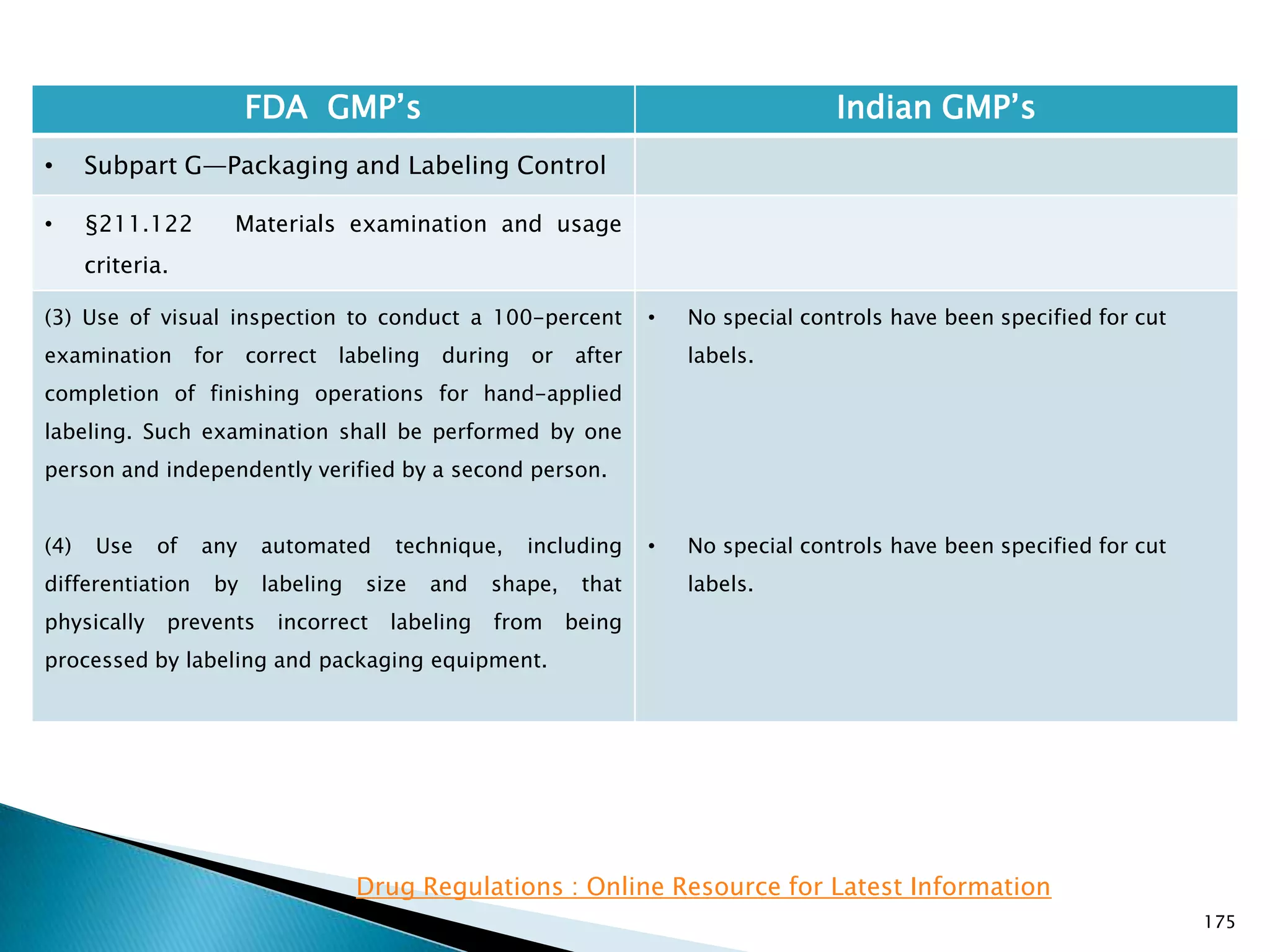
◦ (3) Use of visual inspection to conduct a 100-percent examination for
correct labeling during or after completion of finishing operations for
hand-applied labeling and that such examination shall be performed by
one person and independently verified by a second person is not
specified.
◦ (4) Use of any automated technique, including differentiation by labeling
size and shape, that physically prevents incorrect labeling from being
processed by labeling and packaging equipment is not specified.
39
 Subpart G—Packaging and Labeling Control
4. Printing devices on, or associated with, manufacturing
lines used to imprint labeling upon the drug product
unit label or case shall be monitored to assure that all
imprinting conforms to the print specified in the batch
production record is not specified. ( 211.122 (h))
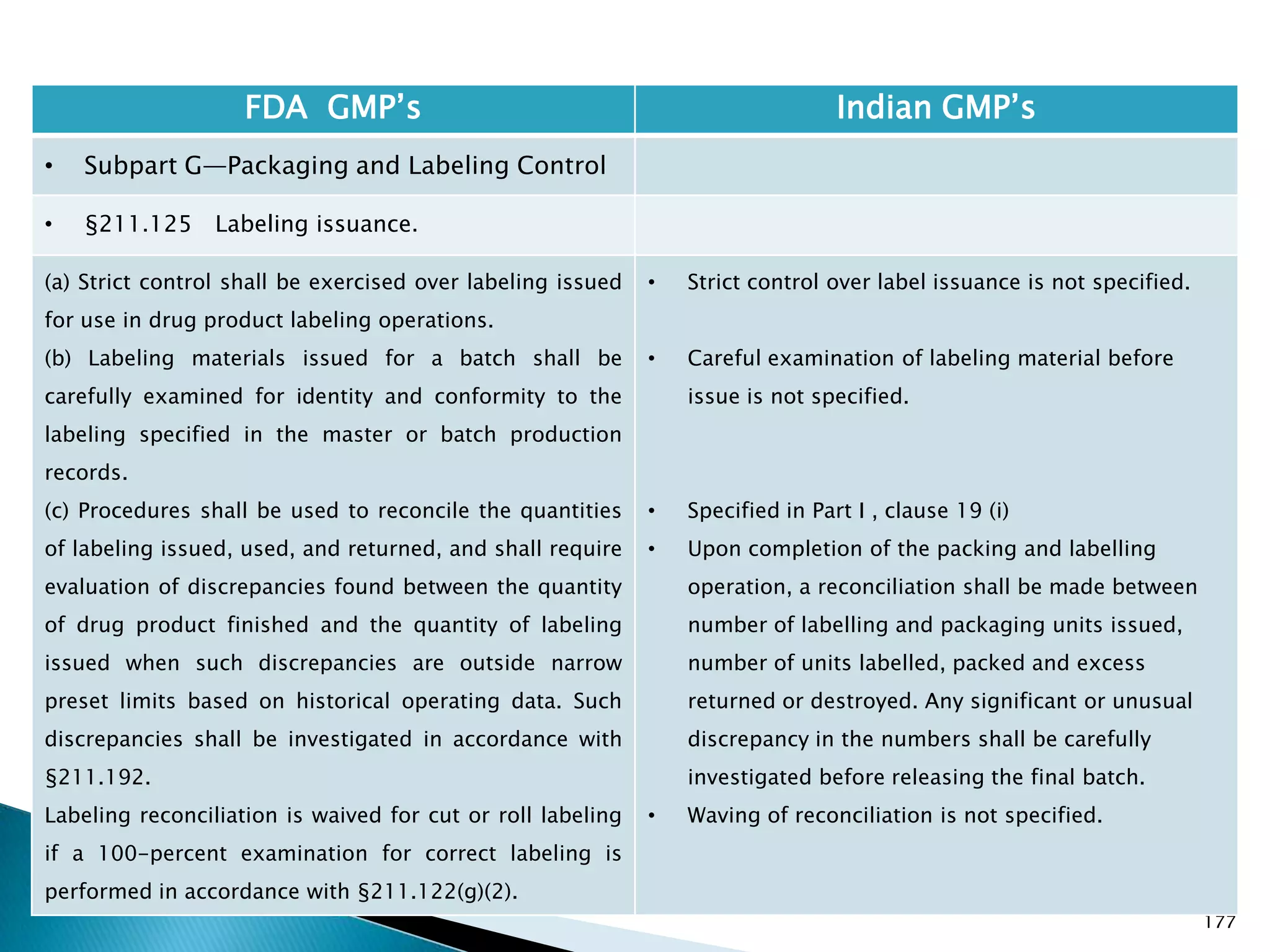
5. Requirement of strict control to be exercised over
labeling issued for use in drug product labeling
operations is not specified. ( 211.125 (a) )
40
 Subpart G—Packaging and Labeling Control
6. Careful examination of labeling materials issued for
a batch for identity and conformity to the labeling
specified in the master or batch production records
is not specified. ( 211.125 (b) )
7. Waving of labeling reconciliation for cut or roll
labeling if a 100-percent examination for correct
labeling is performed is not specified.
( 211.125 ( c ) )
41
 Subpart G—Packaging and Labeling Control
8. Requirement of destroying all excess labeling
bearing lot or control numbers is not specified.
( 211.125 (d)).
9. Requirement of written procedures describing in
sufficient detail the control procedures employed
for the issuance of labeling and the requirement to
follow such written procedures is not specified.
( 211.125 ( f ) ).
42
 Subpart G—Packaging and Labeling Control
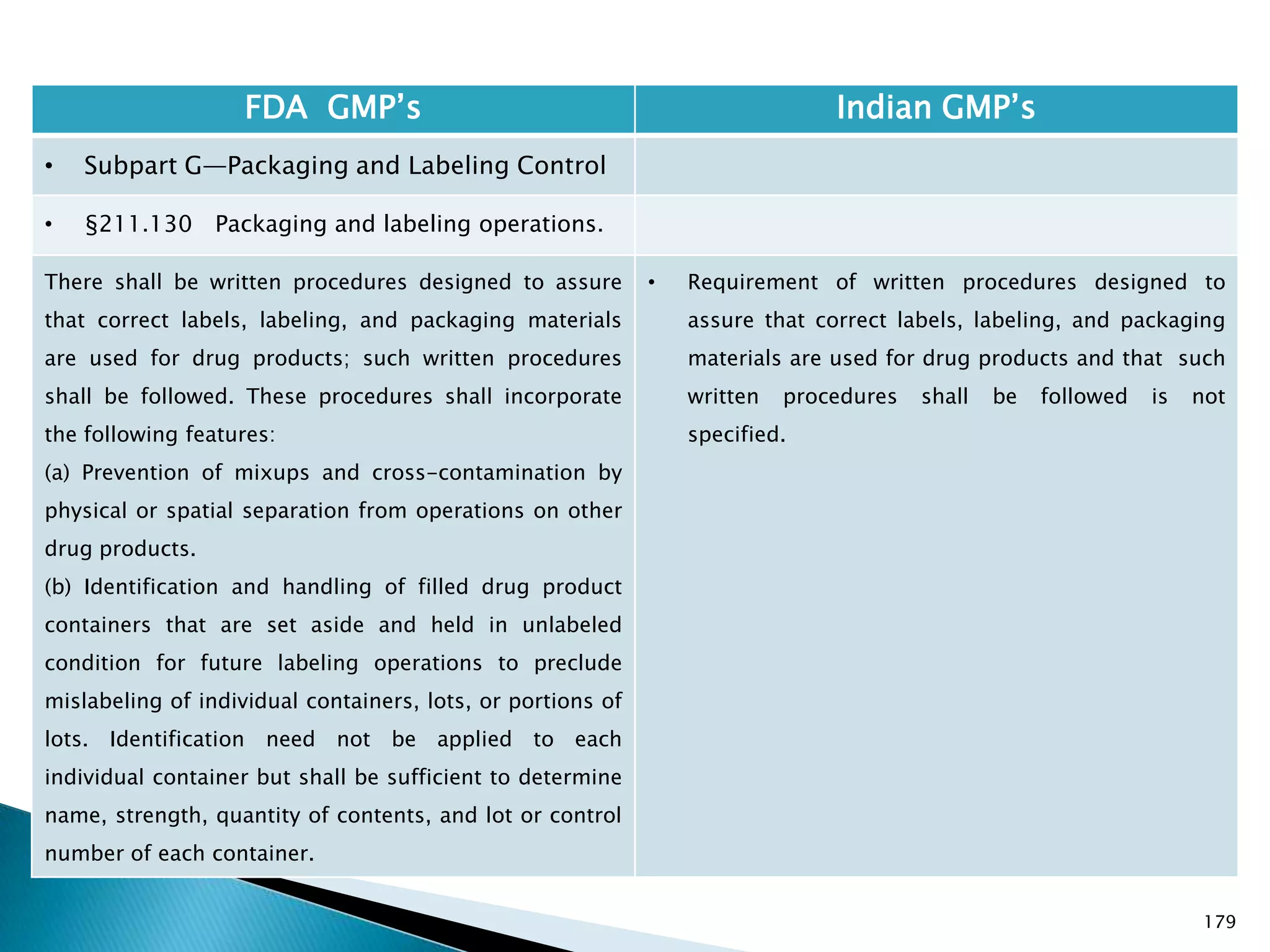
10. Requirement of written procedures with features
given below designed to assure that correct labels,
labeling, and packaging materials are used for drug
products and that such written procedures shall be
followed is not specified. ( 211.130)
• Requirement to Prevent mixups and cross-contamination
by physical or spatial separation from operations on
other drug products is not specified . ( 211.130 (a) )
43
 Subpart G—Packaging and Labeling Control
• Requirement of identification and handling of filled drug product
containers that are set aside and held in unlabeled condition for future
labeling operations to preclude mislabelling of individual
containers, lots, or portions of lots is not specified. ( 211.130 (b) ).
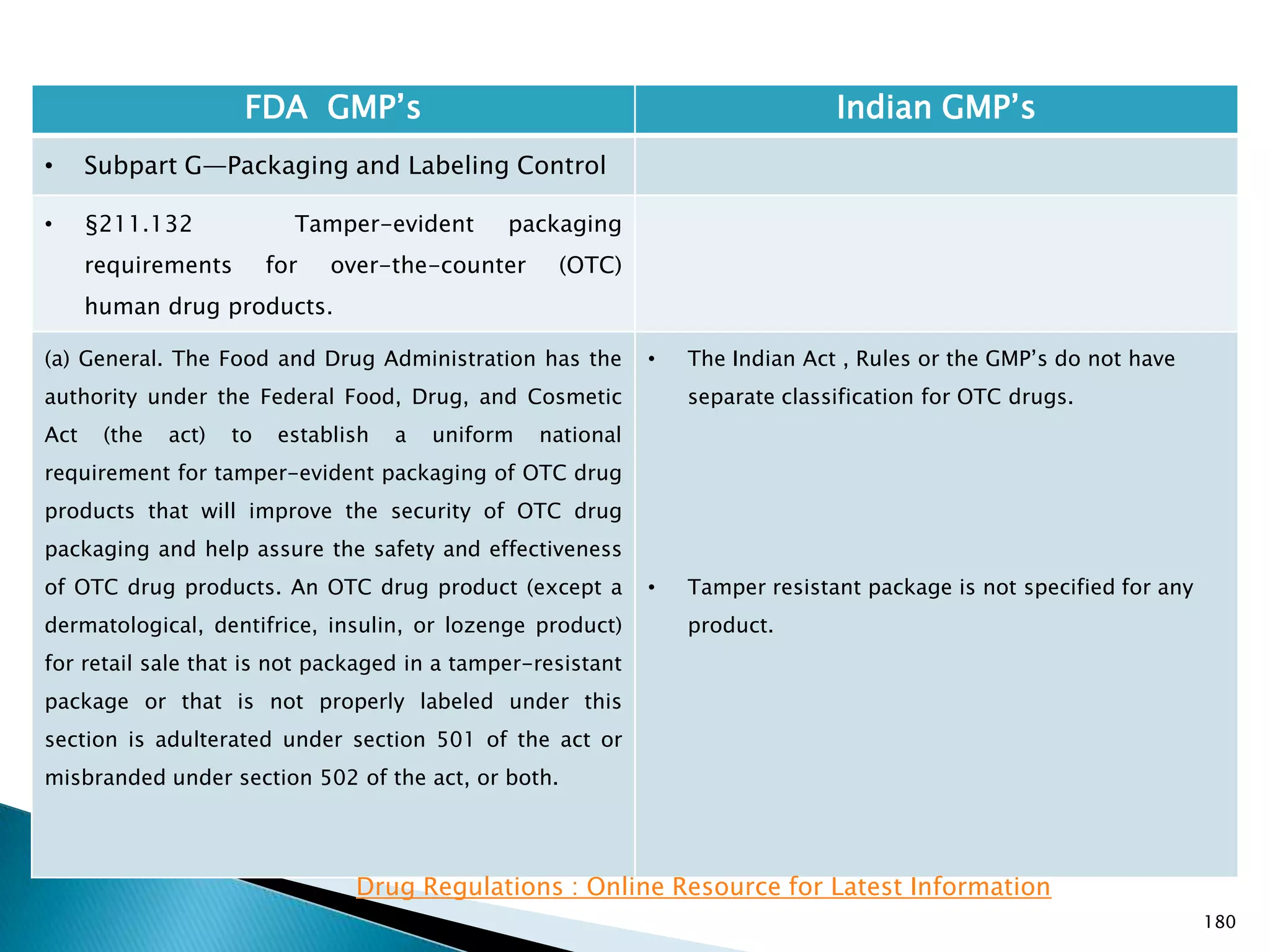
11. The Indian Act , Rules or the GMP‘s do not have separate
classification for OTC drugs. ( 211.132 (a))
12. Requirement of an OTC drug product (except a
dermatological, dentifrice, insulin, or lozenge product) for
retail sale that is not packaged in a tamper-resistant
package or that is not properly labelled under this section is
adulterated is not specified. ( 211.132 (a) )
44
 Subpart G—Packaging and Labeling Control
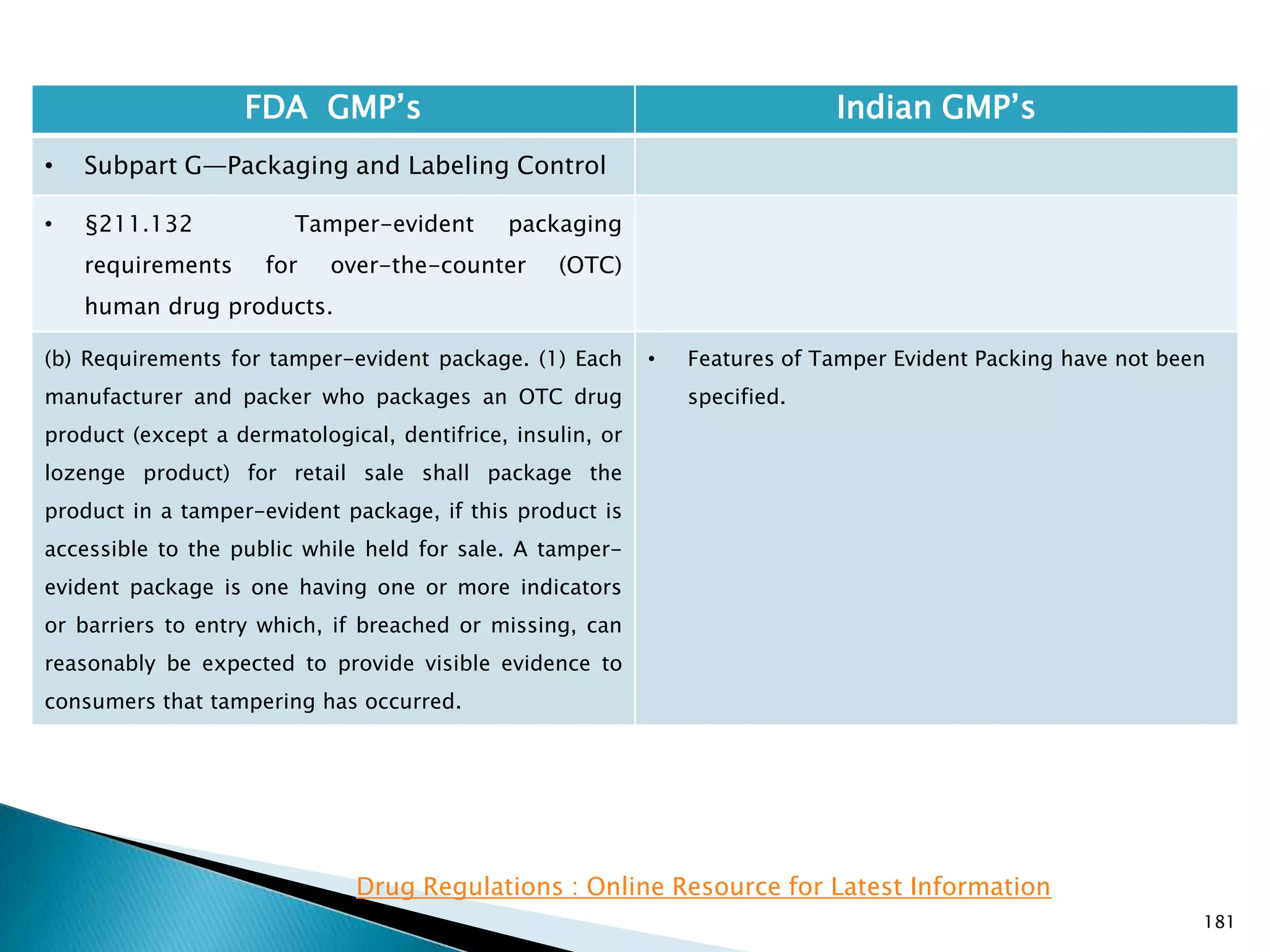
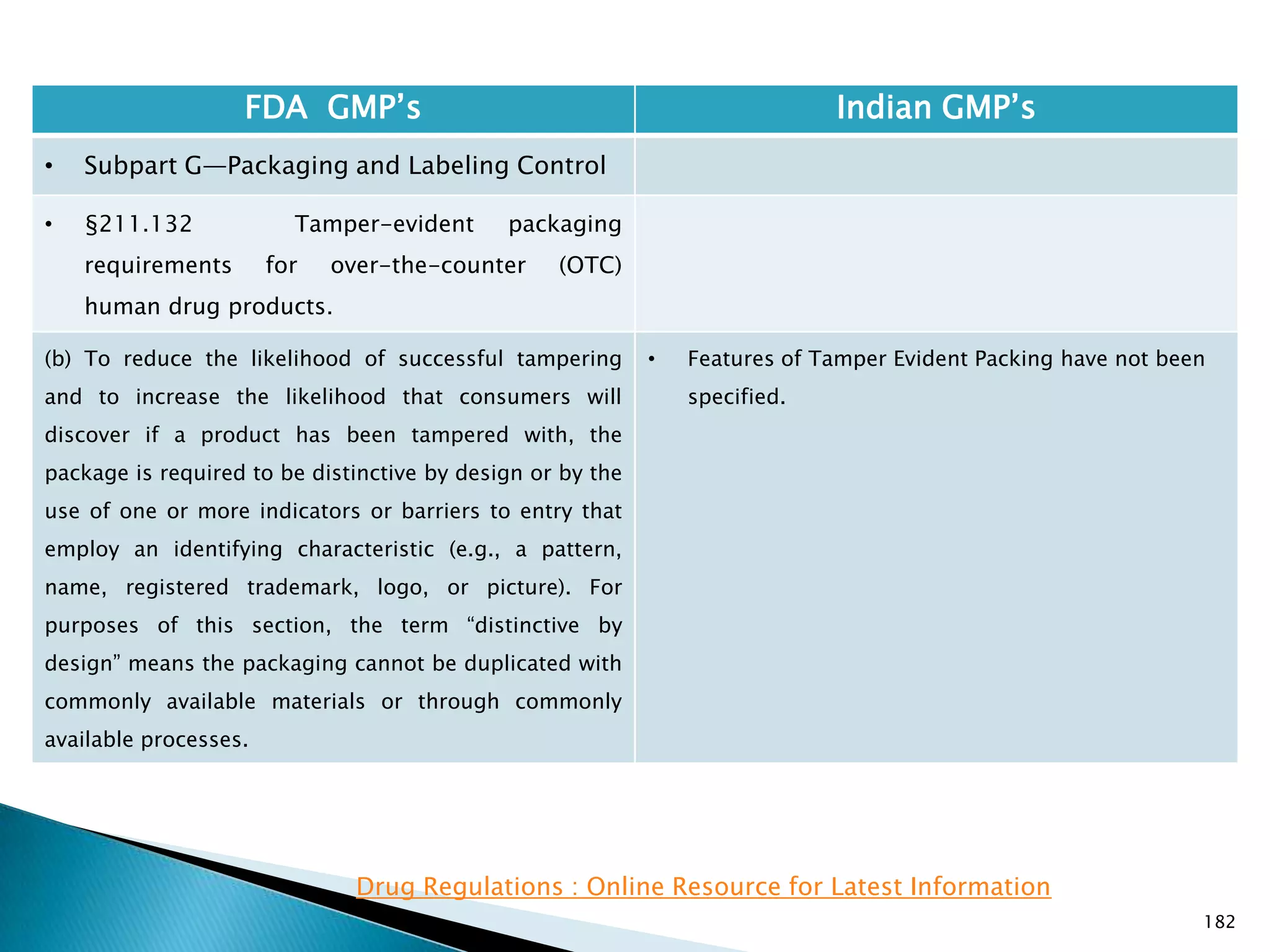
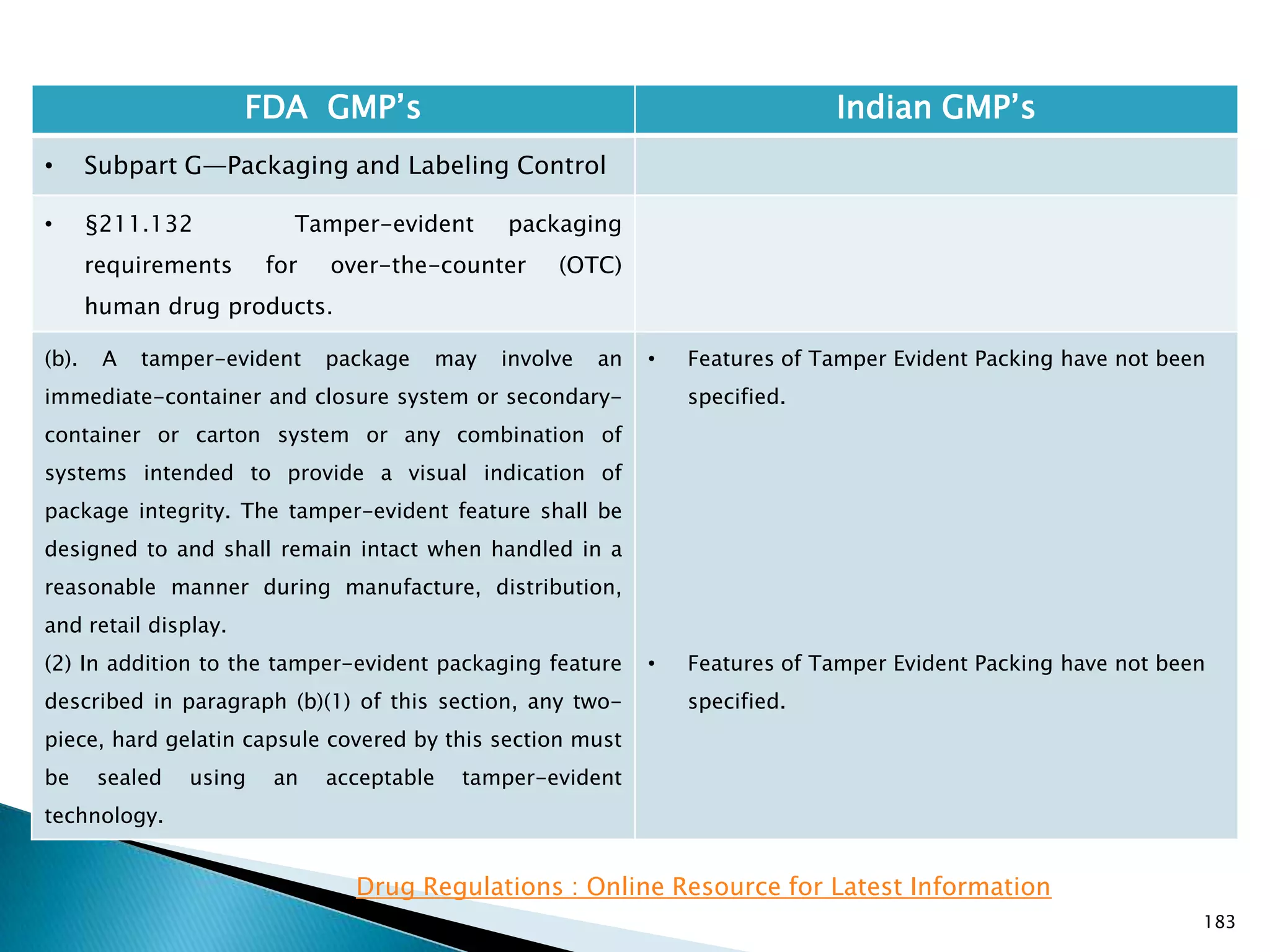
13. Features of Tamper Evident packing are not
specified. ( 211.132 (b) )
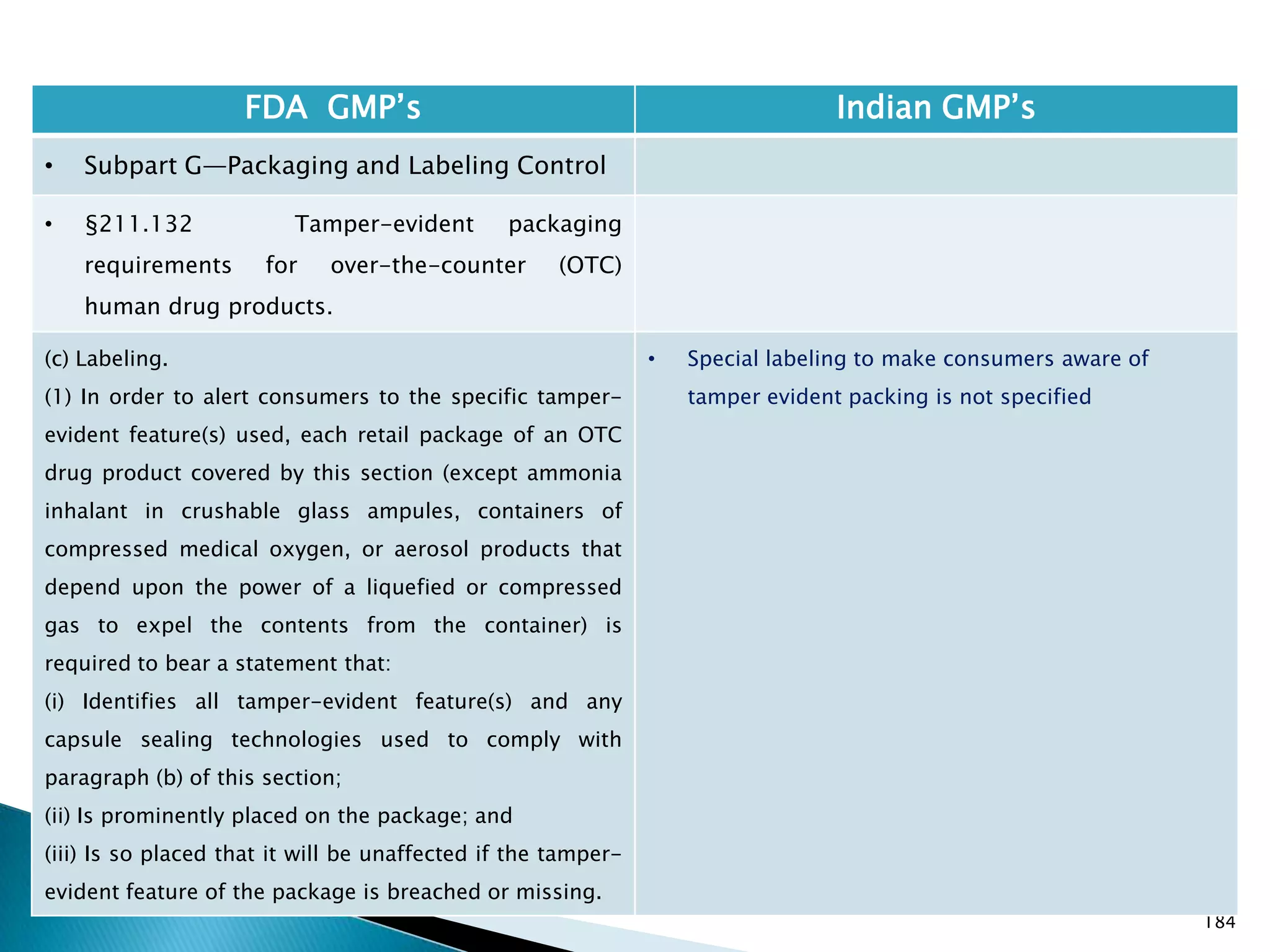
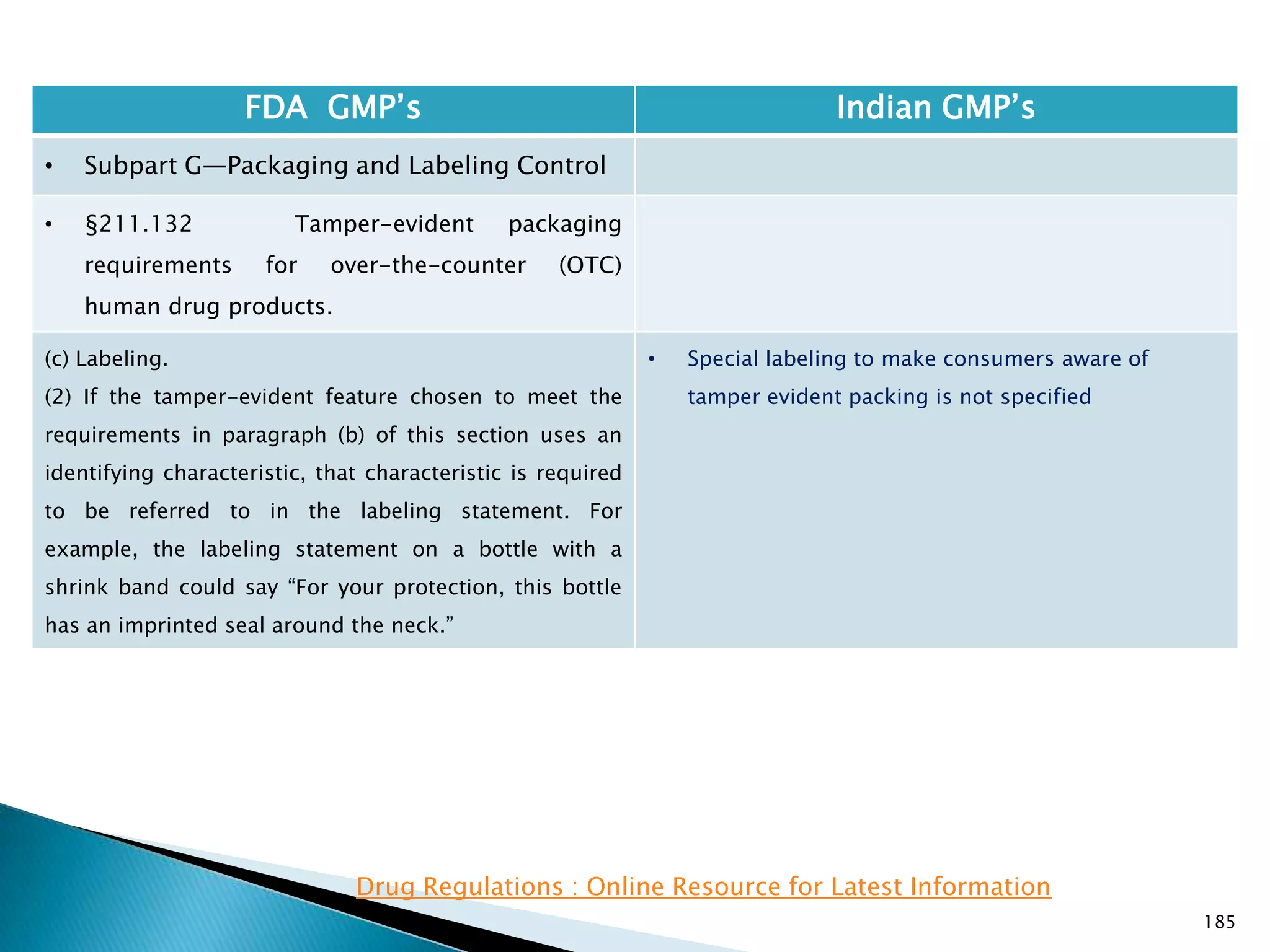
14. Special labeling to make consumers aware of
tamper evident packing is not specified.
( 211.132 (c ) ).
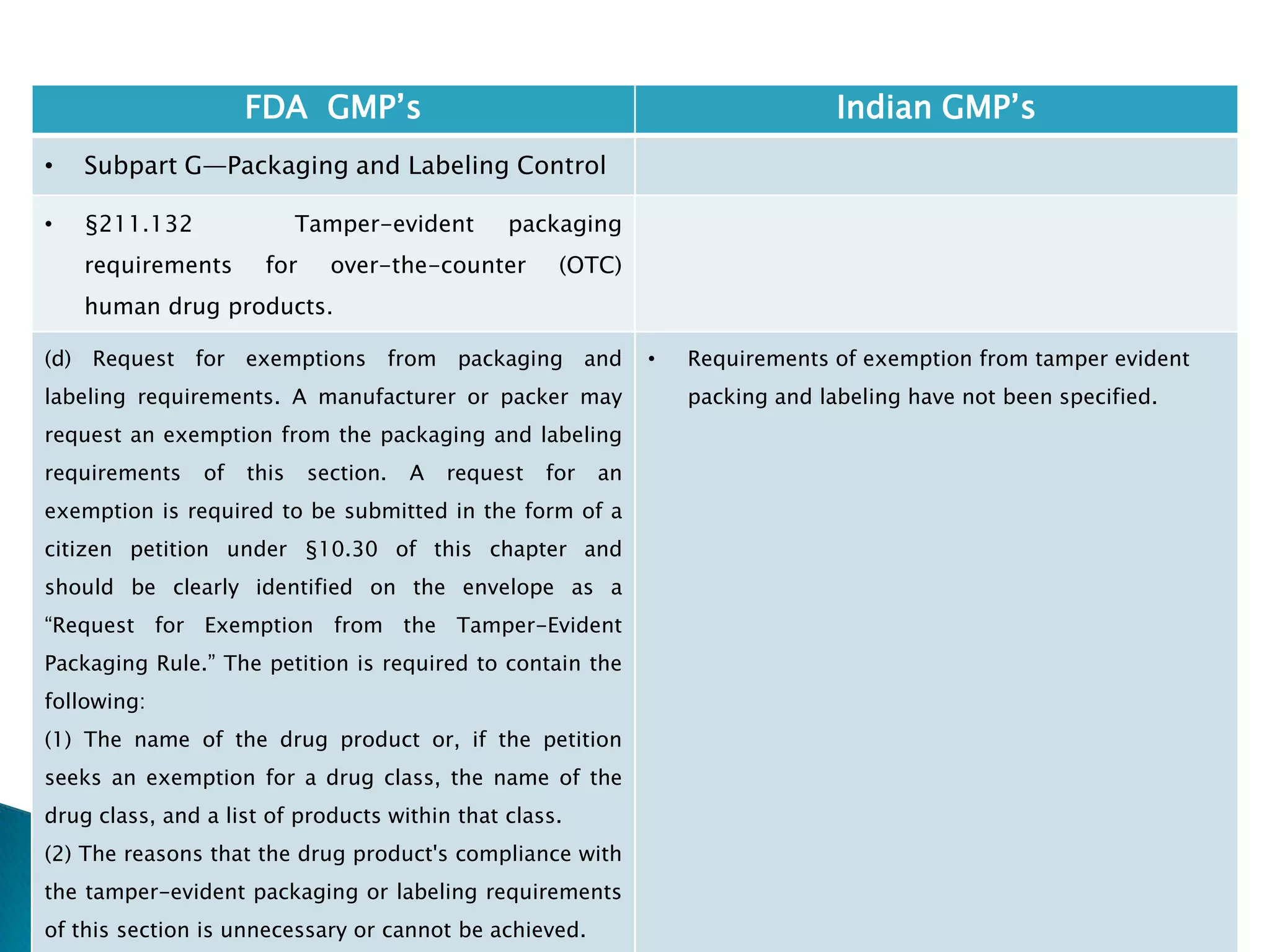
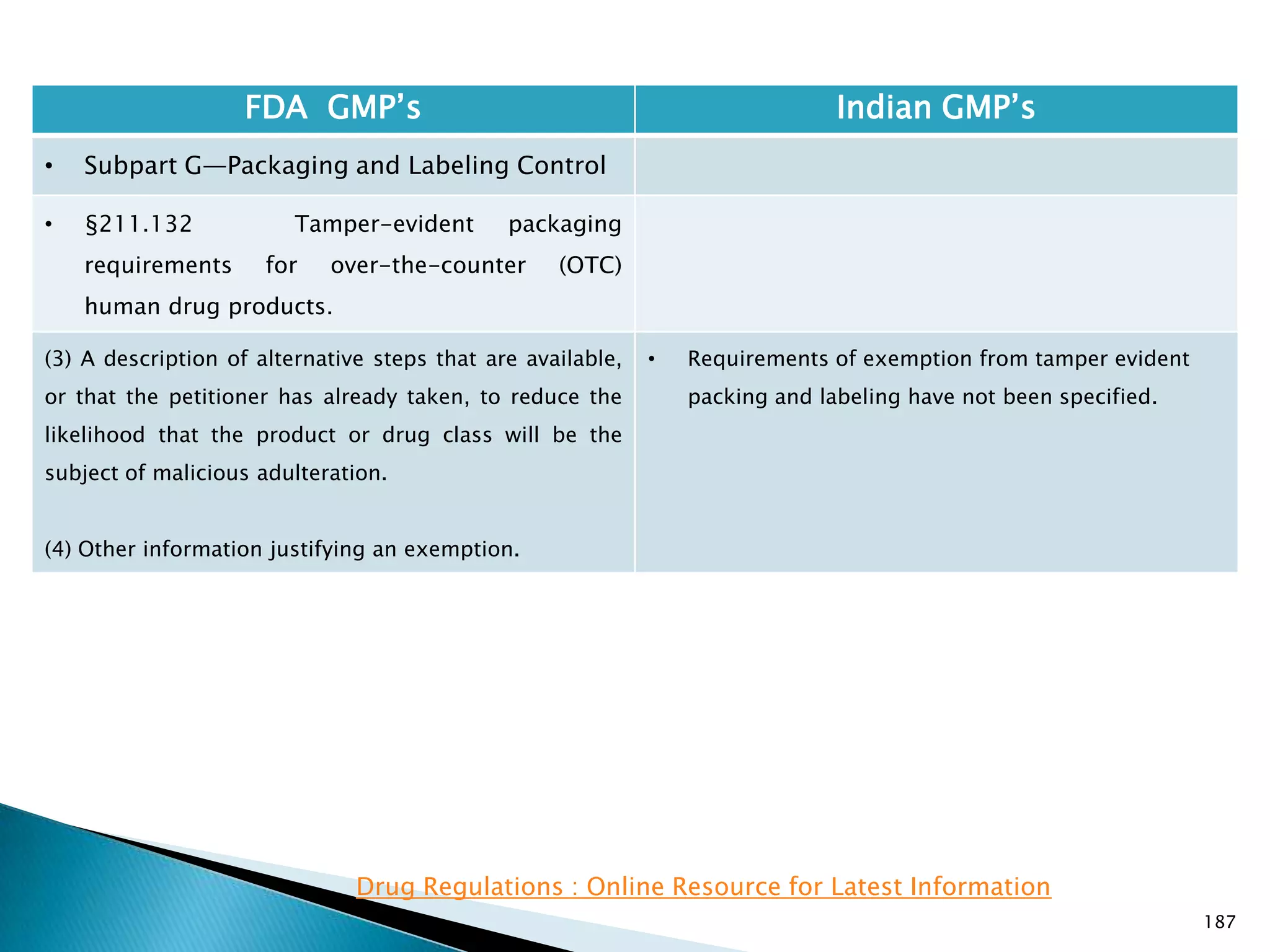
15. Requirements of exemption from tamper evident
packing and labeling have not been specified.
( 211.132 ( d ) )
45
 Subpart G—Packaging and Labeling Control
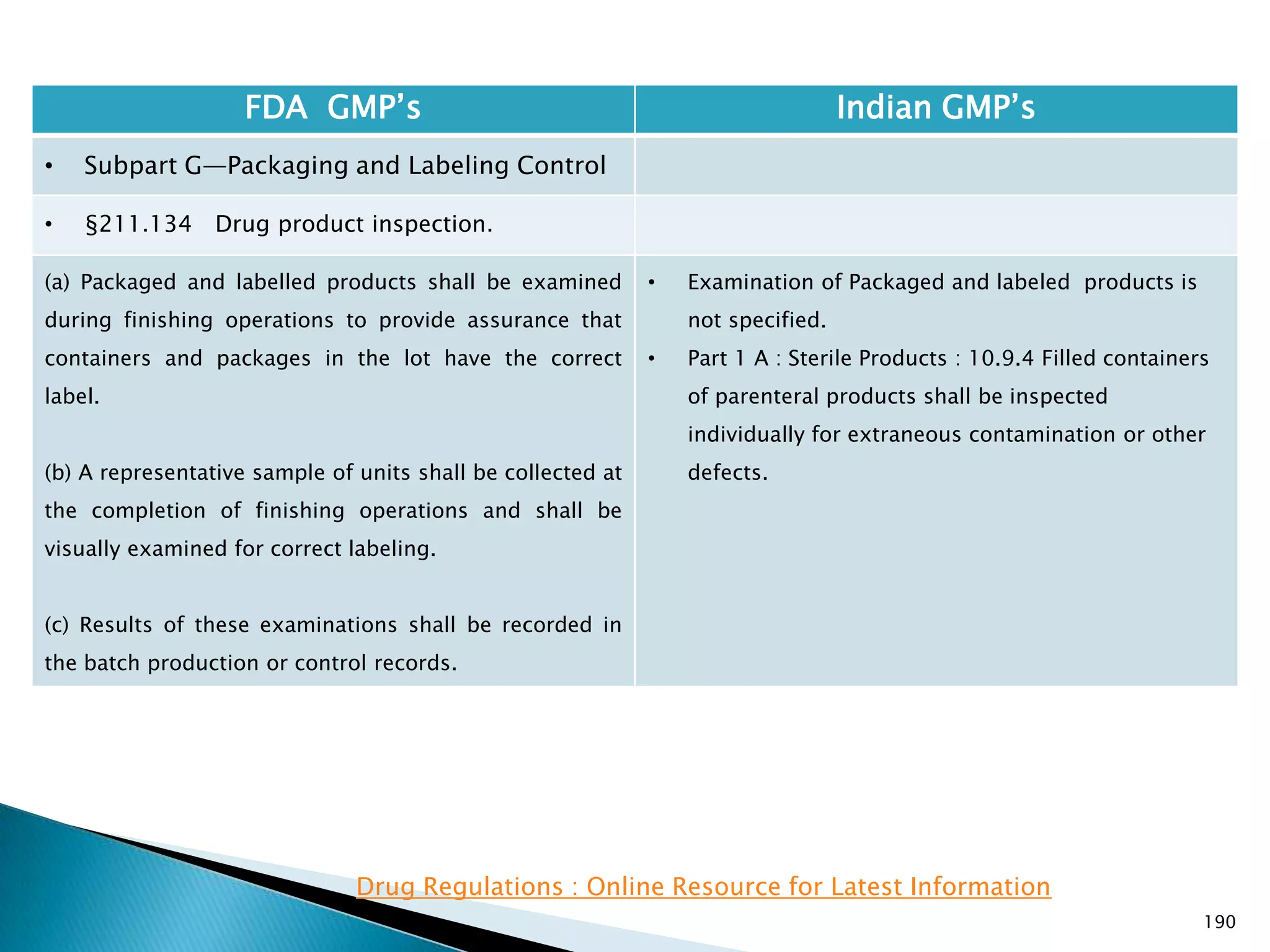
16. Requirement of examining packaged and labelled products
during finishing operations to provide assurance that
containers and packages in the lot have the correct labels is
not specified . ( 211.134 (a) )
17. Requirement of visually examining a representative sample
of units at the completion of finishing operations for correct
labeling is not specified. (211.134 (b) )
18. Requirement of documenting results of these examinations
in the batch production or control records is not specified.
( 211.134 (c ) )
46
 Subpart G—Packaging and Labeling
Control
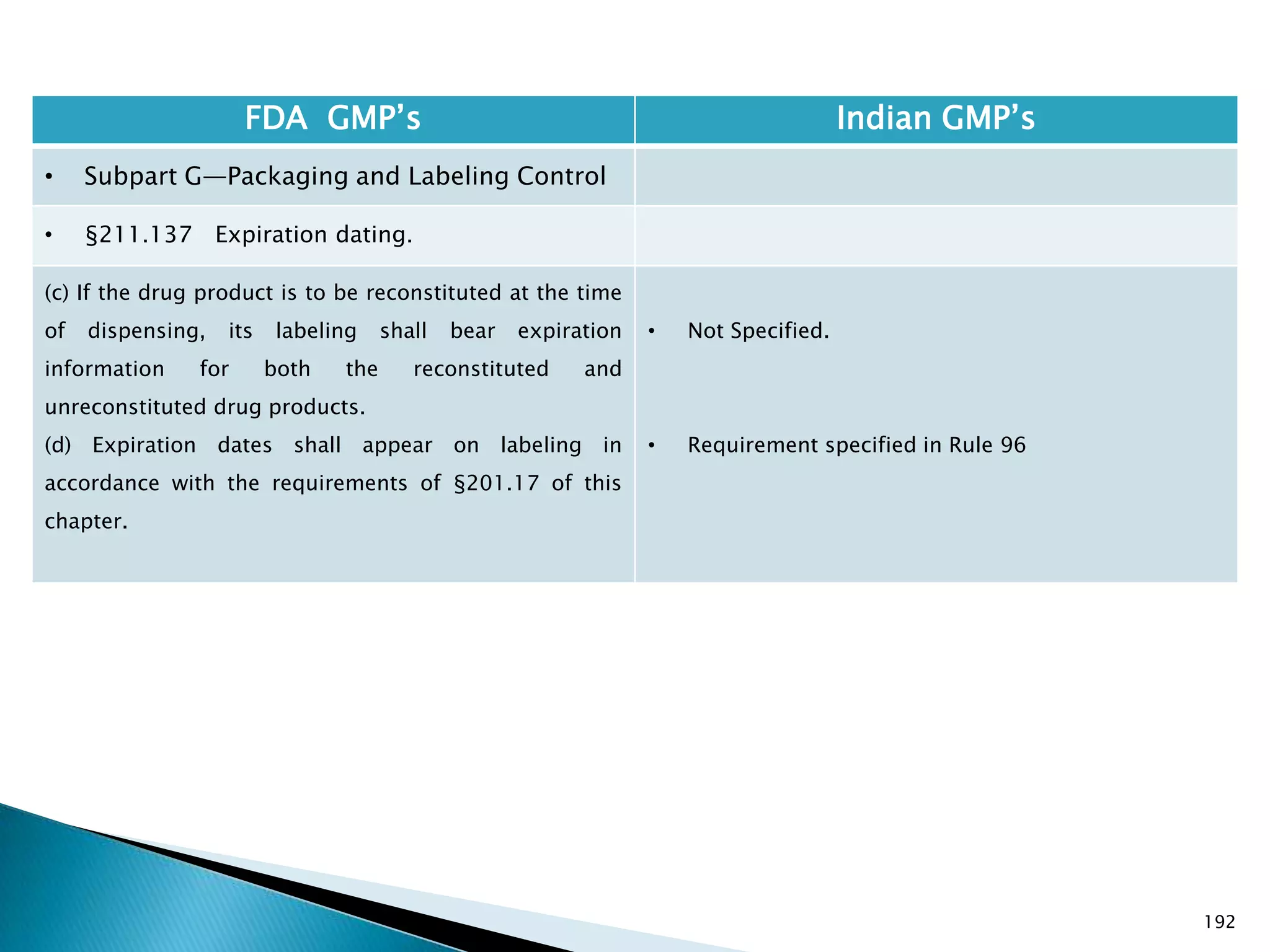
19.Requirement that if the drug product is to be
reconstituted at the time of dispensing, its
labeling shall bear expiration information for
both the reconstituted and unreconstituted
drug products is not specified.
( 211.137 (c ) ).
47
 Subpart G—Packaging and Labeling Control
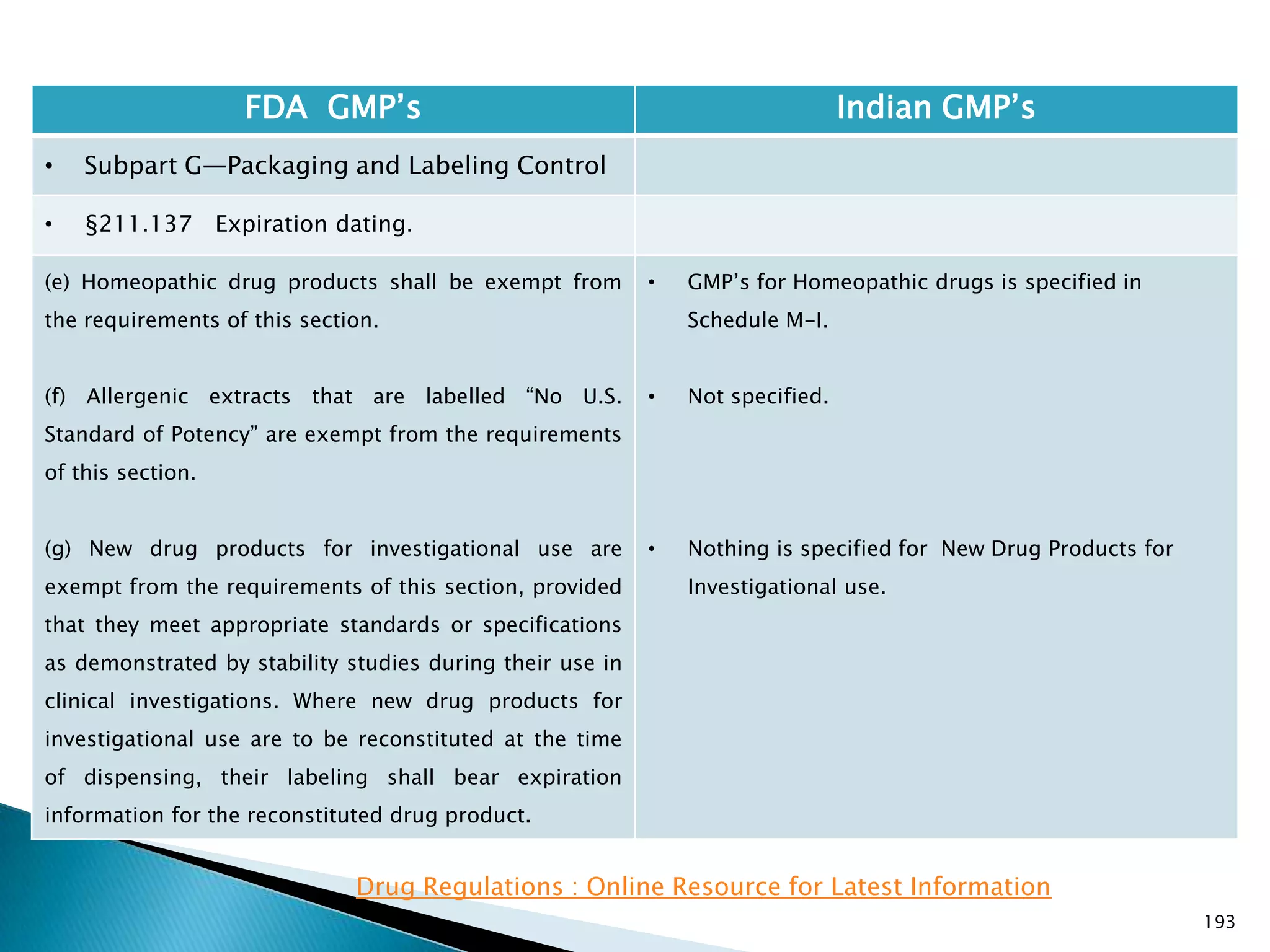
20. Requirement that New drug products for investigational use
are exempt from the requirements of Packaging & Labeling
Controls , provided that they meet appropriate standards or
specifications as demonstrated by stability studies during
their use in clinical investigations is not specified.
( 211.137 (g) )
 Requirement that where new drug products for investigational use
are to be reconstituted at the time of dispensing, their labeling
shall bear expiration information for the reconstituted drug
product is not specified.
48
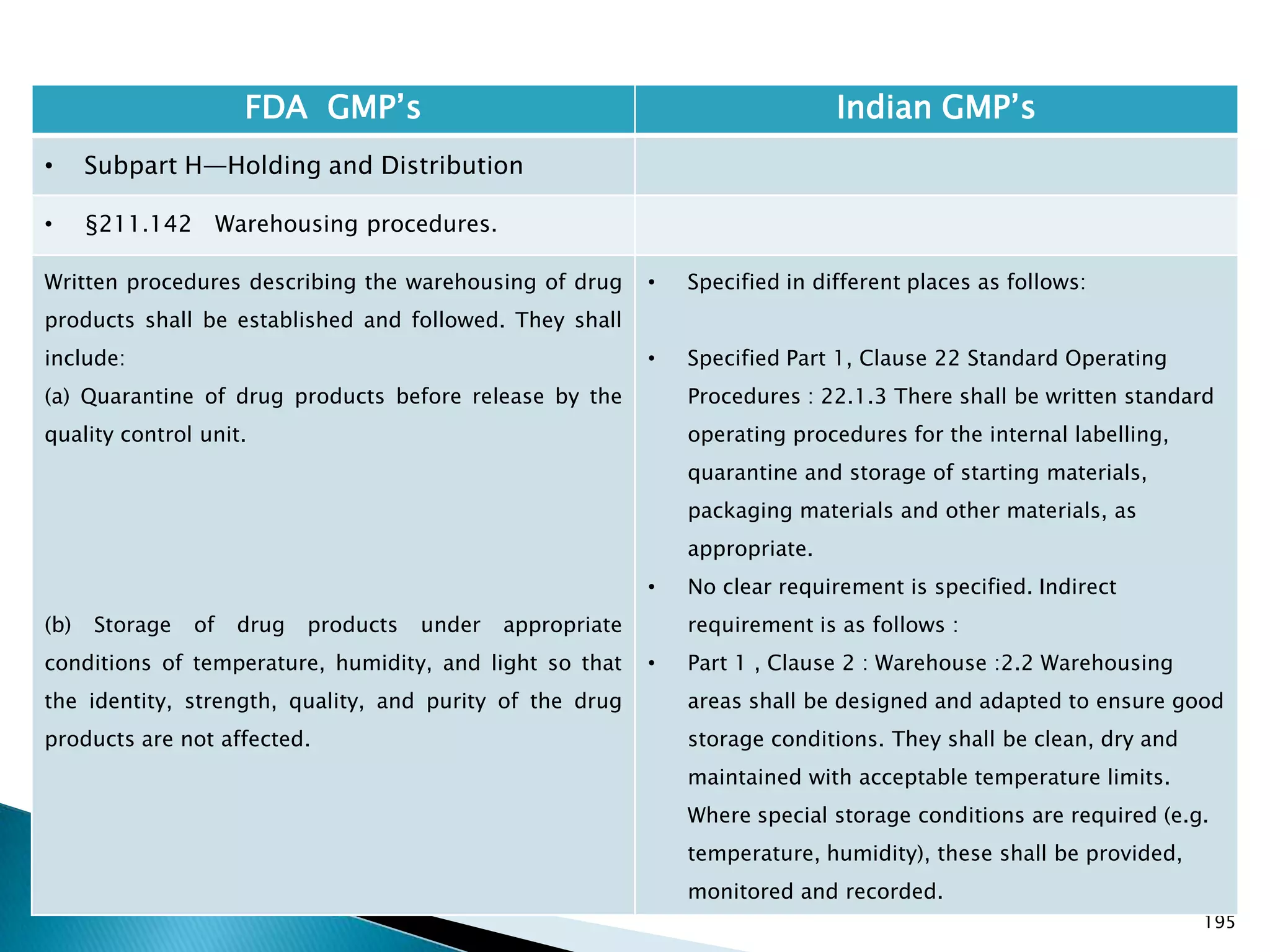
 Subpart H—Holding and Distribution
1. Requirement of storage of drug products
under appropriate conditions of temperature,
humidity, and light so that the identity,
strength, quality, and purity of the drug
products are not affected is not specified
clearly & directly. ( 211.142 (b) )
49
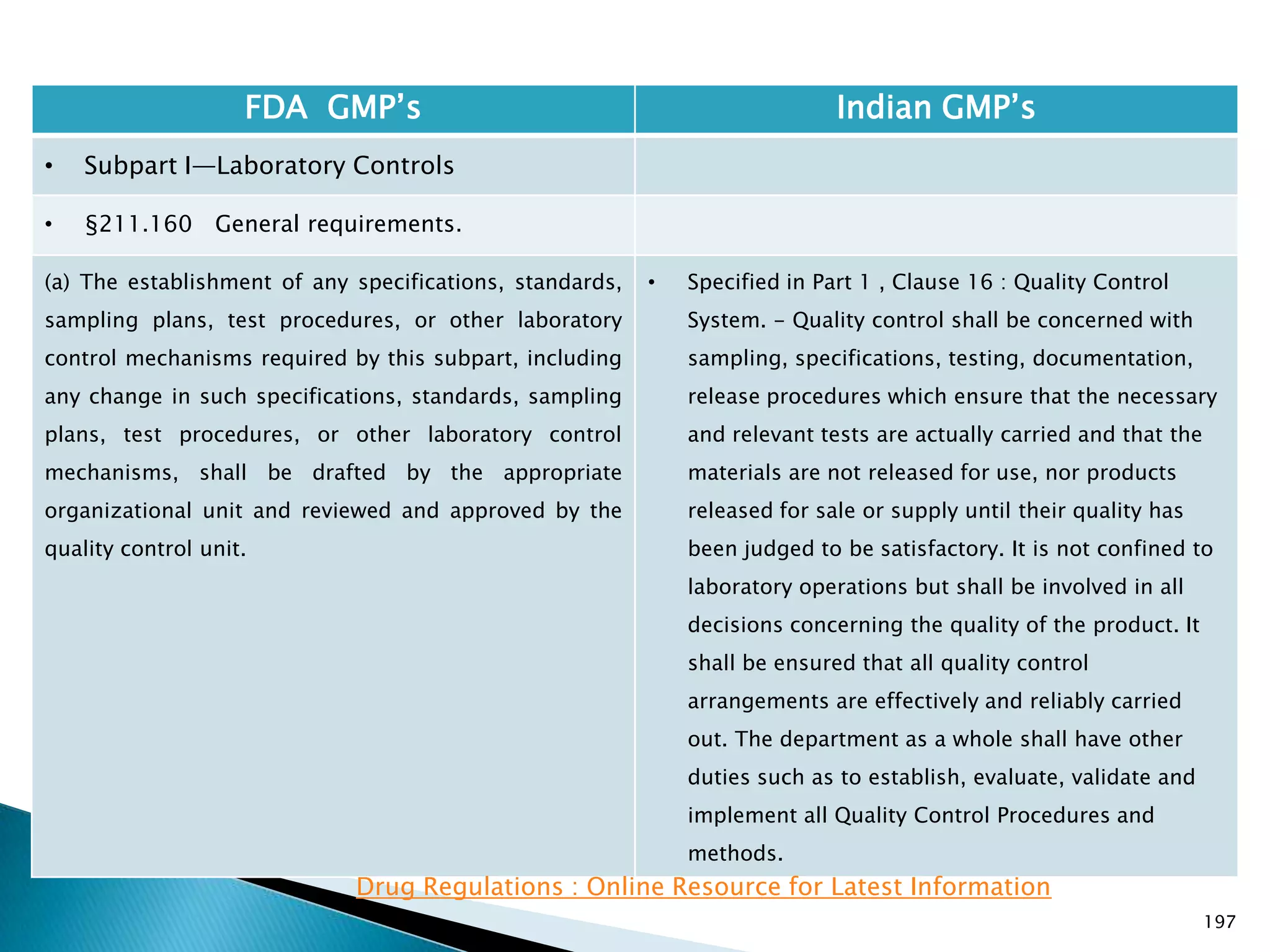
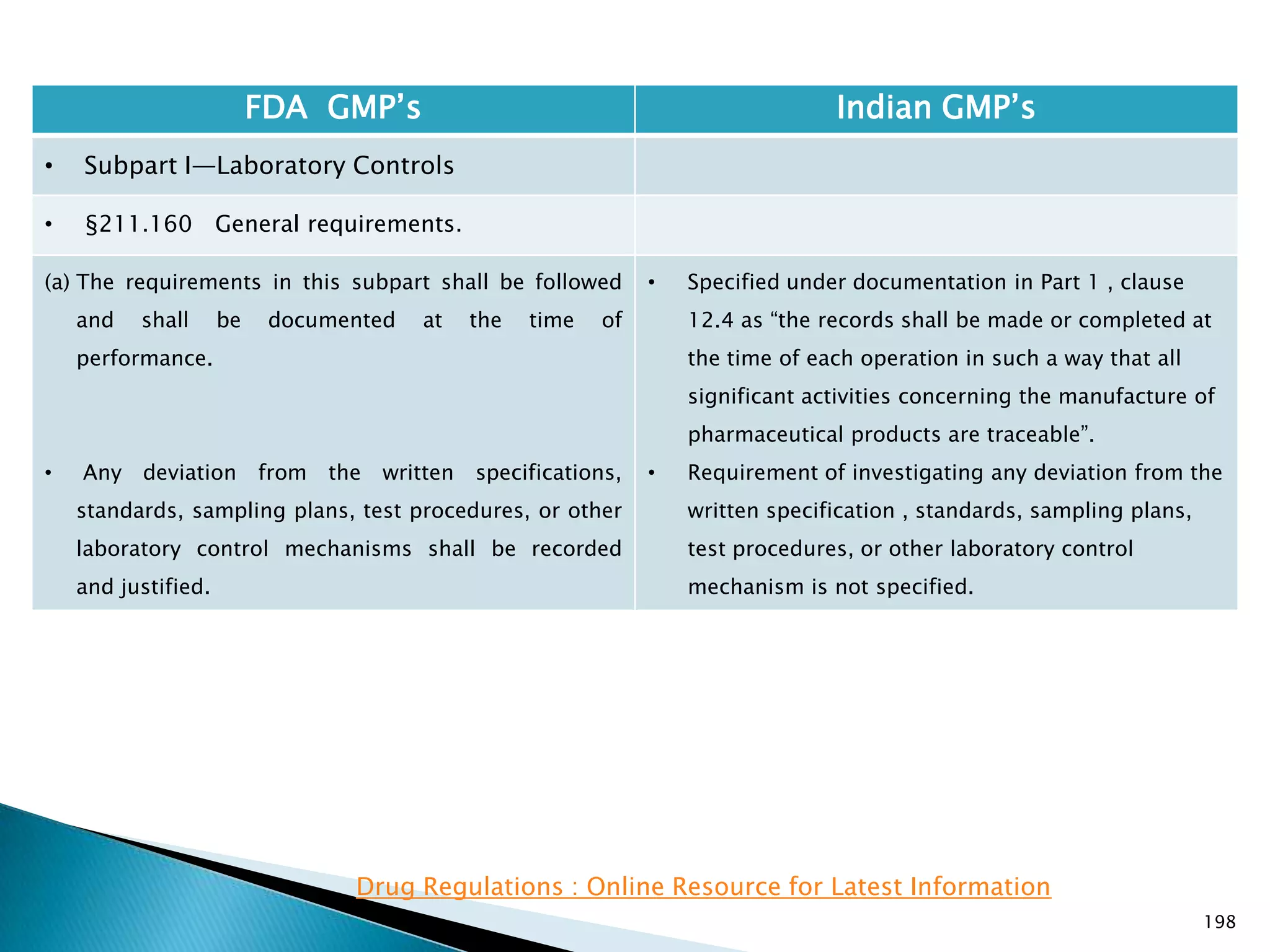
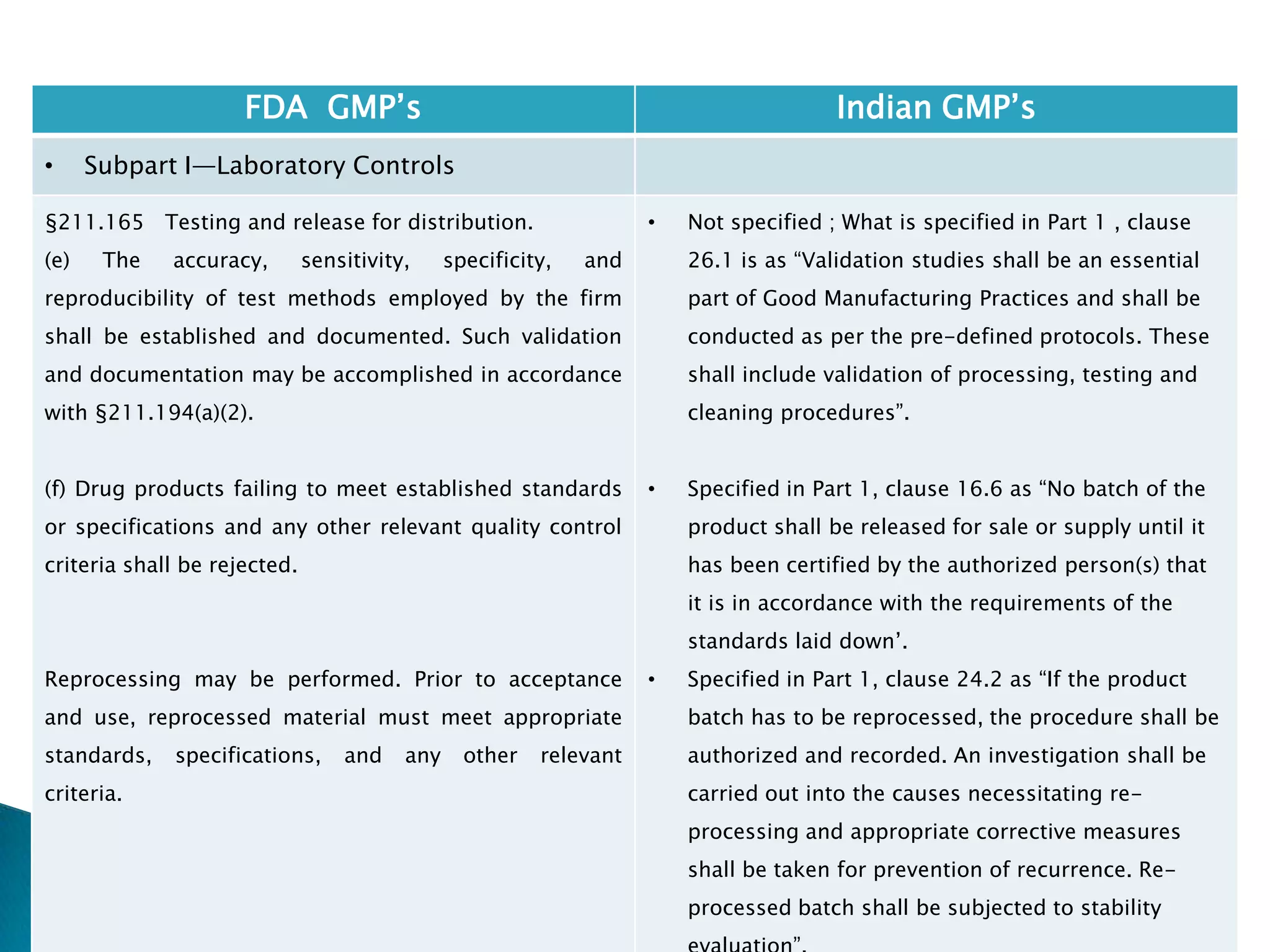
 Subpart I—Laboratory Controls
1. Requirement of investigating any deviation from the
written specification , standards, sampling plans, test
procedures, or other laboratory control mechanism is
not specified ( 211.160 (a) ).
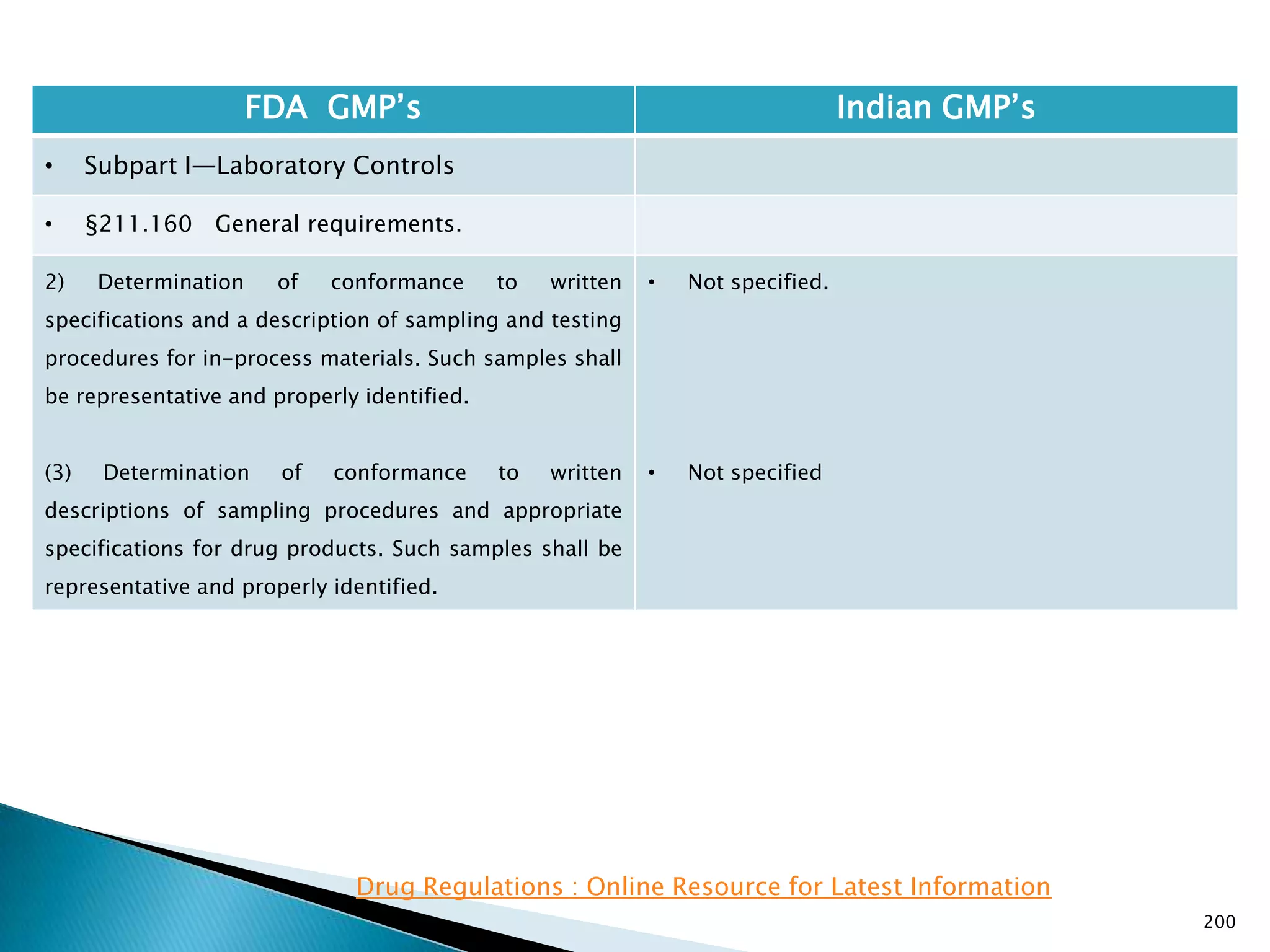
2. Requirement of determination of conformance to
written specifications and a description of sampling
and testing procedures for in-process materials and
that such samples shall be representative and properly
identified is not specified. ( 211.160 (b) (2) )
50
 Subpart I—Laboratory Controls
3. Requirement of determination of conformance to written
descriptions of sampling procedures and appropriate
specifications for drug products and that such samples shall
be representative and properly identified is not specified.
(211.160 (b) ( 3))
4. Requirement of having provisions for remedial action in the
event accuracy and/or precision limits are not met during
calibration and the requirement of not using instruments,
apparatus, gauges, and recording devices not meeting
established specifications is not specified. (211.160 (b) (4) )
51
 Subpart I—Laboratory Controls
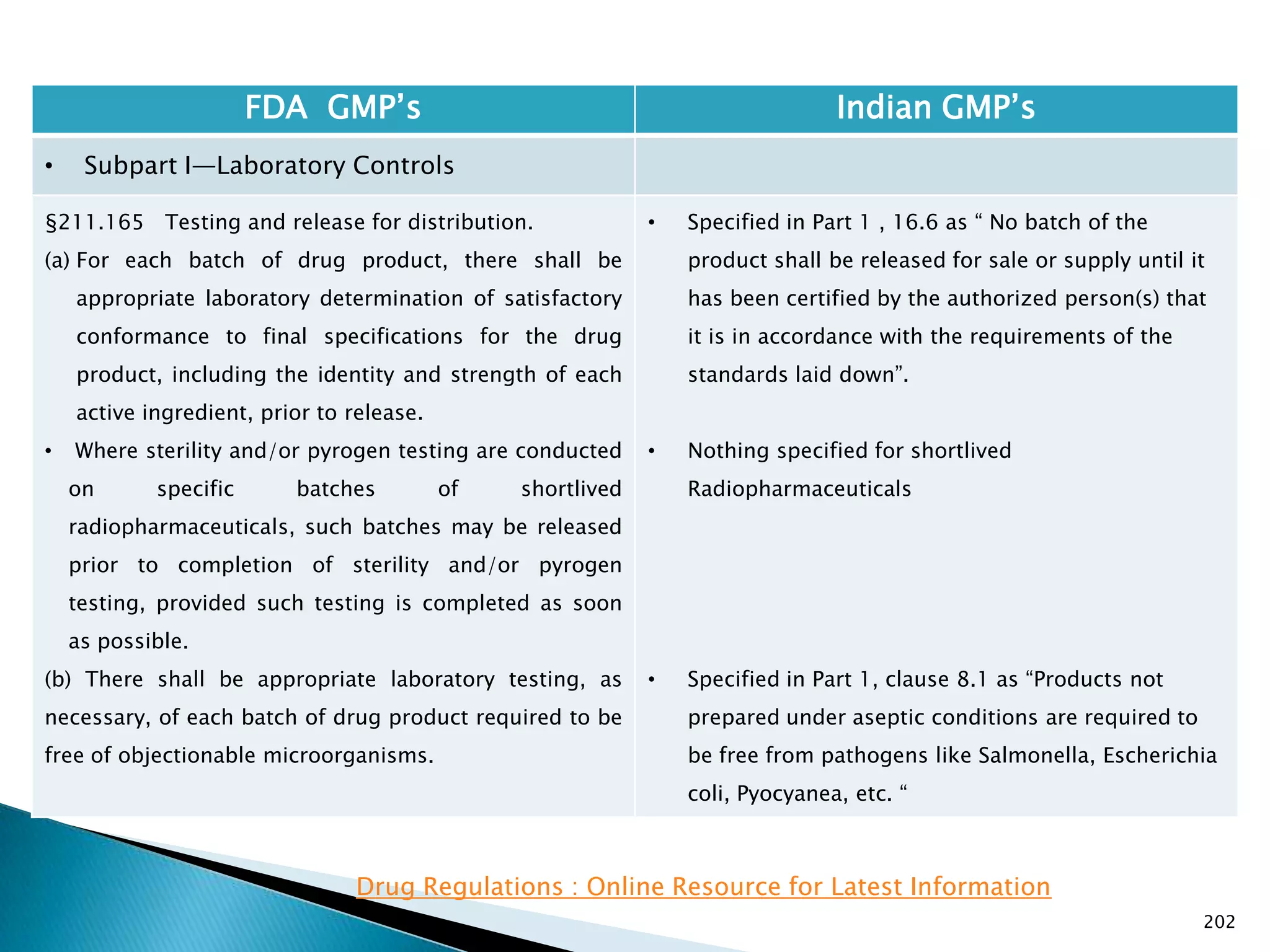
5. Where sterility and/or pyrogen testing are conducted on
specific batches of shortlived radiopharmaceuticals, such
batches may be released prior to completion of sterility
and/or pyrogen testing, provided such testing is completed
as soon as possible is not specified. ( 211.165 (a) )
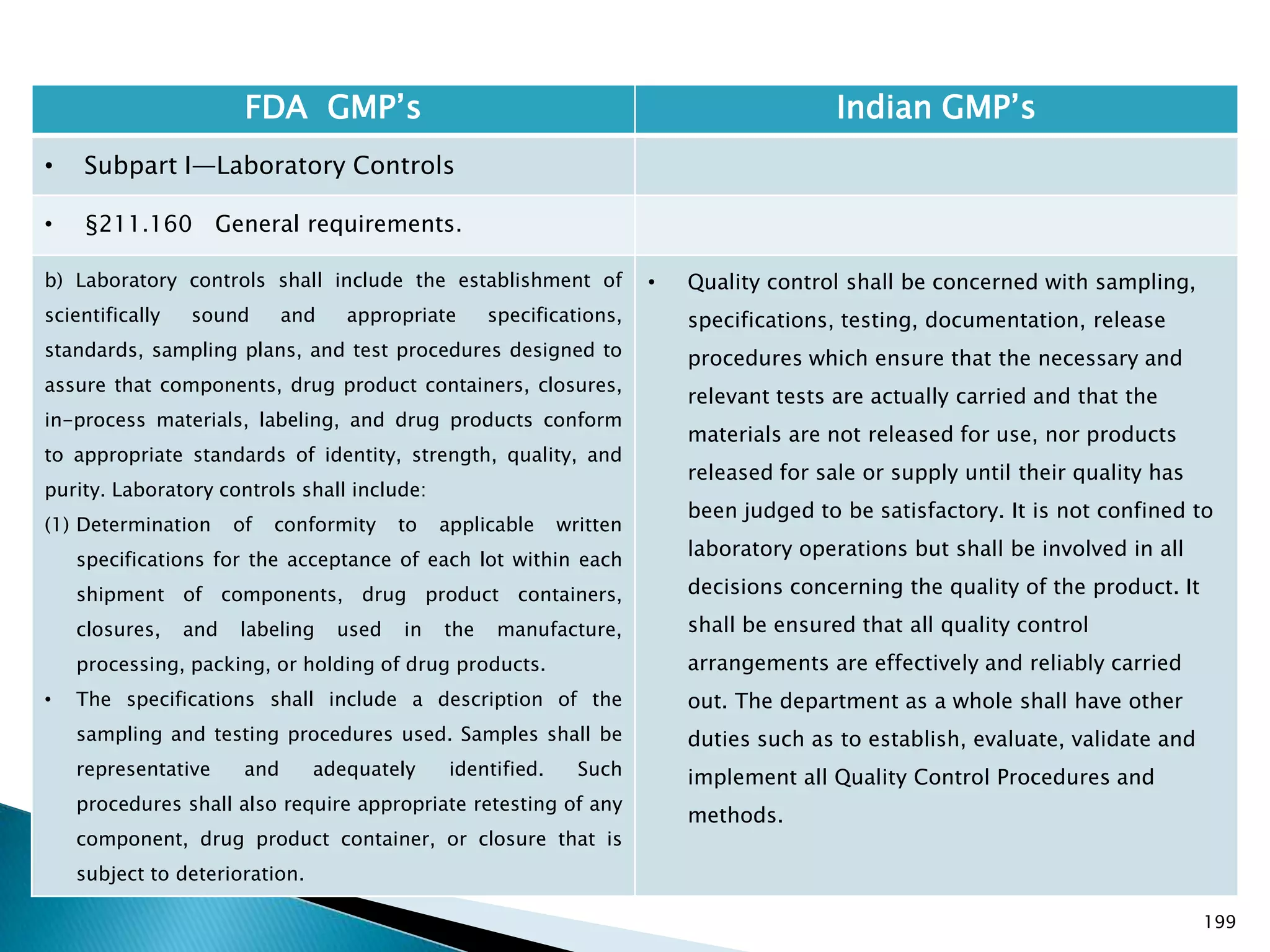
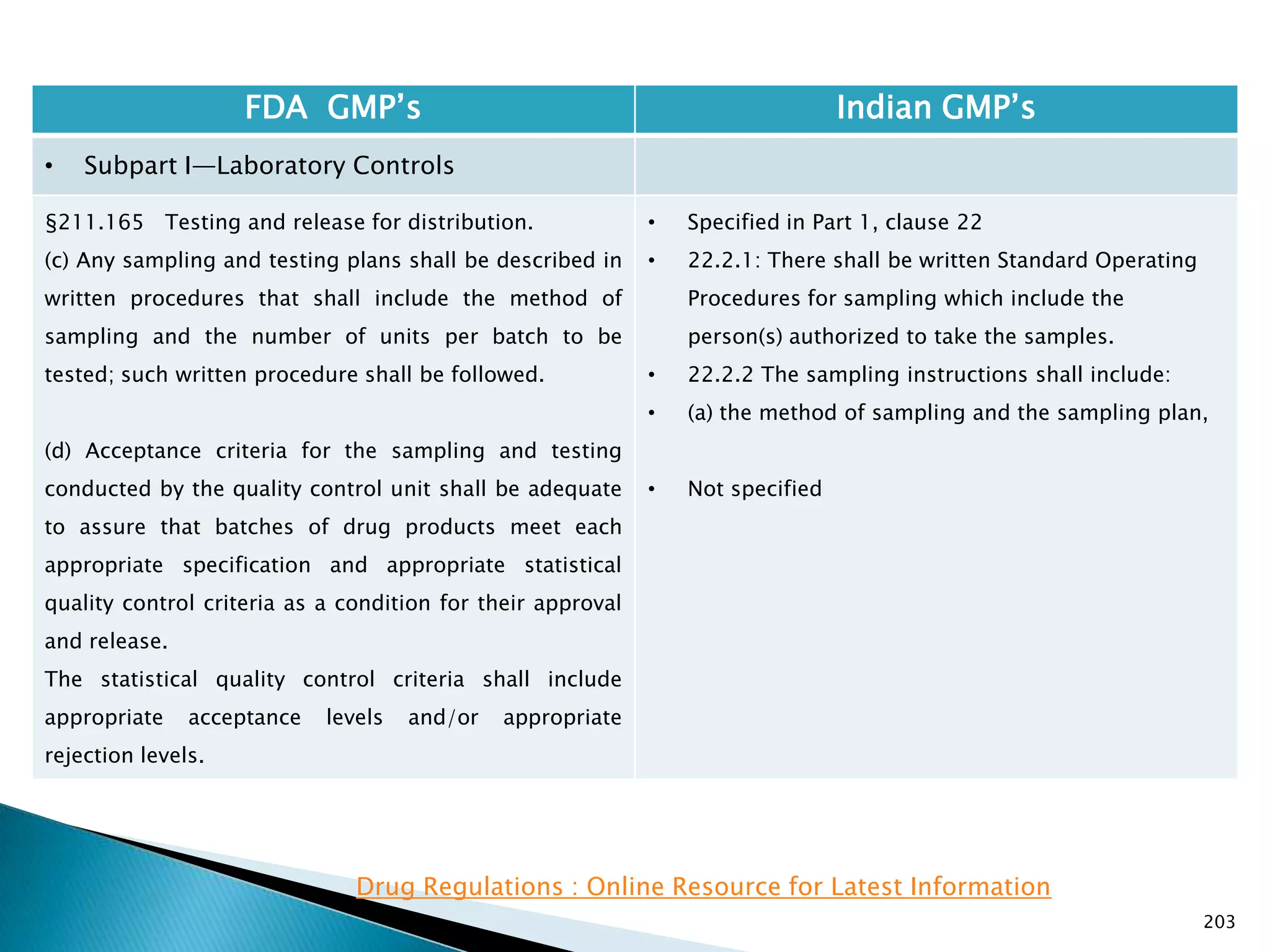
6. Requirement of acceptance criteria for the sampling and
testing conducted by the quality control unit to be adequate
to assure that batches of drug products meet each
appropriate specification and appropriate statistical quality
control criteria as a condition for their approval and release
is not specified.( 211.165 (d) )
52
 Subpart I—Laboratory Controls
7. Requirement of establishing and documenting
the accuracy, sensitivity, specificity, and
reproducibility of test methods employed by the
firm is not specified. ( 211.165 ( e ) ).
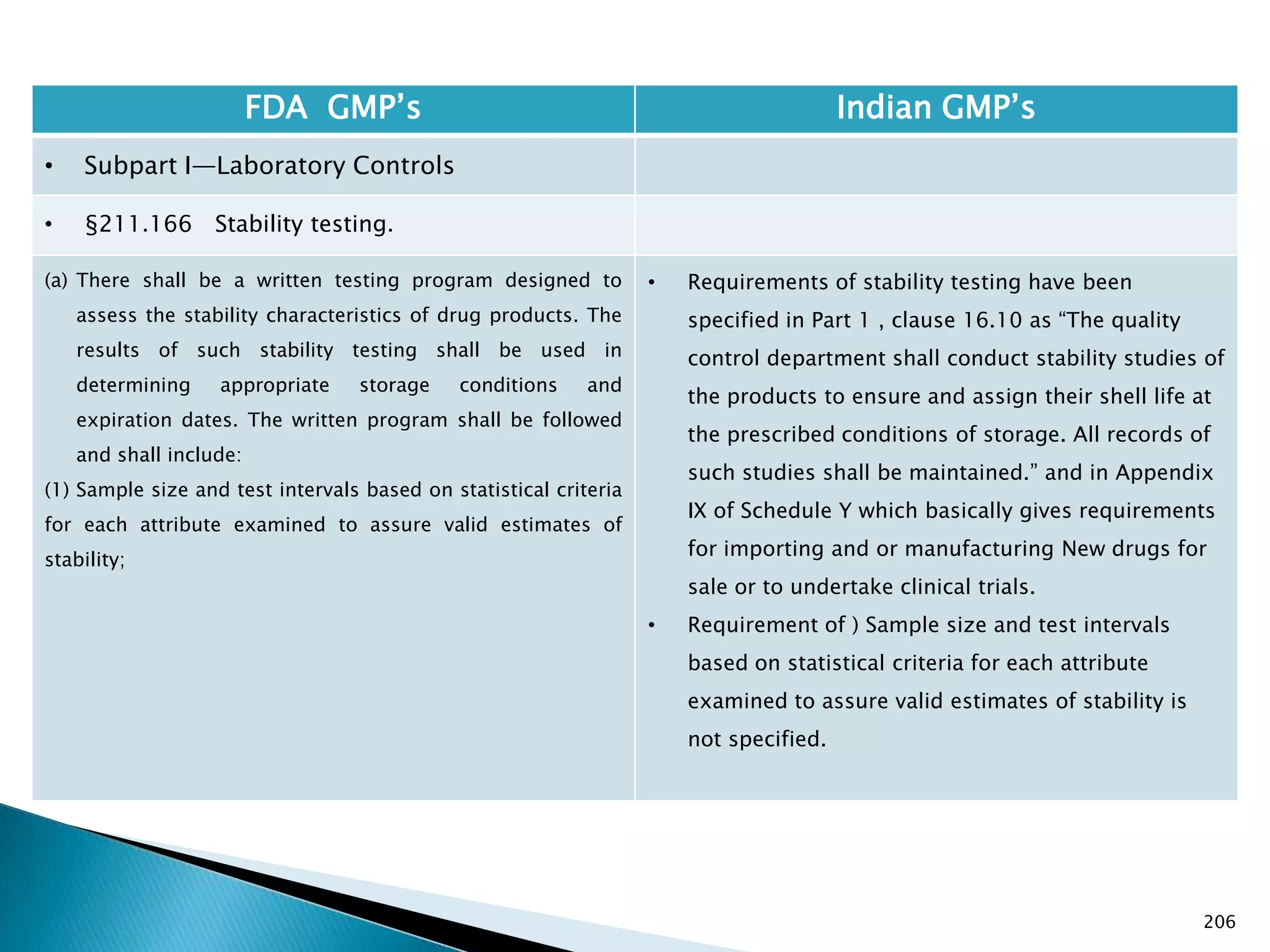
8. Requirement of Sample size and test intervals
based on statistical criteria for each attribute
examined to assure valid estimates of stability is
not specified. ( 211.166 (a) (1) )
53
 Subpart I—Laboratory Controls
9. Requirement of a written testing program designed to
assess the stability characteristics of drug products is
specified only for New Drugs under Schedule Y to the
Act. Similarly the requirement that results of such
stability testing shall be used in determining
appropriate storage conditions and expiration dates
and that the written program shall be followed and
shall include requirements given below is specified for
New Drugs Only.: ( 211.166 (a) (1) to (5) )
54
 Subpart I—Laboratory Controls
• Sample size and test intervals based on statistical criteria for each
attribute examined to assure valid estimates of stability is not specified
at all. ( 211.166 (a) (1) )
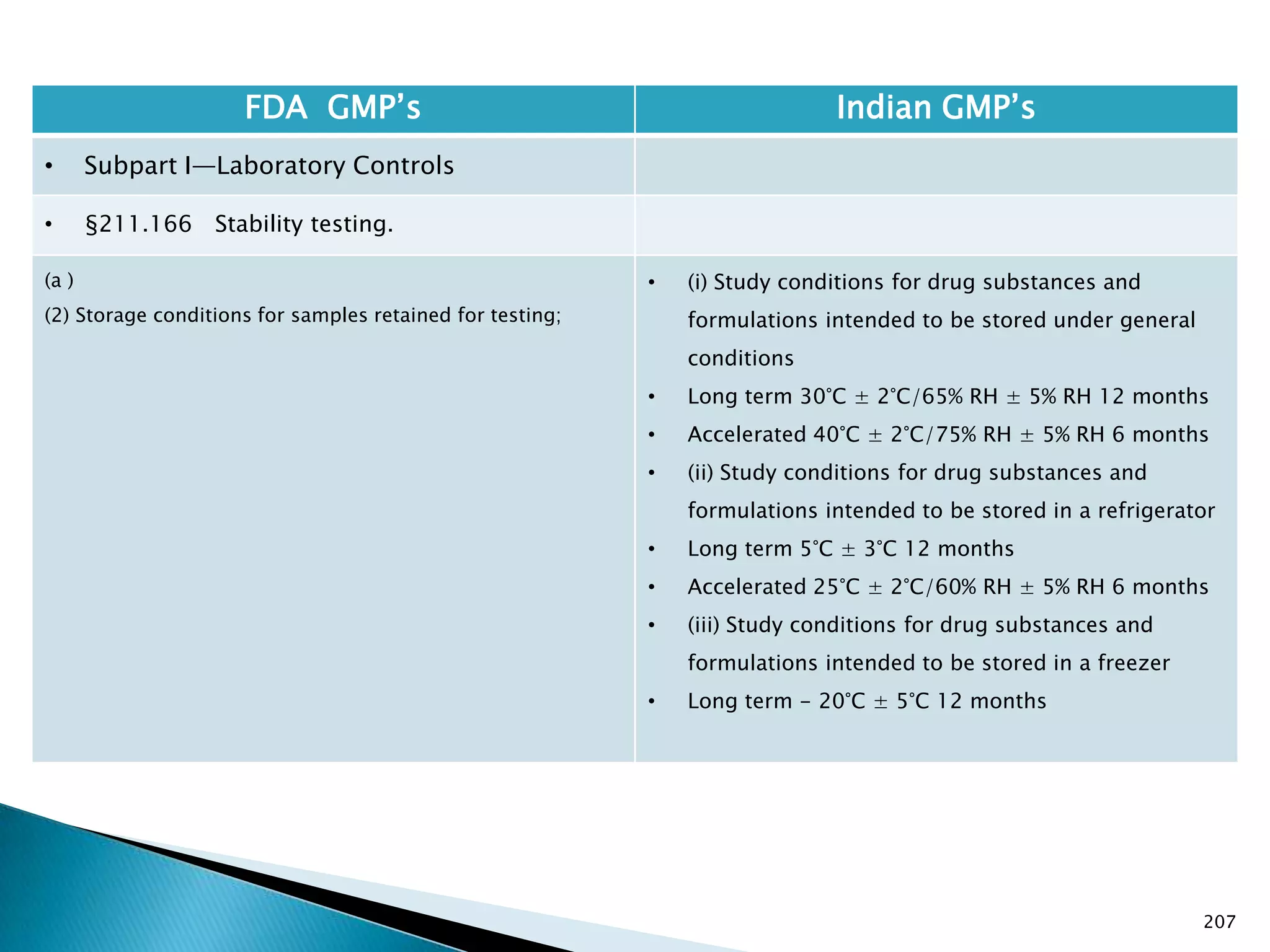
• Storage conditions for samples retained for testing is specified for New
products only; ( 211.166 (a) (2) )
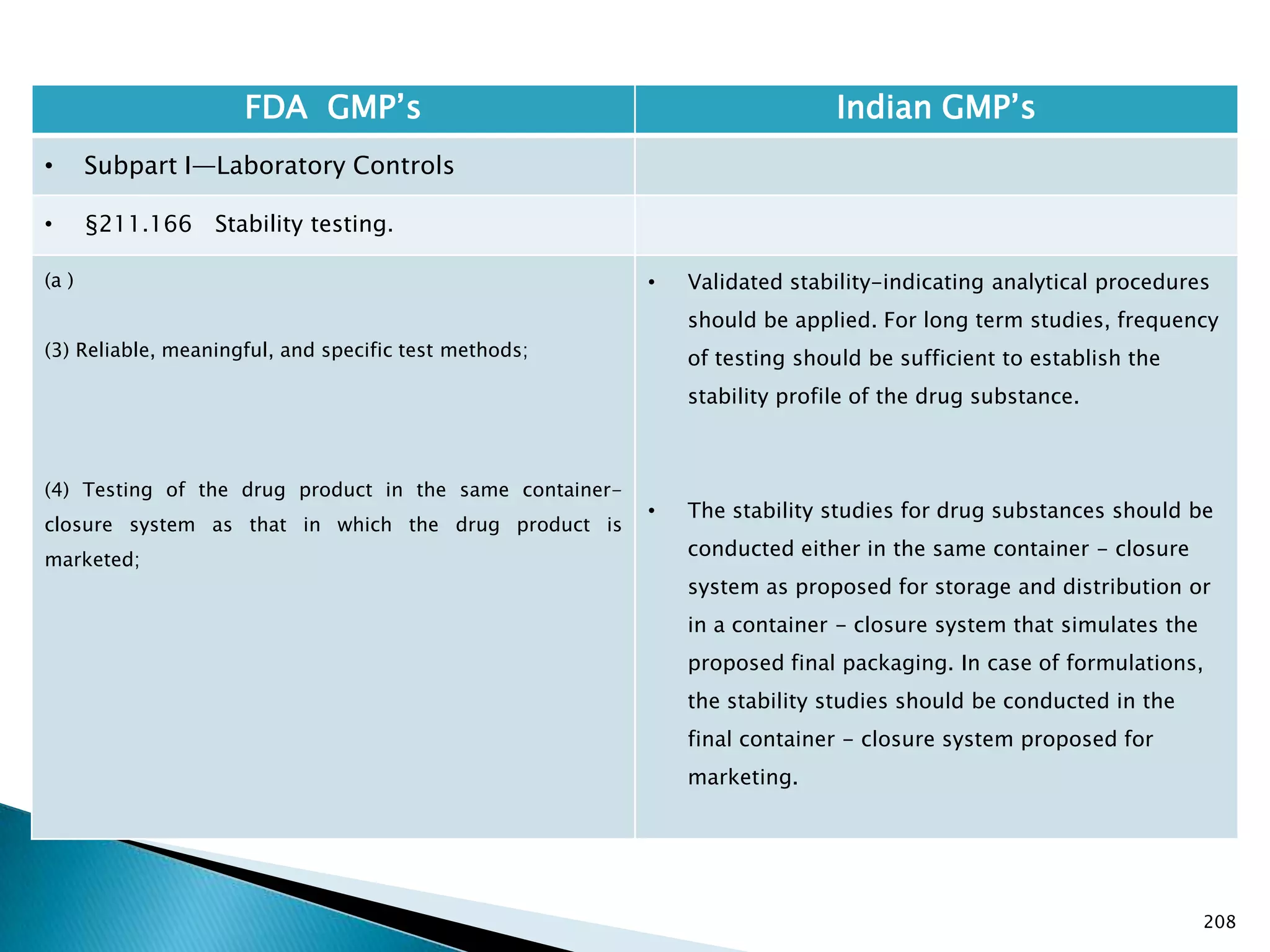
• Reliable, meaningful, and specific test methods is specified for new
products only. ( 211.166 (a) (3) )
• Testing of the drug product in the same container-closure system as that
in which the drug product is marketed is specified for new products only;
( 211.166 (a) (4) )
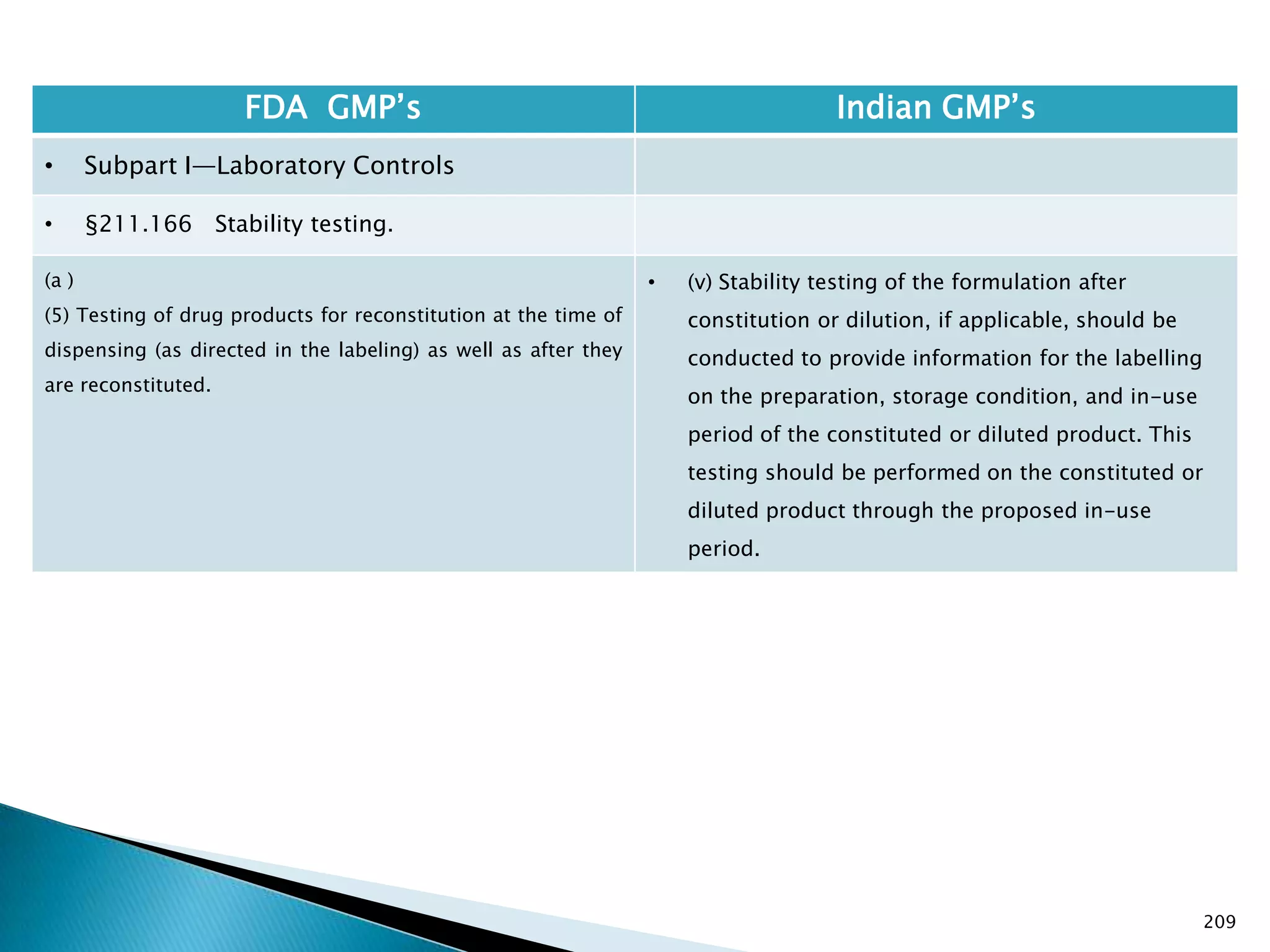
• Testing of drug products for reconstitution at the time of dispensing (as
directed in the labeling) as well as after they are reconstituted is
specified for new products only. ( 211.166 (a) (5))
55
 Subpart I—Laboratory Controls
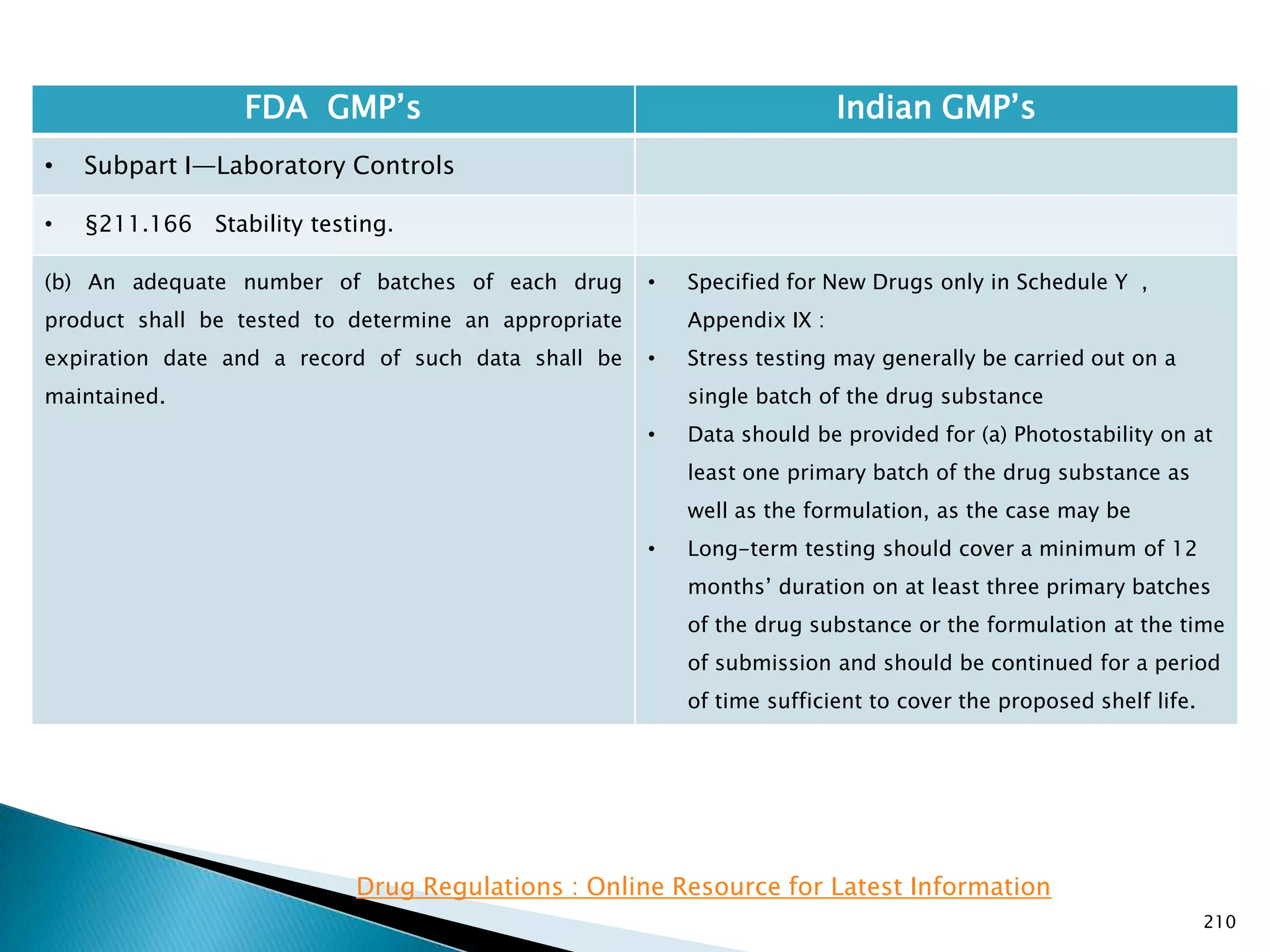
10. Requirement of adequate number of batches of each drug
product shall be tested to determine an appropriate
expiration date and a record of such data shall be
maintained is not specified.( 211.166 (b) )
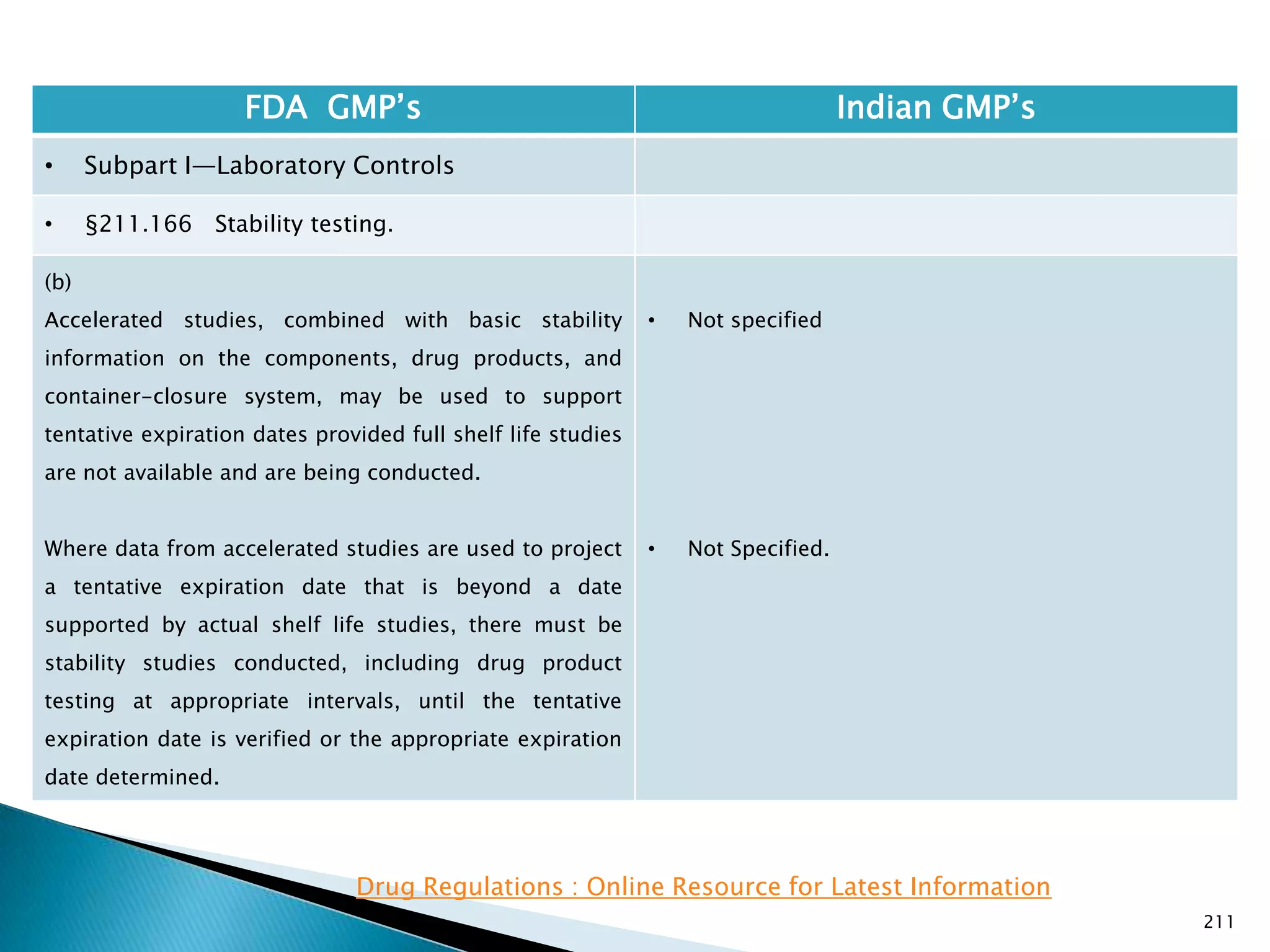
◦ Requirement of accelerated studies, combined with basic
stability information on the components, drug products, and
container-closure system, may be used to support tentative
expiration dates provided full shelf life studies are not
available and are being conducted is not specified.
( 211.166 (b) )
56
 Subpart I—Laboratory Controls
◦ Requirement that where data from accelerated studies
are used to project a tentative expiration date that is
beyond a date supported by actual shelf life studies,
there must be stability studies conducted, including
drug product testing at appropriate intervals, until the
tentative expiration date is verified or the appropriate
expiration date determined is not specified
( 211.166 (b) )
57
 Subpart I—Laboratory Controls
11. Requirement that for each batch of controlled-release dosage form, there shall be
appropriate laboratory testing to determine conformance to the specifications for
the rate of release of each active ingredient and that the test procedures shall be in
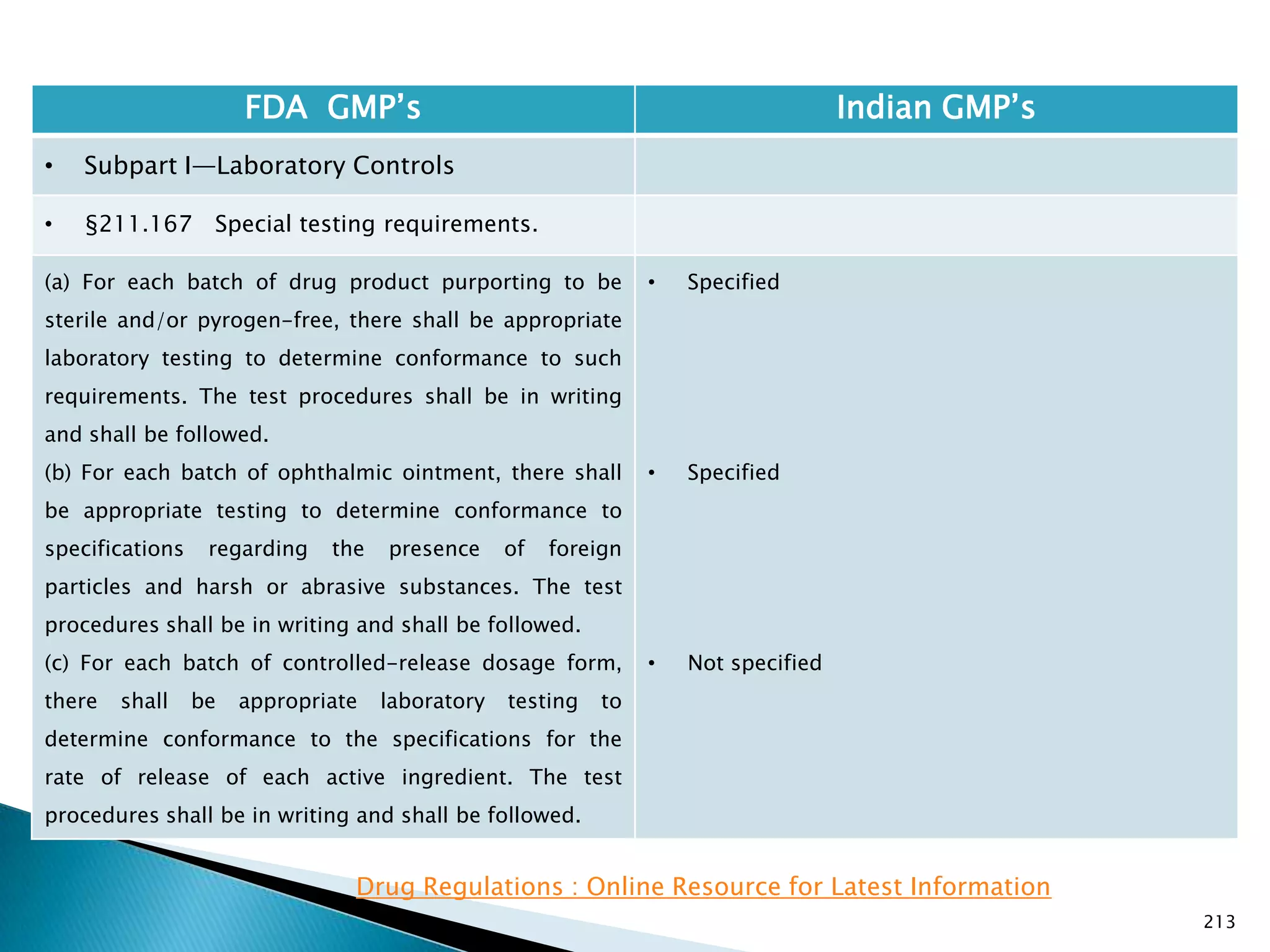
writing and shall be followed is not specified. ( 211.167 ( C ) )
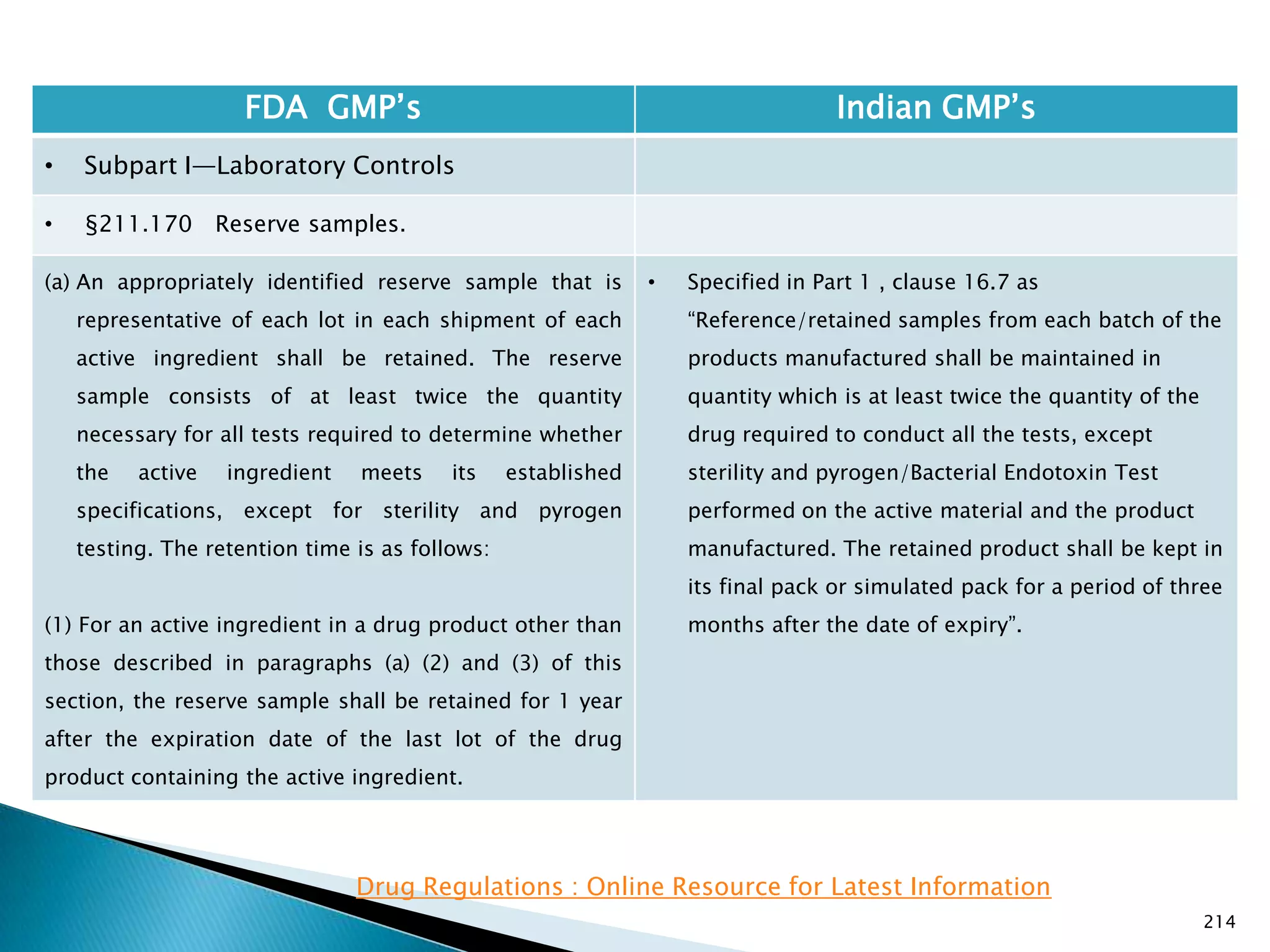
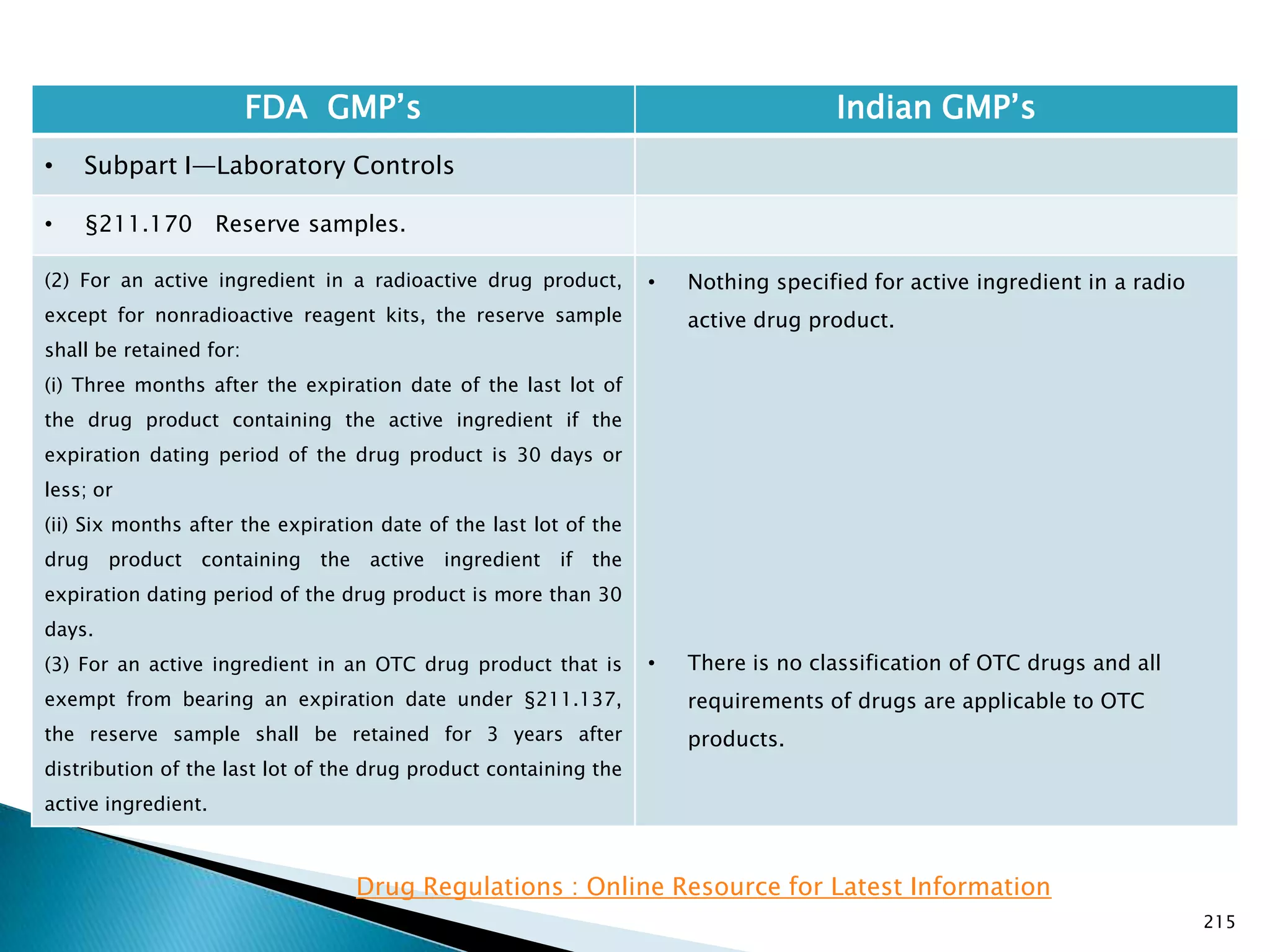
12. Requirement that for an active ingredient in a radioactive drug product, except for
nonradioactive reagent kits, the reserve sample shall be retained for:
◦ (i) Three months after the expiration date of the last lot of the drug product
containing the active ingredient if the expiration dating period of the drug product
is 30 days or less; or
◦ (ii) Six months after the expiration date of the last lot of the drug product
containing the active ingredient if the expiration dating period of the drug product
is more than 30 days is not specified ( 211.170 ( a) (2) )
58
 Subpart I—Laboratory Controls
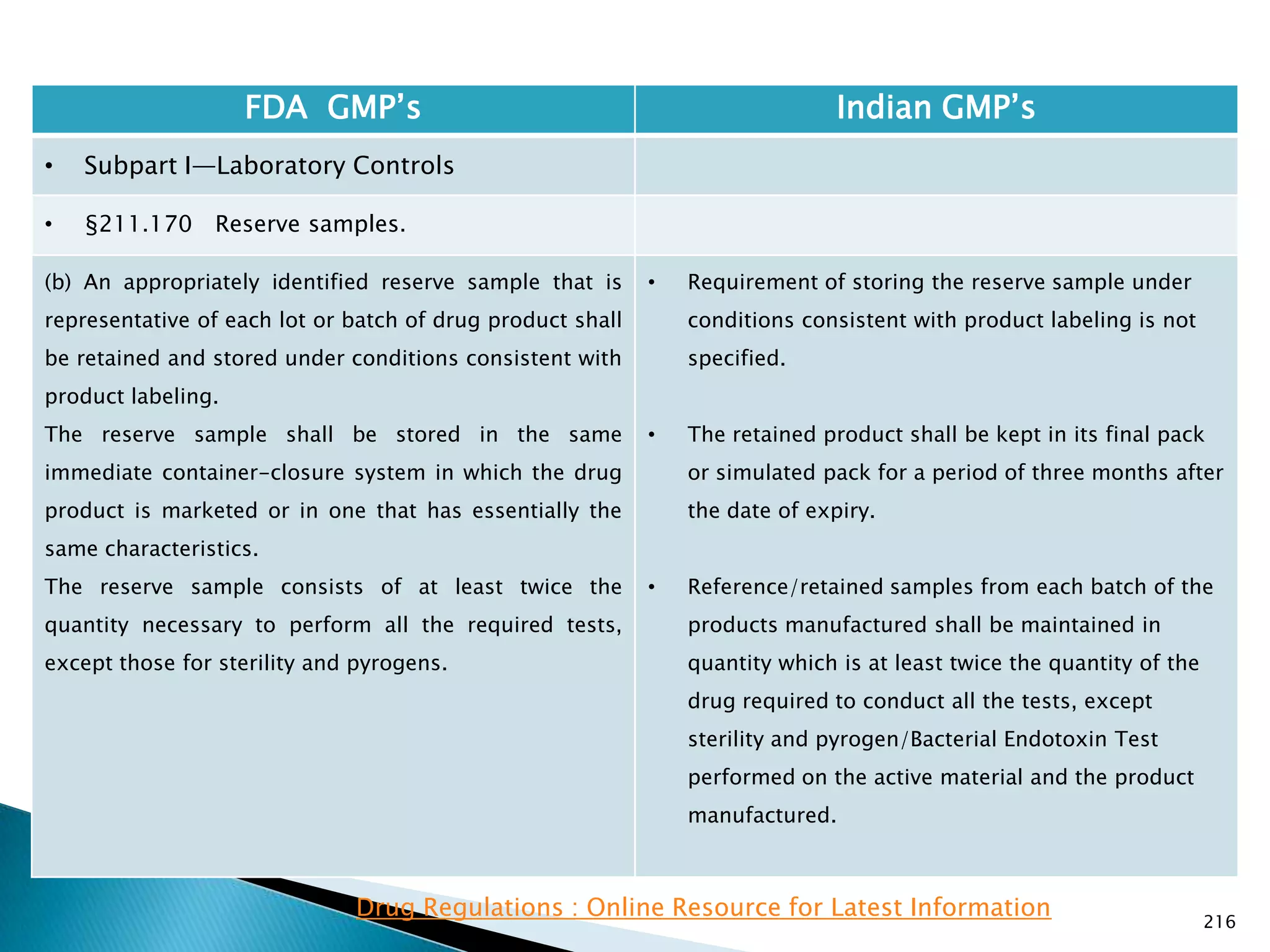
13. Requirement of storing the reserve sample under conditions
consistent with product labeling is not specified. ( 211.170
(b) )
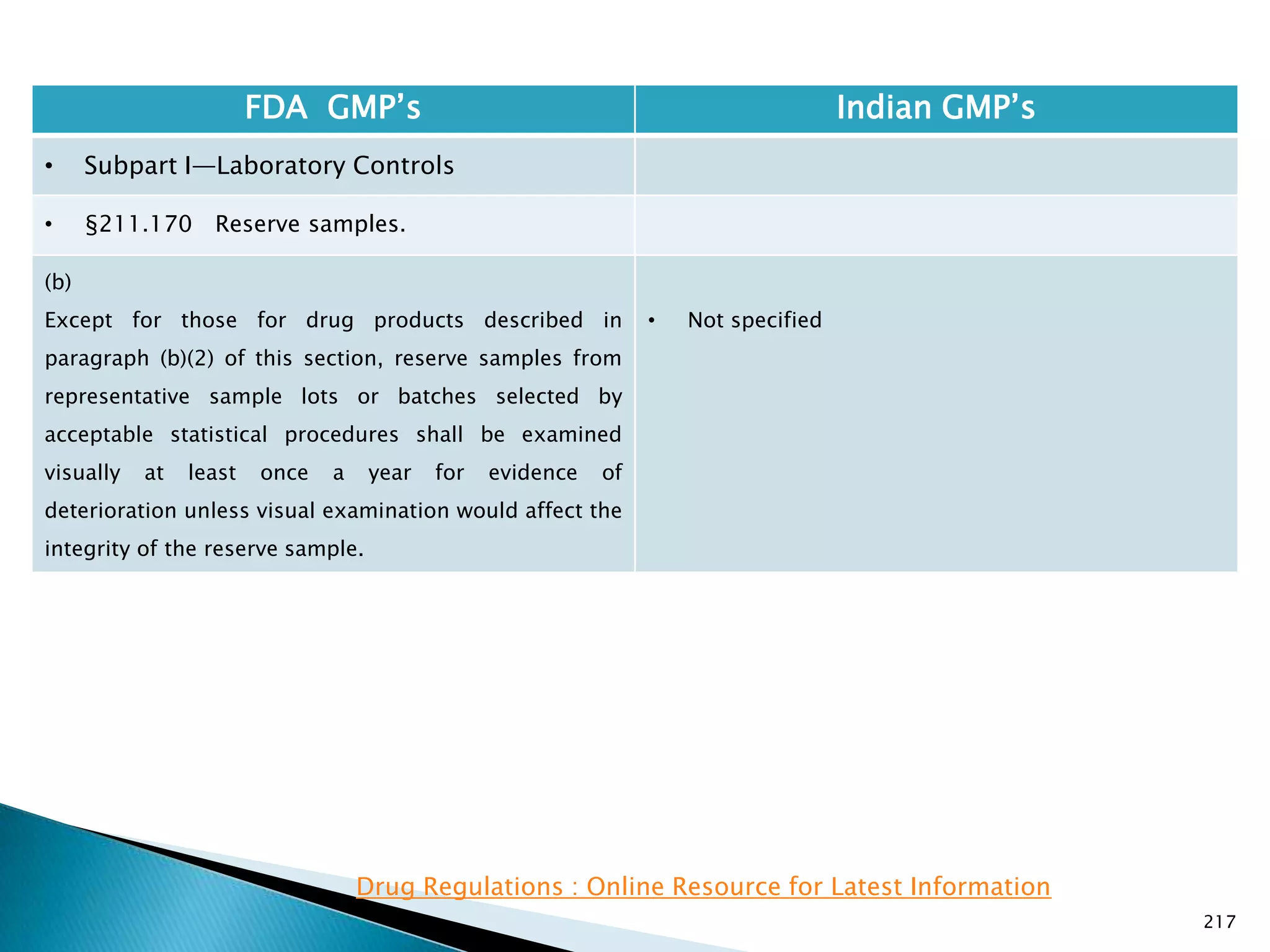
14. Except for those for drug products described in paragraph
(b)(2) of this section, reserve samples from representative
sample lots or batches selected by acceptable statistical
procedures shall be examined visually at least once a year
for evidence of deterioration unless visual examination
would affect the integrity of the reserve sample is not
specified. (211.170 (b) )
59
 Subpart I—Laboratory Controls
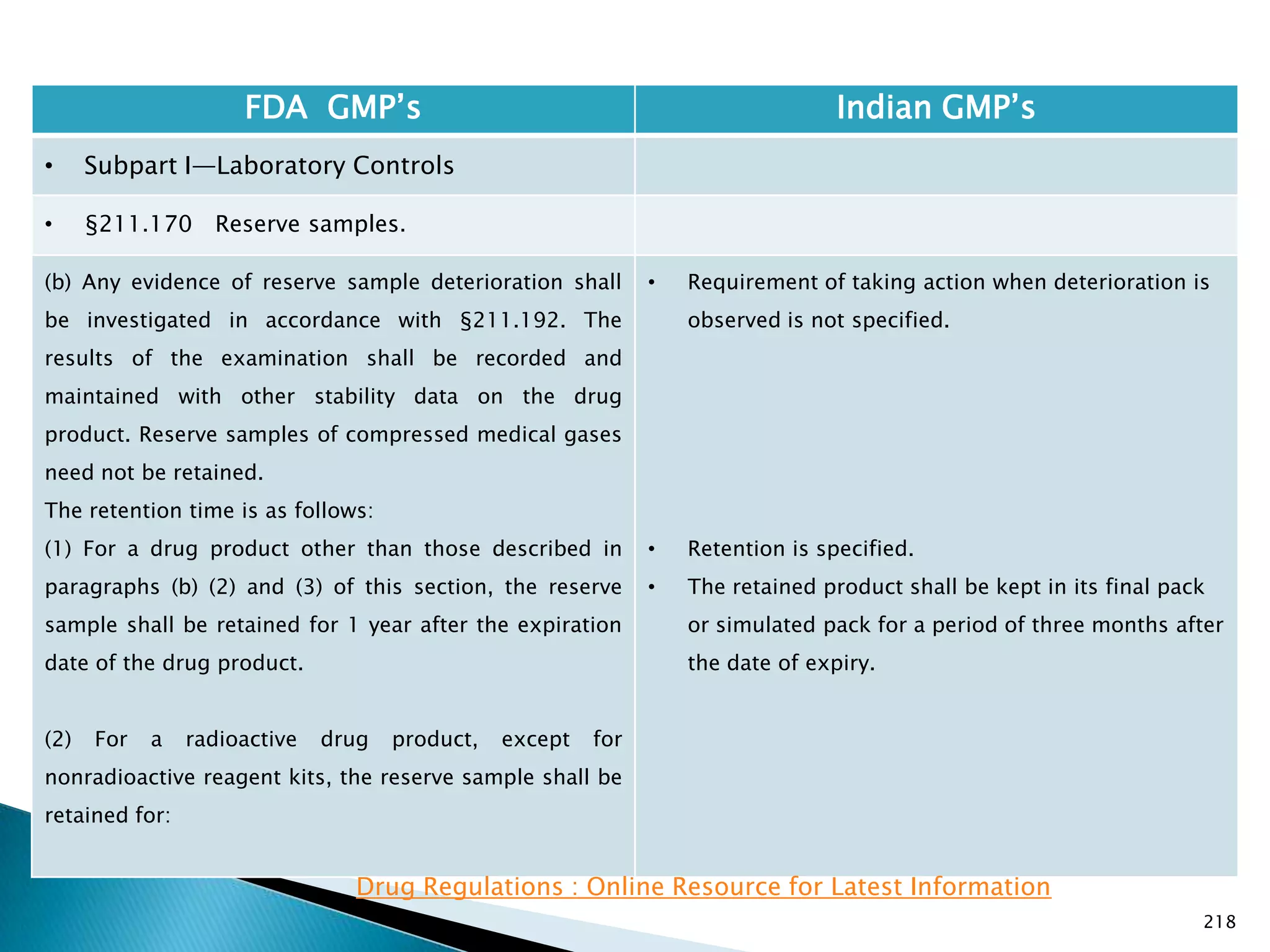
15. Requirement of performing investigations on evidence of reserve sample
deterioration is not specified. ( 211.170 (b) )
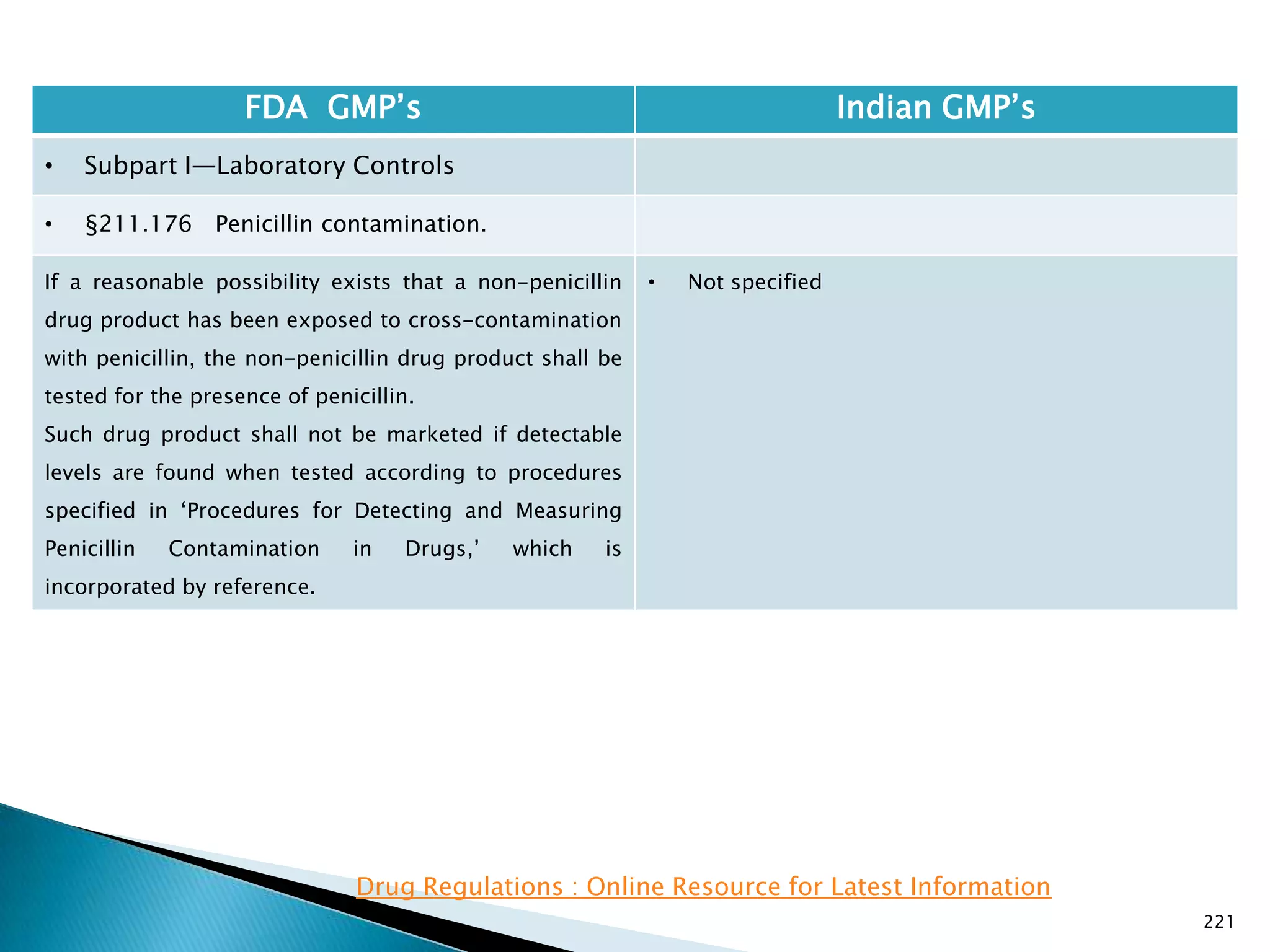
16. Requirement that if a reasonable possibility exists that a non-penicillin
drug product has been exposed to cross-contamination with
penicillin, the non-penicillin drug product shall be tested for the
presence of penicillin is not specified. ( 211.176 )
◦ Further such drug product shall not be marketed if detectable levels are
found when tested according to procedures specified in ‗Procedures for
Detecting and Measuring Penicillin Contamination in Drugs,‘ which is
incorporated by reference is not specified..
60
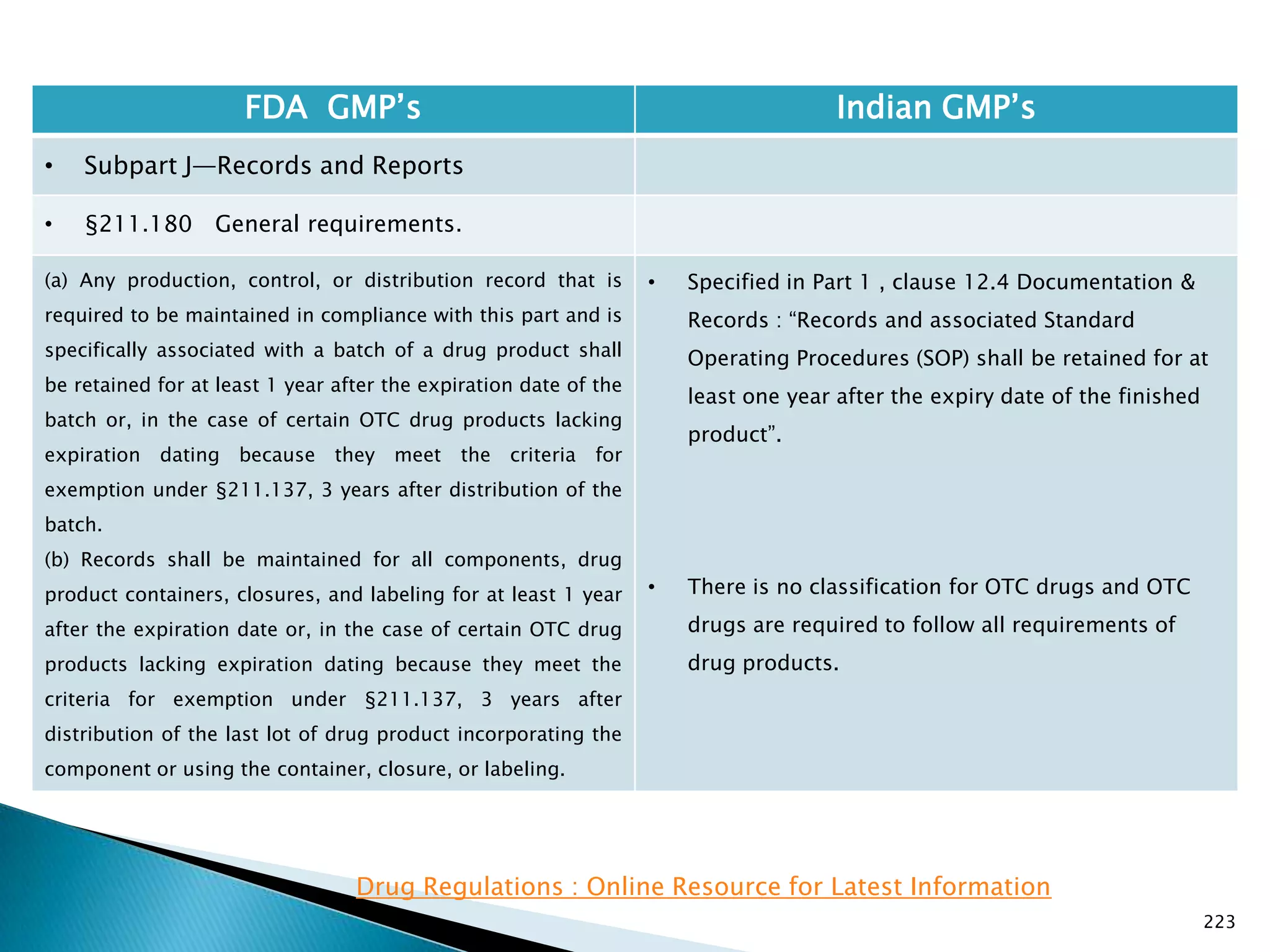
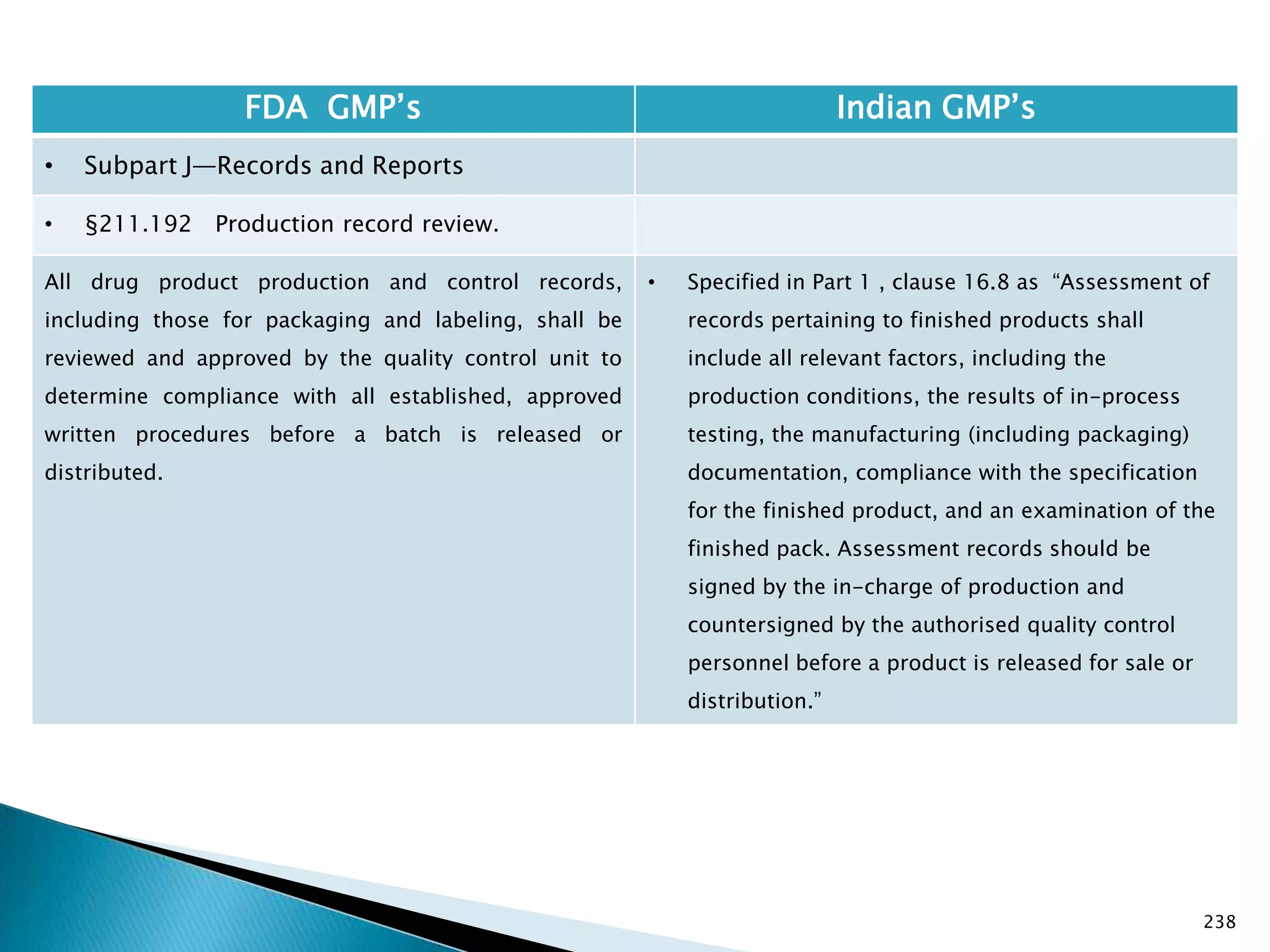
 Subpart J—Records and Reports
1. Requirement that all records required under this part, or
copies of such records, shall be readily available for
authorized inspection during the retention period at the
establishment where the activities described in such records
occurred is not specified. ( 211.180 (c ) )
 Requirement that these records or copies thereof shall be subject
to photocopying or other means of reproduction as part of such
inspection is not specified
 Requirement that records that can be immediately retrieved from
another location by computer or other electronic means shall be
considered as meeting the requirements of this paragraph is not
specified.
61
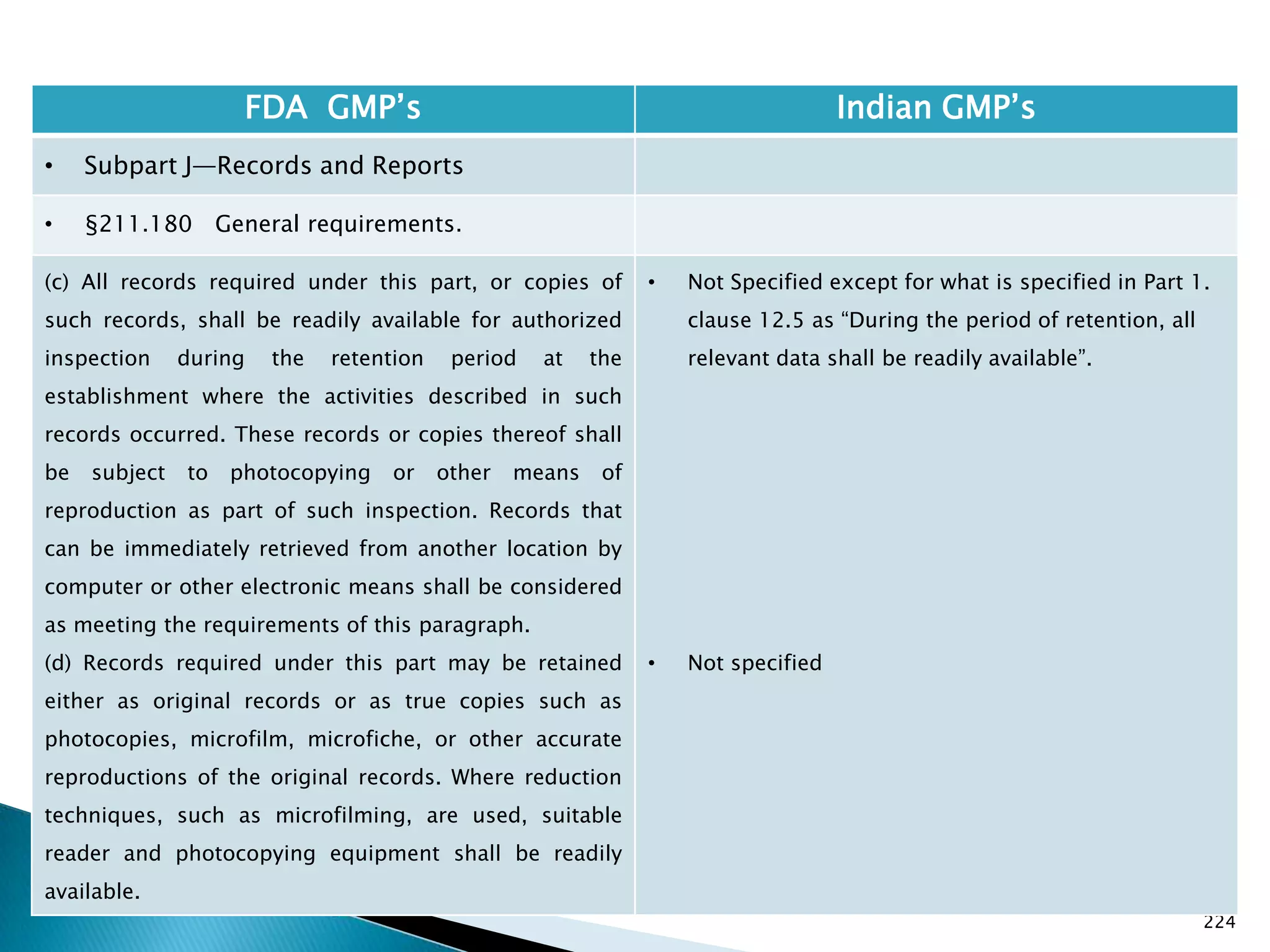
 Subpart J—Records and Reports
2. Requirement that records required under this part may
be retained either as original records or as true copies
such as photocopies, microfilm, microfiche, or other
accurate reproductions of the original records is not
specified. ( 211.180 (d) ).
 Where reduction techniques, such as microfilming, are
used, suitable reader and photocopying equipment shall
be readily available is not specified. ( 211.180 (d) ).
62
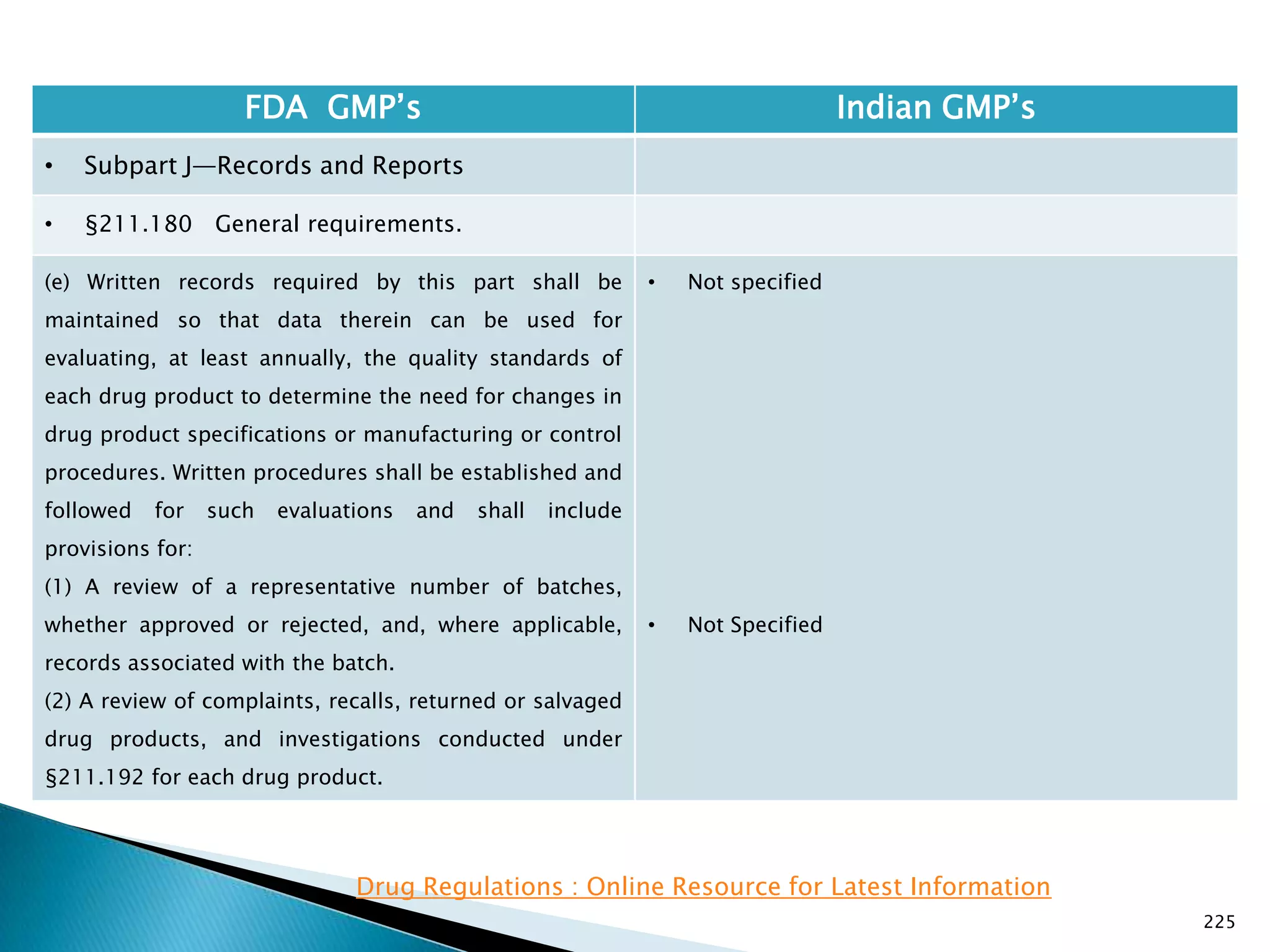
 Subpart J—Records and Reports
3. Requirement that written records required by this part shall
be maintained so that data therein can be used for
evaluating, at least annually, the quality standards of each
drug product to determine the need for changes in drug
product specifications or manufacturing or control
procedures is not specified. ( 211.180 (e) )
 Requirement of establishing written procedures which shall be
followed for such evaluations and shall include following
provisions is not specified.
63
 Subpart J—Records and Reports
 Requirement that a review of a representative
number of batches, whether approved or
rejected, and, where applicable, records associated
with the batch is not specified. ( 211.180 (e) (1 ) )
 Requirement that a review of
complaints, recalls, returned or salvaged drug
products, and investigations conducted under
§211.192 for each drug product is not specified. (
211.180 (e) (1 ) )
64
 Subpart J—Records and Reports
4. Requirement that procedures shall be established to assure
that the responsible officials of the firm, if they are not
personally involved in or immediately aware of such actions,
are notified in writing of any investigations conducted under
§§211.198, 211.204, or 211.208 of these regulations, any
recalls, reports of inspectional observations issued by the
Food and Drug Administration, or any regulatory actions
relating to good manufacturing practices brought by the
Food and Drug Administration is not specified.
(211.180 ( f ) )
65
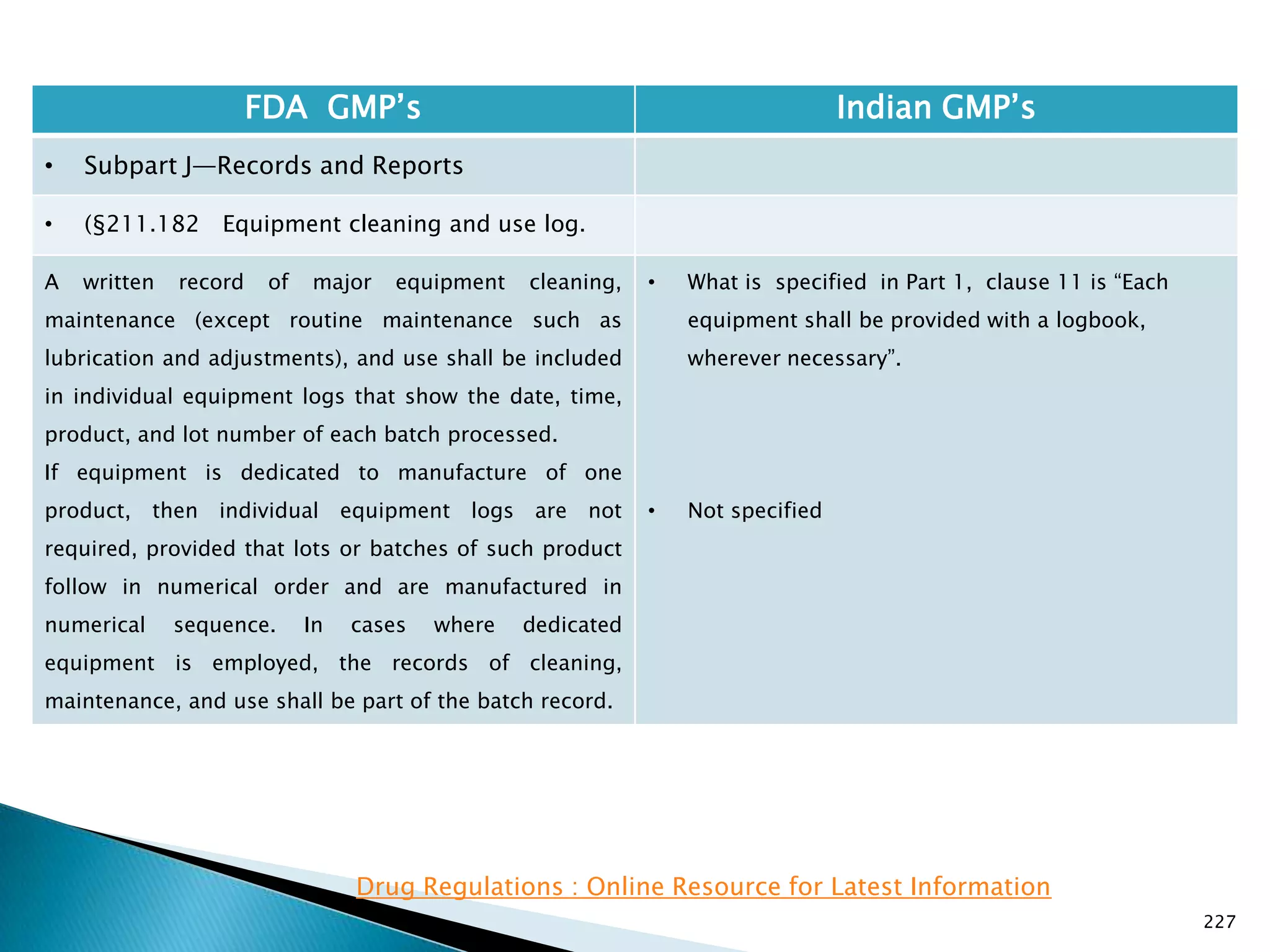
 Subpart J—Records and Reports
5. Requirement that a written record of major equipment cleaning,
maintenance (except routine maintenance such as lubrication and
adjustments), and use shall be included in individual equipment logs that
show the date, time, product, and lot number of each batch processed is
not specified . ( 211.182)
 Requirement that if equipment is dedicated to manufacture of one product,
then individual equipment logs are not required, provided that lots or
batches of such product follow in numerical order and are manufactured in
numerical sequence. In cases where dedicated equipment is employed, the
records of cleaning, maintenance, and use shall be part of the batch record
is not specified.
66
 Subpart J—Records and Reports
 Requirement that the persons performing and
double-checking the cleaning and maintenance (or,
if the cleaning and maintenance is performed using
automated equipment under §211.68, just the
person verifying the cleaning and maintenance done
by the automated equipment) shall date and sign or
initial the log indicating that the work was
performed and entries in the log shall be in
chronological order is not specified.
67
 Subpart J—Records and Reports
6. Requirement of permitting reasonable
variations, however, in the amount of components
necessary for the preparation in the dosage
form, provided they are justified in the master
production and control records is not specified ;(
211.186 (b) (4) )
7. Requirement of a statement of theoretical
yield, including the maximum and minimum
percentages of theoretical yield beyond which
investigation is required is not specified; ( 211.186 (b)
68
 Subpart J—Records and Reports
8. Requirement that if a significant step in the
operation is performed by automated
equipment under §211.68, the identification
of the person checking the significant step
performed by the automated equipment be
recorded is not specified. ( 211.188 (b) (11)
9. Requirement of any investigation made be
recorded is not specified. ( 211.188 (b) (12)
69
 Subpart J—Records and Reports
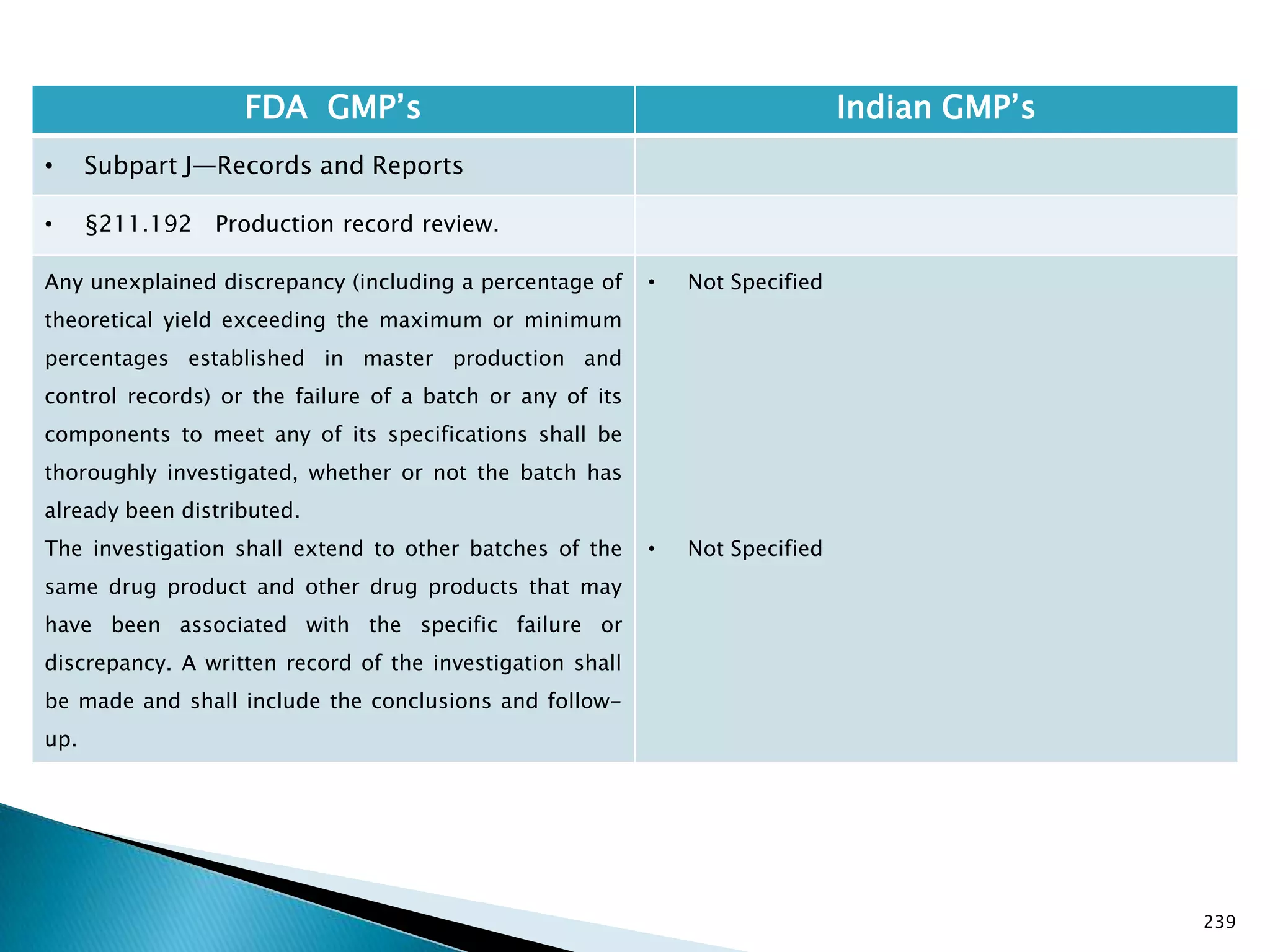
10. Requirement of thoroughly investigating any unexplained
discrepancy (including a percentage of theoretical yield
exceeding the maximum or minimum percentages
established in master production and control records) or the
failure of a batch or any of its components to meet any of its
specifications, whether or not the batch has already been
distributed is not specified. ( 211.192)
 Requirement that the investigation shall extend to other batches
of the same drug product and other drug products that may have
been associated with the specific failure or discrepancy and the
requirement of making a written record of the investigation with
the conclusions and follow-up is not specified. ( 211.192)
70
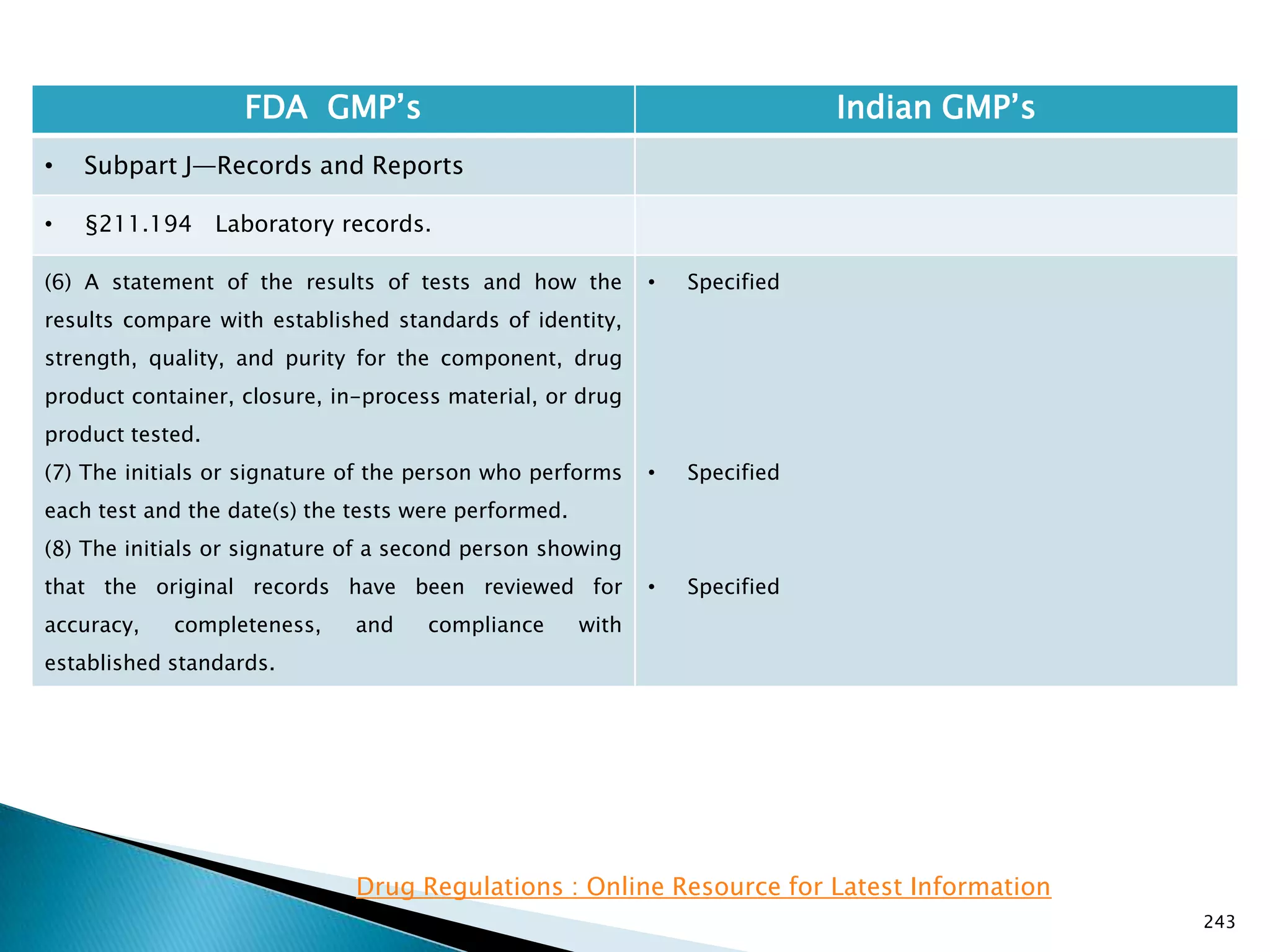
 Subpart J—Records and Reports
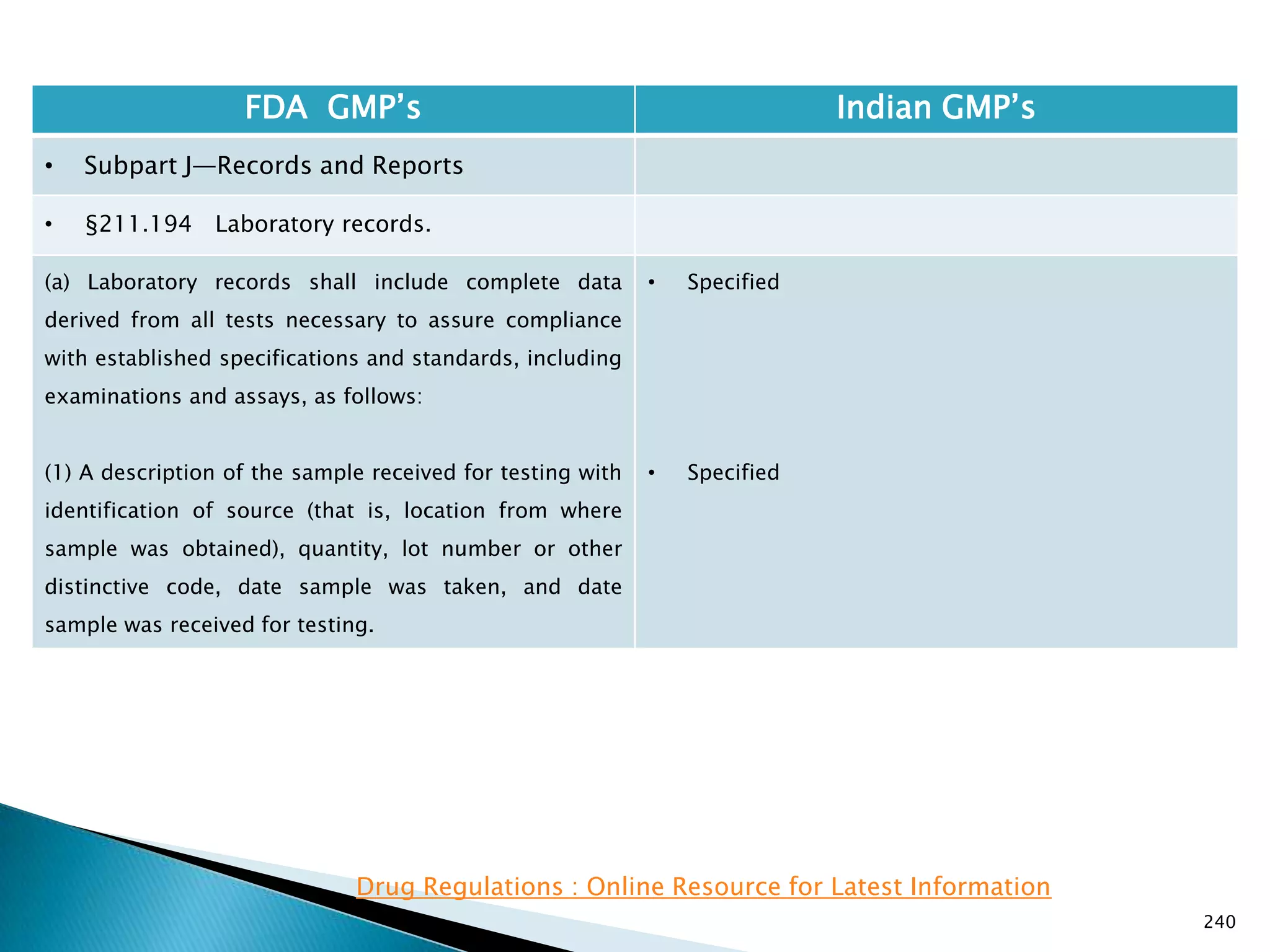
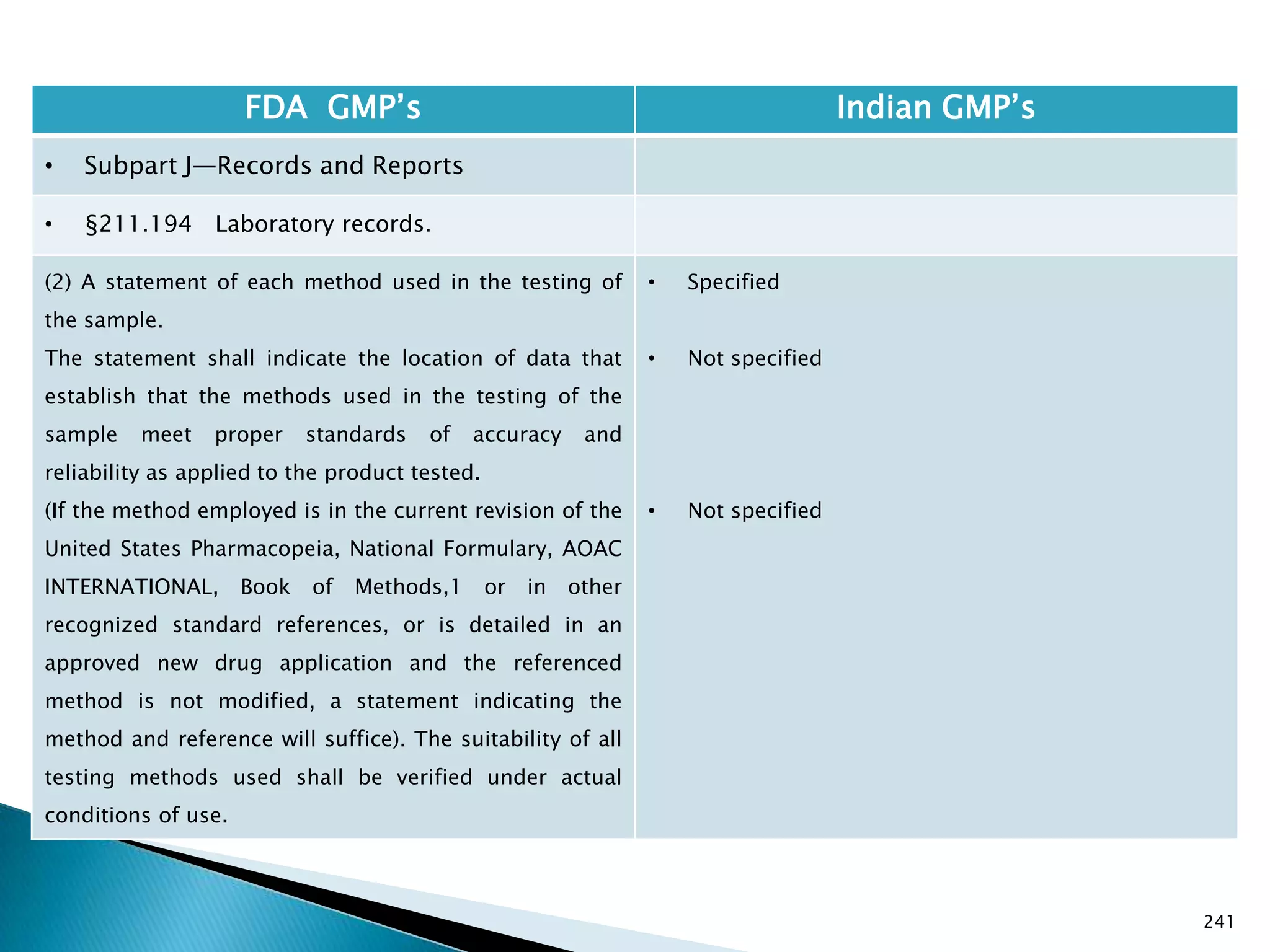
11. Requirement that the records shall indicate the location of
data that establish that the methods used in the testing of
the sample meet proper standards of accuracy and reliability
as applied to the product tested is not specified. ( 211.194)
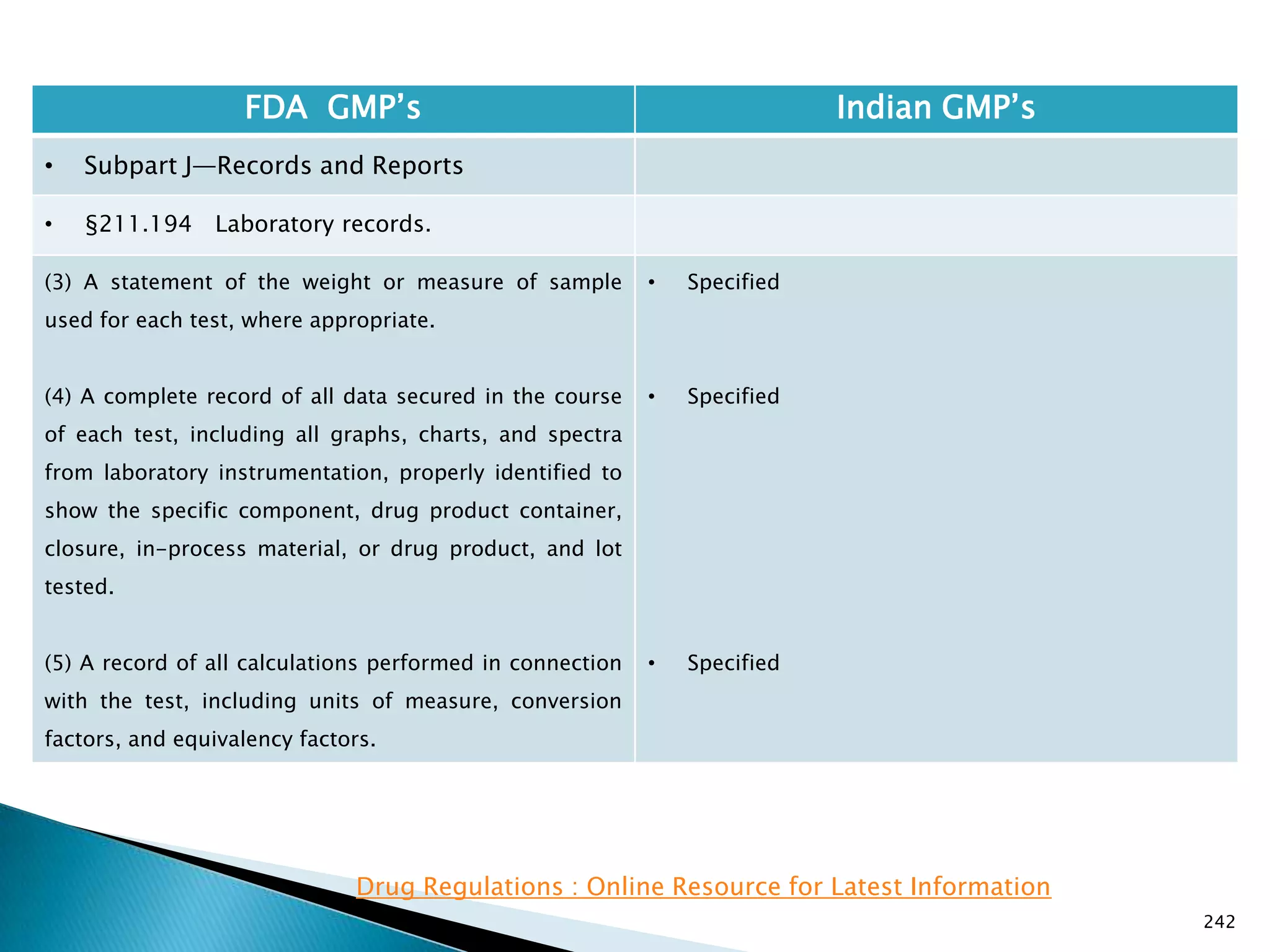
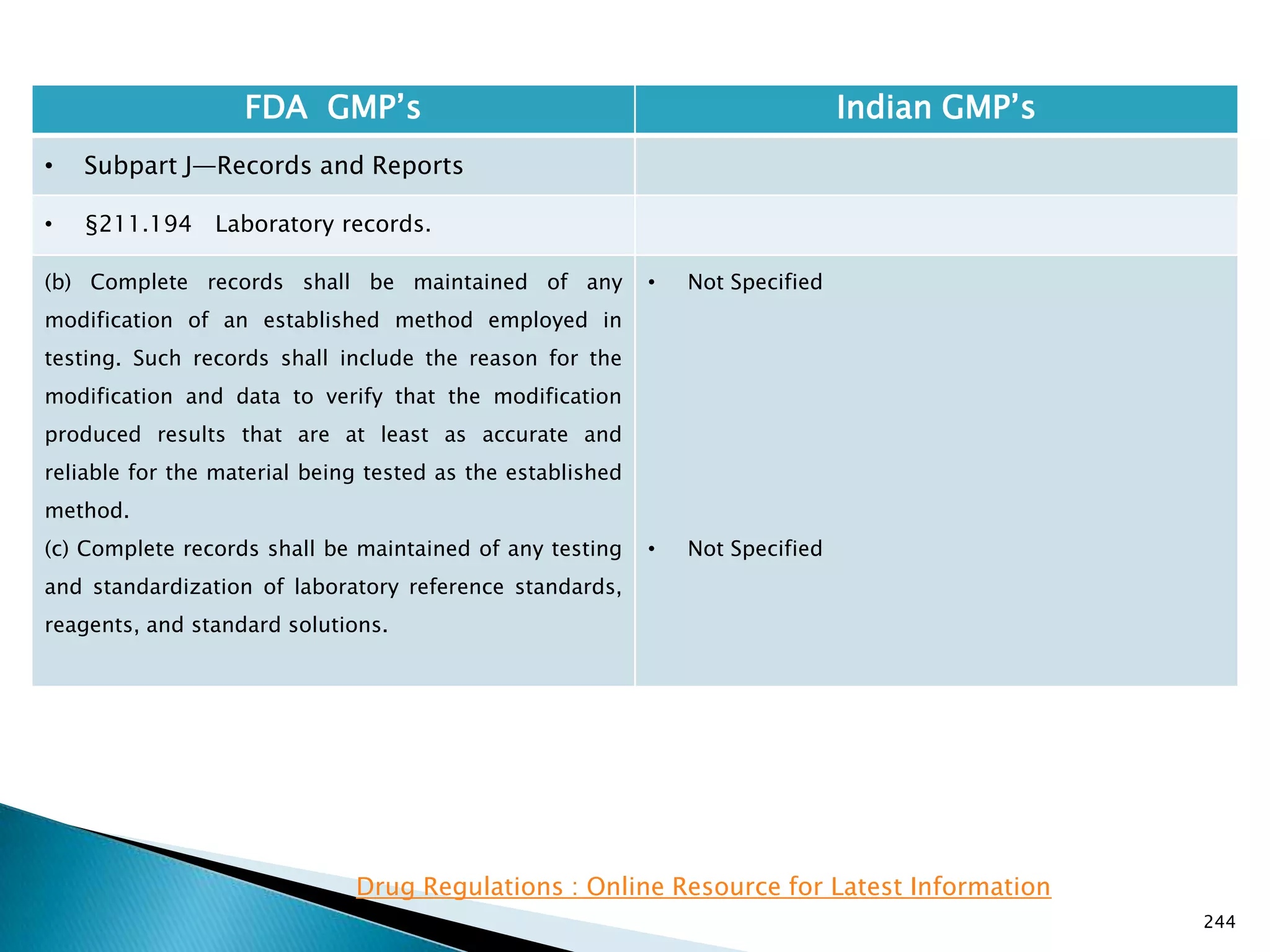
12. Requirement to keep complete records of any modification of an
established method employed in testing; and the requirement that
such records shall include the reason for the modification and data
to verify that the modification produced results that are at least as
accurate and reliable for the material being tested as the established
method is not specified. ( 211.194 (b ) )
71
 Subpart J—Records and Reports
13. Requirement of maintaining complete records of any testing and
standardization of laboratory reference standards, reagents, and
standard solutions is not specified. (211.194 (c ) )
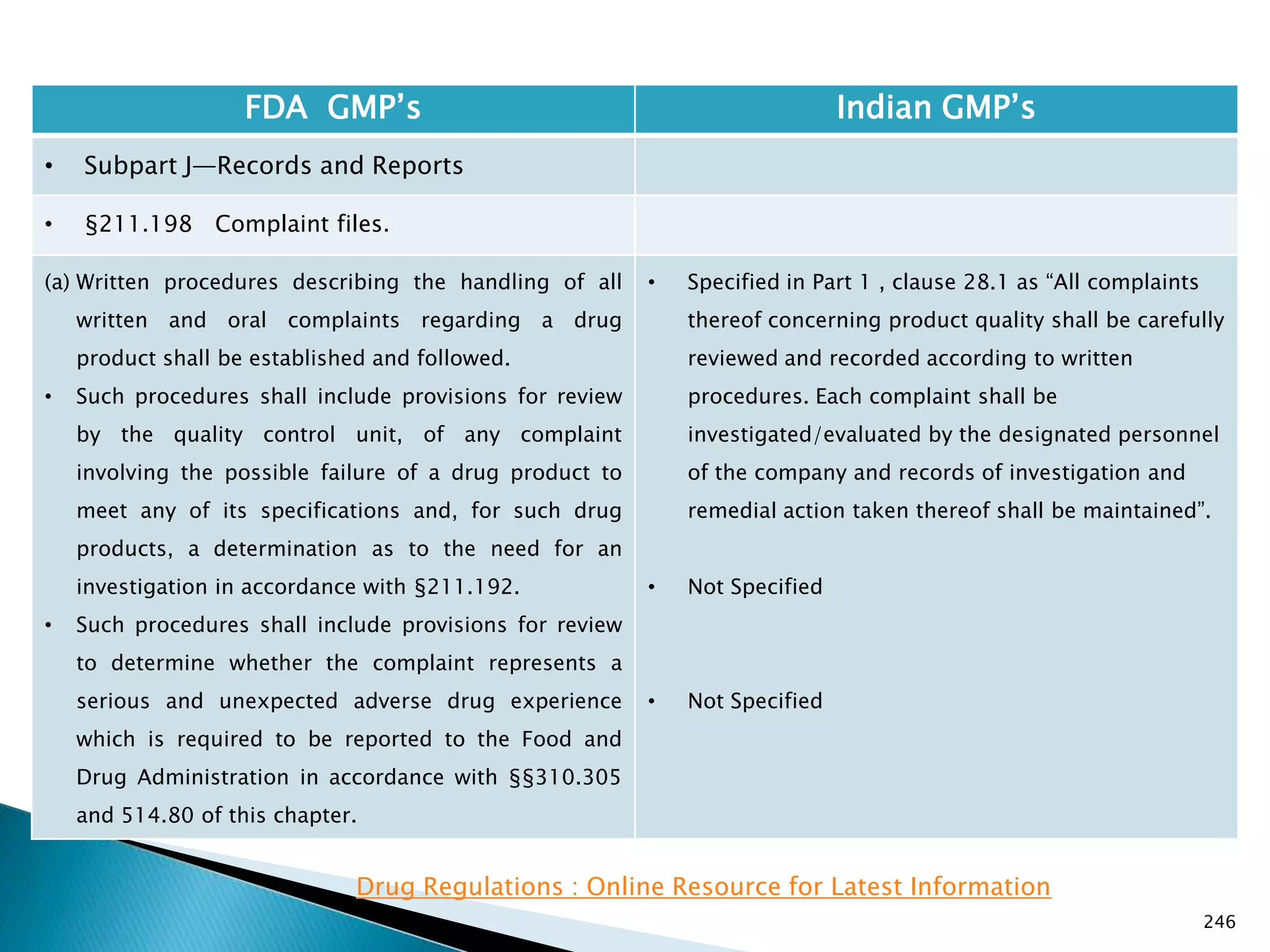
14. Requirement of Complaint handling procedures to include provisions for
review by the quality control unit, of any complaint involving the possible
failure of a drug product to meet any of its specifications and, for such drug
products, a determination as to the need for an investigation is not specified (
211.198 (a) )
 Requirement that such procedures include provisions for review to determine
whether the complaint represents a serious and unexpected adverse drug
experience which is required to be reported to the Food and Drug Administration
is not specified.
72
 Subpart J—Records and Reports
15. Following requirement of complaint file is not
specified. ( 211.198 (b))
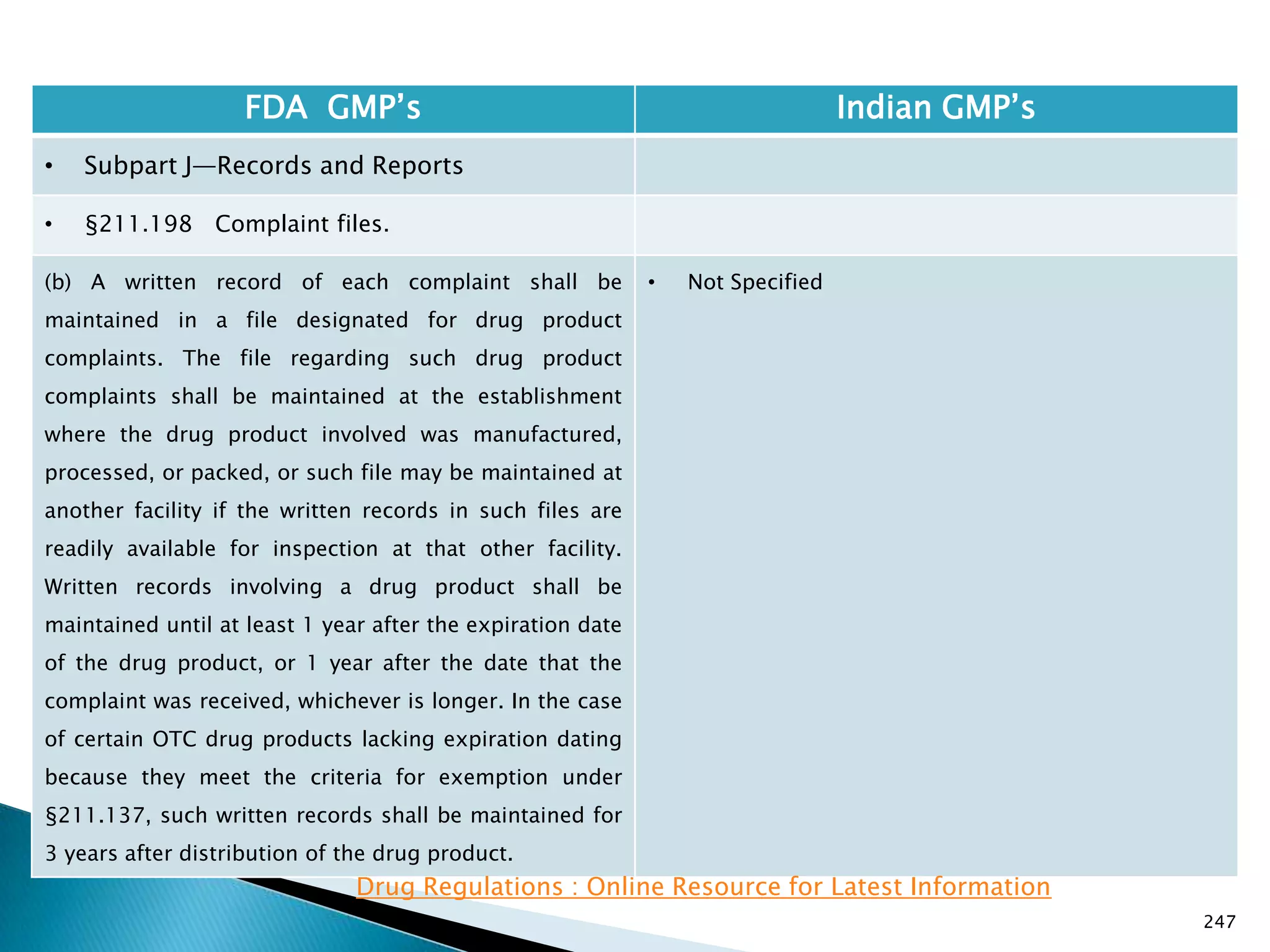
◦ A written record of each complaint shall be maintained
in a file designated for drug product complaints. The
file regarding such drug product complaints shall be
maintained at the establishment where the drug
product involved was manufactured, processed, or
packed, or such file may be maintained at another
facility if the written records in such files are readily
available for inspection at that other facility.
73
 Subpart J—Records and Reports
15. Following requirement of complaint file is not specified.
( 211.198 (b))
◦ Written records involving a drug product shall be maintained
until at least 1 year after the expiration date of the drug
product, or 1 year after the date that the complaint was
received, whichever is longer. In the case of certain OTC
drug products lacking expiration dating because they meet
the criteria for exemption under §211.137, such written
records shall be maintained for 3 years after distribution of
the drug product.
74
 Subpart J—Records and Reports
15. Following requirement of complaint file is not specified. (
211.198 (b))
◦ ((1) The written record shall include the following information, where
known: the name and strength of the drug product, lot number, name of
complainant, nature of complaint, and reply to complainant.
◦ (2) Where an investigation under §211.192 is conducted, the written
record shall include the findings of the investigation and followup. The
record or copy of the record of the investigation shall be maintained at
the establishment where the investigation occurred in accordance with
§211.180(c).
◦ (3) Where an investigation under §211.192 is not conducted, the written
record shall include the reason that an investigation was found not to be
necessary and the name of the responsible person making such a
determination.
75
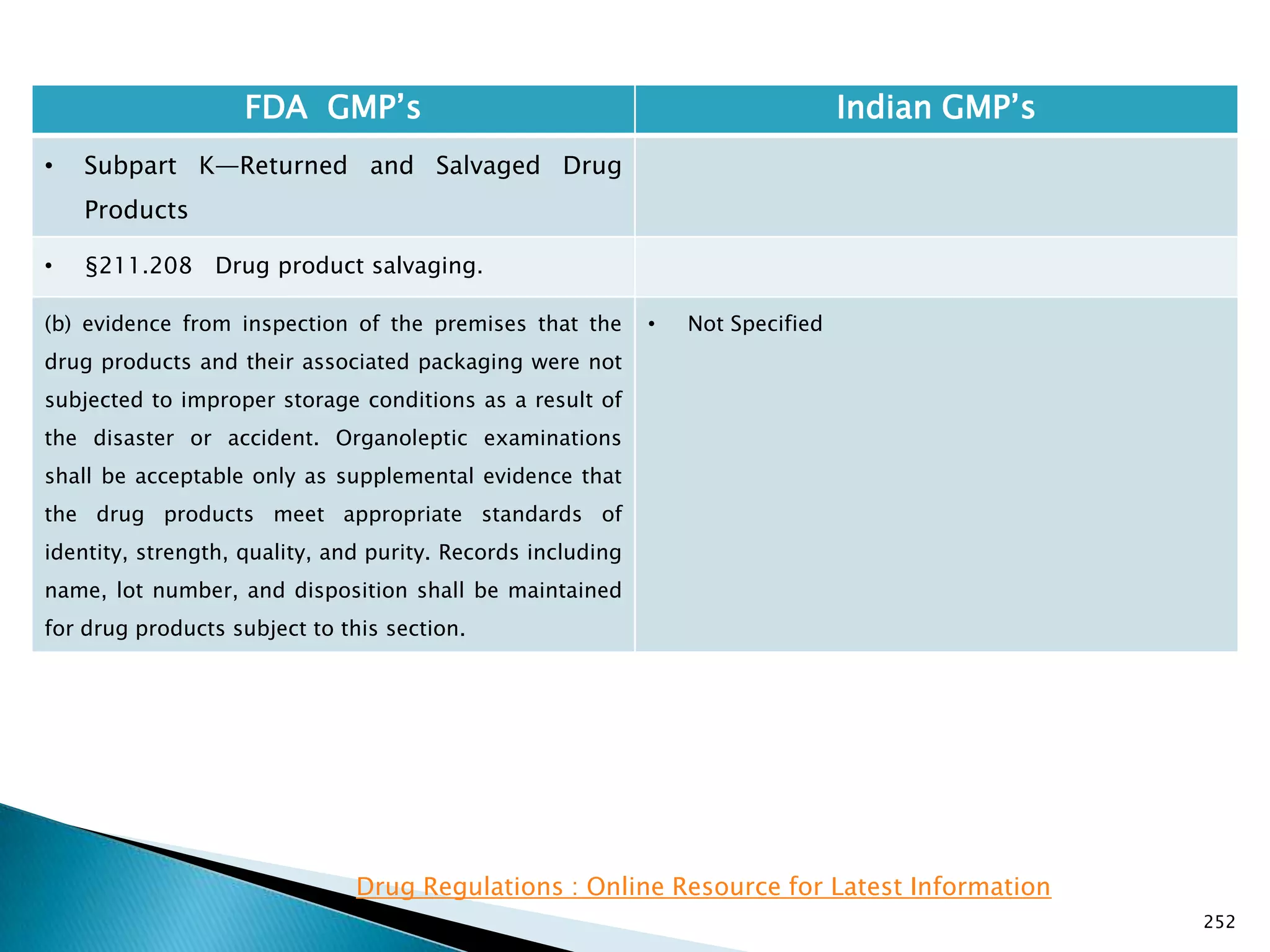
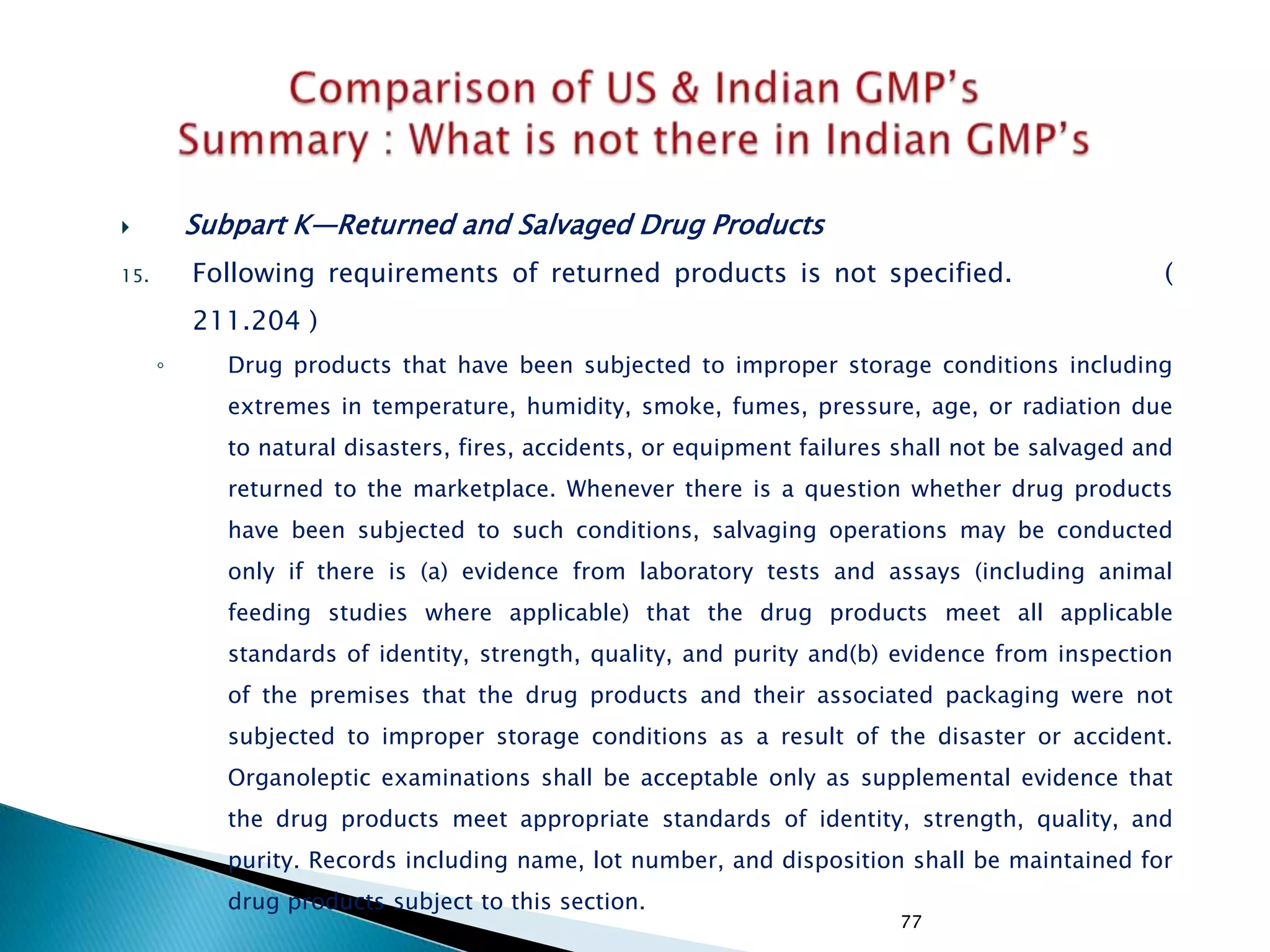
 Subpart K—Returned and Salvaged Drug Products
15. Following requirements of returned products is not specified.
( 211.204 )
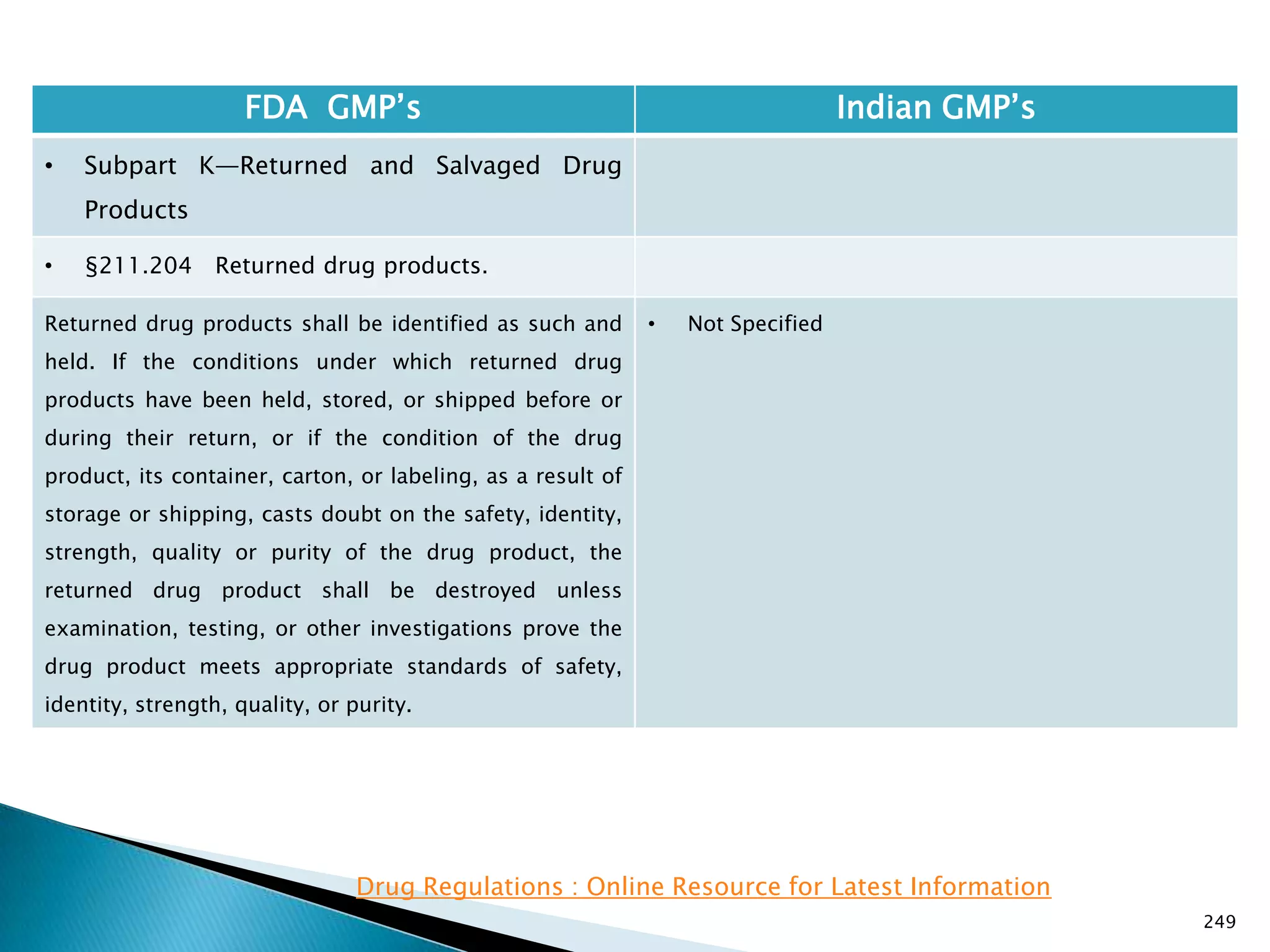
◦ Returned drug products shall be identified as such and held. If the
conditions under which returned drug products have been
held, stored, or shipped before or during their return, or if the condition
of the drug product, its container, carton, or labeling, as a result of
storage or shipping, casts doubt on the safety, identity, strength, quality
or purity of the drug product, the returned drug product shall be
destroyed unless examination, testing, or other investigations prove the
drug product meets appropriate standards of
safety, identity, strength, quality, or purity.
76
 Subpart K—Returned and Salvaged Drug Products
15. Following requirements of returned products is not specified.
( 211.204 )
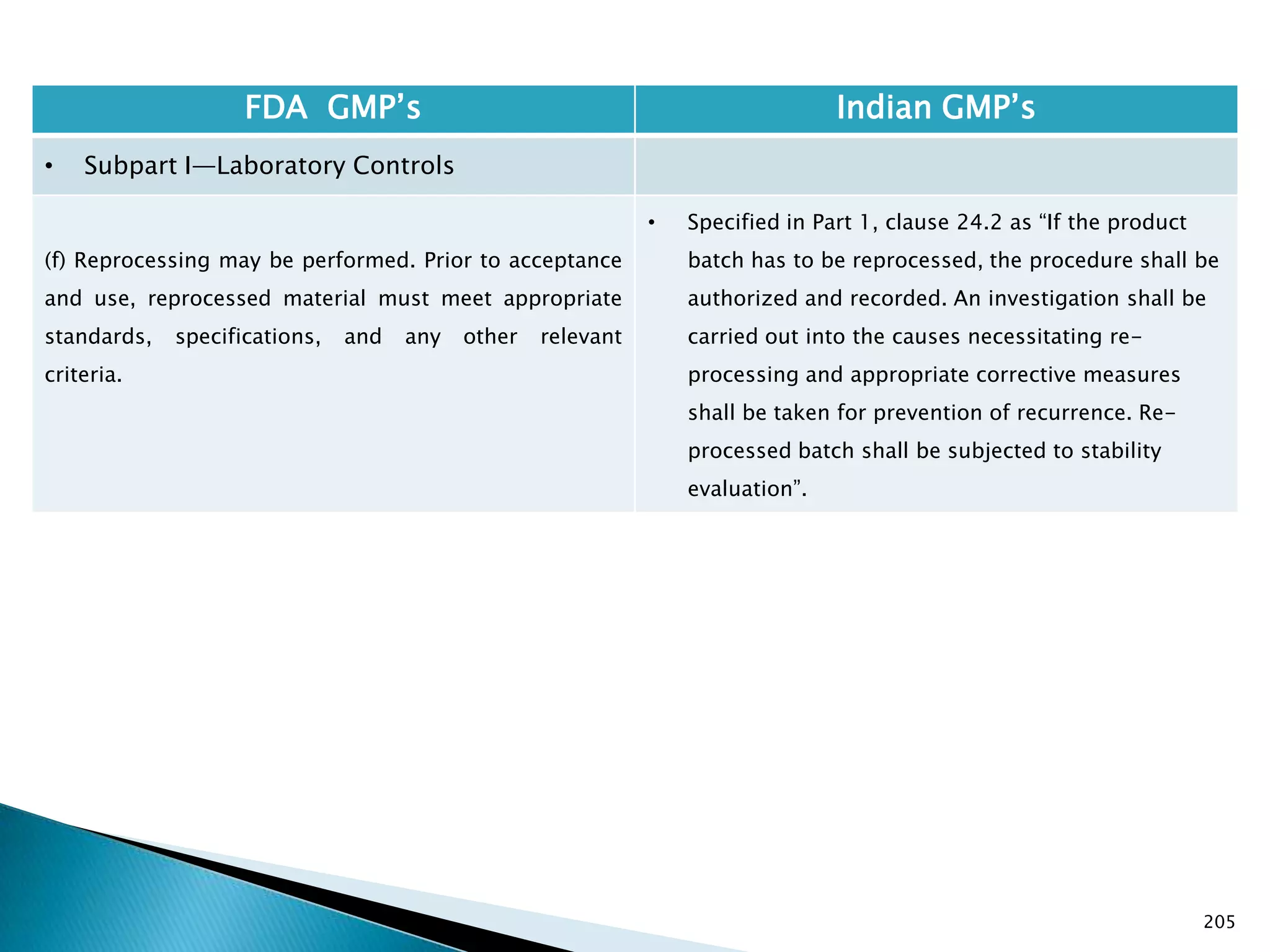
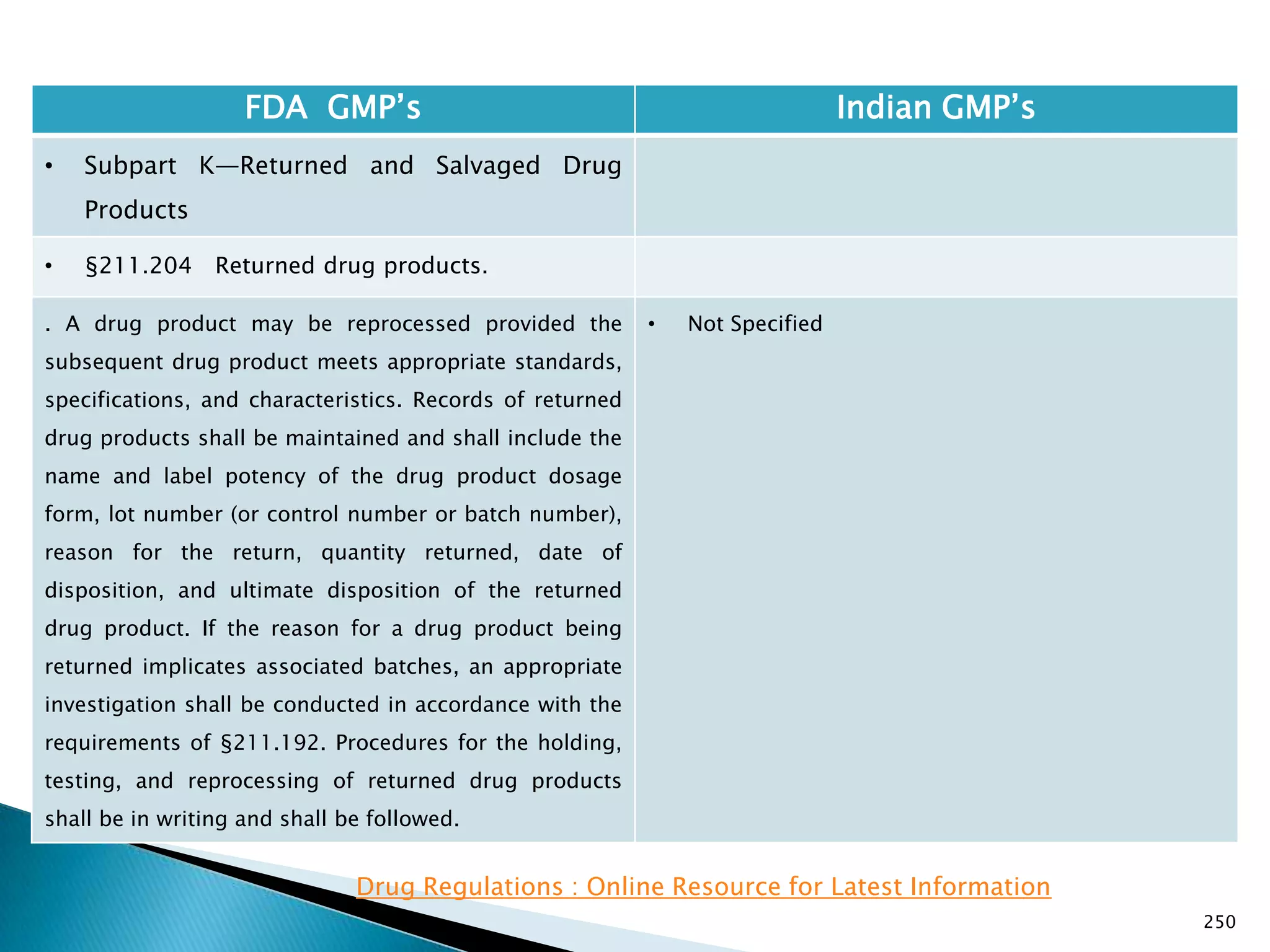
◦ A drug product may be reprocessed provided the subsequent drug
product meets appropriate standards, specifications, and characteristics.
Records of returned drug products shall be maintained and shall include
the name and label potency of the drug product dosage form, lot
number (or control number or batch number), reason for the return,
quantity returned, date of disposition, and ultimate disposition of the
returned drug product. If the reason for a drug product being returned
implicates associated batches, an appropriate investigation shall be
conducted in accordance with the requirements of §211.192. Procedures
for the holding, testing, and reprocessing of returned drug products
shall be in writing and shall be followed.
77
 Subpart K—Returned and Salvaged Drug Products
15. Following requirements of returned products is not specified. (
211.204 )
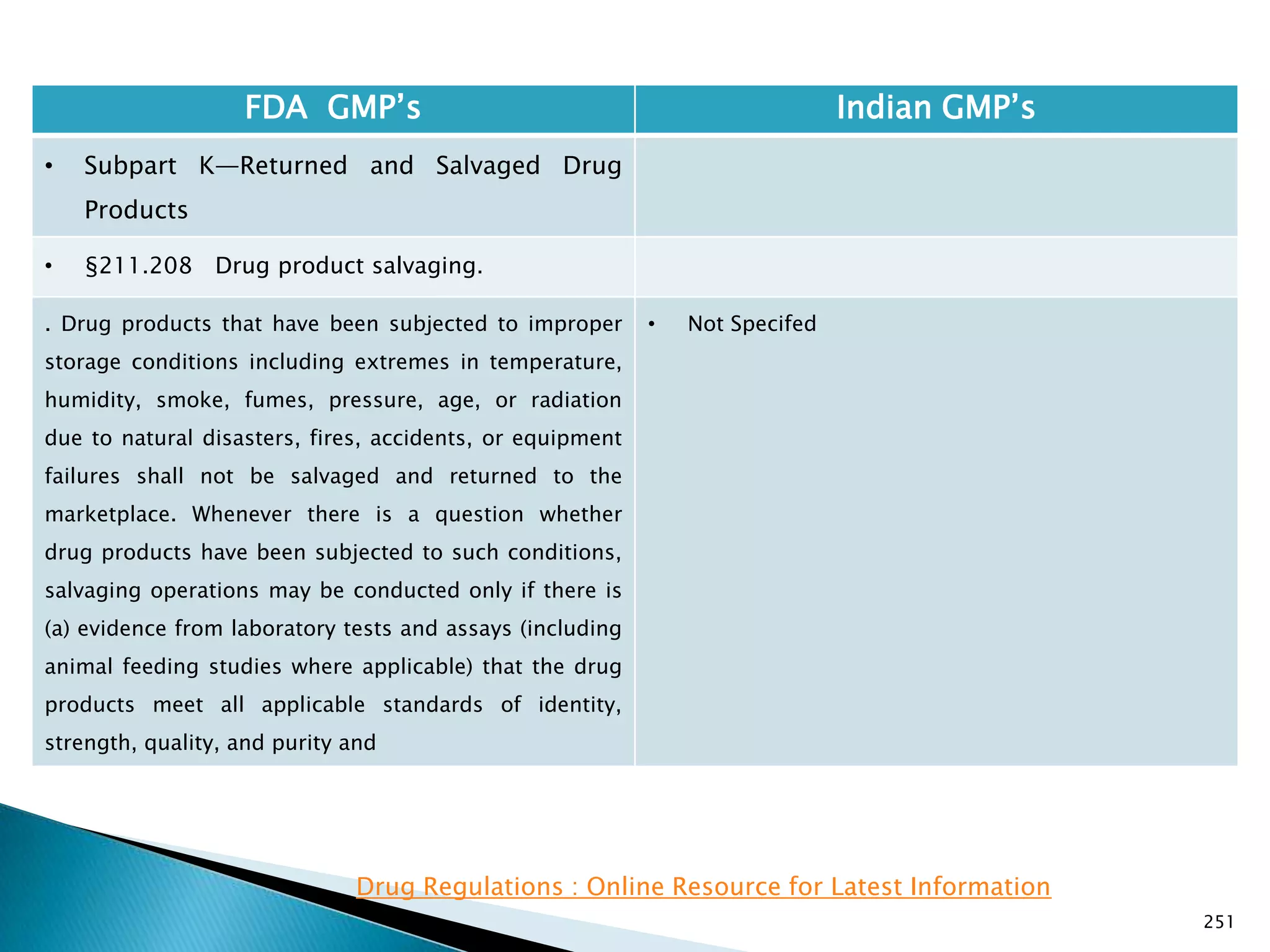
◦ Drug products that have been subjected to improper storage conditions including
extremes in temperature, humidity, smoke, fumes, pressure, age, or radiation due
to natural disasters, fires, accidents, or equipment failures shall not be salvaged and
returned to the marketplace. Whenever there is a question whether drug products
have been subjected to such conditions, salvaging operations may be conducted
only if there is (a) evidence from laboratory tests and assays (including animal
feeding studies where applicable) that the drug products meet all applicable
standards of identity, strength, quality, and purity and(b) evidence from inspection
of the premises that the drug products and their associated packaging were not
subjected to improper storage conditions as a result of the disaster or accident.
Organoleptic examinations shall be acceptable only as supplemental evidence that
the drug products meet appropriate standards of identity, strength, quality, and
purity. Records including name, lot number, and disposition shall be maintained for
drug products subject to this section.
78
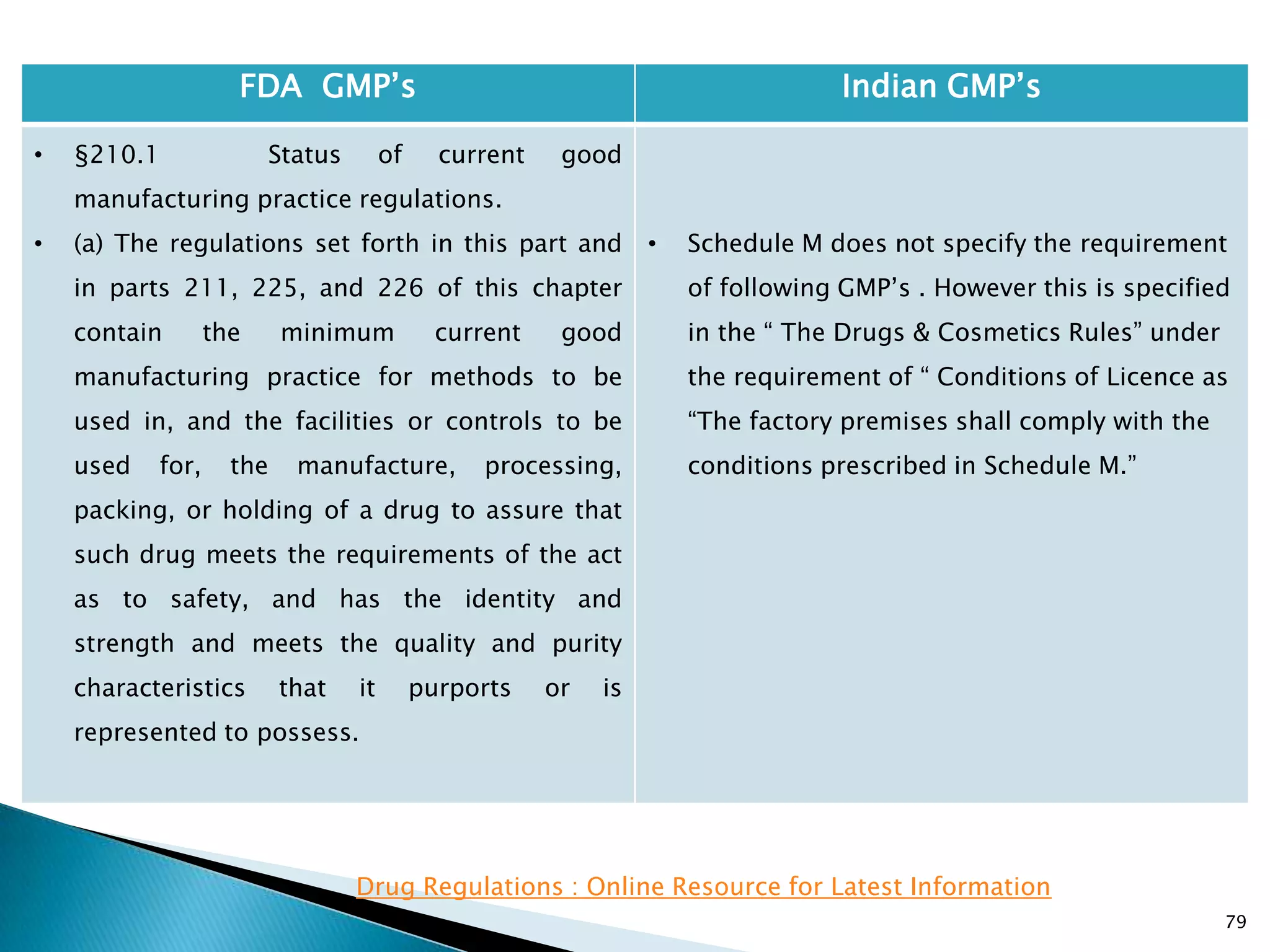
79
FDA GMP‘s Indian GMP‘s
• §210.1 Status of current good
manufacturing practice regulations.
• (a) The regulations set forth in this part and
in parts 211, 225, and 226 of this chapter
contain the minimum current good
manufacturing practice for methods to be
used in, and the facilities or controls to be
used for, the manufacture, processing,
packing, or holding of a drug to assure that
such drug meets the requirements of the act
as to safety, and has the identity and
strength and meets the quality and purity
characteristics that it purports or is
represented to possess.
• Schedule M does not specify the requirement
of following GMP‘s . However this is specified
in the ― The Drugs & Cosmetics Rules‖ under
the requirement of ― Conditions of Licence as
―The factory premises shall comply with the
conditions prescribed in Schedule M.‖
Drug Regulations : Online Resource for Latest Information
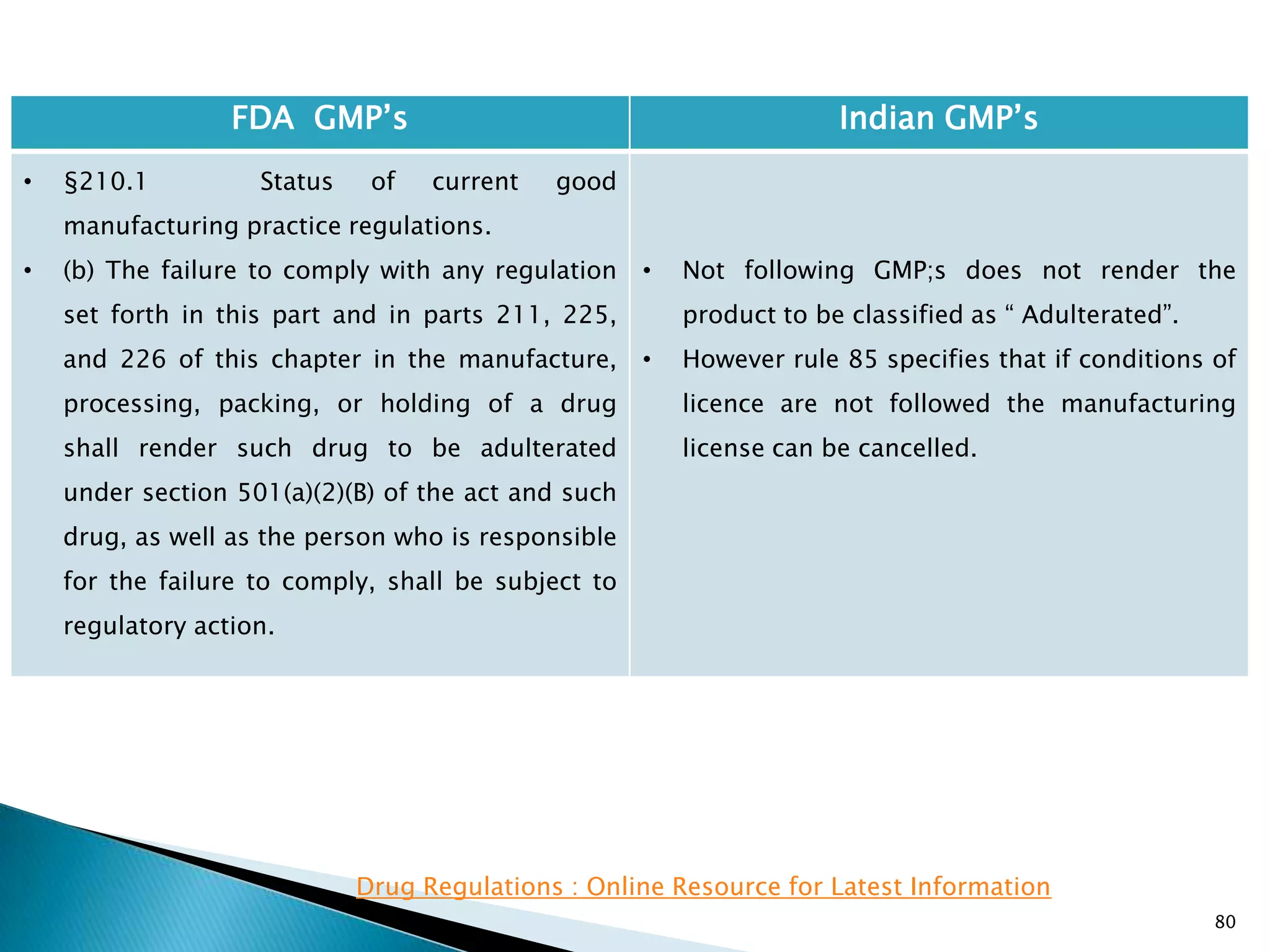
80
FDA GMP‘s Indian GMP‘s
• §210.1 Status of current good
manufacturing practice regulations.
• (b) The failure to comply with any regulation
set forth in this part and in parts 211, 225,
and 226 of this chapter in the manufacture,
processing, packing, or holding of a drug
shall render such drug to be adulterated
under section 501(a)(2)(B) of the act and such
drug, as well as the person who is responsible
for the failure to comply, shall be subject to
regulatory action.
• Not following GMP;s does not render the
product to be classified as ― Adulterated‖.
• However rule 85 specifies that if conditions of
licence are not followed the manufacturing
license can be cancelled.
Drug Regulations : Online Resource for Latest Information
81
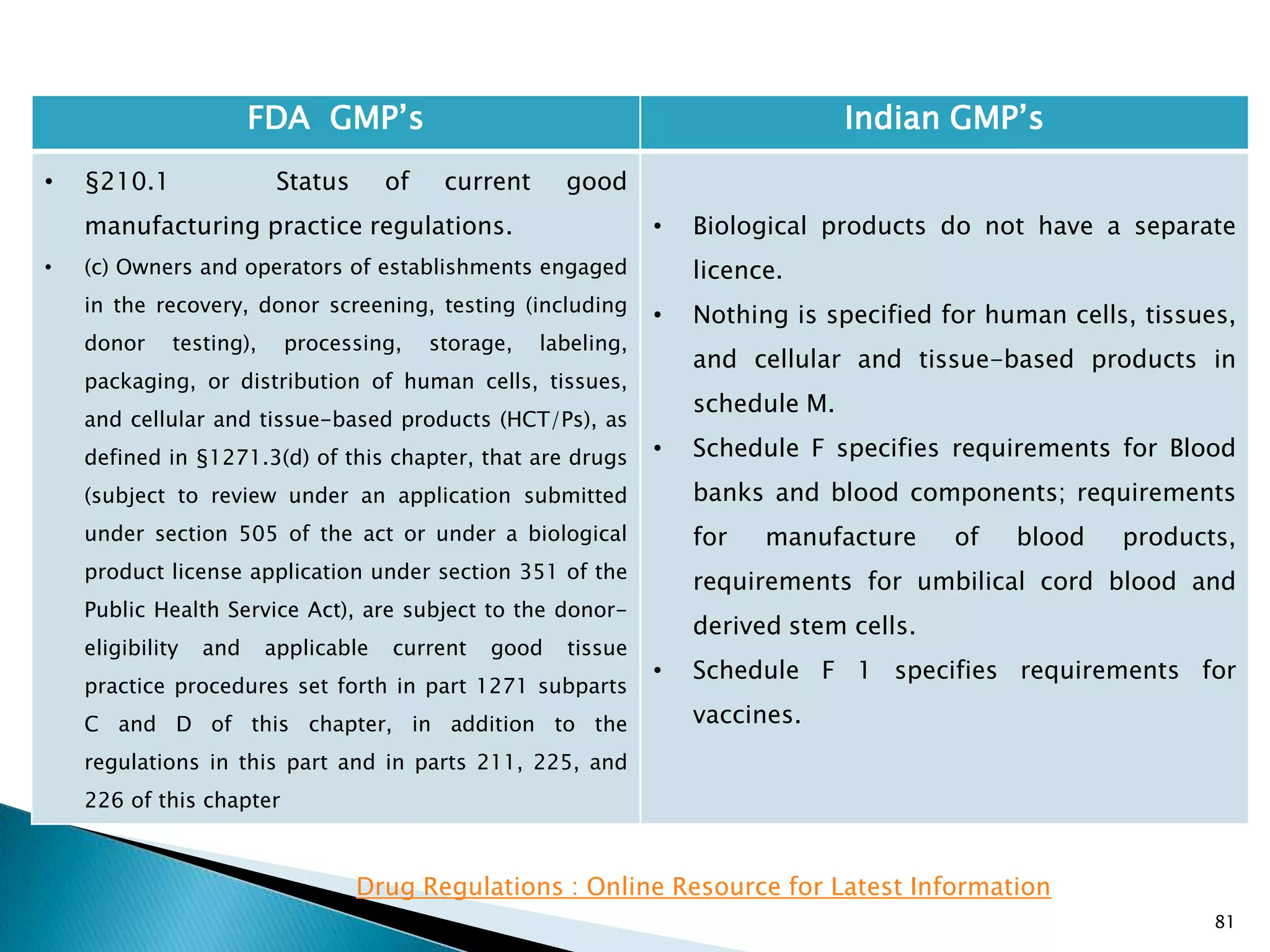
FDA GMP‘s Indian GMP‘s
• §210.1 Status of current good
manufacturing practice regulations.
• (c) Owners and operators of establishments engaged
in the recovery, donor screening, testing (including
donor testing), processing, storage, labeling,
packaging, or distribution of human cells, tissues,
and cellular and tissue-based products (HCT/Ps), as
defined in §1271.3(d) of this chapter, that are drugs
(subject to review under an application submitted
under section 505 of the act or under a biological
product license application under section 351 of the
Public Health Service Act), are subject to the donor-
eligibility and applicable current good tissue
practice procedures set forth in part 1271 subparts
C and D of this chapter, in addition to the
regulations in this part and in parts 211, 225, and
226 of this chapter
• Biological products do not have a separate
licence.
• Nothing is specified for human cells, tissues,
and cellular and tissue-based products in
schedule M.
• Schedule F specifies requirements for Blood
banks and blood components; requirements
for manufacture of blood products,
requirements for umbilical cord blood and
derived stem cells.
• Schedule F 1 specifies requirements for
vaccines.
Drug Regulations : Online Resource for Latest Information
82
FDA GMP‘s Indian GMP‘s
• §210.1 Status of current good
manufacturing practice regulations.
• (c) Failure to comply with any applicable regulation
set forth in this part, in parts 211, 225, and 226 of
this chapter, in part 1271 subpart C of this chapter,
or in part 1271 subpart D of this chapter with
respect to the manufacture, processing, packing or
holding of a drug, renders an HCT/P adulterated
under section 501(a)(2)(B) of the act. Such HCT/P, as
well as the person who is responsible for the failure
to comply, is subject to regulatory action.
• [43 FR 45076, Sept. 29, 1978, as amended at 69 FR
29828, May 25, 2004; 74 FR 65431, Dec. 10, 2009]
• Not following GMP;s does not render the
product to be classified as ― Adulterated‖.
• However the rule 85 specifies that if
conditions of licence are not followed the
manufacturing license can be cancelled.
Drug Regulations : Online Resource for Latest Information
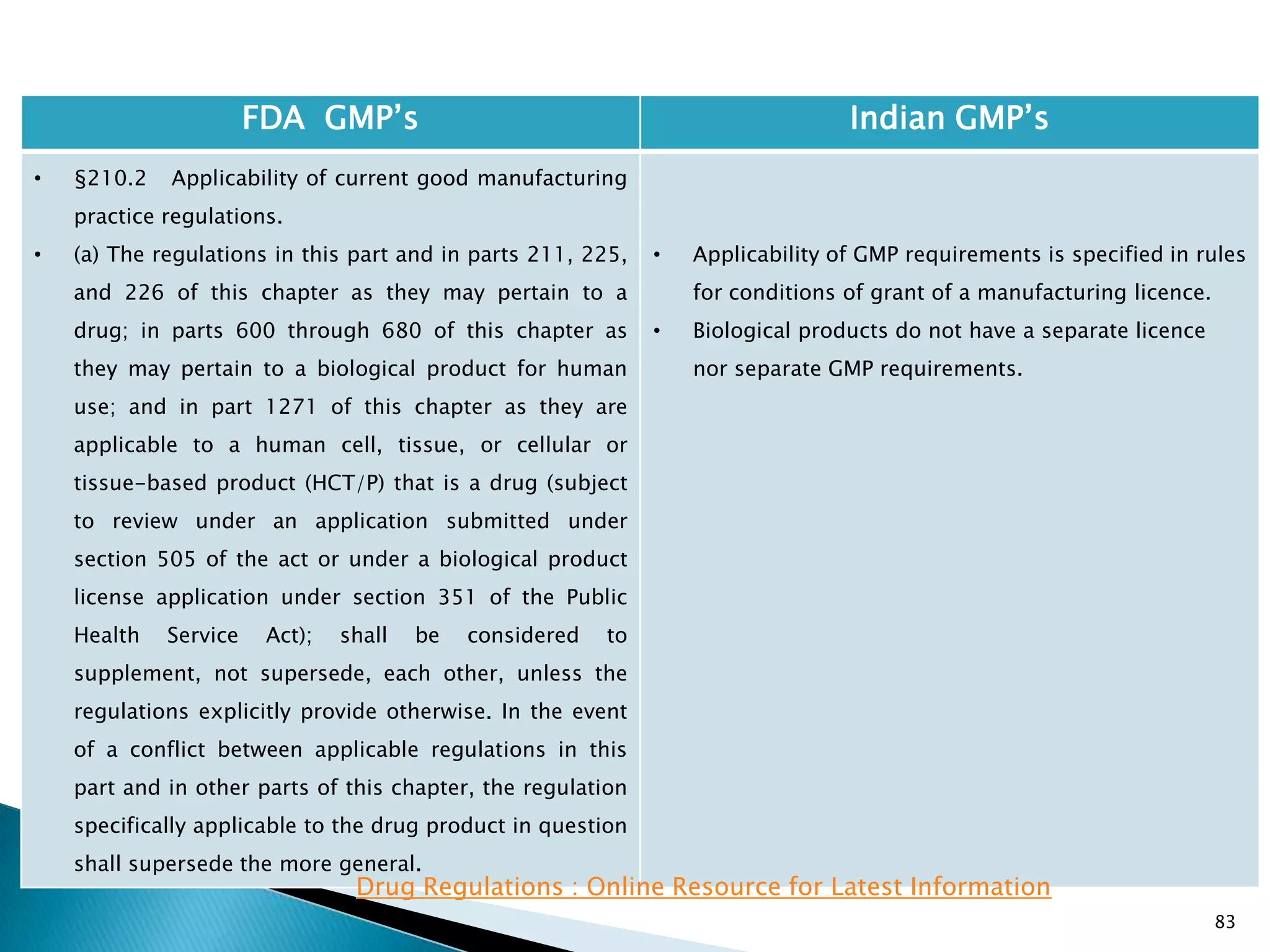
83
FDA GMP‘s Indian GMP‘s
• §210.2 Applicability of current good manufacturing
practice regulations.
• (a) The regulations in this part and in parts 211, 225,
and 226 of this chapter as they may pertain to a
drug; in parts 600 through 680 of this chapter as
they may pertain to a biological product for human
use; and in part 1271 of this chapter as they are
applicable to a human cell, tissue, or cellular or
tissue-based product (HCT/P) that is a drug (subject
to review under an application submitted under
section 505 of the act or under a biological product
license application under section 351 of the Public
Health Service Act); shall be considered to
supplement, not supersede, each other, unless the
regulations explicitly provide otherwise. In the event
of a conflict between applicable regulations in this
part and in other parts of this chapter, the regulation
specifically applicable to the drug product in question
shall supersede the more general.
• Applicability of GMP requirements is specified in rules
for conditions of grant of a manufacturing licence.
• Biological products do not have a separate licence
nor separate GMP requirements.
Drug Regulations : Online Resource for Latest Information
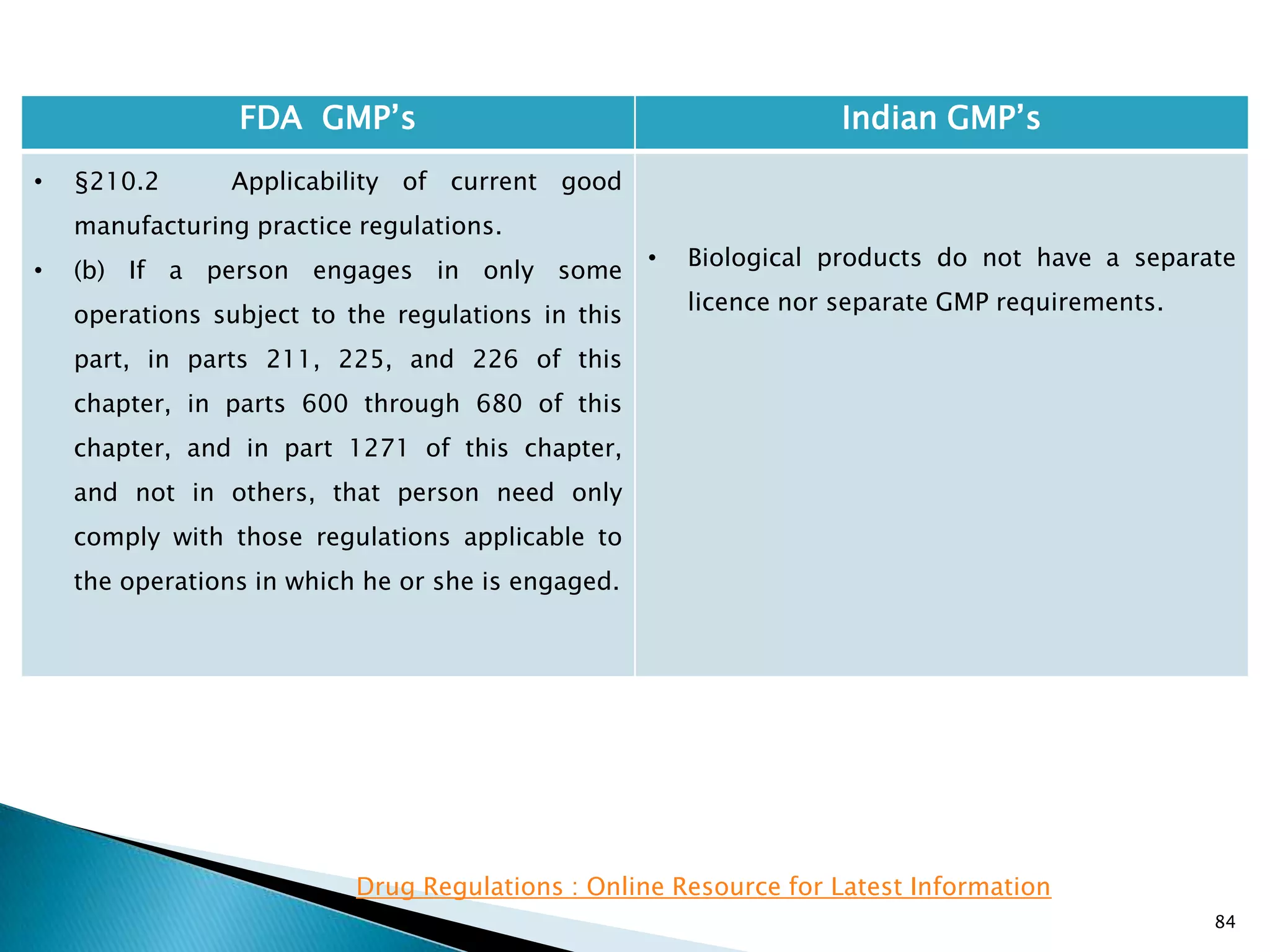
84
FDA GMP‘s Indian GMP‘s
• §210.2 Applicability of current good
manufacturing practice regulations.
• (b) If a person engages in only some
operations subject to the regulations in this
part, in parts 211, 225, and 226 of this
chapter, in parts 600 through 680 of this
chapter, and in part 1271 of this chapter,
and not in others, that person need only
comply with those regulations applicable to
the operations in which he or she is engaged.
• Biological products do not have a separate
licence nor separate GMP requirements.
Drug Regulations : Online Resource for Latest Information
85
FDA GMP‘s Indian GMP‘s
• §210.2 Applicability of current good
manufacturing practice regulations.
• (c) An investigational drug for use in a phase 1
study, as described in §312.21(a) of this chapter, is
subject to the statutory requirements set forth in 21
U.S.C. 351(a)(2)(B). The production of such drug is
exempt from compliance with the regulations in part
211 of this chapter. However, this exemption does
not apply to an investigational drug for use in a
phase 1 study once the investigational drug has
been made available for use by or for the sponsor in
a phase 2 or phase 3 study, as described in
§312.21(b) and (c) of this chapter, or the drug has
been lawfully marketed. If the investigational drug
has been made available in a phase 2 or phase 3
study or the drug has been lawfully marketed, the
drug for use in the phase 1 study must comply with
part 211.
• [69 FR 29828, May 25, 2004, as amended at 73 FR
40462, July 15, 2008; 74 FR 65431, Dec. 10, 2009]
• Investigational drug has not been defined and there
are no specific requirements for Investigational
drugs.
• Rules 86 to 93 define requirements for manufacture
of products for experimental purposes. These rules
define the labeling and storage of such material and
the procedure to apply for a test licence.
• Rule 86 defines that the exemption for such
products from the requirements of Section 18 of the
Drugs and Cosmetics Act. Section 18 specifies the
Quality standards for products. Therefore most of
the requirements of the act , rules and schedules do
not apply to such materials.
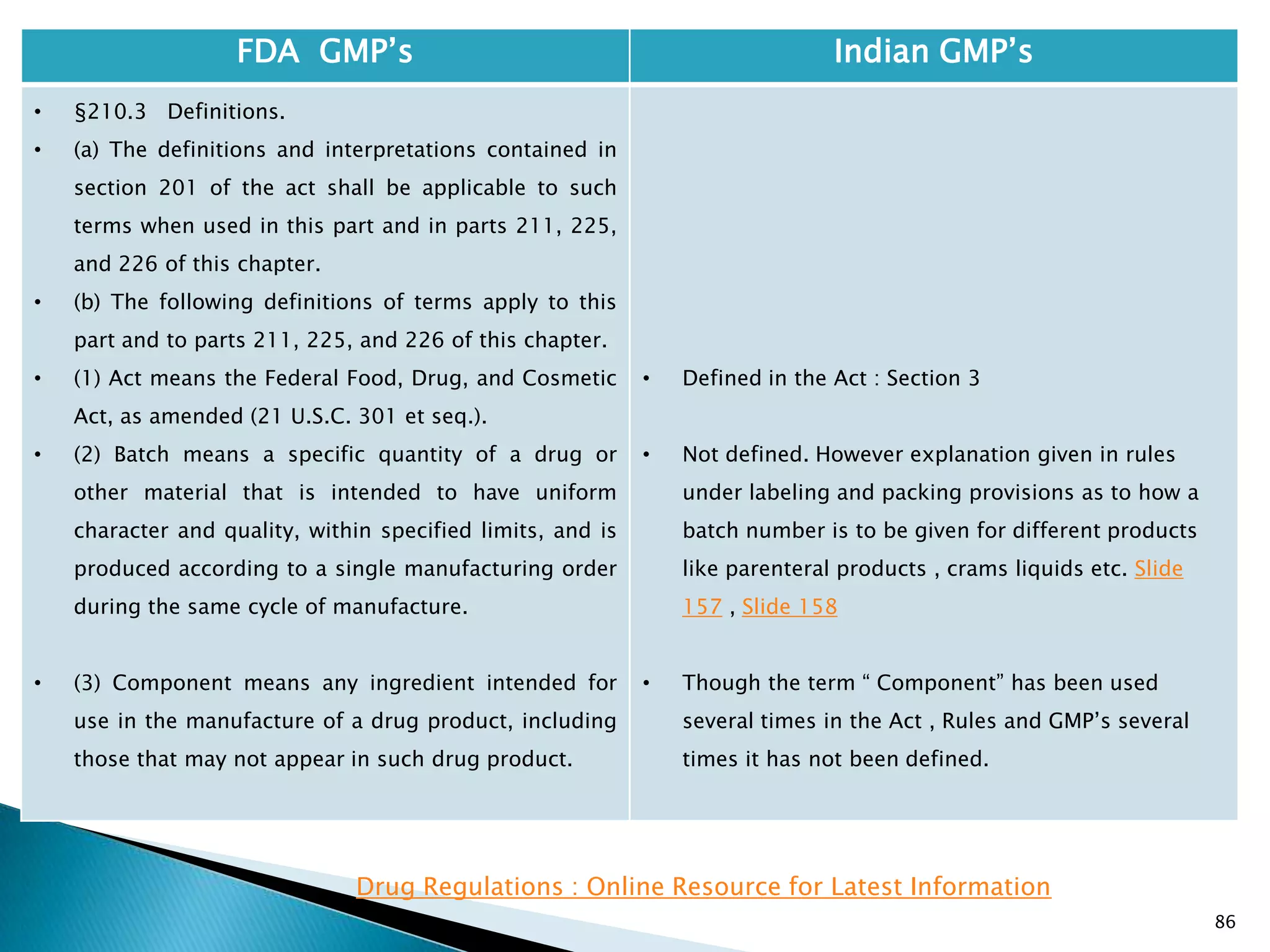
86
FDA GMP‘s Indian GMP‘s
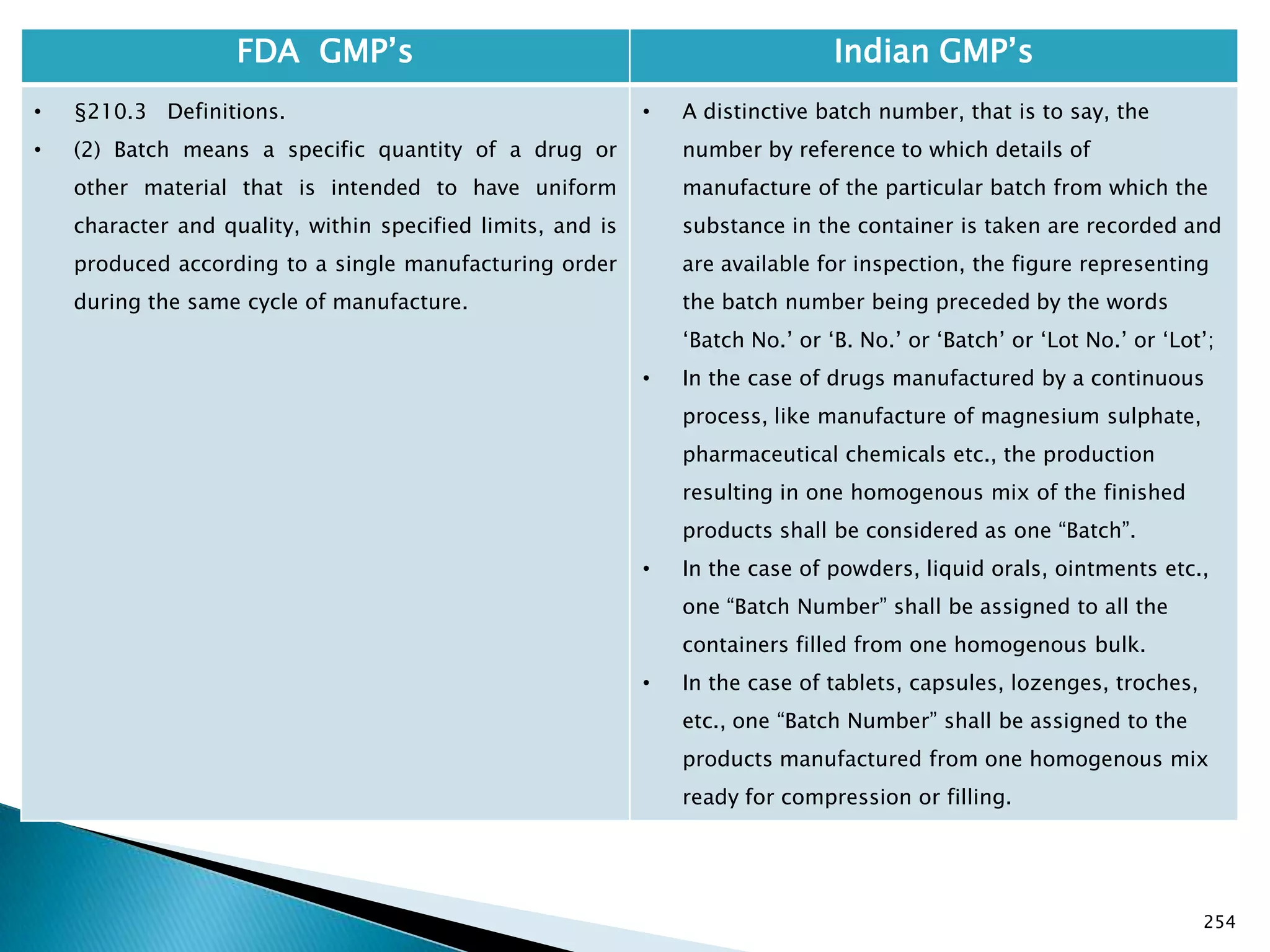
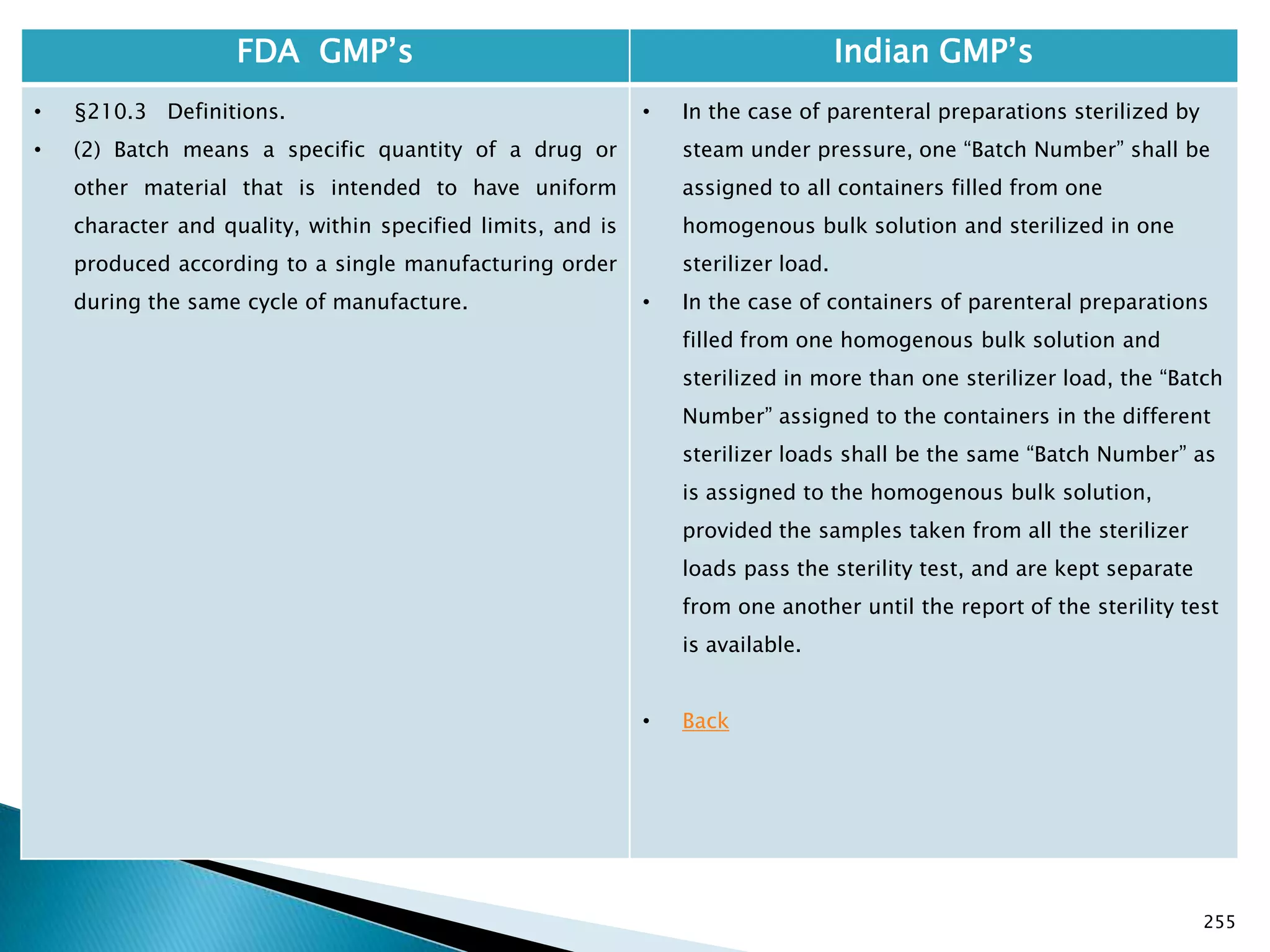
• §210.3 Definitions.
• (a) The definitions and interpretations contained in
section 201 of the act shall be applicable to such
terms when used in this part and in parts 211, 225,
and 226 of this chapter.
• (b) The following definitions of terms apply to this
part and to parts 211, 225, and 226 of this chapter.
• (1) Act means the Federal Food, Drug, and Cosmetic
Act, as amended (21 U.S.C. 301 et seq.).
• (2) Batch means a specific quantity of a drug or
other material that is intended to have uniform
character and quality, within specified limits, and is
produced according to a single manufacturing order
during the same cycle of manufacture.
• (3) Component means any ingredient intended for
use in the manufacture of a drug product, including
those that may not appear in such drug product.
• Defined in the Act : Section 3
• Not defined. However explanation given in rules
under labeling and packing provisions as to how a
batch number is to be given for different products
like parenteral products , crams liquids etc. Slide
157 , Slide 158
• Though the term ― Component‖ has been used
several times in the Act , Rules and GMP‘s several
times it has not been defined.
Drug Regulations : Online Resource for Latest Information
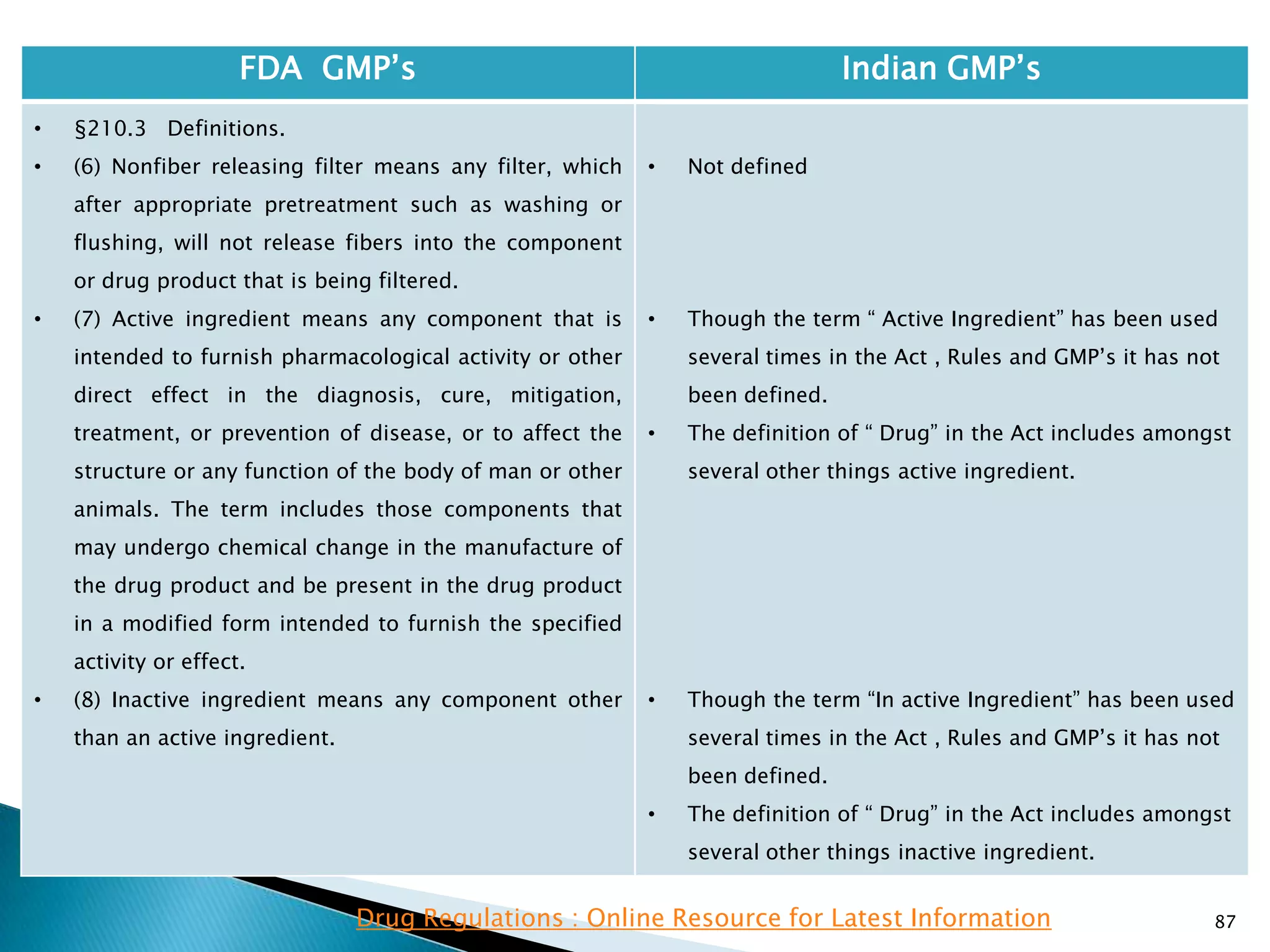
87
FDA GMP‘s Indian GMP‘s
• §210.3 Definitions.
• (6) Nonfiber releasing filter means any filter, which
after appropriate pretreatment such as washing or
flushing, will not release fibers into the component
or drug product that is being filtered.
• (7) Active ingredient means any component that is
intended to furnish pharmacological activity or other
direct effect in the diagnosis, cure, mitigation,
treatment, or prevention of disease, or to affect the
structure or any function of the body of man or other
animals. The term includes those components that
may undergo chemical change in the manufacture of
the drug product and be present in the drug product
in a modified form intended to furnish the specified
activity or effect.
• (8) Inactive ingredient means any component other
than an active ingredient.
• Not defined
• Though the term ― Active Ingredient‖ has been used
several times in the Act , Rules and GMP‘s it has not
been defined.
• The definition of ― Drug‖ in the Act includes amongst
several other things active ingredient.
• Though the term ―In active Ingredient‖ has been used
several times in the Act , Rules and GMP‘s it has not
been defined.
• The definition of ― Drug‖ in the Act includes amongst
several other things inactive ingredient.
Drug Regulations : Online Resource for Latest Information
88
FDA GMP‘s Indian GMP‘s
• §210.3 Definitions.
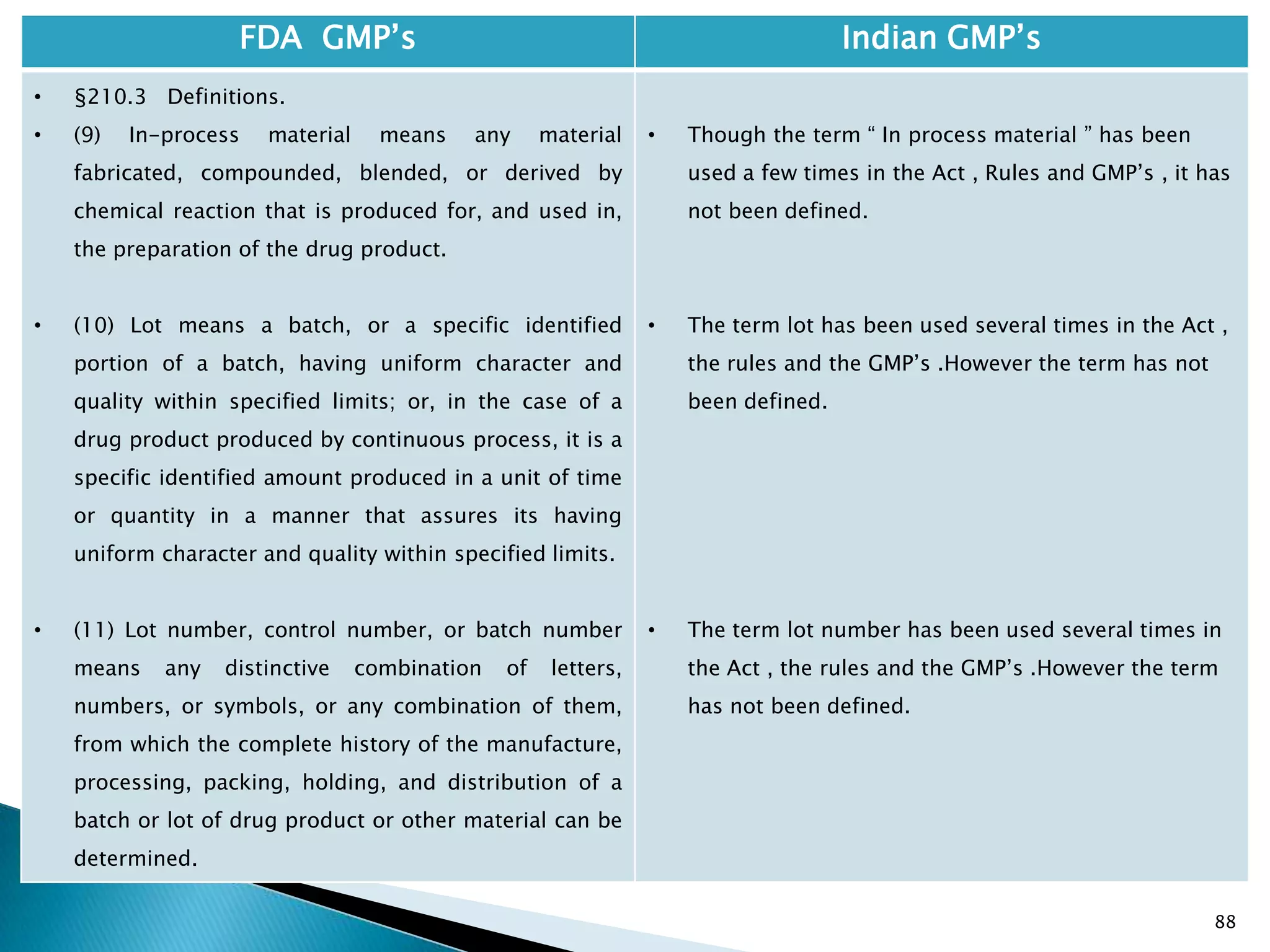
• (9) In-process material means any material
fabricated, compounded, blended, or derived by
chemical reaction that is produced for, and used in,
the preparation of the drug product.
• (10) Lot means a batch, or a specific identified
portion of a batch, having uniform character and
quality within specified limits; or, in the case of a
drug product produced by continuous process, it is a
specific identified amount produced in a unit of time
or quantity in a manner that assures its having
uniform character and quality within specified limits.
• (11) Lot number, control number, or batch number
means any distinctive combination of letters,
numbers, or symbols, or any combination of them,
from which the complete history of the manufacture,
processing, packing, holding, and distribution of a
batch or lot of drug product or other material can be
determined.
• Though the term ― In process material ‖ has been
used a few times in the Act , Rules and GMP‘s , it has
not been defined.
• The term lot has been used several times in the Act ,
the rules and the GMP‘s .However the term has not
been defined.
• The term lot number has been used several times in
the Act , the rules and the GMP‘s .However the term
has not been defined.
89
FDA GMP‘s Indian GMP‘s
• §210.3 Definitions.
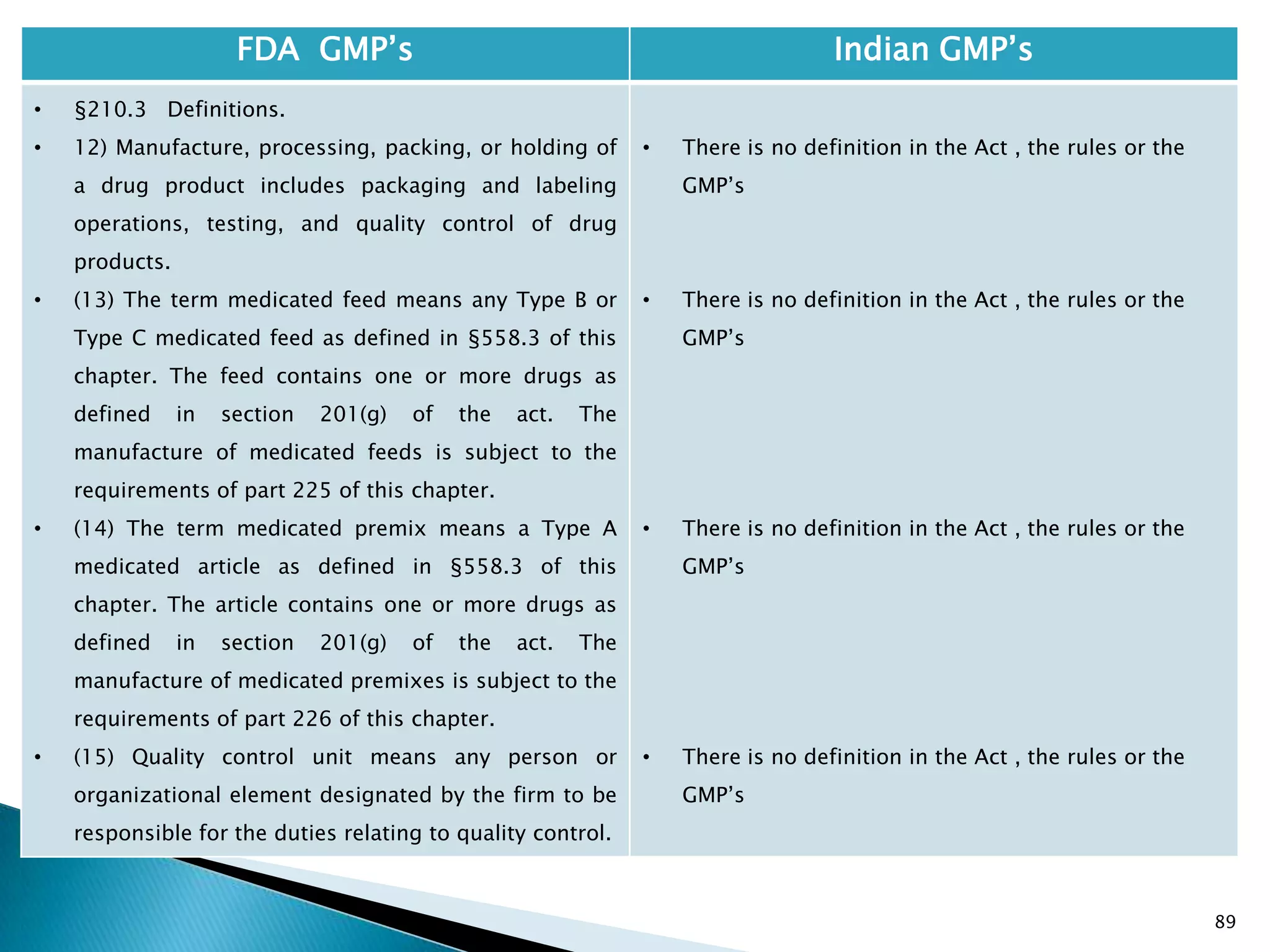
• 12) Manufacture, processing, packing, or holding of
a drug product includes packaging and labeling
operations, testing, and quality control of drug
products.
• (13) The term medicated feed means any Type B or
Type C medicated feed as defined in §558.3 of this
chapter. The feed contains one or more drugs as
defined in section 201(g) of the act. The
manufacture of medicated feeds is subject to the
requirements of part 225 of this chapter.
• (14) The term medicated premix means a Type A
medicated article as defined in §558.3 of this
chapter. The article contains one or more drugs as
defined in section 201(g) of the act. The
manufacture of medicated premixes is subject to the
requirements of part 226 of this chapter.
• (15) Quality control unit means any person or
organizational element designated by the firm to be
responsible for the duties relating to quality control.
• There is no definition in the Act , the rules or the
GMP‘s
• There is no definition in the Act , the rules or the
GMP‘s
• There is no definition in the Act , the rules or the
GMP‘s
• There is no definition in the Act , the rules or the
GMP‘s
90
FDA GMP‘s Indian GMP‘s
• §210.3 Definitions.
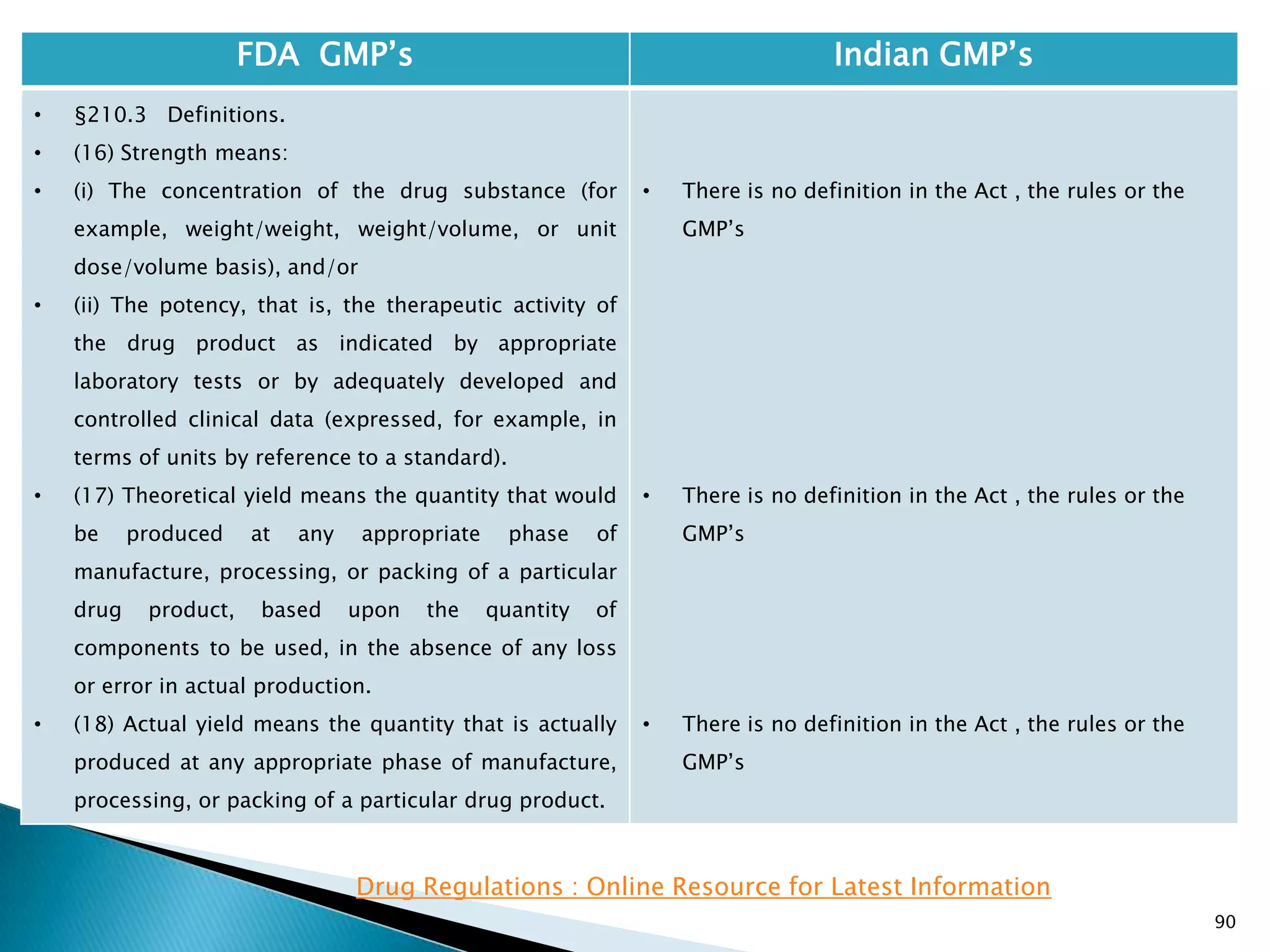
• (16) Strength means:
• (i) The concentration of the drug substance (for
example, weight/weight, weight/volume, or unit
dose/volume basis), and/or
• (ii) The potency, that is, the therapeutic activity of
the drug product as indicated by appropriate
laboratory tests or by adequately developed and
controlled clinical data (expressed, for example, in
terms of units by reference to a standard).
• (17) Theoretical yield means the quantity that would
be produced at any appropriate phase of
manufacture, processing, or packing of a particular
drug product, based upon the quantity of
components to be used, in the absence of any loss
or error in actual production.
• (18) Actual yield means the quantity that is actually
produced at any appropriate phase of manufacture,
processing, or packing of a particular drug product.
• There is no definition in the Act , the rules or the
GMP‘s
• There is no definition in the Act , the rules or the
GMP‘s
• There is no definition in the Act , the rules or the
GMP‘s
Drug Regulations : Online Resource for Latest Information
91
FDA GMP‘s Indian GMP‘s
• §210.3 Definitions.
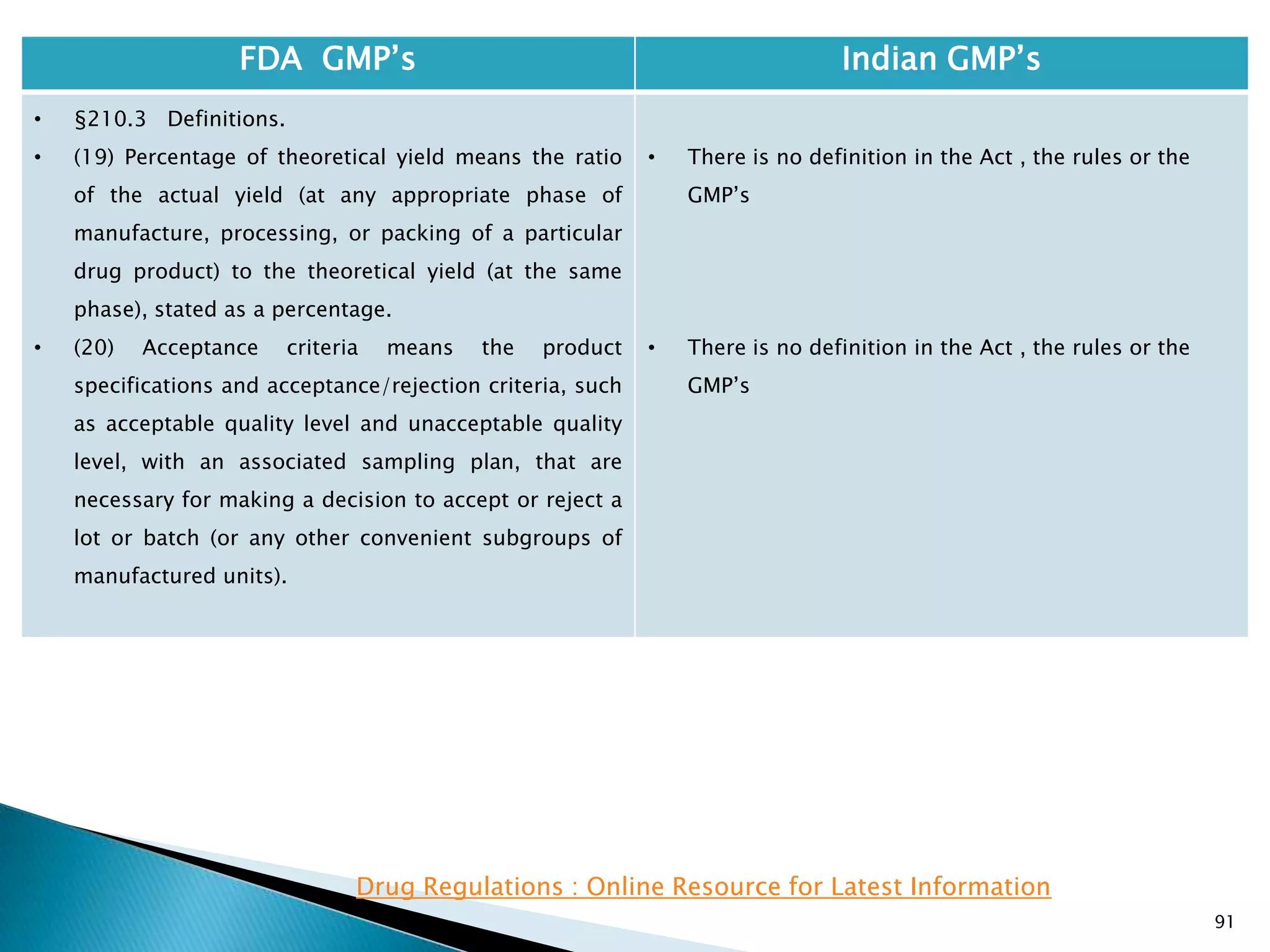
• (19) Percentage of theoretical yield means the ratio
of the actual yield (at any appropriate phase of
manufacture, processing, or packing of a particular
drug product) to the theoretical yield (at the same
phase), stated as a percentage.
• (20) Acceptance criteria means the product
specifications and acceptance/rejection criteria, such
as acceptable quality level and unacceptable quality
level, with an associated sampling plan, that are
necessary for making a decision to accept or reject a
lot or batch (or any other convenient subgroups of
manufactured units).
• There is no definition in the Act , the rules or the
GMP‘s
• There is no definition in the Act , the rules or the
GMP‘s
Drug Regulations : Online Resource for Latest Information
92
FDA GMP‘s Indian GMP‘s
• §210.3 Definitions.
• (21) Representative sample means a sample that
consists of a number of units that are drawn based
on rational criteria such as random sampling and
intended to assure that the sample accurately
portrays the material being sampled.
• (22) Gang-printed labeling means labeling derived
from a sheet of material on which more than one
item of labeling is printed.
• [43 FR 45076, Sept. 29, 1978, as amended at 51 FR
7389, Mar. 3, 1986; 58 FR 41353, Aug. 3, 1993; 73
FR 51931, Sept. 8, 2008; 74 FR 65431, Dec. 10,
2009]
• There is no definition in the Act , the rules or the
GMP‘s
• There is no definition in the Act , the rules or the
GMP‘s
Drug Regulations : Online Resource for Latest Information
93
FDA GMP‘s Indian GMP‘s
• Subpart A—General Provisions
• §211.1 Scope.
• (a) The regulations in this part contain the minimum
current good manufacturing practice for preparation
of drug products (excluding positron emission
tomography drugs) for administration to humans or
animals.
• (b) The current good manufacturing practice
regulations in this chapter as they pertain to drug
products; in parts 600 through 680 of this chapter,
as they pertain to drugs that are also biological
products for human use; and in part 1271 of this
chapter, as they are applicable to drugs that are also
human cells, tissues, and cellular and tissue-based
products (HCT/Ps) and that are drugs (subject to
review under an application submitted under section
505 of the act or under a biological product license
application under section 351 of the Public Health
Service Act);
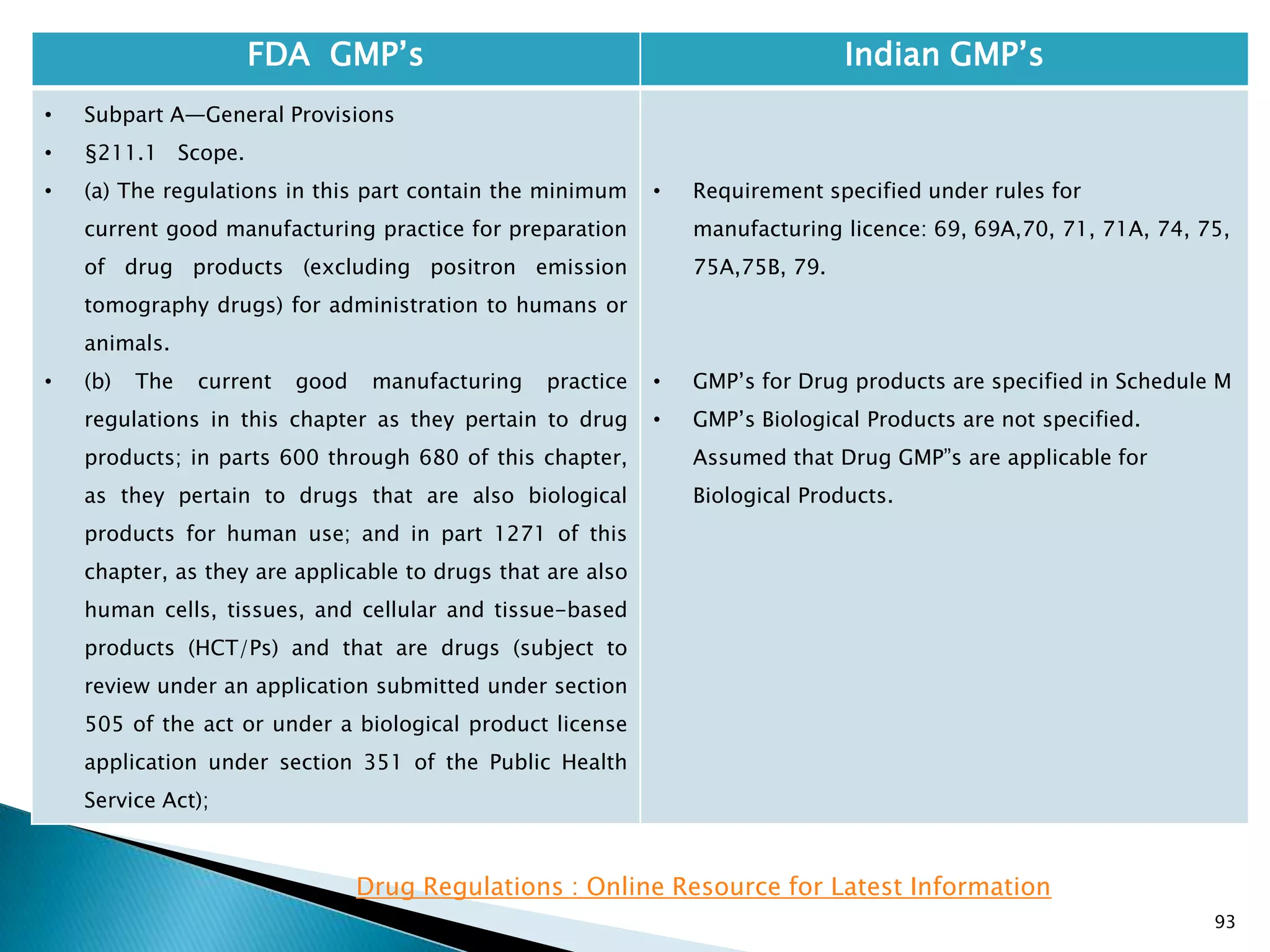
• Requirement specified under rules for
manufacturing licence: 69, 69A,70, 71, 71A, 74, 75,
75A,75B, 79.
• GMP‘s for Drug products are specified in Schedule M
• GMP‘s Biological Products are not specified.
Assumed that Drug GMP‖s are applicable for
Biological Products.
Drug Regulations : Online Resource for Latest Information
94
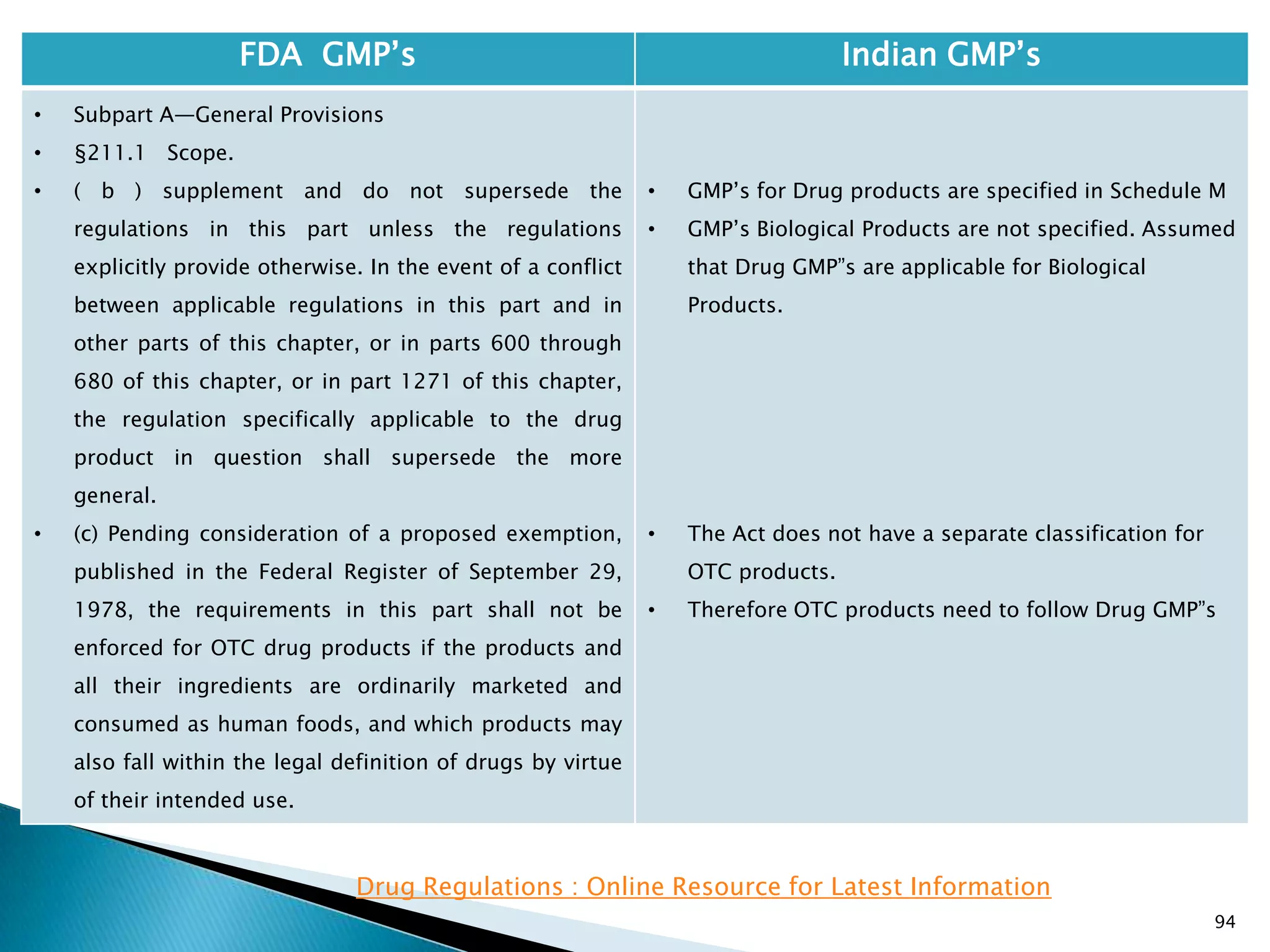
FDA GMP‘s Indian GMP‘s
• Subpart A—General Provisions
• §211.1 Scope.
• ( b ) supplement and do not supersede the
regulations in this part unless the regulations
explicitly provide otherwise. In the event of a conflict
between applicable regulations in this part and in
other parts of this chapter, or in parts 600 through
680 of this chapter, or in part 1271 of this chapter,
the regulation specifically applicable to the drug
product in question shall supersede the more
general.
• (c) Pending consideration of a proposed exemption,
published in the Federal Register of September 29,
1978, the requirements in this part shall not be
enforced for OTC drug products if the products and
all their ingredients are ordinarily marketed and
consumed as human foods, and which products may
also fall within the legal definition of drugs by virtue
of their intended use.
• GMP‘s for Drug products are specified in Schedule M
• GMP‘s Biological Products are not specified. Assumed
that Drug GMP‖s are applicable for Biological
Products.
• The Act does not have a separate classification for
OTC products.
• Therefore OTC products need to follow Drug GMP‖s
Drug Regulations : Online Resource for Latest Information
95
FDA GMP‘s Indian GMP‘s
• Subpart A—General Provisions
• §211.1 Scope.
• ( c ) Therefore, until further notice, regulations
under part 110 of this chapter, and where applicable,
parts 113 to 129 of this chapter, shall be applied in
determining whether these OTC drug products that
are also foods are manufactured, processed, packed,
or held under current good manufacturing practice.
• [43 FR 45077, Sept. 29, 1978, as amended at 62 FR
66522, Dec. 19, 1997; 69 FR 29828, May 25, 2004;
74 FR 65431, Dec. 10, 2009]
• The Act does not have a separate classification for
OTC products.
• Therefore OTC products need to follow Drug GMP‖s
Drug Regulations : Online Resource for Latest Information
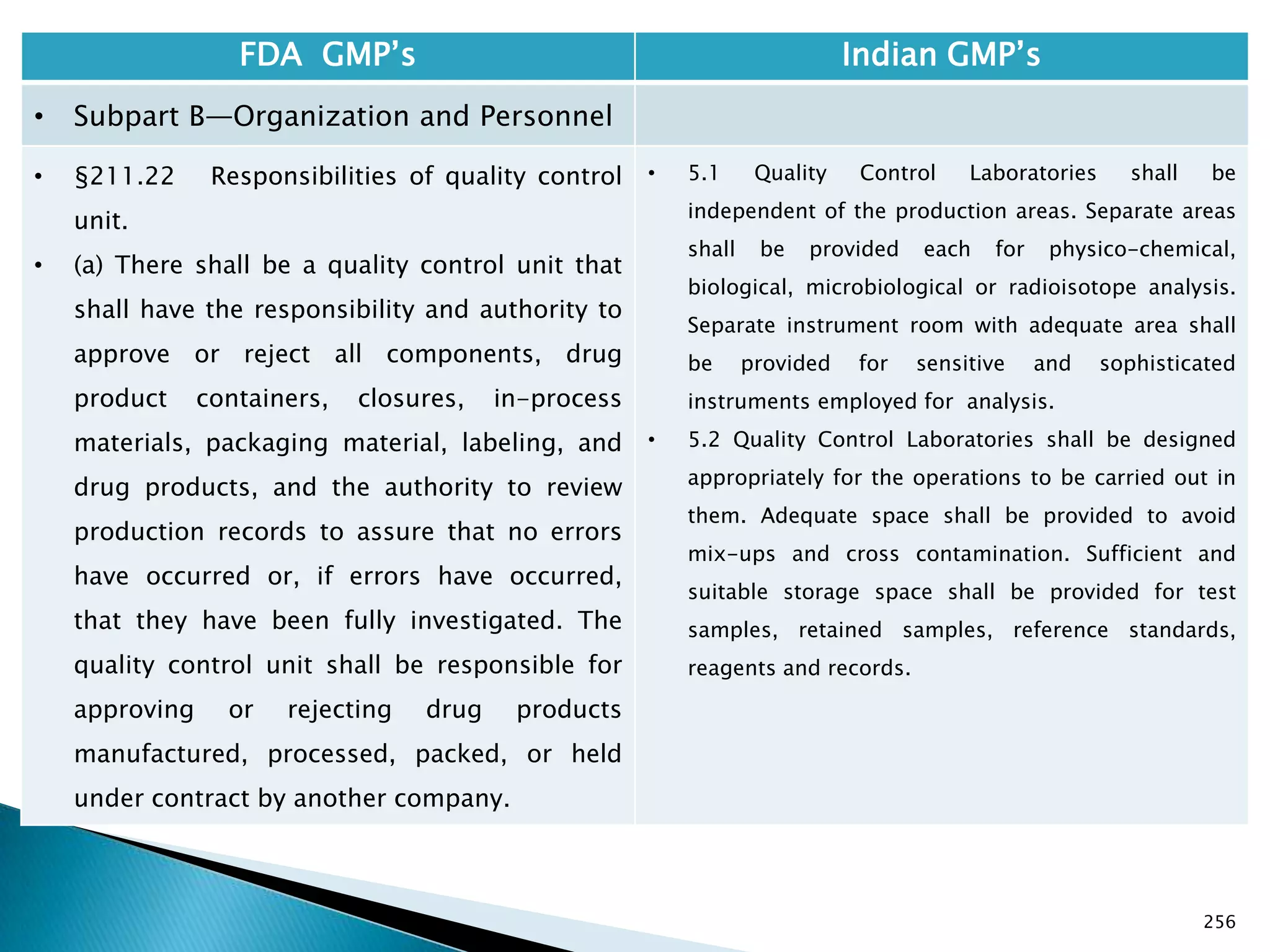
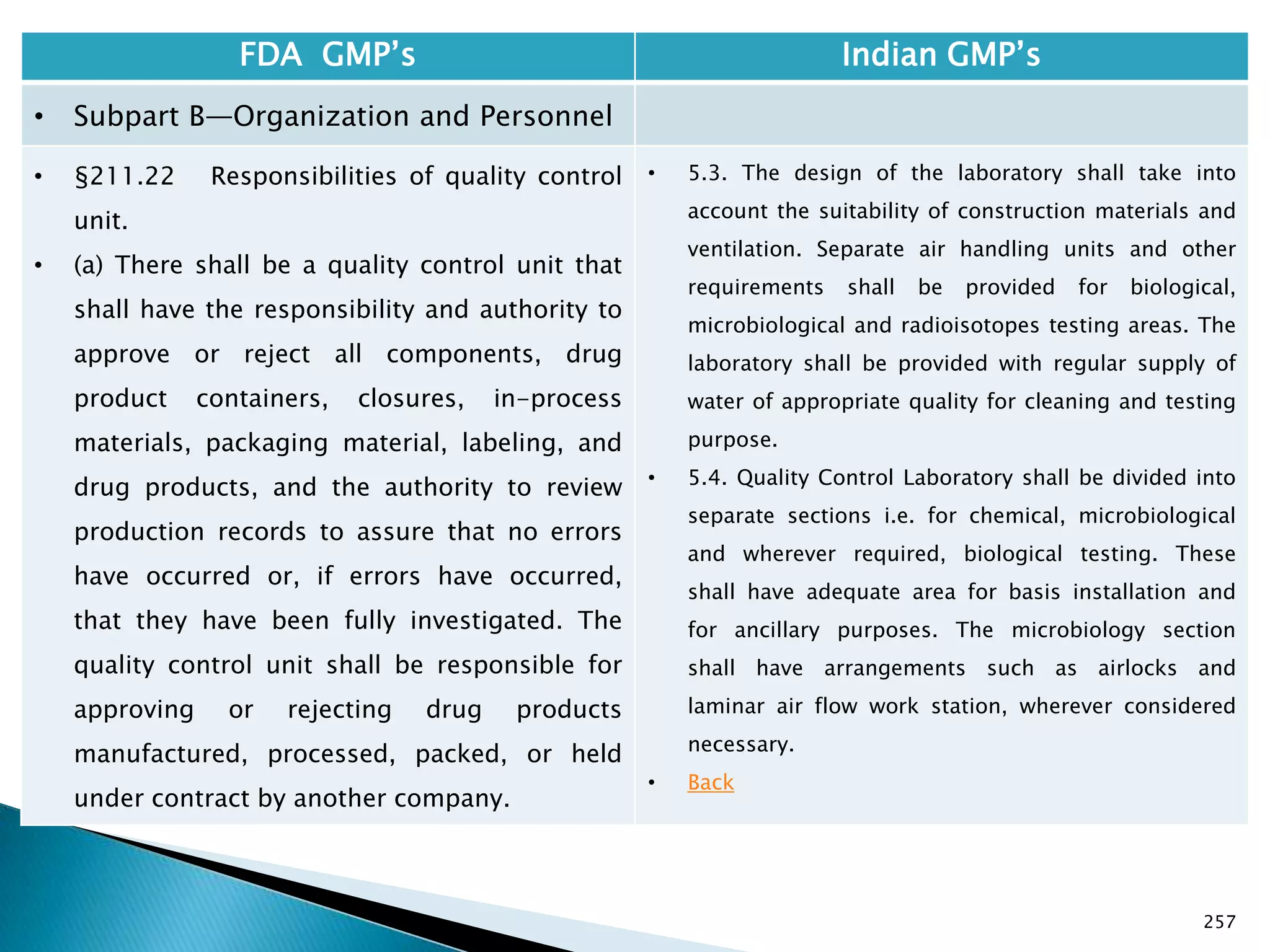
96
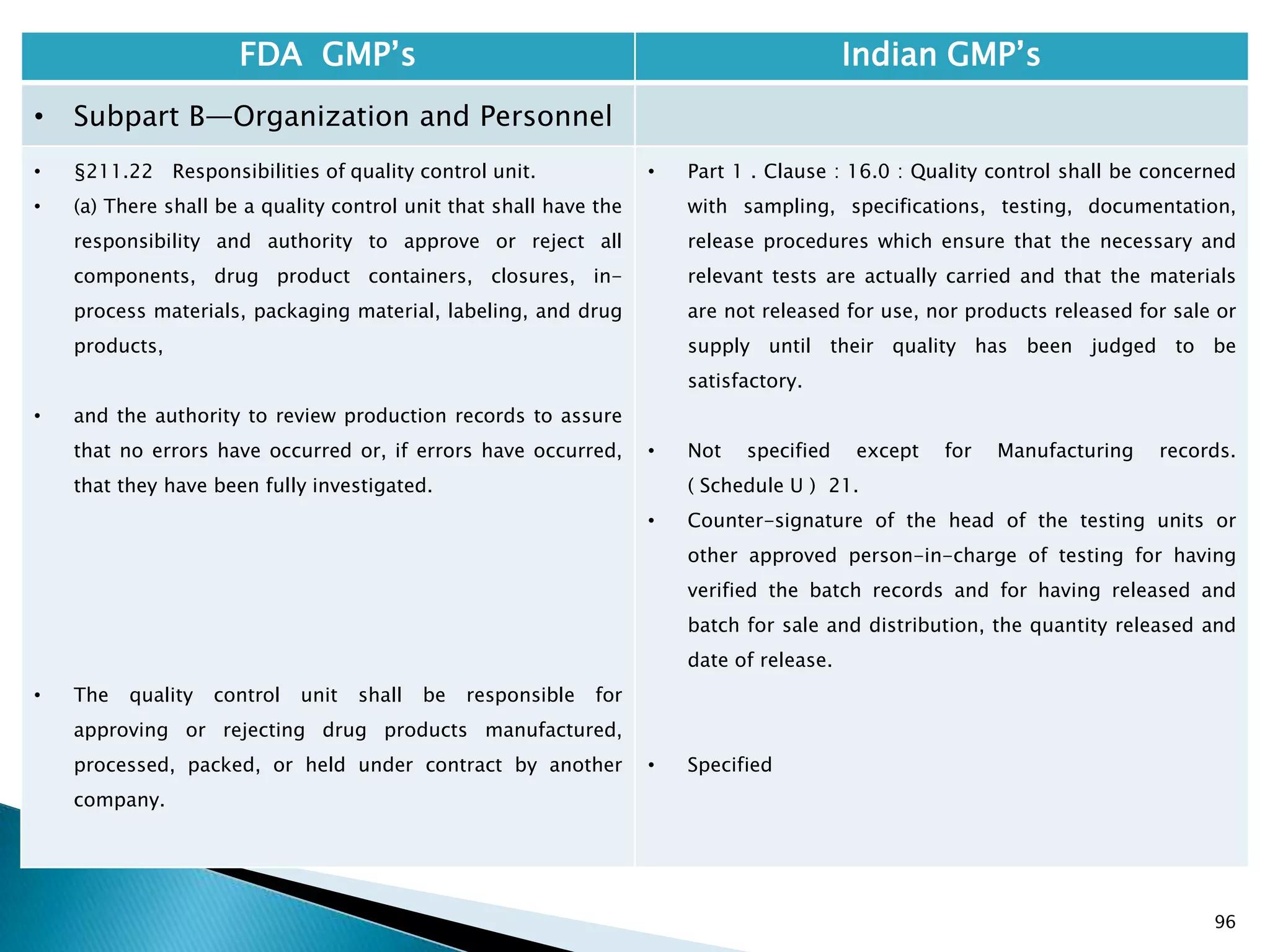
FDA GMP‘s Indian GMP‘s
• Subpart B—Organization and Personnel
• §211.22 Responsibilities of quality control unit.
• (a) There shall be a quality control unit that shall have the
responsibility and authority to approve or reject all
components, drug product containers, closures, in-
process materials, packaging material, labeling, and drug
products,
• and the authority to review production records to assure
that no errors have occurred or, if errors have occurred,
that they have been fully investigated.
• The quality control unit shall be responsible for
approving or rejecting drug products manufactured,
processed, packed, or held under contract by another
company.
• Part 1 . Clause : 16.0 : Quality control shall be concerned
with sampling, specifications, testing, documentation,
release procedures which ensure that the necessary and
relevant tests are actually carried and that the materials
are not released for use, nor products released for sale or
supply until their quality has been judged to be
satisfactory.
• Not specified except for Manufacturing records.
( Schedule U ) 21.
• Counter-signature of the head of the testing units or
other approved person-in-charge of testing for having
verified the batch records and for having released and
batch for sale and distribution, the quantity released and
date of release.
• Specified
97
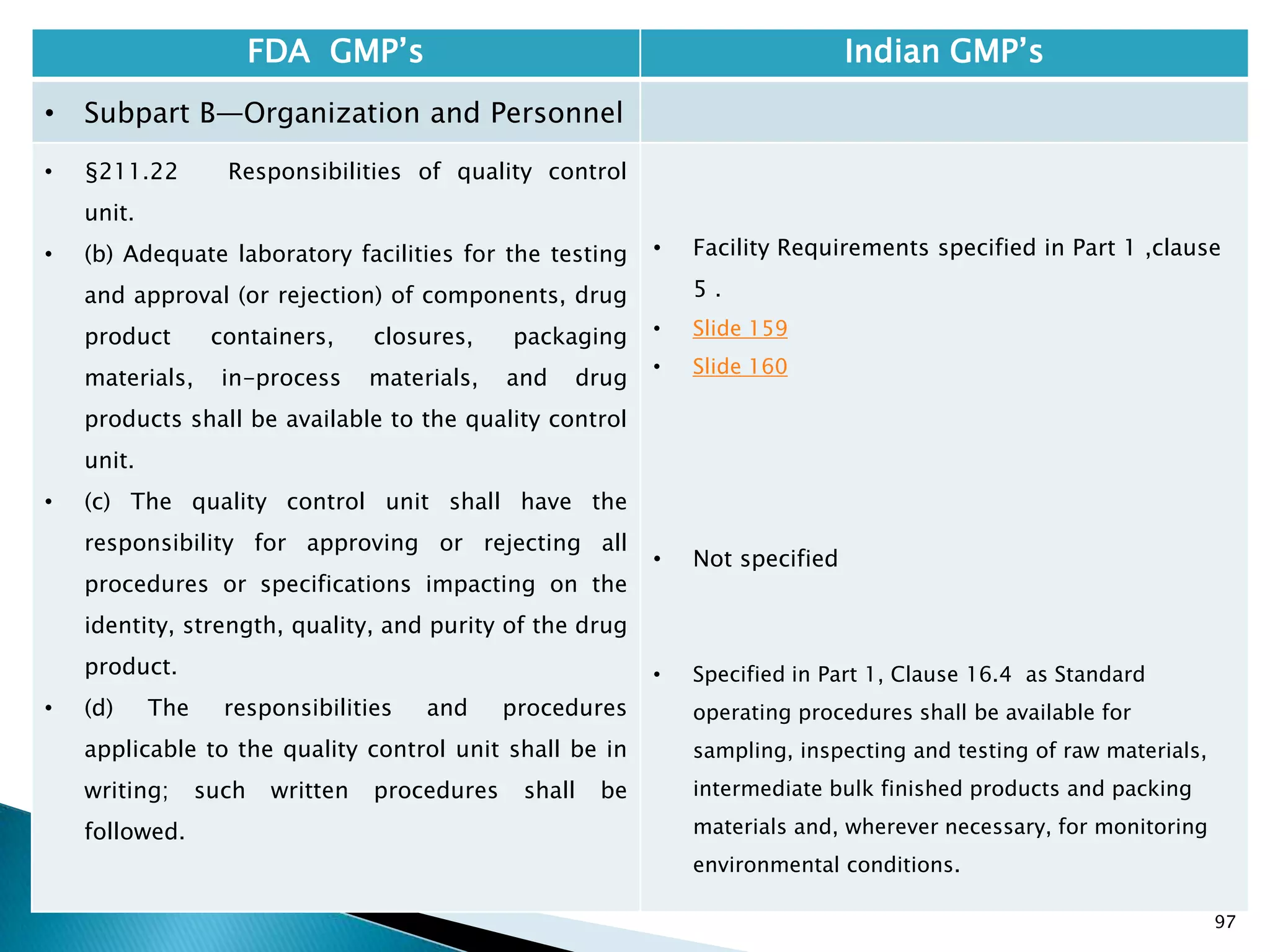
FDA GMP‘s Indian GMP‘s
• Subpart B—Organization and Personnel
• §211.22 Responsibilities of quality control
unit.
• (b) Adequate laboratory facilities for the testing
and approval (or rejection) of components, drug
product containers, closures, packaging
materials, in-process materials, and drug
products shall be available to the quality control
unit.
• (c) The quality control unit shall have the
responsibility for approving or rejecting all
procedures or specifications impacting on the
identity, strength, quality, and purity of the drug
product.
• (d) The responsibilities and procedures
applicable to the quality control unit shall be in
writing; such written procedures shall be
followed.
• Facility Requirements specified in Part 1 ,clause
5 .
• Slide 159
• Slide 160
• Not specified
• Specified in Part 1, Clause 16.4 as Standard
operating procedures shall be available for
sampling, inspecting and testing of raw materials,
intermediate bulk finished products and packing
materials and, wherever necessary, for monitoring
environmental conditions.
98
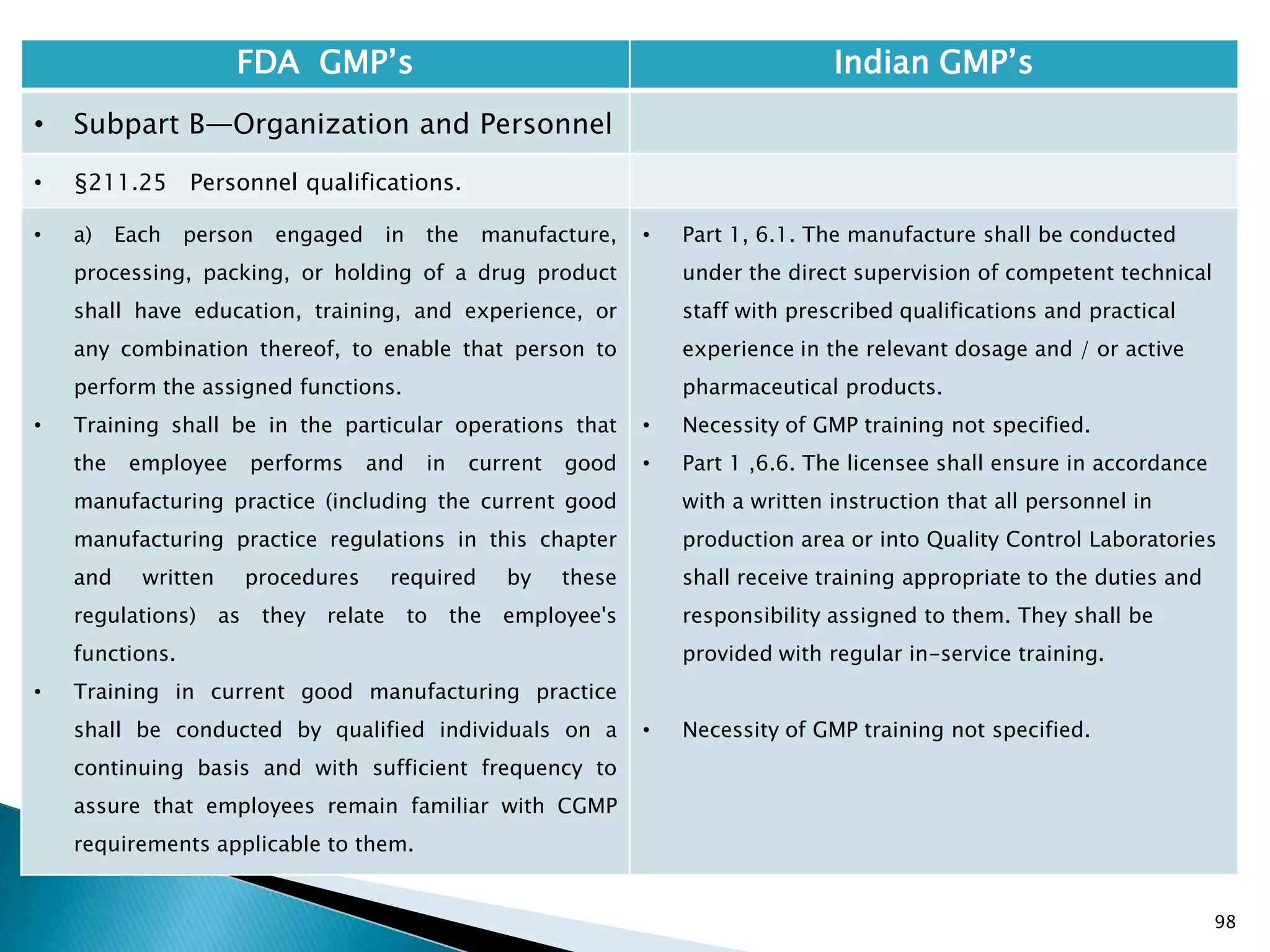
FDA GMP‘s Indian GMP‘s
• Subpart B—Organization and Personnel
• §211.25 Personnel qualifications.
• a) Each person engaged in the manufacture,
processing, packing, or holding of a drug product
shall have education, training, and experience, or
any combination thereof, to enable that person to
perform the assigned functions.
• Training shall be in the particular operations that
the employee performs and in current good
manufacturing practice (including the current good
manufacturing practice regulations in this chapter
and written procedures required by these
regulations) as they relate to the employee's
functions.
• Training in current good manufacturing practice
shall be conducted by qualified individuals on a
continuing basis and with sufficient frequency to
assure that employees remain familiar with CGMP
requirements applicable to them.
• Part 1, 6.1. The manufacture shall be conducted
under the direct supervision of competent technical
staff with prescribed qualifications and practical
experience in the relevant dosage and / or active
pharmaceutical products.
• Necessity of GMP training not specified.
• Part 1 ,6.6. The licensee shall ensure in accordance
with a written instruction that all personnel in
production area or into Quality Control Laboratories
shall receive training appropriate to the duties and
responsibility assigned to them. They shall be
provided with regular in-service training.
• Necessity of GMP training not specified.
99
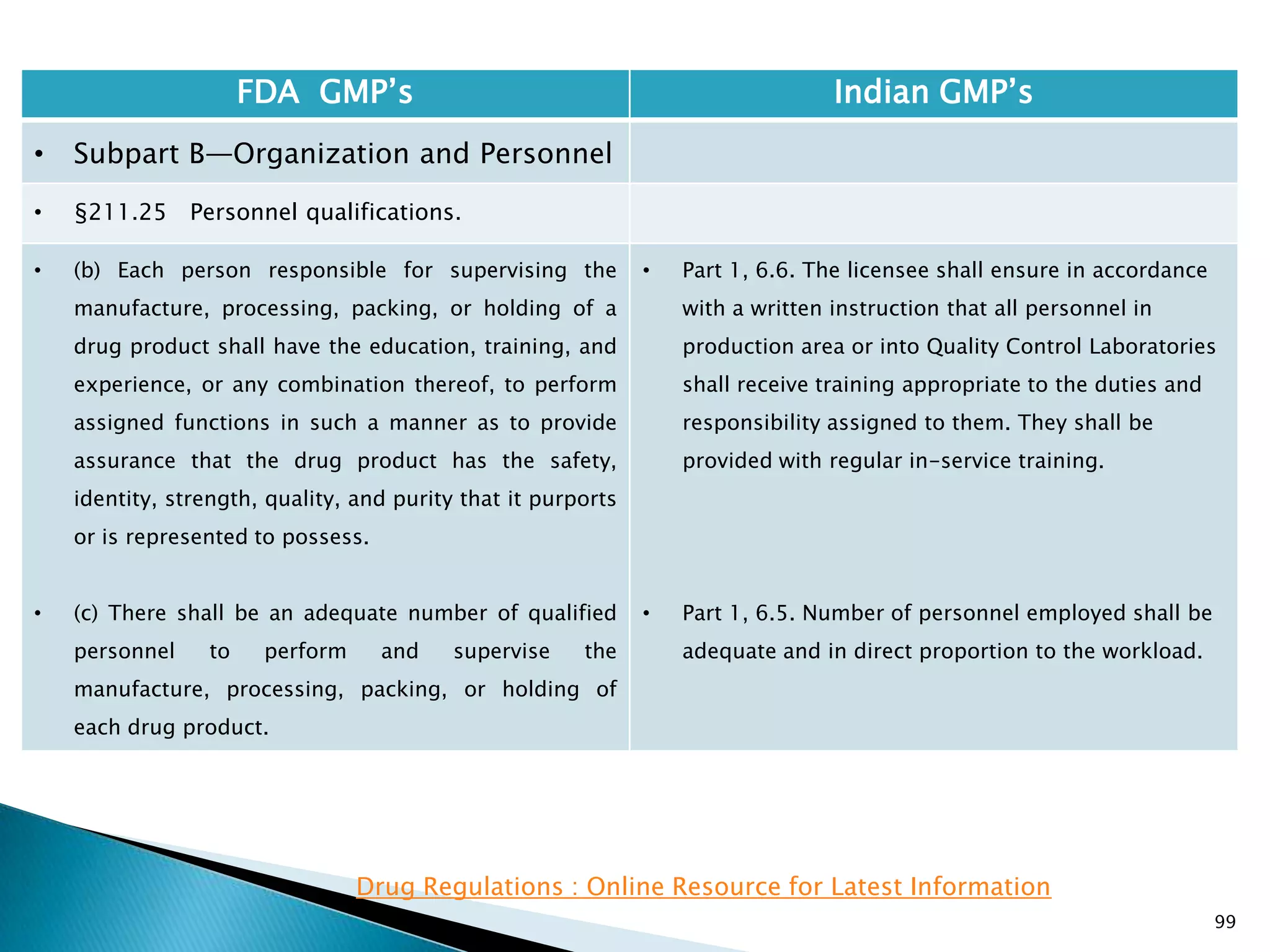
FDA GMP‘s Indian GMP‘s
• Subpart B—Organization and Personnel
• §211.25 Personnel qualifications.
• (b) Each person responsible for supervising the
manufacture, processing, packing, or holding of a
drug product shall have the education, training, and
experience, or any combination thereof, to perform
assigned functions in such a manner as to provide
assurance that the drug product has the safety,
identity, strength, quality, and purity that it purports
or is represented to possess.
• (c) There shall be an adequate number of qualified
personnel to perform and supervise the
manufacture, processing, packing, or holding of
each drug product.
• Part 1, 6.6. The licensee shall ensure in accordance
with a written instruction that all personnel in
production area or into Quality Control Laboratories
shall receive training appropriate to the duties and
responsibility assigned to them. They shall be
provided with regular in-service training.
• Part 1, 6.5. Number of personnel employed shall be
adequate and in direct proportion to the workload.
Drug Regulations : Online Resource for Latest Information
100
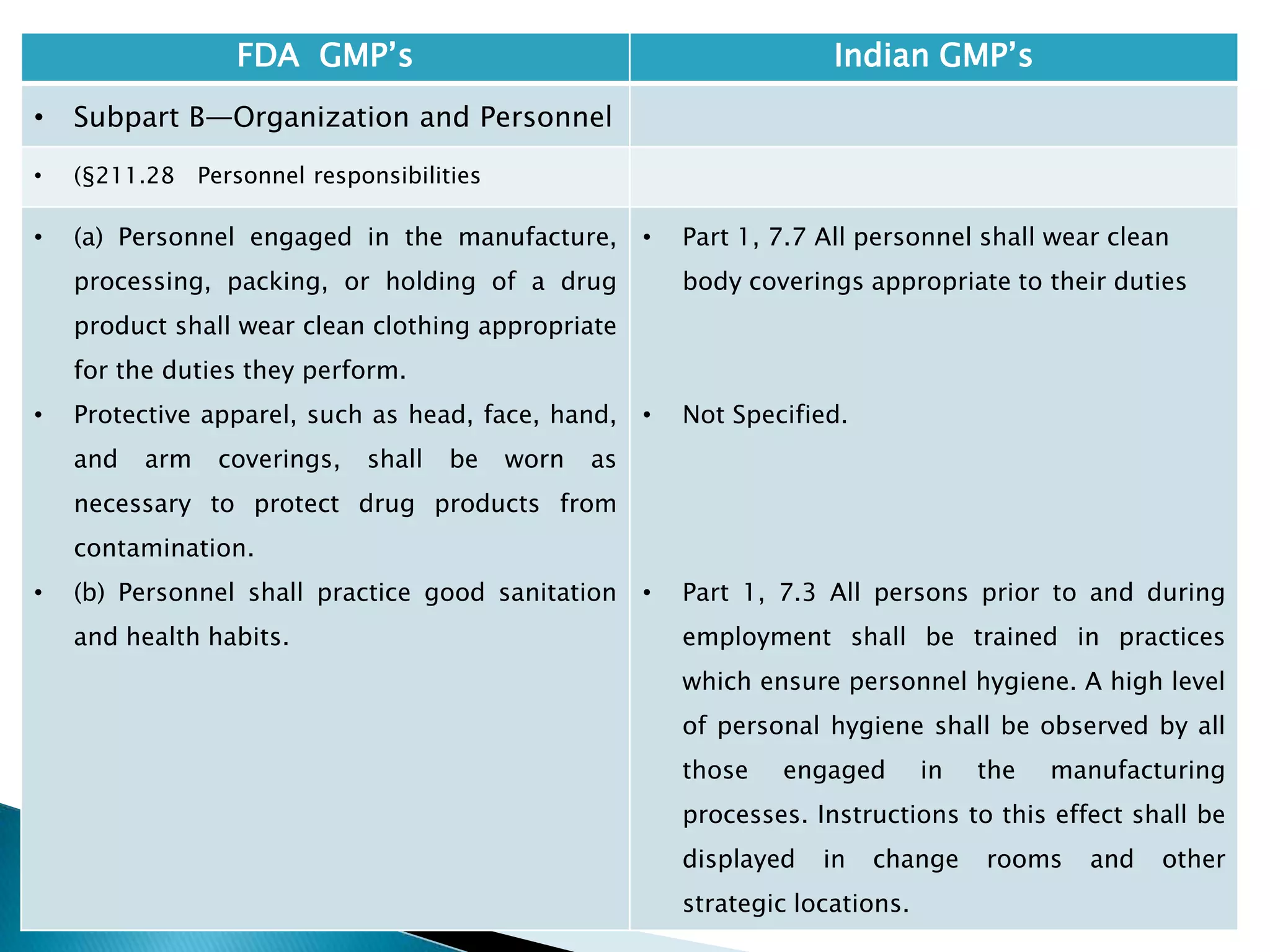
FDA GMP‘s Indian GMP‘s
• Subpart B—Organization and Personnel
• (§211.28 Personnel responsibilities
• (a) Personnel engaged in the manufacture,
processing, packing, or holding of a drug
product shall wear clean clothing appropriate
for the duties they perform.
• Protective apparel, such as head, face, hand,
and arm coverings, shall be worn as
necessary to protect drug products from
contamination.
• (b) Personnel shall practice good sanitation
and health habits.
• Part 1, 7.7 All personnel shall wear clean
body coverings appropriate to their duties
• Not Specified.
• Part 1, 7.3 All persons prior to and during
employment shall be trained in practices
which ensure personnel hygiene. A high level
of personal hygiene shall be observed by all
those engaged in the manufacturing
processes. Instructions to this effect shall be
displayed in change rooms and other
strategic locations.
101
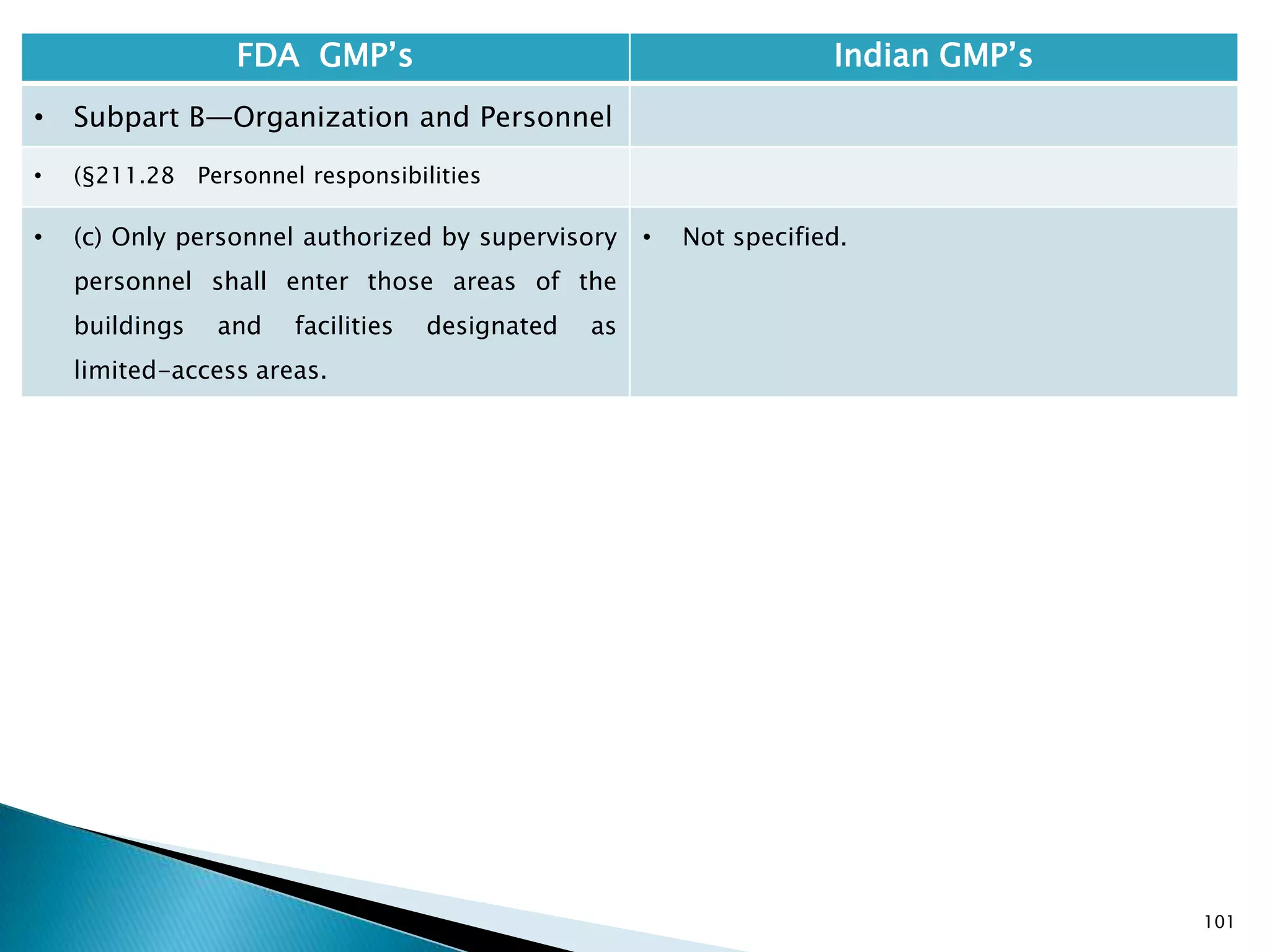
FDA GMP‘s Indian GMP‘s
• Subpart B—Organization and Personnel
• (§211.28 Personnel responsibilities
• (c) Only personnel authorized by supervisory
personnel shall enter those areas of the
buildings and facilities designated as
limited-access areas.
• Not specified.
102
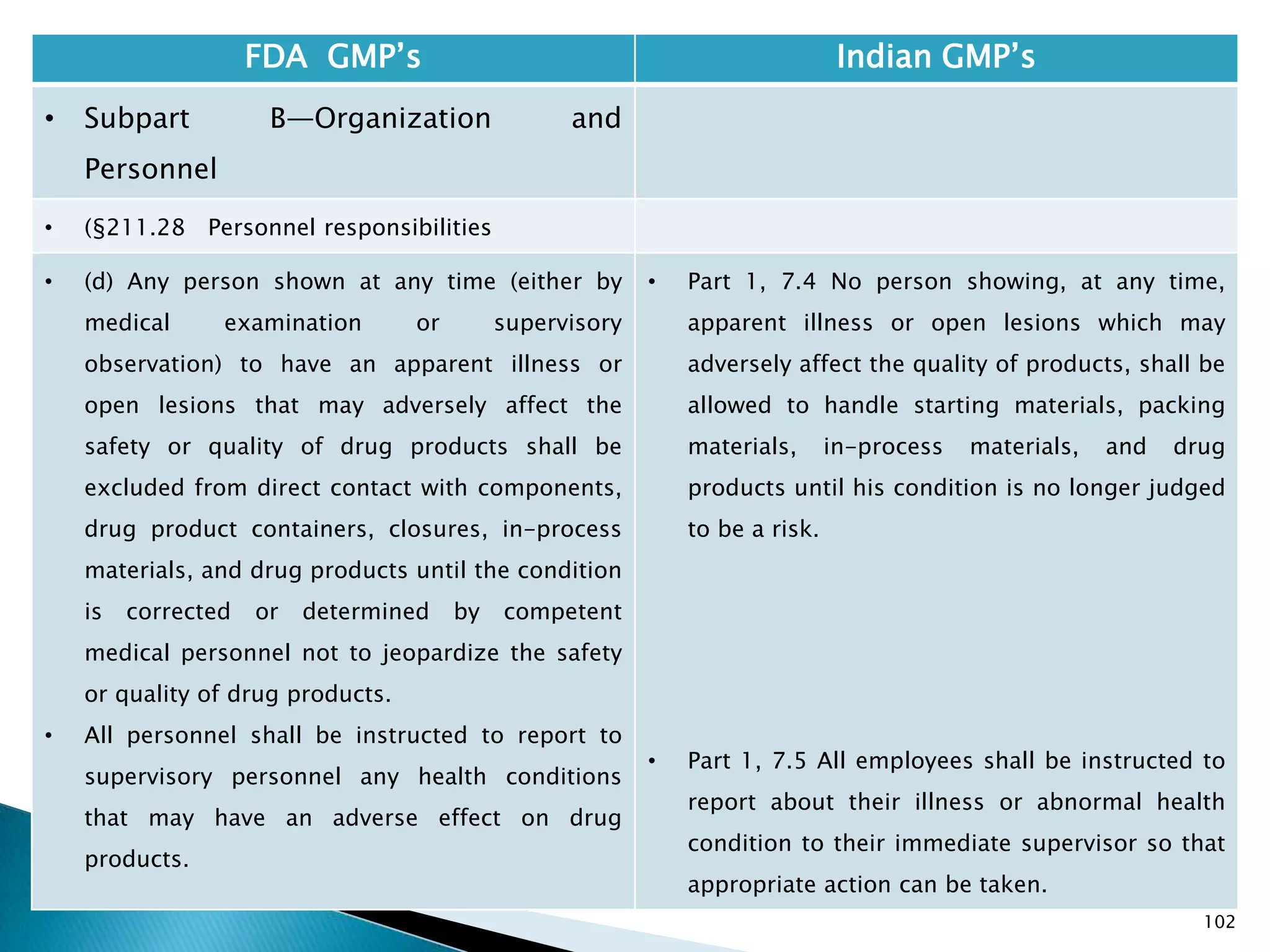
FDA GMP‘s Indian GMP‘s
• Subpart B—Organization and
Personnel
• (§211.28 Personnel responsibilities
• (d) Any person shown at any time (either by
medical examination or supervisory
observation) to have an apparent illness or
open lesions that may adversely affect the
safety or quality of drug products shall be
excluded from direct contact with components,
drug product containers, closures, in-process
materials, and drug products until the condition
is corrected or determined by competent
medical personnel not to jeopardize the safety
or quality of drug products.
• All personnel shall be instructed to report to
supervisory personnel any health conditions
that may have an adverse effect on drug
products.
• Part 1, 7.4 No person showing, at any time,
apparent illness or open lesions which may
adversely affect the quality of products, shall be
allowed to handle starting materials, packing
materials, in-process materials, and drug
products until his condition is no longer judged
to be a risk.
• Part 1, 7.5 All employees shall be instructed to
report about their illness or abnormal health
condition to their immediate supervisor so that
appropriate action can be taken.
103
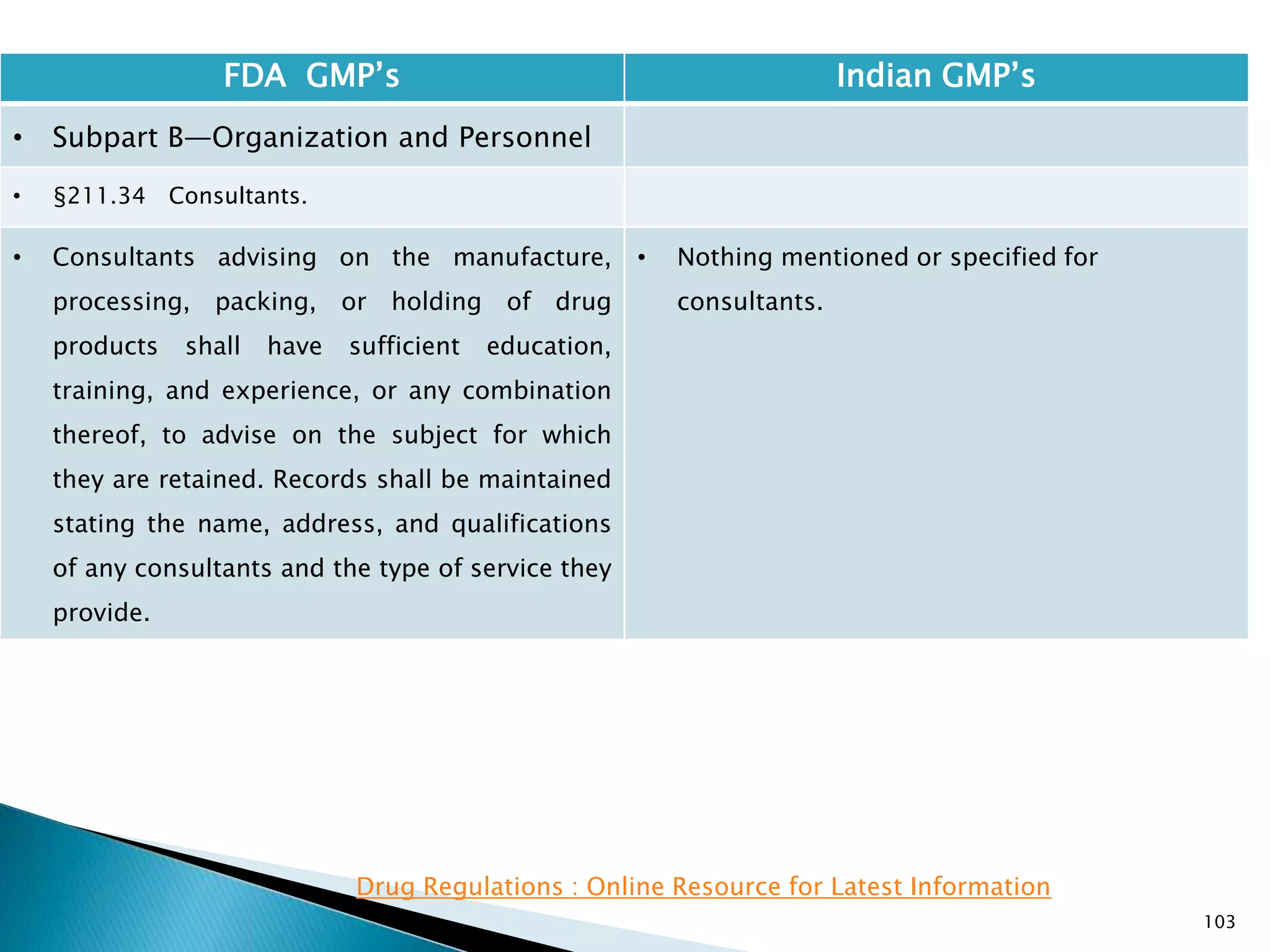
FDA GMP‘s Indian GMP‘s
• Subpart B—Organization and Personnel
• §211.34 Consultants.
• Consultants advising on the manufacture,
processing, packing, or holding of drug
products shall have sufficient education,
training, and experience, or any combination
thereof, to advise on the subject for which
they are retained. Records shall be maintained
stating the name, address, and qualifications
of any consultants and the type of service they
provide.
• Nothing mentioned or specified for
consultants.
Drug Regulations : Online Resource for Latest Information
104
FDA GMP‘s Indian GMP‘s
• Subpart C—Buildings and Facilities
• §211.42 Design and construction features.
• (a) Any building or buildings used in the
manufacture, processing, packing, or holding of
a drug product shall be of suitable size,
construction and location to facilitate cleaning,
maintenance, and proper operations.
• (b) Any such building shall have adequate space
for the orderly placement of equipment and
materials to prevent mixups between different
components, drug product containers, closures,
labeling, in-process materials, or drug
products, and to prevent contamination.
• The flow of components, drug product
containers, closures, labeling, in-process
materials, and drug products through the
building or buildings shall be designed to
prevent contamination.
• Part 1.2 Building and premises.- The building(s)
used for the factory shall be designed, constructed,
adapted and maintained to suit the manufacturing
operations so as to permit production of drugs
under hygienic conditions.
• The premises used for manufacturing, processing,
warehousing, packaging labeling and testing
purposes shall be – (i) compatible with other drug
manufacturing operations that may be carried out in
the same or adjacent area / section; (ii) adequately
provided with working space to allow orderly and
logical placement of equipment, materials and
movement of personnel so as to: (a) avoid the risk
of mix-up between different categories of drugs or
with raw materials, intermediates and in-process
material; (b) avoid the possibilities of contamination
and cross- contamination by providing suitable
mechanism;
105
FDA GMP‘s Indian GMP‘s
• Subpart C—Buildings and Facilities
• §211.42 Design and construction features.
• (c) Operations shall be performed within specifically
defined areas of adequate size. There shall be
separate or defined areas or such other control
systems for the firm's operations as are necessary
to prevent contamination or mixups during the
course of the following procedures:
• (1) Receipt, identification, storage, and withholding
from use of components, drug product containers,
closures, and labeling, pending the appropriate
sampling, testing, or examination by the quality
control unit before release for manufacturing or
packaging;
• (2) Holding rejected components, drug product
containers, closures, and labeling before
disposition;
• See last slide Last Slide
• Part 2.1 Adequate areas shall be designed to allow
sufficient and orderly warehousing of various
categories of materials and products like starting
and packaging materials, intermediates, bulk and
finished products, products in quarantine, released,
rejected, returned or recalled, machine and
equipment spare parts and change items.
• Part 2.5.Segregation shall be provided for the
storage of rejected, recalled or returned materials
or products. Such areas, materials or products shall
be suitably marked and secured. Access to these
areas and materials shall be restricted.
106
FDA GMP‘s Indian GMP‘s
• Subpart C—Buildings and Facilities
• §211.42 Design and construction features.
• (3) Storage of released components, drug product
containers, closures, and labeling;
• (4) Storage of in-process materials;
• (5) Manufacturing and processing operations;
• (6) Packaging and labeling operations;
• (7) Quarantine storage before release of drug
products;
• (8) Storage of drug products after release;
• (9) Control and laboratory operations;
• Specified : see last slide
• Specified : See last slide
• Specified : See this slide
Drug Regulations : Online Resource for Latest Information
107
FDA GMP‘s Indian GMP‘s
• Subpart C—Buildings and Facilities
• §211.42 Design and construction features.
• (10) Aseptic processing, which includes as
appropriate:
• (i) Floors, walls, and ceilings of smooth, hard
surfaces that are easily cleanable;
• (ii) Temperature and humidity controls;
• (iii) An air supply filtered through high-
efficiency particulate air filters under positive
pressure, regardless of whether flow is laminar
or nonlaminar;
• (iv) A system for monitoring environmental
conditions;
• (v) A system for cleaning and disinfecting the
room and equipment to produce aseptic
conditions;
• Specified under Part I A : Specific requirements for
sterile products
Drug Regulations : Online Resource for Latest Information
108
FDA GMP‘s Indian GMP‘s
• Subpart C—Buildings and Facilities
• §211.42 Design and construction features.
• (vi) A system for maintaining any equipment
used to control the aseptic conditions.
• (d) Operations relating to the manufacture,
processing, and packing of penicillin shall be
performed in facilities separate from those
used for other drug products for human use.
• [43 FR 45077, Sept. 29, 1978, as amended at
60 FR 4091, Jan. 20, 1995]
• Specified under Part I A : Specific requirements for
sterile products
• Part 1, 3.2. In order to avoid the risk of cross-
contamination, separate dedicated and self
contained facilities shall be made available for the
production of sensitive pharmaceutical products
like penicillin or biological preparations with live
micro-organisms. Separate dedicated facilities
shall be provided for the manufacture of
contamination causing and potent products such
as Beta-Lactum, sex hormones and cytotoxic
substances.
Drug Regulations : Online Resource for Latest Information
109
FDA GMP‘s Indian GMP‘s
• Subpart C—Buildings and Facilities
• §211.44 Lighting.
• Adequate lighting shall be provided in all
areas.
• Part 1, 1.2 ( iv) The production and dispensing areas
shall be well lighted…….. Also mentioned at several
other places under different headings.
• §211.46 Ventilation, air filtration, air
heating and cooling.
• Part 1, 1.2 (iv) air-conditioned, where prescribed for
the operations and dosage forms under production.
The production and dispensing areas shall be well
lighted, effectively ventilated, with air control facilities
and may have proper Air Handling Units (wherever
applicable) to maintain conditions including
temperature and, wherever necessary, humidity, as
defined for the relevant product. These conditions
shall be appropriate to the category of drugs and
nature of the operation. These shall also be suitable to
the comforts of the personnel working with protective
clothing, products handled, operations undertaken
within them in relation to the external environment.
These areas shall be regularly monitored for
compliance with required specifications;
110
FDA GMP‘s Indian GMP‘s
• Subpart C—Buildings and Facilities
• §211.46 Ventilation, air filtration, air heating
and cooling.
• (a) Adequate ventilation shall be provided.
• (b) Equipment for adequate control over air
pressure, micro-organisms, dust, humidity,
and temperature shall be provided when
appropriate for the manufacture, processing,
packing, or holding of a drug product.
• Specified : See last slide
• Part 1, 8.2.1. The licensee shall prevent mix-up
and cross-contamination of drug material and drug
product (from environmental dust) by proper air-
handling system, pressure differential, segregation,
status labeling and cleaning. Proper records and
Standard Operating Procedures thereof shall be
maintained.
• Nothing specified for adequate control over,
microorganisms
Drug Regulations : Online Resource for Latest Information
111
FDA GMP‘s Indian GMP‘s
• Subpart C—Buildings and Facilities
• §211.46 Ventilation, air filtration, air heating
and cooling.
• (b) Equipment for adequate control over air
pressure, micro-organisms, dust, humidity,
and temperature shall be provided when
appropriate for the manufacture, processing,
packing, or holding of a drug product.
• Part 1 B : : Oral Solid Dosage Forms:
• 1.5 : Where the facilities are designed to provide
special environmental conditions of pressure
differentials between rooms, these conditions shall
be regularly monitored and any specification
results brought to the immediate attention of the
Production and quality Assurance Department
which shall be immediately attended to.
• Part I E Metered Dose Inhalers
• 3.1. Where products or clean components are
exposed, the area shall be supplied with filtered air
of Grade C.
• 3.3 There shall be a difference in room pressure
between the manufacturing area and the support
areas and the differential pressure shall be not less
than 15 Pascals (0.06 inches or 1.5mm water
gauge).
112
FDA GMP‘s Indian GMP‘s
• Subpart C—Buildings and Facilities
• §211.46 Ventilation, air filtration, air heating
and cooling.
• (c) Air filtration systems, including prefilters and
particulate matter air filters, shall be used when
appropriate on air supplies to production areas.
• If air is recirculated to production areas, measures
shall be taken to control recirculation of dust from
production.
• In areas where air contamination occurs during
production, there shall be adequate exhaust
systems or other systems adequate to control
contaminants.
• Part 1, 8.2.1. The licensee shall prevent mix-up
and cross-contamination of drug material and drug
product (from environmental dust) by proper air-
handling system, pressure differential, segregation,
status labeling and cleaning. Proper records and
Standard Operating Procedures thereof shall be
maintained.
• Not specified.
• Specified
113
FDA GMP‘s Indian GMP‘s
• Subpart C—Buildings and Facilities
• §211.46 Ventilation, air filtration, air heating
and cooling.
• (d) Air-handling systems for the manufacture,
processing, and packing of penicillin shall be
completely separate from those for other drug
products for human use.
• Part 1, 3.2. In order to avoid the risk of cross-
contamination, separate dedicated and self-
contained facilities shall be made available for the
production of sensitive pharmaceutical products
like penicillin or biological preparations with live
micro-organisms. Separate dedicated facilities shall
be provided for the manufacture of contamination
causing and potent products such as Beta-Lactum,
sex hormones and cytotoxic substances.
• Part 1, 8.2.2 The licensee shall ensure processing
of sensitive drugs like Beta-Lactum antibiotics, sex
hormones and cytotoxic substances in segregated
areas or isolated production areas within the
building with independent air-handling unit and
proper pressure differential. The effective
segregation of these areas shall be demonstrated
with adequate records of maintenance and services.
114
FDA GMP‘s Indian GMP‘s
• Subpart C—Buildings and Facilities
• §211.48 Plumbing.
• (a) Potable water shall be supplied under
continuous positive pressure in a plumbing system
free of defects that could contribute contamination
to any drug product. Potable water shall meet the
standards prescribed in the Environmental
Protection Agency's Primary Drinking Water
Regulations set forth in 40 CFR part 141. Water not
meeting such standards shall not be permitted in
the potable water system.
• (b) Drains shall be of adequate size and, where
connected directly to a sewer, shall be provided
with an air break or other mechanical device to
prevent back-siphonage.
• [43 FR 45077, Sept. 29, 1978, as amended at 48 FR
11426, Mar. 18, 1983]
• Potable water to be supplied under continuous
positive pressure not specified.
• Specified that potable water should meet Indian
specifications.
• Part 1, 1.2 , (v) Provided with drainage system, as
specified for the various categories of products,
which shall be of adequate size and so designed as
to prevent back flow and/or prevent insets and
rodents entering the premises. Open channels shall
be avoided in manufacturing areas and, where
provided, these shall be shallow to facilitate
cleaning and disinfection;
115
FDA GMP‘s Indian GMP‘s
• Subpart C—Buildings and Facilities
• §211.50 Sewage and refuse.
• Sewage, trash, and other refuse in and from the
building and immediate premises shall be
disposed of in a safe and sanitary manner.
• Part 1, 1.4 (i) The disposal of sewage and effluents
(solid, liquid and gas) from the manufactory shall
be in conformity with the requirements of
Environment Pollution Control Board.
• §211.52 Washing and toilet facilities.
• Adequate washing facilities shall be provided,
including hot and cold water, soap or
detergent, air driers or single-service towels,
and clean toilet facilities easily accessible to
working areas.
• Part 1, 4.2 Facilities for changing, storing clothes
and for washing and toilet purposes shall be easily
accessible and adequate for the number of users.
Toilets, separate for males and females, shall not be
directly connected with production or storage areas.
There shall be written instructions for cleaning and
disinfection of such areas.
Drug Regulations : Online Resource for Latest Information
116
FDA GMP‘s Indian GMP‘s
• Subpart C—Buildings and Facilities
• §211.56 Sanitation.
• (a) Any building used in the manufacture,
processing, packing, or holding of a drug product
shall be maintained in a clean and sanitary
condition.
• Any such building shall be free of infestation by
rodents, birds, insects, and other vermin (other
than laboratory animals).
• Trash and organic waste matter shall be held and
disposed of in a timely and sanitary manner.
• Part 1, 9.1 The manufacturing premises shall be
cleaned and maintained in an orderly manner, so
that it is free from accumulated waste, dust, debris
and other similar material. A validated cleaning
procedure shall be maintained.
• Part 1, 1.2 (iii) designed / constructed / maintained
to prevent entry of insects, pests, birds, vermins,
and rodents.
• Specified in Part 1, 1.4 : Disposal of waste.
• (b) There shall be written procedures assigning
responsibility for sanitation and describing in
sufficient detail the cleaning schedules, methods,
equipment, and materials to be used in cleaning the
buildings and facilities; such written procedures
shall be followed.
• Specified.
Drug Regulations : Online Resource for Latest Information
117
FDA GMP‘s Indian GMP‘s
• Subpart C—Buildings and Facilities
• §211.56 Sanitation.
• (c) There shall be written procedures for use of
suitable rodenticides, insecticides, fungicides,
fumigating agents, and cleaning and sanitizing
agents.
• Such written procedures shall be designed to
prevent the contamination of equipment,
components, drug product containers, closures,
packaging, labeling materials, or drug products and
shall be followed.
• Rodenticides, insecticides, and fungicides shall not
be used unless registered and used in accordance
with the Federal Insecticide, Fungicide, and
Rodenticide Act (7 U.S.C. 135).
• Written procedures for use of suitable rodenticides,
insecticides, fungicides, fumigating agents is not
specified except for warehoue.
• Not specified.
• Not Specified.
Drug Regulations : Online Resource for Latest Information
118
FDA GMP‘s Indian GMP‘s
• Subpart C—Buildings and Facilities
• §211.56 Sanitation.
• (d) Sanitation procedures shall apply to work
performed by contractors or temporary
employees as well as work performed by full-
time employees during the ordinary course of
operations.
• Not Specified.
• §211.58 Maintenance.
• Any building used in the manufacture,
processing, packing, or holding of a drug
product shall be maintained in a good state of
repair.
• Specified.
Drug Regulations : Online Resource for Latest Information
119
FDA GMP‘s Indian GMP‘s
• Subpart D—Equipment
• §211.63 Equipment design, size, and location.
• Equipment used in the manufacture,
processing, packing, or holding of a drug
product shall be of appropriate design,
adequate size, and suitably located to facilitate
operations for its intended use and for its
cleaning and maintenance.
• Part 1, 11.1 Equipment shall be located, designed,
constructed, adapted and maintained to suit the
operations to be carried out. The layout and design
of the equipment shall aim to minimise the risk of
errors and permit effective cleaning and
maintenance in order to avoid cross contamination,
build-up of dust or dirt and, in general any adverse
effect on the quality of products. Each equipment
shall be provided with a logbook, wherever
necessary.
• §211.65 Equipment construction.
• a) Equipment shall be constructed so that
surfaces that contact components, in-process
materials, or drug products shall not be
reactive, additive, or absorptive so as to alter
the safety, identity, strength, quality, or purity
of the drug product beyond the official or other
established requirements.
• Part 1,11.3 The parts of the production equipment
that come into contact with the product shall not be
reactive, additive or adsorptive to an extent that
would affect the quality of the product.
120
FDA GMP‘s Indian GMP‘s
• Subpart D—Equipment
• §211.65 Equipment construction.
• (b) Any substances required for operation, such
as lubricants or coolants, shall not come into
contact with components, drug product
containers, closures, in-process materials, or
drug products so as to alter the safety, identity,
strength, quality, or purity of the drug product
beyond the official or other established
requirements.
• Part 1, 11.4 To avoid accidental contamination,
wherever possible, non-toxic/edible grade
lubricants shall be used and the equipment shall be
maintained in a way that lubricants do not
contaminate the products being produced.
Drug Regulations : Online Resource for Latest Information
121
FDA GMP‘s Indian GMP‘s
• Subpart D—Equipment
• §211.67 Equipment cleaning and maintenance.
• (a) Equipment and utensils shall be cleaned,
maintained, and, as appropriate for the nature
of the drug, sanitized and/or sterilized at
appropriate intervals to prevent malfunctions or
contamination that would alter the safety,
identity, strength, quality, or purity of the drug
product beyond the official or other established
requirements.
• Mentioned in a confused way in different sections under
Blood bank , Equipment, Batch Packing & Processing
Records and under different dosage forms.
• Blood Banks : Rules Part 12 B ( E ) :Equipment used in
the collection, processing, testing, storage and
sale/distribution of blood and is components shall be
maintained in a clean and proper manner and so placed
as to facilitate cleaning and maintenance.
• Schedule M : Part 1, 11.1 Equipment shall be located,
designed, constructed, adapted and maintained to suit
the operations to be carried out. The layout and design
of the equipment shall aim to minimise the risk of errors
and permit effective cleaning and maintenance in order
to avoid cross contamination, build-up of dust or dirt
and, in general any adverse effect on the quality of
products. Each equipment shall be provided with a
logbook, wherever necessary.
122
FDA GMP‘s Indian GMP‘s
• Subpart D—Equipment
• §211.67 Equipment cleaning and maintenance.
• (a) Equipment and utensils shall be cleaned,
maintained, and, as appropriate for the nature
of the drug, sanitized and/or sterilized at
appropriate intervals to prevent malfunctions or
contamination that would alter the safety,
identity, strength, quality, or purity of the drug
product beyond the official or other established
requirements.
• Part 1, 20.2 Before any packaging operation begins,
check shall be made and recorded that the
equipment and the work stations are clear of the
previous products, documents or materials not
required for the planned packaging operations, and
that the equipment is clean and suitable for use.
• Part 1, 21.2 Before any processing begins, check
shall be performed and recorded to ensure that the
equipment and work station are clear of previous
products, documents or materials not required for
the planned process are removed and the
equipment is clean and suitable for use.
123
FDA GMP‘s Indian GMP‘s
• Subpart D—Equipment
• §211.67 Equipment cleaning and maintenance.
• (a) Equipment and utensils shall be cleaned,
maintained, and, as appropriate for the nature
of the drug, sanitized and/or sterilized at
appropriate intervals to prevent malfunctions or
contamination that would alter the safety,
identity, strength, quality, or purity of the drug
product beyond the official or other established
requirements.
• Part I B : ( Oral Solid Dosage Forms) :
• 1.6. Care shall be taken to guard against any
material lodging and remaining undetected in any
processing or packaging equipment. Particular care
shall be taken to ensure that any vacuum,
compressed air or air-extraction nozzles are kept
clean and that there is no evidence lubricants
leaking into the product from any part of the
equipment.
• 7.1. Care shall be taken when using automatic
tablet and capsule counting, strip and blister
packaging equipment to ensure that all ‗rogue‘
tablets, capsules or foils from packaging operation
are removed before a new packaging operation is
commenced.
124
FDA GMP‘s Indian GMP‘s
• Subpart D—Equipment
• §211.67 Equipment cleaning and maintenance.
• (a) Equipment and utensils shall be cleaned,
maintained, and, as appropriate for the nature
of the drug, sanitized and/or sterilized at
appropriate intervals to prevent malfunctions or
contamination that would alter the safety,
identity, strength, quality, or purity of the drug
product beyond the official or other established
requirements.
• Part I D : ( Topical Dosage Forms) :
• 4. The equipment used shall be designed and
maintained to prevent the product from being
accidentally contaminated with any foreign matter
or lubricant.
• Part 1 F ( API)
• 4.2. If the equipment is used for different
intermediates and active pharmaceutical
ingredients, proper cleaning before switching from
one product to another becomes particularly
important. If cleaning of a specific type of
equipment is difficult, the equipment may need to
be dedicated to a particular intermediate or active
pharmaceutical ingredient.
125
FDA GMP‘s Indian GMP‘s
• Subpart D—Equipment
• §211.67 Equipment cleaning and maintenance.
• (a) Equipment and utensils shall be cleaned,
maintained, and, as appropriate for the nature
of the drug, sanitized and/or sterilized at
appropriate intervals to prevent malfunctions or
contamination that would alter the safety,
identity, strength, quality, or purity of the drug
product beyond the official or other established
requirements.
• Part 1 F ( API)
• 4.4. Written procedures shall be established and
followed for cleaning and maintenance of
equipment, including utensils used in the
manufacture, processing, packing or holding of
active pharmaceutical ingredients.
• 4.5. Equipment shall be cleaned between successive
batches to prevent contamination and carry-over of
degraded material or contaminants unless
otherwise established by validation.
126
FDA GMP‘s Indian GMP‘s
• Subpart D—Equipment
• §211.67 Equipment cleaning and maintenance.
• (b) Written procedures shall be established and
followed for cleaning and maintenance of
equipment, including utensils, used in the
manufacture, processing, packing, or holding of
a drug product. These procedures shall include,
but are not necessarily limited to, the following:
• (1) Assignment of responsibility for cleaning
and maintaining equipment;
• (2) Maintenance and cleaning schedules,
including, where appropriate, sanitizing
schedules;
• Mentioned in a very confused way under different parts:
under Part 1 General Requirements and under Part 1 F
for API‘s as follows:
• Part I :
• 22.5.2 There shall be written standard operating
procedures and the associated records of actions taken
for: (c) maintenance, cleaning and sanitation;
• Part 1 F : API
• 4.4. Written procedures shall be established and
followed for cleaning and maintenance of equipment,
including utensils used in the manufacture, processing,
packing or holding of active pharmaceutical ingredients.
These procedures shall include but should not be limited
to the following :
• (a) assignment of responsibility for cleaning and
maintaining equipment;
• (b) maintenance and cleaning program schedules,
including where appropriate
127
FDA GMP‘s Indian GMP‘s
• Subpart D—Equipment
• §211.67 Equipment cleaning and maintenance.
• (3) A description in sufficient detail of the
methods, equipment, and materials used in
cleaning and maintenance operations, and the
methods of disassembling and reassembling
equipment as necessary to assure proper
cleaning and maintenance;
• (4) Removal or obliteration of previous batch
identification;
• (5) Protection of clean equipment from
contamination prior to use;
Mentioned in a very confused way under different parts
under Part 1 General Requirements and under Part 1 F
for API‘s. See last slide .
Drug Regulations : Online Resource for Latest Information
128
FDA GMP‘s Indian GMP‘s
• Subpart D—Equipment
• §211.67 Equipment cleaning and
maintenance.
• (6) Inspection of equipment for cleanliness
immediately before use.
• (c) Records shall be kept of maintenance,
cleaning, sanitizing, and inspection as specified
in §§211.180 and 211.182.
• [43 FR 45077, Sept. 29, 1978, as amended at
73 FR 51931, Sept. 8, 2008]
• Specified.
• Not Clearly specified for keeping records of
maintenance, cleaning, sanitizing, and inspection
Drug Regulations : Online Resource for Latest Information
129
FDA GMP‘s Indian GMP‘s
• Subpart D—Equipment
• §211.68 Automatic, mechanical, and
electronic equipment.
• (a) Automatic, mechanical, or electronic
equipment or other types of equipment,
including computers, or related systems that
will perform a function satisfactorily, may be
used in the manufacture, processing, packing,
and holding of a drug product.
• If such equipment is so used, it shall be
routinely calibrated, inspected, or checked
according to a written program designed to
assure proper performance.
• Written records of those calibration checks and
inspections shall be maintained.
• Nothing is specified for Automatic and Electronic
Equipment.
• Nothing is specified for routine calibration and
inspection of Automatic and Electronic Equipment.
• Nothing is specified for written records of
calibration & inspection of Automatic and
Electronic Equipment.
130
FDA GMP‘s Indian GMP‘s
• Subpart D—Equipment
• §211.68 Automatic, mechanical, and
electronic equipment.
• (b) Appropriate controls shall be exercised over
computer or related systems to assure that
changes in master production and control
records or other records are instituted only by
authorized personnel.
• Input to and output from the computer or
related system of formulas or other records or
data shall be checked for accuracy.
• The degree and frequency of input/output
verification shall be based on the complexity
and reliability of the computer or related
system.
• Nothing is specified for appropriate controls.
• Nothing is specified for checking input and out put
from computer systems.
• Nothing is specified for frequency of input / out put
verification.
Drug Regulations : Online Resource for Latest Information
131
FDA GMP‘s Indian GMP‘s
• Subpart D—Equipment
• §211.68 Automatic, mechanical, and
electronic equipment.
• (b) A backup file of data entered into the
computer or related system shall be maintained
except where certain data, such as calculations
performed in connection with laboratory
analysis, are eliminated by computerization or
other automated processes.
• In such instances a written record of the
program shall be maintained along with
appropriate validation data.
• Hard copy or alternative systems, such as
duplicates, tapes, or microfilm, designed to
assure that backup data are exact and complete
and that it is secure from alteration, inadvertent
erasures, or loss shall be maintained.
• Backup file of data entered into the computer
system is not specified.
• Hard copies specified for Master formulae and
operating procedures related to systems only.
132
FDA GMP‘s Indian GMP‘s
• Subpart D—Equipment
• §211.68 Automatic, mechanical, and
electronic equipment.
• (c) Such automated equipment used for
performance of operations addressed by
§§211.101(c) or (d), 211.103, 211.182, or
211.188(b)(11) can satisfy the requirements
included in those sections relating to the
performance of an operation by one person and
checking by another person if such equipment
is used in conformity with this section, and one
person checks that the equipment properly
performed the operation.
• [43 FR 45077, Sept. 29, 1978, as amended at
60 FR 4091, Jan. 20, 1995; 73 FR 51932, Sept.
8, 2008]
• Entry of critical data to be checked by other is
specified.
Drug Regulations : Online Resource for Latest Information
133
FDA GMP‘s Indian GMP‘s
• Subpart D—Equipment
• §211.72 Filters.
Filters for liquid filtration used in the manufacture,
processing, or packing of injectable drug products
intended for human use shall not release fibers
into such products.
Fiber-releasing filters may be used when it is not possible to
manufacture such products without the use of these filters.
If use of a fiber-releasing filter is necessary, an additional
nonfiber-releasing filter having a maximum nominal pore
size rating of 0.2 micron (0.45 micron if the manufacturing
conditions so dictate) shall subsequently be used to reduce
the content of particles in the injectable drug product.
The use of an asbestos-containing filter is prohibited.
[73 FR 51932, Sept. 8, 2008]
• Part 1 A Sterile Products10. 5 (i)
• Solutions for Large Volume Parenterals shall be
filtered through a non-fibre releasing, sterilizing
grade cartridge/membrane filter of nominal pore
size of 0.22 μ for aseptic filling whereas 0.45 μ
porosity shall be used for terminally sterilized
products.
• Use of Fiber releasing filters when manufacturing
without them is not possible is not specified.
• Prohibition of asbestos containing filter is not
specified.
134
FDA GMP‘s Indian GMP‘s
• Subpart E—Control of Components and
Drug Product Containers and Closures
• §211.80 General requirements.
(a) There shall be written procedures describing in
sufficient detail the receipt, identification,
storage, handling, sampling, testing, and
approval or rejection of components and drug
product containers and closures; such written
procedures shall be followed.
(a) (b) Components and drug product containers
and closures shall at all times be handled and
stored in a manner to prevent contamination.
• Part 1, 22.1.1 there shall be written Standard Operating
Procedures and records for the receipt of each delivery
of raw, primary and printed packaging material.
• Part 1, 22.2.1 There shall be written Standard Operating
Procedures for sampling which include the person(s)
authorized to take the samples
• Part 1, 22.4.1 There shall be written procedures for
testing materials and products at different stages of
manufacture, describing the methods and equipment to
be used. The tests performed shall be recorded.
• Part 1, 16.4 Standard operating procedures shall be
available for sampling, inspecting and testing of raw
materials, intermediate bulk finished products and
packing materials and, wherever necessary, for
monitoring environmental conditions.
• Handling of components and drug product containers
and closures to prevent cross contamination is not
specified.
135
FDA GMP‘s Indian GMP‘s
• Subpart E—Control of Components and
Drug Product Containers and Closures
• §211.80 General requirements.
(c) Bagged or boxed components of drug product
containers, or closures shall be stored off the floor
and suitably spaced to permit cleaning and
inspection.
(d) Each container or grouping of containers for
components or drug product containers, or
closures shall be identified with a distinctive code
for each lot in each shipment received. This code
shall be used in recording the disposition of each
lot. Each lot shall be appropriately identified as to
its status (i.e., quarantined, approved, or rejected).
• Nothing specified for Bagged or boxed
components of drug product containers or
closures.
• Specified for individual containers
• Coding of grouping of containers is not
permitted.
Drug Regulations : Online Resource for Latest Information
136
FDA GMP‘s Indian GMP‘s
• Subpart E—Control of Components and
Drug Product Containers and Closures
• §211.82 Receipt and storage of untested
components, drug product containers, and
closures.
(a) Upon receipt and before acceptance, each
container or grouping of containers of
components, drug product containers, and closures
shall be examined visually for appropriate labeling
as to contents, container damage or broken seals,
and contamination.
(b) Components, drug product containers, and
closures shall be stored under quarantine until they
have been tested or examined, whichever is
appropriate, and released. Storage within the area
shall conform to the requirements of §211.80.
[43 FR 45077, Sept. 29, 1978, as amended at 73 FR
51932, Sept. 8, 2008]
• Nothing specified for checking appropriate labeling
as to contents and contamination.
• Part 1, 10.4 Authorized staff appointed by the
licensee in this behalf, which may include personnel
from the Quality Control Department, shall examine
each consignment on receipt and shall check each
container for integrity of package and seal.
Damaged containers shall be identified, recorded
and segregated.
• Part 1, 10.2 All incoming materials shall be
quarantined immediately after receipt or
processing.
137
FDA GMP‘s Indian GMP‘s
• Subpart E—Control of Components and
Drug Product Containers and Closures
• §211.84 Testing and approval or rejection of
components, drug product containers, and
closures.
(a) Each lot of components, drug product
containers, and closures shall be withheld from use
until the lot has been sampled, tested, or
examined, as appropriate, and released for use by
the quality control unit.
• Part 1, 10.9 Only raw materials which have been
released by the Quality Control Department and
which are within their shelf-life shall be used. It
shall be ensured that shelf life of formulation
product shall not exceed with that of active raw
materials used.
Drug Regulations : Online Resource for Latest Information
138
FDA GMP‘s Indian GMP‘s
• Subpart E—Control of Components and
Drug Product Containers and Closures
• §211.84 Testing and approval or rejection of
components, drug product containers, and
closures.
(b) Representative samples of each shipment of
each lot shall be collected for testing or
examination.
The number of containers to be sampled, and the
amount of material to be taken from each
container, shall be based upon appropriate criteria
such as statistical criteria for component variability,
confidence levels, and degree of precision desired,
the past quality history of the supplier, and the
quantity needed for analysis and reserve where
required by §211.170.
• Specified indirectly in 22.2 for Standard operating
procedures. ― The sampling instructions shall
include the method of sampling and the sampling
pan.
• The statistical basis of sampling is not specified.
Drug Regulations : Online Resource for Latest Information
139
FDA GMP‘s Indian GMP‘s
• Subpart E—Control of Components and
Drug Product Containers and Closures
• §211.84 Testing and approval or rejection of
components, drug product containers, and
closures.
(c) Samples shall be collected in accordance with
the following procedures:
(1) The containers of components selected shall be
cleaned when necessary in a manner to prevent
introduction of contaminants into the component.
(2) The containers shall be opened, sampled, and
resealed in a manner designed to prevent
contamination of their contents and contamination
of other components, drug product containers, or
closures.
• Not specified.
• Not specified
Drug Regulations : Online Resource for Latest Information
140
FDA GMP‘s Indian GMP‘s
• Subpart E—Control of Components and
Drug Product Containers and Closures
• §211.84 Testing and approval or rejection of
components, drug product containers, and
closures.
(3) Sterile equipment and aseptic sampling
techniques shall be used when necessary.
(4) If it is necessary to sample a component from
the top, middle, and bottom of its container, such
sample subdivisions shall not be composited for
testing.
• Specified
• Not Specified
Drug Regulations : Online Resource for Latest Information
141
FDA GMP‘s Indian GMP‘s
• Subpart E—Control of Components and
Drug Product Containers and Closures
• §211.84 Testing and approval or rejection of
components, drug product containers, and
closures.
(5) Sample containers shall be identified so that the
following information can be determined: name of
the material sampled, the lot number, the container
from which the sample was taken, the date on
which the sample was taken, and the name of the
person who collected the sample.
(6) Containers from which samples have been taken
shall be marked to show that samples have been
removed from them.
• Nothing is specified for sample containers. However
what is specified in 10.8 is Containers from which
samples have been drawn shall be identified.
• Part 1, 10.8 Containers from which samples have
been drawn shall be identified.
Drug Regulations : Online Resource for Latest Information
142
FDA GMP‘s Indian GMP‘s
• Subpart E—Control of Components and
Drug Product Containers and Closures
• §211.84 Testing and approval or rejection of
components, drug product containers, and
closures.
(d) Samples shall be examined and tested as follows:
(1) At least one test shall be conducted to verify the
identity of each component of a drug product. Specific
identity tests, if they exist, shall be used.
(2) Each component shall be tested for conformity with
all appropriate written specifications for purity,
strength, and quality.
In lieu of such testing by the manufacturer, a report of
analysis may be accepted from the supplier of a
component, provided that at least one specific identity
test is conducted on such component by the
manufacturer, and provided that the manufacturer
establishes the reliability of the supplier's analyses
through appropriate validation of the supplier's test
results at appropriate intervals.
• Complete testing is specified.
• Report of analysis is not accepted in lieu of testing
by the manufacturer.
143
FDA GMP‘s Indian GMP‘s
• Subpart E—Control of Components and
Drug Product Containers and Closures
• §211.84 Testing and approval or rejection of
components, drug product containers, and
closures.
(3) Containers and closures shall be tested for
conformity with all appropriate written
specifications.
In lieu of such testing by the manufacturer, a
certificate of testing may be accepted from the
supplier, provided that at least a visual
identification is conducted on such
containers/closures by the manufacturer and
provided that the manufacturer establishes the
reliability of the supplier's test results through
appropriate validation of the supplier's test results
at appropriate intervals.
• Complete testing is specified.
• Report of analysis is not accepted in lieu of testing
by the manufacturer.
Drug Regulations : Online Resource for Latest Information
144
FDA GMP‘s Indian GMP‘s
• Subpart E—Control of Components and
Drug Product Containers and Closures
• §211.84 Testing and approval or rejection of
components, drug product containers, and
closures.
(4) When appropriate, components shall be
microscopically examined.
(5) Each lot of a component, drug product
container, or closure that is liable to contamination
with filth, insect infestation, or other extraneous
adulterant shall be examined against established
specifications for such contamination.
• Microscopic examination of components is not
specified.
•
Drug Regulations : Online Resource for Latest Information
145
FDA GMP‘s Indian GMP‘s
• Subpart E—Control of Components and
Drug Product Containers and Closures
• §211.84 Testing and approval or rejection of
components, drug product containers, and
closures.
(e) Any lot of components, drug product
containers, or closures that meets the appropriate
written specifications of identity, strength, quality,
and purity and related tests under paragraph (d) of
this section may be approved and released for use.
Any lot of such material that does not meet such
specifications shall be rejected.
[43 FR 45077, Sept. 29, 1978, as amended at 63 FR
14356, Mar. 25, 1998; 73 FR 51932, Sept. 8, 2008]
• Specified at different places
• Part 1, 10.9 : Only raw materials which have been
released by the Quality Control Department and
which are within their shelf-life shall be used.
• Part 1, 13.3 : Prior to release, all labels for
containers, cartons and boxes and all circulars,
inserts and leaflets shall be examined by the Quality
Control Department of the licensee.
• Part 1, 16.6 : No batch of the product shall be
released for sale or supply until it has been certified
by the authorized person(s) that it is in accordance
with the requirements of the standards laid down.
Drug Regulations : Online Resource for Latest Information
146
FDA GMP‘s Indian GMP‘s
• Subpart E—Control of Components and
Drug Product Containers and Closures
• §211.86 Use of approved components, drug
product containers, and closures.
• Components, drug product containers, and
closures approved for use shall be rotated so
that the oldest approved stock is used first.
Deviation from this requirement is permitted if
such deviation is temporary and appropriate.
• Part 1, 10.2 All incoming materials shall be
quarantined immediately after receipt or
processing. All materials shall be stored under
appropriate conditions and in an orderly fashion to
permit batch segregation and stock rotation by a
‗first in/first expiry‘ – ‗first-out‘ principle.
Drug Regulations : Online Resource for Latest Information
147
FDA GMP‘s Indian GMP‘s
• Subpart E—Control of Components and
Drug Product Containers and Closures
• §211.87 Retesting of approved components,
drug product containers, and closures.
• Components, drug product containers, and
closures shall be retested or reexamined, as
appropriate, for identity, strength, quality, and
purity and approved or rejected by the quality
control unit in accordance with §211.84 as
necessary, e.g., after storage for long periods
or after exposure to air, heat or other
conditions that might adversely affect the
component, drug product container, or closure.
• No retesting has been specified for approved
components stored for long period of time.
Drug Regulations : Online Resource for Latest Information
148
FDA GMP‘s Indian GMP‘s
• Subpart E—Control of Components and
Drug Product Containers and Closures
• §211.89 Rejected components, drug product
containers, and closures.
• Rejected components, drug product containers,
and closures shall be identified and controlled
under a quarantine system designed to prevent
their use in manufacturing or processing
operations for which they are unsuitable.
• Not specified.
Drug Regulations : Online Resource for Latest Information
149
FDA GMP‘s Indian GMP‘s
• Subpart E—Control of Components and
Drug Product Containers and Closures
• §211.94 Drug product containers and
closures.
• (a) Drug product containers and closures shall
not be reactive, additive, or absorptive so as to
alter the safety, identity, strength, quality, or
purity of the drug beyond the official or
established requirements.
• Specified for Sterile Products Part 1 A : 11.5
• It shall be ensured that containers and closures
chosen for a particular product are such that when
coming into contact they are not absorbed into the
product and they do not affect the product
adversely.
• Specified for API‘s Part 1 F :6.1
• 6.1. All containers and closures shall comply with
the pharmacopoeial or any other requirement,
suitable sampling methods, sample sizes,
specifications, test methods, cleaning procedures
and sterilization procedures, when indicated, shall
be used to assure that containers, closures and
other component parts of drug packages are
suitable and are not reactive, additive, adsorptive or
leachable to an extent that significantly affects the
quality or purity of the drug.
150
FDA GMP‘s Indian GMP‘s
• Subpart E—Control of Components and
Drug Product Containers and Closures
• §211.94 Drug product containers and
closures.
• (b) Container closure systems shall provide
adequate protection against foreseeable
external factors in storage and use that can
cause deterioration or contamination of the
drug product.
• Not Specified.
151
FDA GMP‘s Indian GMP‘s
• Subpart E—Control of Components and
Drug Product Containers and Closures
• §211.94 Drug product containers and
closures.
• (c) Drug product containers and closures shall be
clean and, where indicated by the nature of the
drug, sterilized and processed to remove pyrogenic
properties to assure that they are suitable for their
intended use. Such depyrogenation processes shall
be validated.
• (d) Standards or specifications, methods of testing,
and, where indicated, methods of cleaning,
sterilizing, and processing to remove pyrogenic
properties shall be written and followed for drug
product containers and closures.
• [43 FR 45077, Sept. 29, 1978, as amended at 73 FR
51932, Sept. 8, 2008]
• Specified
• Specified
Drug Regulations : Online Resource for Latest Information
152
FDA GMP‘s Indian GMP‘s
• Subpart F—Production and Process Controls
• §211.100 Written procedures; deviations.
(a) There shall be written procedures for
production and process control designed to assure
that the drug products have the identity, strength,
quality, and purity they purport or are represented
to possess.
Such procedures shall include all requirements in
this subpart.
These written procedures, including any changes,
shall be drafted, reviewed, and approved by the
appropriate organizational units and reviewed and
approved by the quality control unit.
• Nothing is specified
• Review of Production procedures by Quality control
unit is not specified.
Drug Regulations : Online Resource for Latest Information
153
FDA GMP‘s Indian GMP‘s
• Subpart F—Production and Process Controls
• §211.100 Written procedures; deviations.
(b) Written production and process control
procedures shall be followed in the execution of
the various production and process control
functions and shall be documented at the time of
performance. Any deviation from the written
procedures shall be recorded and justified.
• Nothing is specified.
Drug Regulations : Online Resource for Latest Information
154
FDA GMP‘s Indian GMP‘s
• Subpart F—Production and Process Controls
• §211.101 Charge-in of components.
Written production and control procedures shall
include the following, which are designed to assure
that the drug products produced have the identity,
strength, quality, and purity they purport or are
represented to possess:
(a) The batch shall be formulated with the intent to
provide not less than 100 percent of the labelled or
established amount of active ingredient.
• Requirement that a batch shall be formulated
with the intent to provide not less than 100
percent of labeled amount is not specified.
Drug Regulations : Online Resource for Latest Information
155
FDA GMP‘s Indian GMP‘s
• Subpart F—Production and Process Controls
• §211.101 Charge-in of components.
(b) Components for drug product manufacturing
shall be weighed, measured, or subdivided as
appropriate. If a component is removed from the
original container to another, the new container
shall be identified with the following information:
(1) Component name or item code;
(2) Receiving or control number;
(3) Weight or measure in new container;
(4) Batch for which component was dispensed,
including its product name, strength, and lot
number.
• Nothing specified .
Drug Regulations : Online Resource for Latest Information
156
FDA GMP‘s Indian GMP‘s
• Subpart F—Production and Process Controls
• §211.101 Charge-in of components.
(c) Weighing, measuring, or subdividing operations
for components shall be adequately supervised.
Each container of component dispensed to
manufacturing shall be examined by a second
person to assure that:
(1) The component was released by the quality
control unit;
(2) The weight or measure is correct as stated in
the batch production records;
• Schedule U , Part I, Clause 7: Name of all
ingredients, specifications quantities required for
the lot/Batch size and quantities actually used. All
weighings and measurements shall be carried out
by a responsible person and initialled by him and
shall be counter-checked and signed by the
competent technical staff under whose personal
supervision the ingredients are used for
manufacture.
• Not Specified
• Specified as above
Drug Regulations : Online Resource for Latest Information
157
FDA GMP‘s Indian GMP‘s
• Subpart F—Production and Process Controls
• §211.101 Charge-in of components.
(3) The containers are properly identified. If the
weighing, measuring, or subdividing operations are
performed by automated equipment under
§211.68, only one person is needed to assure
paragraphs (c)(1), (c)(2), and (c)(3) of this section.
(d) Each component shall either be added to the
batch by one person and verified by a second
person or, if the components are added by
automated equipment under §211.68, only verified
by one person.
[43 FR 45077, Sept. 29, 1978, as amended at 73 FR
51932, Sept. 8, 2008]
• Nothing is specified for automated equipment.
• Schedule U, Part I , Clause 7 : Name of all
ingredients, specifications quantities required for
the lot/Batch size and quantities actually used. All
weighings and measurements shall be carried out
by a responsible person and initialled by him and
shall be counter-checked and signed by the
competent technical staff under whose personal
supervision the ingredients are used for
manufacture.
158
FDA GMP‘s Indian GMP‘s
• Subpart F—Production and Process Controls
• §211.103 Calculation of yield.
Actual yields and percentages of theoretical yield
shall be determined at the conclusion of each
appropriate phase of manufacturing, processing,
packaging, or holding of the drug product.
Such calculations shall either be performed by one
person and independently verified by a second
person, or,
if the yield is calculated by automated equipment
under §211.68, be independently verified by one
person.
[73 FR 51932, Sept. 8, 2008]
• Schedule U , Part I , Clause 18 : The theoretical yield
and actual productions yield and packing
particulars indicating the size and quantity of
finished packings.
• Second check of yield calculation is not specified.
• Nothing specified if yield is calculated by automated
equipment.
Drug Regulations : Online Resource for Latest Information
159
FDA GMP‘s Indian GMP‘s
• Subpart F—Production and Process Controls
• §211.105 Equipment identification.
(a) All compounding and storage containers,
processing lines, and major equipment used
during the production of a batch of a drug product
shall be properly identified at all times to indicate
their contents and, when necessary, the phase of
processing of the batch.
(b) Major equipment shall be identified by a distinctive
identification number or code that shall be
recorded in the batch production record to show
the specific equipment used in the manufacture of
each batch of a drug product. In cases where only
one of a particular type of equipment exists in a
manufacturing facility, the name of the equipment
may be used in lieu of a distinctive identification
number or code.
• The contents of all vessels and containers used in
manufacture and storage during the various
manufacturing stages shall be conspicuously
labelled with the name of the product, batch
number, batch size and stage of manufacture. Each
label should be initialled and dated by the
authorised technical staff.
• Requirement of distinctive identification number or
code for equipment is not specified.
160
FDA GMP‘s Indian GMP‘s
• Subpart F—Production and Process Controls
• §211.110 Sampling and testing of in-process
materials and drug products.
(a) To assure batch uniformity and integrity of drug
products, written procedures shall be established
and followed that describe the in-process controls,
and tests, or examinations to be conducted on
appropriate samples of in-process materials of each
batch.
• Such control procedures shall be established to
monitor the output and to validate the performance
of those manufacturing processes that may be
responsible for causing variability in the
characteristics of in-process material and the drug
product. Such control procedures shall include, but
are not limited to, the following, where appropriate:
• Part 1 B : Oral Solid dosage Forms In-process
control shall be employed to ensure that the
products remain within specification. During
compression, samples of tablets shall be taken at
regular intervals of not greater than 30 minutes to
ensure that they are being produced in compliance
with specified in-process specification. The tablets
shall also be periodically checked for additional
parameters such as ‗appearance‘, ‗weight variation‘,
‗disintegration‘, ‗hardness‘, ‗friability‘ and
‗thickness‘ and contamination by lubricating oil.:
161
FDA GMP‘s Indian GMP‘s
• Subpart F—Production and Process Controls
• §211.110 Sampling and testing of in-process
materials and drug products.
(a) To assure batch uniformity and integrity of drug
products, written procedures shall be established
and followed that describe the in-process controls,
and tests, or examinations to be conducted on
appropriate samples of in-process materials of each
batch.
• Such control procedures shall be established to
monitor the output and to validate the performance
of those manufacturing processes that may be
responsible for causing variability in the
characteristics of in-process material and the drug
product. Such control procedures shall include, but
are not limited to, the following, where appropriate:
• Part 1 E : Metered Dose Inhalers: 7.5
• In-process controls shall include periodical
checking of weight of bulk formulation filled in the
containers. In a two-shot-filling process (liquid
filling followed by gaseous filling), it shall be
ensured that 100% check on weight is carried out.
162
FDA GMP‘s Indian GMP‘s
• Subpart F—Production and Process Controls
• §211.110 Sampling and testing of in-process
materials and drug products.
(a) To assure batch uniformity and integrity of drug
products, written procedures shall be established
and followed that describe the in-process controls,
and tests, or examinations to be conducted on
appropriate samples of in-process materials of each
batch.
• Such control procedures shall be established to
monitor the output and to validate the performance
of those manufacturing processes that may be
responsible for causing variability in the
characteristics of in-process material and the drug
product. Such control procedures shall include, but
are not limited to, the following, where appropriate:
• Part 1 F Active Pharmaceutical Ingredients: 5.1
• In-Process Controls:
• 5.1. In-process control for chemical reactions may
include the following:
• (a) reaction time or reaction completion;
• (b) reaction mass appearance, clarity, completeness
or pH solutions;
• (c) reaction temperature;
• (d) concentration of a reactant;
• (e) assay or purity of the product;
• (f) process completion check by TLC / any other
means.
163
FDA GMP‘s Indian GMP‘s
• Subpart F—Production and Process Controls
• §211.110 Sampling and testing of in-process
materials and drug products.
(a) To assure batch uniformity and integrity of drug
products, written procedures shall be established
and followed that describe the in-process controls,
and tests, or examinations to be conducted on
appropriate samples of in-process materials of each
batch.
• Such control procedures shall be established to
monitor the output and to validate the performance
of those manufacturing processes that may be
responsible for causing variability in the
characteristics of in-process material and the drug
product. Such control procedures shall include, but
are not limited to, the following, where appropriate:
• Part 1 F Active Pharmaceutical Ingredients: 5.1
• In-Process Controls:
• 5.2. In-process control for physical operations may
include the following:
• (a) appearance and colour;
• (b) uniformity of the blend;
• (c) temperature of a process;
• (d) concentration of a solution;
• (e) processing rate or time;
• (f) particle size analysis;
• (g) bulk/tap density;
• (h) pH determination;
• (i) moisture content.
164
FDA GMP‘s Indian GMP‘s
• Subpart F—Production and Process Controls
• §211.110 Sampling and testing of in-process
materials and drug products.
(a) To assure batch uniformity and integrity of drug
products, written procedures shall be established
and followed that describe the in-process controls,
and tests, or examinations to be conducted on
appropriate samples of in-process materials of each
batch.
• Such control procedures shall be established to
monitor the output and to validate the performance
of those manufacturing processes that may be
responsible for causing variability in the
characteristics of in-process material and the drug
product. Such control procedures shall include, but
are not limited to, the following, where appropriate:
• Schedule U : Particulars to be shown in batch
records : Clause 13 :
• (a) Uniformity of mixing.
• (b) Moisture content of granules/powder in case of
Tablet/Capsules.
• (c) pH of solution in case of liquid.
• (d) Weight variation.
• (e) Disintegration time.
• (f) Hardness
• (g) Friability test
• (h) Leak test in case of strip packing.
• (i) Filled volume of liquids.
• (j) Quantity of tablets/capsules in the final
container.
• (k) Content of ointment in the filled containers.
165
FDA GMP‘s Indian GMP‘s
• Subpart F—Production and Process Controls
• §211.110 Sampling and testing of in-process
materials and drug products.
( a) Continued …..
(1) Tablet or capsule weight variation;
(2) Disintegration time;
(3) Adequacy of mixing to assure uniformity and
homogeneity;
(4) Dissolution time and rate;
(5) Clarity, completeness, or pH of solutions.
(6) Bioburden testing.
• See Slide 86 , Slide 87, Slide 88, Slide 89, Slide 90
• Bio burden testing is not specified.
Drug Regulations : Online Resource for Latest Information
166
FDA GMP‘s Indian GMP‘s
• Subpart F—Production and Process Controls
• §211.110 Sampling and testing of in-process
materials and drug products.
(b) Valid in-process specifications for such
characteristics shall be consistent with drug product
final specifications and shall be derived from previous
acceptable process average and process variability
estimates where possible and determined by the
application of suitable statistical procedures where
appropriate. Examination and testing of samples shall
assure that the drug product and in-process material
conform to specifications.
• Not specified other information given in Slide 86 ,
Slide 87, Slide 88, Slide 89, Slide 90 and Slide 91.
Drug Regulations : Online Resource for Latest Information
167
FDA GMP‘s Indian GMP‘s
• Subpart F—Production and Process Controls
• §211.110 Sampling and testing of in-process
materials and drug products.
(c) In-process materials shall be tested for identity,
strength, quality, and purity as appropriate, and
approved or rejected by the quality control unit, during
the production process, e.g., at commencement or
completion of significant phases or after storage for
long periods.
(d) Rejected in-process materials shall be identified and
controlled under a quarantine system designed to
prevent their use in manufacturing or processing
operations for which they are unsuitable.
[43 FR 45077, Sept. 29, 1978, as amended at 73 FR
51932, Sept. 8, 2008]
• Not clearly specified. What is specified is given in
Slide 86 , Slide 87, Slide 88, Slide 89, Slide 90 and
Slide 91.
• Requirement about Rejected In Process Material is
not t Specified except for following.
• Part 1 B : Oral dosage forms: Clause 3.7 : Rejected
or discarded tablets shall be isolated in identified
containers and their quantity recorded in the Batch
Manufacturing Record.
168
FDA GMP‘s Indian GMP‘s
• Subpart F—Production and Process Controls
• §211.111 Time limitations on production.
When appropriate, time limits for the completion of
each phase of production shall be established to assure
the quality of the drug product. Deviation from
established time limits may be acceptable if such
deviation does not compromise the quality of the drug
product. Such deviation shall be justified and
documented.
• Requirement not specified clearly except for the
following:
• Part 1 A : Sterile Products : 9.3 The time between
the start of the preparation of the solution and its
sterilization or filtration through a micro-organism
retaining filter shall be minimized. There shall be a
set maximum permissible time for each product
that takes into account its composition and method
of storage mentioned in the Master formula record.
• Part 1 C : Oral Liquids: 9.3 The time between the
start of the preparation of the solution and its
sterilization or filtration through a micro-organism
retaining filter shall be minimized. There shall be a
set maximum permissible time for each product
that takes into account its composition and method
of storage mentioned in the Master formula record.
169
FDA GMP‘s Indian GMP‘s
• Subpart F—Production and Process Controls
• §211.113 Control of microbiological contamination.
(a) Appropriate written procedures, designed to prevent
objectionable microorganisms in drug products not
required to be sterile, shall be established and followed.
(b) Appropriate written procedures, designed to prevent
microbiological contamination of drug products
purporting to be sterile, shall be established and
followed. Such procedures shall include validation of all
aseptic and sterilization processes.
[43 FR 45077, Sept. 29, 1978, as amended at 73 FR
51932, Sept. 8, 2008]
• Only requirement of absence of objectionable
organisms from products not required to be sterile
is specified. Part I , clause 8 : Products not
prepared under aseptic conditions are required to
be free from pathogens like Salmonella, Escherichia
coli, Pyocyanea, etc.
• Specified.
170
FDA GMP‘s Indian GMP‘s
• Subpart F—Production and Process Controls
• §211.115 Reprocessing.
(a) Written procedures shall be established and followed
prescribing a system for reprocessing batches that do
not conform to standards or specifications and the
steps to be taken to insure that the reprocessed
batches will conform with all established standards,
specifications, and characteristics.
(b) Reprocessing shall not be performed without the
review and approval of the quality control unit.
• Specified . Part 1
• 23.1 : Where reprocessing is necessary, written
procedures shall be established and approved by
the Quality Assurance Department that shall specify
the conditions and limitations of repeating chemical
reactions. Such reprocessing shall be validated.
• 23.2 : If the product batch has to be reprocessed,
the procedure shall be authorized and recorded. An
investigation shall be carried out into the causes
necessitating re-processing and appropriate
corrective measures shall be taken for prevention of
recurrence. Re-processed batch shall be subjected
to stability evaluation.
Drug Regulations : Online Resource for Latest Information
171
FDA GMP‘s Indian GMP‘s
• Subpart G—Packaging and Labeling Control
• §211.122 Materials examination and usage
criteria.
(a) There shall be written procedures describing in
sufficient detail the receipt, identification, storage,
handling, sampling, examination, and/or testing of
labeling and packaging materials;
• such written procedures shall be followed. Labeling
and packaging materials shall be representatively
sampled, and examined or tested upon receipt and
before use in packaging or labeling of a drug
product.
• Specified in Part 1, Clause 22 ;
• 22.1.1 There shall be written Standard Operating
Procedures and records for the receipt of each
delivery of raw, primary and printed packaging
material.
• 22.1.3 There shall be written standard operating
procedures for the internal labelling, quarantine
and storage of starting materials, packaging
materials and other materials, as appropriate.
• 22.2.1 There shall be written Standard Operating
Procedures for sampling which include the
person(s) authorized to take the samples.
172
FDA GMP‘s Indian GMP‘s
• Subpart G—Packaging and Labeling Control
• §211.122 Materials examination and usage
criteria.
(b) Any labeling or packaging materials meeting
appropriate written specifications may be approved and
released for use.
Any labeling or packaging materials that do not meet
such specifications shall be rejected to prevent their
use in operations for which they are unsuitable.
• Specified in Part I :
• 13.3 Prior to release, all labels for containers,
cartons and boxes and all circulars, inserts and
leaflets shall be examined by the Quality Control
Department of the licensee.
• 13.4 Prior to packaging and labelling of a given
batch of a drug, it shall be ensured by the licensee
that samples are drawn from the bulk and duly
tested, approved and released by the quality control
personnel.
173
FDA GMP‘s Indian GMP‘s
• Subpart G—Packaging and Labeling Control
• §211.122 Materials examination and usage
criteria.
(c) Records shall be maintained for each shipment
received of each different labeling and packaging
material indicating receipt, examination or testing, and
whether accepted or rejected.
(d) Labels and other labeling materials for each
different drug product, strength, dosage form, or
quantity of contents shall be stored separately with
suitable identification. Access to the storage area shall
be limited to authorized personnel.
(e) Obsolete and outdated labels, labeling, and other
packaging materials shall be destroyed.
• Specified : Part I : 13.5 Records of receipt of all
labelling and packaging materials shall be
maintained for each shipment received indicating
receipt, control reference numbers and whether
accepted or rejected. Unused coded and damaged
labels and packaging materials shall be destroyed
and recorded.
• Specified : Part I :13.2 To avoid chance mix-up of
printed packaging materials, product leaflets,
relating to different products, shall be stored
separately.
• Not specified.
174
FDA GMP‘s Indian GMP‘s
• Subpart G—Packaging and Labeling Control
• §211.122 Materials examination and usage
criteria.
(f) Use of gang-printed labeling for different drug
products, or different strengths or net contents of the
same drug product, is prohibited unless the labeling
from gang-printed sheets is adequately differentiated
by size, shape, or color.
(g) If cut labeling is used for immediate container
labels, individual unit cartons, or multiunit cartons
containing immediate containers that are not packaged
in individual unit cartons, packaging and labeling
operations shall include one of the following special
control procedures:
(1) Dedication of labeling and packaging lines to each
different strength of each different drug product;
(2) Use of appropriate electronic or electromechanical
equipment to conduct a 100-percent examination for
correct labeling during or after completion of finishing
operations; or
• Nothing is specified about gang printing
• No special controls have been specified for cut
labels.
• No special controls have been specified for cut
labels.
• No special controls have been specified for cut
labels.
175
FDA GMP‘s Indian GMP‘s
• Subpart G—Packaging and Labeling Control
• §211.122 Materials examination and usage
criteria.
(3) Use of visual inspection to conduct a 100-percent
examination for correct labeling during or after
completion of finishing operations for hand-applied
labeling. Such examination shall be performed by one
person and independently verified by a second person.
(4) Use of any automated technique, including
differentiation by labeling size and shape, that
physically prevents incorrect labeling from being
processed by labeling and packaging equipment.
• No special controls have been specified for cut
labels.
• No special controls have been specified for cut
labels.
Drug Regulations : Online Resource for Latest Information
176
FDA GMP‘s Indian GMP‘s
• Subpart G—Packaging and Labeling Control
• §211.122 Materials examination and usage
criteria.
(h) Printing devices on, or associated with,
manufacturing lines used to imprint labeling upon the
drug product unit label or case shall be monitored to
assure that all imprinting conforms to the print
specified in the batch production record.
[43 FR 45077, Sept. 29, 1978, as amended at 58 FR
41353, Aug. 3, 1993; 77 FR 16163, Mar. 20, 2012]
• Nothing is specified for printing devices.
Drug Regulations : Online Resource for Latest Information
177
FDA GMP‘s Indian GMP‘s
• Subpart G—Packaging and Labeling Control
• §211.125 Labeling issuance.
(a) Strict control shall be exercised over labeling issued
for use in drug product labeling operations.
(b) Labeling materials issued for a batch shall be
carefully examined for identity and conformity to the
labeling specified in the master or batch production
records.
(c) Procedures shall be used to reconcile the quantities
of labeling issued, used, and returned, and shall require
evaluation of discrepancies found between the quantity
of drug product finished and the quantity of labeling
issued when such discrepancies are outside narrow
preset limits based on historical operating data. Such
discrepancies shall be investigated in accordance with
§211.192.
Labeling reconciliation is waived for cut or roll labeling
if a 100-percent examination for correct labeling is
performed in accordance with §211.122(g)(2).
• Strict control over label issuance is not specified.
• Careful examination of labeling material before
issue is not specified.
• Specified in Part I , clause 19 (i)
• Upon completion of the packing and labelling
operation, a reconciliation shall be made between
number of labelling and packaging units issued,
number of units labelled, packed and excess
returned or destroyed. Any significant or unusual
discrepancy in the numbers shall be carefully
investigated before releasing the final batch.
• Waving of reconciliation is not specified.
178
FDA GMP‘s Indian GMP‘s
• Subpart G—Packaging and Labeling Control
• §211.125 Labeling issuance.
(d) All excess labeling bearing lot or control numbers
shall be destroyed.
(e) Returned labeling shall be maintained and stored in
a manner to prevent mixups and provide proper
identification.
(f) Procedures shall be written describing in sufficient
detail the control procedures employed for the issuance
of labeling; such written procedures shall be followed.
[43 FR 45077, Sept. 29, 1978, as amended at 58 FR
41354, Aug. 3, 1993]
• Destruction of excess labeling bearing lot number
is not specified.
• Nothing is specified for returned labeling.
• Requirement of detailed procedure is not specified.
Drug Regulations : Online Resource for Latest Information
179
FDA GMP‘s Indian GMP‘s
• Subpart G—Packaging and Labeling Control
• §211.130 Packaging and labeling operations.
There shall be written procedures designed to assure
that correct labels, labeling, and packaging materials
are used for drug products; such written procedures
shall be followed. These procedures shall incorporate
the following features:
(a) Prevention of mixups and cross-contamination by
physical or spatial separation from operations on other
drug products.
(b) Identification and handling of filled drug product
containers that are set aside and held in unlabeled
condition for future labeling operations to preclude
mislabeling of individual containers, lots, or portions of
lots. Identification need not be applied to each
individual container but shall be sufficient to determine
name, strength, quantity of contents, and lot or control
number of each container.
• Requirement of written procedures designed to
assure that correct labels, labeling, and packaging
materials are used for drug products and that such
written procedures shall be followed is not
specified.
180
FDA GMP‘s Indian GMP‘s
• Subpart G—Packaging and Labeling Control
• §211.132 Tamper-evident packaging
requirements for over-the-counter (OTC)
human drug products.
(a) General. The Food and Drug Administration has the
authority under the Federal Food, Drug, and Cosmetic
Act (the act) to establish a uniform national
requirement for tamper-evident packaging of OTC drug
products that will improve the security of OTC drug
packaging and help assure the safety and effectiveness
of OTC drug products. An OTC drug product (except a
dermatological, dentifrice, insulin, or lozenge product)
for retail sale that is not packaged in a tamper-resistant
package or that is not properly labeled under this
section is adulterated under section 501 of the act or
misbranded under section 502 of the act, or both.
• The Indian Act , Rules or the GMP‘s do not have
separate classification for OTC drugs.
• Tamper resistant package is not specified for any
product.
Drug Regulations : Online Resource for Latest Information
181
FDA GMP‘s Indian GMP‘s
• Subpart G—Packaging and Labeling Control
• §211.132 Tamper-evident packaging
requirements for over-the-counter (OTC)
human drug products.
(b) Requirements for tamper-evident package. (1) Each
manufacturer and packer who packages an OTC drug
product (except a dermatological, dentifrice, insulin, or
lozenge product) for retail sale shall package the
product in a tamper-evident package, if this product is
accessible to the public while held for sale. A tamper-
evident package is one having one or more indicators
or barriers to entry which, if breached or missing, can
reasonably be expected to provide visible evidence to
consumers that tampering has occurred.
• Features of Tamper Evident Packing have not been
specified.
Drug Regulations : Online Resource for Latest Information
182
FDA GMP‘s Indian GMP‘s
• Subpart G—Packaging and Labeling Control
• §211.132 Tamper-evident packaging
requirements for over-the-counter (OTC)
human drug products.
(b) To reduce the likelihood of successful tampering
and to increase the likelihood that consumers will
discover if a product has been tampered with, the
package is required to be distinctive by design or by the
use of one or more indicators or barriers to entry that
employ an identifying characteristic (e.g., a pattern,
name, registered trademark, logo, or picture). For
purposes of this section, the term ―distinctive by
design‖ means the packaging cannot be duplicated with
commonly available materials or through commonly
available processes.
• Features of Tamper Evident Packing have not been
specified.
Drug Regulations : Online Resource for Latest Information
183
FDA GMP‘s Indian GMP‘s
• Subpart G—Packaging and Labeling Control
• §211.132 Tamper-evident packaging
requirements for over-the-counter (OTC)
human drug products.
(b). A tamper-evident package may involve an
immediate-container and closure system or secondary-
container or carton system or any combination of
systems intended to provide a visual indication of
package integrity. The tamper-evident feature shall be
designed to and shall remain intact when handled in a
reasonable manner during manufacture, distribution,
and retail display.
(2) In addition to the tamper-evident packaging feature
described in paragraph (b)(1) of this section, any two-
piece, hard gelatin capsule covered by this section must
be sealed using an acceptable tamper-evident
technology.
• Features of Tamper Evident Packing have not been
specified.
• Features of Tamper Evident Packing have not been
specified.
Drug Regulations : Online Resource for Latest Information
184
FDA GMP‘s Indian GMP‘s
• Subpart G—Packaging and Labeling Control
• §211.132 Tamper-evident packaging
requirements for over-the-counter (OTC)
human drug products.
(c) Labeling.
(1) In order to alert consumers to the specific tamper-
evident feature(s) used, each retail package of an OTC
drug product covered by this section (except ammonia
inhalant in crushable glass ampules, containers of
compressed medical oxygen, or aerosol products that
depend upon the power of a liquefied or compressed
gas to expel the contents from the container) is
required to bear a statement that:
(i) Identifies all tamper-evident feature(s) and any
capsule sealing technologies used to comply with
paragraph (b) of this section;
(ii) Is prominently placed on the package; and
(iii) Is so placed that it will be unaffected if the tamper-
evident feature of the package is breached or missing.
• Special labeling to make consumers aware of
tamper evident packing is not specified
185
FDA GMP‘s Indian GMP‘s
• Subpart G—Packaging and Labeling Control
• §211.132 Tamper-evident packaging
requirements for over-the-counter (OTC)
human drug products.
(c) Labeling.
(2) If the tamper-evident feature chosen to meet the
requirements in paragraph (b) of this section uses an
identifying characteristic, that characteristic is required
to be referred to in the labeling statement. For
example, the labeling statement on a bottle with a
shrink band could say ―For your protection, this bottle
has an imprinted seal around the neck.‖
• Special labeling to make consumers aware of
tamper evident packing is not specified
Drug Regulations : Online Resource for Latest Information
186
FDA GMP‘s Indian GMP‘s
• Subpart G—Packaging and Labeling Control
• §211.132 Tamper-evident packaging
requirements for over-the-counter (OTC)
human drug products.
(d) Request for exemptions from packaging and
labeling requirements. A manufacturer or packer may
request an exemption from the packaging and labeling
requirements of this section. A request for an
exemption is required to be submitted in the form of a
citizen petition under §10.30 of this chapter and
should be clearly identified on the envelope as a
―Request for Exemption from the Tamper-Evident
Packaging Rule.‖ The petition is required to contain the
following:
(1) The name of the drug product or, if the petition
seeks an exemption for a drug class, the name of the
drug class, and a list of products within that class.
(2) The reasons that the drug product's compliance with
the tamper-evident packaging or labeling requirements
of this section is unnecessary or cannot be achieved.
• Requirements of exemption from tamper evident
packing and labeling have not been specified.
187
FDA GMP‘s Indian GMP‘s
• Subpart G—Packaging and Labeling Control
• §211.132 Tamper-evident packaging
requirements for over-the-counter (OTC)
human drug products.
(3) A description of alternative steps that are available,
or that the petitioner has already taken, to reduce the
likelihood that the product or drug class will be the
subject of malicious adulteration.
(4) Other information justifying an exemption.
• Requirements of exemption from tamper evident
packing and labeling have not been specified.
Drug Regulations : Online Resource for Latest Information
188
FDA GMP‘s Indian GMP‘s
• Subpart G—Packaging and Labeling Control
• §211.132 Tamper-evident packaging
requirements for over-the-counter (OTC)
human drug products.
(e) OTC drug products subject to approved new drug
applications. Holders of approved new drug
applications for OTC drug products are required under
§314.70 of this chapter to provide the agency with
notification of changes in packaging and labeling to
comply with the requirements of this section. Changes
in packaging and labeling required by this regulation
may be made before FDA approval, as provided under
§314.70(c) of this chapter. Manufacturing changes by
which capsules are to be sealed require prior FDA
approval under §314.70(b) of this chapter.
• Not specified.
Drug Regulations : Online Resource for Latest Information
189
FDA GMP‘s Indian GMP‘s
• Subpart G—Packaging and Labeling Control
• §211.132 Tamper-evident packaging
requirements for over-the-counter (OTC)
human drug products.
(f) Poison Prevention Packaging Act of 1970. This
section does not affect any requirements for ―special
packaging‖ as defined under §310.3(l) of this chapter
and required under the Poison Prevention Packaging Act
of 1970.
(Approved by the Office of Management and Budget
under OMB control number 0910-0149)
[54 FR 5228, Feb. 2, 1989, as amended at 63 FR 59470,
Nov. 4, 1998]
• Nothing is specified.
Drug Regulations : Online Resource for Latest Information
190
FDA GMP‘s Indian GMP‘s
• Subpart G—Packaging and Labeling Control
• §211.134 Drug product inspection.
(a) Packaged and labelled products shall be examined
during finishing operations to provide assurance that
containers and packages in the lot have the correct
label.
(b) A representative sample of units shall be collected at
the completion of finishing operations and shall be
visually examined for correct labeling.
(c) Results of these examinations shall be recorded in
the batch production or control records.
• Examination of Packaged and labeled products is
not specified.
• Part 1 A : Sterile Products : 10.9.4 Filled containers
of parenteral products shall be inspected
individually for extraneous contamination or other
defects.
Drug Regulations : Online Resource for Latest Information
191
FDA GMP‘s Indian GMP‘s
• Subpart G—Packaging and Labeling Control
• §211.137 Expiration dating.
(a) To assure that a drug product meets applicable
standards of identity, strength, quality, and purity at
the time of use, it shall bear an expiration date
determined by appropriate stability testing described in
§211.166.
(b) Expiration dates shall be related to any storage
conditions stated on the labeling, as determined by
stability studies described in §211.166.
• The expiry dating is based on stability study and
also based on rule 96 which specifies that for drugs
mentioned in Schedule P , the shelf life shall be that
mentioned in the schedule for each drug under the
storage condition specified therein. For drugs not
mentioned in Schedule P , the shelf life shall not
exceed 60 months. For such drugs storage
condition is not mentioned. Stability testing is
specified only for New Drugs.
• Stability requirement is specified in Part 1 , Clause
16.10 as :‖ The quality control department shall
conduct stability studies of the products to ensure
and assign their shell life at the prescribed
conditions of storage. All records of such studies
shall be maintained‖
192
FDA GMP‘s Indian GMP‘s
• Subpart G—Packaging and Labeling Control
• §211.137 Expiration dating.
(c) If the drug product is to be reconstituted at the time
of dispensing, its labeling shall bear expiration
information for both the reconstituted and
unreconstituted drug products.
(d) Expiration dates shall appear on labeling in
accordance with the requirements of §201.17 of this
chapter.
• Not Specified.
• Requirement specified in Rule 96
193
FDA GMP‘s Indian GMP‘s
• Subpart G—Packaging and Labeling Control
• §211.137 Expiration dating.
(e) Homeopathic drug products shall be exempt from
the requirements of this section.
(f) Allergenic extracts that are labelled ―No U.S.
Standard of Potency‖ are exempt from the requirements
of this section.
(g) New drug products for investigational use are
exempt from the requirements of this section, provided
that they meet appropriate standards or specifications
as demonstrated by stability studies during their use in
clinical investigations. Where new drug products for
investigational use are to be reconstituted at the time
of dispensing, their labeling shall bear expiration
information for the reconstituted drug product.
• GMP‘s for Homeopathic drugs is specified in
Schedule M-I.
• Not specified.
• Nothing is specified for New Drug Products for
Investigational use.
Drug Regulations : Online Resource for Latest Information
194
FDA GMP‘s Indian GMP‘s
• Subpart G—Packaging and Labeling Control
• §211.137 Expiration dating.
(h) Pending consideration of a proposed exemption,
published in the Federal Register of September 29,
1978, the requirements in this section shall not be
enforced for human OTC drug products if their labeling
does not bear dosage limitations and they are stable for
at least 3 years as supported by appropriate stability
data.
[43 FR 45077, Sept. 29, 1978, as amended at 46 FR
56412, Nov. 17, 1981; 60 FR 4091, Jan. 20, 1995]
• There is no separate classification for OTC products
and therefore they to follow requirements specified
in Schedule P. See Slide 117
Drug Regulations : Online Resource for Latest Information
195
FDA GMP‘s Indian GMP‘s
• Subpart H—Holding and Distribution
• §211.142 Warehousing procedures.
Written procedures describing the warehousing of drug
products shall be established and followed. They shall
include:
(a) Quarantine of drug products before release by the
quality control unit.
(b) Storage of drug products under appropriate
conditions of temperature, humidity, and light so that
the identity, strength, quality, and purity of the drug
products are not affected.
• Specified in different places as follows:
• Specified Part 1, Clause 22 Standard Operating
Procedures : 22.1.3 There shall be written standard
operating procedures for the internal labelling,
quarantine and storage of starting materials,
packaging materials and other materials, as
appropriate.
• No clear requirement is specified. Indirect
requirement is as follows :
• Part 1 , Clause 2 : Warehouse :2.2 Warehousing
areas shall be designed and adapted to ensure good
storage conditions. They shall be clean, dry and
maintained with acceptable temperature limits.
Where special storage conditions are required (e.g.
temperature, humidity), these shall be provided,
monitored and recorded.
196
FDA GMP‘s Indian GMP‘s
• Subpart H—Holding and Distribution
• §211.150 Distribution procedures.
Written procedures shall be established, and followed,
describing the distribution of drug products. They shall
include:
(a) A procedure whereby the oldest approved stock of a
drug product is distributed first. Deviation from this
requirement is permitted if such deviation is temporary
and appropriate.
(b) A system by which the distribution of each lot of
drug product can be readily determined to facilitate its
recall if necessary.
• Part 1 , Clause 25 specifies a few requirements for
distribution records.
• Requirement of distributing oldest approved stocks
first is not specified.
• Specified. Part 1 Clause 25.2 Records for
distribution shall be maintained in a manner so as
to facilitate prompt and complete recall of the
batch, if and when necessary.
Drug Regulations : Online Resource for Latest Information
197
FDA GMP‘s Indian GMP‘s
• Subpart I—Laboratory Controls
• §211.160 General requirements.
(a) The establishment of any specifications, standards,
sampling plans, test procedures, or other laboratory
control mechanisms required by this subpart, including
any change in such specifications, standards, sampling
plans, test procedures, or other laboratory control
mechanisms, shall be drafted by the appropriate
organizational unit and reviewed and approved by the
quality control unit.
• Specified in Part 1 , Clause 16 : Quality Control
System. - Quality control shall be concerned with
sampling, specifications, testing, documentation,
release procedures which ensure that the necessary
and relevant tests are actually carried and that the
materials are not released for use, nor products
released for sale or supply until their quality has
been judged to be satisfactory. It is not confined to
laboratory operations but shall be involved in all
decisions concerning the quality of the product. It
shall be ensured that all quality control
arrangements are effectively and reliably carried
out. The department as a whole shall have other
duties such as to establish, evaluate, validate and
implement all Quality Control Procedures and
methods.
Drug Regulations : Online Resource for Latest Information
198
FDA GMP‘s Indian GMP‘s
• Subpart I—Laboratory Controls
• §211.160 General requirements.
(a) The requirements in this subpart shall be followed
and shall be documented at the time of
performance.
• Any deviation from the written specifications,
standards, sampling plans, test procedures, or other
laboratory control mechanisms shall be recorded
and justified.
• Specified under documentation in Part 1 , clause
12.4 as ―the records shall be made or completed at
the time of each operation in such a way that all
significant activities concerning the manufacture of
pharmaceutical products are traceable‖.
• Requirement of investigating any deviation from the
written specification , standards, sampling plans,
test procedures, or other laboratory control
mechanism is not specified.
Drug Regulations : Online Resource for Latest Information
199
FDA GMP‘s Indian GMP‘s
• Subpart I—Laboratory Controls
• §211.160 General requirements.
b) Laboratory controls shall include the establishment of
scientifically sound and appropriate specifications,
standards, sampling plans, and test procedures designed to
assure that components, drug product containers, closures,
in-process materials, labeling, and drug products conform
to appropriate standards of identity, strength, quality, and
purity. Laboratory controls shall include:
(1) Determination of conformity to applicable written
specifications for the acceptance of each lot within each
shipment of components, drug product containers,
closures, and labeling used in the manufacture,
processing, packing, or holding of drug products.
• The specifications shall include a description of the
sampling and testing procedures used. Samples shall be
representative and adequately identified. Such
procedures shall also require appropriate retesting of any
component, drug product container, or closure that is
subject to deterioration.
• Quality control shall be concerned with sampling,
specifications, testing, documentation, release
procedures which ensure that the necessary and
relevant tests are actually carried and that the
materials are not released for use, nor products
released for sale or supply until their quality has
been judged to be satisfactory. It is not confined to
laboratory operations but shall be involved in all
decisions concerning the quality of the product. It
shall be ensured that all quality control
arrangements are effectively and reliably carried
out. The department as a whole shall have other
duties such as to establish, evaluate, validate and
implement all Quality Control Procedures and
methods.
200
FDA GMP‘s Indian GMP‘s
• Subpart I—Laboratory Controls
• §211.160 General requirements.
2) Determination of conformance to written
specifications and a description of sampling and testing
procedures for in-process materials. Such samples shall
be representative and properly identified.
(3) Determination of conformance to written
descriptions of sampling procedures and appropriate
specifications for drug products. Such samples shall be
representative and properly identified.
• Not specified.
• Not specified
Drug Regulations : Online Resource for Latest Information
201
FDA GMP‘s Indian GMP‘s
• Subpart I—Laboratory Controls
• §211.160 General requirements.
(4) The calibration of instruments, apparatus, gauges,
and recording devices at suitable intervals in
accordance with an established written program
containing specific directions, schedules, limits for
accuracy and precision, and provisions for remedial
action in the event accuracy and/or precision limits are
not met. Instruments, apparatus, gauges, and recording
devices not meeting established specifications shall not
be used.
[43 FR 45077, Sept. 29, 1978, as amended at 73 FR
51932, Sept. 8, 2008]
• Specified in Part 1 , Clause 16.12 : All instruments
shall be calibrated and testing procedures validted
before these are adopted for routine testing.
Periodical calibration of instrument and validation
of procedures shall be carried out.
Drug Regulations : Online Resource for Latest Information
202
FDA GMP‘s Indian GMP‘s
• Subpart I—Laboratory Controls
§211.165 Testing and release for distribution.
(a) For each batch of drug product, there shall be
appropriate laboratory determination of satisfactory
conformance to final specifications for the drug
product, including the identity and strength of each
active ingredient, prior to release.
• Where sterility and/or pyrogen testing are conducted
on specific batches of shortlived
radiopharmaceuticals, such batches may be released
prior to completion of sterility and/or pyrogen
testing, provided such testing is completed as soon
as possible.
(b) There shall be appropriate laboratory testing, as
necessary, of each batch of drug product required to be
free of objectionable microorganisms.
• Specified in Part 1 , 16.6 as ― No batch of the
product shall be released for sale or supply until it
has been certified by the authorized person(s) that
it is in accordance with the requirements of the
standards laid down‖.
• Nothing specified for shortlived
Radiopharmaceuticals
• Specified in Part 1, clause 8.1 as ―Products not
prepared under aseptic conditions are required to
be free from pathogens like Salmonella, Escherichia
coli, Pyocyanea, etc. ―
Drug Regulations : Online Resource for Latest Information
203
FDA GMP‘s Indian GMP‘s
• Subpart I—Laboratory Controls
§211.165 Testing and release for distribution.
(c) Any sampling and testing plans shall be described in
written procedures that shall include the method of
sampling and the number of units per batch to be
tested; such written procedure shall be followed.
(d) Acceptance criteria for the sampling and testing
conducted by the quality control unit shall be adequate
to assure that batches of drug products meet each
appropriate specification and appropriate statistical
quality control criteria as a condition for their approval
and release.
The statistical quality control criteria shall include
appropriate acceptance levels and/or appropriate
rejection levels.
• Specified in Part 1, clause 22
• 22.2.1: There shall be written Standard Operating
Procedures for sampling which include the
person(s) authorized to take the samples.
• 22.2.2 The sampling instructions shall include:
• (a) the method of sampling and the sampling plan,
• Not specified
Drug Regulations : Online Resource for Latest Information
204
FDA GMP‘s Indian GMP‘s
• Subpart I—Laboratory Controls
§211.165 Testing and release for distribution.
(e) The accuracy, sensitivity, specificity, and
reproducibility of test methods employed by the firm
shall be established and documented. Such validation
and documentation may be accomplished in accordance
with §211.194(a)(2).
(f) Drug products failing to meet established standards
or specifications and any other relevant quality control
criteria shall be rejected.
Reprocessing may be performed. Prior to acceptance
and use, reprocessed material must meet appropriate
standards, specifications, and any other relevant
criteria.
• Not specified ; What is specified in Part 1 , clause
26.1 is as ―Validation studies shall be an essential
part of Good Manufacturing Practices and shall be
conducted as per the pre-defined protocols. These
shall include validation of processing, testing and
cleaning procedures‖.
• Specified in Part 1, clause 16.6 as ―No batch of the
product shall be released for sale or supply until it
has been certified by the authorized person(s) that
it is in accordance with the requirements of the
standards laid down‘.
• Specified in Part 1, clause 24.2 as ―If the product
batch has to be reprocessed, the procedure shall be
authorized and recorded. An investigation shall be
carried out into the causes necessitating re-
processing and appropriate corrective measures
shall be taken for prevention of recurrence. Re-
processed batch shall be subjected to stability
205
FDA GMP‘s Indian GMP‘s
• Subpart I—Laboratory Controls
(f) Reprocessing may be performed. Prior to acceptance
and use, reprocessed material must meet appropriate
standards, specifications, and any other relevant
criteria.
• Specified in Part 1, clause 24.2 as ―If the product
batch has to be reprocessed, the procedure shall be
authorized and recorded. An investigation shall be
carried out into the causes necessitating re-
processing and appropriate corrective measures
shall be taken for prevention of recurrence. Re-
processed batch shall be subjected to stability
evaluation‖.
206
FDA GMP‘s Indian GMP‘s
• Subpart I—Laboratory Controls
• §211.166 Stability testing.
(a) There shall be a written testing program designed to
assess the stability characteristics of drug products. The
results of such stability testing shall be used in
determining appropriate storage conditions and
expiration dates. The written program shall be followed
and shall include:
(1) Sample size and test intervals based on statistical criteria
for each attribute examined to assure valid estimates of
stability;
• Requirements of stability testing have been
specified in Part 1 , clause 16.10 as ―The quality
control department shall conduct stability studies of
the products to ensure and assign their shell life at
the prescribed conditions of storage. All records of
such studies shall be maintained.‖ and in Appendix
IX of Schedule Y which basically gives requirements
for importing and or manufacturing New drugs for
sale or to undertake clinical trials.
• Requirement of ) Sample size and test intervals
based on statistical criteria for each attribute
examined to assure valid estimates of stability is
not specified.
207
FDA GMP‘s Indian GMP‘s
• Subpart I—Laboratory Controls
• §211.166 Stability testing.
(a )
(2) Storage conditions for samples retained for testing;
• (i) Study conditions for drug substances and
formulations intended to be stored under general
conditions
• Long term 30°C ± 2°C/65% RH ± 5% RH 12 months
• Accelerated 40°C ± 2°C/75% RH ± 5% RH 6 months
• (ii) Study conditions for drug substances and
formulations intended to be stored in a refrigerator
• Long term 5°C ± 3°C 12 months
• Accelerated 25°C ± 2°C/60% RH ± 5% RH 6 months
• (iii) Study conditions for drug substances and
formulations intended to be stored in a freezer
• Long term - 20°C ± 5°C 12 months
208
FDA GMP‘s Indian GMP‘s
• Subpart I—Laboratory Controls
• §211.166 Stability testing.
(a )
(3) Reliable, meaningful, and specific test methods;
(4) Testing of the drug product in the same container-
closure system as that in which the drug product is
marketed;
• Validated stability-indicating analytical procedures
should be applied. For long term studies, frequency
of testing should be sufficient to establish the
stability profile of the drug substance.
• The stability studies for drug substances should be
conducted either in the same container - closure
system as proposed for storage and distribution or
in a container - closure system that simulates the
proposed final packaging. In case of formulations,
the stability studies should be conducted in the
final container - closure system proposed for
marketing.
209
FDA GMP‘s Indian GMP‘s
• Subpart I—Laboratory Controls
• §211.166 Stability testing.
(a )
(5) Testing of drug products for reconstitution at the time of
dispensing (as directed in the labeling) as well as after they
are reconstituted.
• (v) Stability testing of the formulation after
constitution or dilution, if applicable, should be
conducted to provide information for the labelling
on the preparation, storage condition, and in-use
period of the constituted or diluted product. This
testing should be performed on the constituted or
diluted product through the proposed in-use
period.
210
FDA GMP‘s Indian GMP‘s
• Subpart I—Laboratory Controls
• §211.166 Stability testing.
(b) An adequate number of batches of each drug
product shall be tested to determine an appropriate
expiration date and a record of such data shall be
maintained.
• Specified for New Drugs only in Schedule Y ,
Appendix IX :
• Stress testing may generally be carried out on a
single batch of the drug substance
• Data should be provided for (a) Photostability on at
least one primary batch of the drug substance as
well as the formulation, as the case may be
• Long-term testing should cover a minimum of 12
months‘ duration on at least three primary batches
of the drug substance or the formulation at the time
of submission and should be continued for a period
of time sufficient to cover the proposed shelf life.
Drug Regulations : Online Resource for Latest Information
211
FDA GMP‘s Indian GMP‘s
• Subpart I—Laboratory Controls
• §211.166 Stability testing.
(b)
Accelerated studies, combined with basic stability
information on the components, drug products, and
container-closure system, may be used to support
tentative expiration dates provided full shelf life studies
are not available and are being conducted.
Where data from accelerated studies are used to project
a tentative expiration date that is beyond a date
supported by actual shelf life studies, there must be
stability studies conducted, including drug product
testing at appropriate intervals, until the tentative
expiration date is verified or the appropriate expiration
date determined.
• Not specified
• Not Specified.
Drug Regulations : Online Resource for Latest Information
212
FDA GMP‘s Indian GMP‘s
• Subpart I—Laboratory Controls
• §211.166 Stability testing.
(c) For homeopathic drug products, the requirements of
this section are as follows:
(1) There shall be a written assessment of stability
based at least on testing or examination of the drug
product for compatibility of the ingredients, and based
on marketing experience with the drug product to
indicate that there is no degradation of the product for
the normal or expected period of use.
(2) Evaluation of stability shall be based on the same
container-closure system in which the drug product is
being marketed.
(d) Allergenic extracts that are labeled ―No U.S.
Standard of Potency‖ are exempt from the requirements
of this section.
[43 FR 45077, Sept. 29, 1978, as amended at 46 FR
56412, Nov. 17, 1981]
• Requirements specified in Schedule M-I
Drug Regulations : Online Resource for Latest Information
213
FDA GMP‘s Indian GMP‘s
• Subpart I—Laboratory Controls
• §211.167 Special testing requirements.
(a) For each batch of drug product purporting to be
sterile and/or pyrogen-free, there shall be appropriate
laboratory testing to determine conformance to such
requirements. The test procedures shall be in writing
and shall be followed.
(b) For each batch of ophthalmic ointment, there shall
be appropriate testing to determine conformance to
specifications regarding the presence of foreign
particles and harsh or abrasive substances. The test
procedures shall be in writing and shall be followed.
(c) For each batch of controlled-release dosage form,
there shall be appropriate laboratory testing to
determine conformance to the specifications for the
rate of release of each active ingredient. The test
procedures shall be in writing and shall be followed.
• Specified
• Specified
• Not specified
Drug Regulations : Online Resource for Latest Information
214
FDA GMP‘s Indian GMP‘s
• Subpart I—Laboratory Controls
• §211.170 Reserve samples.
(a) An appropriately identified reserve sample that is
representative of each lot in each shipment of each
active ingredient shall be retained. The reserve
sample consists of at least twice the quantity
necessary for all tests required to determine whether
the active ingredient meets its established
specifications, except for sterility and pyrogen
testing. The retention time is as follows:
(1) For an active ingredient in a drug product other than
those described in paragraphs (a) (2) and (3) of this
section, the reserve sample shall be retained for 1 year
after the expiration date of the last lot of the drug
product containing the active ingredient.
• Specified in Part 1 , clause 16.7 as
―Reference/retained samples from each batch of the
products manufactured shall be maintained in
quantity which is at least twice the quantity of the
drug required to conduct all the tests, except
sterility and pyrogen/Bacterial Endotoxin Test
performed on the active material and the product
manufactured. The retained product shall be kept in
its final pack or simulated pack for a period of three
months after the date of expiry‖.
Drug Regulations : Online Resource for Latest Information
215
FDA GMP‘s Indian GMP‘s
• Subpart I—Laboratory Controls
• §211.170 Reserve samples.
(2) For an active ingredient in a radioactive drug product,
except for nonradioactive reagent kits, the reserve sample
shall be retained for:
(i) Three months after the expiration date of the last lot of
the drug product containing the active ingredient if the
expiration dating period of the drug product is 30 days or
less; or
(ii) Six months after the expiration date of the last lot of the
drug product containing the active ingredient if the
expiration dating period of the drug product is more than 30
days.
(3) For an active ingredient in an OTC drug product that is
exempt from bearing an expiration date under §211.137,
the reserve sample shall be retained for 3 years after
distribution of the last lot of the drug product containing the
active ingredient.
• Nothing specified for active ingredient in a radio
active drug product.
• There is no classification of OTC drugs and all
requirements of drugs are applicable to OTC
products.
Drug Regulations : Online Resource for Latest Information
216
FDA GMP‘s Indian GMP‘s
• Subpart I—Laboratory Controls
• §211.170 Reserve samples.
(b) An appropriately identified reserve sample that is
representative of each lot or batch of drug product shall
be retained and stored under conditions consistent with
product labeling.
The reserve sample shall be stored in the same
immediate container-closure system in which the drug
product is marketed or in one that has essentially the
same characteristics.
The reserve sample consists of at least twice the
quantity necessary to perform all the required tests,
except those for sterility and pyrogens.
• Requirement of storing the reserve sample under
conditions consistent with product labeling is not
specified.
• The retained product shall be kept in its final pack
or simulated pack for a period of three months after
the date of expiry.
• Reference/retained samples from each batch of the
products manufactured shall be maintained in
quantity which is at least twice the quantity of the
drug required to conduct all the tests, except
sterility and pyrogen/Bacterial Endotoxin Test
performed on the active material and the product
manufactured.
Drug Regulations : Online Resource for Latest Information
217
FDA GMP‘s Indian GMP‘s
• Subpart I—Laboratory Controls
• §211.170 Reserve samples.
(b)
Except for those for drug products described in
paragraph (b)(2) of this section, reserve samples from
representative sample lots or batches selected by
acceptable statistical procedures shall be examined
visually at least once a year for evidence of
deterioration unless visual examination would affect the
integrity of the reserve sample.
• Not specified
Drug Regulations : Online Resource for Latest Information
218
FDA GMP‘s Indian GMP‘s
• Subpart I—Laboratory Controls
• §211.170 Reserve samples.
(b) Any evidence of reserve sample deterioration shall
be investigated in accordance with §211.192. The
results of the examination shall be recorded and
maintained with other stability data on the drug
product. Reserve samples of compressed medical gases
need not be retained.
The retention time is as follows:
(1) For a drug product other than those described in
paragraphs (b) (2) and (3) of this section, the reserve
sample shall be retained for 1 year after the expiration
date of the drug product.
(2) For a radioactive drug product, except for
nonradioactive reagent kits, the reserve sample shall be
retained for:
• Requirement of taking action when deterioration is
observed is not specified.
• Retention is specified.
• The retained product shall be kept in its final pack
or simulated pack for a period of three months after
the date of expiry.
Drug Regulations : Online Resource for Latest Information
219
FDA GMP‘s Indian GMP‘s
• Subpart I—Laboratory Controls
• §211.170 Reserve samples.
(b) ( 1)
(i) Three months after the expiration date of the drug
product if the expiration dating period of the drug
product is 30 days or less; or
(ii) Six months after the expiration date of the drug
product if the expiration dating period of the drug
product is more than 30 days.
(3) For an OTC drug product that is exempt for bearing
an expiration date under §211.137, the reserve sample
must be retained for 3 years after the lot or batch of
drug product is distributed.
[48 FR 13025, Mar. 29, 1983, as amended at 60 FR
4091, Jan. 20, 1995]
• Nothing is specified for radio active materials.
Drug Regulations : Online Resource for Latest Information
220
FDA GMP‘s Indian GMP‘s
• Subpart I—Laboratory Controls
• §211.173 Laboratory animals.
(b) ( 1)
Animals used in testing components, in-process
materials, or drug products for compliance with
established specifications shall be maintained and
controlled in a manner that assures their suitability for
their intended use. They shall be identified, and
adequate records shall be maintained showing the
history of their use.
• Specified
Drug Regulations : Online Resource for Latest Information
221
FDA GMP‘s Indian GMP‘s
• Subpart I—Laboratory Controls
• §211.176 Penicillin contamination.
If a reasonable possibility exists that a non-penicillin
drug product has been exposed to cross-contamination
with penicillin, the non-penicillin drug product shall be
tested for the presence of penicillin.
Such drug product shall not be marketed if detectable
levels are found when tested according to procedures
specified in ‗Procedures for Detecting and Measuring
Penicillin Contamination in Drugs,‘ which is
incorporated by reference.
• Not specified
Drug Regulations : Online Resource for Latest Information
222
FDA GMP‘s Indian GMP‘s
• Subpart I—Laboratory Controls
• §211.176 Penicillin contamination.
Copies are available from the Division of Research and
Testing (HFD-470), Center for Drug Evaluation and
Research, Food and Drug Administration, 5100 Paint Branch
Pkwy., College Park, MD 20740, or available for inspection at
the National Archives and Records Administration (NARA).
For information on the availability of this material at NARA,
call 202-741-6030, or go to:
http://www.archives.gov/federal_register/code_of_federal_r
egulations/ibr_locations.html.
[43 FR 45077, Sept. 29, 1978, as amended at 47 FR 9396,
Mar. 5, 1982; 50 FR 8996, Mar. 6, 1985; 55 FR 11577, Mar.
29, 1990; 66 FR 56035, Nov. 6, 2001; 69 FR 18803, Apr. 9,
2004]
• Not specified
Drug Regulations : Online Resource for Latest Information
223
FDA GMP‘s Indian GMP‘s
• Subpart J—Records and Reports
• §211.180 General requirements.
(a) Any production, control, or distribution record that is
required to be maintained in compliance with this part and is
specifically associated with a batch of a drug product shall
be retained for at least 1 year after the expiration date of the
batch or, in the case of certain OTC drug products lacking
expiration dating because they meet the criteria for
exemption under §211.137, 3 years after distribution of the
batch.
(b) Records shall be maintained for all components, drug
product containers, closures, and labeling for at least 1 year
after the expiration date or, in the case of certain OTC drug
products lacking expiration dating because they meet the
criteria for exemption under §211.137, 3 years after
distribution of the last lot of drug product incorporating the
component or using the container, closure, or labeling.
• Specified in Part 1 , clause 12.4 Documentation &
Records : ―Records and associated Standard
Operating Procedures (SOP) shall be retained for at
least one year after the expiry date of the finished
product‖.
• There is no classification for OTC drugs and OTC
drugs are required to follow all requirements of
drug products.
Drug Regulations : Online Resource for Latest Information
224
FDA GMP‘s Indian GMP‘s
• Subpart J—Records and Reports
• §211.180 General requirements.
(c) All records required under this part, or copies of
such records, shall be readily available for authorized
inspection during the retention period at the
establishment where the activities described in such
records occurred. These records or copies thereof shall
be subject to photocopying or other means of
reproduction as part of such inspection. Records that
can be immediately retrieved from another location by
computer or other electronic means shall be considered
as meeting the requirements of this paragraph.
(d) Records required under this part may be retained
either as original records or as true copies such as
photocopies, microfilm, microfiche, or other accurate
reproductions of the original records. Where reduction
techniques, such as microfilming, are used, suitable
reader and photocopying equipment shall be readily
available.
• Not Specified except for what is specified in Part 1.
clause 12.5 as ―During the period of retention, all
relevant data shall be readily available‖.
• Not specified
225
FDA GMP‘s Indian GMP‘s
• Subpart J—Records and Reports
• §211.180 General requirements.
(e) Written records required by this part shall be
maintained so that data therein can be used for
evaluating, at least annually, the quality standards of
each drug product to determine the need for changes in
drug product specifications or manufacturing or control
procedures. Written procedures shall be established and
followed for such evaluations and shall include
provisions for:
(1) A review of a representative number of batches,
whether approved or rejected, and, where applicable,
records associated with the batch.
(2) A review of complaints, recalls, returned or salvaged
drug products, and investigations conducted under
§211.192 for each drug product.
• Not specified
• Not Specified
Drug Regulations : Online Resource for Latest Information
226
FDA GMP‘s Indian GMP‘s
• Subpart J—Records and Reports
• §211.180 General requirements.
(f) Procedures shall be established to assure that the
responsible officials of the firm, if they are not
personally involved in or immediately aware of such
actions, are notified in writing of any investigations
conducted under §§211.198, 211.204, or 211.208 of
these regulations, any recalls, reports of inspectional
observations issued by the Food and Drug
Administration, or any regulatory actions relating to
good manufacturing practices brought by the Food and
Drug Administration.
[43 FR 45077, Sept. 29, 1978, as amended at 60 FR
4091, Jan. 20, 1995]
• Not specified
Drug Regulations : Online Resource for Latest Information
227
FDA GMP‘s Indian GMP‘s
• Subpart J—Records and Reports
• (§211.182 Equipment cleaning and use log.
A written record of major equipment cleaning,
maintenance (except routine maintenance such as
lubrication and adjustments), and use shall be included
in individual equipment logs that show the date, time,
product, and lot number of each batch processed.
If equipment is dedicated to manufacture of one
product, then individual equipment logs are not
required, provided that lots or batches of such product
follow in numerical order and are manufactured in
numerical sequence. In cases where dedicated
equipment is employed, the records of cleaning,
maintenance, and use shall be part of the batch record.
• What is specified in Part 1, clause 11 is ―Each
equipment shall be provided with a logbook,
wherever necessary‖.
• Not specified
Drug Regulations : Online Resource for Latest Information
228
FDA GMP‘s Indian GMP‘s
• Subpart J—Records and Reports
• (§211.182 Equipment cleaning and use log.
The persons performing and double-checking the
cleaning and maintenance (or, if the cleaning and
maintenance is performed using automated equipment
under §211.68, just the person verifying the cleaning
and maintenance done by the automated equipment)
shall date and sign or initial the log indicating that the
work was performed. Entries in the log shall be in
chronological order.
[73 FR 51933, Sept. 8, 2008]
• Not specified
Drug Regulations : Online Resource for Latest Information
229
FDA GMP‘s Indian GMP‘s
• Subpart J—Records and Reports
• §211.184 Component, drug product
container, closure, and labeling records.
. These records shall include the following:
(a) The identity and quantity of each shipment of each
lot of components, drug product containers, closures,
and labeling; the name of the supplier; the supplier's lot
number(s) if known; the receiving code as specified in
§211.80; and the date of receipt. The name and
location of the prime manufacturer, if different from the
supplier, shall be listed if known.
(b) The results of any test or examination performed
(including those performed as required by §211.82(a),
§211.84(d), or §211.122(a)) and the conclusions
derived therefrom.
• Specified in Part 1, clause 13.5 as ―Records of
receipt of all labelling and packaging materials shall
be maintained for each shipment received
indicating receipt, control reference numbers and
whether accepted or rejected. Unused coded and
damaged labels and packaging materials shall be
destroyed and recorded‘.
• specified
Drug Regulations : Online Resource for Latest Information
230
FDA GMP‘s Indian GMP‘s
• Subpart J—Records and Reports
• §211.184 Component, drug product
container, closure, and labeling records.
. (c) An individual inventory record of each component,
drug product container, and closure and, for each
component, a reconciliation of the use of each lot of
such component. The inventory record shall contain
sufficient information to allow determination of any
batch or lot of drug product associated with the use of
each component, drug product container, and closure.
(d) Documentation of the examination and review of
labels and labeling for conformity with established
specifications in accord with §§211.122(c) and
211.130(c).
(e) The disposition of rejected components, drug
product containers, closure, and labeling.
• Specified in Part 1 , clause 19 (I) as ― upon
completion of the packing and labelling operation,
a reconciliation shall be made between number of
labelling and packaging units issued, number of
units labelled, packed and excess returned or
destroyed. Any significant or unusual discrepancy in
the numbers shall be carefully investigated before
releasing the final batch‖
Drug Regulations : Online Resource for Latest Information
231
FDA GMP‘s Indian GMP‘s
• Subpart J—Records and Reports
• §211.186 Master production and control
records.
. (a) To assure uniformity from batch to batch, master
production and control records for each drug product,
including each batch size thereof, shall be prepared,
dated, and signed (full signature, handwritten) by one
person and independently checked, dated, and signed
by a second person. The preparation of master
production and control records shall be described in a
written procedure and such written procedure shall be
followed.
(b) Master production and control records shall include:
(1) The name and strength of the product and a
description of the dosage form;
• Specified in part 1 , clause 18 as ―There shall be
Master Formula records relating to all
manufacturing procedures for each product and
batch size to be manufactured. These shall be
prepared and endorsed by the competent technical
staff i.e. head of production and quality control‘.
• Specified
Drug Regulations : Online Resource for Latest Information
232
FDA GMP‘s Indian GMP‘s
• Subpart J—Records and Reports
• §211.186 Master production and control
records.
. (b) Master production and control records shall
include:
(2) The name and weight or measure of each active
ingredient per dosage unit or per unit of weight or
measure of the drug product, and a statement of the
total weight or measure of any dosage unit;
(3) A complete list of components designated by names
or codes sufficiently specific to indicate any special
quality characteristic;
• Specified
• Specified
Drug Regulations : Online Resource for Latest Information
233
FDA GMP‘s Indian GMP‘s
• Subpart J—Records and Reports
• §211.186 Master production and control
records.
. (b) Master production and control records shall
include:
(4) An accurate statement of the weight or measure of
each component, using the same weight system
(metric, avoirdupois, or apothecary) for each
component.
Reasonable variations may be permitted, however, in
the amount of components necessary for the
preparation in the dosage form, provided they are
justified in the master production and control records;
(5) A statement concerning any calculated excess of
component;
• Specified
• Not specified
• Specified
Drug Regulations : Online Resource for Latest Information
234
FDA GMP‘s Indian GMP‘s
• Subpart J—Records and Reports
• §211.186 Master production and control
records.
. (b) Master production and control records shall include
(6) A statement of theoretical weight or measure at
appropriate phases of processing;
(7) A statement of theoretical yield, including the
maximum and minimum percentages of theoretical
yield beyond which investigation according to
§211.192 is required;
(8) A description of the drug product containers,
closures, and packaging materials, including a
specimen or copy of each label and all other labeling
signed and dated by the person or persons responsible
for approval of such labeling;
(9) Complete manufacturing and control instructions,
sampling and testing procedures, specifications, special
notations, and precautions to be followed.
• Specified
• Requirement of maximum & minimum yield and
investigations is not specified.
• Specified
• Specified
235
FDA GMP‘s Indian GMP‘s
• Subpart J—Records and Reports
• §211.188 Batch production and control
records.
.Batch production and control records shall be prepared
for each batch of drug product produced and shall
include complete information relating to the production
and control of each batch. These records shall include:
(a) An accurate reproduction of the appropriate master
production or control record, checked for accuracy,
dated, and signed;
(b) Documentation that each significant step in the
manufacture, processing, packing, or holding of the
batch was accomplished, including:
(1) Dates;
(2) Identity of individual major equipment and lines
used;
(3) Specific identification of each batch of component or
in-process material used;
(4) Weights and measures of components used in the
course of processing;
• Specified in Part 1 , clause 21.1 as ―There shall be
Batch Processing Record for each product. It shall
be based on the relevant parts of the currently
approved Master Formula. The method of
preparation of such records included in the Master
Formula shall be designed to avoid transcription
errors‖.
• Specified
• Specified
• Equipment specified
• Specified
• specified
236
FDA GMP‘s Indian GMP‘s
• Subpart J—Records and Reports
• §211.188 Batch production and control
records.
.(5) In-process and laboratory control results;
(6) Inspection of the packaging and labeling area before
and after use;
(7) A statement of the actual yield and a statement of
the percentage of theoretical yield at appropriate
phases of processing;
(8) Complete labeling control records, including
specimens or copies of all labeling used;
(9) Description of drug product containers and closures;
(10) Any sampling performed;
• Specified
• Specified
• Specified
• Specified
• Specified
• specified
Drug Regulations : Online Resource for Latest Information
237
FDA GMP‘s Indian GMP‘s
• Subpart J—Records and Reports
• §211.188 Batch production and control
records.
(11) Identification of the persons performing and
directly supervising or checking each significant step in
the operation, or
if a significant step in the operation is performed by
automated equipment under §211.68, the identification
of the person checking the significant step performed
by the automated equipment.
(12) Any investigation made according to §211.192.
(13) Results of examinations made in accordance with
§211.134.
[43 FR 45077, Sept. 29, 1978, as amended at 73 FR
51933, Sept. 8, 2008]
• Specified
• Not specified
• Not specified
• Not specified
Drug Regulations : Online Resource for Latest Information
238
FDA GMP‘s Indian GMP‘s
• Subpart J—Records and Reports
• §211.192 Production record review.
All drug product production and control records,
including those for packaging and labeling, shall be
reviewed and approved by the quality control unit to
determine compliance with all established, approved
written procedures before a batch is released or
distributed.
• Specified in Part 1 , clause 16.8 as ―Assessment of
records pertaining to finished products shall
include all relevant factors, including the
production conditions, the results of in-process
testing, the manufacturing (including packaging)
documentation, compliance with the specification
for the finished product, and an examination of the
finished pack. Assessment records should be
signed by the in-charge of production and
countersigned by the authorised quality control
personnel before a product is released for sale or
distribution.‖
239
FDA GMP‘s Indian GMP‘s
• Subpart J—Records and Reports
• §211.192 Production record review.
Any unexplained discrepancy (including a percentage of
theoretical yield exceeding the maximum or minimum
percentages established in master production and
control records) or the failure of a batch or any of its
components to meet any of its specifications shall be
thoroughly investigated, whether or not the batch has
already been distributed.
The investigation shall extend to other batches of the
same drug product and other drug products that may
have been associated with the specific failure or
discrepancy. A written record of the investigation shall
be made and shall include the conclusions and follow-
up.
• Not Specified
• Not Specified
240
FDA GMP‘s Indian GMP‘s
• Subpart J—Records and Reports
• §211.194 Laboratory records.
(a) Laboratory records shall include complete data
derived from all tests necessary to assure compliance
with established specifications and standards, including
examinations and assays, as follows:
(1) A description of the sample received for testing with
identification of source (that is, location from where
sample was obtained), quantity, lot number or other
distinctive code, date sample was taken, and date
sample was received for testing.
• Specified
• Specified
Drug Regulations : Online Resource for Latest Information
241
FDA GMP‘s Indian GMP‘s
• Subpart J—Records and Reports
• §211.194 Laboratory records.
(2) A statement of each method used in the testing of
the sample.
The statement shall indicate the location of data that
establish that the methods used in the testing of the
sample meet proper standards of accuracy and
reliability as applied to the product tested.
(If the method employed is in the current revision of the
United States Pharmacopeia, National Formulary, AOAC
INTERNATIONAL, Book of Methods,1 or in other
recognized standard references, or is detailed in an
approved new drug application and the referenced
method is not modified, a statement indicating the
method and reference will suffice). The suitability of all
testing methods used shall be verified under actual
conditions of use.
• Specified
• Not specified
• Not specified
242
FDA GMP‘s Indian GMP‘s
• Subpart J—Records and Reports
• §211.194 Laboratory records.
(3) A statement of the weight or measure of sample
used for each test, where appropriate.
(4) A complete record of all data secured in the course
of each test, including all graphs, charts, and spectra
from laboratory instrumentation, properly identified to
show the specific component, drug product container,
closure, in-process material, or drug product, and lot
tested.
(5) A record of all calculations performed in connection
with the test, including units of measure, conversion
factors, and equivalency factors.
• Specified
• Specified
• Specified
Drug Regulations : Online Resource for Latest Information
243
FDA GMP‘s Indian GMP‘s
• Subpart J—Records and Reports
• §211.194 Laboratory records.
(6) A statement of the results of tests and how the
results compare with established standards of identity,
strength, quality, and purity for the component, drug
product container, closure, in-process material, or drug
product tested.
(7) The initials or signature of the person who performs
each test and the date(s) the tests were performed.
(8) The initials or signature of a second person showing
that the original records have been reviewed for
accuracy, completeness, and compliance with
established standards.
• Specified
• Specified
• Specified
Drug Regulations : Online Resource for Latest Information
244
FDA GMP‘s Indian GMP‘s
• Subpart J—Records and Reports
• §211.194 Laboratory records.
(b) Complete records shall be maintained of any
modification of an established method employed in
testing. Such records shall include the reason for the
modification and data to verify that the modification
produced results that are at least as accurate and
reliable for the material being tested as the established
method.
(c) Complete records shall be maintained of any testing
and standardization of laboratory reference standards,
reagents, and standard solutions.
• Not Specified
• Not Specified
Drug Regulations : Online Resource for Latest Information
245
FDA GMP‘s Indian GMP‘s
• Subpart J—Records and Reports
• §211.196 Distribution records.
Distribution records shall contain the name and
strength of the product and description of the dosage
form, name and address of the consignee, date and
quantity shipped, and lot or control number of the drug
product.
For compressed medical gas products, distribution
records are not required to contain lot or control
numbers.
(Approved by the Office of Management and Budget
under control number 0910-0139)
[49 FR 9865, Mar. 16, 1984]
• Specified in Part 1 ,clause 25.2. as ―Records for
distribution shall be maintained in a manner 1[so
as] to facilitate prompt and complete recall of the
batch, if and when necessary‖
• Exemption for compressed gas is not specified.
Drug Regulations : Online Resource for Latest Information
246
FDA GMP‘s Indian GMP‘s
• Subpart J—Records and Reports
• §211.198 Complaint files.
(a) Written procedures describing the handling of all
written and oral complaints regarding a drug
product shall be established and followed.
• Such procedures shall include provisions for review
by the quality control unit, of any complaint
involving the possible failure of a drug product to
meet any of its specifications and, for such drug
products, a determination as to the need for an
investigation in accordance with §211.192.
• Such procedures shall include provisions for review
to determine whether the complaint represents a
serious and unexpected adverse drug experience
which is required to be reported to the Food and
Drug Administration in accordance with §§310.305
and 514.80 of this chapter.
• Specified in Part 1 , clause 28.1 as ―All complaints
thereof concerning product quality shall be carefully
reviewed and recorded according to written
procedures. Each complaint shall be
investigated/evaluated by the designated personnel
of the company and records of investigation and
remedial action taken thereof shall be maintained‖.
• Not Specified
• Not Specified
Drug Regulations : Online Resource for Latest Information
247
FDA GMP‘s Indian GMP‘s
• Subpart J—Records and Reports
• §211.198 Complaint files.
(b) A written record of each complaint shall be
maintained in a file designated for drug product
complaints. The file regarding such drug product
complaints shall be maintained at the establishment
where the drug product involved was manufactured,
processed, or packed, or such file may be maintained at
another facility if the written records in such files are
readily available for inspection at that other facility.
Written records involving a drug product shall be
maintained until at least 1 year after the expiration date
of the drug product, or 1 year after the date that the
complaint was received, whichever is longer. In the case
of certain OTC drug products lacking expiration dating
because they meet the criteria for exemption under
§211.137, such written records shall be maintained for
3 years after distribution of the drug product.
• Not Specified
Drug Regulations : Online Resource for Latest Information
248
FDA GMP‘s Indian GMP‘s
• Subpart J—Records and Reports
• §211.198 Complaint files.
((1) The written record shall include the following
information, where known: the name and strength of
the drug product, lot number, name of complainant,
nature of complaint, and reply to complainant.
(2) Where an investigation under §211.192 is
conducted, the written record shall include the findings
of the investigation and followup. The record or copy of
the record of the investigation shall be maintained at
the establishment where the investigation occurred in
accordance with §211.180(c).
(3) Where an investigation under §211.192 is not
conducted, the written record shall include the reason
that an investigation was found not to be necessary and
the name of the responsible person making such a
determination.
[43 FR 45077, Sept. 29, 1978, as amended at 51 FR
24479, July 3, 1986; 68 FR 15364, Mar. 31, 2003]
• Not Specified
249
FDA GMP‘s Indian GMP‘s
• Subpart K—Returned and Salvaged Drug
Products
• §211.204 Returned drug products.
Returned drug products shall be identified as such and
held. If the conditions under which returned drug
products have been held, stored, or shipped before or
during their return, or if the condition of the drug
product, its container, carton, or labeling, as a result of
storage or shipping, casts doubt on the safety, identity,
strength, quality or purity of the drug product, the
returned drug product shall be destroyed unless
examination, testing, or other investigations prove the
drug product meets appropriate standards of safety,
identity, strength, quality, or purity.
• Not Specified
Drug Regulations : Online Resource for Latest Information
250
FDA GMP‘s Indian GMP‘s
• Subpart K—Returned and Salvaged Drug
Products
• §211.204 Returned drug products.
. A drug product may be reprocessed provided the
subsequent drug product meets appropriate standards,
specifications, and characteristics. Records of returned
drug products shall be maintained and shall include the
name and label potency of the drug product dosage
form, lot number (or control number or batch number),
reason for the return, quantity returned, date of
disposition, and ultimate disposition of the returned
drug product. If the reason for a drug product being
returned implicates associated batches, an appropriate
investigation shall be conducted in accordance with the
requirements of §211.192. Procedures for the holding,
testing, and reprocessing of returned drug products
shall be in writing and shall be followed.
• Not Specified
Drug Regulations : Online Resource for Latest Information
251
FDA GMP‘s Indian GMP‘s
• Subpart K—Returned and Salvaged Drug
Products
• §211.208 Drug product salvaging.
. Drug products that have been subjected to improper
storage conditions including extremes in temperature,
humidity, smoke, fumes, pressure, age, or radiation
due to natural disasters, fires, accidents, or equipment
failures shall not be salvaged and returned to the
marketplace. Whenever there is a question whether
drug products have been subjected to such conditions,
salvaging operations may be conducted only if there is
(a) evidence from laboratory tests and assays (including
animal feeding studies where applicable) that the drug
products meet all applicable standards of identity,
strength, quality, and purity and
• Not Specifed
Drug Regulations : Online Resource for Latest Information
252
FDA GMP‘s Indian GMP‘s
• Subpart K—Returned and Salvaged Drug
Products
• §211.208 Drug product salvaging.
(b) evidence from inspection of the premises that the
drug products and their associated packaging were not
subjected to improper storage conditions as a result of
the disaster or accident. Organoleptic examinations
shall be acceptable only as supplemental evidence that
the drug products meet appropriate standards of
identity, strength, quality, and purity. Records including
name, lot number, and disposition shall be maintained
for drug products subject to this section.
• Not Specified
Drug Regulations : Online Resource for Latest Information
 This presentation was compiled from freely
available resources like the websites of FDA,
EMA, WHO.
 ―Drug Regulations‖ is a non profit
organization which provides free online
resource to the Pharmaceutical Professional.
 Visit http://www.drugregulations.org for
latest information from the world of
Pharmaceuticals.
3/13/2014
25
3
Drug Regulations : Online
Resource for Latest Information
254
FDA GMP‘s Indian GMP‘s
• §210.3 Definitions.
• (2) Batch means a specific quantity of a drug or
other material that is intended to have uniform
character and quality, within specified limits, and is
produced according to a single manufacturing order
during the same cycle of manufacture.
• A distinctive batch number, that is to say, the
number by reference to which details of
manufacture of the particular batch from which the
substance in the container is taken are recorded and
are available for inspection, the figure representing
the batch number being preceded by the words
‗Batch No.‘ or ‗B. No.‘ or ‗Batch‘ or ‗Lot No.‘ or ‗Lot‘;
• In the case of drugs manufactured by a continuous
process, like manufacture of magnesium sulphate,
pharmaceutical chemicals etc., the production
resulting in one homogenous mix of the finished
products shall be considered as one ―Batch‖.
• In the case of powders, liquid orals, ointments etc.,
one ―Batch Number‖ shall be assigned to all the
containers filled from one homogenous bulk.
• In the case of tablets, capsules, lozenges, troches,
etc., one ―Batch Number‖ shall be assigned to the
products manufactured from one homogenous mix
ready for compression or filling.
255
FDA GMP‘s Indian GMP‘s
• §210.3 Definitions.
• (2) Batch means a specific quantity of a drug or
other material that is intended to have uniform
character and quality, within specified limits, and is
produced according to a single manufacturing order
during the same cycle of manufacture.
• In the case of parenteral preparations sterilized by
steam under pressure, one ―Batch Number‖ shall be
assigned to all containers filled from one
homogenous bulk solution and sterilized in one
sterilizer load.
• In the case of containers of parenteral preparations
filled from one homogenous bulk solution and
sterilized in more than one sterilizer load, the ―Batch
Number‖ assigned to the containers in the different
sterilizer loads shall be the same ―Batch Number‖ as
is assigned to the homogenous bulk solution,
provided the samples taken from all the sterilizer
loads pass the sterility test, and are kept separate
from one another until the report of the sterility test
is available.
• Back
256
FDA GMP‘s Indian GMP‘s
• Subpart B—Organization and Personnel
• §211.22 Responsibilities of quality control
unit.
• (a) There shall be a quality control unit that
shall have the responsibility and authority to
approve or reject all components, drug
product containers, closures, in-process
materials, packaging material, labeling, and
drug products, and the authority to review
production records to assure that no errors
have occurred or, if errors have occurred,
that they have been fully investigated. The
quality control unit shall be responsible for
approving or rejecting drug products
manufactured, processed, packed, or held
under contract by another company.
• 5.1 Quality Control Laboratories shall be
independent of the production areas. Separate areas
shall be provided each for physico-chemical,
biological, microbiological or radioisotope analysis.
Separate instrument room with adequate area shall
be provided for sensitive and sophisticated
instruments employed for analysis.
• 5.2 Quality Control Laboratories shall be designed
appropriately for the operations to be carried out in
them. Adequate space shall be provided to avoid
mix-ups and cross contamination. Sufficient and
suitable storage space shall be provided for test
samples, retained samples, reference standards,
reagents and records.
257
FDA GMP‘s Indian GMP‘s
• Subpart B—Organization and Personnel
• §211.22 Responsibilities of quality control
unit.
• (a) There shall be a quality control unit that
shall have the responsibility and authority to
approve or reject all components, drug
product containers, closures, in-process
materials, packaging material, labeling, and
drug products, and the authority to review
production records to assure that no errors
have occurred or, if errors have occurred,
that they have been fully investigated. The
quality control unit shall be responsible for
approving or rejecting drug products
manufactured, processed, packed, or held
under contract by another company.
• 5.3. The design of the laboratory shall take into
account the suitability of construction materials and
ventilation. Separate air handling units and other
requirements shall be provided for biological,
microbiological and radioisotopes testing areas. The
laboratory shall be provided with regular supply of
water of appropriate quality for cleaning and testing
purpose.
• 5.4. Quality Control Laboratory shall be divided into
separate sections i.e. for chemical, microbiological
and wherever required, biological testing. These
shall have adequate area for basis installation and
for ancillary purposes. The microbiology section
shall have arrangements such as airlocks and
laminar air flow work station, wherever considered
necessary.
• Back

Comparision of US & Indian GMP's

  • 1.
    This presentation iscompiled by ― Drug Regulations‖ a non profit organization which provides free online resource to the Pharmaceutical Professional. Visit http://www.drugregulations.org for latest information from the world of Pharmaceuticals. 3/13/2014 1
  • 2.
     This presentationis compiled from freely available resources like the websites of FDA, EMA, WHO.  ―Drug Regulations‖ is a non profit organization which provides free online resource to the Pharmaceutical Professional.  Visit http://www.drugregulations.org for latest information from the world of Pharmaceuticals. 3/13/2014 2Drug Regulations : Online Resource for Latest Information
  • 3.
    3Drug Regulations :Online Resource for Latest Information
  • 4.
    4  The recentban on Ranbaxy‘s 4th plant in India & the visit of US FDA commissioner created a debate about US & Indian GMP‘s standards.  This presentation compares & highlights the differences.  The GMP‘s in the Indian Act is specified under Schedule M I Part I for Drug products.  The number referred in the comparison for US GMP‘s are from 21 CFR part 210 and 211 ; those for the Indian GMP‘s are from Schedule M Part I Drug Regulations : Online Resource for Latest Information
  • 5.
    5  PART 210—CURRENTGOOD MANUFACTURING PRACTICE IN MANUFACTURING, PROCESSING, PACKING, OR HOLDING OF DRUGS; GENERAL 1. Product is not classified as Adulterated if GMP‘s are not followed. ( 210.1 c ) 2. No separate license or GMP‘s for biological products (210.2 a ) 3. Investigational drug has not been defined ( 210.2 c ) 4. There are no specific requirements for Investigational drugs. ( 210.2 c ) 5. Experimental drugs are completely exempted from GMP‘s Drug Regulations : Online Resource for Latest Information
  • 6.
    6 6. Following termsare not defined ( 210.3 b ) ◦ Component ◦ Non fiber ◦ Fiber ◦ In process material ◦ Manufacture, processing , Holding Packing ◦ Medical Feed , Medical premix ◦ Quality Control Unit ◦ Strength ◦ Theoretical Yield , Actual Yield ,Percentage Theoretical Yield ◦ Acceptance Criteria ◦ Representative Sample ◦ Gang Printed Labeling Drug Regulations : Online Resource for Latest Information
  • 7.
    7  Subpart A—GeneralProvisions 1. No separate classification for OTC drugs ( 211.1 c) 2. Drugs marketed as OTC drugs follow all requirements of Drugs ( 211. 1 c)  Subpart B—ORGANIZATION AND PERSONNEL 1. Requirement that the authority of QC to review production records other than manufacturing records to assure that no errors have occurred or, if errors have occurred, that they have been fully investigated is not specified. ( 211.22 a) 2. Requirement that the responsibility of the quality control unit for approving or rejecting all procedures impacting on the identity, strength, quality, and purity of the drug product not specified. ( 211.22 c). Specified only for specifications and manufacturing records. 3. Requirement of training in GMP‘s is not specified. ( 211.25 a).
  • 8.
    8 4. Use ofprotective apparel, such as head, face, hand, and arm coverings, shall be worn as necessary to protect drug products from contamination is not specified. ( 211.28 a) 5. Requirement that only personnel authorized by supervisory personnel shall enter those areas of the buildings and facilities designated as limited-access areas is not specified. ( 211.28 c ) 6. Requirement that consultants advising on the manufacture, processing, packing, or holding of drug products shall have sufficient education, training, and experience, or any combination thereof, to advise on the subject for which they are retained; Records shall be maintained stating the name, address, and qualifications of any consultants and the type of service they provide has not been specified ( 211.34) Drug Regulations : Online Resource for Latest Information
  • 9.
    9  Subpart C—BUILDINGSAND FACILITIES 1. Requirement that equipment for adequate control over air pressure, micro-organisms, dust, humidity, and temperature shall be provided when appropriate for the manufacture, processing, packing, or holding of a drug product is not specified. ( 211.44 b) 2. Requirement that if air is recirculated to production areas, measures shall be taken to control recirculation of dust from production is not specified. ( 211.46 c) 3. Requirement that potable water to be supplied under continuous positive pressure is not specified. ( 211. 48 a) 4. Requirement that written procedures for use of suitable rodenticides, insecticides, fungicides, fumigating agents is not specified. Specified for cleaning & sanitizing agents and for warehouse only. ( 211. 56 c). Drug Regulations : Online Resource for Latest Information
  • 10.
    10  Subpart C—BUILDINGSAND FACILITIES  Requirement that such written procedures (see 4 above) shall be designed to prevent the contamination of equipment, components, drug product containers, closures, packaging, labeling materials, or drug products and shall be followed is not specified . (211. 56 c )  Requirement that rodenticides, insecticides, and fungicides shall not be used unless registered and used in accordance with the Federal Insecticide, Fungicide, and Rodenticide Act (corresponding Indian Act) is not specified. ( 211.56 c) 5. Requirement that sanitation procedures shall apply to work performed by contractors or temporary employees as well as work performed by full- time employees during the ordinary course of operations is not specified. ( 211.56 d) Drug Regulations : Online Resource for Latest Information
  • 11.
    11  Subpart D—Equipment 1.Requirement that equipment and utensils shall be cleaned, maintained, and, as appropriate for the nature of the drug, sanitized and/or sterilized at appropriate intervals to prevent malfunctions or contamination that would alter the safety, identity, strength, quality, or purity of the drug product beyond the official or other established requirements is not specified. ( 211.67 (a) )  Mentioned in a confused way at different place under Blood bank , Equipment, Batch Packing & Processing Records and under different dosage forms. Drug Regulations : Online Resource for Latest Information
  • 12.
    12  Subpart D—Equipment 2.Requirement that written procedures shall be established and followed for cleaning and maintenance of equipment, including utensils, used in the manufacture, processing, packing, or holding of a drug product is specified in a very confusing way under Part I General requirements and under Part 1 F for API‘s . ( 211.67 (b) ) 3. Requirement that records shall be kept of maintenance, cleaning, sanitizing, and inspection as specified in §§211.180 and 211.182 is not clearly specified. ( 211.67 (c) ) 4. Requirement that automatic, mechanical, or electronic equipment or other types of equipment, including computers, or related systems that will perform a function satisfactorily, may be used in the manufacture, processing, packing, and holding of a drug product is not specified for automatic & Electronic equipment. ( 211.68 (a) ). Drug Regulations : Online Resource for Latest Information
  • 13.
    13  Subpart D—Equipment Requirement that if such equipment is so used, it shall be routinely calibrated, inspected, or checked according to a written program designed to assure proper performance is not specified for automatic & electronic equipment.. ( 211.68 (a) ).  Requirement that written records of those calibration checks and inspections shall be maintained is not specified for automatic & electronic equipment. ( 211.68 (a) ) Drug Regulations : Online Resource for Latest Information
  • 14.
    14  Subpart D—Equipment 5.Requirement that input to and output from the computer or related system of formulas or other records or data shall be checked for accuracy is not specified. ( 211.68 (b) )  Requirement that the degree and frequency of input/output verification shall be based on the complexity and reliability of the computer or related system is not specified. ( 211.68 (b) ) Drug Regulations : Online Resource for Latest Information
  • 15.
    15  Subpart D—Equipment Requirement that a backup file of data entered into the computer or related system shall be maintained except where certain data, such as calculations performed in connection with laboratory analysis, are eliminated by computerization or other automated processes is not specified except for batch records. (211.68 (b) )  Requirement that in such instances a written record of the program shall be maintained along with appropriate validation data is not specified. (211.68 (b) )  Requirement that hard copy or alternative systems, such as duplicates, tapes, or microfilm, designed to assure that backup data are exact and complete and that it is secure from alteration, inadvertent erasures, or loss shall be maintained is not specified. (211.68 (b) ) Drug Regulations : Online Resource for Latest Information
  • 16.
    16  Subpart D—Equipment 6.Requirement that fiber-releasing filters may be used when it is not possible to manufacture such products without the use of these filters is not specified. ( 211.72)  Requirement that if use of a fiber-releasing filter is necessary, an additional nonfiber-releasing filter having a maximum nominal pore size rating of 0.2 micron (0.45 micron if the manufacturing conditions so dictate) shall subsequently be used to reduce the content of particles in the injectable drug product is not specified. ( 211.72)  Prohibition of asbestos containing filter is not specified. ( 211.72) Drug Regulations : Online Resource for Latest Information
  • 17.
    17  Subpart E—Controlof Components and Drug Product Containers and Closures 1. Handling of components and drug product containers and closures to prevent cross contamination is not specified. ( 211.80 (b) ) 2. Coding of grouping of containers is not permitted. ( 211.80 (d) ) Drug Regulations : Online Resource for Latest Information
  • 18.
    18  Subpart E—Controlof Components and Drug Product Containers and Closures 3. Requirement of checking appropriate labeling as to contents and contaminations as well checking of grouping of containers is not specified. Checking is specified for the integrity of the package and seal only and that too for individual containers only. (211.82 ( a) 4. The finished product shelf life can not exceed the shelf life of the starting or input materials ( Both Active & Inactive) is specified. ( 211.84 (a) ) Drug Regulations : Online Resource for Latest Information
  • 19.
    19  Subpart E—Controlof Components and Drug Product Containers and Closures 6. Requirement that the number of containers to be sampled, and the amount of material to be taken from each container, shall be based upon appropriate criteria such as statistical criteria for component variability, confidence levels, and degree of precision desired, the past quality history of the supplier, and the quantity needed for analysis and reserve where required is not specified. ( 211.84 ( b) ). 7. Requirement that samples shall be collected in accordance with the following procedures is not specified: ( 211.84 ( c) ) ◦ (1) The containers of components selected shall be cleaned when necessary in a manner to prevent introduction of contaminants into the component is not specified. Drug Regulations : Online Resource for Latest Information
  • 20.
    20  Subpart E—Controlof Components and Drug Product Containers and Closures 7. (c) Samples shall be collected in accordance with the following procedures is not specified: ( 211.84 ( c) ) ◦ (2) The containers shall be opened, sampled, and resealed in a manner designed to prevent contamination of their contents and contamination of other components, drug product containers, or closures is not specifed. ◦ (3) If it is necessary to sample a component from the top, middle, and bottom of its container, such sample subdivisions shall not be composited for testing is not specified. Drug Regulations : Online Resource for Latest Information
  • 21.
    21  Subpart E—Controlof Components and Drug Product Containers and Closures 7. (c) Samples shall be collected in accordance with the following procedures is not specified: ◦ (4) Sample containers shall be identified so that the following information can be determined: name of the material sampled, the lot number, the container from which the sample was taken, the date on which the sample was taken, and the name of the person who collected the sample is not specified. Drug Regulations : Online Resource for Latest Information
  • 22.
    22  Subpart E—Controlof Components and Drug Product Containers and Closures 8. In lieu of testing of components by the manufacturer, a report of analysis may be accepted from the supplier of a component, provided that at least one specific identity test is conducted on such component by the manufacturer, and provided that the manufacturer establishes the reliability of the supplier's analyses through appropriate validation of the supplier's test results at appropriate intervals is not specified. ( 211.84 (d) (2)) 9. In lieu of such testing by the manufacturer, a certificate of testing may be accepted from the supplier, provided that at least a visual identification is conducted on such containers/closures by the manufacturer and provided that the manufacturer establishes the reliability of the supplier's test results through appropriate validation of the supplier's test results at appropriate intervals is not specified. ( 211.84 (d) (3))
  • 23.
    23  Subpart E—Controlof Components and Drug Product Containers and Closures 10. When appropriate, components shall be microscopically examined is not specified ( 211.84 (d) (4)) 11. Each lot of a component, drug product container, or closure that is liable to contamination with filth, insect infestation, or other extraneous adulterant shall be examined against established specifications for such contamination is not specified. ( 211.84 (d) (5))
  • 24.
    24  Subpart E—Controlof Components and Drug Product Containers and Closures 12. Retesting or re examination of components, drug product containers, and closures as appropriate, for identity, strength, quality, and purity and approved or rejected by the quality control unit in accordance with §211.84 as necessary, e.g., after storage for long periods or after exposure to air, heat or other conditions that might adversely affect the component, drug product container, or closure is not specified.(211.87)
  • 25.
    25  Subpart E—Controlof Components and Drug Product Containers and Closures 13. Rejected components, drug product containers, and closures shall be identified and controlled under a quarantine system designed to prevent their use in manufacturing or processing operations for which they are unsuitable is not specified though a separate rejected area has been specified. (211.89) 14. Drug product containers and closures shall not be reactive, additive, or absorptive so as to alter the safety, identity, strength, quality, or purity of the drug beyond the official or established requirements is specified only for Sterile products & API‘s and for no other products. ( 211.94 ( a) )
  • 26.
    26  Subpart E—Controlof Components and Drug Product Containers and Closures 15. Requirement that container closure systems shall provide adequate protection against foreseeable external factors in storage and use that can cause deterioration or contamination of the drug product is not specified.( 211.94 (b) )
  • 27.
    27  Subpart F—Productionand Process Controls 1. Requirement that there shall be written procedures for production and process control designed to assure that the drug products have the identity, strength, quality, and purity they purport or are represented to possess is not specified. ( 211.100 (a) )  Requirement that these written procedures, including any changes, shall be drafted, reviewed, and approved by the appropriate organizational units and reviewed and approved by the quality control unit is not specified.
  • 28.
    28  Subpart F—Productionand Process Controls 2. Requirement that written production and process control procedures shall be followed in the execution of the various production and process control functions and shall be documented at the time of performance and any deviation from the written procedures shall be recorded and justified is not specified. ( 211.100 (b) ). 3. Requirement that the batch shall be formulated with the intent to provide not less than 100 percent of the labelled or established amount of active ingredient is not specified.( 211.101 (a) )
  • 29.
    29  Subpart F—Productionand Process Controls 4. Requirement that the components for drug product manufacturing shall be weighed, measured, or subdivided as appropriate and that if a component is removed from the original container to another, the new container shall be identified with the following information is not specified: ( 211.101 (b) ) (1) Component name or item code; (2) Receiving or control number; (3) Weight or measure in new container; (4) Batch for which component was dispensed, including its product name, strength, and lot number.
  • 30.
    30  Subpart F—Productionand Process Controls 5. Requirement that weighing, measuring, or subdividing operations for components shall be adequately supervised and that each container of component dispensed to manufacturing shall be examined by a second person to assure following is not specified for followig . (211.101 (c ) ):  (1) The component was released by the quality control unit;  (2) The weight or measure is correct as stated in the batch production records;  (3) The containers are properly identified. If the weighing, measuring, or subdividing operations are performed by automated equipment under §211.68, only one person is needed to assure paragraphs (c)(1), (c)(2), and (c)(3) of this section.
  • 31.
    31  Subpart F—Productionand Process Controls 6. Requirement that such calculations shall either be performed by one person and independently verified by a second person, or, if the yield is calculated by automated equipment under §211.68, be independently verified by one person is not specified (211.103) 7. Requirement of proper identification of processing lines is not specified. ( 211.105 (a)). 8. Requirement of major equipment to be identified by a distinctive identification number or code that shall be recorded in the batch production record to show the specific equipment used in the manufacture of each batch of a drug product; and in cases where only one of a particular type of equipment exists in a manufacturing facility, the name of the equipment may be used in lieu of a distinctive identification number or code is not specified. ( 211.105 (b) )
  • 32.
    32  Subpart F—Productionand Process Controls 9. Requirement of demonstrating adequacy of mixing to assure uniformity and homogeneity is not specified unambiguously but mentioned indirectly under requirement of batch records. ( 211.110 (a) (3) ) 10. Requirement of bioburden testing as an in-process test is not specified. ( 211.110 (a) (5) )
  • 33.
    33  Subpart F—Productionand Process Controls 11. Requirement of valid in-process specifications for such characteristics to be consistent with drug product final specifications and shall be derived from previous acceptable process average and process variability estimates where possible and determined by the application of suitable statistical procedures where appropriate is not specified. ( 211.110 (b)) 12. Requirement of rejected in-process materials to be identified and controlled under a quarantine system designed to prevent their use in manufacturing or processing operations for which they are unsuitable is not specified except for tablets.
  • 34.
    34  Subpart F—Productionand Process Controls 13. Requirement of time limits, when appropriate , for the completion of each phase of production shall be established to assure the quality of the drug products is not specified except for sterile & Liquid orals. ( 211.111)  Requirement of justifying & documenting deviations from established time limits may be acceptable if such deviation does not compromise the quality of the drug product is not specified.
  • 35.
    35  Subpart F—Productionand Process Controls 14. Requirement to establish & follow appropriate written procedures, designed to prevent objectionable microorganisms in drug products not required to be sterile is not specified. ( 211.113 (a) )
  • 36.
    36  Subpart G—Packagingand Labeling Control 1. Requirement of destroying obsolete and outdated labels, labeling, and other packaging materials is not specified. ( 211.122 ( e ).
  • 37.
    37  Subpart G—Packagingand Labeling Control 2. Prohibition of gang-printed labeling for different drug products, or different strengths or net contents of the same drug product unless the labeling from gang-printed sheets is adequately differentiated by size, shape, or color is not specified. ( 211.122 (f) ). 3. Requirement of special control procedures for packaging and labeling operations if cut labeling is used for immediate container labels, individual unit cartons, or multiunit cartons containing immediate containers that are not packaged in individual unit cartons is not specified. ( 211.122 (g) ) ◦ (1) Requirement of dedication of labeling and packaging lines to each different strength of each different drug product is not specified;
  • 38.
    38  Subpart G—Packagingand Labeling Control ◦ (2) Use of appropriate electronic or electromechanical equipment to conduct a 100-percent examination for correct labeling during or after completion of finishing operations is not specified; or ◦ (3) Use of visual inspection to conduct a 100-percent examination for correct labeling during or after completion of finishing operations for hand-applied labeling and that such examination shall be performed by one person and independently verified by a second person is not specified. ◦ (4) Use of any automated technique, including differentiation by labeling size and shape, that physically prevents incorrect labeling from being processed by labeling and packaging equipment is not specified.
  • 39.
    39  Subpart G—Packagingand Labeling Control 4. Printing devices on, or associated with, manufacturing lines used to imprint labeling upon the drug product unit label or case shall be monitored to assure that all imprinting conforms to the print specified in the batch production record is not specified. ( 211.122 (h)) 5. Requirement of strict control to be exercised over labeling issued for use in drug product labeling operations is not specified. ( 211.125 (a) )
  • 40.
    40  Subpart G—Packagingand Labeling Control 6. Careful examination of labeling materials issued for a batch for identity and conformity to the labeling specified in the master or batch production records is not specified. ( 211.125 (b) ) 7. Waving of labeling reconciliation for cut or roll labeling if a 100-percent examination for correct labeling is performed is not specified. ( 211.125 ( c ) )
  • 41.
    41  Subpart G—Packagingand Labeling Control 8. Requirement of destroying all excess labeling bearing lot or control numbers is not specified. ( 211.125 (d)). 9. Requirement of written procedures describing in sufficient detail the control procedures employed for the issuance of labeling and the requirement to follow such written procedures is not specified. ( 211.125 ( f ) ).
  • 42.
    42  Subpart G—Packagingand Labeling Control 10. Requirement of written procedures with features given below designed to assure that correct labels, labeling, and packaging materials are used for drug products and that such written procedures shall be followed is not specified. ( 211.130) • Requirement to Prevent mixups and cross-contamination by physical or spatial separation from operations on other drug products is not specified . ( 211.130 (a) )
  • 43.
    43  Subpart G—Packagingand Labeling Control • Requirement of identification and handling of filled drug product containers that are set aside and held in unlabeled condition for future labeling operations to preclude mislabelling of individual containers, lots, or portions of lots is not specified. ( 211.130 (b) ). 11. The Indian Act , Rules or the GMP‘s do not have separate classification for OTC drugs. ( 211.132 (a)) 12. Requirement of an OTC drug product (except a dermatological, dentifrice, insulin, or lozenge product) for retail sale that is not packaged in a tamper-resistant package or that is not properly labelled under this section is adulterated is not specified. ( 211.132 (a) )
  • 44.
    44  Subpart G—Packagingand Labeling Control 13. Features of Tamper Evident packing are not specified. ( 211.132 (b) ) 14. Special labeling to make consumers aware of tamper evident packing is not specified. ( 211.132 (c ) ). 15. Requirements of exemption from tamper evident packing and labeling have not been specified. ( 211.132 ( d ) )
  • 45.
    45  Subpart G—Packagingand Labeling Control 16. Requirement of examining packaged and labelled products during finishing operations to provide assurance that containers and packages in the lot have the correct labels is not specified . ( 211.134 (a) ) 17. Requirement of visually examining a representative sample of units at the completion of finishing operations for correct labeling is not specified. (211.134 (b) ) 18. Requirement of documenting results of these examinations in the batch production or control records is not specified. ( 211.134 (c ) )
  • 46.
    46  Subpart G—Packagingand Labeling Control 19.Requirement that if the drug product is to be reconstituted at the time of dispensing, its labeling shall bear expiration information for both the reconstituted and unreconstituted drug products is not specified. ( 211.137 (c ) ).
  • 47.
    47  Subpart G—Packagingand Labeling Control 20. Requirement that New drug products for investigational use are exempt from the requirements of Packaging & Labeling Controls , provided that they meet appropriate standards or specifications as demonstrated by stability studies during their use in clinical investigations is not specified. ( 211.137 (g) )  Requirement that where new drug products for investigational use are to be reconstituted at the time of dispensing, their labeling shall bear expiration information for the reconstituted drug product is not specified.
  • 48.
    48  Subpart H—Holdingand Distribution 1. Requirement of storage of drug products under appropriate conditions of temperature, humidity, and light so that the identity, strength, quality, and purity of the drug products are not affected is not specified clearly & directly. ( 211.142 (b) )
  • 49.
    49  Subpart I—LaboratoryControls 1. Requirement of investigating any deviation from the written specification , standards, sampling plans, test procedures, or other laboratory control mechanism is not specified ( 211.160 (a) ). 2. Requirement of determination of conformance to written specifications and a description of sampling and testing procedures for in-process materials and that such samples shall be representative and properly identified is not specified. ( 211.160 (b) (2) )
  • 50.
    50  Subpart I—LaboratoryControls 3. Requirement of determination of conformance to written descriptions of sampling procedures and appropriate specifications for drug products and that such samples shall be representative and properly identified is not specified. (211.160 (b) ( 3)) 4. Requirement of having provisions for remedial action in the event accuracy and/or precision limits are not met during calibration and the requirement of not using instruments, apparatus, gauges, and recording devices not meeting established specifications is not specified. (211.160 (b) (4) )
  • 51.
    51  Subpart I—LaboratoryControls 5. Where sterility and/or pyrogen testing are conducted on specific batches of shortlived radiopharmaceuticals, such batches may be released prior to completion of sterility and/or pyrogen testing, provided such testing is completed as soon as possible is not specified. ( 211.165 (a) ) 6. Requirement of acceptance criteria for the sampling and testing conducted by the quality control unit to be adequate to assure that batches of drug products meet each appropriate specification and appropriate statistical quality control criteria as a condition for their approval and release is not specified.( 211.165 (d) )
  • 52.
    52  Subpart I—LaboratoryControls 7. Requirement of establishing and documenting the accuracy, sensitivity, specificity, and reproducibility of test methods employed by the firm is not specified. ( 211.165 ( e ) ). 8. Requirement of Sample size and test intervals based on statistical criteria for each attribute examined to assure valid estimates of stability is not specified. ( 211.166 (a) (1) )
  • 53.
    53  Subpart I—LaboratoryControls 9. Requirement of a written testing program designed to assess the stability characteristics of drug products is specified only for New Drugs under Schedule Y to the Act. Similarly the requirement that results of such stability testing shall be used in determining appropriate storage conditions and expiration dates and that the written program shall be followed and shall include requirements given below is specified for New Drugs Only.: ( 211.166 (a) (1) to (5) )
  • 54.
    54  Subpart I—LaboratoryControls • Sample size and test intervals based on statistical criteria for each attribute examined to assure valid estimates of stability is not specified at all. ( 211.166 (a) (1) ) • Storage conditions for samples retained for testing is specified for New products only; ( 211.166 (a) (2) ) • Reliable, meaningful, and specific test methods is specified for new products only. ( 211.166 (a) (3) ) • Testing of the drug product in the same container-closure system as that in which the drug product is marketed is specified for new products only; ( 211.166 (a) (4) ) • Testing of drug products for reconstitution at the time of dispensing (as directed in the labeling) as well as after they are reconstituted is specified for new products only. ( 211.166 (a) (5))
  • 55.
    55  Subpart I—LaboratoryControls 10. Requirement of adequate number of batches of each drug product shall be tested to determine an appropriate expiration date and a record of such data shall be maintained is not specified.( 211.166 (b) ) ◦ Requirement of accelerated studies, combined with basic stability information on the components, drug products, and container-closure system, may be used to support tentative expiration dates provided full shelf life studies are not available and are being conducted is not specified. ( 211.166 (b) )
  • 56.
    56  Subpart I—LaboratoryControls ◦ Requirement that where data from accelerated studies are used to project a tentative expiration date that is beyond a date supported by actual shelf life studies, there must be stability studies conducted, including drug product testing at appropriate intervals, until the tentative expiration date is verified or the appropriate expiration date determined is not specified ( 211.166 (b) )
  • 57.
    57  Subpart I—LaboratoryControls 11. Requirement that for each batch of controlled-release dosage form, there shall be appropriate laboratory testing to determine conformance to the specifications for the rate of release of each active ingredient and that the test procedures shall be in writing and shall be followed is not specified. ( 211.167 ( C ) ) 12. Requirement that for an active ingredient in a radioactive drug product, except for nonradioactive reagent kits, the reserve sample shall be retained for: ◦ (i) Three months after the expiration date of the last lot of the drug product containing the active ingredient if the expiration dating period of the drug product is 30 days or less; or ◦ (ii) Six months after the expiration date of the last lot of the drug product containing the active ingredient if the expiration dating period of the drug product is more than 30 days is not specified ( 211.170 ( a) (2) )
  • 58.
    58  Subpart I—LaboratoryControls 13. Requirement of storing the reserve sample under conditions consistent with product labeling is not specified. ( 211.170 (b) ) 14. Except for those for drug products described in paragraph (b)(2) of this section, reserve samples from representative sample lots or batches selected by acceptable statistical procedures shall be examined visually at least once a year for evidence of deterioration unless visual examination would affect the integrity of the reserve sample is not specified. (211.170 (b) )
  • 59.
    59  Subpart I—LaboratoryControls 15. Requirement of performing investigations on evidence of reserve sample deterioration is not specified. ( 211.170 (b) ) 16. Requirement that if a reasonable possibility exists that a non-penicillin drug product has been exposed to cross-contamination with penicillin, the non-penicillin drug product shall be tested for the presence of penicillin is not specified. ( 211.176 ) ◦ Further such drug product shall not be marketed if detectable levels are found when tested according to procedures specified in ‗Procedures for Detecting and Measuring Penicillin Contamination in Drugs,‘ which is incorporated by reference is not specified..
  • 60.
    60  Subpart J—Recordsand Reports 1. Requirement that all records required under this part, or copies of such records, shall be readily available for authorized inspection during the retention period at the establishment where the activities described in such records occurred is not specified. ( 211.180 (c ) )  Requirement that these records or copies thereof shall be subject to photocopying or other means of reproduction as part of such inspection is not specified  Requirement that records that can be immediately retrieved from another location by computer or other electronic means shall be considered as meeting the requirements of this paragraph is not specified.
  • 61.
    61  Subpart J—Recordsand Reports 2. Requirement that records required under this part may be retained either as original records or as true copies such as photocopies, microfilm, microfiche, or other accurate reproductions of the original records is not specified. ( 211.180 (d) ).  Where reduction techniques, such as microfilming, are used, suitable reader and photocopying equipment shall be readily available is not specified. ( 211.180 (d) ).
  • 62.
    62  Subpart J—Recordsand Reports 3. Requirement that written records required by this part shall be maintained so that data therein can be used for evaluating, at least annually, the quality standards of each drug product to determine the need for changes in drug product specifications or manufacturing or control procedures is not specified. ( 211.180 (e) )  Requirement of establishing written procedures which shall be followed for such evaluations and shall include following provisions is not specified.
  • 63.
    63  Subpart J—Recordsand Reports  Requirement that a review of a representative number of batches, whether approved or rejected, and, where applicable, records associated with the batch is not specified. ( 211.180 (e) (1 ) )  Requirement that a review of complaints, recalls, returned or salvaged drug products, and investigations conducted under §211.192 for each drug product is not specified. ( 211.180 (e) (1 ) )
  • 64.
    64  Subpart J—Recordsand Reports 4. Requirement that procedures shall be established to assure that the responsible officials of the firm, if they are not personally involved in or immediately aware of such actions, are notified in writing of any investigations conducted under §§211.198, 211.204, or 211.208 of these regulations, any recalls, reports of inspectional observations issued by the Food and Drug Administration, or any regulatory actions relating to good manufacturing practices brought by the Food and Drug Administration is not specified. (211.180 ( f ) )
  • 65.
    65  Subpart J—Recordsand Reports 5. Requirement that a written record of major equipment cleaning, maintenance (except routine maintenance such as lubrication and adjustments), and use shall be included in individual equipment logs that show the date, time, product, and lot number of each batch processed is not specified . ( 211.182)  Requirement that if equipment is dedicated to manufacture of one product, then individual equipment logs are not required, provided that lots or batches of such product follow in numerical order and are manufactured in numerical sequence. In cases where dedicated equipment is employed, the records of cleaning, maintenance, and use shall be part of the batch record is not specified.
  • 66.
    66  Subpart J—Recordsand Reports  Requirement that the persons performing and double-checking the cleaning and maintenance (or, if the cleaning and maintenance is performed using automated equipment under §211.68, just the person verifying the cleaning and maintenance done by the automated equipment) shall date and sign or initial the log indicating that the work was performed and entries in the log shall be in chronological order is not specified.
  • 67.
    67  Subpart J—Recordsand Reports 6. Requirement of permitting reasonable variations, however, in the amount of components necessary for the preparation in the dosage form, provided they are justified in the master production and control records is not specified ;( 211.186 (b) (4) ) 7. Requirement of a statement of theoretical yield, including the maximum and minimum percentages of theoretical yield beyond which investigation is required is not specified; ( 211.186 (b)
  • 68.
    68  Subpart J—Recordsand Reports 8. Requirement that if a significant step in the operation is performed by automated equipment under §211.68, the identification of the person checking the significant step performed by the automated equipment be recorded is not specified. ( 211.188 (b) (11) 9. Requirement of any investigation made be recorded is not specified. ( 211.188 (b) (12)
  • 69.
    69  Subpart J—Recordsand Reports 10. Requirement of thoroughly investigating any unexplained discrepancy (including a percentage of theoretical yield exceeding the maximum or minimum percentages established in master production and control records) or the failure of a batch or any of its components to meet any of its specifications, whether or not the batch has already been distributed is not specified. ( 211.192)  Requirement that the investigation shall extend to other batches of the same drug product and other drug products that may have been associated with the specific failure or discrepancy and the requirement of making a written record of the investigation with the conclusions and follow-up is not specified. ( 211.192)
  • 70.
    70  Subpart J—Recordsand Reports 11. Requirement that the records shall indicate the location of data that establish that the methods used in the testing of the sample meet proper standards of accuracy and reliability as applied to the product tested is not specified. ( 211.194) 12. Requirement to keep complete records of any modification of an established method employed in testing; and the requirement that such records shall include the reason for the modification and data to verify that the modification produced results that are at least as accurate and reliable for the material being tested as the established method is not specified. ( 211.194 (b ) )
  • 71.
    71  Subpart J—Recordsand Reports 13. Requirement of maintaining complete records of any testing and standardization of laboratory reference standards, reagents, and standard solutions is not specified. (211.194 (c ) ) 14. Requirement of Complaint handling procedures to include provisions for review by the quality control unit, of any complaint involving the possible failure of a drug product to meet any of its specifications and, for such drug products, a determination as to the need for an investigation is not specified ( 211.198 (a) )  Requirement that such procedures include provisions for review to determine whether the complaint represents a serious and unexpected adverse drug experience which is required to be reported to the Food and Drug Administration is not specified.
  • 72.
    72  Subpart J—Recordsand Reports 15. Following requirement of complaint file is not specified. ( 211.198 (b)) ◦ A written record of each complaint shall be maintained in a file designated for drug product complaints. The file regarding such drug product complaints shall be maintained at the establishment where the drug product involved was manufactured, processed, or packed, or such file may be maintained at another facility if the written records in such files are readily available for inspection at that other facility.
  • 73.
    73  Subpart J—Recordsand Reports 15. Following requirement of complaint file is not specified. ( 211.198 (b)) ◦ Written records involving a drug product shall be maintained until at least 1 year after the expiration date of the drug product, or 1 year after the date that the complaint was received, whichever is longer. In the case of certain OTC drug products lacking expiration dating because they meet the criteria for exemption under §211.137, such written records shall be maintained for 3 years after distribution of the drug product.
  • 74.
    74  Subpart J—Recordsand Reports 15. Following requirement of complaint file is not specified. ( 211.198 (b)) ◦ ((1) The written record shall include the following information, where known: the name and strength of the drug product, lot number, name of complainant, nature of complaint, and reply to complainant. ◦ (2) Where an investigation under §211.192 is conducted, the written record shall include the findings of the investigation and followup. The record or copy of the record of the investigation shall be maintained at the establishment where the investigation occurred in accordance with §211.180(c). ◦ (3) Where an investigation under §211.192 is not conducted, the written record shall include the reason that an investigation was found not to be necessary and the name of the responsible person making such a determination.
  • 75.
    75  Subpart K—Returnedand Salvaged Drug Products 15. Following requirements of returned products is not specified. ( 211.204 ) ◦ Returned drug products shall be identified as such and held. If the conditions under which returned drug products have been held, stored, or shipped before or during their return, or if the condition of the drug product, its container, carton, or labeling, as a result of storage or shipping, casts doubt on the safety, identity, strength, quality or purity of the drug product, the returned drug product shall be destroyed unless examination, testing, or other investigations prove the drug product meets appropriate standards of safety, identity, strength, quality, or purity.
  • 76.
    76  Subpart K—Returnedand Salvaged Drug Products 15. Following requirements of returned products is not specified. ( 211.204 ) ◦ A drug product may be reprocessed provided the subsequent drug product meets appropriate standards, specifications, and characteristics. Records of returned drug products shall be maintained and shall include the name and label potency of the drug product dosage form, lot number (or control number or batch number), reason for the return, quantity returned, date of disposition, and ultimate disposition of the returned drug product. If the reason for a drug product being returned implicates associated batches, an appropriate investigation shall be conducted in accordance with the requirements of §211.192. Procedures for the holding, testing, and reprocessing of returned drug products shall be in writing and shall be followed.
  • 77.
    77  Subpart K—Returnedand Salvaged Drug Products 15. Following requirements of returned products is not specified. ( 211.204 ) ◦ Drug products that have been subjected to improper storage conditions including extremes in temperature, humidity, smoke, fumes, pressure, age, or radiation due to natural disasters, fires, accidents, or equipment failures shall not be salvaged and returned to the marketplace. Whenever there is a question whether drug products have been subjected to such conditions, salvaging operations may be conducted only if there is (a) evidence from laboratory tests and assays (including animal feeding studies where applicable) that the drug products meet all applicable standards of identity, strength, quality, and purity and(b) evidence from inspection of the premises that the drug products and their associated packaging were not subjected to improper storage conditions as a result of the disaster or accident. Organoleptic examinations shall be acceptable only as supplemental evidence that the drug products meet appropriate standards of identity, strength, quality, and purity. Records including name, lot number, and disposition shall be maintained for drug products subject to this section.
  • 78.
  • 79.
    79 FDA GMP‘s IndianGMP‘s • §210.1 Status of current good manufacturing practice regulations. • (a) The regulations set forth in this part and in parts 211, 225, and 226 of this chapter contain the minimum current good manufacturing practice for methods to be used in, and the facilities or controls to be used for, the manufacture, processing, packing, or holding of a drug to assure that such drug meets the requirements of the act as to safety, and has the identity and strength and meets the quality and purity characteristics that it purports or is represented to possess. • Schedule M does not specify the requirement of following GMP‘s . However this is specified in the ― The Drugs & Cosmetics Rules‖ under the requirement of ― Conditions of Licence as ―The factory premises shall comply with the conditions prescribed in Schedule M.‖ Drug Regulations : Online Resource for Latest Information
  • 80.
    80 FDA GMP‘s IndianGMP‘s • §210.1 Status of current good manufacturing practice regulations. • (b) The failure to comply with any regulation set forth in this part and in parts 211, 225, and 226 of this chapter in the manufacture, processing, packing, or holding of a drug shall render such drug to be adulterated under section 501(a)(2)(B) of the act and such drug, as well as the person who is responsible for the failure to comply, shall be subject to regulatory action. • Not following GMP;s does not render the product to be classified as ― Adulterated‖. • However rule 85 specifies that if conditions of licence are not followed the manufacturing license can be cancelled. Drug Regulations : Online Resource for Latest Information
  • 81.
    81 FDA GMP‘s IndianGMP‘s • §210.1 Status of current good manufacturing practice regulations. • (c) Owners and operators of establishments engaged in the recovery, donor screening, testing (including donor testing), processing, storage, labeling, packaging, or distribution of human cells, tissues, and cellular and tissue-based products (HCT/Ps), as defined in §1271.3(d) of this chapter, that are drugs (subject to review under an application submitted under section 505 of the act or under a biological product license application under section 351 of the Public Health Service Act), are subject to the donor- eligibility and applicable current good tissue practice procedures set forth in part 1271 subparts C and D of this chapter, in addition to the regulations in this part and in parts 211, 225, and 226 of this chapter • Biological products do not have a separate licence. • Nothing is specified for human cells, tissues, and cellular and tissue-based products in schedule M. • Schedule F specifies requirements for Blood banks and blood components; requirements for manufacture of blood products, requirements for umbilical cord blood and derived stem cells. • Schedule F 1 specifies requirements for vaccines. Drug Regulations : Online Resource for Latest Information
  • 82.
    82 FDA GMP‘s IndianGMP‘s • §210.1 Status of current good manufacturing practice regulations. • (c) Failure to comply with any applicable regulation set forth in this part, in parts 211, 225, and 226 of this chapter, in part 1271 subpart C of this chapter, or in part 1271 subpart D of this chapter with respect to the manufacture, processing, packing or holding of a drug, renders an HCT/P adulterated under section 501(a)(2)(B) of the act. Such HCT/P, as well as the person who is responsible for the failure to comply, is subject to regulatory action. • [43 FR 45076, Sept. 29, 1978, as amended at 69 FR 29828, May 25, 2004; 74 FR 65431, Dec. 10, 2009] • Not following GMP;s does not render the product to be classified as ― Adulterated‖. • However the rule 85 specifies that if conditions of licence are not followed the manufacturing license can be cancelled. Drug Regulations : Online Resource for Latest Information
  • 83.
    83 FDA GMP‘s IndianGMP‘s • §210.2 Applicability of current good manufacturing practice regulations. • (a) The regulations in this part and in parts 211, 225, and 226 of this chapter as they may pertain to a drug; in parts 600 through 680 of this chapter as they may pertain to a biological product for human use; and in part 1271 of this chapter as they are applicable to a human cell, tissue, or cellular or tissue-based product (HCT/P) that is a drug (subject to review under an application submitted under section 505 of the act or under a biological product license application under section 351 of the Public Health Service Act); shall be considered to supplement, not supersede, each other, unless the regulations explicitly provide otherwise. In the event of a conflict between applicable regulations in this part and in other parts of this chapter, the regulation specifically applicable to the drug product in question shall supersede the more general. • Applicability of GMP requirements is specified in rules for conditions of grant of a manufacturing licence. • Biological products do not have a separate licence nor separate GMP requirements. Drug Regulations : Online Resource for Latest Information
  • 84.
    84 FDA GMP‘s IndianGMP‘s • §210.2 Applicability of current good manufacturing practice regulations. • (b) If a person engages in only some operations subject to the regulations in this part, in parts 211, 225, and 226 of this chapter, in parts 600 through 680 of this chapter, and in part 1271 of this chapter, and not in others, that person need only comply with those regulations applicable to the operations in which he or she is engaged. • Biological products do not have a separate licence nor separate GMP requirements. Drug Regulations : Online Resource for Latest Information
  • 85.
    85 FDA GMP‘s IndianGMP‘s • §210.2 Applicability of current good manufacturing practice regulations. • (c) An investigational drug for use in a phase 1 study, as described in §312.21(a) of this chapter, is subject to the statutory requirements set forth in 21 U.S.C. 351(a)(2)(B). The production of such drug is exempt from compliance with the regulations in part 211 of this chapter. However, this exemption does not apply to an investigational drug for use in a phase 1 study once the investigational drug has been made available for use by or for the sponsor in a phase 2 or phase 3 study, as described in §312.21(b) and (c) of this chapter, or the drug has been lawfully marketed. If the investigational drug has been made available in a phase 2 or phase 3 study or the drug has been lawfully marketed, the drug for use in the phase 1 study must comply with part 211. • [69 FR 29828, May 25, 2004, as amended at 73 FR 40462, July 15, 2008; 74 FR 65431, Dec. 10, 2009] • Investigational drug has not been defined and there are no specific requirements for Investigational drugs. • Rules 86 to 93 define requirements for manufacture of products for experimental purposes. These rules define the labeling and storage of such material and the procedure to apply for a test licence. • Rule 86 defines that the exemption for such products from the requirements of Section 18 of the Drugs and Cosmetics Act. Section 18 specifies the Quality standards for products. Therefore most of the requirements of the act , rules and schedules do not apply to such materials.
  • 86.
    86 FDA GMP‘s IndianGMP‘s • §210.3 Definitions. • (a) The definitions and interpretations contained in section 201 of the act shall be applicable to such terms when used in this part and in parts 211, 225, and 226 of this chapter. • (b) The following definitions of terms apply to this part and to parts 211, 225, and 226 of this chapter. • (1) Act means the Federal Food, Drug, and Cosmetic Act, as amended (21 U.S.C. 301 et seq.). • (2) Batch means a specific quantity of a drug or other material that is intended to have uniform character and quality, within specified limits, and is produced according to a single manufacturing order during the same cycle of manufacture. • (3) Component means any ingredient intended for use in the manufacture of a drug product, including those that may not appear in such drug product. • Defined in the Act : Section 3 • Not defined. However explanation given in rules under labeling and packing provisions as to how a batch number is to be given for different products like parenteral products , crams liquids etc. Slide 157 , Slide 158 • Though the term ― Component‖ has been used several times in the Act , Rules and GMP‘s several times it has not been defined. Drug Regulations : Online Resource for Latest Information
  • 87.
    87 FDA GMP‘s IndianGMP‘s • §210.3 Definitions. • (6) Nonfiber releasing filter means any filter, which after appropriate pretreatment such as washing or flushing, will not release fibers into the component or drug product that is being filtered. • (7) Active ingredient means any component that is intended to furnish pharmacological activity or other direct effect in the diagnosis, cure, mitigation, treatment, or prevention of disease, or to affect the structure or any function of the body of man or other animals. The term includes those components that may undergo chemical change in the manufacture of the drug product and be present in the drug product in a modified form intended to furnish the specified activity or effect. • (8) Inactive ingredient means any component other than an active ingredient. • Not defined • Though the term ― Active Ingredient‖ has been used several times in the Act , Rules and GMP‘s it has not been defined. • The definition of ― Drug‖ in the Act includes amongst several other things active ingredient. • Though the term ―In active Ingredient‖ has been used several times in the Act , Rules and GMP‘s it has not been defined. • The definition of ― Drug‖ in the Act includes amongst several other things inactive ingredient. Drug Regulations : Online Resource for Latest Information
  • 88.
    88 FDA GMP‘s IndianGMP‘s • §210.3 Definitions. • (9) In-process material means any material fabricated, compounded, blended, or derived by chemical reaction that is produced for, and used in, the preparation of the drug product. • (10) Lot means a batch, or a specific identified portion of a batch, having uniform character and quality within specified limits; or, in the case of a drug product produced by continuous process, it is a specific identified amount produced in a unit of time or quantity in a manner that assures its having uniform character and quality within specified limits. • (11) Lot number, control number, or batch number means any distinctive combination of letters, numbers, or symbols, or any combination of them, from which the complete history of the manufacture, processing, packing, holding, and distribution of a batch or lot of drug product or other material can be determined. • Though the term ― In process material ‖ has been used a few times in the Act , Rules and GMP‘s , it has not been defined. • The term lot has been used several times in the Act , the rules and the GMP‘s .However the term has not been defined. • The term lot number has been used several times in the Act , the rules and the GMP‘s .However the term has not been defined.
  • 89.
    89 FDA GMP‘s IndianGMP‘s • §210.3 Definitions. • 12) Manufacture, processing, packing, or holding of a drug product includes packaging and labeling operations, testing, and quality control of drug products. • (13) The term medicated feed means any Type B or Type C medicated feed as defined in §558.3 of this chapter. The feed contains one or more drugs as defined in section 201(g) of the act. The manufacture of medicated feeds is subject to the requirements of part 225 of this chapter. • (14) The term medicated premix means a Type A medicated article as defined in §558.3 of this chapter. The article contains one or more drugs as defined in section 201(g) of the act. The manufacture of medicated premixes is subject to the requirements of part 226 of this chapter. • (15) Quality control unit means any person or organizational element designated by the firm to be responsible for the duties relating to quality control. • There is no definition in the Act , the rules or the GMP‘s • There is no definition in the Act , the rules or the GMP‘s • There is no definition in the Act , the rules or the GMP‘s • There is no definition in the Act , the rules or the GMP‘s
  • 90.
    90 FDA GMP‘s IndianGMP‘s • §210.3 Definitions. • (16) Strength means: • (i) The concentration of the drug substance (for example, weight/weight, weight/volume, or unit dose/volume basis), and/or • (ii) The potency, that is, the therapeutic activity of the drug product as indicated by appropriate laboratory tests or by adequately developed and controlled clinical data (expressed, for example, in terms of units by reference to a standard). • (17) Theoretical yield means the quantity that would be produced at any appropriate phase of manufacture, processing, or packing of a particular drug product, based upon the quantity of components to be used, in the absence of any loss or error in actual production. • (18) Actual yield means the quantity that is actually produced at any appropriate phase of manufacture, processing, or packing of a particular drug product. • There is no definition in the Act , the rules or the GMP‘s • There is no definition in the Act , the rules or the GMP‘s • There is no definition in the Act , the rules or the GMP‘s Drug Regulations : Online Resource for Latest Information
  • 91.
    91 FDA GMP‘s IndianGMP‘s • §210.3 Definitions. • (19) Percentage of theoretical yield means the ratio of the actual yield (at any appropriate phase of manufacture, processing, or packing of a particular drug product) to the theoretical yield (at the same phase), stated as a percentage. • (20) Acceptance criteria means the product specifications and acceptance/rejection criteria, such as acceptable quality level and unacceptable quality level, with an associated sampling plan, that are necessary for making a decision to accept or reject a lot or batch (or any other convenient subgroups of manufactured units). • There is no definition in the Act , the rules or the GMP‘s • There is no definition in the Act , the rules or the GMP‘s Drug Regulations : Online Resource for Latest Information
  • 92.
    92 FDA GMP‘s IndianGMP‘s • §210.3 Definitions. • (21) Representative sample means a sample that consists of a number of units that are drawn based on rational criteria such as random sampling and intended to assure that the sample accurately portrays the material being sampled. • (22) Gang-printed labeling means labeling derived from a sheet of material on which more than one item of labeling is printed. • [43 FR 45076, Sept. 29, 1978, as amended at 51 FR 7389, Mar. 3, 1986; 58 FR 41353, Aug. 3, 1993; 73 FR 51931, Sept. 8, 2008; 74 FR 65431, Dec. 10, 2009] • There is no definition in the Act , the rules or the GMP‘s • There is no definition in the Act , the rules or the GMP‘s Drug Regulations : Online Resource for Latest Information
  • 93.
    93 FDA GMP‘s IndianGMP‘s • Subpart A—General Provisions • §211.1 Scope. • (a) The regulations in this part contain the minimum current good manufacturing practice for preparation of drug products (excluding positron emission tomography drugs) for administration to humans or animals. • (b) The current good manufacturing practice regulations in this chapter as they pertain to drug products; in parts 600 through 680 of this chapter, as they pertain to drugs that are also biological products for human use; and in part 1271 of this chapter, as they are applicable to drugs that are also human cells, tissues, and cellular and tissue-based products (HCT/Ps) and that are drugs (subject to review under an application submitted under section 505 of the act or under a biological product license application under section 351 of the Public Health Service Act); • Requirement specified under rules for manufacturing licence: 69, 69A,70, 71, 71A, 74, 75, 75A,75B, 79. • GMP‘s for Drug products are specified in Schedule M • GMP‘s Biological Products are not specified. Assumed that Drug GMP‖s are applicable for Biological Products. Drug Regulations : Online Resource for Latest Information
  • 94.
    94 FDA GMP‘s IndianGMP‘s • Subpart A—General Provisions • §211.1 Scope. • ( b ) supplement and do not supersede the regulations in this part unless the regulations explicitly provide otherwise. In the event of a conflict between applicable regulations in this part and in other parts of this chapter, or in parts 600 through 680 of this chapter, or in part 1271 of this chapter, the regulation specifically applicable to the drug product in question shall supersede the more general. • (c) Pending consideration of a proposed exemption, published in the Federal Register of September 29, 1978, the requirements in this part shall not be enforced for OTC drug products if the products and all their ingredients are ordinarily marketed and consumed as human foods, and which products may also fall within the legal definition of drugs by virtue of their intended use. • GMP‘s for Drug products are specified in Schedule M • GMP‘s Biological Products are not specified. Assumed that Drug GMP‖s are applicable for Biological Products. • The Act does not have a separate classification for OTC products. • Therefore OTC products need to follow Drug GMP‖s Drug Regulations : Online Resource for Latest Information
  • 95.
    95 FDA GMP‘s IndianGMP‘s • Subpart A—General Provisions • §211.1 Scope. • ( c ) Therefore, until further notice, regulations under part 110 of this chapter, and where applicable, parts 113 to 129 of this chapter, shall be applied in determining whether these OTC drug products that are also foods are manufactured, processed, packed, or held under current good manufacturing practice. • [43 FR 45077, Sept. 29, 1978, as amended at 62 FR 66522, Dec. 19, 1997; 69 FR 29828, May 25, 2004; 74 FR 65431, Dec. 10, 2009] • The Act does not have a separate classification for OTC products. • Therefore OTC products need to follow Drug GMP‖s Drug Regulations : Online Resource for Latest Information
  • 96.
    96 FDA GMP‘s IndianGMP‘s • Subpart B—Organization and Personnel • §211.22 Responsibilities of quality control unit. • (a) There shall be a quality control unit that shall have the responsibility and authority to approve or reject all components, drug product containers, closures, in- process materials, packaging material, labeling, and drug products, • and the authority to review production records to assure that no errors have occurred or, if errors have occurred, that they have been fully investigated. • The quality control unit shall be responsible for approving or rejecting drug products manufactured, processed, packed, or held under contract by another company. • Part 1 . Clause : 16.0 : Quality control shall be concerned with sampling, specifications, testing, documentation, release procedures which ensure that the necessary and relevant tests are actually carried and that the materials are not released for use, nor products released for sale or supply until their quality has been judged to be satisfactory. • Not specified except for Manufacturing records. ( Schedule U ) 21. • Counter-signature of the head of the testing units or other approved person-in-charge of testing for having verified the batch records and for having released and batch for sale and distribution, the quantity released and date of release. • Specified
  • 97.
    97 FDA GMP‘s IndianGMP‘s • Subpart B—Organization and Personnel • §211.22 Responsibilities of quality control unit. • (b) Adequate laboratory facilities for the testing and approval (or rejection) of components, drug product containers, closures, packaging materials, in-process materials, and drug products shall be available to the quality control unit. • (c) The quality control unit shall have the responsibility for approving or rejecting all procedures or specifications impacting on the identity, strength, quality, and purity of the drug product. • (d) The responsibilities and procedures applicable to the quality control unit shall be in writing; such written procedures shall be followed. • Facility Requirements specified in Part 1 ,clause 5 . • Slide 159 • Slide 160 • Not specified • Specified in Part 1, Clause 16.4 as Standard operating procedures shall be available for sampling, inspecting and testing of raw materials, intermediate bulk finished products and packing materials and, wherever necessary, for monitoring environmental conditions.
  • 98.
    98 FDA GMP‘s IndianGMP‘s • Subpart B—Organization and Personnel • §211.25 Personnel qualifications. • a) Each person engaged in the manufacture, processing, packing, or holding of a drug product shall have education, training, and experience, or any combination thereof, to enable that person to perform the assigned functions. • Training shall be in the particular operations that the employee performs and in current good manufacturing practice (including the current good manufacturing practice regulations in this chapter and written procedures required by these regulations) as they relate to the employee's functions. • Training in current good manufacturing practice shall be conducted by qualified individuals on a continuing basis and with sufficient frequency to assure that employees remain familiar with CGMP requirements applicable to them. • Part 1, 6.1. The manufacture shall be conducted under the direct supervision of competent technical staff with prescribed qualifications and practical experience in the relevant dosage and / or active pharmaceutical products. • Necessity of GMP training not specified. • Part 1 ,6.6. The licensee shall ensure in accordance with a written instruction that all personnel in production area or into Quality Control Laboratories shall receive training appropriate to the duties and responsibility assigned to them. They shall be provided with regular in-service training. • Necessity of GMP training not specified.
  • 99.
    99 FDA GMP‘s IndianGMP‘s • Subpart B—Organization and Personnel • §211.25 Personnel qualifications. • (b) Each person responsible for supervising the manufacture, processing, packing, or holding of a drug product shall have the education, training, and experience, or any combination thereof, to perform assigned functions in such a manner as to provide assurance that the drug product has the safety, identity, strength, quality, and purity that it purports or is represented to possess. • (c) There shall be an adequate number of qualified personnel to perform and supervise the manufacture, processing, packing, or holding of each drug product. • Part 1, 6.6. The licensee shall ensure in accordance with a written instruction that all personnel in production area or into Quality Control Laboratories shall receive training appropriate to the duties and responsibility assigned to them. They shall be provided with regular in-service training. • Part 1, 6.5. Number of personnel employed shall be adequate and in direct proportion to the workload. Drug Regulations : Online Resource for Latest Information
  • 100.
    100 FDA GMP‘s IndianGMP‘s • Subpart B—Organization and Personnel • (§211.28 Personnel responsibilities • (a) Personnel engaged in the manufacture, processing, packing, or holding of a drug product shall wear clean clothing appropriate for the duties they perform. • Protective apparel, such as head, face, hand, and arm coverings, shall be worn as necessary to protect drug products from contamination. • (b) Personnel shall practice good sanitation and health habits. • Part 1, 7.7 All personnel shall wear clean body coverings appropriate to their duties • Not Specified. • Part 1, 7.3 All persons prior to and during employment shall be trained in practices which ensure personnel hygiene. A high level of personal hygiene shall be observed by all those engaged in the manufacturing processes. Instructions to this effect shall be displayed in change rooms and other strategic locations.
  • 101.
    101 FDA GMP‘s IndianGMP‘s • Subpart B—Organization and Personnel • (§211.28 Personnel responsibilities • (c) Only personnel authorized by supervisory personnel shall enter those areas of the buildings and facilities designated as limited-access areas. • Not specified.
  • 102.
    102 FDA GMP‘s IndianGMP‘s • Subpart B—Organization and Personnel • (§211.28 Personnel responsibilities • (d) Any person shown at any time (either by medical examination or supervisory observation) to have an apparent illness or open lesions that may adversely affect the safety or quality of drug products shall be excluded from direct contact with components, drug product containers, closures, in-process materials, and drug products until the condition is corrected or determined by competent medical personnel not to jeopardize the safety or quality of drug products. • All personnel shall be instructed to report to supervisory personnel any health conditions that may have an adverse effect on drug products. • Part 1, 7.4 No person showing, at any time, apparent illness or open lesions which may adversely affect the quality of products, shall be allowed to handle starting materials, packing materials, in-process materials, and drug products until his condition is no longer judged to be a risk. • Part 1, 7.5 All employees shall be instructed to report about their illness or abnormal health condition to their immediate supervisor so that appropriate action can be taken.
  • 103.
    103 FDA GMP‘s IndianGMP‘s • Subpart B—Organization and Personnel • §211.34 Consultants. • Consultants advising on the manufacture, processing, packing, or holding of drug products shall have sufficient education, training, and experience, or any combination thereof, to advise on the subject for which they are retained. Records shall be maintained stating the name, address, and qualifications of any consultants and the type of service they provide. • Nothing mentioned or specified for consultants. Drug Regulations : Online Resource for Latest Information
  • 104.
    104 FDA GMP‘s IndianGMP‘s • Subpart C—Buildings and Facilities • §211.42 Design and construction features. • (a) Any building or buildings used in the manufacture, processing, packing, or holding of a drug product shall be of suitable size, construction and location to facilitate cleaning, maintenance, and proper operations. • (b) Any such building shall have adequate space for the orderly placement of equipment and materials to prevent mixups between different components, drug product containers, closures, labeling, in-process materials, or drug products, and to prevent contamination. • The flow of components, drug product containers, closures, labeling, in-process materials, and drug products through the building or buildings shall be designed to prevent contamination. • Part 1.2 Building and premises.- The building(s) used for the factory shall be designed, constructed, adapted and maintained to suit the manufacturing operations so as to permit production of drugs under hygienic conditions. • The premises used for manufacturing, processing, warehousing, packaging labeling and testing purposes shall be – (i) compatible with other drug manufacturing operations that may be carried out in the same or adjacent area / section; (ii) adequately provided with working space to allow orderly and logical placement of equipment, materials and movement of personnel so as to: (a) avoid the risk of mix-up between different categories of drugs or with raw materials, intermediates and in-process material; (b) avoid the possibilities of contamination and cross- contamination by providing suitable mechanism;
  • 105.
    105 FDA GMP‘s IndianGMP‘s • Subpart C—Buildings and Facilities • §211.42 Design and construction features. • (c) Operations shall be performed within specifically defined areas of adequate size. There shall be separate or defined areas or such other control systems for the firm's operations as are necessary to prevent contamination or mixups during the course of the following procedures: • (1) Receipt, identification, storage, and withholding from use of components, drug product containers, closures, and labeling, pending the appropriate sampling, testing, or examination by the quality control unit before release for manufacturing or packaging; • (2) Holding rejected components, drug product containers, closures, and labeling before disposition; • See last slide Last Slide • Part 2.1 Adequate areas shall be designed to allow sufficient and orderly warehousing of various categories of materials and products like starting and packaging materials, intermediates, bulk and finished products, products in quarantine, released, rejected, returned or recalled, machine and equipment spare parts and change items. • Part 2.5.Segregation shall be provided for the storage of rejected, recalled or returned materials or products. Such areas, materials or products shall be suitably marked and secured. Access to these areas and materials shall be restricted.
  • 106.
    106 FDA GMP‘s IndianGMP‘s • Subpart C—Buildings and Facilities • §211.42 Design and construction features. • (3) Storage of released components, drug product containers, closures, and labeling; • (4) Storage of in-process materials; • (5) Manufacturing and processing operations; • (6) Packaging and labeling operations; • (7) Quarantine storage before release of drug products; • (8) Storage of drug products after release; • (9) Control and laboratory operations; • Specified : see last slide • Specified : See last slide • Specified : See last slide • Specified : See last slide • Specified : See last slide • Specified : See last slide • Specified : See this slide Drug Regulations : Online Resource for Latest Information
  • 107.
    107 FDA GMP‘s IndianGMP‘s • Subpart C—Buildings and Facilities • §211.42 Design and construction features. • (10) Aseptic processing, which includes as appropriate: • (i) Floors, walls, and ceilings of smooth, hard surfaces that are easily cleanable; • (ii) Temperature and humidity controls; • (iii) An air supply filtered through high- efficiency particulate air filters under positive pressure, regardless of whether flow is laminar or nonlaminar; • (iv) A system for monitoring environmental conditions; • (v) A system for cleaning and disinfecting the room and equipment to produce aseptic conditions; • Specified under Part I A : Specific requirements for sterile products Drug Regulations : Online Resource for Latest Information
  • 108.
    108 FDA GMP‘s IndianGMP‘s • Subpart C—Buildings and Facilities • §211.42 Design and construction features. • (vi) A system for maintaining any equipment used to control the aseptic conditions. • (d) Operations relating to the manufacture, processing, and packing of penicillin shall be performed in facilities separate from those used for other drug products for human use. • [43 FR 45077, Sept. 29, 1978, as amended at 60 FR 4091, Jan. 20, 1995] • Specified under Part I A : Specific requirements for sterile products • Part 1, 3.2. In order to avoid the risk of cross- contamination, separate dedicated and self contained facilities shall be made available for the production of sensitive pharmaceutical products like penicillin or biological preparations with live micro-organisms. Separate dedicated facilities shall be provided for the manufacture of contamination causing and potent products such as Beta-Lactum, sex hormones and cytotoxic substances. Drug Regulations : Online Resource for Latest Information
  • 109.
    109 FDA GMP‘s IndianGMP‘s • Subpart C—Buildings and Facilities • §211.44 Lighting. • Adequate lighting shall be provided in all areas. • Part 1, 1.2 ( iv) The production and dispensing areas shall be well lighted…….. Also mentioned at several other places under different headings. • §211.46 Ventilation, air filtration, air heating and cooling. • Part 1, 1.2 (iv) air-conditioned, where prescribed for the operations and dosage forms under production. The production and dispensing areas shall be well lighted, effectively ventilated, with air control facilities and may have proper Air Handling Units (wherever applicable) to maintain conditions including temperature and, wherever necessary, humidity, as defined for the relevant product. These conditions shall be appropriate to the category of drugs and nature of the operation. These shall also be suitable to the comforts of the personnel working with protective clothing, products handled, operations undertaken within them in relation to the external environment. These areas shall be regularly monitored for compliance with required specifications;
  • 110.
    110 FDA GMP‘s IndianGMP‘s • Subpart C—Buildings and Facilities • §211.46 Ventilation, air filtration, air heating and cooling. • (a) Adequate ventilation shall be provided. • (b) Equipment for adequate control over air pressure, micro-organisms, dust, humidity, and temperature shall be provided when appropriate for the manufacture, processing, packing, or holding of a drug product. • Specified : See last slide • Part 1, 8.2.1. The licensee shall prevent mix-up and cross-contamination of drug material and drug product (from environmental dust) by proper air- handling system, pressure differential, segregation, status labeling and cleaning. Proper records and Standard Operating Procedures thereof shall be maintained. • Nothing specified for adequate control over, microorganisms Drug Regulations : Online Resource for Latest Information
  • 111.
    111 FDA GMP‘s IndianGMP‘s • Subpart C—Buildings and Facilities • §211.46 Ventilation, air filtration, air heating and cooling. • (b) Equipment for adequate control over air pressure, micro-organisms, dust, humidity, and temperature shall be provided when appropriate for the manufacture, processing, packing, or holding of a drug product. • Part 1 B : : Oral Solid Dosage Forms: • 1.5 : Where the facilities are designed to provide special environmental conditions of pressure differentials between rooms, these conditions shall be regularly monitored and any specification results brought to the immediate attention of the Production and quality Assurance Department which shall be immediately attended to. • Part I E Metered Dose Inhalers • 3.1. Where products or clean components are exposed, the area shall be supplied with filtered air of Grade C. • 3.3 There shall be a difference in room pressure between the manufacturing area and the support areas and the differential pressure shall be not less than 15 Pascals (0.06 inches or 1.5mm water gauge).
  • 112.
    112 FDA GMP‘s IndianGMP‘s • Subpart C—Buildings and Facilities • §211.46 Ventilation, air filtration, air heating and cooling. • (c) Air filtration systems, including prefilters and particulate matter air filters, shall be used when appropriate on air supplies to production areas. • If air is recirculated to production areas, measures shall be taken to control recirculation of dust from production. • In areas where air contamination occurs during production, there shall be adequate exhaust systems or other systems adequate to control contaminants. • Part 1, 8.2.1. The licensee shall prevent mix-up and cross-contamination of drug material and drug product (from environmental dust) by proper air- handling system, pressure differential, segregation, status labeling and cleaning. Proper records and Standard Operating Procedures thereof shall be maintained. • Not specified. • Specified
  • 113.
    113 FDA GMP‘s IndianGMP‘s • Subpart C—Buildings and Facilities • §211.46 Ventilation, air filtration, air heating and cooling. • (d) Air-handling systems for the manufacture, processing, and packing of penicillin shall be completely separate from those for other drug products for human use. • Part 1, 3.2. In order to avoid the risk of cross- contamination, separate dedicated and self- contained facilities shall be made available for the production of sensitive pharmaceutical products like penicillin or biological preparations with live micro-organisms. Separate dedicated facilities shall be provided for the manufacture of contamination causing and potent products such as Beta-Lactum, sex hormones and cytotoxic substances. • Part 1, 8.2.2 The licensee shall ensure processing of sensitive drugs like Beta-Lactum antibiotics, sex hormones and cytotoxic substances in segregated areas or isolated production areas within the building with independent air-handling unit and proper pressure differential. The effective segregation of these areas shall be demonstrated with adequate records of maintenance and services.
  • 114.
    114 FDA GMP‘s IndianGMP‘s • Subpart C—Buildings and Facilities • §211.48 Plumbing. • (a) Potable water shall be supplied under continuous positive pressure in a plumbing system free of defects that could contribute contamination to any drug product. Potable water shall meet the standards prescribed in the Environmental Protection Agency's Primary Drinking Water Regulations set forth in 40 CFR part 141. Water not meeting such standards shall not be permitted in the potable water system. • (b) Drains shall be of adequate size and, where connected directly to a sewer, shall be provided with an air break or other mechanical device to prevent back-siphonage. • [43 FR 45077, Sept. 29, 1978, as amended at 48 FR 11426, Mar. 18, 1983] • Potable water to be supplied under continuous positive pressure not specified. • Specified that potable water should meet Indian specifications. • Part 1, 1.2 , (v) Provided with drainage system, as specified for the various categories of products, which shall be of adequate size and so designed as to prevent back flow and/or prevent insets and rodents entering the premises. Open channels shall be avoided in manufacturing areas and, where provided, these shall be shallow to facilitate cleaning and disinfection;
  • 115.
    115 FDA GMP‘s IndianGMP‘s • Subpart C—Buildings and Facilities • §211.50 Sewage and refuse. • Sewage, trash, and other refuse in and from the building and immediate premises shall be disposed of in a safe and sanitary manner. • Part 1, 1.4 (i) The disposal of sewage and effluents (solid, liquid and gas) from the manufactory shall be in conformity with the requirements of Environment Pollution Control Board. • §211.52 Washing and toilet facilities. • Adequate washing facilities shall be provided, including hot and cold water, soap or detergent, air driers or single-service towels, and clean toilet facilities easily accessible to working areas. • Part 1, 4.2 Facilities for changing, storing clothes and for washing and toilet purposes shall be easily accessible and adequate for the number of users. Toilets, separate for males and females, shall not be directly connected with production or storage areas. There shall be written instructions for cleaning and disinfection of such areas. Drug Regulations : Online Resource for Latest Information
  • 116.
    116 FDA GMP‘s IndianGMP‘s • Subpart C—Buildings and Facilities • §211.56 Sanitation. • (a) Any building used in the manufacture, processing, packing, or holding of a drug product shall be maintained in a clean and sanitary condition. • Any such building shall be free of infestation by rodents, birds, insects, and other vermin (other than laboratory animals). • Trash and organic waste matter shall be held and disposed of in a timely and sanitary manner. • Part 1, 9.1 The manufacturing premises shall be cleaned and maintained in an orderly manner, so that it is free from accumulated waste, dust, debris and other similar material. A validated cleaning procedure shall be maintained. • Part 1, 1.2 (iii) designed / constructed / maintained to prevent entry of insects, pests, birds, vermins, and rodents. • Specified in Part 1, 1.4 : Disposal of waste. • (b) There shall be written procedures assigning responsibility for sanitation and describing in sufficient detail the cleaning schedules, methods, equipment, and materials to be used in cleaning the buildings and facilities; such written procedures shall be followed. • Specified. Drug Regulations : Online Resource for Latest Information
  • 117.
    117 FDA GMP‘s IndianGMP‘s • Subpart C—Buildings and Facilities • §211.56 Sanitation. • (c) There shall be written procedures for use of suitable rodenticides, insecticides, fungicides, fumigating agents, and cleaning and sanitizing agents. • Such written procedures shall be designed to prevent the contamination of equipment, components, drug product containers, closures, packaging, labeling materials, or drug products and shall be followed. • Rodenticides, insecticides, and fungicides shall not be used unless registered and used in accordance with the Federal Insecticide, Fungicide, and Rodenticide Act (7 U.S.C. 135). • Written procedures for use of suitable rodenticides, insecticides, fungicides, fumigating agents is not specified except for warehoue. • Not specified. • Not Specified. Drug Regulations : Online Resource for Latest Information
  • 118.
    118 FDA GMP‘s IndianGMP‘s • Subpart C—Buildings and Facilities • §211.56 Sanitation. • (d) Sanitation procedures shall apply to work performed by contractors or temporary employees as well as work performed by full- time employees during the ordinary course of operations. • Not Specified. • §211.58 Maintenance. • Any building used in the manufacture, processing, packing, or holding of a drug product shall be maintained in a good state of repair. • Specified. Drug Regulations : Online Resource for Latest Information
  • 119.
    119 FDA GMP‘s IndianGMP‘s • Subpart D—Equipment • §211.63 Equipment design, size, and location. • Equipment used in the manufacture, processing, packing, or holding of a drug product shall be of appropriate design, adequate size, and suitably located to facilitate operations for its intended use and for its cleaning and maintenance. • Part 1, 11.1 Equipment shall be located, designed, constructed, adapted and maintained to suit the operations to be carried out. The layout and design of the equipment shall aim to minimise the risk of errors and permit effective cleaning and maintenance in order to avoid cross contamination, build-up of dust or dirt and, in general any adverse effect on the quality of products. Each equipment shall be provided with a logbook, wherever necessary. • §211.65 Equipment construction. • a) Equipment shall be constructed so that surfaces that contact components, in-process materials, or drug products shall not be reactive, additive, or absorptive so as to alter the safety, identity, strength, quality, or purity of the drug product beyond the official or other established requirements. • Part 1,11.3 The parts of the production equipment that come into contact with the product shall not be reactive, additive or adsorptive to an extent that would affect the quality of the product.
  • 120.
    120 FDA GMP‘s IndianGMP‘s • Subpart D—Equipment • §211.65 Equipment construction. • (b) Any substances required for operation, such as lubricants or coolants, shall not come into contact with components, drug product containers, closures, in-process materials, or drug products so as to alter the safety, identity, strength, quality, or purity of the drug product beyond the official or other established requirements. • Part 1, 11.4 To avoid accidental contamination, wherever possible, non-toxic/edible grade lubricants shall be used and the equipment shall be maintained in a way that lubricants do not contaminate the products being produced. Drug Regulations : Online Resource for Latest Information
  • 121.
    121 FDA GMP‘s IndianGMP‘s • Subpart D—Equipment • §211.67 Equipment cleaning and maintenance. • (a) Equipment and utensils shall be cleaned, maintained, and, as appropriate for the nature of the drug, sanitized and/or sterilized at appropriate intervals to prevent malfunctions or contamination that would alter the safety, identity, strength, quality, or purity of the drug product beyond the official or other established requirements. • Mentioned in a confused way in different sections under Blood bank , Equipment, Batch Packing & Processing Records and under different dosage forms. • Blood Banks : Rules Part 12 B ( E ) :Equipment used in the collection, processing, testing, storage and sale/distribution of blood and is components shall be maintained in a clean and proper manner and so placed as to facilitate cleaning and maintenance. • Schedule M : Part 1, 11.1 Equipment shall be located, designed, constructed, adapted and maintained to suit the operations to be carried out. The layout and design of the equipment shall aim to minimise the risk of errors and permit effective cleaning and maintenance in order to avoid cross contamination, build-up of dust or dirt and, in general any adverse effect on the quality of products. Each equipment shall be provided with a logbook, wherever necessary.
  • 122.
    122 FDA GMP‘s IndianGMP‘s • Subpart D—Equipment • §211.67 Equipment cleaning and maintenance. • (a) Equipment and utensils shall be cleaned, maintained, and, as appropriate for the nature of the drug, sanitized and/or sterilized at appropriate intervals to prevent malfunctions or contamination that would alter the safety, identity, strength, quality, or purity of the drug product beyond the official or other established requirements. • Part 1, 20.2 Before any packaging operation begins, check shall be made and recorded that the equipment and the work stations are clear of the previous products, documents or materials not required for the planned packaging operations, and that the equipment is clean and suitable for use. • Part 1, 21.2 Before any processing begins, check shall be performed and recorded to ensure that the equipment and work station are clear of previous products, documents or materials not required for the planned process are removed and the equipment is clean and suitable for use.
  • 123.
    123 FDA GMP‘s IndianGMP‘s • Subpart D—Equipment • §211.67 Equipment cleaning and maintenance. • (a) Equipment and utensils shall be cleaned, maintained, and, as appropriate for the nature of the drug, sanitized and/or sterilized at appropriate intervals to prevent malfunctions or contamination that would alter the safety, identity, strength, quality, or purity of the drug product beyond the official or other established requirements. • Part I B : ( Oral Solid Dosage Forms) : • 1.6. Care shall be taken to guard against any material lodging and remaining undetected in any processing or packaging equipment. Particular care shall be taken to ensure that any vacuum, compressed air or air-extraction nozzles are kept clean and that there is no evidence lubricants leaking into the product from any part of the equipment. • 7.1. Care shall be taken when using automatic tablet and capsule counting, strip and blister packaging equipment to ensure that all ‗rogue‘ tablets, capsules or foils from packaging operation are removed before a new packaging operation is commenced.
  • 124.
    124 FDA GMP‘s IndianGMP‘s • Subpart D—Equipment • §211.67 Equipment cleaning and maintenance. • (a) Equipment and utensils shall be cleaned, maintained, and, as appropriate for the nature of the drug, sanitized and/or sterilized at appropriate intervals to prevent malfunctions or contamination that would alter the safety, identity, strength, quality, or purity of the drug product beyond the official or other established requirements. • Part I D : ( Topical Dosage Forms) : • 4. The equipment used shall be designed and maintained to prevent the product from being accidentally contaminated with any foreign matter or lubricant. • Part 1 F ( API) • 4.2. If the equipment is used for different intermediates and active pharmaceutical ingredients, proper cleaning before switching from one product to another becomes particularly important. If cleaning of a specific type of equipment is difficult, the equipment may need to be dedicated to a particular intermediate or active pharmaceutical ingredient.
  • 125.
    125 FDA GMP‘s IndianGMP‘s • Subpart D—Equipment • §211.67 Equipment cleaning and maintenance. • (a) Equipment and utensils shall be cleaned, maintained, and, as appropriate for the nature of the drug, sanitized and/or sterilized at appropriate intervals to prevent malfunctions or contamination that would alter the safety, identity, strength, quality, or purity of the drug product beyond the official or other established requirements. • Part 1 F ( API) • 4.4. Written procedures shall be established and followed for cleaning and maintenance of equipment, including utensils used in the manufacture, processing, packing or holding of active pharmaceutical ingredients. • 4.5. Equipment shall be cleaned between successive batches to prevent contamination and carry-over of degraded material or contaminants unless otherwise established by validation.
  • 126.
    126 FDA GMP‘s IndianGMP‘s • Subpart D—Equipment • §211.67 Equipment cleaning and maintenance. • (b) Written procedures shall be established and followed for cleaning and maintenance of equipment, including utensils, used in the manufacture, processing, packing, or holding of a drug product. These procedures shall include, but are not necessarily limited to, the following: • (1) Assignment of responsibility for cleaning and maintaining equipment; • (2) Maintenance and cleaning schedules, including, where appropriate, sanitizing schedules; • Mentioned in a very confused way under different parts: under Part 1 General Requirements and under Part 1 F for API‘s as follows: • Part I : • 22.5.2 There shall be written standard operating procedures and the associated records of actions taken for: (c) maintenance, cleaning and sanitation; • Part 1 F : API • 4.4. Written procedures shall be established and followed for cleaning and maintenance of equipment, including utensils used in the manufacture, processing, packing or holding of active pharmaceutical ingredients. These procedures shall include but should not be limited to the following : • (a) assignment of responsibility for cleaning and maintaining equipment; • (b) maintenance and cleaning program schedules, including where appropriate
  • 127.
    127 FDA GMP‘s IndianGMP‘s • Subpart D—Equipment • §211.67 Equipment cleaning and maintenance. • (3) A description in sufficient detail of the methods, equipment, and materials used in cleaning and maintenance operations, and the methods of disassembling and reassembling equipment as necessary to assure proper cleaning and maintenance; • (4) Removal or obliteration of previous batch identification; • (5) Protection of clean equipment from contamination prior to use; Mentioned in a very confused way under different parts under Part 1 General Requirements and under Part 1 F for API‘s. See last slide . Drug Regulations : Online Resource for Latest Information
  • 128.
    128 FDA GMP‘s IndianGMP‘s • Subpart D—Equipment • §211.67 Equipment cleaning and maintenance. • (6) Inspection of equipment for cleanliness immediately before use. • (c) Records shall be kept of maintenance, cleaning, sanitizing, and inspection as specified in §§211.180 and 211.182. • [43 FR 45077, Sept. 29, 1978, as amended at 73 FR 51931, Sept. 8, 2008] • Specified. • Not Clearly specified for keeping records of maintenance, cleaning, sanitizing, and inspection Drug Regulations : Online Resource for Latest Information
  • 129.
    129 FDA GMP‘s IndianGMP‘s • Subpart D—Equipment • §211.68 Automatic, mechanical, and electronic equipment. • (a) Automatic, mechanical, or electronic equipment or other types of equipment, including computers, or related systems that will perform a function satisfactorily, may be used in the manufacture, processing, packing, and holding of a drug product. • If such equipment is so used, it shall be routinely calibrated, inspected, or checked according to a written program designed to assure proper performance. • Written records of those calibration checks and inspections shall be maintained. • Nothing is specified for Automatic and Electronic Equipment. • Nothing is specified for routine calibration and inspection of Automatic and Electronic Equipment. • Nothing is specified for written records of calibration & inspection of Automatic and Electronic Equipment.
  • 130.
    130 FDA GMP‘s IndianGMP‘s • Subpart D—Equipment • §211.68 Automatic, mechanical, and electronic equipment. • (b) Appropriate controls shall be exercised over computer or related systems to assure that changes in master production and control records or other records are instituted only by authorized personnel. • Input to and output from the computer or related system of formulas or other records or data shall be checked for accuracy. • The degree and frequency of input/output verification shall be based on the complexity and reliability of the computer or related system. • Nothing is specified for appropriate controls. • Nothing is specified for checking input and out put from computer systems. • Nothing is specified for frequency of input / out put verification. Drug Regulations : Online Resource for Latest Information
  • 131.
    131 FDA GMP‘s IndianGMP‘s • Subpart D—Equipment • §211.68 Automatic, mechanical, and electronic equipment. • (b) A backup file of data entered into the computer or related system shall be maintained except where certain data, such as calculations performed in connection with laboratory analysis, are eliminated by computerization or other automated processes. • In such instances a written record of the program shall be maintained along with appropriate validation data. • Hard copy or alternative systems, such as duplicates, tapes, or microfilm, designed to assure that backup data are exact and complete and that it is secure from alteration, inadvertent erasures, or loss shall be maintained. • Backup file of data entered into the computer system is not specified. • Hard copies specified for Master formulae and operating procedures related to systems only.
  • 132.
    132 FDA GMP‘s IndianGMP‘s • Subpart D—Equipment • §211.68 Automatic, mechanical, and electronic equipment. • (c) Such automated equipment used for performance of operations addressed by §§211.101(c) or (d), 211.103, 211.182, or 211.188(b)(11) can satisfy the requirements included in those sections relating to the performance of an operation by one person and checking by another person if such equipment is used in conformity with this section, and one person checks that the equipment properly performed the operation. • [43 FR 45077, Sept. 29, 1978, as amended at 60 FR 4091, Jan. 20, 1995; 73 FR 51932, Sept. 8, 2008] • Entry of critical data to be checked by other is specified. Drug Regulations : Online Resource for Latest Information
  • 133.
    133 FDA GMP‘s IndianGMP‘s • Subpart D—Equipment • §211.72 Filters. Filters for liquid filtration used in the manufacture, processing, or packing of injectable drug products intended for human use shall not release fibers into such products. Fiber-releasing filters may be used when it is not possible to manufacture such products without the use of these filters. If use of a fiber-releasing filter is necessary, an additional nonfiber-releasing filter having a maximum nominal pore size rating of 0.2 micron (0.45 micron if the manufacturing conditions so dictate) shall subsequently be used to reduce the content of particles in the injectable drug product. The use of an asbestos-containing filter is prohibited. [73 FR 51932, Sept. 8, 2008] • Part 1 A Sterile Products10. 5 (i) • Solutions for Large Volume Parenterals shall be filtered through a non-fibre releasing, sterilizing grade cartridge/membrane filter of nominal pore size of 0.22 μ for aseptic filling whereas 0.45 μ porosity shall be used for terminally sterilized products. • Use of Fiber releasing filters when manufacturing without them is not possible is not specified. • Prohibition of asbestos containing filter is not specified.
  • 134.
    134 FDA GMP‘s IndianGMP‘s • Subpart E—Control of Components and Drug Product Containers and Closures • §211.80 General requirements. (a) There shall be written procedures describing in sufficient detail the receipt, identification, storage, handling, sampling, testing, and approval or rejection of components and drug product containers and closures; such written procedures shall be followed. (a) (b) Components and drug product containers and closures shall at all times be handled and stored in a manner to prevent contamination. • Part 1, 22.1.1 there shall be written Standard Operating Procedures and records for the receipt of each delivery of raw, primary and printed packaging material. • Part 1, 22.2.1 There shall be written Standard Operating Procedures for sampling which include the person(s) authorized to take the samples • Part 1, 22.4.1 There shall be written procedures for testing materials and products at different stages of manufacture, describing the methods and equipment to be used. The tests performed shall be recorded. • Part 1, 16.4 Standard operating procedures shall be available for sampling, inspecting and testing of raw materials, intermediate bulk finished products and packing materials and, wherever necessary, for monitoring environmental conditions. • Handling of components and drug product containers and closures to prevent cross contamination is not specified.
  • 135.
    135 FDA GMP‘s IndianGMP‘s • Subpart E—Control of Components and Drug Product Containers and Closures • §211.80 General requirements. (c) Bagged or boxed components of drug product containers, or closures shall be stored off the floor and suitably spaced to permit cleaning and inspection. (d) Each container or grouping of containers for components or drug product containers, or closures shall be identified with a distinctive code for each lot in each shipment received. This code shall be used in recording the disposition of each lot. Each lot shall be appropriately identified as to its status (i.e., quarantined, approved, or rejected). • Nothing specified for Bagged or boxed components of drug product containers or closures. • Specified for individual containers • Coding of grouping of containers is not permitted. Drug Regulations : Online Resource for Latest Information
  • 136.
    136 FDA GMP‘s IndianGMP‘s • Subpart E—Control of Components and Drug Product Containers and Closures • §211.82 Receipt and storage of untested components, drug product containers, and closures. (a) Upon receipt and before acceptance, each container or grouping of containers of components, drug product containers, and closures shall be examined visually for appropriate labeling as to contents, container damage or broken seals, and contamination. (b) Components, drug product containers, and closures shall be stored under quarantine until they have been tested or examined, whichever is appropriate, and released. Storage within the area shall conform to the requirements of §211.80. [43 FR 45077, Sept. 29, 1978, as amended at 73 FR 51932, Sept. 8, 2008] • Nothing specified for checking appropriate labeling as to contents and contamination. • Part 1, 10.4 Authorized staff appointed by the licensee in this behalf, which may include personnel from the Quality Control Department, shall examine each consignment on receipt and shall check each container for integrity of package and seal. Damaged containers shall be identified, recorded and segregated. • Part 1, 10.2 All incoming materials shall be quarantined immediately after receipt or processing.
  • 137.
    137 FDA GMP‘s IndianGMP‘s • Subpart E—Control of Components and Drug Product Containers and Closures • §211.84 Testing and approval or rejection of components, drug product containers, and closures. (a) Each lot of components, drug product containers, and closures shall be withheld from use until the lot has been sampled, tested, or examined, as appropriate, and released for use by the quality control unit. • Part 1, 10.9 Only raw materials which have been released by the Quality Control Department and which are within their shelf-life shall be used. It shall be ensured that shelf life of formulation product shall not exceed with that of active raw materials used. Drug Regulations : Online Resource for Latest Information
  • 138.
    138 FDA GMP‘s IndianGMP‘s • Subpart E—Control of Components and Drug Product Containers and Closures • §211.84 Testing and approval or rejection of components, drug product containers, and closures. (b) Representative samples of each shipment of each lot shall be collected for testing or examination. The number of containers to be sampled, and the amount of material to be taken from each container, shall be based upon appropriate criteria such as statistical criteria for component variability, confidence levels, and degree of precision desired, the past quality history of the supplier, and the quantity needed for analysis and reserve where required by §211.170. • Specified indirectly in 22.2 for Standard operating procedures. ― The sampling instructions shall include the method of sampling and the sampling pan. • The statistical basis of sampling is not specified. Drug Regulations : Online Resource for Latest Information
  • 139.
    139 FDA GMP‘s IndianGMP‘s • Subpart E—Control of Components and Drug Product Containers and Closures • §211.84 Testing and approval or rejection of components, drug product containers, and closures. (c) Samples shall be collected in accordance with the following procedures: (1) The containers of components selected shall be cleaned when necessary in a manner to prevent introduction of contaminants into the component. (2) The containers shall be opened, sampled, and resealed in a manner designed to prevent contamination of their contents and contamination of other components, drug product containers, or closures. • Not specified. • Not specified Drug Regulations : Online Resource for Latest Information
  • 140.
    140 FDA GMP‘s IndianGMP‘s • Subpart E—Control of Components and Drug Product Containers and Closures • §211.84 Testing and approval or rejection of components, drug product containers, and closures. (3) Sterile equipment and aseptic sampling techniques shall be used when necessary. (4) If it is necessary to sample a component from the top, middle, and bottom of its container, such sample subdivisions shall not be composited for testing. • Specified • Not Specified Drug Regulations : Online Resource for Latest Information
  • 141.
    141 FDA GMP‘s IndianGMP‘s • Subpart E—Control of Components and Drug Product Containers and Closures • §211.84 Testing and approval or rejection of components, drug product containers, and closures. (5) Sample containers shall be identified so that the following information can be determined: name of the material sampled, the lot number, the container from which the sample was taken, the date on which the sample was taken, and the name of the person who collected the sample. (6) Containers from which samples have been taken shall be marked to show that samples have been removed from them. • Nothing is specified for sample containers. However what is specified in 10.8 is Containers from which samples have been drawn shall be identified. • Part 1, 10.8 Containers from which samples have been drawn shall be identified. Drug Regulations : Online Resource for Latest Information
  • 142.
    142 FDA GMP‘s IndianGMP‘s • Subpart E—Control of Components and Drug Product Containers and Closures • §211.84 Testing and approval or rejection of components, drug product containers, and closures. (d) Samples shall be examined and tested as follows: (1) At least one test shall be conducted to verify the identity of each component of a drug product. Specific identity tests, if they exist, shall be used. (2) Each component shall be tested for conformity with all appropriate written specifications for purity, strength, and quality. In lieu of such testing by the manufacturer, a report of analysis may be accepted from the supplier of a component, provided that at least one specific identity test is conducted on such component by the manufacturer, and provided that the manufacturer establishes the reliability of the supplier's analyses through appropriate validation of the supplier's test results at appropriate intervals. • Complete testing is specified. • Complete testing is specified. • Report of analysis is not accepted in lieu of testing by the manufacturer.
  • 143.
    143 FDA GMP‘s IndianGMP‘s • Subpart E—Control of Components and Drug Product Containers and Closures • §211.84 Testing and approval or rejection of components, drug product containers, and closures. (3) Containers and closures shall be tested for conformity with all appropriate written specifications. In lieu of such testing by the manufacturer, a certificate of testing may be accepted from the supplier, provided that at least a visual identification is conducted on such containers/closures by the manufacturer and provided that the manufacturer establishes the reliability of the supplier's test results through appropriate validation of the supplier's test results at appropriate intervals. • Complete testing is specified. • Report of analysis is not accepted in lieu of testing by the manufacturer. Drug Regulations : Online Resource for Latest Information
  • 144.
    144 FDA GMP‘s IndianGMP‘s • Subpart E—Control of Components and Drug Product Containers and Closures • §211.84 Testing and approval or rejection of components, drug product containers, and closures. (4) When appropriate, components shall be microscopically examined. (5) Each lot of a component, drug product container, or closure that is liable to contamination with filth, insect infestation, or other extraneous adulterant shall be examined against established specifications for such contamination. • Microscopic examination of components is not specified. • Drug Regulations : Online Resource for Latest Information
  • 145.
    145 FDA GMP‘s IndianGMP‘s • Subpart E—Control of Components and Drug Product Containers and Closures • §211.84 Testing and approval or rejection of components, drug product containers, and closures. (e) Any lot of components, drug product containers, or closures that meets the appropriate written specifications of identity, strength, quality, and purity and related tests under paragraph (d) of this section may be approved and released for use. Any lot of such material that does not meet such specifications shall be rejected. [43 FR 45077, Sept. 29, 1978, as amended at 63 FR 14356, Mar. 25, 1998; 73 FR 51932, Sept. 8, 2008] • Specified at different places • Part 1, 10.9 : Only raw materials which have been released by the Quality Control Department and which are within their shelf-life shall be used. • Part 1, 13.3 : Prior to release, all labels for containers, cartons and boxes and all circulars, inserts and leaflets shall be examined by the Quality Control Department of the licensee. • Part 1, 16.6 : No batch of the product shall be released for sale or supply until it has been certified by the authorized person(s) that it is in accordance with the requirements of the standards laid down. Drug Regulations : Online Resource for Latest Information
  • 146.
    146 FDA GMP‘s IndianGMP‘s • Subpart E—Control of Components and Drug Product Containers and Closures • §211.86 Use of approved components, drug product containers, and closures. • Components, drug product containers, and closures approved for use shall be rotated so that the oldest approved stock is used first. Deviation from this requirement is permitted if such deviation is temporary and appropriate. • Part 1, 10.2 All incoming materials shall be quarantined immediately after receipt or processing. All materials shall be stored under appropriate conditions and in an orderly fashion to permit batch segregation and stock rotation by a ‗first in/first expiry‘ – ‗first-out‘ principle. Drug Regulations : Online Resource for Latest Information
  • 147.
    147 FDA GMP‘s IndianGMP‘s • Subpart E—Control of Components and Drug Product Containers and Closures • §211.87 Retesting of approved components, drug product containers, and closures. • Components, drug product containers, and closures shall be retested or reexamined, as appropriate, for identity, strength, quality, and purity and approved or rejected by the quality control unit in accordance with §211.84 as necessary, e.g., after storage for long periods or after exposure to air, heat or other conditions that might adversely affect the component, drug product container, or closure. • No retesting has been specified for approved components stored for long period of time. Drug Regulations : Online Resource for Latest Information
  • 148.
    148 FDA GMP‘s IndianGMP‘s • Subpart E—Control of Components and Drug Product Containers and Closures • §211.89 Rejected components, drug product containers, and closures. • Rejected components, drug product containers, and closures shall be identified and controlled under a quarantine system designed to prevent their use in manufacturing or processing operations for which they are unsuitable. • Not specified. Drug Regulations : Online Resource for Latest Information
  • 149.
    149 FDA GMP‘s IndianGMP‘s • Subpart E—Control of Components and Drug Product Containers and Closures • §211.94 Drug product containers and closures. • (a) Drug product containers and closures shall not be reactive, additive, or absorptive so as to alter the safety, identity, strength, quality, or purity of the drug beyond the official or established requirements. • Specified for Sterile Products Part 1 A : 11.5 • It shall be ensured that containers and closures chosen for a particular product are such that when coming into contact they are not absorbed into the product and they do not affect the product adversely. • Specified for API‘s Part 1 F :6.1 • 6.1. All containers and closures shall comply with the pharmacopoeial or any other requirement, suitable sampling methods, sample sizes, specifications, test methods, cleaning procedures and sterilization procedures, when indicated, shall be used to assure that containers, closures and other component parts of drug packages are suitable and are not reactive, additive, adsorptive or leachable to an extent that significantly affects the quality or purity of the drug.
  • 150.
    150 FDA GMP‘s IndianGMP‘s • Subpart E—Control of Components and Drug Product Containers and Closures • §211.94 Drug product containers and closures. • (b) Container closure systems shall provide adequate protection against foreseeable external factors in storage and use that can cause deterioration or contamination of the drug product. • Not Specified.
  • 151.
    151 FDA GMP‘s IndianGMP‘s • Subpart E—Control of Components and Drug Product Containers and Closures • §211.94 Drug product containers and closures. • (c) Drug product containers and closures shall be clean and, where indicated by the nature of the drug, sterilized and processed to remove pyrogenic properties to assure that they are suitable for their intended use. Such depyrogenation processes shall be validated. • (d) Standards or specifications, methods of testing, and, where indicated, methods of cleaning, sterilizing, and processing to remove pyrogenic properties shall be written and followed for drug product containers and closures. • [43 FR 45077, Sept. 29, 1978, as amended at 73 FR 51932, Sept. 8, 2008] • Specified • Specified Drug Regulations : Online Resource for Latest Information
  • 152.
    152 FDA GMP‘s IndianGMP‘s • Subpart F—Production and Process Controls • §211.100 Written procedures; deviations. (a) There shall be written procedures for production and process control designed to assure that the drug products have the identity, strength, quality, and purity they purport or are represented to possess. Such procedures shall include all requirements in this subpart. These written procedures, including any changes, shall be drafted, reviewed, and approved by the appropriate organizational units and reviewed and approved by the quality control unit. • Nothing is specified • Nothing is specified • Review of Production procedures by Quality control unit is not specified. Drug Regulations : Online Resource for Latest Information
  • 153.
    153 FDA GMP‘s IndianGMP‘s • Subpart F—Production and Process Controls • §211.100 Written procedures; deviations. (b) Written production and process control procedures shall be followed in the execution of the various production and process control functions and shall be documented at the time of performance. Any deviation from the written procedures shall be recorded and justified. • Nothing is specified. Drug Regulations : Online Resource for Latest Information
  • 154.
    154 FDA GMP‘s IndianGMP‘s • Subpart F—Production and Process Controls • §211.101 Charge-in of components. Written production and control procedures shall include the following, which are designed to assure that the drug products produced have the identity, strength, quality, and purity they purport or are represented to possess: (a) The batch shall be formulated with the intent to provide not less than 100 percent of the labelled or established amount of active ingredient. • Requirement that a batch shall be formulated with the intent to provide not less than 100 percent of labeled amount is not specified. Drug Regulations : Online Resource for Latest Information
  • 155.
    155 FDA GMP‘s IndianGMP‘s • Subpart F—Production and Process Controls • §211.101 Charge-in of components. (b) Components for drug product manufacturing shall be weighed, measured, or subdivided as appropriate. If a component is removed from the original container to another, the new container shall be identified with the following information: (1) Component name or item code; (2) Receiving or control number; (3) Weight or measure in new container; (4) Batch for which component was dispensed, including its product name, strength, and lot number. • Nothing specified . Drug Regulations : Online Resource for Latest Information
  • 156.
    156 FDA GMP‘s IndianGMP‘s • Subpart F—Production and Process Controls • §211.101 Charge-in of components. (c) Weighing, measuring, or subdividing operations for components shall be adequately supervised. Each container of component dispensed to manufacturing shall be examined by a second person to assure that: (1) The component was released by the quality control unit; (2) The weight or measure is correct as stated in the batch production records; • Schedule U , Part I, Clause 7: Name of all ingredients, specifications quantities required for the lot/Batch size and quantities actually used. All weighings and measurements shall be carried out by a responsible person and initialled by him and shall be counter-checked and signed by the competent technical staff under whose personal supervision the ingredients are used for manufacture. • Not Specified • Specified as above Drug Regulations : Online Resource for Latest Information
  • 157.
    157 FDA GMP‘s IndianGMP‘s • Subpart F—Production and Process Controls • §211.101 Charge-in of components. (3) The containers are properly identified. If the weighing, measuring, or subdividing operations are performed by automated equipment under §211.68, only one person is needed to assure paragraphs (c)(1), (c)(2), and (c)(3) of this section. (d) Each component shall either be added to the batch by one person and verified by a second person or, if the components are added by automated equipment under §211.68, only verified by one person. [43 FR 45077, Sept. 29, 1978, as amended at 73 FR 51932, Sept. 8, 2008] • Nothing is specified for automated equipment. • Schedule U, Part I , Clause 7 : Name of all ingredients, specifications quantities required for the lot/Batch size and quantities actually used. All weighings and measurements shall be carried out by a responsible person and initialled by him and shall be counter-checked and signed by the competent technical staff under whose personal supervision the ingredients are used for manufacture.
  • 158.
    158 FDA GMP‘s IndianGMP‘s • Subpart F—Production and Process Controls • §211.103 Calculation of yield. Actual yields and percentages of theoretical yield shall be determined at the conclusion of each appropriate phase of manufacturing, processing, packaging, or holding of the drug product. Such calculations shall either be performed by one person and independently verified by a second person, or, if the yield is calculated by automated equipment under §211.68, be independently verified by one person. [73 FR 51932, Sept. 8, 2008] • Schedule U , Part I , Clause 18 : The theoretical yield and actual productions yield and packing particulars indicating the size and quantity of finished packings. • Second check of yield calculation is not specified. • Nothing specified if yield is calculated by automated equipment. Drug Regulations : Online Resource for Latest Information
  • 159.
    159 FDA GMP‘s IndianGMP‘s • Subpart F—Production and Process Controls • §211.105 Equipment identification. (a) All compounding and storage containers, processing lines, and major equipment used during the production of a batch of a drug product shall be properly identified at all times to indicate their contents and, when necessary, the phase of processing of the batch. (b) Major equipment shall be identified by a distinctive identification number or code that shall be recorded in the batch production record to show the specific equipment used in the manufacture of each batch of a drug product. In cases where only one of a particular type of equipment exists in a manufacturing facility, the name of the equipment may be used in lieu of a distinctive identification number or code. • The contents of all vessels and containers used in manufacture and storage during the various manufacturing stages shall be conspicuously labelled with the name of the product, batch number, batch size and stage of manufacture. Each label should be initialled and dated by the authorised technical staff. • Requirement of distinctive identification number or code for equipment is not specified.
  • 160.
    160 FDA GMP‘s IndianGMP‘s • Subpart F—Production and Process Controls • §211.110 Sampling and testing of in-process materials and drug products. (a) To assure batch uniformity and integrity of drug products, written procedures shall be established and followed that describe the in-process controls, and tests, or examinations to be conducted on appropriate samples of in-process materials of each batch. • Such control procedures shall be established to monitor the output and to validate the performance of those manufacturing processes that may be responsible for causing variability in the characteristics of in-process material and the drug product. Such control procedures shall include, but are not limited to, the following, where appropriate: • Part 1 B : Oral Solid dosage Forms In-process control shall be employed to ensure that the products remain within specification. During compression, samples of tablets shall be taken at regular intervals of not greater than 30 minutes to ensure that they are being produced in compliance with specified in-process specification. The tablets shall also be periodically checked for additional parameters such as ‗appearance‘, ‗weight variation‘, ‗disintegration‘, ‗hardness‘, ‗friability‘ and ‗thickness‘ and contamination by lubricating oil.:
  • 161.
    161 FDA GMP‘s IndianGMP‘s • Subpart F—Production and Process Controls • §211.110 Sampling and testing of in-process materials and drug products. (a) To assure batch uniformity and integrity of drug products, written procedures shall be established and followed that describe the in-process controls, and tests, or examinations to be conducted on appropriate samples of in-process materials of each batch. • Such control procedures shall be established to monitor the output and to validate the performance of those manufacturing processes that may be responsible for causing variability in the characteristics of in-process material and the drug product. Such control procedures shall include, but are not limited to, the following, where appropriate: • Part 1 E : Metered Dose Inhalers: 7.5 • In-process controls shall include periodical checking of weight of bulk formulation filled in the containers. In a two-shot-filling process (liquid filling followed by gaseous filling), it shall be ensured that 100% check on weight is carried out.
  • 162.
    162 FDA GMP‘s IndianGMP‘s • Subpart F—Production and Process Controls • §211.110 Sampling and testing of in-process materials and drug products. (a) To assure batch uniformity and integrity of drug products, written procedures shall be established and followed that describe the in-process controls, and tests, or examinations to be conducted on appropriate samples of in-process materials of each batch. • Such control procedures shall be established to monitor the output and to validate the performance of those manufacturing processes that may be responsible for causing variability in the characteristics of in-process material and the drug product. Such control procedures shall include, but are not limited to, the following, where appropriate: • Part 1 F Active Pharmaceutical Ingredients: 5.1 • In-Process Controls: • 5.1. In-process control for chemical reactions may include the following: • (a) reaction time or reaction completion; • (b) reaction mass appearance, clarity, completeness or pH solutions; • (c) reaction temperature; • (d) concentration of a reactant; • (e) assay or purity of the product; • (f) process completion check by TLC / any other means.
  • 163.
    163 FDA GMP‘s IndianGMP‘s • Subpart F—Production and Process Controls • §211.110 Sampling and testing of in-process materials and drug products. (a) To assure batch uniformity and integrity of drug products, written procedures shall be established and followed that describe the in-process controls, and tests, or examinations to be conducted on appropriate samples of in-process materials of each batch. • Such control procedures shall be established to monitor the output and to validate the performance of those manufacturing processes that may be responsible for causing variability in the characteristics of in-process material and the drug product. Such control procedures shall include, but are not limited to, the following, where appropriate: • Part 1 F Active Pharmaceutical Ingredients: 5.1 • In-Process Controls: • 5.2. In-process control for physical operations may include the following: • (a) appearance and colour; • (b) uniformity of the blend; • (c) temperature of a process; • (d) concentration of a solution; • (e) processing rate or time; • (f) particle size analysis; • (g) bulk/tap density; • (h) pH determination; • (i) moisture content.
  • 164.
    164 FDA GMP‘s IndianGMP‘s • Subpart F—Production and Process Controls • §211.110 Sampling and testing of in-process materials and drug products. (a) To assure batch uniformity and integrity of drug products, written procedures shall be established and followed that describe the in-process controls, and tests, or examinations to be conducted on appropriate samples of in-process materials of each batch. • Such control procedures shall be established to monitor the output and to validate the performance of those manufacturing processes that may be responsible for causing variability in the characteristics of in-process material and the drug product. Such control procedures shall include, but are not limited to, the following, where appropriate: • Schedule U : Particulars to be shown in batch records : Clause 13 : • (a) Uniformity of mixing. • (b) Moisture content of granules/powder in case of Tablet/Capsules. • (c) pH of solution in case of liquid. • (d) Weight variation. • (e) Disintegration time. • (f) Hardness • (g) Friability test • (h) Leak test in case of strip packing. • (i) Filled volume of liquids. • (j) Quantity of tablets/capsules in the final container. • (k) Content of ointment in the filled containers.
  • 165.
    165 FDA GMP‘s IndianGMP‘s • Subpart F—Production and Process Controls • §211.110 Sampling and testing of in-process materials and drug products. ( a) Continued ….. (1) Tablet or capsule weight variation; (2) Disintegration time; (3) Adequacy of mixing to assure uniformity and homogeneity; (4) Dissolution time and rate; (5) Clarity, completeness, or pH of solutions. (6) Bioburden testing. • See Slide 86 , Slide 87, Slide 88, Slide 89, Slide 90 • Bio burden testing is not specified. Drug Regulations : Online Resource for Latest Information
  • 166.
    166 FDA GMP‘s IndianGMP‘s • Subpart F—Production and Process Controls • §211.110 Sampling and testing of in-process materials and drug products. (b) Valid in-process specifications for such characteristics shall be consistent with drug product final specifications and shall be derived from previous acceptable process average and process variability estimates where possible and determined by the application of suitable statistical procedures where appropriate. Examination and testing of samples shall assure that the drug product and in-process material conform to specifications. • Not specified other information given in Slide 86 , Slide 87, Slide 88, Slide 89, Slide 90 and Slide 91. Drug Regulations : Online Resource for Latest Information
  • 167.
    167 FDA GMP‘s IndianGMP‘s • Subpart F—Production and Process Controls • §211.110 Sampling and testing of in-process materials and drug products. (c) In-process materials shall be tested for identity, strength, quality, and purity as appropriate, and approved or rejected by the quality control unit, during the production process, e.g., at commencement or completion of significant phases or after storage for long periods. (d) Rejected in-process materials shall be identified and controlled under a quarantine system designed to prevent their use in manufacturing or processing operations for which they are unsuitable. [43 FR 45077, Sept. 29, 1978, as amended at 73 FR 51932, Sept. 8, 2008] • Not clearly specified. What is specified is given in Slide 86 , Slide 87, Slide 88, Slide 89, Slide 90 and Slide 91. • Requirement about Rejected In Process Material is not t Specified except for following. • Part 1 B : Oral dosage forms: Clause 3.7 : Rejected or discarded tablets shall be isolated in identified containers and their quantity recorded in the Batch Manufacturing Record.
  • 168.
    168 FDA GMP‘s IndianGMP‘s • Subpart F—Production and Process Controls • §211.111 Time limitations on production. When appropriate, time limits for the completion of each phase of production shall be established to assure the quality of the drug product. Deviation from established time limits may be acceptable if such deviation does not compromise the quality of the drug product. Such deviation shall be justified and documented. • Requirement not specified clearly except for the following: • Part 1 A : Sterile Products : 9.3 The time between the start of the preparation of the solution and its sterilization or filtration through a micro-organism retaining filter shall be minimized. There shall be a set maximum permissible time for each product that takes into account its composition and method of storage mentioned in the Master formula record. • Part 1 C : Oral Liquids: 9.3 The time between the start of the preparation of the solution and its sterilization or filtration through a micro-organism retaining filter shall be minimized. There shall be a set maximum permissible time for each product that takes into account its composition and method of storage mentioned in the Master formula record.
  • 169.
    169 FDA GMP‘s IndianGMP‘s • Subpart F—Production and Process Controls • §211.113 Control of microbiological contamination. (a) Appropriate written procedures, designed to prevent objectionable microorganisms in drug products not required to be sterile, shall be established and followed. (b) Appropriate written procedures, designed to prevent microbiological contamination of drug products purporting to be sterile, shall be established and followed. Such procedures shall include validation of all aseptic and sterilization processes. [43 FR 45077, Sept. 29, 1978, as amended at 73 FR 51932, Sept. 8, 2008] • Only requirement of absence of objectionable organisms from products not required to be sterile is specified. Part I , clause 8 : Products not prepared under aseptic conditions are required to be free from pathogens like Salmonella, Escherichia coli, Pyocyanea, etc. • Specified.
  • 170.
    170 FDA GMP‘s IndianGMP‘s • Subpart F—Production and Process Controls • §211.115 Reprocessing. (a) Written procedures shall be established and followed prescribing a system for reprocessing batches that do not conform to standards or specifications and the steps to be taken to insure that the reprocessed batches will conform with all established standards, specifications, and characteristics. (b) Reprocessing shall not be performed without the review and approval of the quality control unit. • Specified . Part 1 • 23.1 : Where reprocessing is necessary, written procedures shall be established and approved by the Quality Assurance Department that shall specify the conditions and limitations of repeating chemical reactions. Such reprocessing shall be validated. • 23.2 : If the product batch has to be reprocessed, the procedure shall be authorized and recorded. An investigation shall be carried out into the causes necessitating re-processing and appropriate corrective measures shall be taken for prevention of recurrence. Re-processed batch shall be subjected to stability evaluation. Drug Regulations : Online Resource for Latest Information
  • 171.
    171 FDA GMP‘s IndianGMP‘s • Subpart G—Packaging and Labeling Control • §211.122 Materials examination and usage criteria. (a) There shall be written procedures describing in sufficient detail the receipt, identification, storage, handling, sampling, examination, and/or testing of labeling and packaging materials; • such written procedures shall be followed. Labeling and packaging materials shall be representatively sampled, and examined or tested upon receipt and before use in packaging or labeling of a drug product. • Specified in Part 1, Clause 22 ; • 22.1.1 There shall be written Standard Operating Procedures and records for the receipt of each delivery of raw, primary and printed packaging material. • 22.1.3 There shall be written standard operating procedures for the internal labelling, quarantine and storage of starting materials, packaging materials and other materials, as appropriate. • 22.2.1 There shall be written Standard Operating Procedures for sampling which include the person(s) authorized to take the samples.
  • 172.
    172 FDA GMP‘s IndianGMP‘s • Subpart G—Packaging and Labeling Control • §211.122 Materials examination and usage criteria. (b) Any labeling or packaging materials meeting appropriate written specifications may be approved and released for use. Any labeling or packaging materials that do not meet such specifications shall be rejected to prevent their use in operations for which they are unsuitable. • Specified in Part I : • 13.3 Prior to release, all labels for containers, cartons and boxes and all circulars, inserts and leaflets shall be examined by the Quality Control Department of the licensee. • 13.4 Prior to packaging and labelling of a given batch of a drug, it shall be ensured by the licensee that samples are drawn from the bulk and duly tested, approved and released by the quality control personnel.
  • 173.
    173 FDA GMP‘s IndianGMP‘s • Subpart G—Packaging and Labeling Control • §211.122 Materials examination and usage criteria. (c) Records shall be maintained for each shipment received of each different labeling and packaging material indicating receipt, examination or testing, and whether accepted or rejected. (d) Labels and other labeling materials for each different drug product, strength, dosage form, or quantity of contents shall be stored separately with suitable identification. Access to the storage area shall be limited to authorized personnel. (e) Obsolete and outdated labels, labeling, and other packaging materials shall be destroyed. • Specified : Part I : 13.5 Records of receipt of all labelling and packaging materials shall be maintained for each shipment received indicating receipt, control reference numbers and whether accepted or rejected. Unused coded and damaged labels and packaging materials shall be destroyed and recorded. • Specified : Part I :13.2 To avoid chance mix-up of printed packaging materials, product leaflets, relating to different products, shall be stored separately. • Not specified.
  • 174.
    174 FDA GMP‘s IndianGMP‘s • Subpart G—Packaging and Labeling Control • §211.122 Materials examination and usage criteria. (f) Use of gang-printed labeling for different drug products, or different strengths or net contents of the same drug product, is prohibited unless the labeling from gang-printed sheets is adequately differentiated by size, shape, or color. (g) If cut labeling is used for immediate container labels, individual unit cartons, or multiunit cartons containing immediate containers that are not packaged in individual unit cartons, packaging and labeling operations shall include one of the following special control procedures: (1) Dedication of labeling and packaging lines to each different strength of each different drug product; (2) Use of appropriate electronic or electromechanical equipment to conduct a 100-percent examination for correct labeling during or after completion of finishing operations; or • Nothing is specified about gang printing • No special controls have been specified for cut labels. • No special controls have been specified for cut labels. • No special controls have been specified for cut labels.
  • 175.
    175 FDA GMP‘s IndianGMP‘s • Subpart G—Packaging and Labeling Control • §211.122 Materials examination and usage criteria. (3) Use of visual inspection to conduct a 100-percent examination for correct labeling during or after completion of finishing operations for hand-applied labeling. Such examination shall be performed by one person and independently verified by a second person. (4) Use of any automated technique, including differentiation by labeling size and shape, that physically prevents incorrect labeling from being processed by labeling and packaging equipment. • No special controls have been specified for cut labels. • No special controls have been specified for cut labels. Drug Regulations : Online Resource for Latest Information
  • 176.
    176 FDA GMP‘s IndianGMP‘s • Subpart G—Packaging and Labeling Control • §211.122 Materials examination and usage criteria. (h) Printing devices on, or associated with, manufacturing lines used to imprint labeling upon the drug product unit label or case shall be monitored to assure that all imprinting conforms to the print specified in the batch production record. [43 FR 45077, Sept. 29, 1978, as amended at 58 FR 41353, Aug. 3, 1993; 77 FR 16163, Mar. 20, 2012] • Nothing is specified for printing devices. Drug Regulations : Online Resource for Latest Information
  • 177.
    177 FDA GMP‘s IndianGMP‘s • Subpart G—Packaging and Labeling Control • §211.125 Labeling issuance. (a) Strict control shall be exercised over labeling issued for use in drug product labeling operations. (b) Labeling materials issued for a batch shall be carefully examined for identity and conformity to the labeling specified in the master or batch production records. (c) Procedures shall be used to reconcile the quantities of labeling issued, used, and returned, and shall require evaluation of discrepancies found between the quantity of drug product finished and the quantity of labeling issued when such discrepancies are outside narrow preset limits based on historical operating data. Such discrepancies shall be investigated in accordance with §211.192. Labeling reconciliation is waived for cut or roll labeling if a 100-percent examination for correct labeling is performed in accordance with §211.122(g)(2). • Strict control over label issuance is not specified. • Careful examination of labeling material before issue is not specified. • Specified in Part I , clause 19 (i) • Upon completion of the packing and labelling operation, a reconciliation shall be made between number of labelling and packaging units issued, number of units labelled, packed and excess returned or destroyed. Any significant or unusual discrepancy in the numbers shall be carefully investigated before releasing the final batch. • Waving of reconciliation is not specified.
  • 178.
    178 FDA GMP‘s IndianGMP‘s • Subpart G—Packaging and Labeling Control • §211.125 Labeling issuance. (d) All excess labeling bearing lot or control numbers shall be destroyed. (e) Returned labeling shall be maintained and stored in a manner to prevent mixups and provide proper identification. (f) Procedures shall be written describing in sufficient detail the control procedures employed for the issuance of labeling; such written procedures shall be followed. [43 FR 45077, Sept. 29, 1978, as amended at 58 FR 41354, Aug. 3, 1993] • Destruction of excess labeling bearing lot number is not specified. • Nothing is specified for returned labeling. • Requirement of detailed procedure is not specified. Drug Regulations : Online Resource for Latest Information
  • 179.
    179 FDA GMP‘s IndianGMP‘s • Subpart G—Packaging and Labeling Control • §211.130 Packaging and labeling operations. There shall be written procedures designed to assure that correct labels, labeling, and packaging materials are used for drug products; such written procedures shall be followed. These procedures shall incorporate the following features: (a) Prevention of mixups and cross-contamination by physical or spatial separation from operations on other drug products. (b) Identification and handling of filled drug product containers that are set aside and held in unlabeled condition for future labeling operations to preclude mislabeling of individual containers, lots, or portions of lots. Identification need not be applied to each individual container but shall be sufficient to determine name, strength, quantity of contents, and lot or control number of each container. • Requirement of written procedures designed to assure that correct labels, labeling, and packaging materials are used for drug products and that such written procedures shall be followed is not specified.
  • 180.
    180 FDA GMP‘s IndianGMP‘s • Subpart G—Packaging and Labeling Control • §211.132 Tamper-evident packaging requirements for over-the-counter (OTC) human drug products. (a) General. The Food and Drug Administration has the authority under the Federal Food, Drug, and Cosmetic Act (the act) to establish a uniform national requirement for tamper-evident packaging of OTC drug products that will improve the security of OTC drug packaging and help assure the safety and effectiveness of OTC drug products. An OTC drug product (except a dermatological, dentifrice, insulin, or lozenge product) for retail sale that is not packaged in a tamper-resistant package or that is not properly labeled under this section is adulterated under section 501 of the act or misbranded under section 502 of the act, or both. • The Indian Act , Rules or the GMP‘s do not have separate classification for OTC drugs. • Tamper resistant package is not specified for any product. Drug Regulations : Online Resource for Latest Information
  • 181.
    181 FDA GMP‘s IndianGMP‘s • Subpart G—Packaging and Labeling Control • §211.132 Tamper-evident packaging requirements for over-the-counter (OTC) human drug products. (b) Requirements for tamper-evident package. (1) Each manufacturer and packer who packages an OTC drug product (except a dermatological, dentifrice, insulin, or lozenge product) for retail sale shall package the product in a tamper-evident package, if this product is accessible to the public while held for sale. A tamper- evident package is one having one or more indicators or barriers to entry which, if breached or missing, can reasonably be expected to provide visible evidence to consumers that tampering has occurred. • Features of Tamper Evident Packing have not been specified. Drug Regulations : Online Resource for Latest Information
  • 182.
    182 FDA GMP‘s IndianGMP‘s • Subpart G—Packaging and Labeling Control • §211.132 Tamper-evident packaging requirements for over-the-counter (OTC) human drug products. (b) To reduce the likelihood of successful tampering and to increase the likelihood that consumers will discover if a product has been tampered with, the package is required to be distinctive by design or by the use of one or more indicators or barriers to entry that employ an identifying characteristic (e.g., a pattern, name, registered trademark, logo, or picture). For purposes of this section, the term ―distinctive by design‖ means the packaging cannot be duplicated with commonly available materials or through commonly available processes. • Features of Tamper Evident Packing have not been specified. Drug Regulations : Online Resource for Latest Information
  • 183.
    183 FDA GMP‘s IndianGMP‘s • Subpart G—Packaging and Labeling Control • §211.132 Tamper-evident packaging requirements for over-the-counter (OTC) human drug products. (b). A tamper-evident package may involve an immediate-container and closure system or secondary- container or carton system or any combination of systems intended to provide a visual indication of package integrity. The tamper-evident feature shall be designed to and shall remain intact when handled in a reasonable manner during manufacture, distribution, and retail display. (2) In addition to the tamper-evident packaging feature described in paragraph (b)(1) of this section, any two- piece, hard gelatin capsule covered by this section must be sealed using an acceptable tamper-evident technology. • Features of Tamper Evident Packing have not been specified. • Features of Tamper Evident Packing have not been specified. Drug Regulations : Online Resource for Latest Information
  • 184.
    184 FDA GMP‘s IndianGMP‘s • Subpart G—Packaging and Labeling Control • §211.132 Tamper-evident packaging requirements for over-the-counter (OTC) human drug products. (c) Labeling. (1) In order to alert consumers to the specific tamper- evident feature(s) used, each retail package of an OTC drug product covered by this section (except ammonia inhalant in crushable glass ampules, containers of compressed medical oxygen, or aerosol products that depend upon the power of a liquefied or compressed gas to expel the contents from the container) is required to bear a statement that: (i) Identifies all tamper-evident feature(s) and any capsule sealing technologies used to comply with paragraph (b) of this section; (ii) Is prominently placed on the package; and (iii) Is so placed that it will be unaffected if the tamper- evident feature of the package is breached or missing. • Special labeling to make consumers aware of tamper evident packing is not specified
  • 185.
    185 FDA GMP‘s IndianGMP‘s • Subpart G—Packaging and Labeling Control • §211.132 Tamper-evident packaging requirements for over-the-counter (OTC) human drug products. (c) Labeling. (2) If the tamper-evident feature chosen to meet the requirements in paragraph (b) of this section uses an identifying characteristic, that characteristic is required to be referred to in the labeling statement. For example, the labeling statement on a bottle with a shrink band could say ―For your protection, this bottle has an imprinted seal around the neck.‖ • Special labeling to make consumers aware of tamper evident packing is not specified Drug Regulations : Online Resource for Latest Information
  • 186.
    186 FDA GMP‘s IndianGMP‘s • Subpart G—Packaging and Labeling Control • §211.132 Tamper-evident packaging requirements for over-the-counter (OTC) human drug products. (d) Request for exemptions from packaging and labeling requirements. A manufacturer or packer may request an exemption from the packaging and labeling requirements of this section. A request for an exemption is required to be submitted in the form of a citizen petition under §10.30 of this chapter and should be clearly identified on the envelope as a ―Request for Exemption from the Tamper-Evident Packaging Rule.‖ The petition is required to contain the following: (1) The name of the drug product or, if the petition seeks an exemption for a drug class, the name of the drug class, and a list of products within that class. (2) The reasons that the drug product's compliance with the tamper-evident packaging or labeling requirements of this section is unnecessary or cannot be achieved. • Requirements of exemption from tamper evident packing and labeling have not been specified.
  • 187.
    187 FDA GMP‘s IndianGMP‘s • Subpart G—Packaging and Labeling Control • §211.132 Tamper-evident packaging requirements for over-the-counter (OTC) human drug products. (3) A description of alternative steps that are available, or that the petitioner has already taken, to reduce the likelihood that the product or drug class will be the subject of malicious adulteration. (4) Other information justifying an exemption. • Requirements of exemption from tamper evident packing and labeling have not been specified. Drug Regulations : Online Resource for Latest Information
  • 188.
    188 FDA GMP‘s IndianGMP‘s • Subpart G—Packaging and Labeling Control • §211.132 Tamper-evident packaging requirements for over-the-counter (OTC) human drug products. (e) OTC drug products subject to approved new drug applications. Holders of approved new drug applications for OTC drug products are required under §314.70 of this chapter to provide the agency with notification of changes in packaging and labeling to comply with the requirements of this section. Changes in packaging and labeling required by this regulation may be made before FDA approval, as provided under §314.70(c) of this chapter. Manufacturing changes by which capsules are to be sealed require prior FDA approval under §314.70(b) of this chapter. • Not specified. Drug Regulations : Online Resource for Latest Information
  • 189.
    189 FDA GMP‘s IndianGMP‘s • Subpart G—Packaging and Labeling Control • §211.132 Tamper-evident packaging requirements for over-the-counter (OTC) human drug products. (f) Poison Prevention Packaging Act of 1970. This section does not affect any requirements for ―special packaging‖ as defined under §310.3(l) of this chapter and required under the Poison Prevention Packaging Act of 1970. (Approved by the Office of Management and Budget under OMB control number 0910-0149) [54 FR 5228, Feb. 2, 1989, as amended at 63 FR 59470, Nov. 4, 1998] • Nothing is specified. Drug Regulations : Online Resource for Latest Information
  • 190.
    190 FDA GMP‘s IndianGMP‘s • Subpart G—Packaging and Labeling Control • §211.134 Drug product inspection. (a) Packaged and labelled products shall be examined during finishing operations to provide assurance that containers and packages in the lot have the correct label. (b) A representative sample of units shall be collected at the completion of finishing operations and shall be visually examined for correct labeling. (c) Results of these examinations shall be recorded in the batch production or control records. • Examination of Packaged and labeled products is not specified. • Part 1 A : Sterile Products : 10.9.4 Filled containers of parenteral products shall be inspected individually for extraneous contamination or other defects. Drug Regulations : Online Resource for Latest Information
  • 191.
    191 FDA GMP‘s IndianGMP‘s • Subpart G—Packaging and Labeling Control • §211.137 Expiration dating. (a) To assure that a drug product meets applicable standards of identity, strength, quality, and purity at the time of use, it shall bear an expiration date determined by appropriate stability testing described in §211.166. (b) Expiration dates shall be related to any storage conditions stated on the labeling, as determined by stability studies described in §211.166. • The expiry dating is based on stability study and also based on rule 96 which specifies that for drugs mentioned in Schedule P , the shelf life shall be that mentioned in the schedule for each drug under the storage condition specified therein. For drugs not mentioned in Schedule P , the shelf life shall not exceed 60 months. For such drugs storage condition is not mentioned. Stability testing is specified only for New Drugs. • Stability requirement is specified in Part 1 , Clause 16.10 as :‖ The quality control department shall conduct stability studies of the products to ensure and assign their shell life at the prescribed conditions of storage. All records of such studies shall be maintained‖
  • 192.
    192 FDA GMP‘s IndianGMP‘s • Subpart G—Packaging and Labeling Control • §211.137 Expiration dating. (c) If the drug product is to be reconstituted at the time of dispensing, its labeling shall bear expiration information for both the reconstituted and unreconstituted drug products. (d) Expiration dates shall appear on labeling in accordance with the requirements of §201.17 of this chapter. • Not Specified. • Requirement specified in Rule 96
  • 193.
    193 FDA GMP‘s IndianGMP‘s • Subpart G—Packaging and Labeling Control • §211.137 Expiration dating. (e) Homeopathic drug products shall be exempt from the requirements of this section. (f) Allergenic extracts that are labelled ―No U.S. Standard of Potency‖ are exempt from the requirements of this section. (g) New drug products for investigational use are exempt from the requirements of this section, provided that they meet appropriate standards or specifications as demonstrated by stability studies during their use in clinical investigations. Where new drug products for investigational use are to be reconstituted at the time of dispensing, their labeling shall bear expiration information for the reconstituted drug product. • GMP‘s for Homeopathic drugs is specified in Schedule M-I. • Not specified. • Nothing is specified for New Drug Products for Investigational use. Drug Regulations : Online Resource for Latest Information
  • 194.
    194 FDA GMP‘s IndianGMP‘s • Subpart G—Packaging and Labeling Control • §211.137 Expiration dating. (h) Pending consideration of a proposed exemption, published in the Federal Register of September 29, 1978, the requirements in this section shall not be enforced for human OTC drug products if their labeling does not bear dosage limitations and they are stable for at least 3 years as supported by appropriate stability data. [43 FR 45077, Sept. 29, 1978, as amended at 46 FR 56412, Nov. 17, 1981; 60 FR 4091, Jan. 20, 1995] • There is no separate classification for OTC products and therefore they to follow requirements specified in Schedule P. See Slide 117 Drug Regulations : Online Resource for Latest Information
  • 195.
    195 FDA GMP‘s IndianGMP‘s • Subpart H—Holding and Distribution • §211.142 Warehousing procedures. Written procedures describing the warehousing of drug products shall be established and followed. They shall include: (a) Quarantine of drug products before release by the quality control unit. (b) Storage of drug products under appropriate conditions of temperature, humidity, and light so that the identity, strength, quality, and purity of the drug products are not affected. • Specified in different places as follows: • Specified Part 1, Clause 22 Standard Operating Procedures : 22.1.3 There shall be written standard operating procedures for the internal labelling, quarantine and storage of starting materials, packaging materials and other materials, as appropriate. • No clear requirement is specified. Indirect requirement is as follows : • Part 1 , Clause 2 : Warehouse :2.2 Warehousing areas shall be designed and adapted to ensure good storage conditions. They shall be clean, dry and maintained with acceptable temperature limits. Where special storage conditions are required (e.g. temperature, humidity), these shall be provided, monitored and recorded.
  • 196.
    196 FDA GMP‘s IndianGMP‘s • Subpart H—Holding and Distribution • §211.150 Distribution procedures. Written procedures shall be established, and followed, describing the distribution of drug products. They shall include: (a) A procedure whereby the oldest approved stock of a drug product is distributed first. Deviation from this requirement is permitted if such deviation is temporary and appropriate. (b) A system by which the distribution of each lot of drug product can be readily determined to facilitate its recall if necessary. • Part 1 , Clause 25 specifies a few requirements for distribution records. • Requirement of distributing oldest approved stocks first is not specified. • Specified. Part 1 Clause 25.2 Records for distribution shall be maintained in a manner so as to facilitate prompt and complete recall of the batch, if and when necessary. Drug Regulations : Online Resource for Latest Information
  • 197.
    197 FDA GMP‘s IndianGMP‘s • Subpart I—Laboratory Controls • §211.160 General requirements. (a) The establishment of any specifications, standards, sampling plans, test procedures, or other laboratory control mechanisms required by this subpart, including any change in such specifications, standards, sampling plans, test procedures, or other laboratory control mechanisms, shall be drafted by the appropriate organizational unit and reviewed and approved by the quality control unit. • Specified in Part 1 , Clause 16 : Quality Control System. - Quality control shall be concerned with sampling, specifications, testing, documentation, release procedures which ensure that the necessary and relevant tests are actually carried and that the materials are not released for use, nor products released for sale or supply until their quality has been judged to be satisfactory. It is not confined to laboratory operations but shall be involved in all decisions concerning the quality of the product. It shall be ensured that all quality control arrangements are effectively and reliably carried out. The department as a whole shall have other duties such as to establish, evaluate, validate and implement all Quality Control Procedures and methods. Drug Regulations : Online Resource for Latest Information
  • 198.
    198 FDA GMP‘s IndianGMP‘s • Subpart I—Laboratory Controls • §211.160 General requirements. (a) The requirements in this subpart shall be followed and shall be documented at the time of performance. • Any deviation from the written specifications, standards, sampling plans, test procedures, or other laboratory control mechanisms shall be recorded and justified. • Specified under documentation in Part 1 , clause 12.4 as ―the records shall be made or completed at the time of each operation in such a way that all significant activities concerning the manufacture of pharmaceutical products are traceable‖. • Requirement of investigating any deviation from the written specification , standards, sampling plans, test procedures, or other laboratory control mechanism is not specified. Drug Regulations : Online Resource for Latest Information
  • 199.
    199 FDA GMP‘s IndianGMP‘s • Subpart I—Laboratory Controls • §211.160 General requirements. b) Laboratory controls shall include the establishment of scientifically sound and appropriate specifications, standards, sampling plans, and test procedures designed to assure that components, drug product containers, closures, in-process materials, labeling, and drug products conform to appropriate standards of identity, strength, quality, and purity. Laboratory controls shall include: (1) Determination of conformity to applicable written specifications for the acceptance of each lot within each shipment of components, drug product containers, closures, and labeling used in the manufacture, processing, packing, or holding of drug products. • The specifications shall include a description of the sampling and testing procedures used. Samples shall be representative and adequately identified. Such procedures shall also require appropriate retesting of any component, drug product container, or closure that is subject to deterioration. • Quality control shall be concerned with sampling, specifications, testing, documentation, release procedures which ensure that the necessary and relevant tests are actually carried and that the materials are not released for use, nor products released for sale or supply until their quality has been judged to be satisfactory. It is not confined to laboratory operations but shall be involved in all decisions concerning the quality of the product. It shall be ensured that all quality control arrangements are effectively and reliably carried out. The department as a whole shall have other duties such as to establish, evaluate, validate and implement all Quality Control Procedures and methods.
  • 200.
    200 FDA GMP‘s IndianGMP‘s • Subpart I—Laboratory Controls • §211.160 General requirements. 2) Determination of conformance to written specifications and a description of sampling and testing procedures for in-process materials. Such samples shall be representative and properly identified. (3) Determination of conformance to written descriptions of sampling procedures and appropriate specifications for drug products. Such samples shall be representative and properly identified. • Not specified. • Not specified Drug Regulations : Online Resource for Latest Information
  • 201.
    201 FDA GMP‘s IndianGMP‘s • Subpart I—Laboratory Controls • §211.160 General requirements. (4) The calibration of instruments, apparatus, gauges, and recording devices at suitable intervals in accordance with an established written program containing specific directions, schedules, limits for accuracy and precision, and provisions for remedial action in the event accuracy and/or precision limits are not met. Instruments, apparatus, gauges, and recording devices not meeting established specifications shall not be used. [43 FR 45077, Sept. 29, 1978, as amended at 73 FR 51932, Sept. 8, 2008] • Specified in Part 1 , Clause 16.12 : All instruments shall be calibrated and testing procedures validted before these are adopted for routine testing. Periodical calibration of instrument and validation of procedures shall be carried out. Drug Regulations : Online Resource for Latest Information
  • 202.
    202 FDA GMP‘s IndianGMP‘s • Subpart I—Laboratory Controls §211.165 Testing and release for distribution. (a) For each batch of drug product, there shall be appropriate laboratory determination of satisfactory conformance to final specifications for the drug product, including the identity and strength of each active ingredient, prior to release. • Where sterility and/or pyrogen testing are conducted on specific batches of shortlived radiopharmaceuticals, such batches may be released prior to completion of sterility and/or pyrogen testing, provided such testing is completed as soon as possible. (b) There shall be appropriate laboratory testing, as necessary, of each batch of drug product required to be free of objectionable microorganisms. • Specified in Part 1 , 16.6 as ― No batch of the product shall be released for sale or supply until it has been certified by the authorized person(s) that it is in accordance with the requirements of the standards laid down‖. • Nothing specified for shortlived Radiopharmaceuticals • Specified in Part 1, clause 8.1 as ―Products not prepared under aseptic conditions are required to be free from pathogens like Salmonella, Escherichia coli, Pyocyanea, etc. ― Drug Regulations : Online Resource for Latest Information
  • 203.
    203 FDA GMP‘s IndianGMP‘s • Subpart I—Laboratory Controls §211.165 Testing and release for distribution. (c) Any sampling and testing plans shall be described in written procedures that shall include the method of sampling and the number of units per batch to be tested; such written procedure shall be followed. (d) Acceptance criteria for the sampling and testing conducted by the quality control unit shall be adequate to assure that batches of drug products meet each appropriate specification and appropriate statistical quality control criteria as a condition for their approval and release. The statistical quality control criteria shall include appropriate acceptance levels and/or appropriate rejection levels. • Specified in Part 1, clause 22 • 22.2.1: There shall be written Standard Operating Procedures for sampling which include the person(s) authorized to take the samples. • 22.2.2 The sampling instructions shall include: • (a) the method of sampling and the sampling plan, • Not specified Drug Regulations : Online Resource for Latest Information
  • 204.
    204 FDA GMP‘s IndianGMP‘s • Subpart I—Laboratory Controls §211.165 Testing and release for distribution. (e) The accuracy, sensitivity, specificity, and reproducibility of test methods employed by the firm shall be established and documented. Such validation and documentation may be accomplished in accordance with §211.194(a)(2). (f) Drug products failing to meet established standards or specifications and any other relevant quality control criteria shall be rejected. Reprocessing may be performed. Prior to acceptance and use, reprocessed material must meet appropriate standards, specifications, and any other relevant criteria. • Not specified ; What is specified in Part 1 , clause 26.1 is as ―Validation studies shall be an essential part of Good Manufacturing Practices and shall be conducted as per the pre-defined protocols. These shall include validation of processing, testing and cleaning procedures‖. • Specified in Part 1, clause 16.6 as ―No batch of the product shall be released for sale or supply until it has been certified by the authorized person(s) that it is in accordance with the requirements of the standards laid down‘. • Specified in Part 1, clause 24.2 as ―If the product batch has to be reprocessed, the procedure shall be authorized and recorded. An investigation shall be carried out into the causes necessitating re- processing and appropriate corrective measures shall be taken for prevention of recurrence. Re- processed batch shall be subjected to stability
  • 205.
    205 FDA GMP‘s IndianGMP‘s • Subpart I—Laboratory Controls (f) Reprocessing may be performed. Prior to acceptance and use, reprocessed material must meet appropriate standards, specifications, and any other relevant criteria. • Specified in Part 1, clause 24.2 as ―If the product batch has to be reprocessed, the procedure shall be authorized and recorded. An investigation shall be carried out into the causes necessitating re- processing and appropriate corrective measures shall be taken for prevention of recurrence. Re- processed batch shall be subjected to stability evaluation‖.
  • 206.
    206 FDA GMP‘s IndianGMP‘s • Subpart I—Laboratory Controls • §211.166 Stability testing. (a) There shall be a written testing program designed to assess the stability characteristics of drug products. The results of such stability testing shall be used in determining appropriate storage conditions and expiration dates. The written program shall be followed and shall include: (1) Sample size and test intervals based on statistical criteria for each attribute examined to assure valid estimates of stability; • Requirements of stability testing have been specified in Part 1 , clause 16.10 as ―The quality control department shall conduct stability studies of the products to ensure and assign their shell life at the prescribed conditions of storage. All records of such studies shall be maintained.‖ and in Appendix IX of Schedule Y which basically gives requirements for importing and or manufacturing New drugs for sale or to undertake clinical trials. • Requirement of ) Sample size and test intervals based on statistical criteria for each attribute examined to assure valid estimates of stability is not specified.
  • 207.
    207 FDA GMP‘s IndianGMP‘s • Subpart I—Laboratory Controls • §211.166 Stability testing. (a ) (2) Storage conditions for samples retained for testing; • (i) Study conditions for drug substances and formulations intended to be stored under general conditions • Long term 30°C ± 2°C/65% RH ± 5% RH 12 months • Accelerated 40°C ± 2°C/75% RH ± 5% RH 6 months • (ii) Study conditions for drug substances and formulations intended to be stored in a refrigerator • Long term 5°C ± 3°C 12 months • Accelerated 25°C ± 2°C/60% RH ± 5% RH 6 months • (iii) Study conditions for drug substances and formulations intended to be stored in a freezer • Long term - 20°C ± 5°C 12 months
  • 208.
    208 FDA GMP‘s IndianGMP‘s • Subpart I—Laboratory Controls • §211.166 Stability testing. (a ) (3) Reliable, meaningful, and specific test methods; (4) Testing of the drug product in the same container- closure system as that in which the drug product is marketed; • Validated stability-indicating analytical procedures should be applied. For long term studies, frequency of testing should be sufficient to establish the stability profile of the drug substance. • The stability studies for drug substances should be conducted either in the same container - closure system as proposed for storage and distribution or in a container - closure system that simulates the proposed final packaging. In case of formulations, the stability studies should be conducted in the final container - closure system proposed for marketing.
  • 209.
    209 FDA GMP‘s IndianGMP‘s • Subpart I—Laboratory Controls • §211.166 Stability testing. (a ) (5) Testing of drug products for reconstitution at the time of dispensing (as directed in the labeling) as well as after they are reconstituted. • (v) Stability testing of the formulation after constitution or dilution, if applicable, should be conducted to provide information for the labelling on the preparation, storage condition, and in-use period of the constituted or diluted product. This testing should be performed on the constituted or diluted product through the proposed in-use period.
  • 210.
    210 FDA GMP‘s IndianGMP‘s • Subpart I—Laboratory Controls • §211.166 Stability testing. (b) An adequate number of batches of each drug product shall be tested to determine an appropriate expiration date and a record of such data shall be maintained. • Specified for New Drugs only in Schedule Y , Appendix IX : • Stress testing may generally be carried out on a single batch of the drug substance • Data should be provided for (a) Photostability on at least one primary batch of the drug substance as well as the formulation, as the case may be • Long-term testing should cover a minimum of 12 months‘ duration on at least three primary batches of the drug substance or the formulation at the time of submission and should be continued for a period of time sufficient to cover the proposed shelf life. Drug Regulations : Online Resource for Latest Information
  • 211.
    211 FDA GMP‘s IndianGMP‘s • Subpart I—Laboratory Controls • §211.166 Stability testing. (b) Accelerated studies, combined with basic stability information on the components, drug products, and container-closure system, may be used to support tentative expiration dates provided full shelf life studies are not available and are being conducted. Where data from accelerated studies are used to project a tentative expiration date that is beyond a date supported by actual shelf life studies, there must be stability studies conducted, including drug product testing at appropriate intervals, until the tentative expiration date is verified or the appropriate expiration date determined. • Not specified • Not Specified. Drug Regulations : Online Resource for Latest Information
  • 212.
    212 FDA GMP‘s IndianGMP‘s • Subpart I—Laboratory Controls • §211.166 Stability testing. (c) For homeopathic drug products, the requirements of this section are as follows: (1) There shall be a written assessment of stability based at least on testing or examination of the drug product for compatibility of the ingredients, and based on marketing experience with the drug product to indicate that there is no degradation of the product for the normal or expected period of use. (2) Evaluation of stability shall be based on the same container-closure system in which the drug product is being marketed. (d) Allergenic extracts that are labeled ―No U.S. Standard of Potency‖ are exempt from the requirements of this section. [43 FR 45077, Sept. 29, 1978, as amended at 46 FR 56412, Nov. 17, 1981] • Requirements specified in Schedule M-I Drug Regulations : Online Resource for Latest Information
  • 213.
    213 FDA GMP‘s IndianGMP‘s • Subpart I—Laboratory Controls • §211.167 Special testing requirements. (a) For each batch of drug product purporting to be sterile and/or pyrogen-free, there shall be appropriate laboratory testing to determine conformance to such requirements. The test procedures shall be in writing and shall be followed. (b) For each batch of ophthalmic ointment, there shall be appropriate testing to determine conformance to specifications regarding the presence of foreign particles and harsh or abrasive substances. The test procedures shall be in writing and shall be followed. (c) For each batch of controlled-release dosage form, there shall be appropriate laboratory testing to determine conformance to the specifications for the rate of release of each active ingredient. The test procedures shall be in writing and shall be followed. • Specified • Specified • Not specified Drug Regulations : Online Resource for Latest Information
  • 214.
    214 FDA GMP‘s IndianGMP‘s • Subpart I—Laboratory Controls • §211.170 Reserve samples. (a) An appropriately identified reserve sample that is representative of each lot in each shipment of each active ingredient shall be retained. The reserve sample consists of at least twice the quantity necessary for all tests required to determine whether the active ingredient meets its established specifications, except for sterility and pyrogen testing. The retention time is as follows: (1) For an active ingredient in a drug product other than those described in paragraphs (a) (2) and (3) of this section, the reserve sample shall be retained for 1 year after the expiration date of the last lot of the drug product containing the active ingredient. • Specified in Part 1 , clause 16.7 as ―Reference/retained samples from each batch of the products manufactured shall be maintained in quantity which is at least twice the quantity of the drug required to conduct all the tests, except sterility and pyrogen/Bacterial Endotoxin Test performed on the active material and the product manufactured. The retained product shall be kept in its final pack or simulated pack for a period of three months after the date of expiry‖. Drug Regulations : Online Resource for Latest Information
  • 215.
    215 FDA GMP‘s IndianGMP‘s • Subpart I—Laboratory Controls • §211.170 Reserve samples. (2) For an active ingredient in a radioactive drug product, except for nonradioactive reagent kits, the reserve sample shall be retained for: (i) Three months after the expiration date of the last lot of the drug product containing the active ingredient if the expiration dating period of the drug product is 30 days or less; or (ii) Six months after the expiration date of the last lot of the drug product containing the active ingredient if the expiration dating period of the drug product is more than 30 days. (3) For an active ingredient in an OTC drug product that is exempt from bearing an expiration date under §211.137, the reserve sample shall be retained for 3 years after distribution of the last lot of the drug product containing the active ingredient. • Nothing specified for active ingredient in a radio active drug product. • There is no classification of OTC drugs and all requirements of drugs are applicable to OTC products. Drug Regulations : Online Resource for Latest Information
  • 216.
    216 FDA GMP‘s IndianGMP‘s • Subpart I—Laboratory Controls • §211.170 Reserve samples. (b) An appropriately identified reserve sample that is representative of each lot or batch of drug product shall be retained and stored under conditions consistent with product labeling. The reserve sample shall be stored in the same immediate container-closure system in which the drug product is marketed or in one that has essentially the same characteristics. The reserve sample consists of at least twice the quantity necessary to perform all the required tests, except those for sterility and pyrogens. • Requirement of storing the reserve sample under conditions consistent with product labeling is not specified. • The retained product shall be kept in its final pack or simulated pack for a period of three months after the date of expiry. • Reference/retained samples from each batch of the products manufactured shall be maintained in quantity which is at least twice the quantity of the drug required to conduct all the tests, except sterility and pyrogen/Bacterial Endotoxin Test performed on the active material and the product manufactured. Drug Regulations : Online Resource for Latest Information
  • 217.
    217 FDA GMP‘s IndianGMP‘s • Subpart I—Laboratory Controls • §211.170 Reserve samples. (b) Except for those for drug products described in paragraph (b)(2) of this section, reserve samples from representative sample lots or batches selected by acceptable statistical procedures shall be examined visually at least once a year for evidence of deterioration unless visual examination would affect the integrity of the reserve sample. • Not specified Drug Regulations : Online Resource for Latest Information
  • 218.
    218 FDA GMP‘s IndianGMP‘s • Subpart I—Laboratory Controls • §211.170 Reserve samples. (b) Any evidence of reserve sample deterioration shall be investigated in accordance with §211.192. The results of the examination shall be recorded and maintained with other stability data on the drug product. Reserve samples of compressed medical gases need not be retained. The retention time is as follows: (1) For a drug product other than those described in paragraphs (b) (2) and (3) of this section, the reserve sample shall be retained for 1 year after the expiration date of the drug product. (2) For a radioactive drug product, except for nonradioactive reagent kits, the reserve sample shall be retained for: • Requirement of taking action when deterioration is observed is not specified. • Retention is specified. • The retained product shall be kept in its final pack or simulated pack for a period of three months after the date of expiry. Drug Regulations : Online Resource for Latest Information
  • 219.
    219 FDA GMP‘s IndianGMP‘s • Subpart I—Laboratory Controls • §211.170 Reserve samples. (b) ( 1) (i) Three months after the expiration date of the drug product if the expiration dating period of the drug product is 30 days or less; or (ii) Six months after the expiration date of the drug product if the expiration dating period of the drug product is more than 30 days. (3) For an OTC drug product that is exempt for bearing an expiration date under §211.137, the reserve sample must be retained for 3 years after the lot or batch of drug product is distributed. [48 FR 13025, Mar. 29, 1983, as amended at 60 FR 4091, Jan. 20, 1995] • Nothing is specified for radio active materials. Drug Regulations : Online Resource for Latest Information
  • 220.
    220 FDA GMP‘s IndianGMP‘s • Subpart I—Laboratory Controls • §211.173 Laboratory animals. (b) ( 1) Animals used in testing components, in-process materials, or drug products for compliance with established specifications shall be maintained and controlled in a manner that assures their suitability for their intended use. They shall be identified, and adequate records shall be maintained showing the history of their use. • Specified Drug Regulations : Online Resource for Latest Information
  • 221.
    221 FDA GMP‘s IndianGMP‘s • Subpart I—Laboratory Controls • §211.176 Penicillin contamination. If a reasonable possibility exists that a non-penicillin drug product has been exposed to cross-contamination with penicillin, the non-penicillin drug product shall be tested for the presence of penicillin. Such drug product shall not be marketed if detectable levels are found when tested according to procedures specified in ‗Procedures for Detecting and Measuring Penicillin Contamination in Drugs,‘ which is incorporated by reference. • Not specified Drug Regulations : Online Resource for Latest Information
  • 222.
    222 FDA GMP‘s IndianGMP‘s • Subpart I—Laboratory Controls • §211.176 Penicillin contamination. Copies are available from the Division of Research and Testing (HFD-470), Center for Drug Evaluation and Research, Food and Drug Administration, 5100 Paint Branch Pkwy., College Park, MD 20740, or available for inspection at the National Archives and Records Administration (NARA). For information on the availability of this material at NARA, call 202-741-6030, or go to: http://www.archives.gov/federal_register/code_of_federal_r egulations/ibr_locations.html. [43 FR 45077, Sept. 29, 1978, as amended at 47 FR 9396, Mar. 5, 1982; 50 FR 8996, Mar. 6, 1985; 55 FR 11577, Mar. 29, 1990; 66 FR 56035, Nov. 6, 2001; 69 FR 18803, Apr. 9, 2004] • Not specified Drug Regulations : Online Resource for Latest Information
  • 223.
    223 FDA GMP‘s IndianGMP‘s • Subpart J—Records and Reports • §211.180 General requirements. (a) Any production, control, or distribution record that is required to be maintained in compliance with this part and is specifically associated with a batch of a drug product shall be retained for at least 1 year after the expiration date of the batch or, in the case of certain OTC drug products lacking expiration dating because they meet the criteria for exemption under §211.137, 3 years after distribution of the batch. (b) Records shall be maintained for all components, drug product containers, closures, and labeling for at least 1 year after the expiration date or, in the case of certain OTC drug products lacking expiration dating because they meet the criteria for exemption under §211.137, 3 years after distribution of the last lot of drug product incorporating the component or using the container, closure, or labeling. • Specified in Part 1 , clause 12.4 Documentation & Records : ―Records and associated Standard Operating Procedures (SOP) shall be retained for at least one year after the expiry date of the finished product‖. • There is no classification for OTC drugs and OTC drugs are required to follow all requirements of drug products. Drug Regulations : Online Resource for Latest Information
  • 224.
    224 FDA GMP‘s IndianGMP‘s • Subpart J—Records and Reports • §211.180 General requirements. (c) All records required under this part, or copies of such records, shall be readily available for authorized inspection during the retention period at the establishment where the activities described in such records occurred. These records or copies thereof shall be subject to photocopying or other means of reproduction as part of such inspection. Records that can be immediately retrieved from another location by computer or other electronic means shall be considered as meeting the requirements of this paragraph. (d) Records required under this part may be retained either as original records or as true copies such as photocopies, microfilm, microfiche, or other accurate reproductions of the original records. Where reduction techniques, such as microfilming, are used, suitable reader and photocopying equipment shall be readily available. • Not Specified except for what is specified in Part 1. clause 12.5 as ―During the period of retention, all relevant data shall be readily available‖. • Not specified
  • 225.
    225 FDA GMP‘s IndianGMP‘s • Subpart J—Records and Reports • §211.180 General requirements. (e) Written records required by this part shall be maintained so that data therein can be used for evaluating, at least annually, the quality standards of each drug product to determine the need for changes in drug product specifications or manufacturing or control procedures. Written procedures shall be established and followed for such evaluations and shall include provisions for: (1) A review of a representative number of batches, whether approved or rejected, and, where applicable, records associated with the batch. (2) A review of complaints, recalls, returned or salvaged drug products, and investigations conducted under §211.192 for each drug product. • Not specified • Not Specified Drug Regulations : Online Resource for Latest Information
  • 226.
    226 FDA GMP‘s IndianGMP‘s • Subpart J—Records and Reports • §211.180 General requirements. (f) Procedures shall be established to assure that the responsible officials of the firm, if they are not personally involved in or immediately aware of such actions, are notified in writing of any investigations conducted under §§211.198, 211.204, or 211.208 of these regulations, any recalls, reports of inspectional observations issued by the Food and Drug Administration, or any regulatory actions relating to good manufacturing practices brought by the Food and Drug Administration. [43 FR 45077, Sept. 29, 1978, as amended at 60 FR 4091, Jan. 20, 1995] • Not specified Drug Regulations : Online Resource for Latest Information
  • 227.
    227 FDA GMP‘s IndianGMP‘s • Subpart J—Records and Reports • (§211.182 Equipment cleaning and use log. A written record of major equipment cleaning, maintenance (except routine maintenance such as lubrication and adjustments), and use shall be included in individual equipment logs that show the date, time, product, and lot number of each batch processed. If equipment is dedicated to manufacture of one product, then individual equipment logs are not required, provided that lots or batches of such product follow in numerical order and are manufactured in numerical sequence. In cases where dedicated equipment is employed, the records of cleaning, maintenance, and use shall be part of the batch record. • What is specified in Part 1, clause 11 is ―Each equipment shall be provided with a logbook, wherever necessary‖. • Not specified Drug Regulations : Online Resource for Latest Information
  • 228.
    228 FDA GMP‘s IndianGMP‘s • Subpart J—Records and Reports • (§211.182 Equipment cleaning and use log. The persons performing and double-checking the cleaning and maintenance (or, if the cleaning and maintenance is performed using automated equipment under §211.68, just the person verifying the cleaning and maintenance done by the automated equipment) shall date and sign or initial the log indicating that the work was performed. Entries in the log shall be in chronological order. [73 FR 51933, Sept. 8, 2008] • Not specified Drug Regulations : Online Resource for Latest Information
  • 229.
    229 FDA GMP‘s IndianGMP‘s • Subpart J—Records and Reports • §211.184 Component, drug product container, closure, and labeling records. . These records shall include the following: (a) The identity and quantity of each shipment of each lot of components, drug product containers, closures, and labeling; the name of the supplier; the supplier's lot number(s) if known; the receiving code as specified in §211.80; and the date of receipt. The name and location of the prime manufacturer, if different from the supplier, shall be listed if known. (b) The results of any test or examination performed (including those performed as required by §211.82(a), §211.84(d), or §211.122(a)) and the conclusions derived therefrom. • Specified in Part 1, clause 13.5 as ―Records of receipt of all labelling and packaging materials shall be maintained for each shipment received indicating receipt, control reference numbers and whether accepted or rejected. Unused coded and damaged labels and packaging materials shall be destroyed and recorded‘. • specified Drug Regulations : Online Resource for Latest Information
  • 230.
    230 FDA GMP‘s IndianGMP‘s • Subpart J—Records and Reports • §211.184 Component, drug product container, closure, and labeling records. . (c) An individual inventory record of each component, drug product container, and closure and, for each component, a reconciliation of the use of each lot of such component. The inventory record shall contain sufficient information to allow determination of any batch or lot of drug product associated with the use of each component, drug product container, and closure. (d) Documentation of the examination and review of labels and labeling for conformity with established specifications in accord with §§211.122(c) and 211.130(c). (e) The disposition of rejected components, drug product containers, closure, and labeling. • Specified in Part 1 , clause 19 (I) as ― upon completion of the packing and labelling operation, a reconciliation shall be made between number of labelling and packaging units issued, number of units labelled, packed and excess returned or destroyed. Any significant or unusual discrepancy in the numbers shall be carefully investigated before releasing the final batch‖ Drug Regulations : Online Resource for Latest Information
  • 231.
    231 FDA GMP‘s IndianGMP‘s • Subpart J—Records and Reports • §211.186 Master production and control records. . (a) To assure uniformity from batch to batch, master production and control records for each drug product, including each batch size thereof, shall be prepared, dated, and signed (full signature, handwritten) by one person and independently checked, dated, and signed by a second person. The preparation of master production and control records shall be described in a written procedure and such written procedure shall be followed. (b) Master production and control records shall include: (1) The name and strength of the product and a description of the dosage form; • Specified in part 1 , clause 18 as ―There shall be Master Formula records relating to all manufacturing procedures for each product and batch size to be manufactured. These shall be prepared and endorsed by the competent technical staff i.e. head of production and quality control‘. • Specified Drug Regulations : Online Resource for Latest Information
  • 232.
    232 FDA GMP‘s IndianGMP‘s • Subpart J—Records and Reports • §211.186 Master production and control records. . (b) Master production and control records shall include: (2) The name and weight or measure of each active ingredient per dosage unit or per unit of weight or measure of the drug product, and a statement of the total weight or measure of any dosage unit; (3) A complete list of components designated by names or codes sufficiently specific to indicate any special quality characteristic; • Specified • Specified Drug Regulations : Online Resource for Latest Information
  • 233.
    233 FDA GMP‘s IndianGMP‘s • Subpart J—Records and Reports • §211.186 Master production and control records. . (b) Master production and control records shall include: (4) An accurate statement of the weight or measure of each component, using the same weight system (metric, avoirdupois, or apothecary) for each component. Reasonable variations may be permitted, however, in the amount of components necessary for the preparation in the dosage form, provided they are justified in the master production and control records; (5) A statement concerning any calculated excess of component; • Specified • Not specified • Specified Drug Regulations : Online Resource for Latest Information
  • 234.
    234 FDA GMP‘s IndianGMP‘s • Subpart J—Records and Reports • §211.186 Master production and control records. . (b) Master production and control records shall include (6) A statement of theoretical weight or measure at appropriate phases of processing; (7) A statement of theoretical yield, including the maximum and minimum percentages of theoretical yield beyond which investigation according to §211.192 is required; (8) A description of the drug product containers, closures, and packaging materials, including a specimen or copy of each label and all other labeling signed and dated by the person or persons responsible for approval of such labeling; (9) Complete manufacturing and control instructions, sampling and testing procedures, specifications, special notations, and precautions to be followed. • Specified • Requirement of maximum & minimum yield and investigations is not specified. • Specified • Specified
  • 235.
    235 FDA GMP‘s IndianGMP‘s • Subpart J—Records and Reports • §211.188 Batch production and control records. .Batch production and control records shall be prepared for each batch of drug product produced and shall include complete information relating to the production and control of each batch. These records shall include: (a) An accurate reproduction of the appropriate master production or control record, checked for accuracy, dated, and signed; (b) Documentation that each significant step in the manufacture, processing, packing, or holding of the batch was accomplished, including: (1) Dates; (2) Identity of individual major equipment and lines used; (3) Specific identification of each batch of component or in-process material used; (4) Weights and measures of components used in the course of processing; • Specified in Part 1 , clause 21.1 as ―There shall be Batch Processing Record for each product. It shall be based on the relevant parts of the currently approved Master Formula. The method of preparation of such records included in the Master Formula shall be designed to avoid transcription errors‖. • Specified • Specified • Equipment specified • Specified • specified
  • 236.
    236 FDA GMP‘s IndianGMP‘s • Subpart J—Records and Reports • §211.188 Batch production and control records. .(5) In-process and laboratory control results; (6) Inspection of the packaging and labeling area before and after use; (7) A statement of the actual yield and a statement of the percentage of theoretical yield at appropriate phases of processing; (8) Complete labeling control records, including specimens or copies of all labeling used; (9) Description of drug product containers and closures; (10) Any sampling performed; • Specified • Specified • Specified • Specified • Specified • specified Drug Regulations : Online Resource for Latest Information
  • 237.
    237 FDA GMP‘s IndianGMP‘s • Subpart J—Records and Reports • §211.188 Batch production and control records. (11) Identification of the persons performing and directly supervising or checking each significant step in the operation, or if a significant step in the operation is performed by automated equipment under §211.68, the identification of the person checking the significant step performed by the automated equipment. (12) Any investigation made according to §211.192. (13) Results of examinations made in accordance with §211.134. [43 FR 45077, Sept. 29, 1978, as amended at 73 FR 51933, Sept. 8, 2008] • Specified • Not specified • Not specified • Not specified Drug Regulations : Online Resource for Latest Information
  • 238.
    238 FDA GMP‘s IndianGMP‘s • Subpart J—Records and Reports • §211.192 Production record review. All drug product production and control records, including those for packaging and labeling, shall be reviewed and approved by the quality control unit to determine compliance with all established, approved written procedures before a batch is released or distributed. • Specified in Part 1 , clause 16.8 as ―Assessment of records pertaining to finished products shall include all relevant factors, including the production conditions, the results of in-process testing, the manufacturing (including packaging) documentation, compliance with the specification for the finished product, and an examination of the finished pack. Assessment records should be signed by the in-charge of production and countersigned by the authorised quality control personnel before a product is released for sale or distribution.‖
  • 239.
    239 FDA GMP‘s IndianGMP‘s • Subpart J—Records and Reports • §211.192 Production record review. Any unexplained discrepancy (including a percentage of theoretical yield exceeding the maximum or minimum percentages established in master production and control records) or the failure of a batch or any of its components to meet any of its specifications shall be thoroughly investigated, whether or not the batch has already been distributed. The investigation shall extend to other batches of the same drug product and other drug products that may have been associated with the specific failure or discrepancy. A written record of the investigation shall be made and shall include the conclusions and follow- up. • Not Specified • Not Specified
  • 240.
    240 FDA GMP‘s IndianGMP‘s • Subpart J—Records and Reports • §211.194 Laboratory records. (a) Laboratory records shall include complete data derived from all tests necessary to assure compliance with established specifications and standards, including examinations and assays, as follows: (1) A description of the sample received for testing with identification of source (that is, location from where sample was obtained), quantity, lot number or other distinctive code, date sample was taken, and date sample was received for testing. • Specified • Specified Drug Regulations : Online Resource for Latest Information
  • 241.
    241 FDA GMP‘s IndianGMP‘s • Subpart J—Records and Reports • §211.194 Laboratory records. (2) A statement of each method used in the testing of the sample. The statement shall indicate the location of data that establish that the methods used in the testing of the sample meet proper standards of accuracy and reliability as applied to the product tested. (If the method employed is in the current revision of the United States Pharmacopeia, National Formulary, AOAC INTERNATIONAL, Book of Methods,1 or in other recognized standard references, or is detailed in an approved new drug application and the referenced method is not modified, a statement indicating the method and reference will suffice). The suitability of all testing methods used shall be verified under actual conditions of use. • Specified • Not specified • Not specified
  • 242.
    242 FDA GMP‘s IndianGMP‘s • Subpart J—Records and Reports • §211.194 Laboratory records. (3) A statement of the weight or measure of sample used for each test, where appropriate. (4) A complete record of all data secured in the course of each test, including all graphs, charts, and spectra from laboratory instrumentation, properly identified to show the specific component, drug product container, closure, in-process material, or drug product, and lot tested. (5) A record of all calculations performed in connection with the test, including units of measure, conversion factors, and equivalency factors. • Specified • Specified • Specified Drug Regulations : Online Resource for Latest Information
  • 243.
    243 FDA GMP‘s IndianGMP‘s • Subpart J—Records and Reports • §211.194 Laboratory records. (6) A statement of the results of tests and how the results compare with established standards of identity, strength, quality, and purity for the component, drug product container, closure, in-process material, or drug product tested. (7) The initials or signature of the person who performs each test and the date(s) the tests were performed. (8) The initials or signature of a second person showing that the original records have been reviewed for accuracy, completeness, and compliance with established standards. • Specified • Specified • Specified Drug Regulations : Online Resource for Latest Information
  • 244.
    244 FDA GMP‘s IndianGMP‘s • Subpart J—Records and Reports • §211.194 Laboratory records. (b) Complete records shall be maintained of any modification of an established method employed in testing. Such records shall include the reason for the modification and data to verify that the modification produced results that are at least as accurate and reliable for the material being tested as the established method. (c) Complete records shall be maintained of any testing and standardization of laboratory reference standards, reagents, and standard solutions. • Not Specified • Not Specified Drug Regulations : Online Resource for Latest Information
  • 245.
    245 FDA GMP‘s IndianGMP‘s • Subpart J—Records and Reports • §211.196 Distribution records. Distribution records shall contain the name and strength of the product and description of the dosage form, name and address of the consignee, date and quantity shipped, and lot or control number of the drug product. For compressed medical gas products, distribution records are not required to contain lot or control numbers. (Approved by the Office of Management and Budget under control number 0910-0139) [49 FR 9865, Mar. 16, 1984] • Specified in Part 1 ,clause 25.2. as ―Records for distribution shall be maintained in a manner 1[so as] to facilitate prompt and complete recall of the batch, if and when necessary‖ • Exemption for compressed gas is not specified. Drug Regulations : Online Resource for Latest Information
  • 246.
    246 FDA GMP‘s IndianGMP‘s • Subpart J—Records and Reports • §211.198 Complaint files. (a) Written procedures describing the handling of all written and oral complaints regarding a drug product shall be established and followed. • Such procedures shall include provisions for review by the quality control unit, of any complaint involving the possible failure of a drug product to meet any of its specifications and, for such drug products, a determination as to the need for an investigation in accordance with §211.192. • Such procedures shall include provisions for review to determine whether the complaint represents a serious and unexpected adverse drug experience which is required to be reported to the Food and Drug Administration in accordance with §§310.305 and 514.80 of this chapter. • Specified in Part 1 , clause 28.1 as ―All complaints thereof concerning product quality shall be carefully reviewed and recorded according to written procedures. Each complaint shall be investigated/evaluated by the designated personnel of the company and records of investigation and remedial action taken thereof shall be maintained‖. • Not Specified • Not Specified Drug Regulations : Online Resource for Latest Information
  • 247.
    247 FDA GMP‘s IndianGMP‘s • Subpart J—Records and Reports • §211.198 Complaint files. (b) A written record of each complaint shall be maintained in a file designated for drug product complaints. The file regarding such drug product complaints shall be maintained at the establishment where the drug product involved was manufactured, processed, or packed, or such file may be maintained at another facility if the written records in such files are readily available for inspection at that other facility. Written records involving a drug product shall be maintained until at least 1 year after the expiration date of the drug product, or 1 year after the date that the complaint was received, whichever is longer. In the case of certain OTC drug products lacking expiration dating because they meet the criteria for exemption under §211.137, such written records shall be maintained for 3 years after distribution of the drug product. • Not Specified Drug Regulations : Online Resource for Latest Information
  • 248.
    248 FDA GMP‘s IndianGMP‘s • Subpart J—Records and Reports • §211.198 Complaint files. ((1) The written record shall include the following information, where known: the name and strength of the drug product, lot number, name of complainant, nature of complaint, and reply to complainant. (2) Where an investigation under §211.192 is conducted, the written record shall include the findings of the investigation and followup. The record or copy of the record of the investigation shall be maintained at the establishment where the investigation occurred in accordance with §211.180(c). (3) Where an investigation under §211.192 is not conducted, the written record shall include the reason that an investigation was found not to be necessary and the name of the responsible person making such a determination. [43 FR 45077, Sept. 29, 1978, as amended at 51 FR 24479, July 3, 1986; 68 FR 15364, Mar. 31, 2003] • Not Specified
  • 249.
    249 FDA GMP‘s IndianGMP‘s • Subpart K—Returned and Salvaged Drug Products • §211.204 Returned drug products. Returned drug products shall be identified as such and held. If the conditions under which returned drug products have been held, stored, or shipped before or during their return, or if the condition of the drug product, its container, carton, or labeling, as a result of storage or shipping, casts doubt on the safety, identity, strength, quality or purity of the drug product, the returned drug product shall be destroyed unless examination, testing, or other investigations prove the drug product meets appropriate standards of safety, identity, strength, quality, or purity. • Not Specified Drug Regulations : Online Resource for Latest Information
  • 250.
    250 FDA GMP‘s IndianGMP‘s • Subpart K—Returned and Salvaged Drug Products • §211.204 Returned drug products. . A drug product may be reprocessed provided the subsequent drug product meets appropriate standards, specifications, and characteristics. Records of returned drug products shall be maintained and shall include the name and label potency of the drug product dosage form, lot number (or control number or batch number), reason for the return, quantity returned, date of disposition, and ultimate disposition of the returned drug product. If the reason for a drug product being returned implicates associated batches, an appropriate investigation shall be conducted in accordance with the requirements of §211.192. Procedures for the holding, testing, and reprocessing of returned drug products shall be in writing and shall be followed. • Not Specified Drug Regulations : Online Resource for Latest Information
  • 251.
    251 FDA GMP‘s IndianGMP‘s • Subpart K—Returned and Salvaged Drug Products • §211.208 Drug product salvaging. . Drug products that have been subjected to improper storage conditions including extremes in temperature, humidity, smoke, fumes, pressure, age, or radiation due to natural disasters, fires, accidents, or equipment failures shall not be salvaged and returned to the marketplace. Whenever there is a question whether drug products have been subjected to such conditions, salvaging operations may be conducted only if there is (a) evidence from laboratory tests and assays (including animal feeding studies where applicable) that the drug products meet all applicable standards of identity, strength, quality, and purity and • Not Specifed Drug Regulations : Online Resource for Latest Information
  • 252.
    252 FDA GMP‘s IndianGMP‘s • Subpart K—Returned and Salvaged Drug Products • §211.208 Drug product salvaging. (b) evidence from inspection of the premises that the drug products and their associated packaging were not subjected to improper storage conditions as a result of the disaster or accident. Organoleptic examinations shall be acceptable only as supplemental evidence that the drug products meet appropriate standards of identity, strength, quality, and purity. Records including name, lot number, and disposition shall be maintained for drug products subject to this section. • Not Specified Drug Regulations : Online Resource for Latest Information
  • 253.
     This presentationwas compiled from freely available resources like the websites of FDA, EMA, WHO.  ―Drug Regulations‖ is a non profit organization which provides free online resource to the Pharmaceutical Professional.  Visit http://www.drugregulations.org for latest information from the world of Pharmaceuticals. 3/13/2014 25 3 Drug Regulations : Online Resource for Latest Information
  • 254.
    254 FDA GMP‘s IndianGMP‘s • §210.3 Definitions. • (2) Batch means a specific quantity of a drug or other material that is intended to have uniform character and quality, within specified limits, and is produced according to a single manufacturing order during the same cycle of manufacture. • A distinctive batch number, that is to say, the number by reference to which details of manufacture of the particular batch from which the substance in the container is taken are recorded and are available for inspection, the figure representing the batch number being preceded by the words ‗Batch No.‘ or ‗B. No.‘ or ‗Batch‘ or ‗Lot No.‘ or ‗Lot‘; • In the case of drugs manufactured by a continuous process, like manufacture of magnesium sulphate, pharmaceutical chemicals etc., the production resulting in one homogenous mix of the finished products shall be considered as one ―Batch‖. • In the case of powders, liquid orals, ointments etc., one ―Batch Number‖ shall be assigned to all the containers filled from one homogenous bulk. • In the case of tablets, capsules, lozenges, troches, etc., one ―Batch Number‖ shall be assigned to the products manufactured from one homogenous mix ready for compression or filling.
  • 255.
    255 FDA GMP‘s IndianGMP‘s • §210.3 Definitions. • (2) Batch means a specific quantity of a drug or other material that is intended to have uniform character and quality, within specified limits, and is produced according to a single manufacturing order during the same cycle of manufacture. • In the case of parenteral preparations sterilized by steam under pressure, one ―Batch Number‖ shall be assigned to all containers filled from one homogenous bulk solution and sterilized in one sterilizer load. • In the case of containers of parenteral preparations filled from one homogenous bulk solution and sterilized in more than one sterilizer load, the ―Batch Number‖ assigned to the containers in the different sterilizer loads shall be the same ―Batch Number‖ as is assigned to the homogenous bulk solution, provided the samples taken from all the sterilizer loads pass the sterility test, and are kept separate from one another until the report of the sterility test is available. • Back
  • 256.
    256 FDA GMP‘s IndianGMP‘s • Subpart B—Organization and Personnel • §211.22 Responsibilities of quality control unit. • (a) There shall be a quality control unit that shall have the responsibility and authority to approve or reject all components, drug product containers, closures, in-process materials, packaging material, labeling, and drug products, and the authority to review production records to assure that no errors have occurred or, if errors have occurred, that they have been fully investigated. The quality control unit shall be responsible for approving or rejecting drug products manufactured, processed, packed, or held under contract by another company. • 5.1 Quality Control Laboratories shall be independent of the production areas. Separate areas shall be provided each for physico-chemical, biological, microbiological or radioisotope analysis. Separate instrument room with adequate area shall be provided for sensitive and sophisticated instruments employed for analysis. • 5.2 Quality Control Laboratories shall be designed appropriately for the operations to be carried out in them. Adequate space shall be provided to avoid mix-ups and cross contamination. Sufficient and suitable storage space shall be provided for test samples, retained samples, reference standards, reagents and records.
  • 257.
    257 FDA GMP‘s IndianGMP‘s • Subpart B—Organization and Personnel • §211.22 Responsibilities of quality control unit. • (a) There shall be a quality control unit that shall have the responsibility and authority to approve or reject all components, drug product containers, closures, in-process materials, packaging material, labeling, and drug products, and the authority to review production records to assure that no errors have occurred or, if errors have occurred, that they have been fully investigated. The quality control unit shall be responsible for approving or rejecting drug products manufactured, processed, packed, or held under contract by another company. • 5.3. The design of the laboratory shall take into account the suitability of construction materials and ventilation. Separate air handling units and other requirements shall be provided for biological, microbiological and radioisotopes testing areas. The laboratory shall be provided with regular supply of water of appropriate quality for cleaning and testing purpose. • 5.4. Quality Control Laboratory shall be divided into separate sections i.e. for chemical, microbiological and wherever required, biological testing. These shall have adequate area for basis installation and for ancillary purposes. The microbiology section shall have arrangements such as airlocks and laminar air flow work station, wherever considered necessary. • Back