21 CFR Part 211: Current
Good Manufacturing
Practice for Finished
Pharmaceuticals
Presenter Name: Rahul Ashok Raut
First yr. M. Pharm. (Dept. Regulatory
Affairs)
Guided By: Dr. P.P. Nerkar
R. C. Patel Institute of Pharmacy Shirpur
1
Agenda
Introduction
21 CFR part
211
Subparts of 21
CFR Part 211 (A
to K)
Conclusion
References
2
Introduction
The Code of Federal Regulations (CFR) is
the codification of the general and permanent
rules published in the Federal Register by the
executive departments and agencies of the
Federal Government. It is divided into 50 titles
that represent broad areas subject to Federal
regulation.
the 21 CFR is related to Food & drugs
3
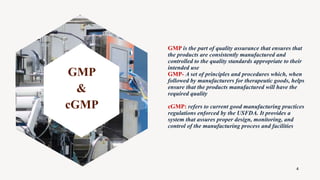
GMP is the part of quality assurance that ensures that
the products are consistently manufactured and
controlled to the quality standards appropriate to their
intended use
GMP- A set of principles and procedures which, when
followed by manufacturers for therapeutic goods, helps
ensure that the products manufactured will have the
required quality
cGMP: refers to current good manufacturing practices
regulations enforced by the USFDA. It provides a
system that assures proper design, monitoring, and
control of the manufacturing process and facilities
GMP
&
cGMP
4
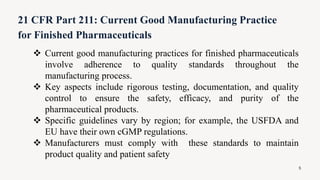
21 CFR Part 211: Current Good Manufacturing Practice
for Finished Pharmaceuticals
5
 Current good manufacturing practices for finished pharmaceuticals
involve adherence to quality standards throughout the
manufacturing process.
 Key aspects include rigorous testing, documentation, and quality
control to ensure the safety, efficacy, and purity of the
pharmaceutical products.
 Specific guidelines vary by region; for example, the USFDA and
EU have their own cGMP regulations.
 Manufacturers must comply with these standards to maintain
product quality and patient safety
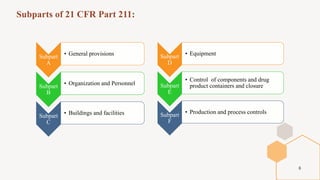
Subparts of 21 CFR Part 211:
6
Subpart
A
• General provisions
Subpart
B
• Organization and Personnel
Subpart
C
• Buildings and facilities
Subpart
D
• Equipment
Subpart
E
• Control of components and drug
product containers and closure
Subpart
F
• Production and process controls
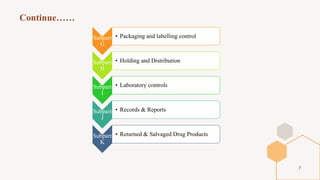
Continue……
7
Subpart
G
• Packaging and labelling control
Subpart
H
• Holding and Distribution
Subpart
I
• Laboratory controls
Subpart
J
• Records & Reports
Subpart
K
• Returned & Salvaged Drug Products
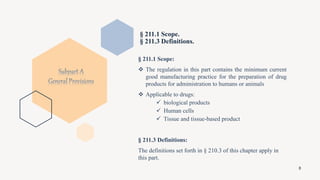
§ 211.1 Scope.
§ 211.3 Definitions.
§ 211.1 Scope:
 The regulation in this part contains the minimum current
good manufacturing practice for the preparation of drug
products for administration to humans or animals
 Applicable to drugs:
 biological products
 Human cells
 Tissue and tissue-based product
§ 211.3 Definitions:
The definitions set forth in § 210.3 of this chapter apply in
this part.
8
9
Subpart B Organization
& Personnel
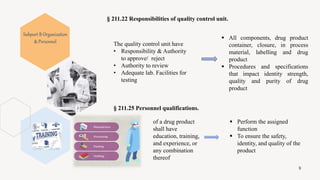
§ 211.22 Responsibilities of quality control unit.
The quality control unit have
• Responsibility & Authority
to approve/ reject
• Authority to review
• Adequate lab. Facilities for
testing
ļ‚§ All components, drug product
container, closure, in process
material, labelling and drug
product
ļ‚§ Procedures and specifications
that impact identity strength,
quality and purity of drug
product
§ 211.25 Personnel qualifications.
of a drug product
shall have
education, training,
and experience, or
any combination
thereof
ļ‚§ Perform the assigned
function
ļ‚§ To ensure the safety,
identity, and quality of the
product
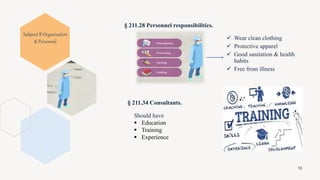
§ 211.28 Personnel responsibilities.
 Wear clean clothing
 Protective apparel
 Good sanitation & health
habits
 Free from illness
§ 211.34 Consultants.
Should have
ļ‚§ Education
ļ‚§ Training
ļ‚§ Experience
10
Subpart B Organization
& Personnel
Subpart C- buildings & facilities
§ 211.42 Design and
construction features.
o buildings used in the
manufacturing,
processing, packing, or
holding of a drug product
shall be of suitable size,
construction, and location
to facilitate cleaning,
maintenance, and proper
operations.
o Separate areas for storage
of finished, in-process,
manufacturing area,
packaging labeling,
quarantine & and aseptic
area
§ 211.44 Lighting.
o Adequate lighting
shall be provided
in all areas
§ 211.46 Ventilation, air
filtration, air heating and
cooling Design
o Adequate ventilation
o Equipment for adequate
control over air pressure,
micro-organisms, dust,
humidity, and temperature
shall be provided
o Air filtration systems
include: prefilters,
particulate matter air filters
o Air-handling systems for the
manufacture, processing,
and packing of penicillin
shall be completely separate
from those for other drug
products for human use.
§211.48
Plumbing.
o Potable water shall
be supplied
o a plumbing system
free of defects that
could contribute
contamination to of
any drug product.
o Potable water shall
meet the standards
prescribed in the
EPA Primary
Drinking Water
Regulations
o Drains shall be of
adequate size 11
o Sewage, trash,
and other refuse
in and from the
building and
immediate
premises shall be
disposed of in a
safe and sanitary
manner
o Adequate
washing facilities
shall be provided,
including hot and
cold water, soap
or detergent, air
driers or single-
service towels,
and clean toilet
facilities easily
accessible to
working areas
o Clean and sanitary
conditions should be
there
o Free from infection from
rodents, birds, insects,
etc.
o Written procedures for
sanitation & use of
suitable rodenticides,
insecticides, fungicides,
fumigating agents, and
cleaning and sanitizing
agents.
o Any building used in
the manufacture,
processing, packing,
or holding of a drug
product shall be
maintained in a good
state of repair
§ 211.50 Sewage
and refuse.
Subpart C- buildings & facilities
§ 211.52
Washing and
toilet facilities
§ 211.56 Sanitation.
§ 211.58
Maintenance.
12
Subpart D—Equipment
13
§ 211.63 Equipment design, size, and location.
• Equipment shall be of appropriate design, adequate size, and suitably located to
facilitate operations for its intended use and for its cleaning and maintenance.
§ 211.65 Equipment Construction
• Equipment shall not be reactive, additive, or absorptive so as to alter the safety, identity,
strength, quality, or purity of the drug product
§ 211.67 Equipment cleaning and maintenance
• Equipment and utensils shall be cleaned, maintained, and, as appropriate for the nature of
the drug, sanitized and/or sterilized at appropriate intervals to prevent malfunctions or
contamination that would alter the safety, identity, strength, quality, or purity of the drug
product beyond the official or other established requirements.
• Written procedures shall be established and followed for cleaning and maintenance of
equipment
• Maintained Record of cleaning
Continue……
14
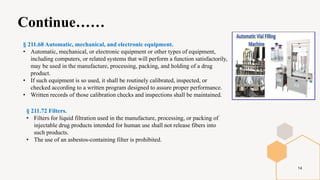
§ 211.68 Automatic, mechanical, and electronic equipment.
• Automatic, mechanical, or electronic equipment or other types of equipment,
including computers, or related systems that will perform a function satisfactorily,
may be used in the manufacture, processing, packing, and holding of a drug
product.
• If such equipment is so used, it shall be routinely calibrated, inspected, or
checked according to a written program designed to assure proper performance.
• Written records of those calibration checks and inspections shall be maintained.
§ 211.72 Filters.
• Filters for liquid filtration used in the manufacture, processing, or packing of
injectable drug products intended for human use shall not release fibers into
such products.
• The use of an asbestos-containing filter is prohibited.
§ 211.80 General requirements.
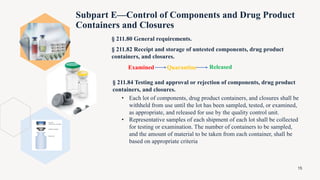
§ 211.82 Receipt and storage of untested components, drug product
containers, and closures.
Examined
Subpart E—Control of Components and Drug Product
Containers and Closures
§ 211.84 Testing and approval or rejection of components, drug product
containers, and closures.
• Each lot of components, drug product containers, and closures shall be
withheld from use until the lot has been sampled, tested, or examined,
as appropriate, and released for use by the quality control unit.
• Representative samples of each shipment of each lot shall be collected
for testing or examination. The number of containers to be sampled,
and the amount of material to be taken from each container, shall be
based on appropriate criteria
15
Quarantine Released
§ 211.86 Use of approved components, drug product containers,
and closures.
Retesting: after storage for long periods or after exposure to air, heat
or other conditions that might adversely affect the component, drug
product container, or closure
§ 211.87 Retesting of approved components, drug product containers,
and closures.
Shall be identified and controlled under a quarantine system
designed to prevent their use in manufacturing or processing
operations for which they are unsuitable.
16
FIFO
§ 211.89 Rejected components, drug product containers, and closures
§ 211.94 Drug product containers and closures.
Drug product containers and closures shall not be reactive, additive,
or absorptive so as to alter the safety, identity, strength, quality, or
purity of the drug beyond the official or established requirements.
§ 211.100 Written procedures; deviations.
17
Subpart F—Production
and Process Controls
• There shall be written procedures for production and process
control designed to assure that the drug products have the
identity, strength, quality, and purity they purport
§ 211.101 Charge-in of components.
• The batch shall be formulated with the intent to provide NLT 100
percent of the labeled amount of active ingredient.
• Components for drug product manufacturing shall be weighed,
measured, or subdivided as appropriate. If a component is removed
from the original container to another, the new container shall be
identified with the following information:
§ 211.103 Calculation of yield.
Actual yields and percentages of theoretical yield shall be determined at
the conclusion of each appropriate phase of manufacturing, processing,
packaging, or holding of the drug product
18
§ 211.105 Equipment identification.
identified by a distinctive identification number or code that shall be
recorded in the batch production record
§ 211.110 Sampling and testing of in-process materials and drug
products
To assure batch uniformity and integrity of drug products, written
procedures shall be established
In-process tests: Tablet or capsule weight variation; Disintegration time;
Adequacy of mixing to assure uniformity and homogeneity; Dissolution
time and rate; Clarity, completeness, or pH of solutions.
§ 211.111 Time limitations on production
Time limits for the completion of each phase of production shall
be established to assure the quality of the drug product
§ 211.113 Control of microbiological contamination.
§ 211.115 Reprocessing
Subpart F—Production
and Process Controls
Subpart G
Packaging
and Labeling
Control
19
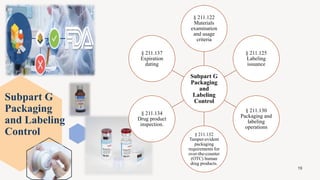
Subpart G
Packaging
and
Labeling
Control
§ 211.122
Materials
examination
and usage
criteria
§ 211.125
Labeling
issuance
§ 211.130
Packaging and
labeling
operations
§ 211.132
Tamper-evident
packaging
requirements for
over-the-counter
(OTC) human
drug products.
§ 211.134
Drug product
inspection.
§ 211.137
Expiration
dating
20
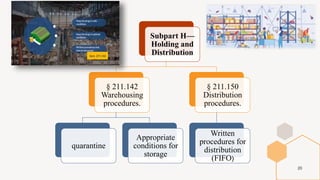
Subpart H—
Holding and
Distribution
§ 211.142
Warehousing
procedures.
quarantine
Appropriate
conditions for
storage
§ 211.150
Distribution
procedures.
Written
procedures for
distribution
(FIFO)
21
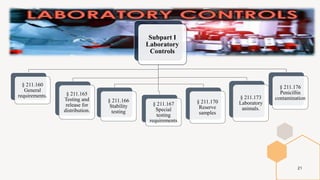
Subpart I
Laboratory
Controls
§ 211.160
General
requirements. § 211.165
Testing and
release for
distribution.
§ 211.166
Stability
testing
§ 211.167
Special
testing
requirements
§ 211.170
Reserve
samples
§ 211.173
Laboratory
animals.
§ 211.176
Penicillin
contamination
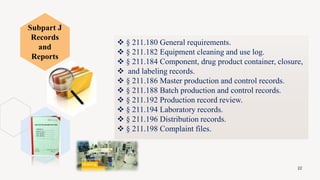
 § 211.180 General requirements.
 § 211.182 Equipment cleaning and use log.
 § 211.184 Component, drug product container, closure,
 and labeling records.
 § 211.186 Master production and control records.
 § 211.188 Batch production and control records.
 § 211.192 Production record review.
 § 211.194 Laboratory records.
 § 211.196 Distribution records.
 § 211.198 Complaint files.
22
Subpart J
Records
and
Reports
23
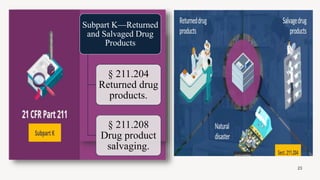
Subpart K—Returned
and Salvaged Drug
Products
§ 211.204
Returned drug
products.
§ 211.208
Drug product
salvaging.
Conclusion:
In conclusion, 21 CFR Part 211 establishes a comprehensive
regulatory framework for the manufacturing of finished
pharmaceuticals. Adherence to these regulations is crucial to
ensuring the quality, safety, and efficacy of pharmaceutical
products. Companies in the pharmaceutical industry must
comply with these cGMP requirements to meet the standards
set forth by the U.S. Food and Drug Administration (FDA) and
to deliver safe and effective pharmaceuticals to consumers.
Continuous adherence to these regulations is essential to
maintaining public trust and upholding the integrity of the
pharmaceutical industry.
24
References:
25
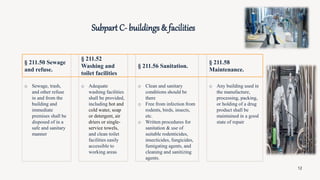
• https://www.ecfr.gov/current/title-21/chapter-I/subchapter-
C/part-211
• https://www.accessdata.fda.gov/scripts/cdrh/cfdocs/cfcfr/CF
RSearch.cfm?CFRPart=211
Thank you

21 CFR Part 211.pptx

  • 1.
    21 CFR Part211: Current Good Manufacturing Practice for Finished Pharmaceuticals Presenter Name: Rahul Ashok Raut First yr. M. Pharm. (Dept. Regulatory Affairs) Guided By: Dr. P.P. Nerkar R. C. Patel Institute of Pharmacy Shirpur 1
  • 2.
    Agenda Introduction 21 CFR part 211 Subpartsof 21 CFR Part 211 (A to K) Conclusion References 2
  • 3.
    Introduction The Code ofFederal Regulations (CFR) is the codification of the general and permanent rules published in the Federal Register by the executive departments and agencies of the Federal Government. It is divided into 50 titles that represent broad areas subject to Federal regulation. the 21 CFR is related to Food & drugs 3
  • 4.
    GMP is thepart of quality assurance that ensures that the products are consistently manufactured and controlled to the quality standards appropriate to their intended use GMP- A set of principles and procedures which, when followed by manufacturers for therapeutic goods, helps ensure that the products manufactured will have the required quality cGMP: refers to current good manufacturing practices regulations enforced by the USFDA. It provides a system that assures proper design, monitoring, and control of the manufacturing process and facilities GMP & cGMP 4
  • 5.
    21 CFR Part211: Current Good Manufacturing Practice for Finished Pharmaceuticals 5  Current good manufacturing practices for finished pharmaceuticals involve adherence to quality standards throughout the manufacturing process.  Key aspects include rigorous testing, documentation, and quality control to ensure the safety, efficacy, and purity of the pharmaceutical products.  Specific guidelines vary by region; for example, the USFDA and EU have their own cGMP regulations.  Manufacturers must comply with these standards to maintain product quality and patient safety
  • 6.
    Subparts of 21CFR Part 211: 6 Subpart A • General provisions Subpart B • Organization and Personnel Subpart C • Buildings and facilities Subpart D • Equipment Subpart E • Control of components and drug product containers and closure Subpart F • Production and process controls
  • 7.
    Continue…… 7 Subpart G • Packaging andlabelling control Subpart H • Holding and Distribution Subpart I • Laboratory controls Subpart J • Records & Reports Subpart K • Returned & Salvaged Drug Products
  • 8.
    § 211.1 Scope. §211.3 Definitions. § 211.1 Scope:  The regulation in this part contains the minimum current good manufacturing practice for the preparation of drug products for administration to humans or animals  Applicable to drugs:  biological products  Human cells  Tissue and tissue-based product § 211.3 Definitions: The definitions set forth in § 210.3 of this chapter apply in this part. 8
  • 9.
    9 Subpart B Organization &Personnel § 211.22 Responsibilities of quality control unit. The quality control unit have • Responsibility & Authority to approve/ reject • Authority to review • Adequate lab. Facilities for testing ļ‚§ All components, drug product container, closure, in process material, labelling and drug product ļ‚§ Procedures and specifications that impact identity strength, quality and purity of drug product § 211.25 Personnel qualifications. of a drug product shall have education, training, and experience, or any combination thereof ļ‚§ Perform the assigned function ļ‚§ To ensure the safety, identity, and quality of the product
  • 10.
    § 211.28 Personnelresponsibilities.  Wear clean clothing  Protective apparel  Good sanitation & health habits  Free from illness § 211.34 Consultants. Should have ļ‚§ Education ļ‚§ Training ļ‚§ Experience 10 Subpart B Organization & Personnel
  • 11.
    Subpart C- buildings& facilities § 211.42 Design and construction features. o buildings used in the manufacturing, processing, packing, or holding of a drug product shall be of suitable size, construction, and location to facilitate cleaning, maintenance, and proper operations. o Separate areas for storage of finished, in-process, manufacturing area, packaging labeling, quarantine & and aseptic area § 211.44 Lighting. o Adequate lighting shall be provided in all areas § 211.46 Ventilation, air filtration, air heating and cooling Design o Adequate ventilation o Equipment for adequate control over air pressure, micro-organisms, dust, humidity, and temperature shall be provided o Air filtration systems include: prefilters, particulate matter air filters o Air-handling systems for the manufacture, processing, and packing of penicillin shall be completely separate from those for other drug products for human use. §211.48 Plumbing. o Potable water shall be supplied o a plumbing system free of defects that could contribute contamination to of any drug product. o Potable water shall meet the standards prescribed in the EPA Primary Drinking Water Regulations o Drains shall be of adequate size 11
  • 12.
    o Sewage, trash, andother refuse in and from the building and immediate premises shall be disposed of in a safe and sanitary manner o Adequate washing facilities shall be provided, including hot and cold water, soap or detergent, air driers or single- service towels, and clean toilet facilities easily accessible to working areas o Clean and sanitary conditions should be there o Free from infection from rodents, birds, insects, etc. o Written procedures for sanitation & use of suitable rodenticides, insecticides, fungicides, fumigating agents, and cleaning and sanitizing agents. o Any building used in the manufacture, processing, packing, or holding of a drug product shall be maintained in a good state of repair § 211.50 Sewage and refuse. Subpart C- buildings & facilities § 211.52 Washing and toilet facilities § 211.56 Sanitation. § 211.58 Maintenance. 12
  • 13.
    Subpart D—Equipment 13 § 211.63Equipment design, size, and location. • Equipment shall be of appropriate design, adequate size, and suitably located to facilitate operations for its intended use and for its cleaning and maintenance. § 211.65 Equipment Construction • Equipment shall not be reactive, additive, or absorptive so as to alter the safety, identity, strength, quality, or purity of the drug product § 211.67 Equipment cleaning and maintenance • Equipment and utensils shall be cleaned, maintained, and, as appropriate for the nature of the drug, sanitized and/or sterilized at appropriate intervals to prevent malfunctions or contamination that would alter the safety, identity, strength, quality, or purity of the drug product beyond the official or other established requirements. • Written procedures shall be established and followed for cleaning and maintenance of equipment • Maintained Record of cleaning
  • 14.
    Continue…… 14 § 211.68 Automatic,mechanical, and electronic equipment. • Automatic, mechanical, or electronic equipment or other types of equipment, including computers, or related systems that will perform a function satisfactorily, may be used in the manufacture, processing, packing, and holding of a drug product. • If such equipment is so used, it shall be routinely calibrated, inspected, or checked according to a written program designed to assure proper performance. • Written records of those calibration checks and inspections shall be maintained. § 211.72 Filters. • Filters for liquid filtration used in the manufacture, processing, or packing of injectable drug products intended for human use shall not release fibers into such products. • The use of an asbestos-containing filter is prohibited.
  • 15.
    § 211.80 Generalrequirements. § 211.82 Receipt and storage of untested components, drug product containers, and closures. Examined Subpart E—Control of Components and Drug Product Containers and Closures § 211.84 Testing and approval or rejection of components, drug product containers, and closures. • Each lot of components, drug product containers, and closures shall be withheld from use until the lot has been sampled, tested, or examined, as appropriate, and released for use by the quality control unit. • Representative samples of each shipment of each lot shall be collected for testing or examination. The number of containers to be sampled, and the amount of material to be taken from each container, shall be based on appropriate criteria 15 Quarantine Released
  • 16.
    § 211.86 Useof approved components, drug product containers, and closures. Retesting: after storage for long periods or after exposure to air, heat or other conditions that might adversely affect the component, drug product container, or closure § 211.87 Retesting of approved components, drug product containers, and closures. Shall be identified and controlled under a quarantine system designed to prevent their use in manufacturing or processing operations for which they are unsuitable. 16 FIFO § 211.89 Rejected components, drug product containers, and closures § 211.94 Drug product containers and closures. Drug product containers and closures shall not be reactive, additive, or absorptive so as to alter the safety, identity, strength, quality, or purity of the drug beyond the official or established requirements.
  • 17.
    § 211.100 Writtenprocedures; deviations. 17 Subpart F—Production and Process Controls • There shall be written procedures for production and process control designed to assure that the drug products have the identity, strength, quality, and purity they purport § 211.101 Charge-in of components. • The batch shall be formulated with the intent to provide NLT 100 percent of the labeled amount of active ingredient. • Components for drug product manufacturing shall be weighed, measured, or subdivided as appropriate. If a component is removed from the original container to another, the new container shall be identified with the following information: § 211.103 Calculation of yield. Actual yields and percentages of theoretical yield shall be determined at the conclusion of each appropriate phase of manufacturing, processing, packaging, or holding of the drug product
  • 18.
    18 § 211.105 Equipmentidentification. identified by a distinctive identification number or code that shall be recorded in the batch production record § 211.110 Sampling and testing of in-process materials and drug products To assure batch uniformity and integrity of drug products, written procedures shall be established In-process tests: Tablet or capsule weight variation; Disintegration time; Adequacy of mixing to assure uniformity and homogeneity; Dissolution time and rate; Clarity, completeness, or pH of solutions. § 211.111 Time limitations on production Time limits for the completion of each phase of production shall be established to assure the quality of the drug product § 211.113 Control of microbiological contamination. § 211.115 Reprocessing Subpart F—Production and Process Controls
  • 19.
    Subpart G Packaging and Labeling Control 19 SubpartG Packaging and Labeling Control § 211.122 Materials examination and usage criteria § 211.125 Labeling issuance § 211.130 Packaging and labeling operations § 211.132 Tamper-evident packaging requirements for over-the-counter (OTC) human drug products. § 211.134 Drug product inspection. § 211.137 Expiration dating
  • 20.
    20 Subpart H— Holding and Distribution §211.142 Warehousing procedures. quarantine Appropriate conditions for storage § 211.150 Distribution procedures. Written procedures for distribution (FIFO)
  • 21.
    21 Subpart I Laboratory Controls § 211.160 General requirements.§ 211.165 Testing and release for distribution. § 211.166 Stability testing § 211.167 Special testing requirements § 211.170 Reserve samples § 211.173 Laboratory animals. § 211.176 Penicillin contamination
  • 22.
     § 211.180General requirements.  § 211.182 Equipment cleaning and use log.  § 211.184 Component, drug product container, closure,  and labeling records.  § 211.186 Master production and control records.  § 211.188 Batch production and control records.  § 211.192 Production record review.  § 211.194 Laboratory records.  § 211.196 Distribution records.  § 211.198 Complaint files. 22 Subpart J Records and Reports
  • 23.
    23 Subpart K—Returned and SalvagedDrug Products § 211.204 Returned drug products. § 211.208 Drug product salvaging.
  • 24.
    Conclusion: In conclusion, 21CFR Part 211 establishes a comprehensive regulatory framework for the manufacturing of finished pharmaceuticals. Adherence to these regulations is crucial to ensuring the quality, safety, and efficacy of pharmaceutical products. Companies in the pharmaceutical industry must comply with these cGMP requirements to meet the standards set forth by the U.S. Food and Drug Administration (FDA) and to deliver safe and effective pharmaceuticals to consumers. Continuous adherence to these regulations is essential to maintaining public trust and upholding the integrity of the pharmaceutical industry. 24
  • 25.
  • 26.