Compaction of Fresh
Concrete &
Concrete Vibrators
PREPARED BY
GOURHARI BISWAS
What is Compaction of Concrete ?
• While placing of fresh concrete a small amount
of air gets entrapped inside concrete. Also fresh
concrete may always not reach to every corner
of the formwork. This entrapped air has the
potential to reduce the strength of concrete by
even 30%. Hence it is of utmost importance to
remove this entrapped air and also ensure that
fresh concrete reaches every corner of the
formwork.
• Compaction is the process of removing the
entrapped air from the freshly placed concrete
and thus ensuring that plastic concrete reaches
at every corner of the formwork.
Purpose of Concrete Compaction
The purpose of compaction of freshly placed
concrete can be summerised as below :
• Compaction removes air bubbles trapped inside
concrete.For each 1% of trapped air, the
strength falls from somewhere between 5 and
7%.
• To achieve high density and making concrete
impermeable
• To ensure proper strength and durability.
• To eliminate formation of honeycomb and other
defects.
Results of Improper Compaction of
Concrete
Various problems and defects may occur due to
inadequate/improper compaction of freshly placed
concrete :
 Honeycomb formation
 Concrete Becomes porous and permeable
 Greater chanches for reinforcement corrosion
 Durability of concrete decreases
 Formation of Subsidence cracking
 Inadequate strength
Types of Compaction
• Hand Compaction : In this method concrete is
compacted by ramming, tamping, sprading or by
slicing with tools.For smaller volumes of
concrete, for narrow columns and crowded
sections, these methods are suitable.
• Machine Compactuion : Concrete is compacted
by using high frequency vibrators. Vibration
reduces the friction between the particles and
set the motion of particles. As a result entrapped
air is removed and the concrete is compacted.
Concrete Vibrators
• A vibrator is a mechanical device to generate vibrations.
The vibration is often generated by an electric motor with
an unbalanced mass on its driveshaft.
• A concrete vibrator is a construction tool typically used
on concrete pouring sites
• The vibrators are used to ensure that the pour is free of
air bubbles and are even.
• Concrete vibrators consolidate freshly poured concrete
so that trapped air and excess water are released and
the concrete settles firmly in place in the formwork.
• Improper consolidation of concrete can cause product
defects, compromise the concrete strength, and produce
surface blemishes such as bug holes and honeycombing.
Category of Vibrators
• Internal concrete vibrator is a steel cylinder
about the size of the handle of a baseball bat,
with a hose or electrical cord attached to one
end. The vibrator head is immersed in the wet
concrete.
• External concrete vibrators attach, via a bracket
or clamp system, to the concrete forms. There
are a wide variety of external concrete vibrators
available and some vibrator manufacturers have
bracket or clamp systems designed to fit the
major brands of concrete forms. External
concrete vibrators are available in hydraulic,
pneumatic or electric power.
Types of Vibrators
Internal Vibrators : There are two major
types of internal vibrators which are
Immersion or Needle Vibrator
Plate Vibrator
External Vibrators : There are two major
types of external vibrators which are
Table or surface vibrator, and
Form vibrator/shutter Vibrator
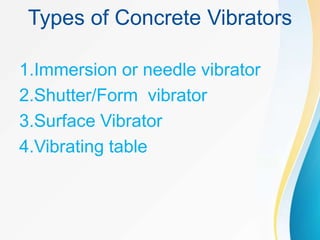
Types of Concrete Vibrators
1.Immersion or needle vibrator
2.Shutter/Form vibrator
3.Surface Vibrator
4.Vibrating table
Immersion or Needle Vibrators
are most commonly used vibrator
for concrete. It consists of a steel
tube (with one end closed and
rounded) having an eccentric
vibrating element inside it. This
steel tube called poker is
connected to an electric motor or
a diesel engine through a flexible
tube. They are available in size
varying from 40 to 100 mm
diameter.
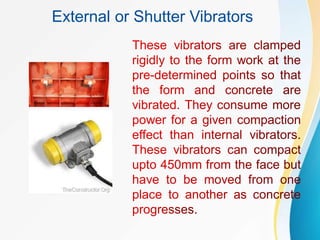
External or Shutter Vibrators
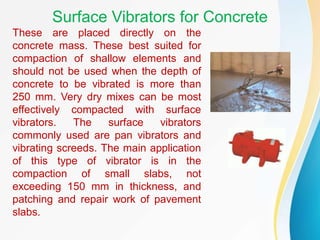
Surface Vibrators for Concrete
These are placed directly on the
concrete mass. These best suited for
compaction of shallow elements and
should not be used when the depth of
concrete to be vibrated is more than
250 mm. Very dry mixes can be most
effectively compacted with surface
vibrators. The surface vibrators
commonly used are pan vibrators and
vibrating screeds. The main application
of this type of vibrator is in the
compaction of small slabs, not
exceeding 150 mm in thickness, and
patching and repair work of pavement
slabs.
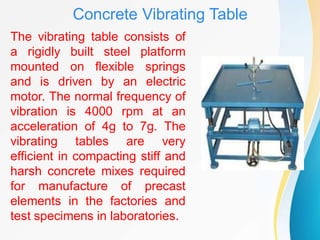
Concrete Vibrating Table
The vibrating table consists of
a rigidly built steel platform
mounted on flexible springs
and is driven by an electric
motor. The normal frequency of
vibration is 4000 rpm at an
acceleration of 4g to 7g. The
vibrating tables are very
efficient in compacting stiff and
harsh concrete mixes required
for manufacture of precast
elements in the factories and
test specimens in laboratories.
Uses of Vibrators
• Needle vibrators are used in concreting
beams and columns, slabs etc.
• Plate vibrators are used for very thin slabs
with congested reinforcement
• Surface vibrators and form vibrators are
useful in concreting slabs.
• Vibrating tables are useful in preparing
precast concrete elements and
inlaboratories for compaction of test
specimens.
Advantages of Using Vibrators
Proper Vibration ensures no honeycomb
formation
Structures with heavy and congested
reinforcement can be compacted easily using
suitable types of vibrators
The vibrators can create a dense and watertight
structure. Increased density ensures strength
and durability of concrete.
It is possible to use a low water-cement ratio by
using vibrators
Concreting can be done at a faster rate
It is possible to use a high aggregate cement
ratio.

Compaction of Concrete & Vibrators.pdf

  • 1.
    Compaction of Fresh Concrete& Concrete Vibrators PREPARED BY GOURHARI BISWAS
  • 2.
    What is Compactionof Concrete ? • While placing of fresh concrete a small amount of air gets entrapped inside concrete. Also fresh concrete may always not reach to every corner of the formwork. This entrapped air has the potential to reduce the strength of concrete by even 30%. Hence it is of utmost importance to remove this entrapped air and also ensure that fresh concrete reaches every corner of the formwork. • Compaction is the process of removing the entrapped air from the freshly placed concrete and thus ensuring that plastic concrete reaches at every corner of the formwork.
  • 3.
    Purpose of ConcreteCompaction The purpose of compaction of freshly placed concrete can be summerised as below : • Compaction removes air bubbles trapped inside concrete.For each 1% of trapped air, the strength falls from somewhere between 5 and 7%. • To achieve high density and making concrete impermeable • To ensure proper strength and durability. • To eliminate formation of honeycomb and other defects.
  • 4.
    Results of ImproperCompaction of Concrete Various problems and defects may occur due to inadequate/improper compaction of freshly placed concrete :  Honeycomb formation  Concrete Becomes porous and permeable  Greater chanches for reinforcement corrosion  Durability of concrete decreases  Formation of Subsidence cracking  Inadequate strength
  • 5.
    Types of Compaction •Hand Compaction : In this method concrete is compacted by ramming, tamping, sprading or by slicing with tools.For smaller volumes of concrete, for narrow columns and crowded sections, these methods are suitable. • Machine Compactuion : Concrete is compacted by using high frequency vibrators. Vibration reduces the friction between the particles and set the motion of particles. As a result entrapped air is removed and the concrete is compacted.
  • 6.
    Concrete Vibrators • Avibrator is a mechanical device to generate vibrations. The vibration is often generated by an electric motor with an unbalanced mass on its driveshaft. • A concrete vibrator is a construction tool typically used on concrete pouring sites • The vibrators are used to ensure that the pour is free of air bubbles and are even. • Concrete vibrators consolidate freshly poured concrete so that trapped air and excess water are released and the concrete settles firmly in place in the formwork. • Improper consolidation of concrete can cause product defects, compromise the concrete strength, and produce surface blemishes such as bug holes and honeycombing.
  • 7.
    Category of Vibrators •Internal concrete vibrator is a steel cylinder about the size of the handle of a baseball bat, with a hose or electrical cord attached to one end. The vibrator head is immersed in the wet concrete. • External concrete vibrators attach, via a bracket or clamp system, to the concrete forms. There are a wide variety of external concrete vibrators available and some vibrator manufacturers have bracket or clamp systems designed to fit the major brands of concrete forms. External concrete vibrators are available in hydraulic, pneumatic or electric power.
  • 8.
    Types of Vibrators InternalVibrators : There are two major types of internal vibrators which are Immersion or Needle Vibrator Plate Vibrator External Vibrators : There are two major types of external vibrators which are Table or surface vibrator, and Form vibrator/shutter Vibrator
  • 9.
    Types of ConcreteVibrators 1.Immersion or needle vibrator 2.Shutter/Form vibrator 3.Surface Vibrator 4.Vibrating table
  • 10.
    Immersion or NeedleVibrators Immersion or Needle Vibrators are most commonly used vibrator for concrete. It consists of a steel tube (with one end closed and rounded) having an eccentric vibrating element inside it. This steel tube called poker is connected to an electric motor or a diesel engine through a flexible tube. They are available in size varying from 40 to 100 mm diameter.
  • 11.
  • 12.
    Surface Vibrators forConcrete These are placed directly on the concrete mass. These best suited for compaction of shallow elements and should not be used when the depth of concrete to be vibrated is more than 250 mm. Very dry mixes can be most effectively compacted with surface vibrators. The surface vibrators commonly used are pan vibrators and vibrating screeds. The main application of this type of vibrator is in the compaction of small slabs, not exceeding 150 mm in thickness, and patching and repair work of pavement slabs.
  • 13.
    Concrete Vibrating Table Thevibrating table consists of a rigidly built steel platform mounted on flexible springs and is driven by an electric motor. The normal frequency of vibration is 4000 rpm at an acceleration of 4g to 7g. The vibrating tables are very efficient in compacting stiff and harsh concrete mixes required for manufacture of precast elements in the factories and test specimens in laboratories.
  • 14.
    Uses of Vibrators •Needle vibrators are used in concreting beams and columns, slabs etc. • Plate vibrators are used for very thin slabs with congested reinforcement • Surface vibrators and form vibrators are useful in concreting slabs. • Vibrating tables are useful in preparing precast concrete elements and inlaboratories for compaction of test specimens.
  • 15.
    Advantages of UsingVibrators Proper Vibration ensures no honeycomb formation Structures with heavy and congested reinforcement can be compacted easily using suitable types of vibrators The vibrators can create a dense and watertight structure. Increased density ensures strength and durability of concrete. It is possible to use a low water-cement ratio by using vibrators Concreting can be done at a faster rate It is possible to use a high aggregate cement ratio.