Placing and Finishing
Concrete
Bijaya Raula
Shapoorji Pallonji & Co. Pvt Ltd
Basic Requirements for
Placing Concrete (1)
 Preserve concrete quality
 Water-cement ratio
 Slump
 Air-content
 Homogeneity
 Avoid separation of
aggregate and mortar
Basic Requirements for
Placing Concrete (2)
 Avoid excessive horizontal
movement
 Consolidate adequately
 Maintain sufficient placement
capacity
 Choose the right equipment for
the concrete
Transportation of concrete
 The method of conveying concrete should not cause
segregation, loss of part of the concrete and loss of
slump.
 Do not add extra water to the concrete (in addition to what
is required as per the W/c ratio) for the purpose of easy
handling / transporting.
 Properly designed and operated buckets are an excellent
means of transporting concrete. But they should be
capable of discharging low slump concrete and the
discharge rate should be controllable. Cylindrical buckets
with proper center discharge gates are the most efficient
Transportation of concrete
 When using chutes for transporting , take care to
avoid segregation. The chutes should be of
rounded cross-section and of smooth metal to
avoid sticking of concrete. They should be of
correct slope so that concrete of the required
slump will slide without flowing. Usually, the
slope is 1 vertical to 2 or 2 ½ horizontal but the
best slope for a particular concrete can be fixed
after a few trials.
hing Concrete
Transportation of concrete
 Control should be provided at the end of the chute
so that concrete will drop vertically without
segregation.Flush the chute with water before
starting to transport the concrete.
 Wheel barrows can be effectively used for
transporting concrete horizontally over a short
distance of about 60 meters. Provide a smooth path
for the wheelbarrows using planks or sheets to
transport the concrete without shaking or spilling.
Preparation
 Do not place the concrete until the place of deposit
has been thoroughly inspected and approved.
Check whether the formwork has been oiled and the
supports are rigid. Also, check whether the
reinforcement , cover blocks, inserts and
embedded plates have been properly secured in
position.
 Where concrete is to be bonded to a previous lift of
concrete , clean the surface thoroughly and chip the
top to a depth sufficient to expose fresh , clean cut
concrete without disturbing or loosening the coarse
aggregate
Preparation
 Keep the dry surface saturated with water for not
less than 24 hours . Before placing fresh concrete,
remove the standing water from depressions and
spread about 1.5 cm thick mortar layer (in same
proportion as in original concrete but not greater
than 1:2) over the contact surface of the old
concrete.
 When concreting has to be done against earthen
surface, compact the base by rolling or ramming
and wet the surface by sprinkling water to prevent
excessive loss of moisture from the concrete.
During Placement
 Deposit the concrete at, or as near as possible to
its final position
 Place the concrete in uniform layers. Avoid placing
in large heaps or sloping layers which will lead to
segregation.
 In walls and columns no layer should be more
than about450mm thick. As more layer thickness
make the concrete impossible to vibrate the
bottom layer and will lead to air entrapment at
bottom and surface blemishes on vertical surface.
 In thin slabs place concrete thickness of 150mm.
During Placement
 Where good finish is required on columns and walls
restrict the pour height to 2m per hour.
 Ensure every layer of concrete is fully compacted
before placing successive layer.
 Ensure the vibrator head penetrates the previous
layer this will eliminate layer lines.
 Always make sure that you can see the concrete
being deposited.
 In columns and walls the placing must be done in
such a way that the concrete does not strike the face
of the formwork, similarly, avoid heavy impact against
reinforcement as the force could displace it
Compaction
 The object of compaction is to get rid of as much
as possible of entrapped air, down to less than
1% is the aim.(This does not apply with deliberate
air entrainment, but in that case the air is uniformly
distributed and stable)
 The amount of air is related to workability.
Concrete with a slump of 75mm contains about
5% air while concrete with 25mm has 20%.
 This is why low slump concrete requires more
vibration or longer time or more poker needles
compared to concrete with higher slump.
Compaction
 It is important to remove this entrapped air for the
following reasons:
 Voids reduces the strength of the concrete. Every
1% of entrapped air the strength falls by about 5 to
6 % . So a concrete with 3% voids will be about 15
to 20% weaker than it should be.
 Voids increased permeability, which in turn
reduces the durability.
 Void reduces the contact between concrete and
reinforcement and other embedded metals. The
required bond will then not be achieved
Compaction
 and the reinforced member will not be as strong
as it should be.
 Voids produces visual blemishes such as
blowholes and honeycombing and porosity on the
struck surface.
Vibration
 Rodding , spading-even using foot- are all ways of
removing air from concrete to compact it, but the
best and quickest method is vibration.
 When concrete is vibrated it is fluidized which
reduces the internal friction between the
aggregate particle and removes the entrapped
air , make them to get packed well to become a
dense member.
Vibration
 With a properly designed cohesive mix,
segregation and bleeding will be minimized. With
an over-wet mix the larger aggregates may settle
during compaction with the result that a weak
layer of laitance will finish up on top surface.
Points to be rembered in
compaction
 Make sure the concrete surface being vibrated is
seen. Light is need for thin section columns and
walls.
 Insert the needle quickly this makes the concrete
liquefies and fill the forms and allow the vibrator
to penetrate to the previous layer.
 Compact concrete in place till the Entrapped air
expels out
 Withdraw the needle slowly. The main thing is to
see the hole made by vibrator head is closed.
Points to be rembered in
compaction
 Have proper lighting arrangement to see the
concrete placed is vibrated
 Excess vibration not to be done this may lead to
Segregate the concrete
 Place the poker needle in not more than 500mm
away from its last position.
 Avoid touching the form face with poker needle.
This will result in colour variation
Points to be rembered in
compaction
 Avoid touching the reinforcement by poker ,
this will displace the
reiniforcement and also will decrease the bond
between the reinforcement and concrete
 Avoid moving concrete to flow using poker.
Stop Vibration When
 The concrete surface takes on a sheen Large air
bubbles no longer escape
 You hear the vibrator change pitch or tone You
feel a change in vibration action
Vibrating Don’ts
 Don’t let a vibrator run very long outside concrete;
it will overheat Don’t use a vibrator to move
concrete horizontally
 Don’t force pr push a vibrator into concrete it won’t
remain vertical and may get caught in the
reinforcement
 Don’t start a job without a spare vibrator
Finshing (Initial)
Strike off:
 Properly done removes excess concrete and brings
top surface to grade
 Start as soon as possible after placing concrete
 End before bleed water appears
 Straight edge uses can be of wood or magnesium
 Straight edge
 Use a side-to-side sawing motion while pulling
forward
 Tilt it slightly backward to create a single cutting
edge
Finshing (Initial)
 Keep about an inch of concrete in front to fill low
spots
 Make a second pass if the surface is not to grade
 Pull concrete into end edge forms.
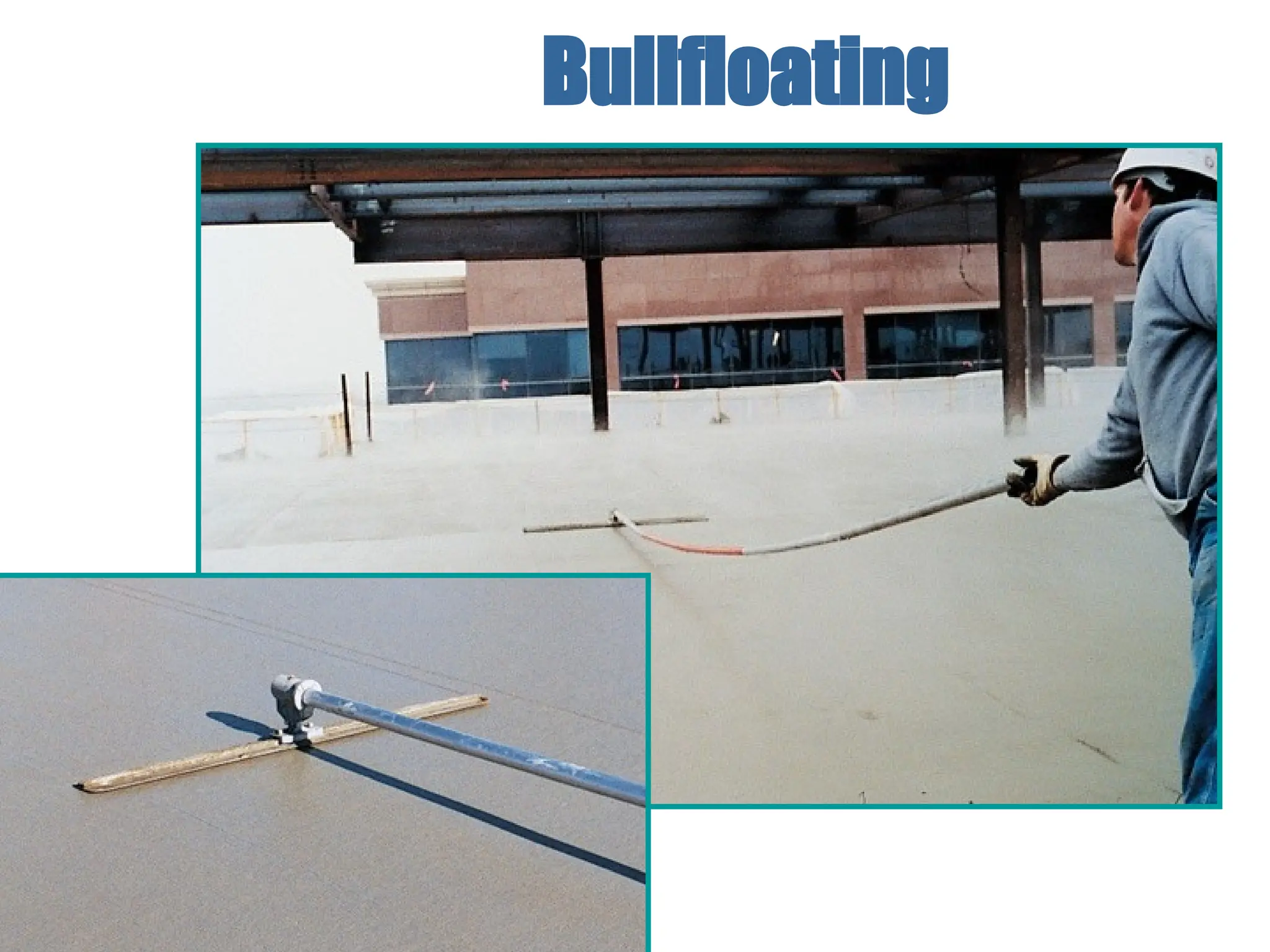
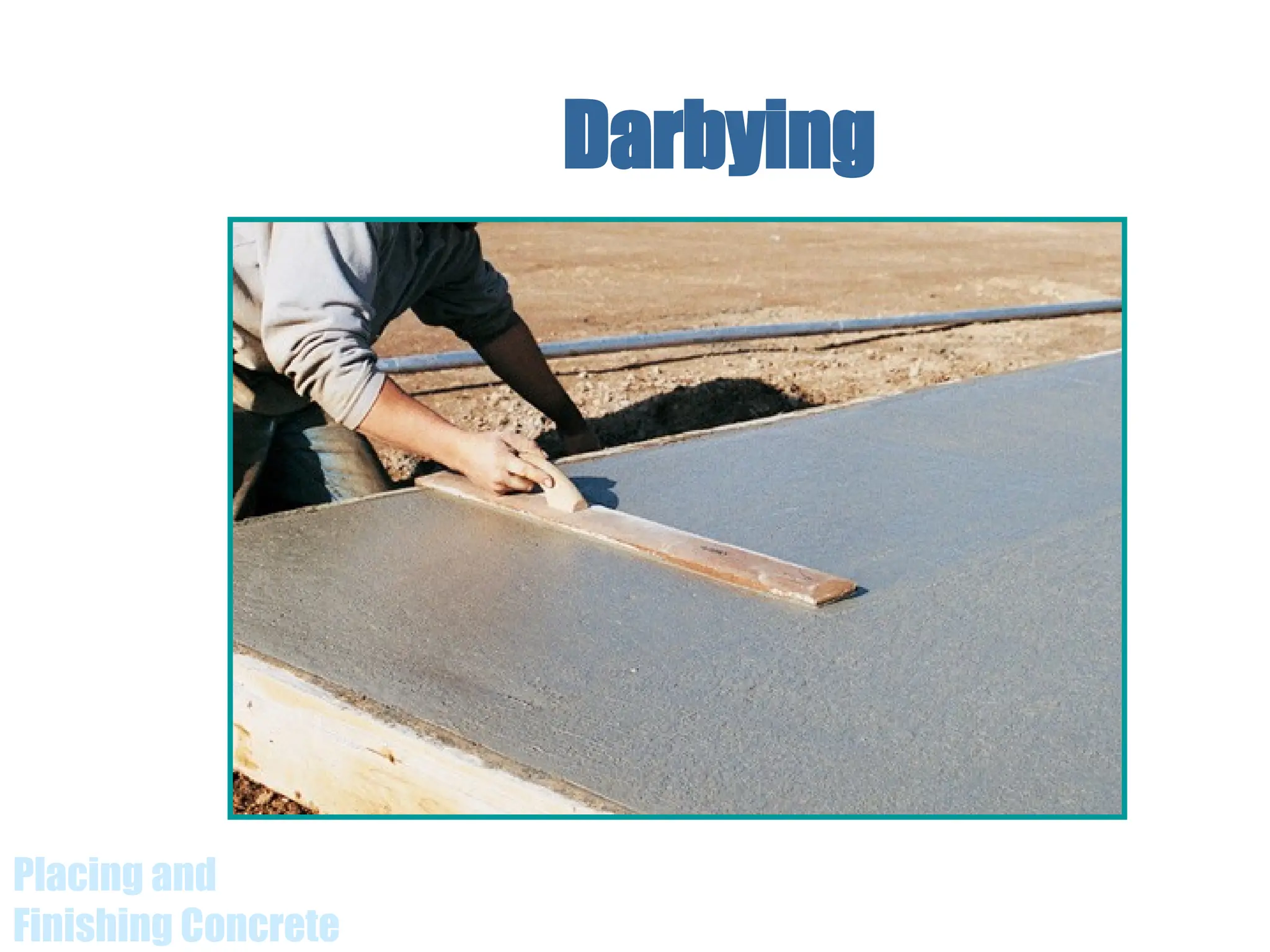
BULL FLOATS AND DARBIES
 Use to level ridges and fill voids left by straightedge
 Start immediately after strike off and finish before
bleed water appears
Finshing (Initial)
 Use at right angle to the direction of strike off
 Push the bull float with the front edge slightly off
the surface to cut bumps; pull the bull float with
the back edge slightly off the surface to fill voids
 Use magnesium tools for sir entrained concrete
 Darbies serve the same purpose as bull floats but
for smaller areas; use in a sawing arc motion
Finshing (Initial)
 WAITING PERIOD
 Begin further finishing when all the bleed water
has evaporated and concrete is firm enough to
leave only ¼ inch foot prints
 Finishing while bleed water is present can cause
surface crazing, dusting or scalling
Finshing (Final)
 Edgers
 Use to produce a clean slab edge that is less likely
to chip
 An edger is less likely to dig into concrete or leave a
bumpy surface if a trowel is used in a vertical
sawing motion to dislodge aggregate particles away
from the edge forms
 Run back and forth with the leading edge slightly
raised
 Don’t start in a corner and don’t raise the edger off
the concrete unless the tool is in motion
Finshing (Final)
 Use a wide edger for the first pass, then a narrow
edger for the second pass
 Groovers
 Use to control crack location by cutting joints to a
depth of atleast one- fourth the slab thickness
 Push the groover into the concrete then move it
forward while applying pressure to the back of the
tool
 After joint is cut, turn the groover around, running it
back over the cut to give as smoother finish
Finshing (Final)
 For a straight cut, use a chalk line or a straight
edge as a guide
Floats
 Use to remove imperfections and to bring mortar to
the surface for troweling
 Hold flot flat and at arm’s length, moving it in awide
semicircular motion until surface is smooth
 Use magnesium tools for air entrained concrete
 More than one float pass may be required
Finshing (Final)
Trowels
 Use to produce a hard, dense surface
 Trowel only after floating, starting with a wide
trowel then moving to smaller trowels on the later
passes
 Hold trowel at a slight tilt at arm’s length and move
it in a semicircular motion , overlapping each pass
by one half until surface finish is smooth.
Placing and
Finishing Concrete
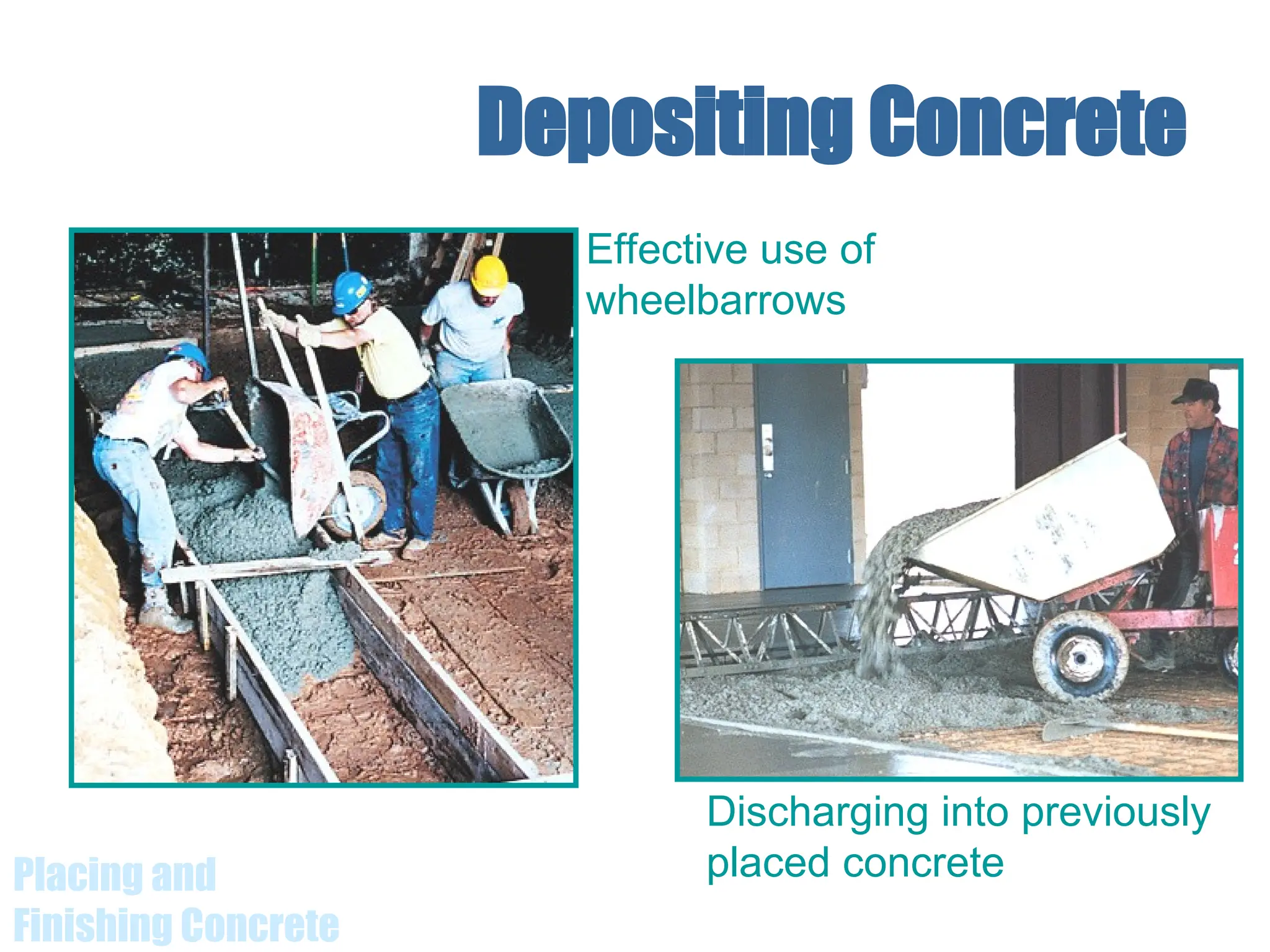
Depositing Concrete
Discharging into previously
placed concrete
Effective use of
wheelbarrows
Placing and
Finishing Concrete
Depositing Concrete
 Deposit in horizontal layers of
uniform thickness
 Reinforced — 150 mm to 500 mm
 Mass — 375 mm to 500 mm
 Consolidate each layer before next
is placed
 Timely placement & consolidation
prevents flow lines and cold joints
Walls
Placing and
Finishing Concrete
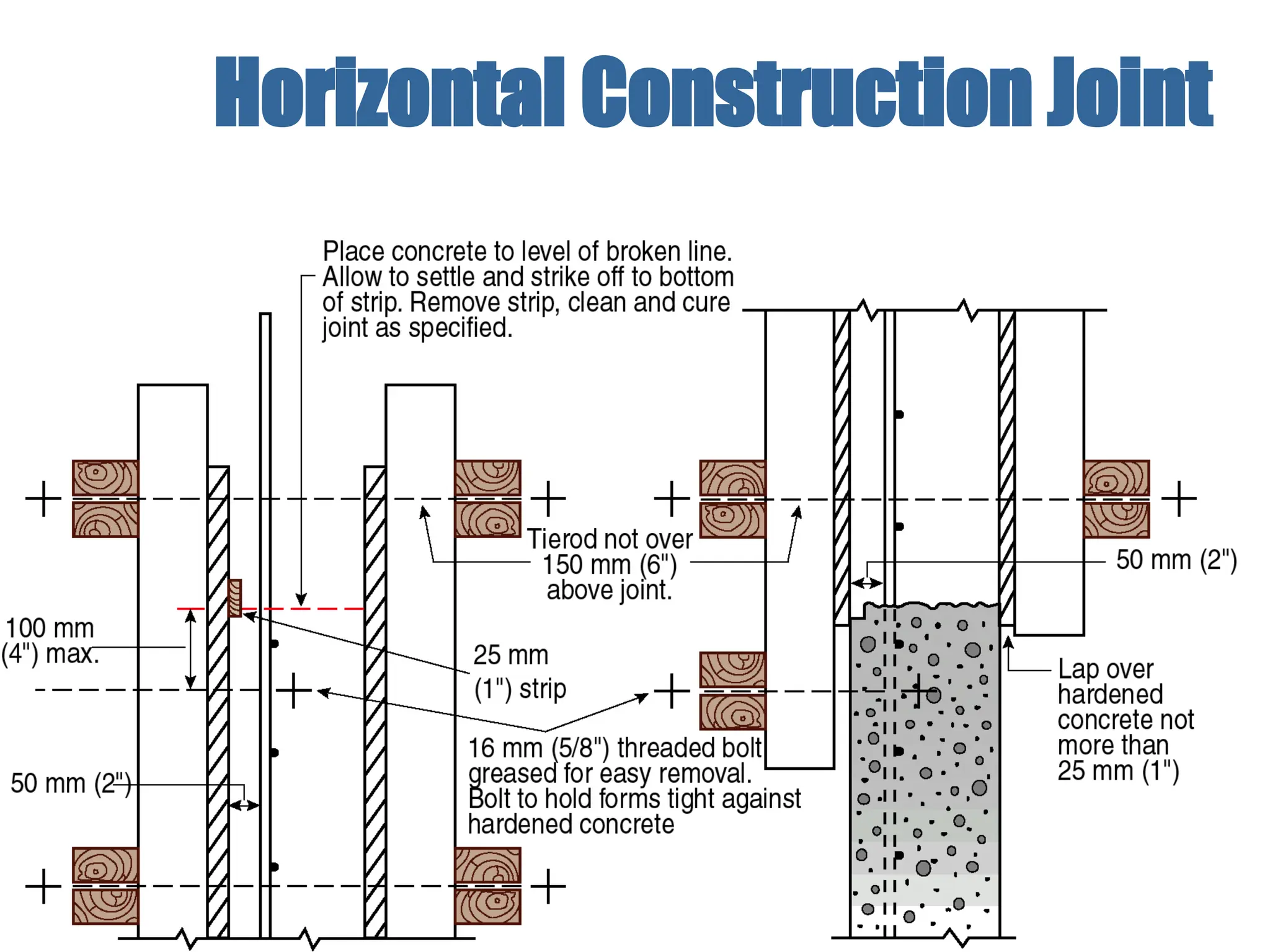
Horizontal Construction Joint
Placing and
Finishing Concrete
Horizontal Construction Joints
Placing and
Finishing Concrete
Underwater Placement
Methods
 Tremie
 Pump
 Bottom dump buckets
 Grouted preplaced
aggregate (specialized)
 Toggle bags
 Bagwork
 Diving bell
Placing and
Finishing Concrete
Placing Concrete
Under Water
 Water velocity  3 m (10 ft) / min.
 Water temperature  5°C
(if below — test for strength gain)
 w/c  0.45
 Cementing materials content
 390 kg/m3
(600 lb/yd3
)
 Slump range 150 to 225 mm (6 to
10 in.)
Basic Recommendations
Placing and
Finishing Concrete
Placing Concrete
Underwater
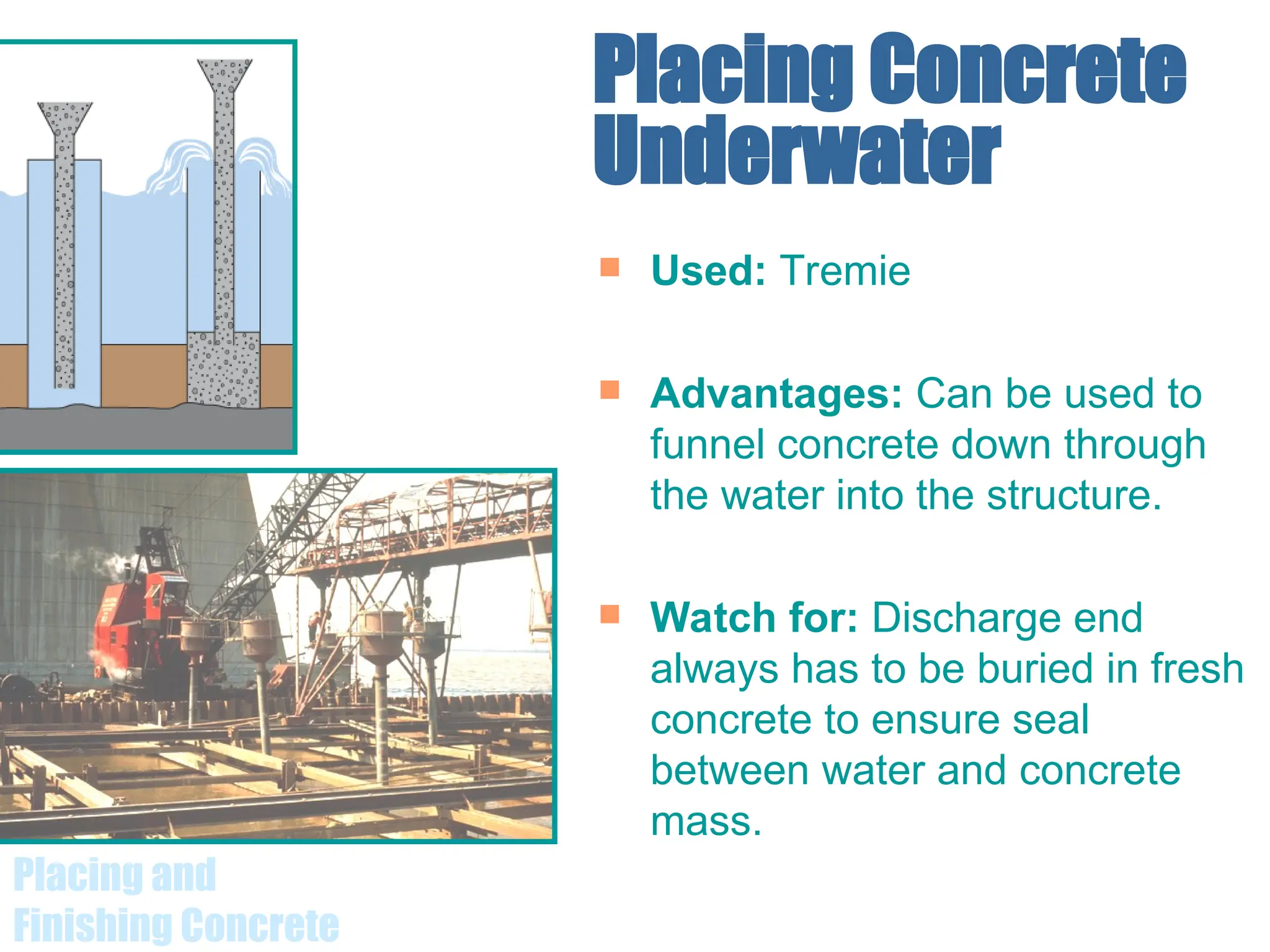
 Used: Tremie
 Advantages: Can be used to
funnel concrete down through
the water into the structure.
 Watch for: Discharge end
always has to be buried in fresh
concrete to ensure seal
between water and concrete
mass.
Placing and
Finishing Concrete
Consolidating
Concrete
 Internal Vibration
 External Vibration
Placing and
Finishing Concrete
Internal Vibration
d
R
1½ R
Vibrator
Radius of Action
Placing and
Finishing Concrete
Internal Vibrators
Diameter
of head,
mm (in.)
Recommended
frequency,
vibrations per
minute
Approximate
radius of
action, mm
(in.)
Rate of
placement,
m3
/h
(yd3
/h) Application
20-40
(3/4-1½)
9000-15,000
80-150
(3-6)
0.8-4
(1-5)
Plastic and flowing
concrete in thin
members. Also used
for lab test
specimens.
30-60
(1¼-2½)
8500-12,500
130-250
(5-10)
2.3-8
(3-10)
Plastic concrete in
thin walls, columns,
beams, precast piles,
thin slabs, and along
construction joints.
50-90
(2-3½)
8000-12,000
180-360
(7-14)
4.6-15
(6-20)
Stiff plastic concrete
(less than 80-mm [3-
in.] slump) in general
construction .
Adapted from ACI 309
Placing and
Finishing Concrete
Systematic Vibration of
Each New Lift
CORRECT
CORRECT
Vertical penetration a few inches into
previous lift (which should not yet be
rigid) of systematic regular intervals
will give adequate consolidation
INCORRECT
INCORRECT
Haphazard random penetration of the
vibrator at all angles and spacings
without sufficient depth will not assure
intimate combination of the two layers
Placing and
Finishing Concrete
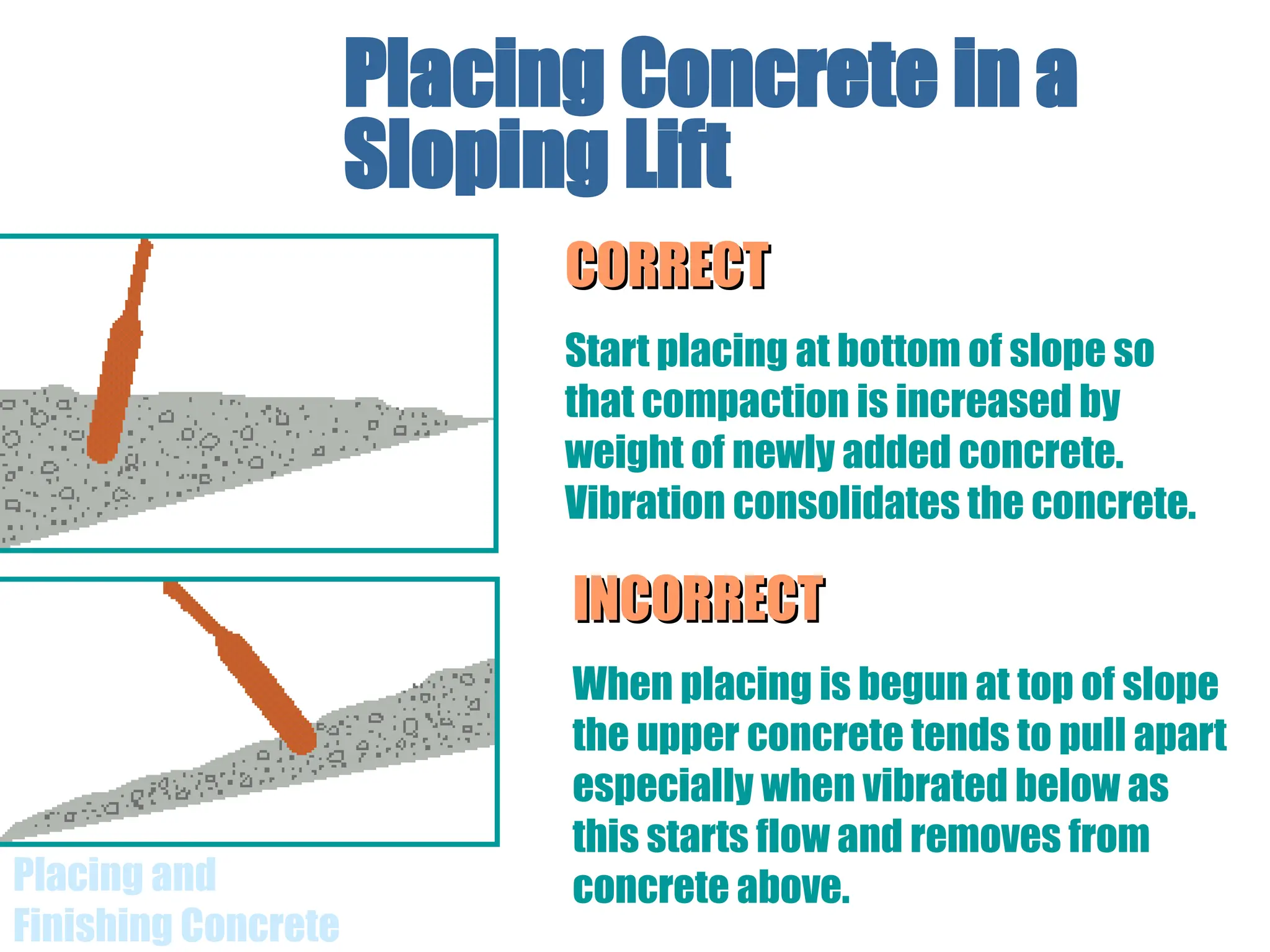
Placing Concrete in a
Sloping Lift
CORRECT
CORRECT
Start placing at bottom of slope so
that compaction is increased by
weight of newly added concrete.
Vibration consolidates the concrete.
INCORRECT
INCORRECT
When placing is begun at top of slope
the upper concrete tends to pull apart
especially when vibrated below as
this starts flow and removes from
concrete above.
Placing and
Finishing Concrete
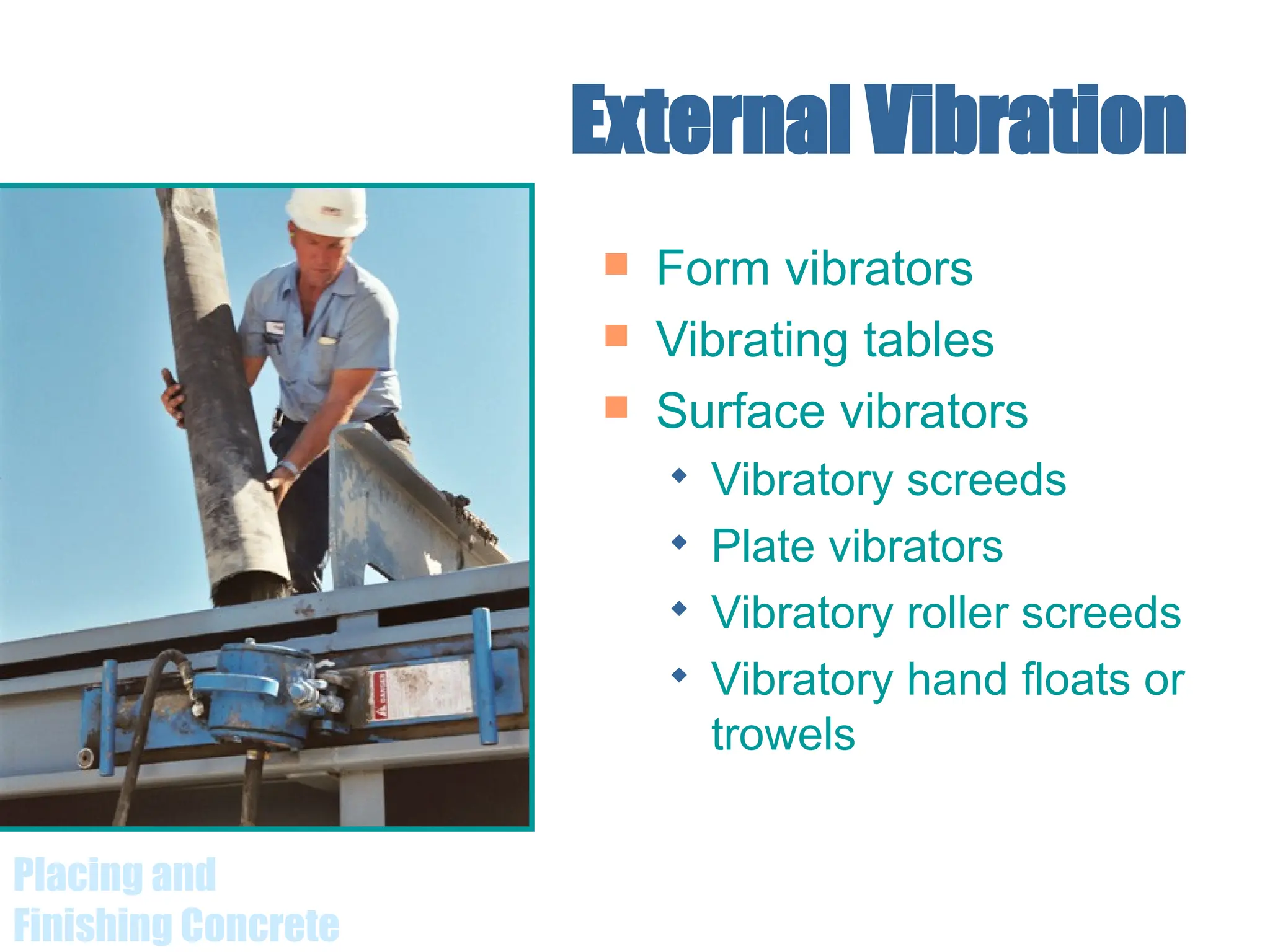
External Vibration
 Form vibrators
 Vibrating tables
 Surface vibrators
 Vibratory screeds
 Plate vibrators
 Vibratory roller screeds
 Vibratory hand floats or
trowels
Placing and
Finishing Concrete
Consolidating Concrete
Inadequate consolidation
can result in:
 Honeycomb
 Excessive amount of entrapped
air voids (bugholes)
 Sand streaks
 Cold joints
 Placement lines
 Subsidence cracking
Placing and
Finishing Concrete
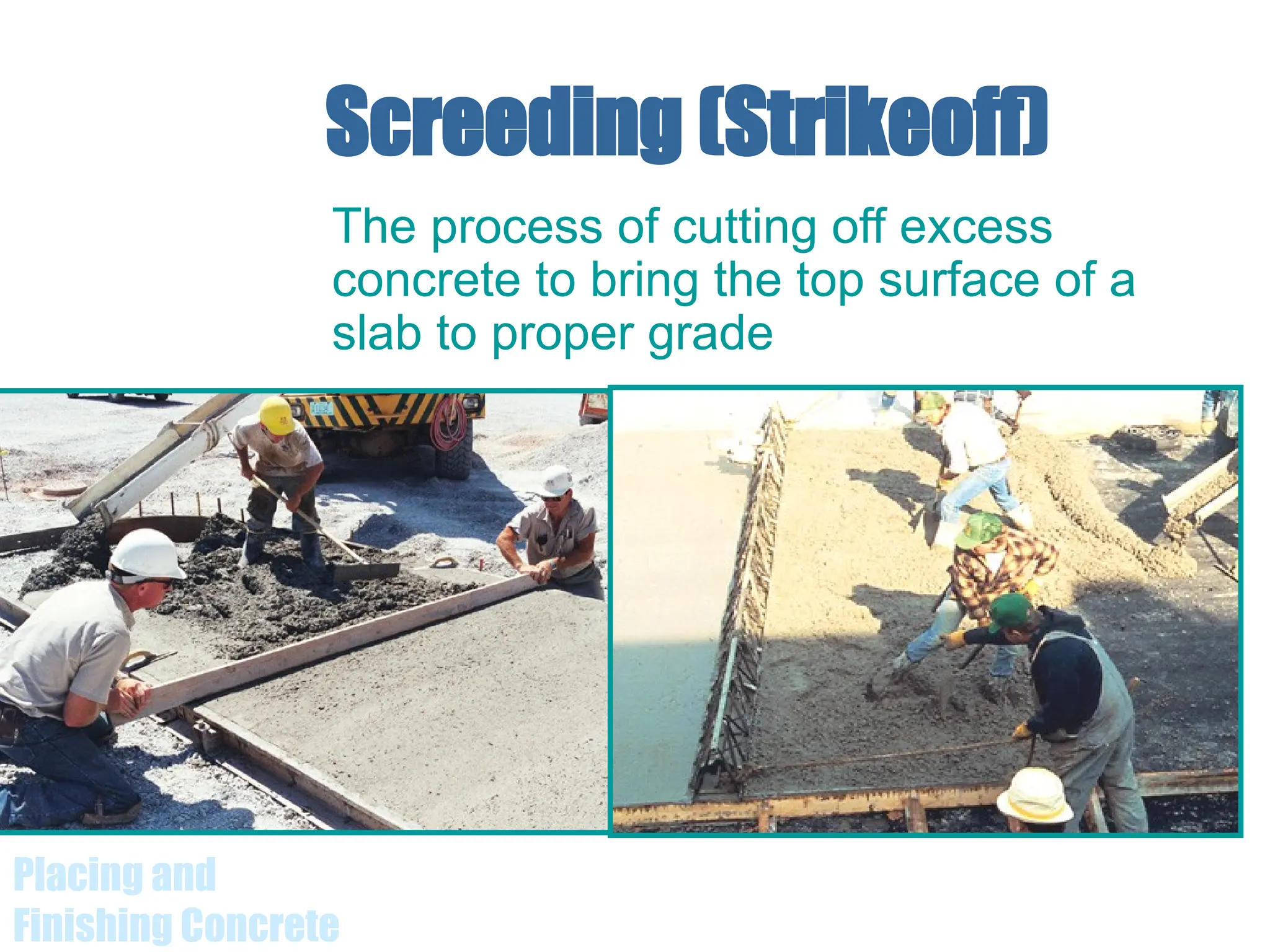
Screeding (Strikeoff)
The process of cutting off excess
concrete to bring the top surface of a
slab to proper grade
Placing and
Finishing Concrete
Vibratory
Screeds
Placing and
Finishing Concrete
Bullfloating
Placing and
Finishing Concrete
Darbying
Placing and
Finishing Concrete
Edging
 Required along all edge forms,
isolation and construction joints
in floors and exterior slabs
 Cut concrete away from forms
to a depth of 25 mm with a
pointed mason or margin trowel
 Edging may be required after
each subsequent finishing
operation for interior slabs
Edging densifies and compacts concrete
next to forms where floating is less effective
Placing and
Finishing Concrete
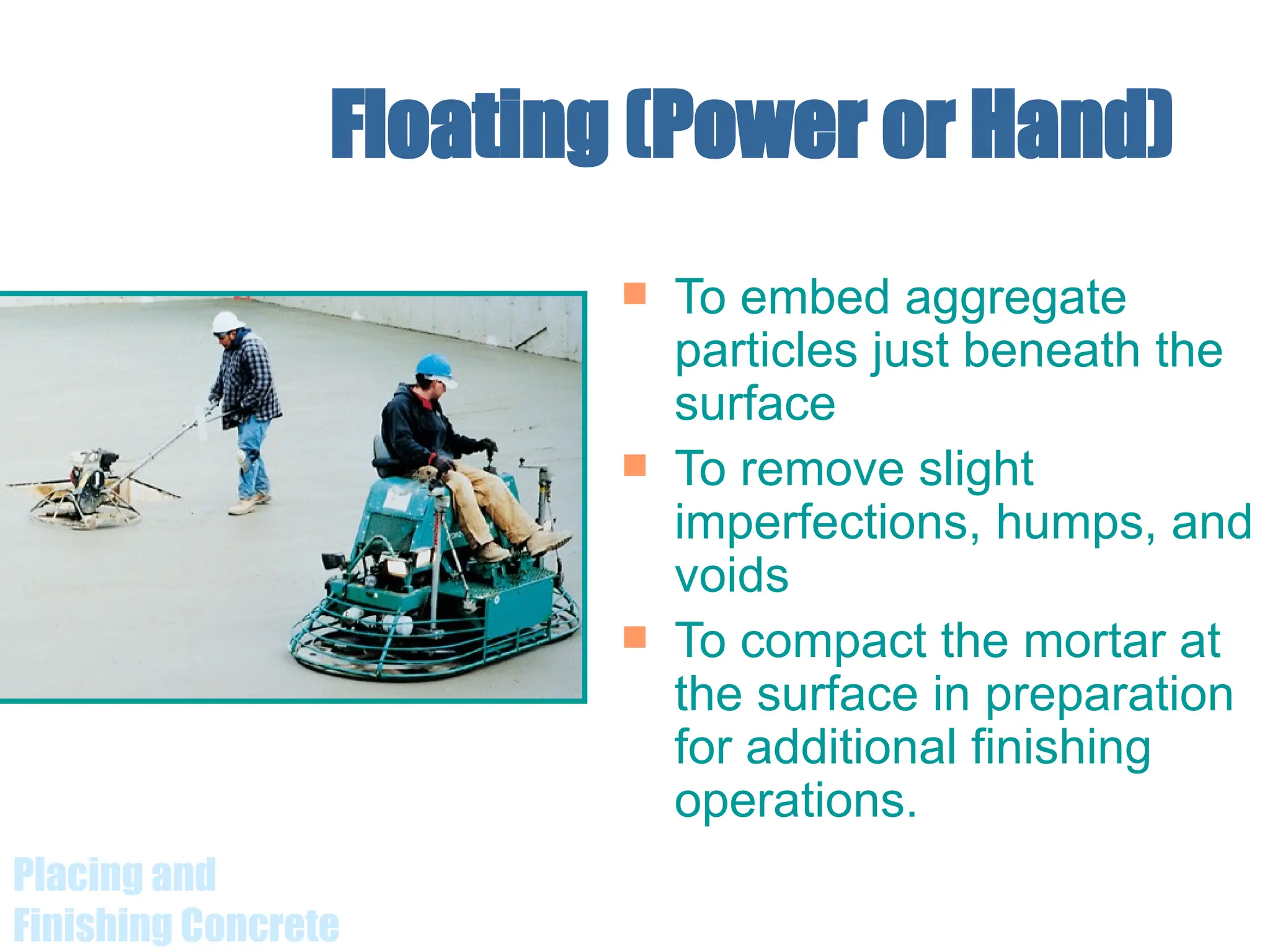
Floating (Power or Hand)
 To embed aggregate
particles just beneath the
surface
 To remove slight
imperfections, humps, and
voids
 To compact the mortar at
the surface in preparation
for additional finishing
operations.
Placing and
Finishing Concrete
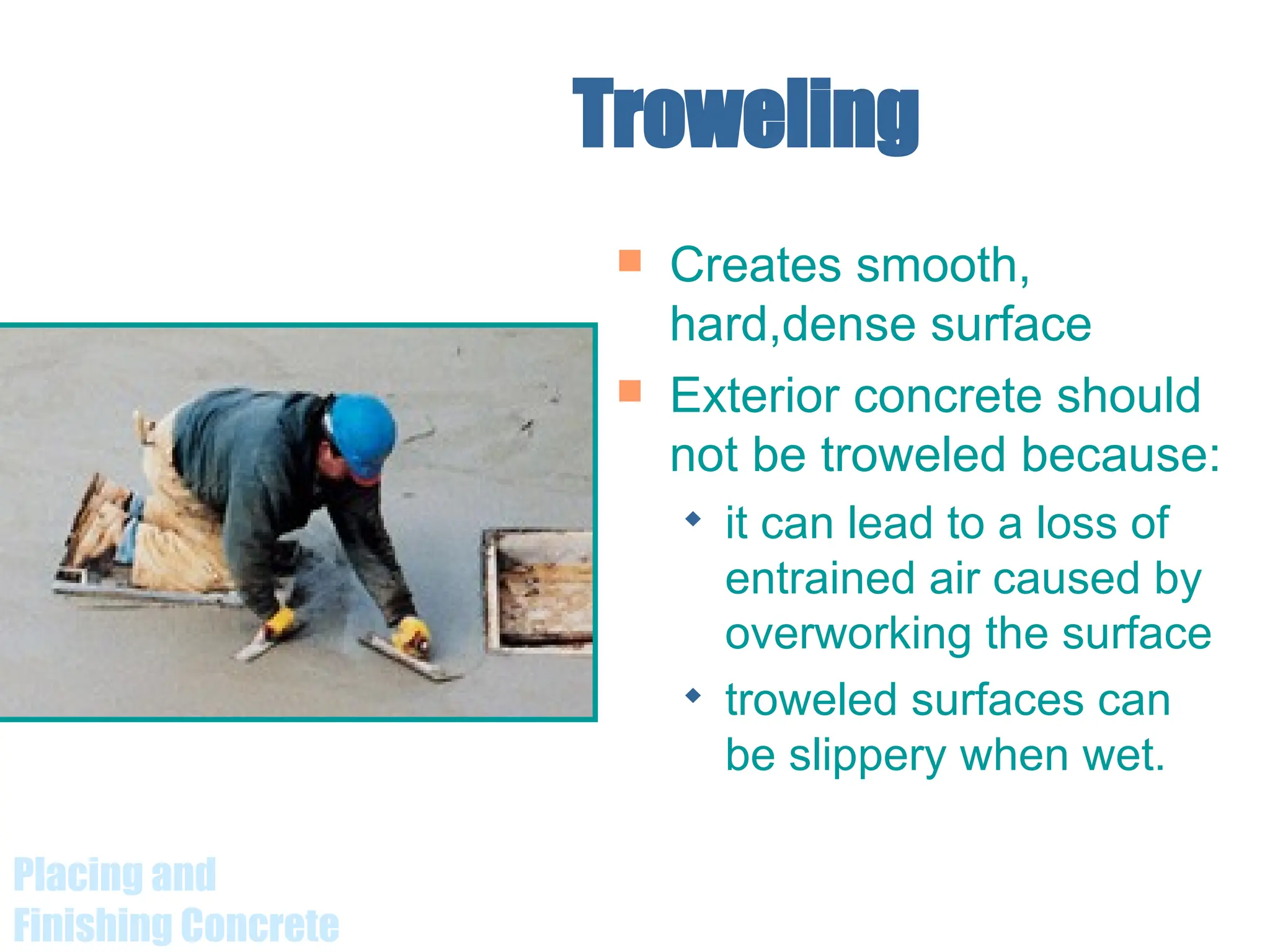
Troweling
 Creates smooth,
hard,dense surface
 Exterior concrete should
not be troweled because:
 it can lead to a loss of
entrained air caused by
overworking the surface
 troweled surfaces can
be slippery when wet.
Placing and
Finishing Concrete
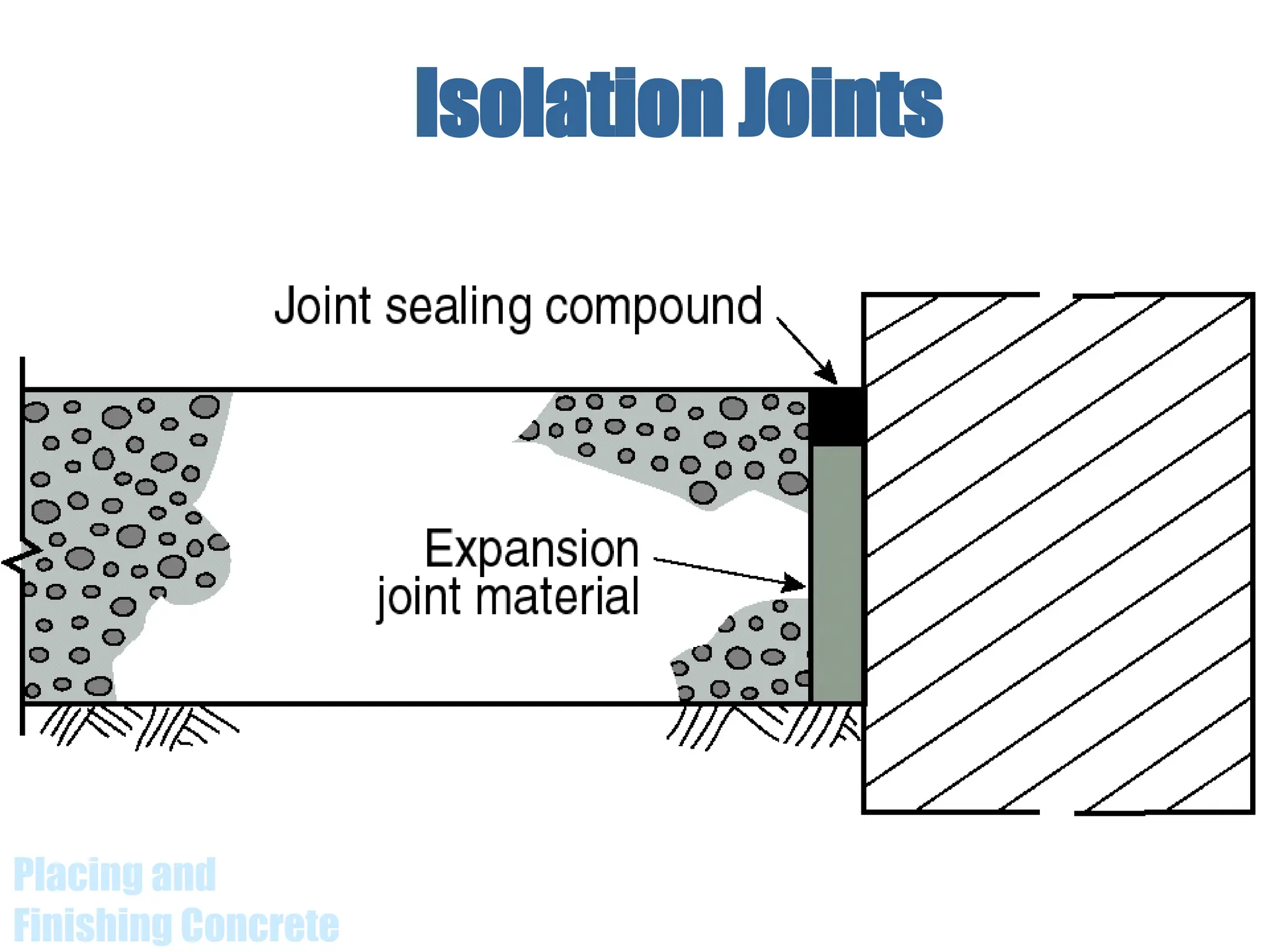
Isolation Joints
Placing and
Finishing Concrete
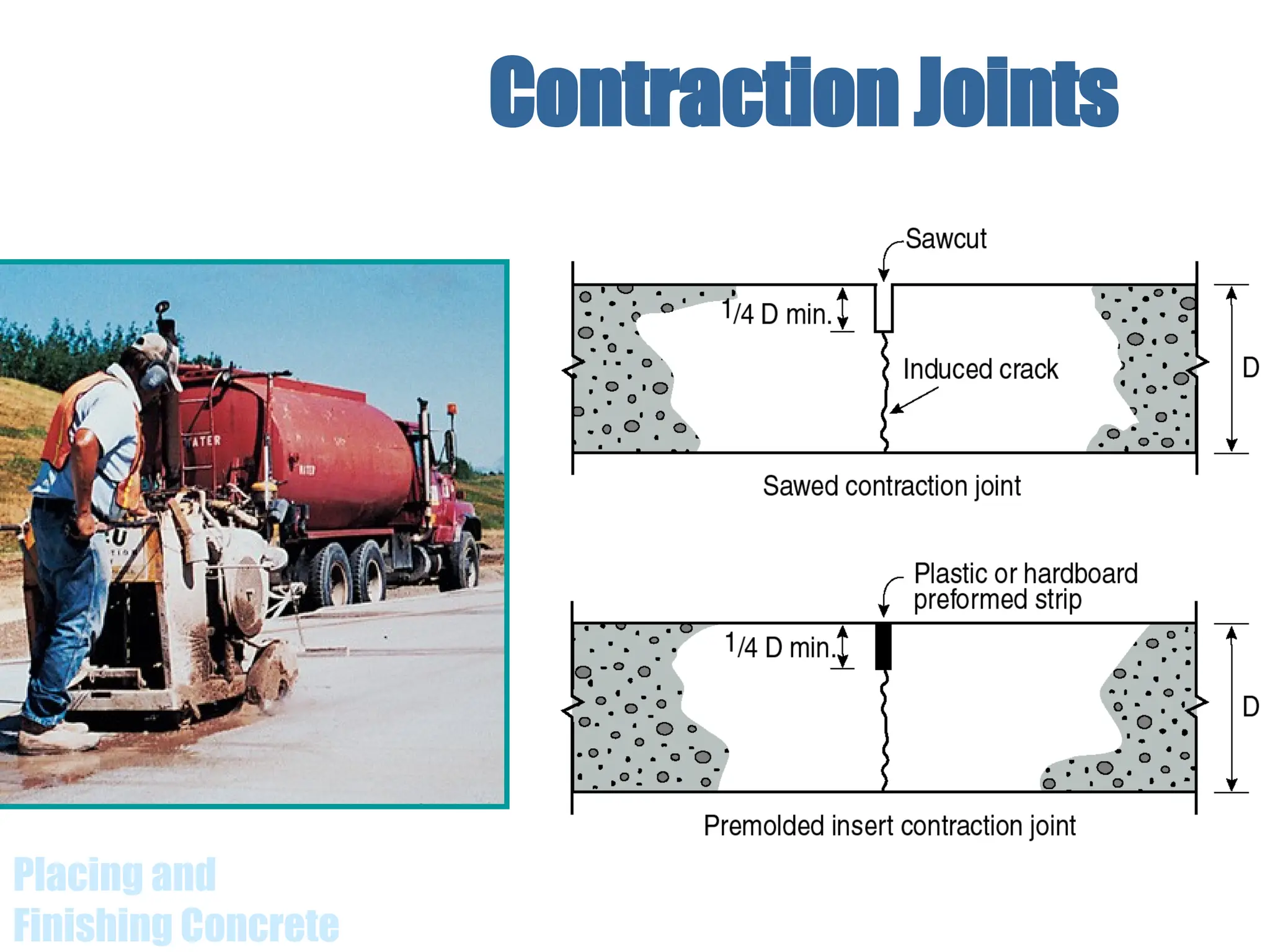
Contraction Joints
Placing and
Finishing Concrete
Spacing of Contraction
Joints in Meters
Slab
thickness,
mm
Maximum-size
aggregate
less than 19 mm
Maximum-size
aggregate
19 mm and larger
100 2.4 3.0
125 3.0 3.75
150 3.75 4.5
175 4.25 5.25
200 5.0 6.0
225 5.5 6.75
250 6.0 7.5
Metric
Metric
Placing and
Finishing Concrete
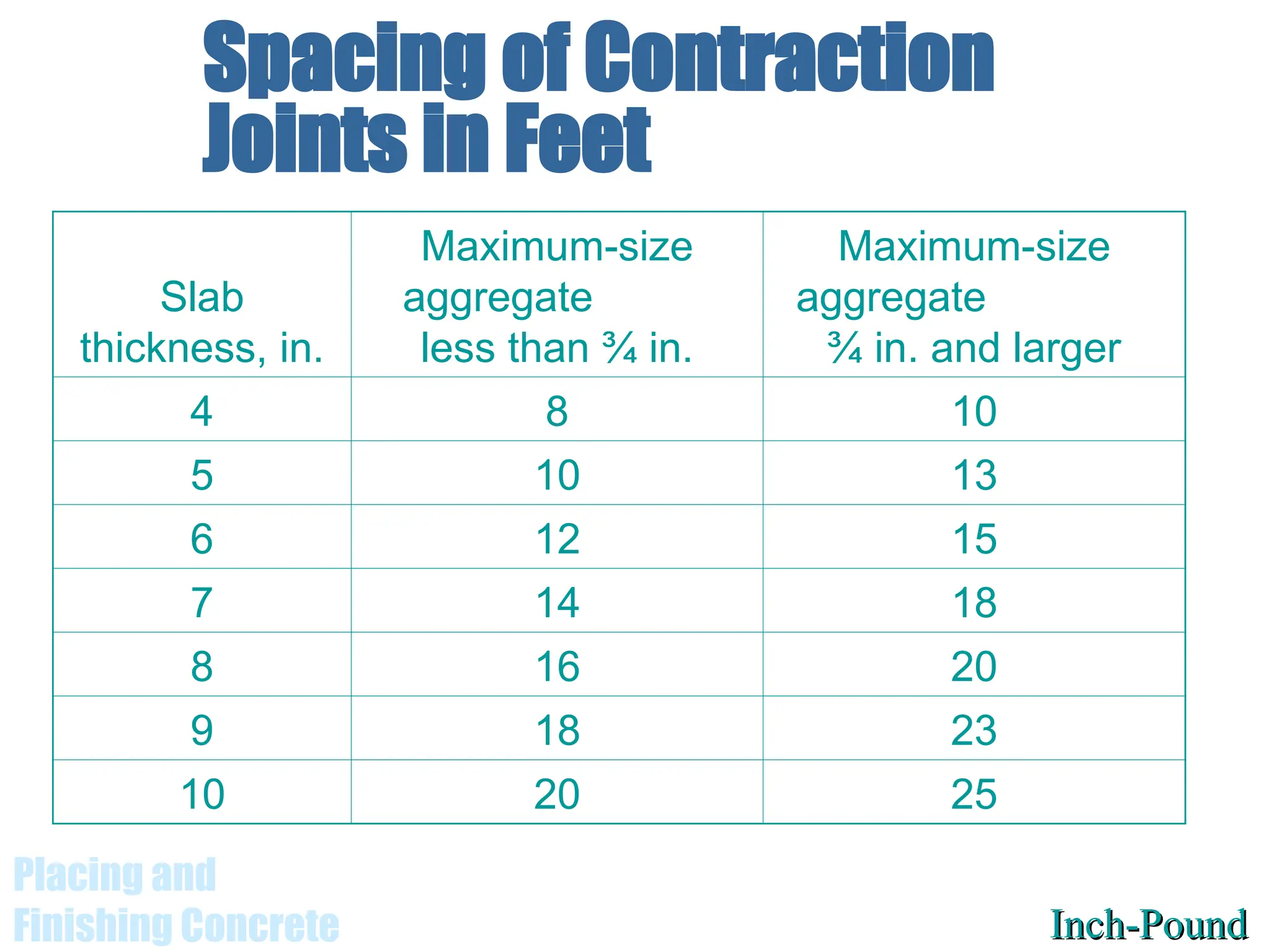
Spacing of Contraction
Joints in Feet
Slab
thickness, in.
Maximum-size
aggregate
less than ¾ in.
Maximum-size
aggregate
¾ in. and larger
4 8 10
5 10 13
6 12 15
7 14 18
8 16 20
9 18 23
10 20 25
Inch-Pound
Inch-Pound
Placing and
Finishing Concrete
Making Contraction Joints
Dry-cut sawing concrete
Grooving tool
on bull-float
Placing and
Finishing Concrete
Construction
Joints
Placing and
Finishing Concrete
Joint Layout for Slabs
 Panels created by contraction
joints should be approximately
square
 Panel aspect ratio max. 1½ to 1
 Contraction (control) joints should
only terminate at a free edge or at
an isolation joint
 When joint spacing exceeds 4.5 m
(15 ft), load transfer by aggregate
interlock decreases significantly
Basic Factors to Remember
Placing and
Finishing Concrete
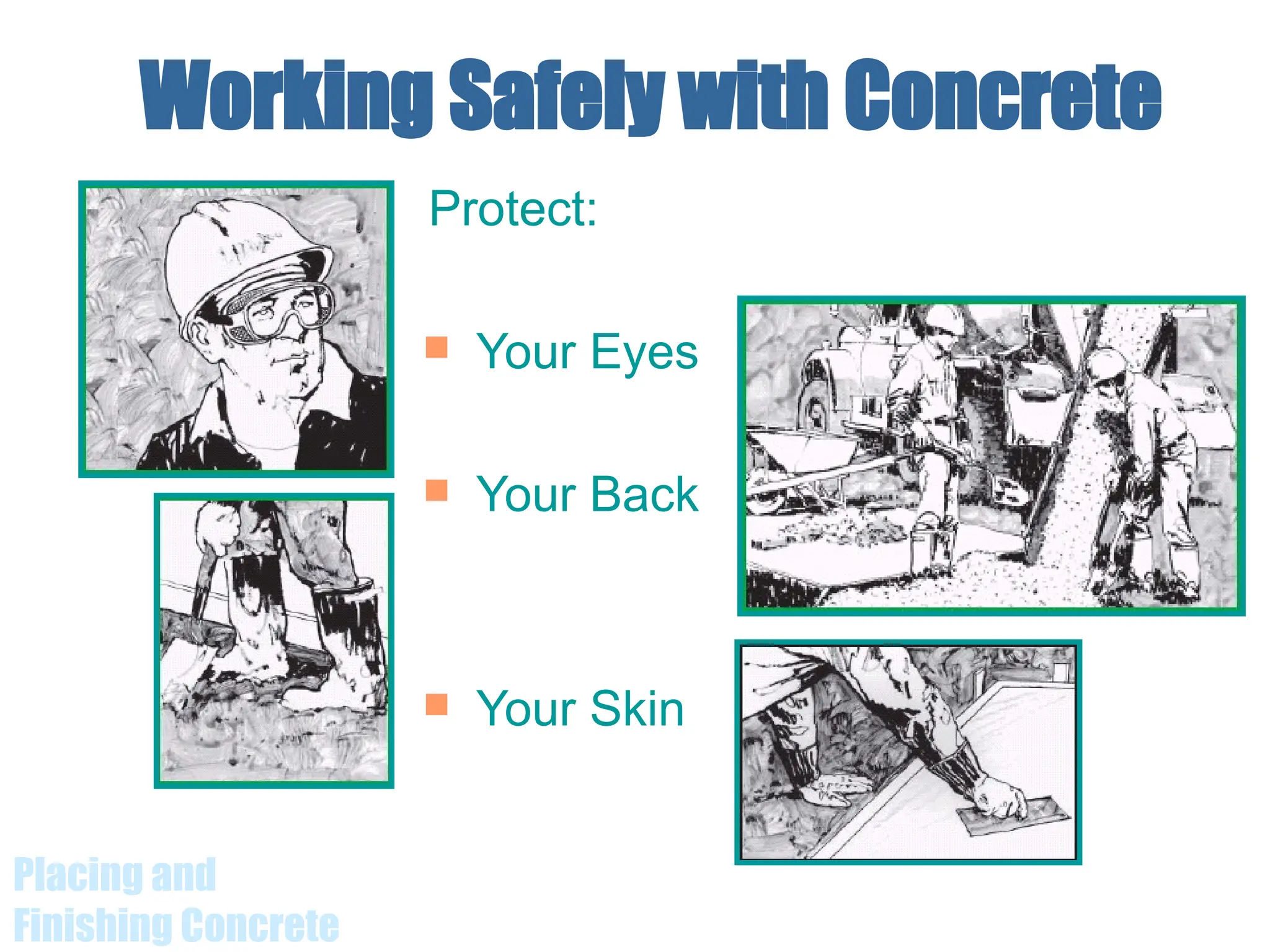
Working Safely with Concrete
Protect:
 Your Eyes
 Your Back
 Your Skin
Placing and
Finishing Concrete
Precautions
http://www.cement.org/pdf_files/ms271.pdf
WARNING: Contact with wet (unhardened) concrete, mortar,
cement, or cement mixtures can cause SKIN IRRITATION,
SEVERE CHEMICAL BURNS (THIRD-DEGREE), or SERIOUS
EYE DAMAGE. Frequent exposure may be associated with irritant
and/or allergic contact dermatitis. Wear water-proof gloves, a long-
sleeved shirt, full-length trousers, and proper eye protection when
working with these materials. If you have to stand in wet concrete,
use waterproof boots that are high enough to keep concrete from
flowing into them. Wash wet concrete, mortar, cement, or cement
mixtures from your skin immediately. Flush eyes with clean water
immediately after contact. In-direct contact through clothing can be
as serious as direct contact, so promptly rinse out wet concrete,
mortar, cement, or cement mixtures from clothing. Seek immediate
medical attention if you have persistent or severe discomfort.
Placing and
Finishing Concrete
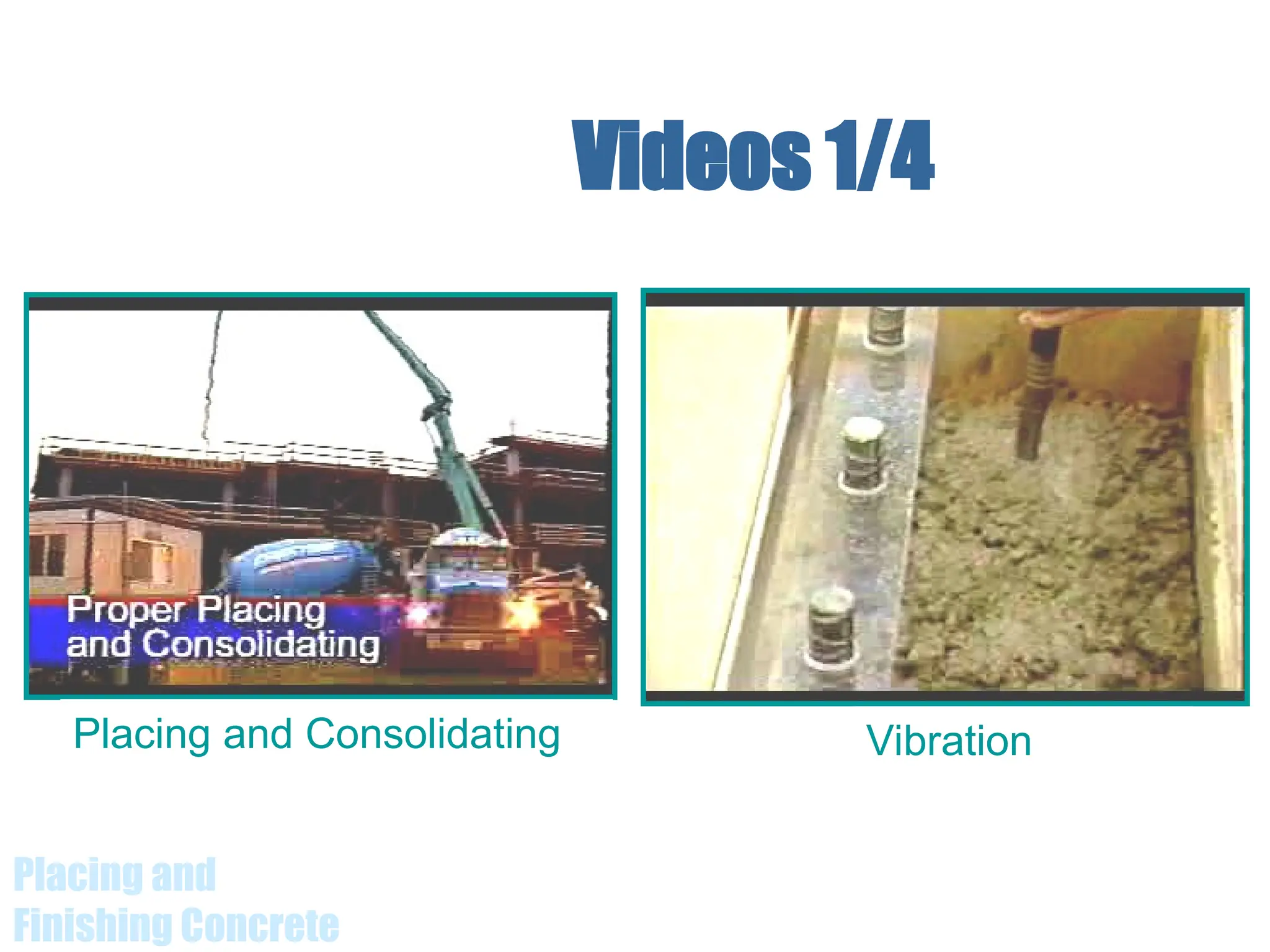
Videos 1/4
Placing and Consolidating Vibration
Placing and
Finishing Concrete
Videos 2/4
Finishing I Finishing II
Placing and
Finishing Concrete
Videos 3/4
Contraction Joints Jointing
Placing and
Finishing Concrete
Videos 4/4
Improper Finishing

Concreting & finishing in building construction

  • 1.
    Placing and Finishing Concrete BijayaRaula Shapoorji Pallonji & Co. Pvt Ltd
  • 2.
    Basic Requirements for PlacingConcrete (1)  Preserve concrete quality  Water-cement ratio  Slump  Air-content  Homogeneity  Avoid separation of aggregate and mortar
  • 3.
    Basic Requirements for PlacingConcrete (2)  Avoid excessive horizontal movement  Consolidate adequately  Maintain sufficient placement capacity  Choose the right equipment for the concrete
  • 4.
    Transportation of concrete The method of conveying concrete should not cause segregation, loss of part of the concrete and loss of slump.  Do not add extra water to the concrete (in addition to what is required as per the W/c ratio) for the purpose of easy handling / transporting.  Properly designed and operated buckets are an excellent means of transporting concrete. But they should be capable of discharging low slump concrete and the discharge rate should be controllable. Cylindrical buckets with proper center discharge gates are the most efficient
  • 5.
    Transportation of concrete When using chutes for transporting , take care to avoid segregation. The chutes should be of rounded cross-section and of smooth metal to avoid sticking of concrete. They should be of correct slope so that concrete of the required slump will slide without flowing. Usually, the slope is 1 vertical to 2 or 2 ½ horizontal but the best slope for a particular concrete can be fixed after a few trials. hing Concrete
  • 6.
    Transportation of concrete Control should be provided at the end of the chute so that concrete will drop vertically without segregation.Flush the chute with water before starting to transport the concrete.  Wheel barrows can be effectively used for transporting concrete horizontally over a short distance of about 60 meters. Provide a smooth path for the wheelbarrows using planks or sheets to transport the concrete without shaking or spilling.
  • 7.
    Preparation  Do notplace the concrete until the place of deposit has been thoroughly inspected and approved. Check whether the formwork has been oiled and the supports are rigid. Also, check whether the reinforcement , cover blocks, inserts and embedded plates have been properly secured in position.  Where concrete is to be bonded to a previous lift of concrete , clean the surface thoroughly and chip the top to a depth sufficient to expose fresh , clean cut concrete without disturbing or loosening the coarse aggregate
  • 8.
    Preparation  Keep thedry surface saturated with water for not less than 24 hours . Before placing fresh concrete, remove the standing water from depressions and spread about 1.5 cm thick mortar layer (in same proportion as in original concrete but not greater than 1:2) over the contact surface of the old concrete.  When concreting has to be done against earthen surface, compact the base by rolling or ramming and wet the surface by sprinkling water to prevent excessive loss of moisture from the concrete.
  • 9.
    During Placement  Depositthe concrete at, or as near as possible to its final position  Place the concrete in uniform layers. Avoid placing in large heaps or sloping layers which will lead to segregation.  In walls and columns no layer should be more than about450mm thick. As more layer thickness make the concrete impossible to vibrate the bottom layer and will lead to air entrapment at bottom and surface blemishes on vertical surface.  In thin slabs place concrete thickness of 150mm.
  • 10.
    During Placement  Wheregood finish is required on columns and walls restrict the pour height to 2m per hour.  Ensure every layer of concrete is fully compacted before placing successive layer.  Ensure the vibrator head penetrates the previous layer this will eliminate layer lines.  Always make sure that you can see the concrete being deposited.  In columns and walls the placing must be done in such a way that the concrete does not strike the face of the formwork, similarly, avoid heavy impact against reinforcement as the force could displace it
  • 11.
    Compaction  The objectof compaction is to get rid of as much as possible of entrapped air, down to less than 1% is the aim.(This does not apply with deliberate air entrainment, but in that case the air is uniformly distributed and stable)  The amount of air is related to workability. Concrete with a slump of 75mm contains about 5% air while concrete with 25mm has 20%.  This is why low slump concrete requires more vibration or longer time or more poker needles compared to concrete with higher slump.
  • 12.
    Compaction  It isimportant to remove this entrapped air for the following reasons:  Voids reduces the strength of the concrete. Every 1% of entrapped air the strength falls by about 5 to 6 % . So a concrete with 3% voids will be about 15 to 20% weaker than it should be.  Voids increased permeability, which in turn reduces the durability.  Void reduces the contact between concrete and reinforcement and other embedded metals. The required bond will then not be achieved
  • 13.
    Compaction  and thereinforced member will not be as strong as it should be.  Voids produces visual blemishes such as blowholes and honeycombing and porosity on the struck surface.
  • 14.
    Vibration  Rodding ,spading-even using foot- are all ways of removing air from concrete to compact it, but the best and quickest method is vibration.  When concrete is vibrated it is fluidized which reduces the internal friction between the aggregate particle and removes the entrapped air , make them to get packed well to become a dense member.
  • 15.
    Vibration  With aproperly designed cohesive mix, segregation and bleeding will be minimized. With an over-wet mix the larger aggregates may settle during compaction with the result that a weak layer of laitance will finish up on top surface.
  • 16.
    Points to berembered in compaction  Make sure the concrete surface being vibrated is seen. Light is need for thin section columns and walls.  Insert the needle quickly this makes the concrete liquefies and fill the forms and allow the vibrator to penetrate to the previous layer.  Compact concrete in place till the Entrapped air expels out  Withdraw the needle slowly. The main thing is to see the hole made by vibrator head is closed.
  • 17.
    Points to berembered in compaction  Have proper lighting arrangement to see the concrete placed is vibrated  Excess vibration not to be done this may lead to Segregate the concrete  Place the poker needle in not more than 500mm away from its last position.  Avoid touching the form face with poker needle. This will result in colour variation
  • 18.
    Points to berembered in compaction  Avoid touching the reinforcement by poker , this will displace the reiniforcement and also will decrease the bond between the reinforcement and concrete  Avoid moving concrete to flow using poker.
  • 19.
    Stop Vibration When The concrete surface takes on a sheen Large air bubbles no longer escape  You hear the vibrator change pitch or tone You feel a change in vibration action
  • 20.
    Vibrating Don’ts  Don’tlet a vibrator run very long outside concrete; it will overheat Don’t use a vibrator to move concrete horizontally  Don’t force pr push a vibrator into concrete it won’t remain vertical and may get caught in the reinforcement  Don’t start a job without a spare vibrator
  • 21.
    Finshing (Initial) Strike off: Properly done removes excess concrete and brings top surface to grade  Start as soon as possible after placing concrete  End before bleed water appears  Straight edge uses can be of wood or magnesium  Straight edge  Use a side-to-side sawing motion while pulling forward  Tilt it slightly backward to create a single cutting edge
  • 22.
    Finshing (Initial)  Keepabout an inch of concrete in front to fill low spots  Make a second pass if the surface is not to grade  Pull concrete into end edge forms. BULL FLOATS AND DARBIES  Use to level ridges and fill voids left by straightedge  Start immediately after strike off and finish before bleed water appears
  • 23.
    Finshing (Initial)  Useat right angle to the direction of strike off  Push the bull float with the front edge slightly off the surface to cut bumps; pull the bull float with the back edge slightly off the surface to fill voids  Use magnesium tools for sir entrained concrete  Darbies serve the same purpose as bull floats but for smaller areas; use in a sawing arc motion
  • 24.
    Finshing (Initial)  WAITINGPERIOD  Begin further finishing when all the bleed water has evaporated and concrete is firm enough to leave only ¼ inch foot prints  Finishing while bleed water is present can cause surface crazing, dusting or scalling
  • 25.
    Finshing (Final)  Edgers Use to produce a clean slab edge that is less likely to chip  An edger is less likely to dig into concrete or leave a bumpy surface if a trowel is used in a vertical sawing motion to dislodge aggregate particles away from the edge forms  Run back and forth with the leading edge slightly raised  Don’t start in a corner and don’t raise the edger off the concrete unless the tool is in motion
  • 26.
    Finshing (Final)  Usea wide edger for the first pass, then a narrow edger for the second pass  Groovers  Use to control crack location by cutting joints to a depth of atleast one- fourth the slab thickness  Push the groover into the concrete then move it forward while applying pressure to the back of the tool  After joint is cut, turn the groover around, running it back over the cut to give as smoother finish
  • 27.
    Finshing (Final)  Fora straight cut, use a chalk line or a straight edge as a guide Floats  Use to remove imperfections and to bring mortar to the surface for troweling  Hold flot flat and at arm’s length, moving it in awide semicircular motion until surface is smooth  Use magnesium tools for air entrained concrete  More than one float pass may be required
  • 28.
    Finshing (Final) Trowels  Useto produce a hard, dense surface  Trowel only after floating, starting with a wide trowel then moving to smaller trowels on the later passes  Hold trowel at a slight tilt at arm’s length and move it in a semicircular motion , overlapping each pass by one half until surface finish is smooth.
  • 29.
    Placing and Finishing Concrete DepositingConcrete Discharging into previously placed concrete Effective use of wheelbarrows
  • 30.
    Placing and Finishing Concrete DepositingConcrete  Deposit in horizontal layers of uniform thickness  Reinforced — 150 mm to 500 mm  Mass — 375 mm to 500 mm  Consolidate each layer before next is placed  Timely placement & consolidation prevents flow lines and cold joints Walls
  • 31.
  • 32.
  • 33.
    Placing and Finishing Concrete UnderwaterPlacement Methods  Tremie  Pump  Bottom dump buckets  Grouted preplaced aggregate (specialized)  Toggle bags  Bagwork  Diving bell
  • 34.
    Placing and Finishing Concrete PlacingConcrete Under Water  Water velocity  3 m (10 ft) / min.  Water temperature  5°C (if below — test for strength gain)  w/c  0.45  Cementing materials content  390 kg/m3 (600 lb/yd3 )  Slump range 150 to 225 mm (6 to 10 in.) Basic Recommendations
  • 35.
    Placing and Finishing Concrete PlacingConcrete Underwater  Used: Tremie  Advantages: Can be used to funnel concrete down through the water into the structure.  Watch for: Discharge end always has to be buried in fresh concrete to ensure seal between water and concrete mass.
  • 36.
    Placing and Finishing Concrete Consolidating Concrete Internal Vibration  External Vibration
  • 37.
    Placing and Finishing Concrete InternalVibration d R 1½ R Vibrator Radius of Action
  • 38.
    Placing and Finishing Concrete InternalVibrators Diameter of head, mm (in.) Recommended frequency, vibrations per minute Approximate radius of action, mm (in.) Rate of placement, m3 /h (yd3 /h) Application 20-40 (3/4-1½) 9000-15,000 80-150 (3-6) 0.8-4 (1-5) Plastic and flowing concrete in thin members. Also used for lab test specimens. 30-60 (1¼-2½) 8500-12,500 130-250 (5-10) 2.3-8 (3-10) Plastic concrete in thin walls, columns, beams, precast piles, thin slabs, and along construction joints. 50-90 (2-3½) 8000-12,000 180-360 (7-14) 4.6-15 (6-20) Stiff plastic concrete (less than 80-mm [3- in.] slump) in general construction . Adapted from ACI 309
  • 39.
    Placing and Finishing Concrete SystematicVibration of Each New Lift CORRECT CORRECT Vertical penetration a few inches into previous lift (which should not yet be rigid) of systematic regular intervals will give adequate consolidation INCORRECT INCORRECT Haphazard random penetration of the vibrator at all angles and spacings without sufficient depth will not assure intimate combination of the two layers
  • 40.
    Placing and Finishing Concrete PlacingConcrete in a Sloping Lift CORRECT CORRECT Start placing at bottom of slope so that compaction is increased by weight of newly added concrete. Vibration consolidates the concrete. INCORRECT INCORRECT When placing is begun at top of slope the upper concrete tends to pull apart especially when vibrated below as this starts flow and removes from concrete above.
  • 41.
    Placing and Finishing Concrete ExternalVibration  Form vibrators  Vibrating tables  Surface vibrators  Vibratory screeds  Plate vibrators  Vibratory roller screeds  Vibratory hand floats or trowels
  • 42.
    Placing and Finishing Concrete ConsolidatingConcrete Inadequate consolidation can result in:  Honeycomb  Excessive amount of entrapped air voids (bugholes)  Sand streaks  Cold joints  Placement lines  Subsidence cracking
  • 43.
    Placing and Finishing Concrete Screeding(Strikeoff) The process of cutting off excess concrete to bring the top surface of a slab to proper grade
  • 44.
  • 45.
  • 46.
  • 47.
    Placing and Finishing Concrete Edging Required along all edge forms, isolation and construction joints in floors and exterior slabs  Cut concrete away from forms to a depth of 25 mm with a pointed mason or margin trowel  Edging may be required after each subsequent finishing operation for interior slabs Edging densifies and compacts concrete next to forms where floating is less effective
  • 48.
    Placing and Finishing Concrete Floating(Power or Hand)  To embed aggregate particles just beneath the surface  To remove slight imperfections, humps, and voids  To compact the mortar at the surface in preparation for additional finishing operations.
  • 49.
    Placing and Finishing Concrete Troweling Creates smooth, hard,dense surface  Exterior concrete should not be troweled because:  it can lead to a loss of entrained air caused by overworking the surface  troweled surfaces can be slippery when wet.
  • 50.
  • 51.
  • 52.
    Placing and Finishing Concrete Spacingof Contraction Joints in Meters Slab thickness, mm Maximum-size aggregate less than 19 mm Maximum-size aggregate 19 mm and larger 100 2.4 3.0 125 3.0 3.75 150 3.75 4.5 175 4.25 5.25 200 5.0 6.0 225 5.5 6.75 250 6.0 7.5 Metric Metric
  • 53.
    Placing and Finishing Concrete Spacingof Contraction Joints in Feet Slab thickness, in. Maximum-size aggregate less than ¾ in. Maximum-size aggregate ¾ in. and larger 4 8 10 5 10 13 6 12 15 7 14 18 8 16 20 9 18 23 10 20 25 Inch-Pound Inch-Pound
  • 54.
    Placing and Finishing Concrete MakingContraction Joints Dry-cut sawing concrete Grooving tool on bull-float
  • 55.
  • 56.
    Placing and Finishing Concrete JointLayout for Slabs  Panels created by contraction joints should be approximately square  Panel aspect ratio max. 1½ to 1  Contraction (control) joints should only terminate at a free edge or at an isolation joint  When joint spacing exceeds 4.5 m (15 ft), load transfer by aggregate interlock decreases significantly Basic Factors to Remember
  • 57.
    Placing and Finishing Concrete WorkingSafely with Concrete Protect:  Your Eyes  Your Back  Your Skin
  • 58.
    Placing and Finishing Concrete Precautions http://www.cement.org/pdf_files/ms271.pdf http://www.cement.org/pdf_files/ms271.pdf WARNING:Contact with wet (unhardened) concrete, mortar, cement, or cement mixtures can cause SKIN IRRITATION, SEVERE CHEMICAL BURNS (THIRD-DEGREE), or SERIOUS EYE DAMAGE. Frequent exposure may be associated with irritant and/or allergic contact dermatitis. Wear water-proof gloves, a long- sleeved shirt, full-length trousers, and proper eye protection when working with these materials. If you have to stand in wet concrete, use waterproof boots that are high enough to keep concrete from flowing into them. Wash wet concrete, mortar, cement, or cement mixtures from your skin immediately. Flush eyes with clean water immediately after contact. In-direct contact through clothing can be as serious as direct contact, so promptly rinse out wet concrete, mortar, cement, or cement mixtures from clothing. Seek immediate medical attention if you have persistent or severe discomfort.
  • 59.
    Placing and Finishing Concrete Videos1/4 Placing and Consolidating Vibration
  • 60.
    Placing and Finishing Concrete Videos2/4 Finishing I Finishing II
  • 61.
    Placing and Finishing Concrete Videos3/4 Contraction Joints Jointing
  • 62.

Editor's Notes

  • #29 Fig. 11-4. Wheelbarrows are used to place concrete in areas that are not easily accessed by other placement methods. (69929) Note placing slab how concrete is discharged into the previously placed concrete Fig. 11-8. Concrete should be placed as near as possible to its final position. (70009)
  • #30 Placement lines
  • #31 Fig. 11-24. A straight, horizontal construction joint can be built using this detail.
  • #32 Fig. 11-30. Horizontal construction joints in walls with V-shaped (a) and beveled (b) rustication strips.
  • #35 IX 56—Tremie placement for a bridge.
  • #36 Fig. 11-10. Proper vibration makes possible the placement of stiff concrete mixtures, even in heavily-reinforced concrete members. (55806)
  • #37 Fig. 11-11. Internal vibrators are commonly used to consolidate concrete in walls, columns, beams, and slabs. (69970) Schematic: Radius of action ( R) of a vibrator is about three to five times the vibrator diameter (d). A Vibrator should be inserted about 1 ½ times the radius of action to consolidate concrete properly. The operator will be able to see the radius of action in the concrete.
  • #38 Table 11-1. Range of Characteristics, Performance, and Applications of Internal Vibrators. Generally, extremely dry or very stiff concrete does not respond well to internal vibrators. While vibrator is operating in concrete. Distance over which concrete is fully consolidated. Assumes the insertion spacing is 11¼2 times the radius of action, and that vibrator operates two-thirds of time concrete is being placed. These ranges reflect not only the capability of the vibrator but also differences in workability of the mix, degree of deaeration desired, and other conditions experienced in construction.
  • #41 129-18
  • #42 Fig. 11-9. Honeycomb and rock pockets are the results of inadequate consolidation. (50207) Bottom: Sand streaks
  • #43 Is the process of cutting off excess concrete to bring the top surface of a slab to proper grade. (Left) Hand strikeoff (screeding) by the use a a straightedge. The straightedge is moved across the slab from side to side in a saw like fashion advancing forward with each movement. (Right) Strikeoff with a vibratory screed which consolidates the concrete as the strikeoff is being done. Vibratory screeds are used for consolidating nonreinforced or lightly reinforced slabs up to 250 mm in thickness. Fig. 11-12. Vibratory screeds such as this truss-type unit reduce the work of strikeoff while consolidating the concrete. (55801)
  • #44 Fig. 11-13. Where floor tolerances are not critical, an experienced operator using this vibratory screed does not need screed poles supported by chairs to guide the screed. Instead, he visually matches elevations to forms or previous passes. The process is called wet screeding. (69938) Fig. 11-14. A laser level stimulating the sensors on this screed guides the operator as he strikes off the concrete. Screed poles and chairs are not needed and fewer workers are required to place concrete. Laser screeds interfaced with total station surveying equipment can also strike off sloped concrete surfaces. (69939)
  • #45 Fig. 11-16. Bullfloating must be completed before any bleed water accumulates on the surface. (69940, 70011)
  • #46 Fig. 11-16. Darbying brings the surface to the specified level and is done in tight places where a bullfloat cannot reach. (70010)
  • #48 Fig. 11-18. Power floating using walk-behind and ride-on equipment. Footprints indicate proper timing. When the bleedwater sheen has evaporated and the concrete will sustain foot pressure with only slight indentation, the surface is ready for floating and final finishing operations. (69942)
  • #49 Fig. 11-19. Hand floating (right hand) the surface with a hand float held flat on the concrete surface and moved in a sweeping arc with a slight sawing motion. Troweling (left hand) with blade tilted is performed before moving the kneeboards. (69933)
  • #50 Fig. 11-26. Isolation joints permit horizontal and vertical movements between abutting faces of a slab and fixed parts of a structure.
  • #51 Fig. 11-27. Contraction joints provide for horizontal movement in the plane of a slab or wall and induce controlled cracking caused by drying and thermal shrinkage. Fig. 11-28. Sawing a continuous cut in the top of a slab is one of the most economical methods for making a contraction joint. (69947)
  • #52 Table 11-2 (Metric). Spacing of Contraction Joints in Meters* *Spacings are appropriate for slumps between 100 mm and 150 mm. If concrete cools at an early age, shorter spacings may be needed to control random cracking. (A temperature difference of only 6°C may be critical.) For slumps less than 100 mm, joint spacing can be increased by 20%. When spacings exceed 4.5 m, load transfer by aggregate interlock decreases markedly.
  • #53 Table 11-2 (Inch-Pound Units). Spacing of Contraction Joints in Feet* *Spacings are appropriate for slumps between 4 in. and 6 in. If concrete cools at an early age, shorter spacings may be needed to control random cracking. (A temperature difference of only 10°F may be critical.) For slumps less than 4 in., joint spacing can be increased by 20%. When spacings exceed 15 ft, load transfer by aggregate interlock decreases markedly.
  • #54 110-13 136-19
  • #55 Fig. 11-29. Construction joints are stopping places in the process of construction. Construction-joint types (a) and (b) are also used as contraction joints.