MECHANICAL COMPACTION
OF CONCRETE
By: Abhishek Shah
CONTENT . . . .
Introduction
Importance of Compaction of Concrete
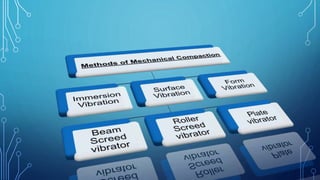
Mechanical Compaction of concrete
Immersion Vibration
Case Study on Immersion vibration
Surface vibrator
Form vibrator
Conclusion
Acknowledgement
References
INTRODUCTION TO COMPACTION
OF
CONCRETE
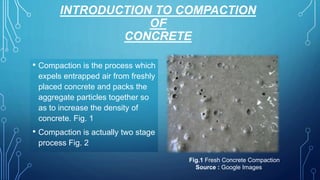
• Compaction is the process which
expels entrapped air from freshly
placed concrete and packs the
aggregate particles together so
as to increase the density of
concrete. Fig. 1
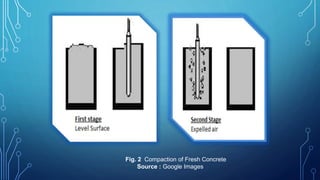
• Compaction is actually two stage
process Fig. 2
Fig.1 Fresh Concrete Compaction
Source : Google Images
Fig. 2 Compaction of Fresh Concrete
Source : Google Images
STAGES OF COMPACTION OF
CONCRETE
• Stage 1:
with vibration, initial consolidation of the concrete can often be achieved relatively
quickly. The concrete liquefies and the surface levels, giving the impression that the
concrete is compacted
• Stage 2:
In the second stage, entrapped air is expelled. Entrapped air takes a little longer to
rise to the surface. Compaction must therefore be prolonged until this is
accomplished, ie until air bubbles no longer appear on the surface.
IMPORTANCE OF COMPACTION
• It is important to compact the concrete fully because, Air voids reduce
the strength of the concrete. For every 1% of entrapped air, the
strength falls by somewhere between 5 and 7%. This means that
concrete containing about 5% air voids due to incomplete compaction
can lose as much as one third of its strength. Figure 3
• Air voids increase concrete's permeability. That in turn reduces its
durability.
• If the concrete is not dense and impermeable, it will not be watertight.
It will be less able to withstand aggressive liquids and its exposed
surfaces will weather badly.
• Moisture and air are more likely to penetrate to the reinforcement
causing it to rust.
• Air voids impair contact between the mix and reinforcement (and,
indeed, any other embedded metals). The required bond will not be
achieved and the reinforced member will not be as strong as it should
• It increases significantly the ultimate strength of concrete and enhances
the bond with reinforcement.
• It also increases the abrasion resistance and general durability of the
concrete, decreases the permeability and helps to minimize its
shrinkage-and-creep characteristics.
• Proper compaction also ensures that the formwork is completely filled
i.e. there are no pockets of honeycombed material and that the required
finish is obtained on vertical surfaces
• When first placed in the form, normal concrete, excluding those with
very low or very high slumps, will contain between 5% and 20% by
volume of entrapped air. The aggregate particles, although coated with
mortar, tend to arch against one another and are prevented from
slumping or consolidating by internal friction.
MECHANICAL COMPACTION OF
CONCRETE
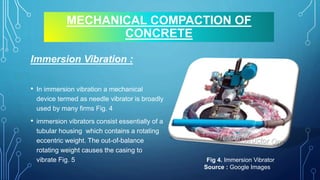
Immersion Vibration :
• In immersion vibration a mechanical
device termed as needle vibrator is broadly
used by many firms Fig. 4
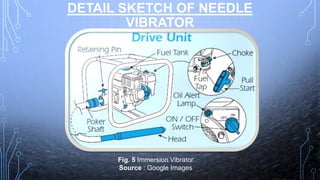
• immersion vibrators consist essentially of a
tubular housing which contains a rotating
eccentric weight. The out-of-balance
rotating weight causes the casing to
vibrate Fig. 5 Fig 4. Immersion Vibrator
Source : Google Images
DETAIL SKETCH OF NEEDLE
VIBRATOR
Fig. 5 Immersion Vibrator
Source : Google Images
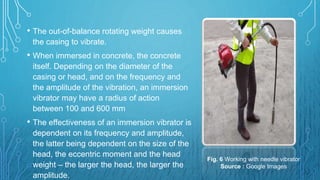
• The out-of-balance rotating weight causes
the casing to vibrate.
• When immersed in concrete, the concrete
itself. Depending on the diameter of the
casing or head, and on the frequency and
the amplitude of the vibration, an immersion
vibrator may have a radius of action
between 100 and 600 mm
• The effectiveness of an immersion vibrator is
dependent on its frequency and amplitude,
the latter being dependent on the size of the
head, the eccentric moment and the head
weight – the larger the head, the larger the
amplitude.
Fig. 6 Working with needle vibrator
Source : Google Images
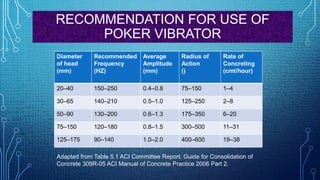
RECOMMENDATION FOR USE OF
POKER VIBRATOR
Diameter
of head
(mm)
Recommended
Frequency
(HZ)
Average
Amplitude
(mm)
Radius of
Action
()
Rate of
Concreting
(cmt/hour)
20–40 150–250 0.4–0.8 75–150 1–4
30–65 140–210 0.5–1.0 125–250 2–8
50–90 130–200 0.6–1.3 175–350 6–20
75–150 120–180 0.8–1.5 300–500 11–31
125–175 90–140 1.0–2.0 400–600 19–38
Adapted from Table 5.1 ACI Committee Report: Guide for Consolidation of
Concrete 309R-05 ACI Manual of Concrete Practice 2006 Part 2.
FOLLOWING CARE SHOULD BE
TAKEN WHILE USING NEEDLE
VIBRATOR
• As a general rule, the radius of action of
a given vibrator not only increases with
the workability of the concrete (higher
slump), but also with the diameter of the
head
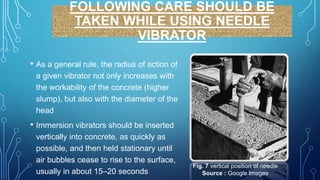
• Immersion vibrators should be inserted
vertically into concrete, as quickly as
possible, and then held stationary until
air bubbles cease to rise to the surface,
usually in about 15–20 seconds
Fig. 7 vertical position of needle
Source : Google Images
• The vibrator should then be slowly
withdrawn and reinserted vertically in a
fresh position adjacent to the first. These
movements should be repeated in a
regular pattern until all the concrete has
been compacted Fig. 7
• Random insertions are likely to leave
areas of the concrete uncompacted.
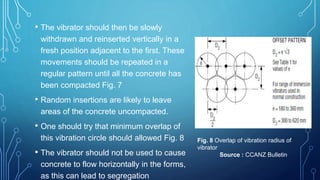
• One should try that minimum overlap of
this vibration circle should allowed Fig. 8
• The vibrator should not be used to cause
concrete to flow horizontally in the forms,
as this can lead to segregation
Fig. 8 Overlap of vibration radius of
vibrator
Source : CCANZ Bulletin
• the vibrator should not be dragged through the concrete as this
leads to inadequate compaction and increases the risk of
segregation.
• In deep sections such as walls, footings and large columns, the
concrete should be placed in layers about 300 mm thick
• The vibrator should penetrate about 150 mm into the previous layer
of fresh concrete to meld the two layers together and avoid ‘cold-
pour’ lines on the finished surface
• The vibrator should not be allowed to touch the forms as this can
cause ‘burn’ marks which will be reflected on the finished surface
• Similarly, the vibrator should not be held against the reinforcement
as this may cause its displacement.
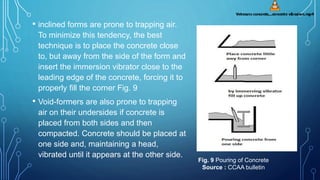
• inclined forms are prone to trapping air.
To minimize this tendency, the best
technique is to place the concrete close
to, but away from the side of the form and
insert the immersion vibrator close to the
leading edge of the concrete, forcing it to
properly fill the corner Fig. 9
• Void-formers are also prone to trapping
air on their undersides if concrete is
placed from both sides and then
compacted. Concrete should be placed at
one side and, maintaining a head,
vibrated until it appears at the other side.
Fig. 9 Pouring of Concrete
Source : CCAA bulletin
Surface vibration:
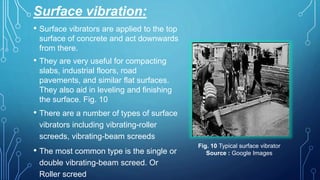
• Surface vibrators are applied to the top
surface of concrete and act downwards
from there.
• They are very useful for compacting
slabs, industrial floors, road
pavements, and similar flat surfaces.
They also aid in leveling and finishing
the surface. Fig. 10
• There are a number of types of surface
vibrators including vibrating-roller
screeds, vibrating-beam screeds
• The most common type is the single or
double vibrating-beam screed. Or
Roller screed
Fig. 10 Typical surface vibrator
Source : Google Images
Beam Screed vibrator
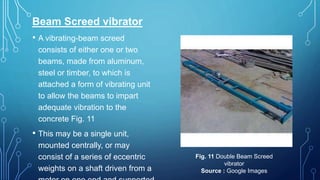
• A vibrating-beam screed
consists of either one or two
beams, made from aluminum,
steel or timber, to which is
attached a form of vibrating unit
to allow the beams to impart
adequate vibration to the
concrete Fig. 11
• This may be a single unit,
mounted centrally, or may
consist of a series of eccentric
weights on a shaft driven from a
Fig. 11 Double Beam Screed
vibrator
Source : Google Images
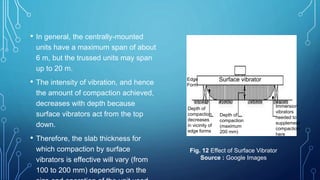
• In general, the centrally-mounted
units have a maximum span of about
6 m, but the trussed units may span
up to 20 m.
• The intensity of vibration, and hence
the amount of compaction achieved,
decreases with depth because
surface vibrators act from the top
down.
• Therefore, the slab thickness for
which compaction by surface
vibrators is effective will vary (from
100 to 200 mm) depending on the
Depth of
compaction
decreases
in vicinity of
edge forms
Depth of
compaction
(maximum
200 mm)
Immersion
vibrators
needed to
supplement
compaction
here
Surface vibratorEdge
Form
Fig. 12 Effect of Surface Vibrator
Source : Google Images
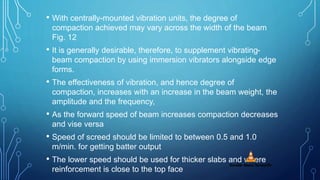
• With centrally-mounted vibration units, the degree of
compaction achieved may vary across the width of the beam
Fig. 12
• It is generally desirable, therefore, to supplement vibrating-
beam compaction by using immersion vibrators alongside edge
forms.
• The effectiveness of vibration, and hence degree of
compaction, increases with an increase in the beam weight, the
amplitude and the frequency,
• As the forward speed of beam increases compaction decreases
and vise versa
• Speed of screed should be limited to between 0.5 and 1.0
m/min. for getting batter output
• The lower speed should be used for thicker slabs and where
reinforcement is close to the top face
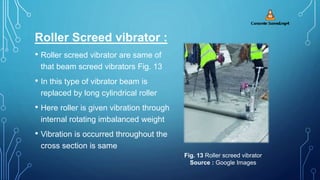
Roller Screed vibrator :
• Roller screed vibrator are same of
that beam screed vibrators Fig. 13
• In this type of vibrator beam is
replaced by long cylindrical roller
• Here roller is given vibration through
internal rotating imbalanced weight
• Vibration is occurred throughout the
cross section is same
Fig. 13 Roller screed vibrator
Source : Google Images
Plate Vibrator :
• Plate vibrator are generally used in
laboratories Fig. 14
• It is generally used for compaction of
practical specification made in lab
• It is not preferred on large scale of
concreting done on big sites
• Vibrating table techniques are usually
restricted to recasting operations
• Also reflection of the pressure waves
against the concrete surface will influence
the amplitude distribution
• Table vibrators can give less consistent
results even with careful operation.
Fig. 14 Plate vibrator
Source : Google Images
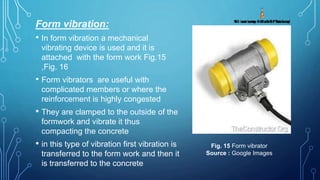
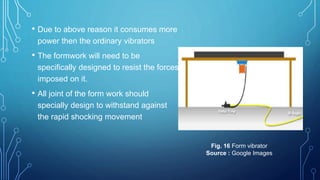
Form vibration:
• In form vibration a mechanical
vibrating device is used and it is
attached with the form work Fig.15
,Fig. 16
• Form vibrators are useful with
complicated members or where the
reinforcement is highly congested
• They are clamped to the outside of the
formwork and vibrate it thus
compacting the concrete
• in this type of vibration first vibration is
transferred to the form work and then it
is transferred to the concrete
Fig. 15 Form vibrator
Source : Google Images
• Due to above reason it consumes more
power then the ordinary vibrators
• The formwork will need to be
specifically designed to resist the forces
imposed on it.
• All joint of the form work should
specially design to withstand against
the rapid shocking movement
Fig. 16 Form vibrator
Source : Google Images
CONCLUSION
• In today’s rapid growing world Concrete is most essential
material for construction.
• But the concrete properties like strength, durability,
serviceability are the problem.
• But with complete compaction of concrete one can improve
concrete property like strength, durability, serviceability with
great extent.
REFERENCE
• Concrete technology by M. S. Shetty
• www.google.com
• www.concretetools.co.nz
• www.concrete.net.au
• www.vibco.com

Mechanical Compaction of Concrete

  • 1.
  • 2.
    CONTENT . .. . Introduction Importance of Compaction of Concrete Mechanical Compaction of concrete Immersion Vibration Case Study on Immersion vibration
  • 3.
  • 4.
    INTRODUCTION TO COMPACTION OF CONCRETE •Compaction is the process which expels entrapped air from freshly placed concrete and packs the aggregate particles together so as to increase the density of concrete. Fig. 1 • Compaction is actually two stage process Fig. 2 Fig.1 Fresh Concrete Compaction Source : Google Images
  • 5.
    Fig. 2 Compactionof Fresh Concrete Source : Google Images
  • 6.
    STAGES OF COMPACTIONOF CONCRETE • Stage 1: with vibration, initial consolidation of the concrete can often be achieved relatively quickly. The concrete liquefies and the surface levels, giving the impression that the concrete is compacted • Stage 2: In the second stage, entrapped air is expelled. Entrapped air takes a little longer to rise to the surface. Compaction must therefore be prolonged until this is accomplished, ie until air bubbles no longer appear on the surface.
  • 7.
  • 8.
    • It isimportant to compact the concrete fully because, Air voids reduce the strength of the concrete. For every 1% of entrapped air, the strength falls by somewhere between 5 and 7%. This means that concrete containing about 5% air voids due to incomplete compaction can lose as much as one third of its strength. Figure 3 • Air voids increase concrete's permeability. That in turn reduces its durability. • If the concrete is not dense and impermeable, it will not be watertight. It will be less able to withstand aggressive liquids and its exposed surfaces will weather badly. • Moisture and air are more likely to penetrate to the reinforcement causing it to rust. • Air voids impair contact between the mix and reinforcement (and, indeed, any other embedded metals). The required bond will not be achieved and the reinforced member will not be as strong as it should
  • 9.
    • It increasessignificantly the ultimate strength of concrete and enhances the bond with reinforcement. • It also increases the abrasion resistance and general durability of the concrete, decreases the permeability and helps to minimize its shrinkage-and-creep characteristics. • Proper compaction also ensures that the formwork is completely filled i.e. there are no pockets of honeycombed material and that the required finish is obtained on vertical surfaces • When first placed in the form, normal concrete, excluding those with very low or very high slumps, will contain between 5% and 20% by volume of entrapped air. The aggregate particles, although coated with mortar, tend to arch against one another and are prevented from slumping or consolidating by internal friction.
  • 11.
    MECHANICAL COMPACTION OF CONCRETE ImmersionVibration : • In immersion vibration a mechanical device termed as needle vibrator is broadly used by many firms Fig. 4 • immersion vibrators consist essentially of a tubular housing which contains a rotating eccentric weight. The out-of-balance rotating weight causes the casing to vibrate Fig. 5 Fig 4. Immersion Vibrator Source : Google Images
  • 12.
    DETAIL SKETCH OFNEEDLE VIBRATOR Fig. 5 Immersion Vibrator Source : Google Images
  • 13.
    • The out-of-balancerotating weight causes the casing to vibrate. • When immersed in concrete, the concrete itself. Depending on the diameter of the casing or head, and on the frequency and the amplitude of the vibration, an immersion vibrator may have a radius of action between 100 and 600 mm • The effectiveness of an immersion vibrator is dependent on its frequency and amplitude, the latter being dependent on the size of the head, the eccentric moment and the head weight – the larger the head, the larger the amplitude. Fig. 6 Working with needle vibrator Source : Google Images
  • 14.
    RECOMMENDATION FOR USEOF POKER VIBRATOR Diameter of head (mm) Recommended Frequency (HZ) Average Amplitude (mm) Radius of Action () Rate of Concreting (cmt/hour) 20–40 150–250 0.4–0.8 75–150 1–4 30–65 140–210 0.5–1.0 125–250 2–8 50–90 130–200 0.6–1.3 175–350 6–20 75–150 120–180 0.8–1.5 300–500 11–31 125–175 90–140 1.0–2.0 400–600 19–38 Adapted from Table 5.1 ACI Committee Report: Guide for Consolidation of Concrete 309R-05 ACI Manual of Concrete Practice 2006 Part 2.
  • 15.
    FOLLOWING CARE SHOULDBE TAKEN WHILE USING NEEDLE VIBRATOR • As a general rule, the radius of action of a given vibrator not only increases with the workability of the concrete (higher slump), but also with the diameter of the head • Immersion vibrators should be inserted vertically into concrete, as quickly as possible, and then held stationary until air bubbles cease to rise to the surface, usually in about 15–20 seconds Fig. 7 vertical position of needle Source : Google Images
  • 16.
    • The vibratorshould then be slowly withdrawn and reinserted vertically in a fresh position adjacent to the first. These movements should be repeated in a regular pattern until all the concrete has been compacted Fig. 7 • Random insertions are likely to leave areas of the concrete uncompacted. • One should try that minimum overlap of this vibration circle should allowed Fig. 8 • The vibrator should not be used to cause concrete to flow horizontally in the forms, as this can lead to segregation Fig. 8 Overlap of vibration radius of vibrator Source : CCANZ Bulletin
  • 17.
    • the vibratorshould not be dragged through the concrete as this leads to inadequate compaction and increases the risk of segregation. • In deep sections such as walls, footings and large columns, the concrete should be placed in layers about 300 mm thick • The vibrator should penetrate about 150 mm into the previous layer of fresh concrete to meld the two layers together and avoid ‘cold- pour’ lines on the finished surface • The vibrator should not be allowed to touch the forms as this can cause ‘burn’ marks which will be reflected on the finished surface • Similarly, the vibrator should not be held against the reinforcement as this may cause its displacement.
  • 18.
    • inclined formsare prone to trapping air. To minimize this tendency, the best technique is to place the concrete close to, but away from the side of the form and insert the immersion vibrator close to the leading edge of the concrete, forcing it to properly fill the corner Fig. 9 • Void-formers are also prone to trapping air on their undersides if concrete is placed from both sides and then compacted. Concrete should be placed at one side and, maintaining a head, vibrated until it appears at the other side. Fig. 9 Pouring of Concrete Source : CCAA bulletin
  • 19.
    Surface vibration: • Surfacevibrators are applied to the top surface of concrete and act downwards from there. • They are very useful for compacting slabs, industrial floors, road pavements, and similar flat surfaces. They also aid in leveling and finishing the surface. Fig. 10 • There are a number of types of surface vibrators including vibrating-roller screeds, vibrating-beam screeds • The most common type is the single or double vibrating-beam screed. Or Roller screed Fig. 10 Typical surface vibrator Source : Google Images
  • 20.
    Beam Screed vibrator •A vibrating-beam screed consists of either one or two beams, made from aluminum, steel or timber, to which is attached a form of vibrating unit to allow the beams to impart adequate vibration to the concrete Fig. 11 • This may be a single unit, mounted centrally, or may consist of a series of eccentric weights on a shaft driven from a Fig. 11 Double Beam Screed vibrator Source : Google Images
  • 21.
    • In general,the centrally-mounted units have a maximum span of about 6 m, but the trussed units may span up to 20 m. • The intensity of vibration, and hence the amount of compaction achieved, decreases with depth because surface vibrators act from the top down. • Therefore, the slab thickness for which compaction by surface vibrators is effective will vary (from 100 to 200 mm) depending on the Depth of compaction decreases in vicinity of edge forms Depth of compaction (maximum 200 mm) Immersion vibrators needed to supplement compaction here Surface vibratorEdge Form Fig. 12 Effect of Surface Vibrator Source : Google Images
  • 22.
    • With centrally-mountedvibration units, the degree of compaction achieved may vary across the width of the beam Fig. 12 • It is generally desirable, therefore, to supplement vibrating- beam compaction by using immersion vibrators alongside edge forms. • The effectiveness of vibration, and hence degree of compaction, increases with an increase in the beam weight, the amplitude and the frequency, • As the forward speed of beam increases compaction decreases and vise versa • Speed of screed should be limited to between 0.5 and 1.0 m/min. for getting batter output • The lower speed should be used for thicker slabs and where reinforcement is close to the top face
  • 23.
    Roller Screed vibrator: • Roller screed vibrator are same of that beam screed vibrators Fig. 13 • In this type of vibrator beam is replaced by long cylindrical roller • Here roller is given vibration through internal rotating imbalanced weight • Vibration is occurred throughout the cross section is same Fig. 13 Roller screed vibrator Source : Google Images
  • 24.
    Plate Vibrator : •Plate vibrator are generally used in laboratories Fig. 14 • It is generally used for compaction of practical specification made in lab • It is not preferred on large scale of concreting done on big sites • Vibrating table techniques are usually restricted to recasting operations • Also reflection of the pressure waves against the concrete surface will influence the amplitude distribution • Table vibrators can give less consistent results even with careful operation. Fig. 14 Plate vibrator Source : Google Images
  • 25.
    Form vibration: • Inform vibration a mechanical vibrating device is used and it is attached with the form work Fig.15 ,Fig. 16 • Form vibrators are useful with complicated members or where the reinforcement is highly congested • They are clamped to the outside of the formwork and vibrate it thus compacting the concrete • in this type of vibration first vibration is transferred to the form work and then it is transferred to the concrete Fig. 15 Form vibrator Source : Google Images
  • 26.
    • Due toabove reason it consumes more power then the ordinary vibrators • The formwork will need to be specifically designed to resist the forces imposed on it. • All joint of the form work should specially design to withstand against the rapid shocking movement Fig. 16 Form vibrator Source : Google Images
  • 27.
    CONCLUSION • In today’srapid growing world Concrete is most essential material for construction. • But the concrete properties like strength, durability, serviceability are the problem. • But with complete compaction of concrete one can improve concrete property like strength, durability, serviceability with great extent.
  • 28.
    REFERENCE • Concrete technologyby M. S. Shetty • www.google.com • www.concretetools.co.nz • www.concrete.net.au • www.vibco.com