The document summarizes the history of concrete vibration from the early 20th century to present day. It discusses how vibration techniques evolved from manual tamping to the development of vibratory machines in the 1930s. Research in the 1940s-1960s improved understanding of how vibration reduces friction and consolidates concrete. Key findings showed eccentric moment, weight, and frequency are important vibrator parameters. Recent studies examine the rheological behavior of fresh concrete and how internal, surface, and form vibration techniques consolidate different concrete mixtures. Ongoing research continues to enhance understanding of the vibration-concrete interaction.
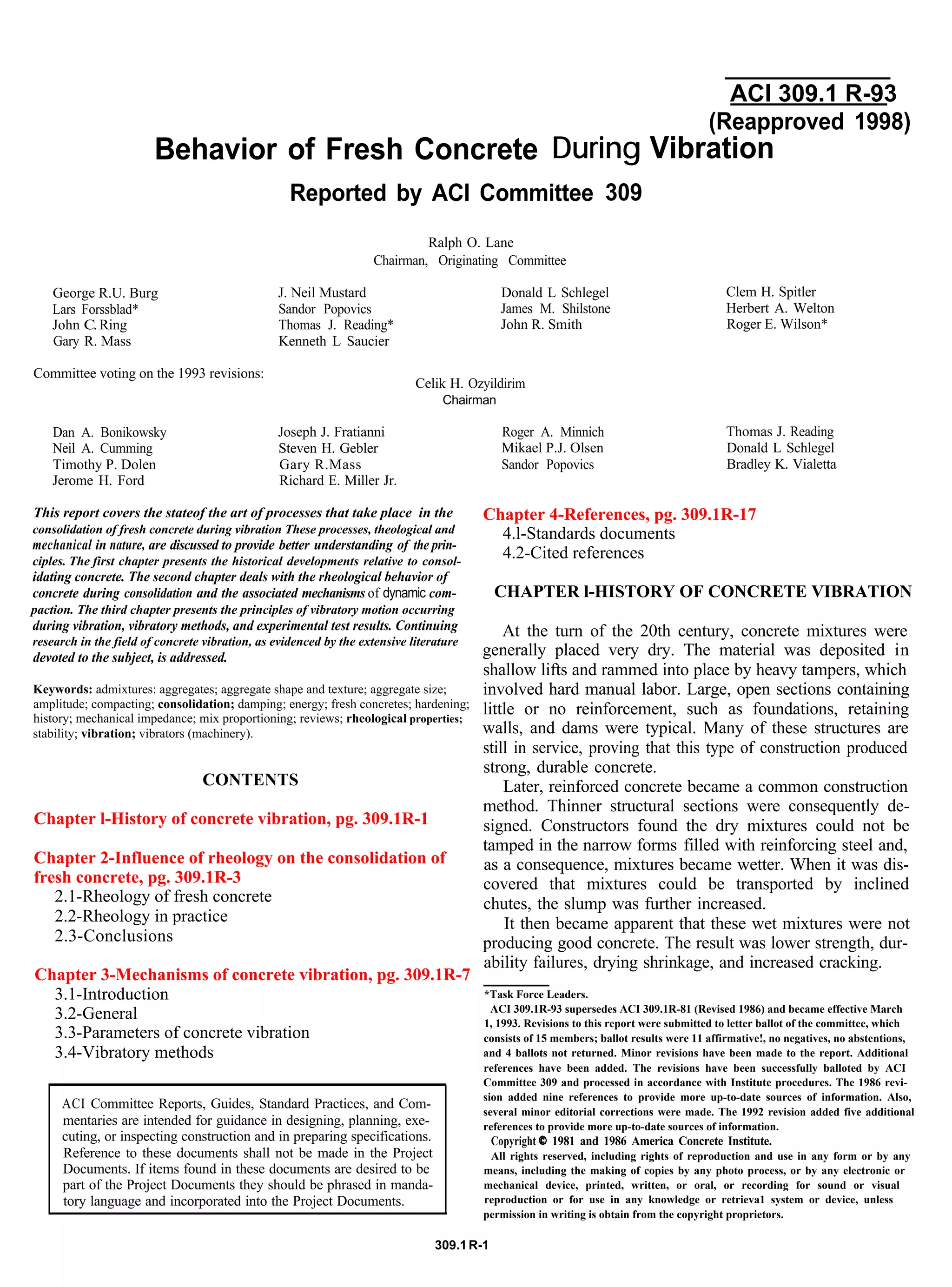


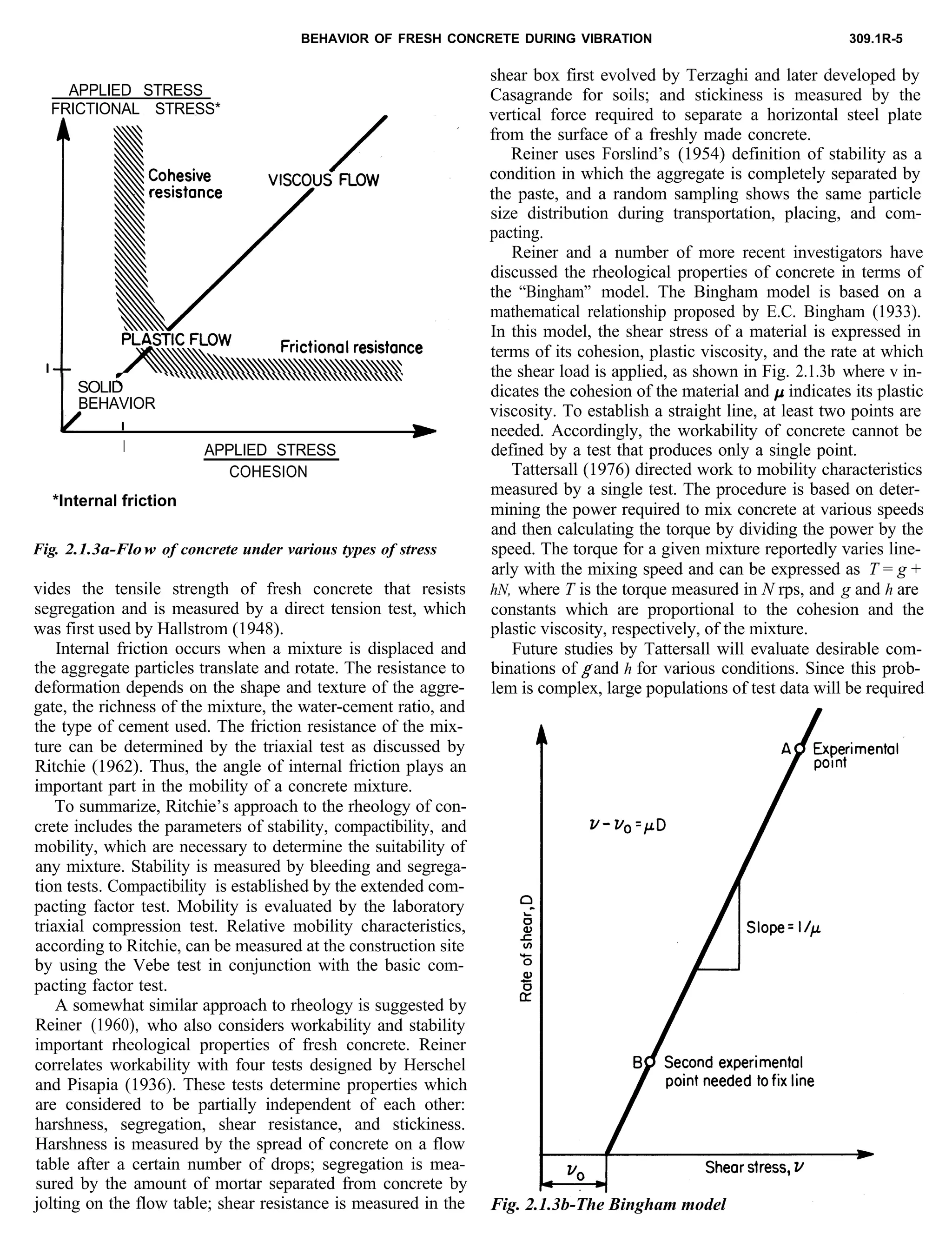


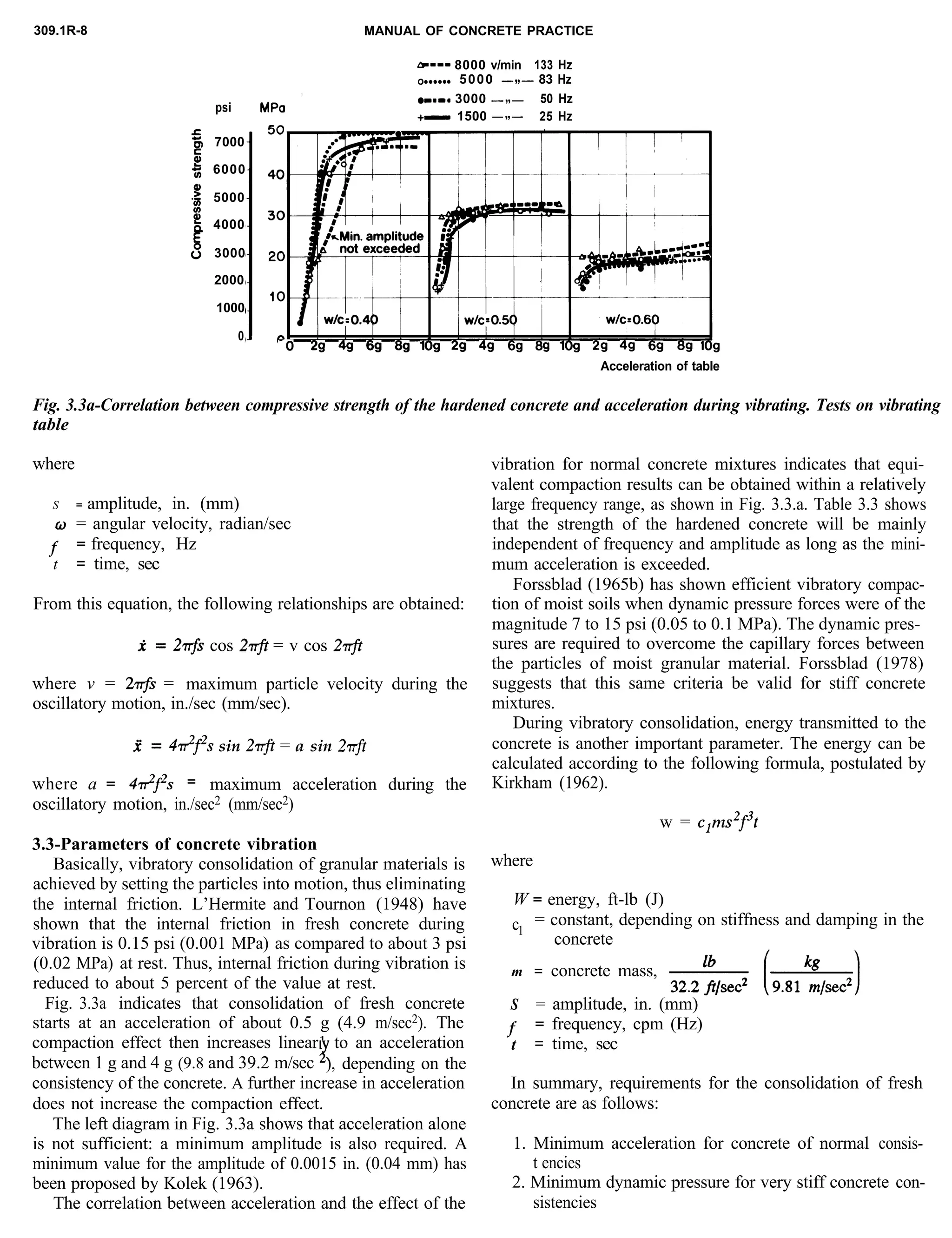


![BEHAVIOR OF FRESH CONCRETE DURING VIBRATION 309.1R-11
inertia is the primary hindrance to motion, Newton’s second
law of motion can be applied:
F = ma
where
F = force, lbf (N)
m = mass,
l b (98&d]32.2 flsec2
a = acceleration, in./sec² (mm/sec²)
This further indicates that acceleration is a major factor in
the consolidation of concrete by vibration.
Fig. 3.3.2c shows three types of behavior of fresh concrete
that take place within a few seconds of each other. First, if
the force level being used to vibrate the concrete is below
that required to get the concrete to flow, the impedance will
be according to Curve 1. The impedance can be described by
a simple model made up of one stiffness element (K), one
mass element (M), and one damping element (C). When con-
nected in the correct fashion, the impedance is equal to
z = c2 + (olu - K/o>2
If the excitation force is suddenly increased to a higher
level, the mechanical properties change and the impedance
momentarily falls until the material changes from a solid to
a liquid form. This decrease in impedance is shown by Curve
2. As long as the higher force level is maintained, the imped-
ance will track up and down a “mass line” indicated by Curve
3 as the frequency is varied. It is understood that as the
impedance is following a mass line, the system being vibrated
is a pure mass without damping and stiffness. The three types
of straight lines shown: horizontal, slanting down to right, and
slanting up to right are preprinted on mechanical impedance
paper to allow one to easily visualize the mechanical motion
taking place. If the impedance had tracked down one of the
lines slanting to the right, it would indicate that the system
being vibrated was pure stiffness. If the impedance had
tracked across one of the horizontal lines, then the system
being vibrated would have been a pure damper. All combina-
tions are possible, and most physical systems consist of all
three mechanical elements: masses, springs, and dampers.
Since concrete mixtures of normal consistencies behave
like a fluid during vibration, hydrodynamic theories are best
suited to calculate the processes and mechanisms of concrete
vibration.
Also, the fluid mixture has no reasonant frequency. Note
that Alexander’s study showed the same results for unconsol-
idated concrete.
Rheological models containing spring-supported masses
cannot readily simulate the behavior of a fresh flowing to
plastic concrete. Theories presuming that fresh concrete
behaves like an elastic body, as suggested by Bache (1973)
and Jurecka, (1968) are applicable only to very stiff mixtures.
Bache (1973) has suggested the application of hydrody-
namic theories based on the bubble movements in the fresh
concrete. Studies on the same subject have also been made
by Smalley and Ahmad (1973). The tendency of the bubbles
to move upward depends on their buoyancy. There is also a
tendency for the bubbles to move toward a vibrating surface
or even downward. For this reason, excessive vibrations of
forms or form sections must be avoided.
Bache (1977) also discussed the stability of freshly com-
pacted concrete. This stability is dependent on internal fric-
tion, cohesion, and capillary pressure. Use of crushed aggre-
gate increases internal friction. A high capillary surface
pressure can be obtained by vacuum treatment or by static or
dynamic pressure created during vibration.
3.3.3 Energy consumption- T h e initial rapid subsidence of
the mixture during vibration can be characterized as plastic
deformation requiring a large energy consumption; for com-
plete consolidation the entire transmitted energy is con-
sumed.
During the final de-aeration stage of vibration, no addi-
tional energy is necessary to keep the mass in motion since
the mixture behaves like a fluid without damping. In an ideal
fluid, the energy consumption of the vibrator is theoretically
the same as in air. A small internal friction and damping re-
mains during the de-aeration stage, thus requiring a limited
energy supply.
3.4-Vibratory methods
Thus far, the discussion on the mechanisms of vibration
has covered only general rules relating to the influence of
vibration on the freshly mixed concrete. For the different
vibratory methods, the entire vibrating system including
vibrator, the fresh concrete mixture, and the effect of the
form must be studied (Bresson 1977).
3.4.1 Internal vibration-An internal vibrator immersed in
fresh concrete generates rapidly recurring circular compres-
sion waves. (See Fig. 3.4.la). The wave amplitudes rapidly
decrease with increasing distance from the vibrator.
Fig. 3.4.1a-Principle of internal vibration](https://image.slidesharecdn.com/309-181105102342/75/309-1-r-93-behavior-of-fresh-concrete-during-vibration-11-2048.jpg)





![Concrete compaction [compatibility mode]](https://cdn.slidesharecdn.com/ss_thumbnails/concretecompactionbyrj14sep13finalcompatibilitymode-140803080639-phpapp02-thumbnail.jpg?width=640&height=640&fit=bounds)


