



Ground Improvement
Techniques
By
V.Lokeswar Reddy
CBIT, CE Dept
Context:
 Aim
 About Expansive Soil
 About Chemical Modification
 About Mechanical Modification
AIM:
 Certain Soils don’t permit the construction of specific structures
on it. The alternative is to improve the strength of the soil by
various methods like:
 Mechanical modification
 Chemical Modification
 Lime stabilization
 Geo textile etc.,
EXPANSIVE SOILS:
 Expansive soils are soils that expand(swell) when water is added,
and shrink when they dry out.
 The expansive soil has considerable strength in dry state, but the
strength goes on reducing on absorption of water. The soil exerts
considerable pressure on foundations during swelling.
 Expansive soils contain minerals such as Montmorillionite, Illite,
Kaolinite clays that are capable of absorbing water.
 In India these expansive soils are known by local names such as
Black Cotton soils (BC) in central India, Bentonite in Rajasthan
and Kashmir. These soils occupy about 30 to 40 % of the land area
of India.
CAUSE OF EXPANSION OF EXPANSIVE SOILS
 Rain
 Lawn and garden watering creates a moist zone on the
exterior of a foundation.
 Cesspools
 Septic tanks
 leaky pipes and
 swimming pools
Problems of expansive soils:
 Essentially expansive soil is one that changes in volume in
relation to changes in water content.
 Many towns, cities, transport routes and buildings are founded on
clay-rich soils and rocks. The clays within these materials may be
a significant hazard to engineering construction due to their
ability to shrink or swell with changes in water content.
 Changing water content may be due to seasonal variations (often
related to rainfall and the evapo-transpiration of vegetation), or
brought about by local site changes such as leakage from water
supply pipes or drains.
 The American Society of Civil Engineers estimates that one in
four homes have some damage caused by expansive soils.
Contd….
 Swelling pressures can cause heaving, or lifting, of structures
while shrinkage can cause differential settlement. Failure results
when the volume changes are unevenly distributed beneath the
foundation.
 Fine-grained clay-rich soils can absorb large quantities of water
after rainfall, becoming sticky and heavy. Conversely, they can
also become very hard when dry, resulting in shrinking and
cracking of the ground. This hardening and softening is known as
‘shrink-swell’ behaviour
TESTS FOR IDENTIFICATION
Simple Laboratory Tests
 Liquid Limit.(L.L.)
 Plasticity Index.(P.I.)
 Shrinkage Limit.(S.L.).
 Swelling Index
Foundation techniques in expansive soils
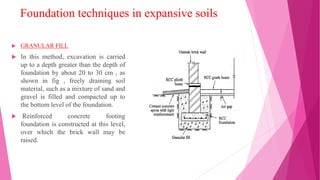
 GRANULAR FILL
 In this method, excavation is carried
up to a depth greater than the depth of
foundation by about 20 to 30 cm , as
shown in fig , freely draining soil
material, such as a mixture of sand and
gravel is filled and compacted up to
the bottom level of the foundation.
 Reinforced concrete footing
foundation is constructed at this level,
over which the brick wall may be
raised.
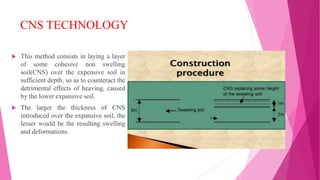
CNS TECHNOLOGY
 This method consists in laying a layer
of some cohesive non swelling
soil(CNS) over the expensive soil in
sufficient depth, so as to counteract the
detrimental effects of heaving, caused
by the lower expansive soil.
 The larger the thickness of CNS
introduced over the expansive soil, the
lesser would be the resulting swelling
and deformations.
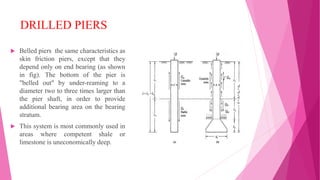
DRILLED PIERS
 Belled piers the same characteristics as
skin friction piers, except that they
depend only on end bearing (as shown
in fig). The bottom of the pier is
"belled out" by under-reaming to a
diameter two to three times larger than
the pier shaft, in order to provide
additional bearing area on the bearing
stratum.
 This system is most commonly used in
areas where competent shale or
limestone is uneconomically deep.
Under Reamed Piles:
 Under-Reamed Piles Foundation is an
answer in area where black cotton soil
could cause structural instability. Many
times, during, soils undergo volumetric
changes due to moisture variation
underneath the ground surface. This
expansion and shrinkage can cause
distress which is very dangerous and
critical as far as bearing of the foundation
is concerned. The fact is that Under
Reamed Piles are considered as most safe
and economical foundation for such black
cotton soils or expansive soils.
 The Under-Reamed Pile is the type of
cast-in-situ concrete pile.
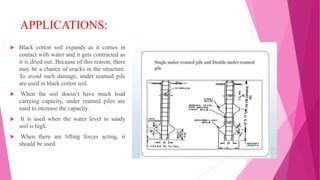
 Under reamed piles are made by C.B.R.I.(
Central Building Research Institute).
 They are made of R.C.C.
 In the bottom portion of the pile, enlarged
portion is given which is called ‘under
reamed’ or ‘bulb’.
 If pile has one bulb, it is called single reamed,
if the pile has two bulbs then it is called
double reamed, and if there are more than two
bulbs, it is called multiple under reamed piles
APPLICATIONS:
 Black cotton soil expands as it comes in
contact with water and it gets contracted as
it is dried out. Because of this reason, there
may be a chance of cracks in the structure.
To avoid such damage, under reamed pile
are used in black cotton soil.
 When the soil doesn’t have much load
carrying capacity, under reamed piles are
used to increase the capacity.
 It is used when the water level in sandy
soil is high.
 When there are lifting forces acting, it
should be used.
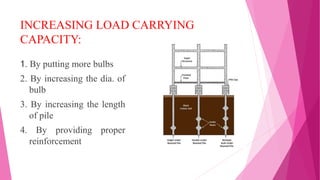
INCREASING LOAD CARRYING
CAPACITY:
1. By putting more bulbs
2. By increasing the dia. of
bulb
3. By increasing the length
of pile
4. By providing proper
reinforcement
Advantages
1. It is 15 to 20% cheaper than the
strip footing.
2. Less material required.
3. Digging is normal so the work is
carried out for anytime of the
year.
4. No back filling is required.
5. Dewatering is not necessary.
Disadvantages
 At a depth, where nature of
soil varies with a climatic
condition, Under-Reamed
Piles are not suitable for
waterlogged soil, as they take
load by friction.
 These piles need strict quality
control and regular supervision
during the construction.
Mechanical modifications:
Compaction:
 A simple ground improvement technique, where the soil is densified through
external compactive effort.
 By these compaction the improvement of soil properties and increasing the
stability of the soil.
 Many types of compacting equipment are available now a days for compacting
different types of soils.
 This is accomplished by applying static or dynamic loads to the soil.
Advantages of compaction:
 Increases shear strength
 Reduces compressibility
 Reduces permeability
 Reduces settlement of
foundation
 Increases slope stability.
Choice of method:
 Type of soil
 Type and degree of improvement
required
 Cost
 Available equipment
 Time
 Damage to adjacent structures
 durability
 Compactive effort
 Moisture content
 Soil type
 Layer thickness
 Contact pressure
 Number of rollers passes
 Speed of rolling
Types of action
 The maximum compaction
is done by
 Ramming
 Vibration
 Static roller
Factors affecting compaction in
the field
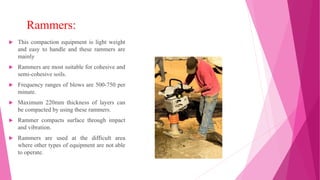
Rammers:
 This compaction equipment is light weight
and easy to handle and these rammers are
mainly
 Rammers are most suitable for cohesive and
semi-cohesive soils.
 Frequency ranges of blows are 500-750 per
minute.
 Maximum 220mm thickness of layers can
be compacted by using these rammers.
 Rammer compacts surface through impact
and vibration.
 Rammers are used at the difficult area
where other types of equipment are not able
to operate.
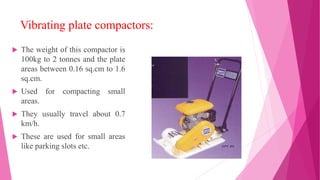
Vibrating plate compactors:
 The weight of this compactor is
100kg to 2 tonnes and the plate
areas between 0.16 sq.cm to 1.6
sq.cm.
 Used for compacting small
areas.
 They usually travel about 0.7
km/h.
 These are used for small areas
like parking slots etc.
Shallow surface compaction
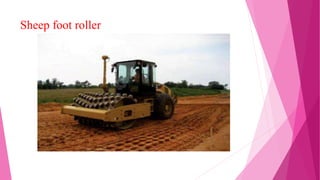
Sheep foot roller
 It is also called tamping foot roller
 Suitable for predominantly clayey soils, not for coarse grained soils.
 Tamping and kneading action
 Protruding studs /feet that penetrate into soil
 Contact pressure: 1500-7000 kPa.
 Usual roller speed 3-6km/hr
 Width of drum is 1.22 m to 1.98 m and Dia of drum is 1.02 m to 1.83 m.
 Weight of empty roller is 1.6 to 7 tonns
 The number of passes necessary for this type of roller to obtain the required
densities must be determined for each type of soil encountered.
Sheep foot roller
Contd…..
 Advantages over smooth wheeled rollers
–More suitable for cohesive sols
–Kneading action
–Increased blending(mixing things together)
–simplification of adding water or drying as needed.
–Effective in breaking down rock pieces
 Disadvantages:
–Slow operation
–Lower compacted density
–Large entrapped air (voids present in the soil due to insufficient compaction)
Smooth drum roller
 Used primarily for granular soils.
 Probably its most effective use in subgrade work is in the final
finish of a surface.
 3-6km/hr speed
 Large contact area hence less pressure(300-400kPa)
 These rollers have one large steel drum in front and two steel
drums on the rear. The gross weight of these rollers is in the range
of 8-10 tonne.
 The other type of smooth wheel roller is called Tandem Roller,
which weighs between 6-8 tonne.
 About 8 passes are adequate for compacting 20 cm layer.
Advantages of Single Drum Roller
 The single drum roller has its unique advantages. Since
it’s smaller than the double drum roller, its sleek shape can
guarantee that it can work in narrow and tight area, which
the double drum roller can’t do.
 The single drum roller is perfect for preparation work
before paving road. Using a single drum roller, we can
easily compact and flatten the ground of sidewalk or
driveway. Therefore, single drum vibratory roller is very
good at highway paving and setting foundations for some
buildings.
 The front of single drum roller is heavier, The drum needs
to be giant and weighs much to compact the ground.
Besides, due to the back tires, the roller will have better
quality than double drum one.
Advantages of Double Drum Roller:
 The most significant advantage of double drum
roller is efficiency. After all when you are
operating the roller, two drums will work on the
same time.
 It’s double area when compared with single
drum roller. That will certainly improve
working efficiency and economize manpower.
 Because of better power and efficiency, double
drum roller can work greatly on asphalt.
 The machine can flatten ground of highway
with fast speed and high accuracy.
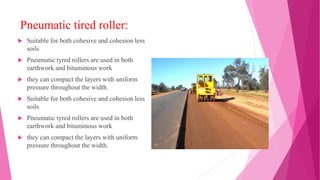
Pneumatic tired roller:
 Suitable for both cohesive and cohesion less
soils
 Pneumatic tyred rollers are used in both
earthwork and bituminous work
 they can compact the layers with uniform
pressure throughout the width.
 Suitable for both cohesive and cohesion less
soils
 Pneumatic tyred rollers are used in both
earthwork and bituminous work
 they can compact the layers with uniform
pressure throughout the width.
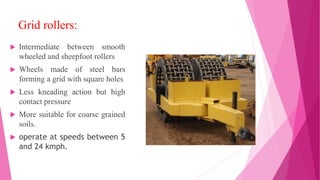
Grid rollers:
 Intermediate between smooth
wheeled and sheepfoot rollers
 Wheels made of steel bars
forming a grid with square holes
 Less kneading action but high
contact pressure
 More suitable for coarse grained
soils.
 operate at speeds between 5
and 24 kmph.
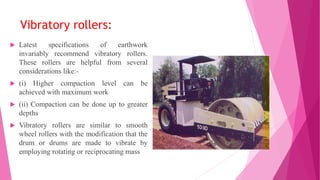
Vibratory rollers:
 Latest specifications of earthwork
invariably recommend vibratory rollers.
These rollers are helpful from several
considerations like:-
 (i) Higher compaction level can be
achieved with maximum work
 (ii) Compaction can be done up to greater
depths
 Vibratory rollers are similar to smooth
wheel rollers with the modification that the
drum or drums are made to vibrate by
employing rotating or reciprocating mass
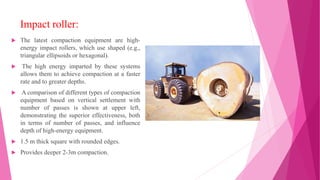
Impact roller:
 The latest compaction equipment are high-
energy impact rollers, which use shaped (e.g.,
triangular ellipsoids or hexagonal).
 The high energy imparted by these systems
allows them to achieve compaction at a faster
rate and to greater depths.
 A comparison of different types of compaction
equipment based on vertical settlement with
number of passes is shown at upper left,
demonstrating the superior effectiveness, both
in terms of number of passes, and influence
depth of high-energy equipment.
 1.5 m thick square with rounded edges.
 Provides deeper 2-3m compaction.
Vibroflotataion Techniques
 Vibroflotation is a ground improvement technique used at
a considerable depth that by using a powered electrically or
hydraulically probe, it strengthens the soil.
 Vibroflotation can be obtained by using three different techniques:
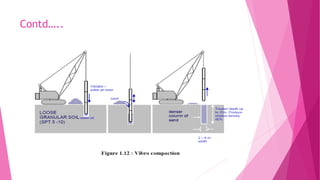
 Vibro Compaction method- This method allows granular soils to be
compacted. This method is only used to compact sandy soils.
 Vibro Replacement or displacement method- The technique is used to
replace poor or inadequate soil material by flushing out the soil with
air or water and replacing it with granular soil. This can be used in
various soil types such as clay and sandy soils.
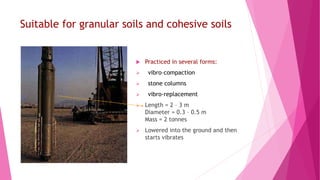
Suitable for granular soils and cohesive soils
 Practiced in several forms:
 vibro–compaction
 stone columns
 vibro-replacement
 Length = 2 – 3 m
Diameter = 0.3 – 0.5 m
Mass = 2 tonnes
 Lowered into the ground and then
starts vibrates
Contd…..
STONE COLUMNS
 Stone columns are a ground improvement technique to
improve the load bearing capacity of the soil
 The stone column consists of crushed coarse aggregates
of various sizes.
 Applicable to wide range of soils and Stone columns are
best suited to cohesive soils.
 Methods of installation
 Cased Borehole method/ Rammed stone column
 Vibration Methods - Vibrofloatation / Vibrocomposer
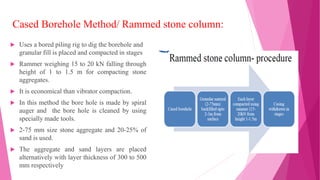
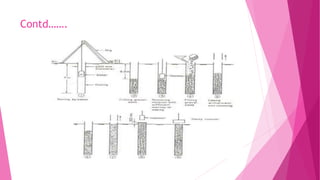
Cased Borehole Method/ Rammed stone column:
 Uses a bored piling rig to dig the borehole and
granular fill is placed and compacted in stages
 Rammer weighing 15 to 20 kN falling through
height of 1 to 1.5 m for compacting stone
aggregates.
 It is economical than vibrator compaction.
 In this method the bore hole is made by spiral
auger and the bore hole is cleaned by using
specially made tools.
 2-75 mm size stone aggregate and 20-25% of
sand is used.
 The aggregate and sand layers are placed
alternatively with layer thickness of 300 to 500
mm respectively
Contd…….
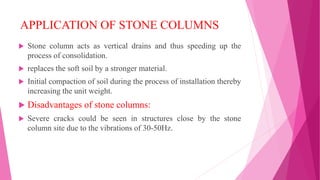
APPLICATION OF STONE COLUMNS
 Stone column acts as vertical drains and thus speeding up the
process of consolidation.
 replaces the soft soil by a stronger material.
 Initial compaction of soil during the process of installation thereby
increasing the unit weight.
 Disadvantages of stone columns:
 Severe cracks could be seen in structures close by the stone
column site due to the vibrations of 30-50Hz.
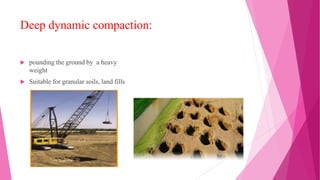
Deep dynamic compaction:
 pounding the ground by a heavy
weight
 Suitable for granular soils, land fills
Advantages of Dynamic
compaction
 Compacts large areas of
loose granular fills.
 Reduces the volume of
landfill waste.
 Increases in situ density
and the voids are
collapsed.
 Increased bearing
capacity.
Disadvantages
 The impact of the weight in
dynamic compaction sends
waves of vibration through
the ground. These vibrations
could cause disturbance and
possible damage of
surrounding structures.
 Another disadvantage
experienced when using
dynamic compaction has
occurred with combination
soil profiles
Chemical Modification:
 Grouting:
 Grouting technology has become a common ground improvement
method used frequently for underground and foundation
constructions.
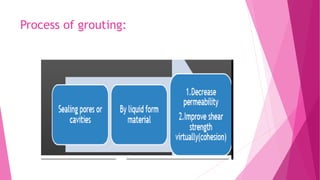
 The process of grouting consists of filling pores or cavities in soil or
rock with a liquid form material to decrease the permeability and
improve the shear strength.
 When the adhesives are injected under pressure through a pipe or
boreholes into the voids of ground or in between the structure, the
process is termed as grouting.
 Mixing adhesive and special material either in the soil surface or
column of soil if required.
Application of Grouting:
The operational limits of different grout mix are dependent on the
type of soils and the grain size distribution of the soil.
 Control of ground water during construction
 Void filling to prevent excessive settlement
 Strengthening adjacent foundation soils to protect them against
damage during excavation.
 Soil Strengthening to reduce lateral support requirements
 Stabilization of loose sands against Liquefaction
 Foundation Underpinning
Process of grouting:
Grout Mix:
 The grout mix can be generally classified into four types:
(1) mortar and pastes such as cement to fill in holes or open cracks;
(2) suspensions such as ultra-fine cement to seal and strengthen sand and
joints;
(3) solutions such as water glass (silicate) and
(4) emulsions such as chemical grout.
The operational limits of different grout mix are dependent on the type of soils
and the grain size distribution of the soil.
Cementitious Grouts:
 Cementitious grouts are the most commonly used materials for grouting and can be categorized
based on their mobility.
 For a grouting program to be cost effective, the grout must have sufficient mobility to fill the
discontinuities intended for treatment.
(1) High-Mobility Grouts :
 High-Mobility Grouts (HMGs) behave as a fluid and can be mixed, circulated, and injected with
relative ease using normal grout mixing and pumping equipment. HMGs range from pourable to
a thick consistency that is just barely able to be mixed and pumped with normal equipment.
) Low-Mobility Grouts
 Low-Mobility Grouts (LMGs) are of a mortar-like consistency and exhibit both plasticity (they
stay together when deformed) and internal friction. LMGs expand as a non-permeating bulb of
plastic material to either fill open voids or displace soil materials.
 HMGs are commonly used for permeation grouting of coarse soils and fractured rock, while
LMGs are typically used for soil densification (compaction grout) and void filling
Non-Cementitious Grouts:
 There are times when the desired impact of a grouting program requires the use of
materials other than cement. Applications such as structural grouting in soil and control of
strongly flowing water commonly lead the grouting specialist to chemical or solution
grouts.
(1) Chemical Grouts: Chemical grouting is a ground treatment method for soils with a
relatively low-viscosity grout. There are many types of chemical grout, each having
different strength, cost, viscosity, toxicity and durability.
 Commonly used solution grouts are sodium silicate these Sodium silicate has commonly
been used for structural or water control applications
 Urethanes are the material of choice for control of flowing water in structures
 Acrylates and acrylamides are highly penetrable in all mediums and form a gel when
reacted
Disadvantages
 However, there are disadvantages, including shrinking and swelling during wetting and
drying cycles, and some real and some perceived environmental impacts
Contd……
(2) Asphalt Grouts: Asphalt grouts or hot bitumen are used
in special circumstances to stop rapidly moving water.
 Asphalt is a solid at room temperature and must be
heated to above 275 °F (135 °C) to create a flowable,
viscous liquid
(3)Clay Grouts: Clay grouts are inexpensive grouts created
from a suspension of clay minerals and cement
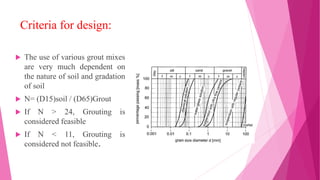
Criteria for design:
 The use of various grout mixes
are very much dependent on
the nature of soil and gradation
of soil
 N= (D15)soil / (D65)Grout
 If N > 24, Grouting is
considered feasible
 If N < 11, Grouting is
considered not feasible.
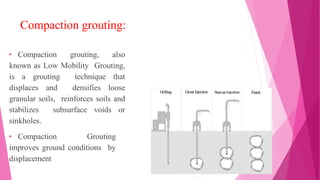
Compaction grouting:
• Compaction grouting, also
known as Low Mobility Grouting,
is a grouting technique that
displaces and densifies loose
granular soils, reinforces soils and
stabilizes subsurface voids or
sinkholes.
• Compaction Grouting
improves ground conditions by
displacement
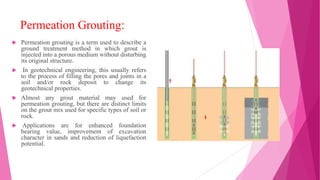
Permeation Grouting:
 Permeation grouting is a term used to describe a
ground treatment method in which grout is
injected into a porous medium without disturbing
its original structure.
 In geotechnical engineering, this usually refers
to the process of filling the pores and joints in a
soil and/or rock deposit to change its
geotechnical properties.
 Almost any grout material may used for
permeation grouting, but there are distinct limits
on the grout mix used for specific types of soil or
rock.
 Applications are for enhanced foundation
bearing value, improvement of excavation
character in sands and reduction of liquefaction
potential.
Contd…
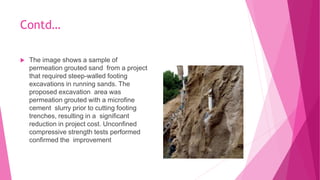
 The image shows a sample of
permeation grouted sand from a project
that required steep-walled footing
excavations in running sands. The
proposed excavation area was
permeation grouted with a microfine
cement slurry prior to cutting footing
trenches, resulting in a significant
reduction in project cost. Unconfined
compressive strength tests performed
confirmed the improvement
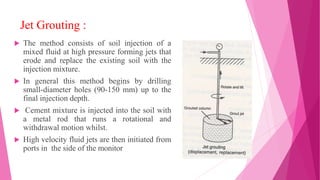
Jet Grouting :
 The method consists of soil injection of a
mixed fluid at high pressure forming jets that
erode and replace the existing soil with the
injection mixture.
 In general this method begins by drilling
small-diameter holes (90-150 mm) up to the
final injection depth.
 Cement mixture is injected into the soil with
a metal rod that runs a rotational and
withdrawal motion whilst.
 High velocity fluid jets are then initiated from
ports in the side of the monitor
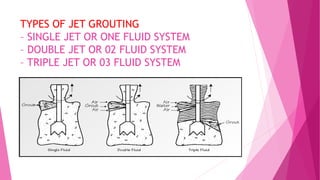
TYPES OF JET GROUTING
– SINGLE JET OR ONE FLUID SYSTEM
– DOUBLE JET OR 02 FLUID SYSTEM
– TRIPLE JET OR 03 FLUID SYSTEM
Jet Grouting Procedure
 Predrilling or foundation coring may be
necessary to access the treatment zone. Other
emerging jet grouting systems include SuperJet
and X-Jet grouting.
 •SuperJet System: a double fluid system
reliant on specialized tooling and high injection
energy for enhanced erosion capability (up to
5m diameter)
 •X-Jet System: a triple fluid system using a
pair of colliding erosion jets to create a more
uniform and controlled diameter of treatment.
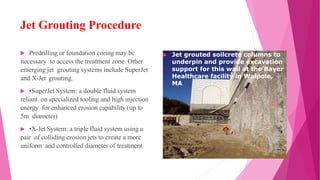
 Jet grouted soilcrete columns to
underpin and provide excavation
support for this wall at the Bayer
Healthcare facility in Walpole,
MA.
Deep soil Mixing technologies:
 The properties of soft cohesive soils can be improved by mixing of a variety of chemical
additives.
 The addition of lime, fly ash and cement in different combinations can significantly
improve the shear strength and compression properties of such soils.
 Deep soil mixing (DSM) is achieved using either a wet or a dry process where metered
quantities of additives are injected into the soil through the hollow stem of a rotary
drill string fitted to a drilling rig.
 The method helps to achieve significant improvement of mechanical and physical
properties of the existing soil, which after mixing with cement or compound binders
becomes the so-called soil-mix (or soil-cement).
 There are different mixing methods of deep soil mixing.
 Dry mixing
 Wet mixing
 Jet mixing
 Mass mixing
Dry mixing :
 Dry mixing (DM) method is clean, quiet with
very low vibration and produces no spoil for
disposal.
 The dry method is more suitable for soft soils
with very high moisture content, and hence
appropriate for mixing with dry binders.
 It has for many years extensively used in
Northern Europe and Japan.
 The method involves the use of dry binders
injected into the soil and thoroughly mixed
with moist soil.
 The soil is premixed using specialized tool
during downward penetration, until it reaches
the desired depth
 the treatment for the soil is possible to depths
up to 60 feet
 Dry soil mixing is a ground improvement
technique that mechanically mixes the soil with
dry cementitious binder to create soilcrete so as
to improve the weak soils such as soft, high
moisture clays, peats. A high speed drill moves
into the ground with a drill rod which has radial
mixing paddles near the bottom so as to
construct the columns. During the penetration
of the tool into the ground, it shears the soils to
prepare them for mixing. As and when the tool
the specified design depth, the binder is injected
through the drill steel where it is assorted with
the soil as the tool is taken out.
Wet Deep Soil Mixing method:
 This method consists of a special mixing tool which is inserted
into the soil on site. This mixing tool comprises of a drilling rod,
transverse beams and a drill end with a head. The drilling does
not cause any vibrations, and is accommodated by cement
slurry outflow from nozzles intentionally placed at the end of the
soil auger. When the design depth is reached, the construction
phase of deep soil mixing (DSM) columns is started.
 The binder slurry is injected through a feed pipe which is attached
to the arm.
 With this method, the treatment of soil is possible to depths up to
100 feet.
Mass soil mixing:
 Mass Soil Mixing is a ground improvement technique that
improves soft or loose soils, by mechanically mixing them with
either wet grout or dry cementitious binder to create soilcrete.
 The mass soil mixing process is typically constructed in pre-
defined ‘cells’ of the order of 4m x 4m in plan area.
 Commonly the cells are mixed adjacent to others to form a 100%
mass stabilised zone, all with a designed strength and stiffness.
 Mass soil mixing is low vibration, quiet, and uses readily available
materials.
 This process is often used in high groundwater conditions and has
the advantage of creating almost no spoil for disposal.
References:
From Dr.P.Purushotham Raj text book on Ground Improvement Technologies.
Mr.M.R.Hausmann
Thank you
lokesh

Ground Improvement Techniques

  • 1.
  • 2.
    Context:  Aim  AboutExpansive Soil  About Chemical Modification  About Mechanical Modification
  • 3.
    AIM:  Certain Soilsdon’t permit the construction of specific structures on it. The alternative is to improve the strength of the soil by various methods like:  Mechanical modification  Chemical Modification  Lime stabilization  Geo textile etc.,
  • 4.
    EXPANSIVE SOILS:  Expansivesoils are soils that expand(swell) when water is added, and shrink when they dry out.  The expansive soil has considerable strength in dry state, but the strength goes on reducing on absorption of water. The soil exerts considerable pressure on foundations during swelling.  Expansive soils contain minerals such as Montmorillionite, Illite, Kaolinite clays that are capable of absorbing water.  In India these expansive soils are known by local names such as Black Cotton soils (BC) in central India, Bentonite in Rajasthan and Kashmir. These soils occupy about 30 to 40 % of the land area of India.
  • 5.
    CAUSE OF EXPANSIONOF EXPANSIVE SOILS  Rain  Lawn and garden watering creates a moist zone on the exterior of a foundation.  Cesspools  Septic tanks  leaky pipes and  swimming pools
  • 6.
    Problems of expansivesoils:  Essentially expansive soil is one that changes in volume in relation to changes in water content.  Many towns, cities, transport routes and buildings are founded on clay-rich soils and rocks. The clays within these materials may be a significant hazard to engineering construction due to their ability to shrink or swell with changes in water content.  Changing water content may be due to seasonal variations (often related to rainfall and the evapo-transpiration of vegetation), or brought about by local site changes such as leakage from water supply pipes or drains.  The American Society of Civil Engineers estimates that one in four homes have some damage caused by expansive soils.
  • 7.
    Contd….  Swelling pressurescan cause heaving, or lifting, of structures while shrinkage can cause differential settlement. Failure results when the volume changes are unevenly distributed beneath the foundation.  Fine-grained clay-rich soils can absorb large quantities of water after rainfall, becoming sticky and heavy. Conversely, they can also become very hard when dry, resulting in shrinking and cracking of the ground. This hardening and softening is known as ‘shrink-swell’ behaviour
  • 8.
    TESTS FOR IDENTIFICATION SimpleLaboratory Tests  Liquid Limit.(L.L.)  Plasticity Index.(P.I.)  Shrinkage Limit.(S.L.).  Swelling Index
  • 9.
    Foundation techniques inexpansive soils  GRANULAR FILL  In this method, excavation is carried up to a depth greater than the depth of foundation by about 20 to 30 cm , as shown in fig , freely draining soil material, such as a mixture of sand and gravel is filled and compacted up to the bottom level of the foundation.  Reinforced concrete footing foundation is constructed at this level, over which the brick wall may be raised.
  • 10.
    CNS TECHNOLOGY  Thismethod consists in laying a layer of some cohesive non swelling soil(CNS) over the expensive soil in sufficient depth, so as to counteract the detrimental effects of heaving, caused by the lower expansive soil.  The larger the thickness of CNS introduced over the expansive soil, the lesser would be the resulting swelling and deformations.
  • 11.
    DRILLED PIERS  Belledpiers the same characteristics as skin friction piers, except that they depend only on end bearing (as shown in fig). The bottom of the pier is "belled out" by under-reaming to a diameter two to three times larger than the pier shaft, in order to provide additional bearing area on the bearing stratum.  This system is most commonly used in areas where competent shale or limestone is uneconomically deep.
  • 12.
    Under Reamed Piles: Under-Reamed Piles Foundation is an answer in area where black cotton soil could cause structural instability. Many times, during, soils undergo volumetric changes due to moisture variation underneath the ground surface. This expansion and shrinkage can cause distress which is very dangerous and critical as far as bearing of the foundation is concerned. The fact is that Under Reamed Piles are considered as most safe and economical foundation for such black cotton soils or expansive soils.  The Under-Reamed Pile is the type of cast-in-situ concrete pile.  Under reamed piles are made by C.B.R.I.( Central Building Research Institute).  They are made of R.C.C.  In the bottom portion of the pile, enlarged portion is given which is called ‘under reamed’ or ‘bulb’.  If pile has one bulb, it is called single reamed, if the pile has two bulbs then it is called double reamed, and if there are more than two bulbs, it is called multiple under reamed piles
  • 13.
    APPLICATIONS:  Black cottonsoil expands as it comes in contact with water and it gets contracted as it is dried out. Because of this reason, there may be a chance of cracks in the structure. To avoid such damage, under reamed pile are used in black cotton soil.  When the soil doesn’t have much load carrying capacity, under reamed piles are used to increase the capacity.  It is used when the water level in sandy soil is high.  When there are lifting forces acting, it should be used.
  • 14.
    INCREASING LOAD CARRYING CAPACITY: 1.By putting more bulbs 2. By increasing the dia. of bulb 3. By increasing the length of pile 4. By providing proper reinforcement
  • 15.
    Advantages 1. It is15 to 20% cheaper than the strip footing. 2. Less material required. 3. Digging is normal so the work is carried out for anytime of the year. 4. No back filling is required. 5. Dewatering is not necessary. Disadvantages  At a depth, where nature of soil varies with a climatic condition, Under-Reamed Piles are not suitable for waterlogged soil, as they take load by friction.  These piles need strict quality control and regular supervision during the construction.
  • 16.
    Mechanical modifications: Compaction:  Asimple ground improvement technique, where the soil is densified through external compactive effort.  By these compaction the improvement of soil properties and increasing the stability of the soil.  Many types of compacting equipment are available now a days for compacting different types of soils.  This is accomplished by applying static or dynamic loads to the soil.
  • 17.
    Advantages of compaction: Increases shear strength  Reduces compressibility  Reduces permeability  Reduces settlement of foundation  Increases slope stability. Choice of method:  Type of soil  Type and degree of improvement required  Cost  Available equipment  Time  Damage to adjacent structures  durability
  • 18.
     Compactive effort Moisture content  Soil type  Layer thickness  Contact pressure  Number of rollers passes  Speed of rolling Types of action  The maximum compaction is done by  Ramming  Vibration  Static roller Factors affecting compaction in the field
  • 19.
    Rammers:  This compactionequipment is light weight and easy to handle and these rammers are mainly  Rammers are most suitable for cohesive and semi-cohesive soils.  Frequency ranges of blows are 500-750 per minute.  Maximum 220mm thickness of layers can be compacted by using these rammers.  Rammer compacts surface through impact and vibration.  Rammers are used at the difficult area where other types of equipment are not able to operate.
  • 20.
    Vibrating plate compactors: The weight of this compactor is 100kg to 2 tonnes and the plate areas between 0.16 sq.cm to 1.6 sq.cm.  Used for compacting small areas.  They usually travel about 0.7 km/h.  These are used for small areas like parking slots etc.
  • 21.
    Shallow surface compaction Sheepfoot roller  It is also called tamping foot roller  Suitable for predominantly clayey soils, not for coarse grained soils.  Tamping and kneading action  Protruding studs /feet that penetrate into soil  Contact pressure: 1500-7000 kPa.  Usual roller speed 3-6km/hr  Width of drum is 1.22 m to 1.98 m and Dia of drum is 1.02 m to 1.83 m.  Weight of empty roller is 1.6 to 7 tonns  The number of passes necessary for this type of roller to obtain the required densities must be determined for each type of soil encountered.
  • 22.
  • 23.
    Contd…..  Advantages oversmooth wheeled rollers –More suitable for cohesive sols –Kneading action –Increased blending(mixing things together) –simplification of adding water or drying as needed. –Effective in breaking down rock pieces  Disadvantages: –Slow operation –Lower compacted density –Large entrapped air (voids present in the soil due to insufficient compaction)
  • 24.
    Smooth drum roller Used primarily for granular soils.  Probably its most effective use in subgrade work is in the final finish of a surface.  3-6km/hr speed  Large contact area hence less pressure(300-400kPa)  These rollers have one large steel drum in front and two steel drums on the rear. The gross weight of these rollers is in the range of 8-10 tonne.  The other type of smooth wheel roller is called Tandem Roller, which weighs between 6-8 tonne.  About 8 passes are adequate for compacting 20 cm layer.
  • 25.
    Advantages of SingleDrum Roller  The single drum roller has its unique advantages. Since it’s smaller than the double drum roller, its sleek shape can guarantee that it can work in narrow and tight area, which the double drum roller can’t do.  The single drum roller is perfect for preparation work before paving road. Using a single drum roller, we can easily compact and flatten the ground of sidewalk or driveway. Therefore, single drum vibratory roller is very good at highway paving and setting foundations for some buildings.  The front of single drum roller is heavier, The drum needs to be giant and weighs much to compact the ground. Besides, due to the back tires, the roller will have better quality than double drum one.
  • 26.
    Advantages of DoubleDrum Roller:  The most significant advantage of double drum roller is efficiency. After all when you are operating the roller, two drums will work on the same time.  It’s double area when compared with single drum roller. That will certainly improve working efficiency and economize manpower.  Because of better power and efficiency, double drum roller can work greatly on asphalt.  The machine can flatten ground of highway with fast speed and high accuracy.
  • 27.
    Pneumatic tired roller: Suitable for both cohesive and cohesion less soils  Pneumatic tyred rollers are used in both earthwork and bituminous work  they can compact the layers with uniform pressure throughout the width.  Suitable for both cohesive and cohesion less soils  Pneumatic tyred rollers are used in both earthwork and bituminous work  they can compact the layers with uniform pressure throughout the width.
  • 28.
    Grid rollers:  Intermediatebetween smooth wheeled and sheepfoot rollers  Wheels made of steel bars forming a grid with square holes  Less kneading action but high contact pressure  More suitable for coarse grained soils.  operate at speeds between 5 and 24 kmph.
  • 29.
    Vibratory rollers:  Latestspecifications of earthwork invariably recommend vibratory rollers. These rollers are helpful from several considerations like:-  (i) Higher compaction level can be achieved with maximum work  (ii) Compaction can be done up to greater depths  Vibratory rollers are similar to smooth wheel rollers with the modification that the drum or drums are made to vibrate by employing rotating or reciprocating mass
  • 30.
    Impact roller:  Thelatest compaction equipment are high- energy impact rollers, which use shaped (e.g., triangular ellipsoids or hexagonal).  The high energy imparted by these systems allows them to achieve compaction at a faster rate and to greater depths.  A comparison of different types of compaction equipment based on vertical settlement with number of passes is shown at upper left, demonstrating the superior effectiveness, both in terms of number of passes, and influence depth of high-energy equipment.  1.5 m thick square with rounded edges.  Provides deeper 2-3m compaction.
  • 31.
    Vibroflotataion Techniques  Vibroflotationis a ground improvement technique used at a considerable depth that by using a powered electrically or hydraulically probe, it strengthens the soil.  Vibroflotation can be obtained by using three different techniques:  Vibro Compaction method- This method allows granular soils to be compacted. This method is only used to compact sandy soils.  Vibro Replacement or displacement method- The technique is used to replace poor or inadequate soil material by flushing out the soil with air or water and replacing it with granular soil. This can be used in various soil types such as clay and sandy soils.
  • 32.
    Suitable for granularsoils and cohesive soils  Practiced in several forms:  vibro–compaction  stone columns  vibro-replacement  Length = 2 – 3 m Diameter = 0.3 – 0.5 m Mass = 2 tonnes  Lowered into the ground and then starts vibrates
  • 33.
  • 34.
    STONE COLUMNS  Stonecolumns are a ground improvement technique to improve the load bearing capacity of the soil  The stone column consists of crushed coarse aggregates of various sizes.  Applicable to wide range of soils and Stone columns are best suited to cohesive soils.  Methods of installation  Cased Borehole method/ Rammed stone column  Vibration Methods - Vibrofloatation / Vibrocomposer
  • 35.
    Cased Borehole Method/Rammed stone column:  Uses a bored piling rig to dig the borehole and granular fill is placed and compacted in stages  Rammer weighing 15 to 20 kN falling through height of 1 to 1.5 m for compacting stone aggregates.  It is economical than vibrator compaction.  In this method the bore hole is made by spiral auger and the bore hole is cleaned by using specially made tools.  2-75 mm size stone aggregate and 20-25% of sand is used.  The aggregate and sand layers are placed alternatively with layer thickness of 300 to 500 mm respectively
  • 36.
  • 37.
    APPLICATION OF STONECOLUMNS  Stone column acts as vertical drains and thus speeding up the process of consolidation.  replaces the soft soil by a stronger material.  Initial compaction of soil during the process of installation thereby increasing the unit weight.  Disadvantages of stone columns:  Severe cracks could be seen in structures close by the stone column site due to the vibrations of 30-50Hz.
  • 38.
    Deep dynamic compaction: pounding the ground by a heavy weight  Suitable for granular soils, land fills
  • 39.
    Advantages of Dynamic compaction Compacts large areas of loose granular fills.  Reduces the volume of landfill waste.  Increases in situ density and the voids are collapsed.  Increased bearing capacity. Disadvantages  The impact of the weight in dynamic compaction sends waves of vibration through the ground. These vibrations could cause disturbance and possible damage of surrounding structures.  Another disadvantage experienced when using dynamic compaction has occurred with combination soil profiles
  • 40.
    Chemical Modification:  Grouting: Grouting technology has become a common ground improvement method used frequently for underground and foundation constructions.  The process of grouting consists of filling pores or cavities in soil or rock with a liquid form material to decrease the permeability and improve the shear strength.  When the adhesives are injected under pressure through a pipe or boreholes into the voids of ground or in between the structure, the process is termed as grouting.  Mixing adhesive and special material either in the soil surface or column of soil if required.
  • 41.
    Application of Grouting: Theoperational limits of different grout mix are dependent on the type of soils and the grain size distribution of the soil.  Control of ground water during construction  Void filling to prevent excessive settlement  Strengthening adjacent foundation soils to protect them against damage during excavation.  Soil Strengthening to reduce lateral support requirements  Stabilization of loose sands against Liquefaction  Foundation Underpinning
  • 42.
  • 43.
    Grout Mix:  Thegrout mix can be generally classified into four types: (1) mortar and pastes such as cement to fill in holes or open cracks; (2) suspensions such as ultra-fine cement to seal and strengthen sand and joints; (3) solutions such as water glass (silicate) and (4) emulsions such as chemical grout. The operational limits of different grout mix are dependent on the type of soils and the grain size distribution of the soil.
  • 44.
    Cementitious Grouts:  Cementitiousgrouts are the most commonly used materials for grouting and can be categorized based on their mobility.  For a grouting program to be cost effective, the grout must have sufficient mobility to fill the discontinuities intended for treatment. (1) High-Mobility Grouts :  High-Mobility Grouts (HMGs) behave as a fluid and can be mixed, circulated, and injected with relative ease using normal grout mixing and pumping equipment. HMGs range from pourable to a thick consistency that is just barely able to be mixed and pumped with normal equipment. ) Low-Mobility Grouts  Low-Mobility Grouts (LMGs) are of a mortar-like consistency and exhibit both plasticity (they stay together when deformed) and internal friction. LMGs expand as a non-permeating bulb of plastic material to either fill open voids or displace soil materials.  HMGs are commonly used for permeation grouting of coarse soils and fractured rock, while LMGs are typically used for soil densification (compaction grout) and void filling
  • 45.
    Non-Cementitious Grouts:  Thereare times when the desired impact of a grouting program requires the use of materials other than cement. Applications such as structural grouting in soil and control of strongly flowing water commonly lead the grouting specialist to chemical or solution grouts. (1) Chemical Grouts: Chemical grouting is a ground treatment method for soils with a relatively low-viscosity grout. There are many types of chemical grout, each having different strength, cost, viscosity, toxicity and durability.  Commonly used solution grouts are sodium silicate these Sodium silicate has commonly been used for structural or water control applications  Urethanes are the material of choice for control of flowing water in structures  Acrylates and acrylamides are highly penetrable in all mediums and form a gel when reacted Disadvantages  However, there are disadvantages, including shrinking and swelling during wetting and drying cycles, and some real and some perceived environmental impacts
  • 46.
    Contd…… (2) Asphalt Grouts:Asphalt grouts or hot bitumen are used in special circumstances to stop rapidly moving water.  Asphalt is a solid at room temperature and must be heated to above 275 °F (135 °C) to create a flowable, viscous liquid (3)Clay Grouts: Clay grouts are inexpensive grouts created from a suspension of clay minerals and cement
  • 47.
    Criteria for design: The use of various grout mixes are very much dependent on the nature of soil and gradation of soil  N= (D15)soil / (D65)Grout  If N > 24, Grouting is considered feasible  If N < 11, Grouting is considered not feasible.
  • 48.
    Compaction grouting: • Compactiongrouting, also known as Low Mobility Grouting, is a grouting technique that displaces and densifies loose granular soils, reinforces soils and stabilizes subsurface voids or sinkholes. • Compaction Grouting improves ground conditions by displacement
  • 49.
    Permeation Grouting:  Permeationgrouting is a term used to describe a ground treatment method in which grout is injected into a porous medium without disturbing its original structure.  In geotechnical engineering, this usually refers to the process of filling the pores and joints in a soil and/or rock deposit to change its geotechnical properties.  Almost any grout material may used for permeation grouting, but there are distinct limits on the grout mix used for specific types of soil or rock.  Applications are for enhanced foundation bearing value, improvement of excavation character in sands and reduction of liquefaction potential.
  • 50.
    Contd…  The imageshows a sample of permeation grouted sand from a project that required steep-walled footing excavations in running sands. The proposed excavation area was permeation grouted with a microfine cement slurry prior to cutting footing trenches, resulting in a significant reduction in project cost. Unconfined compressive strength tests performed confirmed the improvement
  • 51.
    Jet Grouting : The method consists of soil injection of a mixed fluid at high pressure forming jets that erode and replace the existing soil with the injection mixture.  In general this method begins by drilling small-diameter holes (90-150 mm) up to the final injection depth.  Cement mixture is injected into the soil with a metal rod that runs a rotational and withdrawal motion whilst.  High velocity fluid jets are then initiated from ports in the side of the monitor
  • 52.
    TYPES OF JETGROUTING – SINGLE JET OR ONE FLUID SYSTEM – DOUBLE JET OR 02 FLUID SYSTEM – TRIPLE JET OR 03 FLUID SYSTEM
  • 53.
    Jet Grouting Procedure Predrilling or foundation coring may be necessary to access the treatment zone. Other emerging jet grouting systems include SuperJet and X-Jet grouting.  •SuperJet System: a double fluid system reliant on specialized tooling and high injection energy for enhanced erosion capability (up to 5m diameter)  •X-Jet System: a triple fluid system using a pair of colliding erosion jets to create a more uniform and controlled diameter of treatment.  Jet grouted soilcrete columns to underpin and provide excavation support for this wall at the Bayer Healthcare facility in Walpole, MA.
  • 54.
    Deep soil Mixingtechnologies:  The properties of soft cohesive soils can be improved by mixing of a variety of chemical additives.  The addition of lime, fly ash and cement in different combinations can significantly improve the shear strength and compression properties of such soils.  Deep soil mixing (DSM) is achieved using either a wet or a dry process where metered quantities of additives are injected into the soil through the hollow stem of a rotary drill string fitted to a drilling rig.  The method helps to achieve significant improvement of mechanical and physical properties of the existing soil, which after mixing with cement or compound binders becomes the so-called soil-mix (or soil-cement).  There are different mixing methods of deep soil mixing.  Dry mixing  Wet mixing  Jet mixing  Mass mixing
  • 55.
    Dry mixing : Dry mixing (DM) method is clean, quiet with very low vibration and produces no spoil for disposal.  The dry method is more suitable for soft soils with very high moisture content, and hence appropriate for mixing with dry binders.  It has for many years extensively used in Northern Europe and Japan.  The method involves the use of dry binders injected into the soil and thoroughly mixed with moist soil.  The soil is premixed using specialized tool during downward penetration, until it reaches the desired depth  the treatment for the soil is possible to depths up to 60 feet  Dry soil mixing is a ground improvement technique that mechanically mixes the soil with dry cementitious binder to create soilcrete so as to improve the weak soils such as soft, high moisture clays, peats. A high speed drill moves into the ground with a drill rod which has radial mixing paddles near the bottom so as to construct the columns. During the penetration of the tool into the ground, it shears the soils to prepare them for mixing. As and when the tool the specified design depth, the binder is injected through the drill steel where it is assorted with the soil as the tool is taken out.
  • 56.
    Wet Deep SoilMixing method:  This method consists of a special mixing tool which is inserted into the soil on site. This mixing tool comprises of a drilling rod, transverse beams and a drill end with a head. The drilling does not cause any vibrations, and is accommodated by cement slurry outflow from nozzles intentionally placed at the end of the soil auger. When the design depth is reached, the construction phase of deep soil mixing (DSM) columns is started.  The binder slurry is injected through a feed pipe which is attached to the arm.  With this method, the treatment of soil is possible to depths up to 100 feet.
  • 57.
    Mass soil mixing: Mass Soil Mixing is a ground improvement technique that improves soft or loose soils, by mechanically mixing them with either wet grout or dry cementitious binder to create soilcrete.  The mass soil mixing process is typically constructed in pre- defined ‘cells’ of the order of 4m x 4m in plan area.  Commonly the cells are mixed adjacent to others to form a 100% mass stabilised zone, all with a designed strength and stiffness.  Mass soil mixing is low vibration, quiet, and uses readily available materials.  This process is often used in high groundwater conditions and has the advantage of creating almost no spoil for disposal.
  • 58.
    References: From Dr.P.Purushotham Rajtext book on Ground Improvement Technologies. Mr.M.R.Hausmann
  • 59.