SHEAR STRENGTH OF
SOIL
PREPARED BY
GOURHARI BISWAS
What is Shear strength ?
• Shear strength of soil may be defined as the resistance
to shearing stresses and a consequent tendency for
shear deformation.
• Most failure patterns in geotechnical or foundation
engineering are based on shear stress development in
soil mass due to induced loading or unloading caused by
construction practices.
• Shear strength of a soil is indicative of its resistance to
erosion.
• Soil shear strength is made up of cohesion between
particles and resistance of particles sliding over each
other due to friction or interlocking.
Soil derives its shearing strength from
the following:
1. Resistance due to interlocking of particles
2.Frictional resistance between the individual soil
grains which may be sliding friction, rolling friction or
both
3.Adhesion between soil particles or cohesion
Granular soils of sands may derive their shear
strength from the first two sources(φ soil) while
cohesive soils or clays may derive their shear
strength from the second and third sources( c soil).
In nature we mostly find a mixture of different soil
grains or mixed soils which derives its shear
strength from all the above three sources ( c- φ soil).
Shear strength of cohesionless Soil
The shear strength of cohesionless
materials is essentially controlled by five
factors:
(a) mineralogical composition,
(b) size and gradation of the individual
particles,
(c) shape of the individual particles,
(d) void ratio or dry density, and
(e) confining pressure.
Internal Friction:
FRICTION
• ‘Friction’ is the primary source of shearing strength in
most natural soils. Hence, a few important aspects of the
concept of frictional resistance need to be considered.
Friction in soil occurs due to sliding,rolling and
interlocking among soil particles .
• When two solid bodies are in contact with each other, the
frictional resistance available is dependent upon the
normal force between the two and an intrinsic property
known as the ‘Coefficient of friction’.
• The coefficient of friction, in turn, depends upon the
nature and the condition of the surfaces in contact.
• Internal Friction: The frictional resistance between the
individual particles at their contact point is known as
internal friction.
Angle of Internal Friction (Ø)
• It represents the frictional resistance between
the soil particles which is directly proportional to
the normal stress.
• Angle of internal friction (friction angle) is a
measure of the ability of a unit of soil to
withstand a shear stress. It is the angle (φ),
measured between the normal force (N) and
resultant force (R), that is attained when failure
just occurs in response to a shearing stress (S).
• Angle of Internal Friction can be determined in
the laboratory by the Direct Shear Test or
the Triaxial Stress Test.
Cohesion
• The attraction between the molecules of the
same material is called Cohesion.
• It is the force that holds together molecules or
like particles within a soil.
• Cohesion is the component of shear strength of
a rock or soil that is independent of
interparticle friction.
• Clayey Soil has maximum Cohesion
• The Cohesion of Soil depends on-
a. Fineness of Clay Particles.
b. Amount of Clay
c. Water Content of Soil
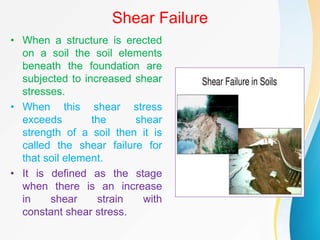
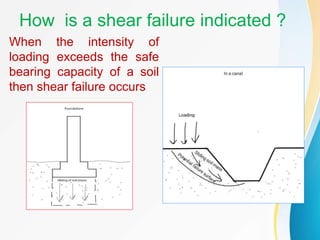
Shear Failure
• When a structure is erected
on a soil the soil elements
beneath the foundation are
subjected to increased shear
stresses.
• When this shear stress
exceeds the shear
strength of a soil then it is
called the shear failure for
that soil element.
• It is defined as the stage
when there is an increase
in shear strain with
constant shear stress.
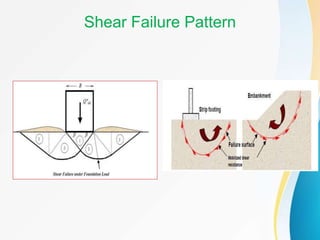
Shear Failure Pattern
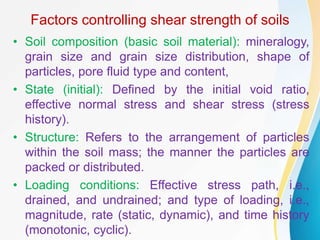
How is a shear failure indicated ?
When the intensity of
loading exceeds the safe
bearing capacity of a soil
then shear failure occurs
Factors controlling shear strength of soils
• Soil composition (basic soil material): mineralogy,
grain size and grain size distribution, shape of
particles, pore fluid type and content,
• State (initial): Defined by the initial void ratio,
effective normal stress and shear stress (stress
history).
• Structure: Refers to the arrangement of particles
within the soil mass; the manner the particles are
packed or distributed.
• Loading conditions: Effective stress path, i.e.,
drained, and undrained; and type of loading, i.e.,
magnitude, rate (static, dynamic), and time history
(monotonic, cyclic).
Mohr-Coulomb Failure Theory
• The Mohr- Coulomb theory of shearing strength of
soil was first pronounced by Coulomb(1976) and
later generalized by Mohr.
• Mohr–Coulomb failure criterion is commonly used
for determining soil shear strength.
• The failure criterion most commonly used for
defining the shear strength of a soil along a plane
is based on following Mohr- Coulomb equation:
τ = c + σ′tanφ
Where, τ = shear strength, c = effective or total
cohesion or cohesion intercept, φ = effective or
total friction angel(angle of shearing resistance)
and σ′ = effective or mean confining stress acting
on the shear surface.
Mohr-Coulomb Failure Theory contd..
• The shear failure in soils is by slippage of
particles due to shear stresses.
• According to Mohr, the failure is caused by
a critical combination of normal and shear
stresses.
• The soil fails when the shear stress on the
failure plane at failure is a unique function
of the normal stress acting on that plane.
• The Mohr theory is concerned with the
shear stress at failure plane at failure.
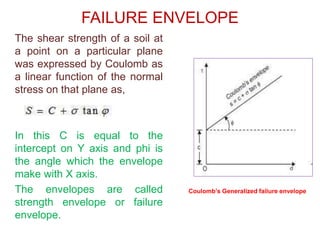
FAILURE ENVELOPE
The shear strength of a soil at
a point on a particular plane
was expressed by Coulomb as
a linear function of the normal
stress on that plane as,
In this C is equal to the
intercept on Y axis and phi is
the angle which the envelope
make with X axis.
The envelopes are called
strength envelope or failure
envelope.
Coulomb’s Generalized failure envelope
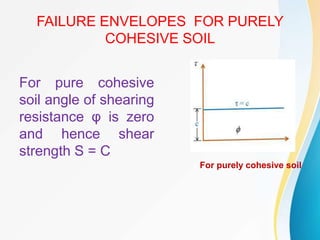
FAILURE ENVELOPES FOR PURELY
COHESIVE SOIL
For pure cohesive
soil angle of shearing
resistance φ is zero
and hence shear
strength S = C
For purely cohesive soil
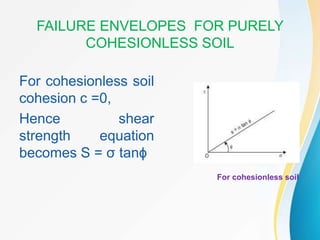
FAILURE ENVELOPES FOR PURELY
COHESIONLESS SOIL
For cohesionless soil
cohesion c =0,
Hence shear
strength equation
becomes S = σ tanϕ
For cohesionless soil
Different Types of Shear Tests and Drainage
Conditions
The following tests are used to measure the shear
strength of the soil
1.Direct shear test
2.Triaxial compression test
3.Unconfined compression test
4.Vane shear test
Depending upon the drainage conditions, there are
three types of tests
 Unconsolidated-Undrained condition
 Consolidated – Undrained condition
 Consolidated-Drained condition

SHEAR STRENGTH OF SOIL.ppt

  • 1.
  • 2.
    What is Shearstrength ? • Shear strength of soil may be defined as the resistance to shearing stresses and a consequent tendency for shear deformation. • Most failure patterns in geotechnical or foundation engineering are based on shear stress development in soil mass due to induced loading or unloading caused by construction practices. • Shear strength of a soil is indicative of its resistance to erosion. • Soil shear strength is made up of cohesion between particles and resistance of particles sliding over each other due to friction or interlocking.
  • 3.
    Soil derives itsshearing strength from the following: 1. Resistance due to interlocking of particles 2.Frictional resistance between the individual soil grains which may be sliding friction, rolling friction or both 3.Adhesion between soil particles or cohesion Granular soils of sands may derive their shear strength from the first two sources(φ soil) while cohesive soils or clays may derive their shear strength from the second and third sources( c soil). In nature we mostly find a mixture of different soil grains or mixed soils which derives its shear strength from all the above three sources ( c- φ soil).
  • 4.
    Shear strength ofcohesionless Soil The shear strength of cohesionless materials is essentially controlled by five factors: (a) mineralogical composition, (b) size and gradation of the individual particles, (c) shape of the individual particles, (d) void ratio or dry density, and (e) confining pressure.
  • 5.
    Internal Friction: FRICTION • ‘Friction’is the primary source of shearing strength in most natural soils. Hence, a few important aspects of the concept of frictional resistance need to be considered. Friction in soil occurs due to sliding,rolling and interlocking among soil particles . • When two solid bodies are in contact with each other, the frictional resistance available is dependent upon the normal force between the two and an intrinsic property known as the ‘Coefficient of friction’. • The coefficient of friction, in turn, depends upon the nature and the condition of the surfaces in contact. • Internal Friction: The frictional resistance between the individual particles at their contact point is known as internal friction.
  • 6.
    Angle of InternalFriction (Ø) • It represents the frictional resistance between the soil particles which is directly proportional to the normal stress. • Angle of internal friction (friction angle) is a measure of the ability of a unit of soil to withstand a shear stress. It is the angle (φ), measured between the normal force (N) and resultant force (R), that is attained when failure just occurs in response to a shearing stress (S). • Angle of Internal Friction can be determined in the laboratory by the Direct Shear Test or the Triaxial Stress Test.
  • 7.
    Cohesion • The attractionbetween the molecules of the same material is called Cohesion. • It is the force that holds together molecules or like particles within a soil. • Cohesion is the component of shear strength of a rock or soil that is independent of interparticle friction. • Clayey Soil has maximum Cohesion • The Cohesion of Soil depends on- a. Fineness of Clay Particles. b. Amount of Clay c. Water Content of Soil
  • 8.
    Shear Failure • Whena structure is erected on a soil the soil elements beneath the foundation are subjected to increased shear stresses. • When this shear stress exceeds the shear strength of a soil then it is called the shear failure for that soil element. • It is defined as the stage when there is an increase in shear strain with constant shear stress.
  • 9.
  • 10.
    How is ashear failure indicated ? When the intensity of loading exceeds the safe bearing capacity of a soil then shear failure occurs
  • 11.
    Factors controlling shearstrength of soils • Soil composition (basic soil material): mineralogy, grain size and grain size distribution, shape of particles, pore fluid type and content, • State (initial): Defined by the initial void ratio, effective normal stress and shear stress (stress history). • Structure: Refers to the arrangement of particles within the soil mass; the manner the particles are packed or distributed. • Loading conditions: Effective stress path, i.e., drained, and undrained; and type of loading, i.e., magnitude, rate (static, dynamic), and time history (monotonic, cyclic).
  • 12.
    Mohr-Coulomb Failure Theory •The Mohr- Coulomb theory of shearing strength of soil was first pronounced by Coulomb(1976) and later generalized by Mohr. • Mohr–Coulomb failure criterion is commonly used for determining soil shear strength. • The failure criterion most commonly used for defining the shear strength of a soil along a plane is based on following Mohr- Coulomb equation: τ = c + σ′tanφ Where, τ = shear strength, c = effective or total cohesion or cohesion intercept, φ = effective or total friction angel(angle of shearing resistance) and σ′ = effective or mean confining stress acting on the shear surface.
  • 13.
    Mohr-Coulomb Failure Theorycontd.. • The shear failure in soils is by slippage of particles due to shear stresses. • According to Mohr, the failure is caused by a critical combination of normal and shear stresses. • The soil fails when the shear stress on the failure plane at failure is a unique function of the normal stress acting on that plane. • The Mohr theory is concerned with the shear stress at failure plane at failure.
  • 14.
    FAILURE ENVELOPE The shearstrength of a soil at a point on a particular plane was expressed by Coulomb as a linear function of the normal stress on that plane as, In this C is equal to the intercept on Y axis and phi is the angle which the envelope make with X axis. The envelopes are called strength envelope or failure envelope. Coulomb’s Generalized failure envelope
  • 15.
    FAILURE ENVELOPES FORPURELY COHESIVE SOIL For pure cohesive soil angle of shearing resistance φ is zero and hence shear strength S = C For purely cohesive soil
  • 16.
    FAILURE ENVELOPES FORPURELY COHESIONLESS SOIL For cohesionless soil cohesion c =0, Hence shear strength equation becomes S = σ tanϕ For cohesionless soil
  • 17.
    Different Types ofShear Tests and Drainage Conditions The following tests are used to measure the shear strength of the soil 1.Direct shear test 2.Triaxial compression test 3.Unconfined compression test 4.Vane shear test Depending upon the drainage conditions, there are three types of tests  Unconsolidated-Undrained condition  Consolidated – Undrained condition  Consolidated-Drained condition