1
Presentation Sequence
• Introduction
• What is vibration
• What are Vibrators?
• Functions of Vibrators.
• How vibration could be done?
• Types of Vibrators.
• Applications.
• How long to vibrate concrete?
• Conclusion.
2
Introduction
• Presented To:
Sir Hadhi
• Presented By:
Muhammad Usman 2017-CCET-CIVIL-10
Hassan Ur Rahman 2017-CCET-CIVIL-18
Zaid Ur Rehman 2017-CCET-CIVIL-22
Chenab College Of Engineering & Technology Gujranwala 3
Vibration
• Vibration means quickly moving back and
forth (or up and down) about a point of
equilibrium. The vibration may be periodic
(having a pattern) or random. Something that
is vibrating may shake at the same time. If it
vibrates in a regular way, it may produce a
musical note because it can make the air
vibrate.
4
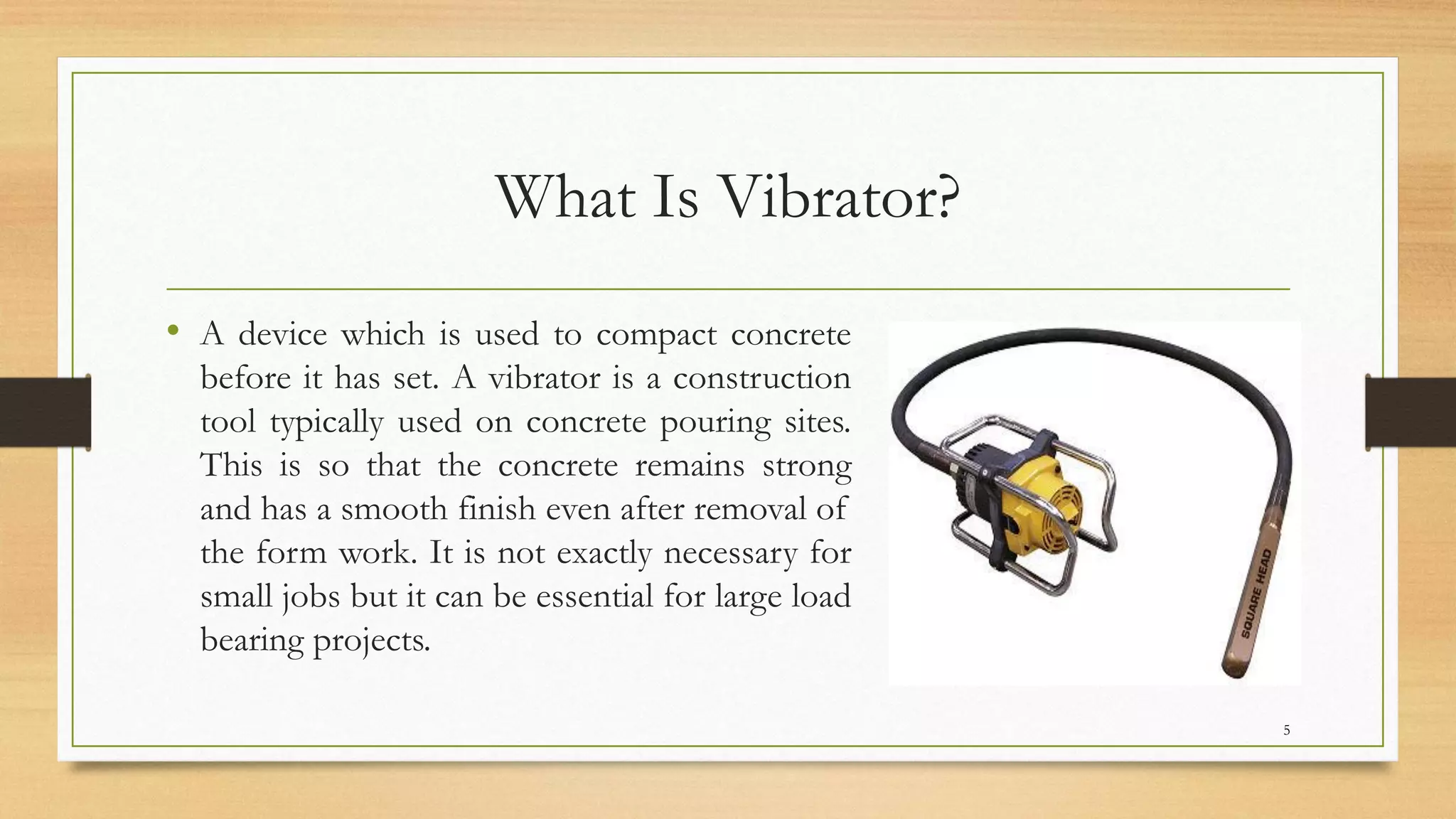
What Is Vibrator?
• A device which is used to compact concrete
before it has set. A vibrator is a construction
tool typically used on concrete pouring sites.
This is so that the concrete remains strong
and has a smooth finish even after removal of
the form work. It is not exactly necessary for
small jobs but it can be essential for large load
bearing projects.
5
Function Of Vibrator
• A vibrator is a mechanical device to generate
vibrations.
• The vibration is often generated by an electric
motor with an unbalanced mass on its
driveshaft.
6
How vibration could be done?
• Historically, it was achieved by ramming or punning, but nowadays
compaction is mostly carried out by vibration.
• Air bubbles develop when the fresh concrete is poured in the form. If we do
not eliminate air bubbles from the concrete mix then concrete becomes
porous or permeable.
• Porous or permeable concrete leads to the problems like leakages, corrosion,
etc. in house or building. The technique eliminates most of the entrapped air
bubbles from the fresh concrete.
7
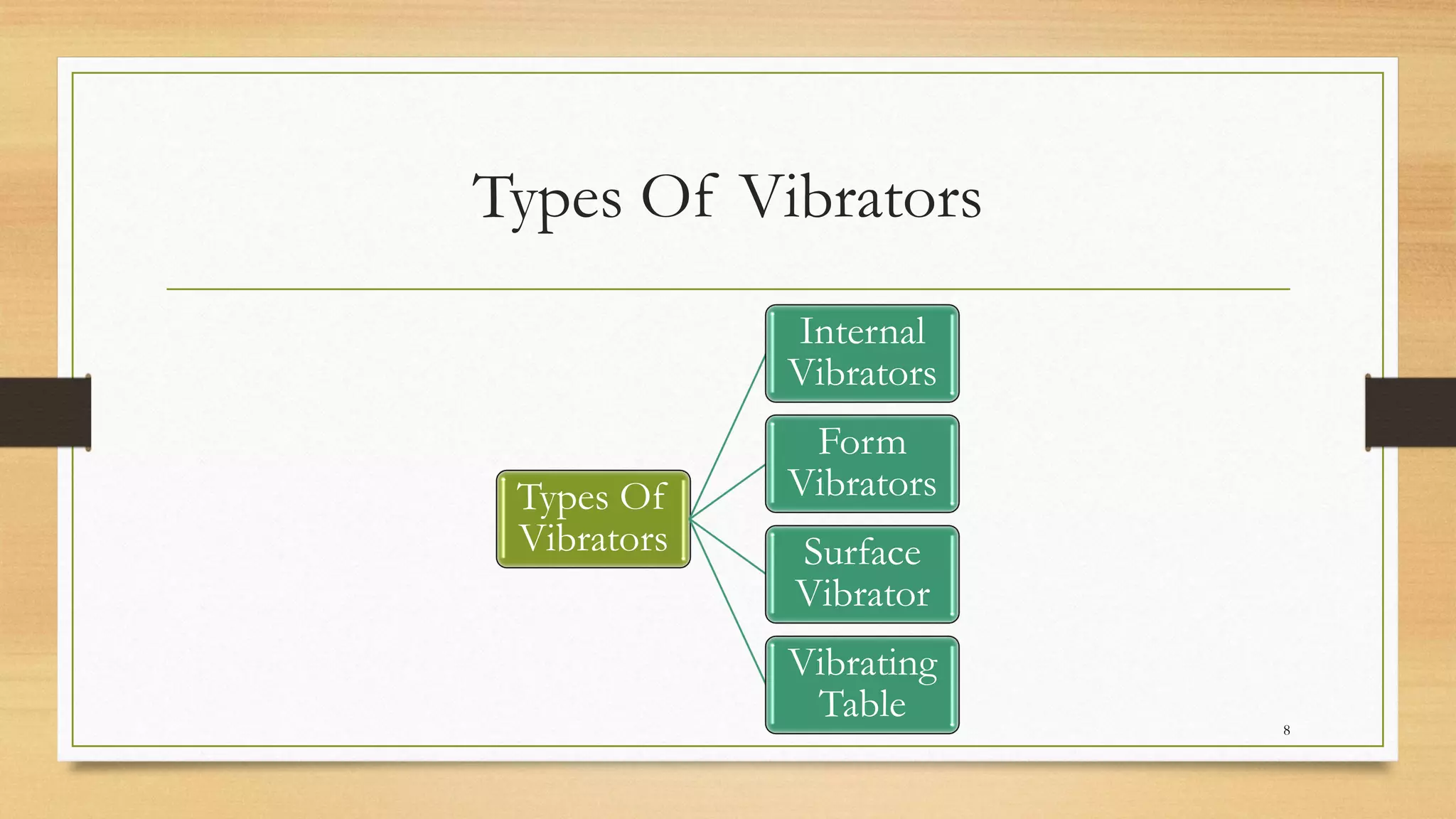
Types Of Vibrators
8
Types Of
Vibrators
Internal
Vibrators
Form
Vibrators
Surface
Vibrator
Vibrating
Table
Internal Vibrator
• These are also called immersion, poker or needle
vibrators. They essentially consist of a power unit
and a long flexible tube at the end of which a
vibrating head is attached.
• Power is provided by electric motor, compressed
air or petrol engine. The long tube houses a
flexible shaft which rotates an eccentric weight
inside the vibrating head. The vibrating head is
inserted in the concrete.
9
Form Vibrator
• A shutter form vibrator is also called an external vibrator
and is clamped rigidly to the form work at pre-determined
points. This allows for the form and concrete to be vibrated.
They are more powerful for a given compaction than an
internal vibrator.
• They are used only if the use of internal vibrators is not
practicable as in the case of thin and congested sections,
arches and tunnel lining, etc.
• Efficiency is low because these are not directly immersed
into concrete. It is placed on outer part of shuttering.
10
Surface Vibrator
• They are also called screed or pan vibrators.
Surface vibrators are placed on the concrete mass
and are best used for the compaction of shallow
elements.
• Mixes that are extremely dry can be most effective
compacted using surface vibrators. There are two
surface vibrators that are most commonly used:
pan vibrators and vibrating screeds.
11
Vibrating Table
• These are rigidly built steel platforms mounted on steel
springs and driven by electric motors. The concrete is
placed in moulds mounted on the platforms and securely
clamped to the vibrating table, so that mould and concrete
vibrate in union.
• These types of vibrators are excellent for compacting harsh
concrete mixes that are used for manufactured pre-cast
elements such as those in factories or laboratories.
12
Applications
• Internal Vibrators:
Internal concrete vibrators are most
common type used. Many can be handled by a
single operator. The process is relatively simple:
The worker quickly jams a probe-like internal
vibrator down into the wet concrete, then slowly
withdraws it.
13
Form Vibrator
• Formwork vibration is commonly used in
precast concrete construction and involves
mounting the vibrators to the outsides of
the concrete forms. For larger pours, the
external form vibrators are often spaced 6
feet apart.
14
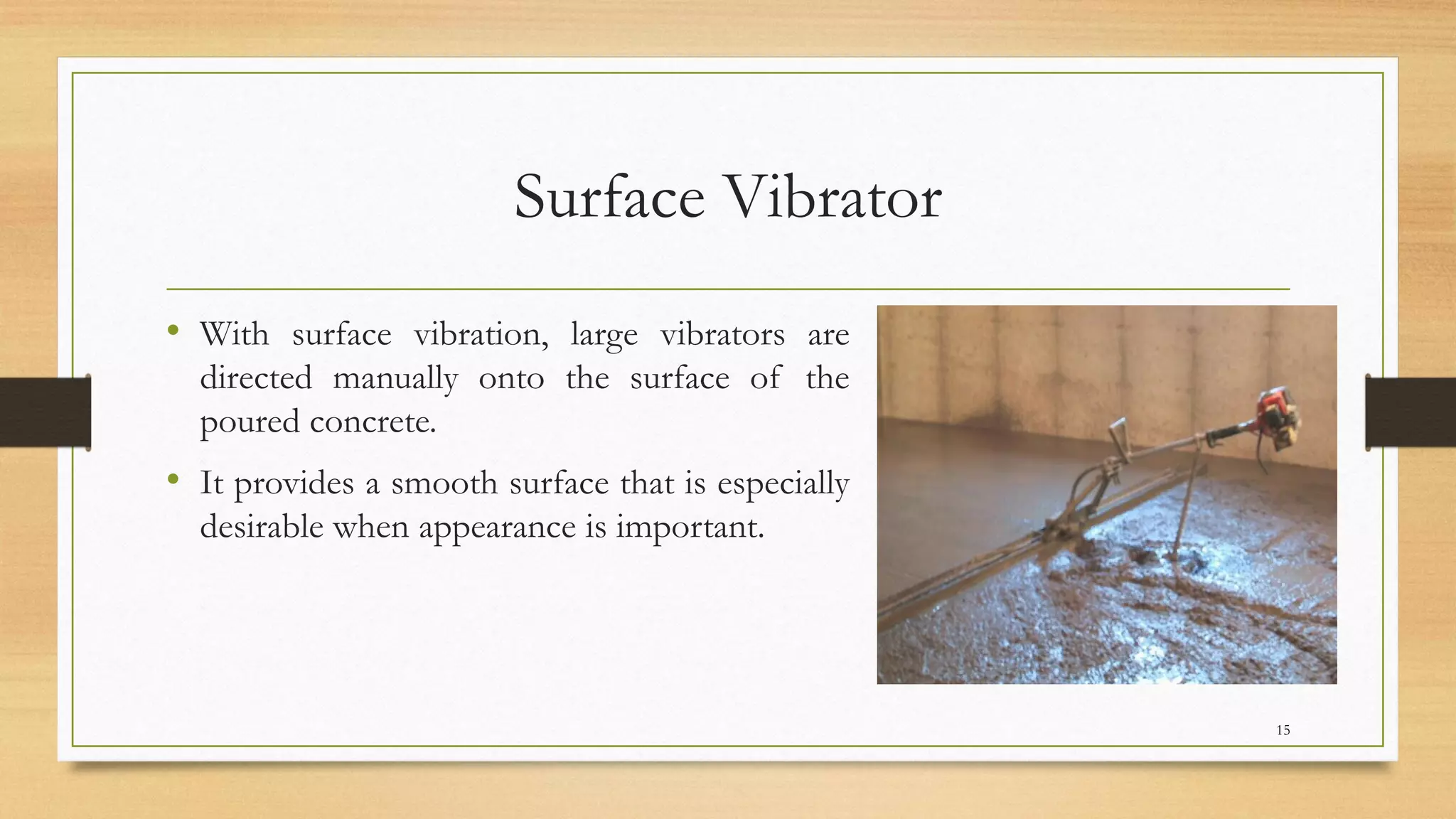
Surface Vibrator
• With surface vibration, large vibrators are
directed manually onto the surface of the
poured concrete.
• It provides a smooth surface that is especially
desirable when appearance is important.
15
How long to vibrate concrete?
• As you bring the vibrator up slowly, watch the air bubbles rise, then stop
when a thin film of paste is covering the surface. Coming up slowly is the
key to proper consolidation, at a recommended rate of about 1″ per second.
• Insert again quickly, and remove slowly, watching the bubbles rise and
diminish. You may think that you’re coming up too slow, but start slow and
watch how the concrete reacts, and see how it looks at the end. Generally, the
slower the better.
16
Conclusion
• The major use of vibrator is to compact the green concrete to achieve
maximum density which is directly proportional to the strength of concrete.
• Most common vibrator is needle, because less price and easy handling and
used everywhere needed.
• Second most common vibrator is plate, this is needed where needle vibrator
does not work.
17
Thank You
18

Vibrators

  • 1.
  • 2.
    Presentation Sequence • Introduction •What is vibration • What are Vibrators? • Functions of Vibrators. • How vibration could be done? • Types of Vibrators. • Applications. • How long to vibrate concrete? • Conclusion. 2
  • 3.
    Introduction • Presented To: SirHadhi • Presented By: Muhammad Usman 2017-CCET-CIVIL-10 Hassan Ur Rahman 2017-CCET-CIVIL-18 Zaid Ur Rehman 2017-CCET-CIVIL-22 Chenab College Of Engineering & Technology Gujranwala 3
  • 4.
    Vibration • Vibration meansquickly moving back and forth (or up and down) about a point of equilibrium. The vibration may be periodic (having a pattern) or random. Something that is vibrating may shake at the same time. If it vibrates in a regular way, it may produce a musical note because it can make the air vibrate. 4
  • 5.
    What Is Vibrator? •A device which is used to compact concrete before it has set. A vibrator is a construction tool typically used on concrete pouring sites. This is so that the concrete remains strong and has a smooth finish even after removal of the form work. It is not exactly necessary for small jobs but it can be essential for large load bearing projects. 5
  • 6.
    Function Of Vibrator •A vibrator is a mechanical device to generate vibrations. • The vibration is often generated by an electric motor with an unbalanced mass on its driveshaft. 6
  • 7.
    How vibration couldbe done? • Historically, it was achieved by ramming or punning, but nowadays compaction is mostly carried out by vibration. • Air bubbles develop when the fresh concrete is poured in the form. If we do not eliminate air bubbles from the concrete mix then concrete becomes porous or permeable. • Porous or permeable concrete leads to the problems like leakages, corrosion, etc. in house or building. The technique eliminates most of the entrapped air bubbles from the fresh concrete. 7
  • 8.
    Types Of Vibrators 8 TypesOf Vibrators Internal Vibrators Form Vibrators Surface Vibrator Vibrating Table
  • 9.
    Internal Vibrator • Theseare also called immersion, poker or needle vibrators. They essentially consist of a power unit and a long flexible tube at the end of which a vibrating head is attached. • Power is provided by electric motor, compressed air or petrol engine. The long tube houses a flexible shaft which rotates an eccentric weight inside the vibrating head. The vibrating head is inserted in the concrete. 9
  • 10.
    Form Vibrator • Ashutter form vibrator is also called an external vibrator and is clamped rigidly to the form work at pre-determined points. This allows for the form and concrete to be vibrated. They are more powerful for a given compaction than an internal vibrator. • They are used only if the use of internal vibrators is not practicable as in the case of thin and congested sections, arches and tunnel lining, etc. • Efficiency is low because these are not directly immersed into concrete. It is placed on outer part of shuttering. 10
  • 11.
    Surface Vibrator • Theyare also called screed or pan vibrators. Surface vibrators are placed on the concrete mass and are best used for the compaction of shallow elements. • Mixes that are extremely dry can be most effective compacted using surface vibrators. There are two surface vibrators that are most commonly used: pan vibrators and vibrating screeds. 11
  • 12.
    Vibrating Table • Theseare rigidly built steel platforms mounted on steel springs and driven by electric motors. The concrete is placed in moulds mounted on the platforms and securely clamped to the vibrating table, so that mould and concrete vibrate in union. • These types of vibrators are excellent for compacting harsh concrete mixes that are used for manufactured pre-cast elements such as those in factories or laboratories. 12
  • 13.
    Applications • Internal Vibrators: Internalconcrete vibrators are most common type used. Many can be handled by a single operator. The process is relatively simple: The worker quickly jams a probe-like internal vibrator down into the wet concrete, then slowly withdraws it. 13
  • 14.
    Form Vibrator • Formworkvibration is commonly used in precast concrete construction and involves mounting the vibrators to the outsides of the concrete forms. For larger pours, the external form vibrators are often spaced 6 feet apart. 14
  • 15.
    Surface Vibrator • Withsurface vibration, large vibrators are directed manually onto the surface of the poured concrete. • It provides a smooth surface that is especially desirable when appearance is important. 15
  • 16.
    How long tovibrate concrete? • As you bring the vibrator up slowly, watch the air bubbles rise, then stop when a thin film of paste is covering the surface. Coming up slowly is the key to proper consolidation, at a recommended rate of about 1″ per second. • Insert again quickly, and remove slowly, watching the bubbles rise and diminish. You may think that you’re coming up too slow, but start slow and watch how the concrete reacts, and see how it looks at the end. Generally, the slower the better. 16
  • 17.
    Conclusion • The majoruse of vibrator is to compact the green concrete to achieve maximum density which is directly proportional to the strength of concrete. • Most common vibrator is needle, because less price and easy handling and used everywhere needed. • Second most common vibrator is plate, this is needed where needle vibrator does not work. 17
  • 18.