Communications in underground mining using
Broad Band Power Line Modem
Ervin Hung
Nautitech Mining Systems
10th December 2015
Introduction – Data communications in underground coal
• Data communications an integral part of every mines
operation
• Key factor of success
• Growing importance
• Improvements in communications benefits
• Logistics of people
• Fleet optimisation
• Contractor monitoring
• Machine performance (monitoring)
Introduction – Data communications in underground coal
(cont)
• Improvements in communications benefits (cont)
• Automation
• Efficiency
• Productivity improvements
Current Solutions:
• Generally 2 types commonly used:
• Wired
• Twisted pair, coax, CAT5, fibre optics, trailing
cables etc
• Wireless
• Radio (point to point and mesh), Wi-fi, Leaky
Feeders etc
Current Solutions (cont)
• Typical product technologies available
• 2 way radios
• VOIP phones
• DACs
• Cap lamps
• Nodes/access points
• Serial Powerline Modems
• Broadband Powerline Modems
• RF tracking tags
• Etc.
Current Solutions (cont)
• Existing product technologies are proven and supported
well
• Ideally, high bandwidth and coverage for areas currently
with no / low coverage
• Current practices for roadway development: Access
points along wall to boost Wi-Fi signal
• Laying Fibre
Case Study:
• Minesite:
• Ensham Resources, Emerald QLD
• Brad Price - EEM
• Requirements:
• Network connections – Wired equipment
• Network connections – Wi-Fi equipment
• Reliable provisions of network access
• Support existing product technologies
• Simple installation
Case Study (cont.):
• Solution:
• Solution will have to fulfil 2 functional requirements:
• Surface to CM - Power line comms
• Wi-Fi Hotspot around CM - Wi-Fi access point
• Combination of different but existing and proven
comms technology
Case Study (cont.):
• Solution:
• Characteristics of power line modems
• Reliable and high bandwidth
• Uses existing trailing cable
• Protected from mining environment
• Characteristics of Wi-Fi hotspots
• Use of portable equipment without wires
• Coverage in areas where it’s needed
Case Study (cont.):
• Solution:
• Requirements catered for by 2 separate sub-systems
• Spitfire BPLM kit
• I.S. Access point
• Proposed solution are
• Technology well proven
• Existing
• Bolt on, no new approvals required
• Readily available
• Used extensively
Case Study (cont.):
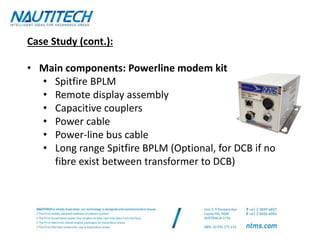
• Main components: Powerline modem kit
• Spitfire BPLM
• Remote display assembly
• Capacitive couplers
• Power cable
• Power-line bus cable
• Long range Spitfire BPLM (Optional, for DCB if no
fibre exist between transformer to DCB)
Case Study (cont.):
• Main components: Wireless kit
• I.S. PSU
• I.S. NetPort Access Point
• Media converter
• Antenna
• FRAS LMR 400 coax cable 5m M-M
Case Study (cont.):
• Advantages
• Reduce cost of communications infrastructure
• No need for Wif-Fi infrastructure all along the
roadway between DCB and Continuous miners
• Bring connectivity to the coal face with the CM
• Increase data bandwidth
• Consistent and reliable connections with no drop
outs in coverage around the CM
Case Study (cont.):
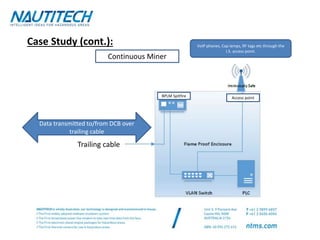
Trailing cable
BPLM Spitfire
VoIP phones, Cap lamps, RF tags etc through the
I.S. access point.
Access point
Continuous Miner
Data transmitted to/from DCB over
trailing cable
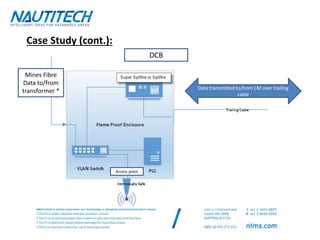
Mines Fibre
Data to/from
transformer *
Case Study (cont.):
DCB
Access point
Data transmitted to/from CM over trailing
cable
Case Study (cont.):
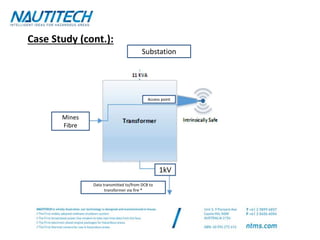
Mines
Fibre
Data transmitted to/from DCB to
transformer via fire *
Substation
Access point
1kV
Conclusion:
• The Spitfire BPLM Wifi solution installed at Ensham and
the 1st system in the field for 12 weeks
• Physical layer data rate consistently around 50 Mbps
with no drop outs
• Subsequently, a second system has been installed into
another CM
• Ensham looking to extend the use of the BPLM wifi
system into their other applications
Conclusion: Future applications and considerations
• Breaker / Feeder
• Shuttle cars
• Conveyors
• Proximity detection system connectivity
• Live video streaming
• Data logging of machine state
• Production improvement
• Fault analysis & Preventative maintenance
• Diagnostics
Conclusion: Future applications and considerations
• CM automation
• Instantaneous pointing and tilt information
• Automated roadway alignments
• Remote control from surface
Thank you

Underground Mining Communications using Broadband Power Line Modems

  • 1.
    Communications in undergroundmining using Broad Band Power Line Modem Ervin Hung Nautitech Mining Systems 10th December 2015
  • 2.
    Introduction – Datacommunications in underground coal • Data communications an integral part of every mines operation • Key factor of success • Growing importance • Improvements in communications benefits • Logistics of people • Fleet optimisation • Contractor monitoring • Machine performance (monitoring)
  • 3.
    Introduction – Datacommunications in underground coal (cont) • Improvements in communications benefits (cont) • Automation • Efficiency • Productivity improvements
  • 4.
    Current Solutions: • Generally2 types commonly used: • Wired • Twisted pair, coax, CAT5, fibre optics, trailing cables etc • Wireless • Radio (point to point and mesh), Wi-fi, Leaky Feeders etc
  • 5.
    Current Solutions (cont) •Typical product technologies available • 2 way radios • VOIP phones • DACs • Cap lamps • Nodes/access points • Serial Powerline Modems • Broadband Powerline Modems • RF tracking tags • Etc.
  • 6.
    Current Solutions (cont) •Existing product technologies are proven and supported well • Ideally, high bandwidth and coverage for areas currently with no / low coverage • Current practices for roadway development: Access points along wall to boost Wi-Fi signal • Laying Fibre
  • 7.
    Case Study: • Minesite: •Ensham Resources, Emerald QLD • Brad Price - EEM • Requirements: • Network connections – Wired equipment • Network connections – Wi-Fi equipment • Reliable provisions of network access • Support existing product technologies • Simple installation
  • 8.
    Case Study (cont.): •Solution: • Solution will have to fulfil 2 functional requirements: • Surface to CM - Power line comms • Wi-Fi Hotspot around CM - Wi-Fi access point • Combination of different but existing and proven comms technology
  • 9.
    Case Study (cont.): •Solution: • Characteristics of power line modems • Reliable and high bandwidth • Uses existing trailing cable • Protected from mining environment • Characteristics of Wi-Fi hotspots • Use of portable equipment without wires • Coverage in areas where it’s needed
  • 10.
    Case Study (cont.): •Solution: • Requirements catered for by 2 separate sub-systems • Spitfire BPLM kit • I.S. Access point • Proposed solution are • Technology well proven • Existing • Bolt on, no new approvals required • Readily available • Used extensively
  • 11.
    Case Study (cont.): •Main components: Powerline modem kit • Spitfire BPLM • Remote display assembly • Capacitive couplers • Power cable • Power-line bus cable • Long range Spitfire BPLM (Optional, for DCB if no fibre exist between transformer to DCB)
  • 12.
    Case Study (cont.): •Main components: Wireless kit • I.S. PSU • I.S. NetPort Access Point • Media converter • Antenna • FRAS LMR 400 coax cable 5m M-M
  • 13.
    Case Study (cont.): •Advantages • Reduce cost of communications infrastructure • No need for Wif-Fi infrastructure all along the roadway between DCB and Continuous miners • Bring connectivity to the coal face with the CM • Increase data bandwidth • Consistent and reliable connections with no drop outs in coverage around the CM
  • 14.
    Case Study (cont.): Trailingcable BPLM Spitfire VoIP phones, Cap lamps, RF tags etc through the I.S. access point. Access point Continuous Miner Data transmitted to/from DCB over trailing cable
  • 15.
    Mines Fibre Data to/from transformer* Case Study (cont.): DCB Access point Data transmitted to/from CM over trailing cable
  • 16.
    Case Study (cont.): Mines Fibre Datatransmitted to/from DCB to transformer via fire * Substation Access point 1kV
  • 17.
    Conclusion: • The SpitfireBPLM Wifi solution installed at Ensham and the 1st system in the field for 12 weeks • Physical layer data rate consistently around 50 Mbps with no drop outs • Subsequently, a second system has been installed into another CM • Ensham looking to extend the use of the BPLM wifi system into their other applications
  • 18.
    Conclusion: Future applicationsand considerations • Breaker / Feeder • Shuttle cars • Conveyors • Proximity detection system connectivity • Live video streaming • Data logging of machine state • Production improvement • Fault analysis & Preventative maintenance • Diagnostics
  • 19.
    Conclusion: Future applicationsand considerations • CM automation • Instantaneous pointing and tilt information • Automated roadway alignments • Remote control from surface
  • 20.

Editor's Notes

  • #3 Data communications in an underground coal mine is an integral part of every mines operations. This key factor of success of any mining operation is dependent on the data communications from surface to right down the coal face whether it is at the long wall or at the continuous miner In recent times, real time communications from anywhere underground to the surface is increasingly becoming more important. Improvements in reliable comms coverage and real time communications to above ground will directly benefit: Logistics of people Fleet optimisation Contractor monitoring Machine performance (and health of machines) Automation Thus improve efficiency and productivity improvements etc
  • #4 Therefore, the requirement for reliable comms is now beginning to extend into areas that typically in the past do not have reliable comms or have very little data transfer abilities. Such area of concern which currently do not have or have very limited comms for either voice or machine to machine data communications is at the location of the continuous miners where fixed comms infrastructures are often not established or is some distance away from the continuous miners.
  • #5 Data comms methods in mines has varied over the years but is distinguished into generally 2 types commonly used: For the purpose of simplicity, I have not distinguished protection methods, but rather just the technologies available. Wired and wireless
  • #6 Typical product technologies available in the market comes in all sorts from different companies. All of them used quite extensively in underground coal mines and have proven robust
  • #7 These product technologies supporting communications in an underground coal mine have been proven to work quite well historically. However, often the limitations to these product technologies is the coverage areas and the data bandwidth achievable. In an ideal situation, reliable and high bandwidth comms infrastructure would be needed to support the areas currently with low coverage. In the case of the areas of where the continuous miner operates, communications from the surface to the continuous miner underground is historically difficult with either low coverage and/or low bandwidth. Current practices include putting individual access points to boost the wifi signal to the continuous miner areas which is costly and may not have all the coverage required. Laying fibre which may go to the DCB but unlikely to go all the way through the CM. Also very costly and lengthy exercise. Which leads to our case study Putting solution together using BPLM and wifi access point
  • #8 Network Connection – wired equipment Machine operating data Cameras Remote configuration Other system relying comms to the surface Network connection – Wi-Fi equipment Voice communications e.g. VoIP phone, this will decrease reliance for people to walk back to the crib area for voice comms Messaging systems. E.g. cap-lamp messaging system Reduce the need for mounting access points along the roadway Allows surface comms directly to the people and machines at the areas of the continuous miners
  • #9 To extend comms to the miner and miner area, 2 main functionality was recognised as essential in order to achieve the outcome desired Use Power line comms to extend the surface network to the CM Use Wi-Fi access point to create a hotspot around the miner The proposed solution is to have a combination of different but existing and proven communications technologies that will give reliable comms for equipment, machines and people that are operating at and around the continuous miners. Recognising the importance of existing proven technologies, Nautitech has worked in partnership with NLT and Ensham to achieve reliable comms with no drop outs at the continuous miner with wifi hotspot access.
  • #10 Modems Reliable and high bandwidth. Use extensively in Shearer applications and now CMs. No new infrastructure required. Direct injection of signals into power line Inside FLP Wi-fi hotspots
  • #11 Hence these two requirements were split to be catered for by 2 separate sub-systems that are solutions currently in use. The reason why we went down this path is because the components to the 2 main parts of the proposed solution are well proven, robust and existing solutions that are readily available. Moreover, the two independent systems has been used extensively in many different mines applications in Australia and overseas markets; in underground coal/non coal thus giving the application solution the best chance of succeeding.
  • #12 Spitfire BPLM – Broadband power line modem, provides the vital backbone for the comms link to the surface Remote display – simple visual display for the modem operations Capacitive Couplers – Used to couple and inject the data signals from the Spitfire BPLM to the trailing cable to 2 conductor cores. Power cable – for powering up the BPLM from mains power in FLP Power-line bus cable – connecting the capacitive couplers to the Spitfire BPLM Long range Spitfire BPLM Ensham had fibre from transformer to DCB so this was not installed
  • #13 I.S. PSU – provide power from CM FLP to power up I.S. access point I.S. Netport – Provides the wifi-connectivity for surrounding areas around CM Media converter – Usually this already exist in FLP of CM (Moxas, etc) Antennas – Directional pointing from the back of the miner to maximise coverage around CM. The wifi hotspot will bleed through the sides to cover width of roadway FRAS LMR 400 coax cable 5m M-M – connects antennae to access point
  • #14 Due to the hassle of mounting access points, some mine sites choose not to have comms to CMs Constant wifi access from the CM area. Due to the Spitfire BPLM reliability and stability, we now can have increased data bandwidth constantly.
  • #15  Equipment on CM - Ensham Very simple setup Antennae installed on CM pointing towards DCB direction I.S. access point connected via Fibre to Ethernet switch powered by IS PSU BPLM connect to switch Capacitive coupler connected to BPLM and trailing cable VOIP phones, Caplamps RF tags etc through the IS access point From the access point, all the data then goes through the switch to the Spitfire BPLM From the BPLM, the signals get injected through the coupler on to the trailing cable Signals transmits over trailing cable distance to DCB
  • #16 Similarly for the DCB the hardware BPLM Couplers Switch Antennae Access point Signals from trailing cable is received through the couplers to the Spitfire BPLM. Then through the switch through the mine fibre to the transformer * Note the super spitfire set up not used on Ensham
  • #17 Similarly for the transformer Switch Antennae Access point Permutation – Alternative if mine fibre is not available from transformer to DCB
  • #18 Physical data rate – 50Mbps, More than enough for streaming numerous cameras Typical cameras 1-8 Mbps depending on settings
  • #19 The same setup of spitfire BPLM wifi system can be applied to other application considerations Shuttle cars – some has colour / thermal camera systems
  • #20 Ultimately Automation of continuous Miners This system opens door up for more applications