<< mobiledata >>


Miners
 Give a Nod
                 to Nodes
  New mesh networking technology
  boosts worker safety and
  productivity and fulfills new
  federal requirements.
  By Byron Henderson


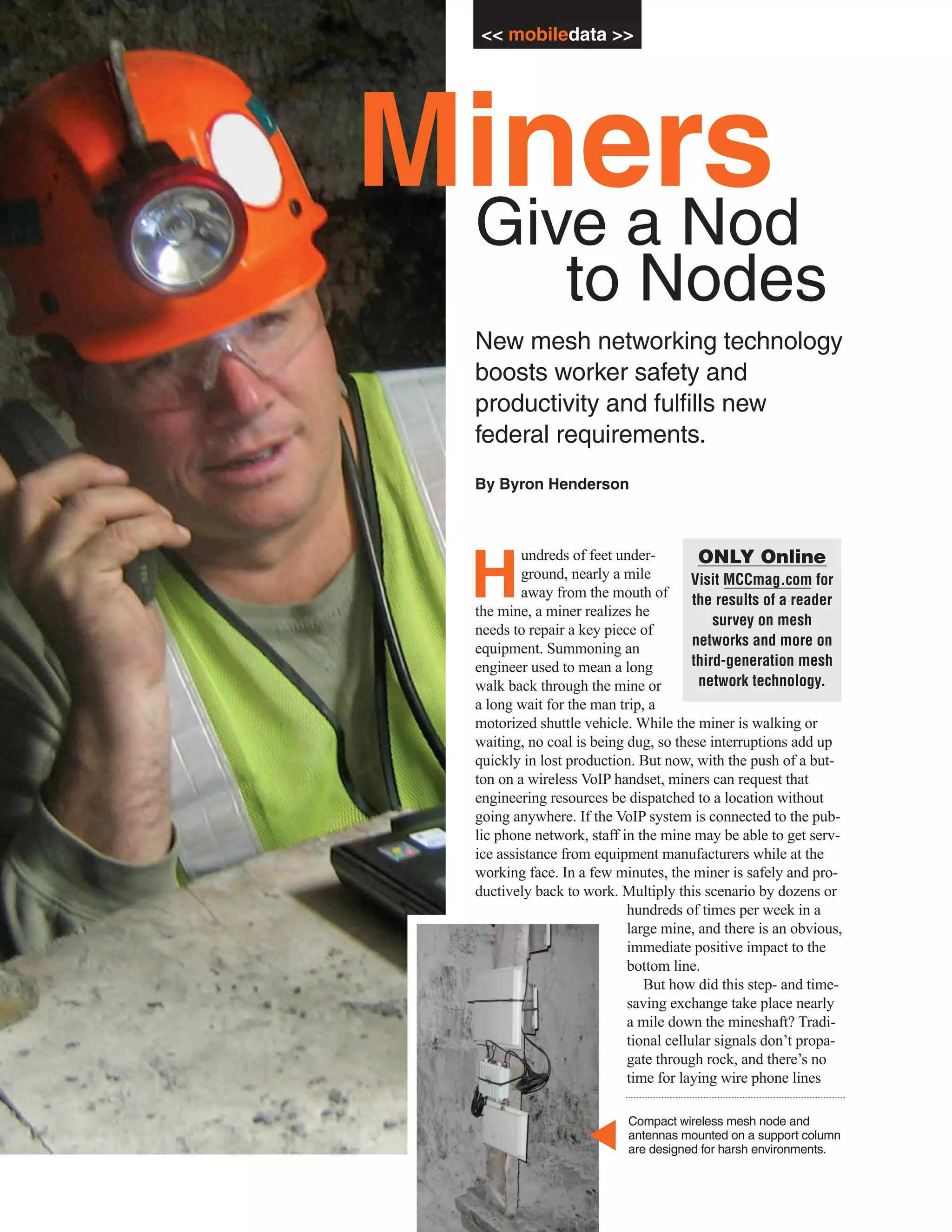
          undreds of feet under-         ONLY Online
  H       ground, nearly a mile
          away from the mouth of
  the mine, a miner realizes he
                                        Visit MCCmag.com for
                                        the results of a reader
                                            survey on mesh
  needs to repair a key piece of
                                        networks and more on
  equipment. Summoning an
  engineer used to mean a long          third-generation mesh
  walk back through the mine or          network technology.
  a long wait for the man trip, a
  motorized shuttle vehicle. While the miner is walking or
  waiting, no coal is being dug, so these interruptions add up
  quickly in lost production. But now, with the push of a but-
  ton on a wireless VoIP handset, miners can request that
  engineering resources be dispatched to a location without
  going anywhere. If the VoIP system is connected to the pub-
  lic phone network, staff in the mine may be able to get serv-
  ice assistance from equipment manufacturers while at the
  working face. In a few minutes, the miner is safely and pro-
  ductively back to work. Multiply this scenario by dozens or
                            hundreds of times per week in a
                            large mine, and there is an obvious,
                            immediate positive impact to the
                            bottom line.
                               But how did this step- and time-
                            saving exchange take place nearly
                            a mile down the mineshaft? Tradi-
                            tional cellular signals don’t propa-
                            gate through rock, and there’s no
                            time for laying wire phone lines

                           Compact wireless mesh node and
                   ▼


                           antennas mounted on a support column
                           are designed for harsh environments.
Miners Give a Nod to Nodes

that might be damaged by rock falls             Mining network communications            quarters site, with public switched
and moving equipment. The answer is          and tracking supplier Active Control        telephone network (PSTN) access via
third-generation wireless mesh tech-         Technology (ACT) of Burlington,             the PBX. Clear voice connections are
nology based on the Wi-Fi 802.11 pro-        Ontario, Canada, has installed wireless     provided at 12 hops to the farthest
tocol. A series of multiradio enclo-         mesh technology supplied by Mesh-           extent of the current installation.
sures, called wireless mesh nodes,           Dynamics in a number or mines.                 A miner location and tracking sys-
propagate the signal down the length                                                     tem based on Wi-Fi is also supported
of the mineshaft and wirelessly con-         Underground Coal Mines                      over the wireless infrastructure, which
nect miners working or traveling near-           Underground coal mines, both            helps fulfill the MINER Act require-
by. The nodes may be placed along            “long wall” and “room and pillar,” are      ments. In addition, an IP-based video
entries, travel ways, beltways or in air-    challenging settings for wireless com-      camera remotely monitors a key junc-
way intakes and returns to wirelessly        munications. There are often multiple       tion of the belt system crucial to mine
link miners at the working face to the       adjacent entries (tunnels) into the mine.   productivity. The mine operator enjoys
rest of the mine, as well as to the          At the least, the network must provide      multiple benefits from the installation.
office and managers outside the mine.        coverage in the belt entry, the main        Besides fulfilling MINER Act require-
                                             travelway, primary escape route and         ments, mine personnel are instantly
Improving Safety                             for the working unit at the mine face.      more productive through better com-
and Response                                 Another challenging characteristic is       munications. Requests for repairs, sup-
   Besides the time-saving productivi-       that the mine is constantly changing:       plies, tools and other material may be
ty boost, the wireless mesh nodes also       The working unit progresses forward         made over the VoIP system, saving the
provide infrastructure that delivers life-   everyday, and therefore the supporting      time and inconvenience of multiple
saving miner location and communica-         infrastructure must move with the unit.     man-trip shuttles. The ability to
tions capability in case of an accident      Any communications systems must be          remotely monitor the operation of key
or disaster. Preserving the safety of        easily deployable, configurable and         belt locations via video has also
underground mine personnel has been          resilient.                                  increased uptime and productivity.
an important focus of government and             Because of the vehicle and human
industry. In the aftermath of the Sago       traffic and hazards such as moisture,       Surface Mining Applications
mine disaster, a coal mine explosion in      rock fall and vibration, a compact and          Outdoor, aboveground mining
Sago, W. Va., in January 2006, the fed-      robust physical device is required. The     sites also require wireless voice, data
eral government set in place a               safety and communications mission           and video communications. There is
timetable for underground coal-mining        demands the ability to work from bat-       an increasing need for up-to-the-
operations to upgrade procedures,            tery power and for isolated portions of     minute status on operations, equip-
equipment and technology with the            the network to continue operation if        ment and personnel, as well as a
passage of the Mine Improvement and          disconnected by an incident. Because        strong move toward mine automa-
New Emergency Response (MINER)               distances in the tunnels can be quite       tion. But because an open-pit mine is
Act in 2006. Major elements of the           long, the mining environment poses          a constantly changing landscape, it’s
MINER Act require a wireless two-            unique challenges for real-time data        necessary for any network deploy-
way medium of communications and             over many hops.                             ment to be simple to deploy and rede-
tracking of individuals by 2009. A               A recent successful installation in a   ploy. The wireless mesh nodes act
wireless communications system that          working room-and-pillar underground         similar to “radio robots” to locate
provides two-way communications              coal mine required long-distance con-       one another and quickly establish a
between underground and surface per-         nectivity for voice, location tracking      network without operator intervention.
sonnel and an electronic tracking sys-       and video process monitoring.                   The nodes may also be in motion
tem that allows surface personnel to         Because the headquarters and pro-           relative to one another and to fixed
independently determine the location         cessing plant is 3.5 miles from the         elements of the network, yet remain
of anyone trapped underground is key         main lateral entry to the mine, multi-      constantly connected. It’s critical for
to meeting the requirements. New Wi-         ple hops were needed both outside           mining enterprises to monitor the pro-
Fi wireless mesh technology delivers         and inside the mine. In a number of         ductivity of a haulage fleet and report
high performance and reliability at low      locations within the mine itself, wire-     that information back to local and cor-
cost over long distances in under-           less mesh nodes were secured to the         porate management. Additionally,
ground coal mines in numerous pilot          roof bolt or supporting timbers and         visual monitoring through video cam-
and production mine networks,                powered by a battery backup system.         eras mounted on mining vehicles
because it allows for reliable two-way       Individual miners carry wireless Wi-        allows for immediate response from
VoIP communications and Wi-Fi loca-          Fi VoIP handsets that provide voice         the control center rather than requiring
tion tracking.                               connectivity to the PBX at the head-        a manned trip to a location in the
The nodes wirelessly link miners at the                                                                                          may also easily be deployed over the
                                                                                                                                 wireless mesh infrastructure.
working face to the rest of the mine, as                                                                                             The wireless mesh technology pro-
                                                                                                                                 vides the high performance, low delay
well as to the office and managers                                                                                               and jitter, and mobility required for
outside the mine.                                                                                                                reliable communications in demanding
                                                                                                                                 mining environments. Best of all, net-
                                                                                                                                 works deployed to increase miner safe-
mine. Extending the network into the                            nodes on haulage trucks and loaders                              ty may also boost productivity and
mine also extends the private tele-                             provided communications for the                                  vice-versa. As mining becomes more
phone network into the pit — vital for                          automated mining application in use                              technical and automated, third-
remote locations that are often without                         on the vehicles. Because of third-                               generation wireless mesh keeps the
cellular service — and at much lower                            generation radio intelligence, the                               mining enterprise seamlessly connect-
cost than satellite telephony.                                  nodes maintain communications                                    ed from working face to office. ■
    In a recent installation in an open-                        throughout the active area of the mine
pit mine, a fixed wireless mesh node                            and can be easily relocated. Optional                            Byron Henderson is vice president, market-
was placed at the administrative                                GPS capability allows managers to                                ing for MeshDynamics, which serves cus-
office, and several relocatable wireless                        instantly locate any of the wireless                             tomers in many market areas: mining and
mesh nodes with solar power were                                mesh nodes and its host vehicle on a                             industrial sites, defense, transportation, pub-
deployed on trailers throughout the                             map view of the mine. Additional                                 lic safety and municipal networking. E-mail
active area of the mine. Mobile mesh                            safety voice and video applications                              comments to editor@RRMediaGroup.com.


RadioResource MissionCritical Communications delivers wireless voice and data solutions for mobile and remote mission-critical operations. The magazine covers business, public
safety, and regulatory news; case studies; in-depth features; innovative applications; product information and comparisons; emerging technologies; industry reports and trends; and
technical tips. In addition, each issue contains Public Safety Report, a special section devoted solely to the needs of the public safety community. Editorial content targets organizations
in the United States and Canada with mobile and remote communications needs, including public safety, government, transportation, manufacturing, utility/energy, business, and
industrial entities. To request a FREE subscription or get more information, go to www.mccmag.com. RadioResource MissionCritical Communications is published by the RadioResource
Media Group. Pandata Corp., 7108 S. Alton Way, Building H, Centennial, CO 80112, Tel: 303-792-2390, Fax: 303-792-2391, www.rr mediagroup.com. Copyright 2008
Pandata Cor p. All rights reser ved. Reprinted from the July 2008 issue of RadioResource MissionCritical Communications. For more infor mation about
MissionCritical Communications and the RadioResource Media Group please call 303-792-2390 or visit www.mccmag.com

Mesh Networks in Underground Mining [MeshDynamics]

  • 1.
    << mobiledata >> Miners Give a Nod to Nodes New mesh networking technology boosts worker safety and productivity and fulfills new federal requirements. By Byron Henderson undreds of feet under- ONLY Online H ground, nearly a mile away from the mouth of the mine, a miner realizes he Visit MCCmag.com for the results of a reader survey on mesh needs to repair a key piece of networks and more on equipment. Summoning an engineer used to mean a long third-generation mesh walk back through the mine or network technology. a long wait for the man trip, a motorized shuttle vehicle. While the miner is walking or waiting, no coal is being dug, so these interruptions add up quickly in lost production. But now, with the push of a but- ton on a wireless VoIP handset, miners can request that engineering resources be dispatched to a location without going anywhere. If the VoIP system is connected to the pub- lic phone network, staff in the mine may be able to get serv- ice assistance from equipment manufacturers while at the working face. In a few minutes, the miner is safely and pro- ductively back to work. Multiply this scenario by dozens or hundreds of times per week in a large mine, and there is an obvious, immediate positive impact to the bottom line. But how did this step- and time- saving exchange take place nearly a mile down the mineshaft? Tradi- tional cellular signals don’t propa- gate through rock, and there’s no time for laying wire phone lines Compact wireless mesh node and ▼ antennas mounted on a support column are designed for harsh environments.
  • 2.
    Miners Give aNod to Nodes that might be damaged by rock falls Mining network communications quarters site, with public switched and moving equipment. The answer is and tracking supplier Active Control telephone network (PSTN) access via third-generation wireless mesh tech- Technology (ACT) of Burlington, the PBX. Clear voice connections are nology based on the Wi-Fi 802.11 pro- Ontario, Canada, has installed wireless provided at 12 hops to the farthest tocol. A series of multiradio enclo- mesh technology supplied by Mesh- extent of the current installation. sures, called wireless mesh nodes, Dynamics in a number or mines. A miner location and tracking sys- propagate the signal down the length tem based on Wi-Fi is also supported of the mineshaft and wirelessly con- Underground Coal Mines over the wireless infrastructure, which nect miners working or traveling near- Underground coal mines, both helps fulfill the MINER Act require- by. The nodes may be placed along “long wall” and “room and pillar,” are ments. In addition, an IP-based video entries, travel ways, beltways or in air- challenging settings for wireless com- camera remotely monitors a key junc- way intakes and returns to wirelessly munications. There are often multiple tion of the belt system crucial to mine link miners at the working face to the adjacent entries (tunnels) into the mine. productivity. The mine operator enjoys rest of the mine, as well as to the At the least, the network must provide multiple benefits from the installation. office and managers outside the mine. coverage in the belt entry, the main Besides fulfilling MINER Act require- travelway, primary escape route and ments, mine personnel are instantly Improving Safety for the working unit at the mine face. more productive through better com- and Response Another challenging characteristic is munications. Requests for repairs, sup- Besides the time-saving productivi- that the mine is constantly changing: plies, tools and other material may be ty boost, the wireless mesh nodes also The working unit progresses forward made over the VoIP system, saving the provide infrastructure that delivers life- everyday, and therefore the supporting time and inconvenience of multiple saving miner location and communica- infrastructure must move with the unit. man-trip shuttles. The ability to tions capability in case of an accident Any communications systems must be remotely monitor the operation of key or disaster. Preserving the safety of easily deployable, configurable and belt locations via video has also underground mine personnel has been resilient. increased uptime and productivity. an important focus of government and Because of the vehicle and human industry. In the aftermath of the Sago traffic and hazards such as moisture, Surface Mining Applications mine disaster, a coal mine explosion in rock fall and vibration, a compact and Outdoor, aboveground mining Sago, W. Va., in January 2006, the fed- robust physical device is required. The sites also require wireless voice, data eral government set in place a safety and communications mission and video communications. There is timetable for underground coal-mining demands the ability to work from bat- an increasing need for up-to-the- operations to upgrade procedures, tery power and for isolated portions of minute status on operations, equip- equipment and technology with the the network to continue operation if ment and personnel, as well as a passage of the Mine Improvement and disconnected by an incident. Because strong move toward mine automa- New Emergency Response (MINER) distances in the tunnels can be quite tion. But because an open-pit mine is Act in 2006. Major elements of the long, the mining environment poses a constantly changing landscape, it’s MINER Act require a wireless two- unique challenges for real-time data necessary for any network deploy- way medium of communications and over many hops. ment to be simple to deploy and rede- tracking of individuals by 2009. A A recent successful installation in a ploy. The wireless mesh nodes act wireless communications system that working room-and-pillar underground similar to “radio robots” to locate provides two-way communications coal mine required long-distance con- one another and quickly establish a between underground and surface per- nectivity for voice, location tracking network without operator intervention. sonnel and an electronic tracking sys- and video process monitoring. The nodes may also be in motion tem that allows surface personnel to Because the headquarters and pro- relative to one another and to fixed independently determine the location cessing plant is 3.5 miles from the elements of the network, yet remain of anyone trapped underground is key main lateral entry to the mine, multi- constantly connected. It’s critical for to meeting the requirements. New Wi- ple hops were needed both outside mining enterprises to monitor the pro- Fi wireless mesh technology delivers and inside the mine. In a number of ductivity of a haulage fleet and report high performance and reliability at low locations within the mine itself, wire- that information back to local and cor- cost over long distances in under- less mesh nodes were secured to the porate management. Additionally, ground coal mines in numerous pilot roof bolt or supporting timbers and visual monitoring through video cam- and production mine networks, powered by a battery backup system. eras mounted on mining vehicles because it allows for reliable two-way Individual miners carry wireless Wi- allows for immediate response from VoIP communications and Wi-Fi loca- Fi VoIP handsets that provide voice the control center rather than requiring tion tracking. connectivity to the PBX at the head- a manned trip to a location in the
  • 3.
    The nodes wirelesslylink miners at the may also easily be deployed over the wireless mesh infrastructure. working face to the rest of the mine, as The wireless mesh technology pro- vides the high performance, low delay well as to the office and managers and jitter, and mobility required for outside the mine. reliable communications in demanding mining environments. Best of all, net- works deployed to increase miner safe- mine. Extending the network into the nodes on haulage trucks and loaders ty may also boost productivity and mine also extends the private tele- provided communications for the vice-versa. As mining becomes more phone network into the pit — vital for automated mining application in use technical and automated, third- remote locations that are often without on the vehicles. Because of third- generation wireless mesh keeps the cellular service — and at much lower generation radio intelligence, the mining enterprise seamlessly connect- cost than satellite telephony. nodes maintain communications ed from working face to office. ■ In a recent installation in an open- throughout the active area of the mine pit mine, a fixed wireless mesh node and can be easily relocated. Optional Byron Henderson is vice president, market- was placed at the administrative GPS capability allows managers to ing for MeshDynamics, which serves cus- office, and several relocatable wireless instantly locate any of the wireless tomers in many market areas: mining and mesh nodes with solar power were mesh nodes and its host vehicle on a industrial sites, defense, transportation, pub- deployed on trailers throughout the map view of the mine. Additional lic safety and municipal networking. E-mail active area of the mine. Mobile mesh safety voice and video applications comments to editor@RRMediaGroup.com. RadioResource MissionCritical Communications delivers wireless voice and data solutions for mobile and remote mission-critical operations. The magazine covers business, public safety, and regulatory news; case studies; in-depth features; innovative applications; product information and comparisons; emerging technologies; industry reports and trends; and technical tips. In addition, each issue contains Public Safety Report, a special section devoted solely to the needs of the public safety community. Editorial content targets organizations in the United States and Canada with mobile and remote communications needs, including public safety, government, transportation, manufacturing, utility/energy, business, and industrial entities. To request a FREE subscription or get more information, go to www.mccmag.com. RadioResource MissionCritical Communications is published by the RadioResource Media Group. Pandata Corp., 7108 S. Alton Way, Building H, Centennial, CO 80112, Tel: 303-792-2390, Fax: 303-792-2391, www.rr mediagroup.com. Copyright 2008 Pandata Cor p. All rights reser ved. Reprinted from the July 2008 issue of RadioResource MissionCritical Communications. For more infor mation about MissionCritical Communications and the RadioResource Media Group please call 303-792-2390 or visit www.mccmag.com