Presented By
Joycee G Pillay
MBA 1st Year
Dr.Babasaheb Ambedkar Marathwada University Aurangabad
Objectives
Define and
understand
communication and
the communication
process
List and overcome the
filters/barriers in a
communication
ProcessPractice active
listening
Need for communication
 On a daily basis we work with people who have different
opinions, values, beliefs, and needs then our own. Our ability to
 Exchange idea with others
 Understand other's perspectives,
 Solve problemswill depend significantly on how effectively we
are able to communicate with others.
What is Communication?
 COMMUNICATION IS THE ART OF TRANSMITTINGINFORMATION, IDEAS AND ATTITUDES FROM ONE PERSON TO
ANOTHER COMMUNICATION IS THE PROCESS OF MEANINGFUL INTERACTION AMONG HUMAN BEINGS.
 ITS ESSENCES : -
 PERSONAL PROCESS
 OCCURS BETWEEN PEOPLE
 MEANS TO INFLUENCE OTHERS
 EXPRESSION OF THOUGHTS ANDEMOTIONS THROUGH WORDS & ACTIONS.
 TOOLS FOR CONTROLLING AND MOTIVATING PEOPLE
 IT IS A SOCIAL AND EMOTIONAL PROCESS
What are the most common ways we communicate?
 Downwards Communication: Highly Directive, From Senior To
Subordinates, To Assign Duties, Give Instructions, To Inform To
Offer Feed Back, Approval To Highlight Problems Etc.
 Upwards Communications:it Is Non Directive In Nature From
Down Below, To Give Feedback, To Inform About
Progress/Problems, Seeking Approvals
 Lateral Or Horizontal Communication
 Formal Network : Virtually Vertical As Per Chain Go Command
Within The Hierarchy.
 Informal Network: Free To Move In Any Direction May Skip
Formal Chain Of Command. Likely To Satisfy Social And Emotional
Needs And Also Can Facilitate Task Accomplishment.
Types of Communication
Types of communication
 Lateral communication: This form of
communication is found among
members working at the same level i.e.
the colleague or peer group. It is the
most effective form of communication
as there is no barrier of subordinate or
boss present over there.However, it
often degenerates in to rumors and
gossips, which are harmful to the
growth of any institution.
Types of communication
 Diagonal communication: In large
organizations various departments
need communicative support from
each other. As no one is directly
responsible for the ultimate
action, communication depends, in
such situations, on the goodwill
and cooperation of the members.
Types of communication
 The Grapevine :
The commonplace form of
lateral or horizontal form of
communication is grapevine, is
called backbiting and
backstabbing.
Forms of communication
 Verbal Communication : Oral
communication- Face to Face,
Public speech, Telephone,
Interview, Meeting
Written Communication -Letter,
Memo, Circular, Report, Minutes, e
mail, sms
 Non verbal communication : Visual-
Pictorial symbols, Poster, Graphs &
charts, Signs, Signals
Aural- Drum beat, Siren, Whistle, Horn,
Buzzer & bell
The communication process
Essentials of a communication
 A common communication
environment
 Cooperation between the
sender and the receiver
 Selection of an appropriate
channel
 Correct encoding and decoding
of the message
 Receipt of the desired response
and feedback
Levels of communication
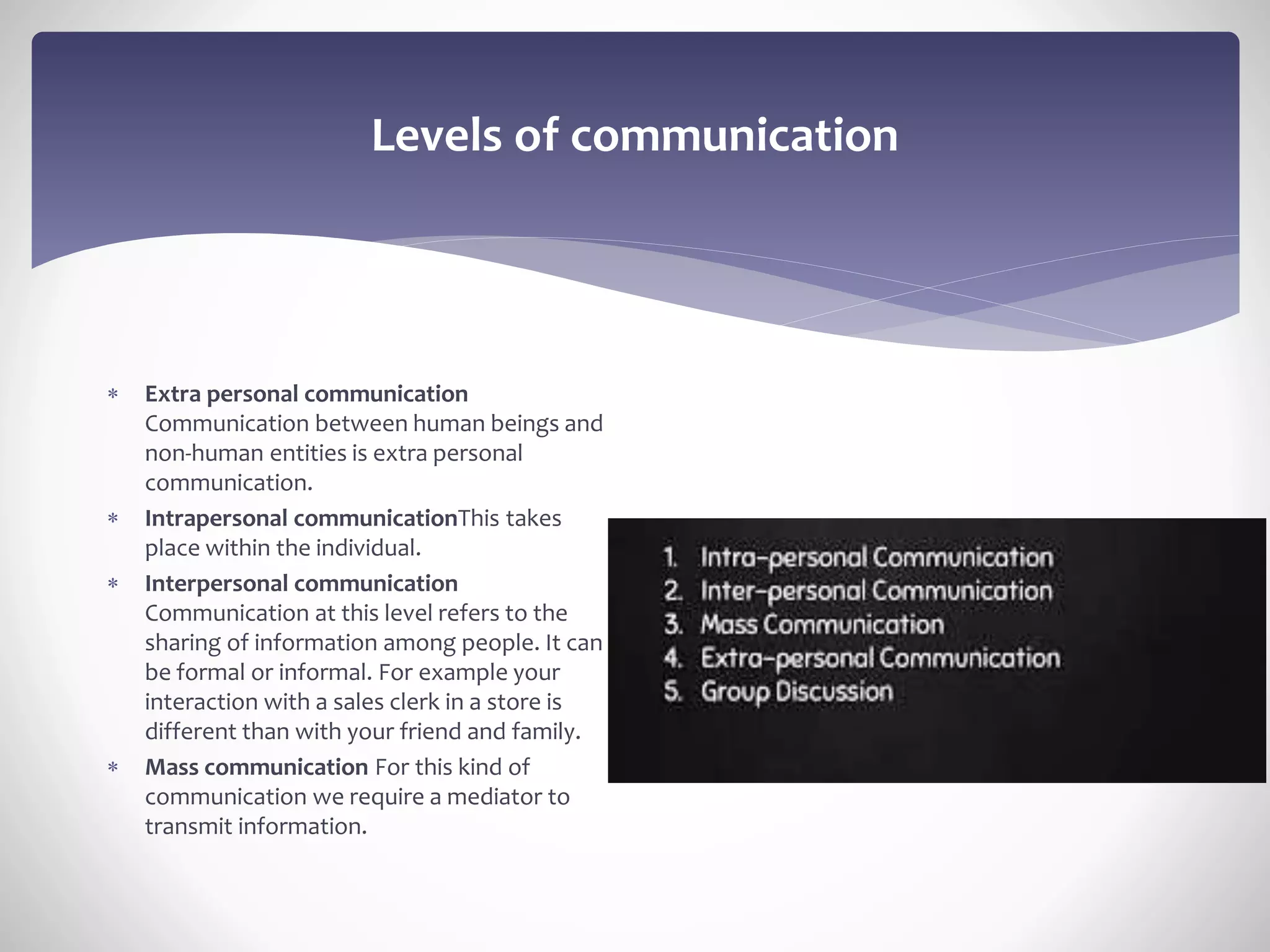
 Extra personal communication
Communication between human beings and
non-human entities is extra personal
communication.
 Intrapersonal communicationThis takes
place within the individual.
 Interpersonal communication
Communication at this level refers to the
sharing of information among people. It can
be formal or informal. For example your
interaction with a sales clerk in a store is
different than with your friend and family.
 Mass communication For this kind of
communication we require a mediator to
transmit information.
Barriers to communication
Hearing Vs Listening
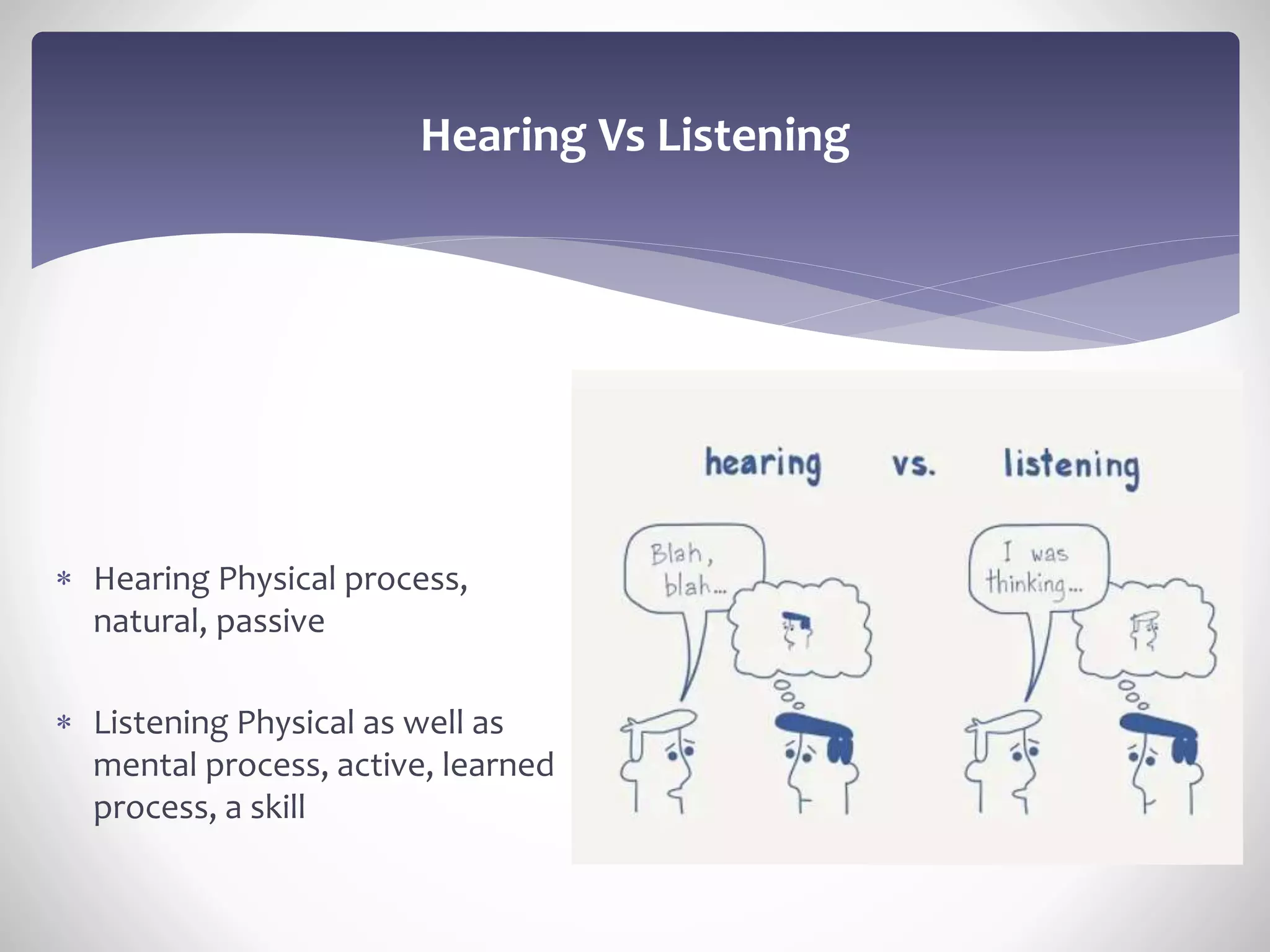
 Hearing Physical process,
natural, passive
 Listening Physical as well as
mental process, active, learned
process, a skill
 Always think ahead about what you are going to say.
 Use simple words and phrases that are understood by every body
 Increase your knowledge on all subjects you are required to speak.
 Speak clearly and audibly.
 Check twice with the listener whether you have been understood
accurately or not
 Always pay undivided attention to the speaker while listening.
 While listening, always make notes of important points.
 Repeat what the speaker has said to check whether you have
understood accurately.
ESSENTIALS OF COMMUNICATION
Dos
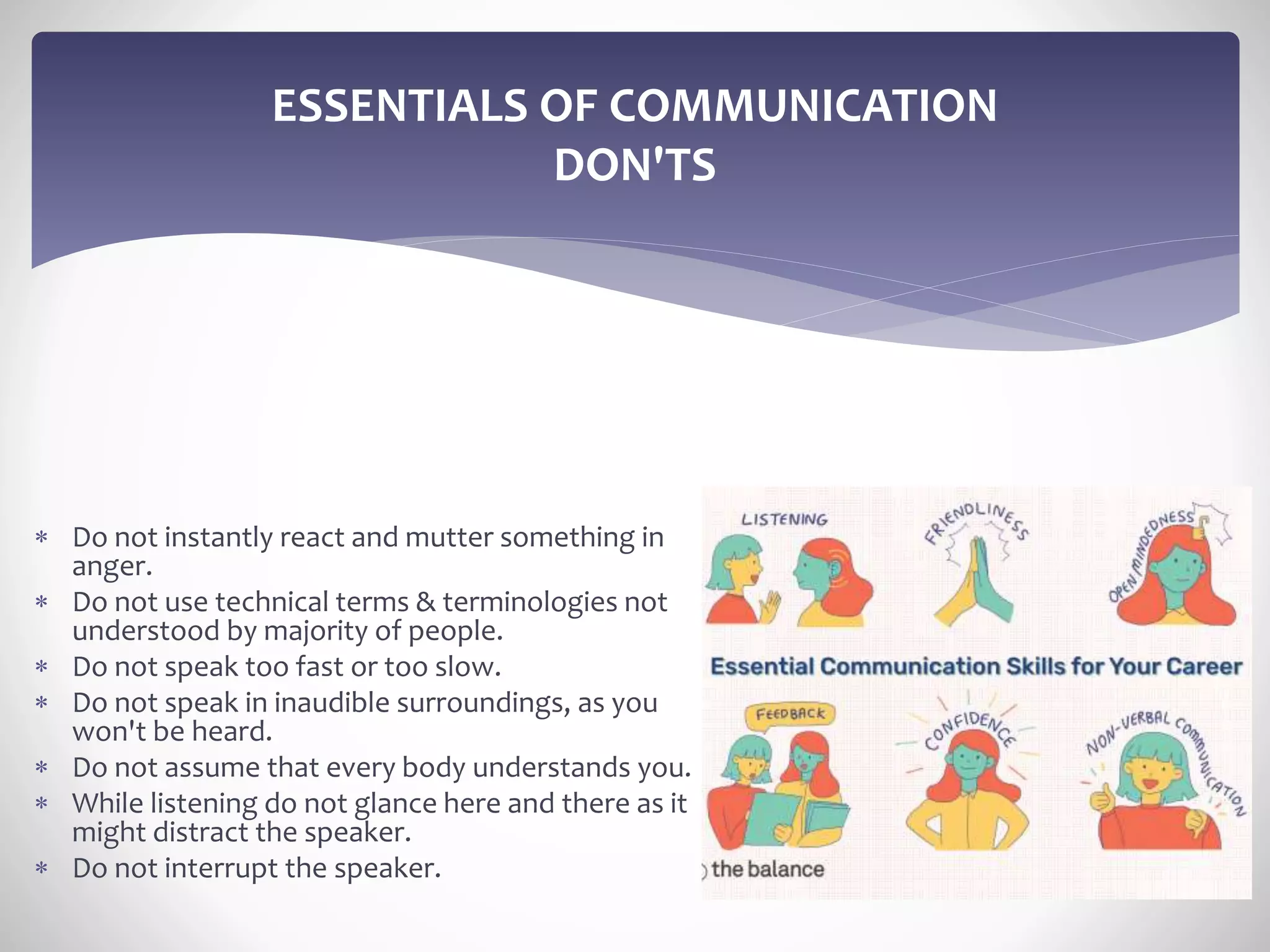
 Do not instantly react and mutter something in
anger.
 Do not use technical terms & terminologies not
understood by majority of people.
 Do not speak too fast or too slow.
 Do not speak in inaudible surroundings, as you
won't be heard.
 Do not assume that every body understands you.
 While listening do not glance here and there as it
might distract the speaker.
 Do not interrupt the speaker.
ESSENTIALS OF COMMUNICATION
DON'TS
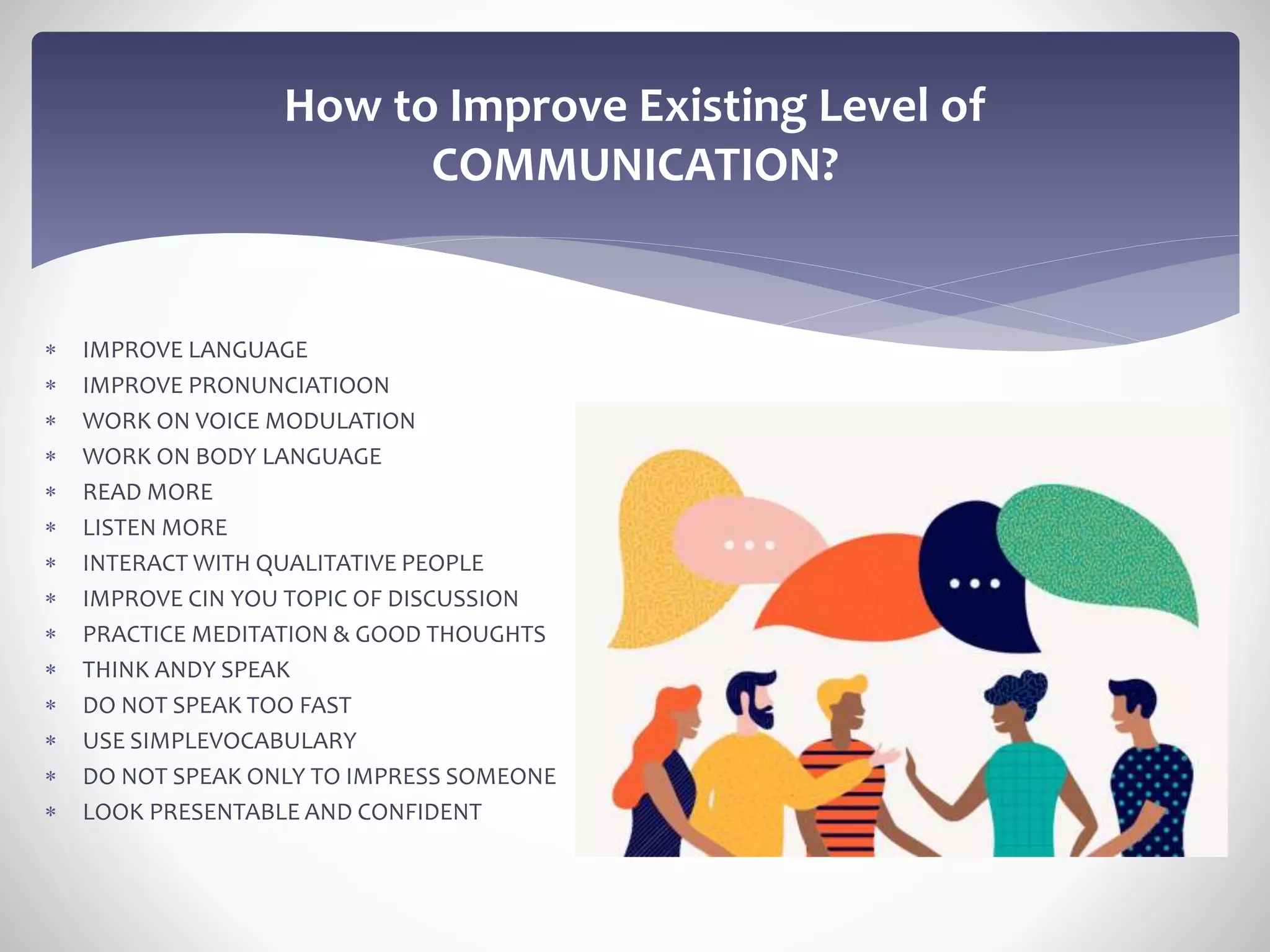
 IMPROVE LANGUAGE
 IMPROVE PRONUNCIATIOON
 WORK ON VOICE MODULATION
 WORK ON BODY LANGUAGE
 READ MORE
 LISTEN MORE
 INTERACT WITH QUALITATIVE PEOPLE
 IMPROVE CIN YOU TOPIC OF DISCUSSION
 PRACTICE MEDITATION & GOOD THOUGHTS
 THINK ANDY SPEAK
 DO NOT SPEAK TOO FAST
 USE SIMPLEVOCABULARY
 DO NOT SPEAK ONLY TO IMPRESS SOMEONE
 LOOK PRESENTABLE AND CONFIDENT
How to Improve Existing Level of
COMMUNICATION?
 Keep appropriate distance
 Take care of your appearance
 Be aware - people may give false
cues.
 Maintain eye contact
 Smile genuinely
Improving Body Language Tips
Success for YOU...
...in the new global and diverse workplace requires
excellent communication skills!
Thanks…..

Communication Skills by Joycee Pillay.pptx

  • 1.
    Presented By Joycee GPillay MBA 1st Year Dr.Babasaheb Ambedkar Marathwada University Aurangabad
  • 2.
    Objectives Define and understand communication and thecommunication process List and overcome the filters/barriers in a communication ProcessPractice active listening
  • 3.
    Need for communication On a daily basis we work with people who have different opinions, values, beliefs, and needs then our own. Our ability to  Exchange idea with others  Understand other's perspectives,  Solve problemswill depend significantly on how effectively we are able to communicate with others.
  • 4.
    What is Communication? COMMUNICATION IS THE ART OF TRANSMITTINGINFORMATION, IDEAS AND ATTITUDES FROM ONE PERSON TO ANOTHER COMMUNICATION IS THE PROCESS OF MEANINGFUL INTERACTION AMONG HUMAN BEINGS.  ITS ESSENCES : -  PERSONAL PROCESS  OCCURS BETWEEN PEOPLE  MEANS TO INFLUENCE OTHERS  EXPRESSION OF THOUGHTS ANDEMOTIONS THROUGH WORDS & ACTIONS.  TOOLS FOR CONTROLLING AND MOTIVATING PEOPLE  IT IS A SOCIAL AND EMOTIONAL PROCESS
  • 5.
    What are themost common ways we communicate?
  • 6.
     Downwards Communication:Highly Directive, From Senior To Subordinates, To Assign Duties, Give Instructions, To Inform To Offer Feed Back, Approval To Highlight Problems Etc.  Upwards Communications:it Is Non Directive In Nature From Down Below, To Give Feedback, To Inform About Progress/Problems, Seeking Approvals  Lateral Or Horizontal Communication  Formal Network : Virtually Vertical As Per Chain Go Command Within The Hierarchy.  Informal Network: Free To Move In Any Direction May Skip Formal Chain Of Command. Likely To Satisfy Social And Emotional Needs And Also Can Facilitate Task Accomplishment. Types of Communication
  • 7.
    Types of communication Lateral communication: This form of communication is found among members working at the same level i.e. the colleague or peer group. It is the most effective form of communication as there is no barrier of subordinate or boss present over there.However, it often degenerates in to rumors and gossips, which are harmful to the growth of any institution.
  • 8.
    Types of communication Diagonal communication: In large organizations various departments need communicative support from each other. As no one is directly responsible for the ultimate action, communication depends, in such situations, on the goodwill and cooperation of the members.
  • 9.
    Types of communication The Grapevine : The commonplace form of lateral or horizontal form of communication is grapevine, is called backbiting and backstabbing.
  • 10.
    Forms of communication Verbal Communication : Oral communication- Face to Face, Public speech, Telephone, Interview, Meeting Written Communication -Letter, Memo, Circular, Report, Minutes, e mail, sms  Non verbal communication : Visual- Pictorial symbols, Poster, Graphs & charts, Signs, Signals Aural- Drum beat, Siren, Whistle, Horn, Buzzer & bell
  • 11.
  • 12.
    Essentials of acommunication  A common communication environment  Cooperation between the sender and the receiver  Selection of an appropriate channel  Correct encoding and decoding of the message  Receipt of the desired response and feedback
  • 13.
    Levels of communication Extra personal communication Communication between human beings and non-human entities is extra personal communication.  Intrapersonal communicationThis takes place within the individual.  Interpersonal communication Communication at this level refers to the sharing of information among people. It can be formal or informal. For example your interaction with a sales clerk in a store is different than with your friend and family.  Mass communication For this kind of communication we require a mediator to transmit information.
  • 14.
  • 15.
    Hearing Vs Listening Hearing Physical process, natural, passive  Listening Physical as well as mental process, active, learned process, a skill
  • 16.
     Always thinkahead about what you are going to say.  Use simple words and phrases that are understood by every body  Increase your knowledge on all subjects you are required to speak.  Speak clearly and audibly.  Check twice with the listener whether you have been understood accurately or not  Always pay undivided attention to the speaker while listening.  While listening, always make notes of important points.  Repeat what the speaker has said to check whether you have understood accurately. ESSENTIALS OF COMMUNICATION Dos
  • 17.
     Do notinstantly react and mutter something in anger.  Do not use technical terms & terminologies not understood by majority of people.  Do not speak too fast or too slow.  Do not speak in inaudible surroundings, as you won't be heard.  Do not assume that every body understands you.  While listening do not glance here and there as it might distract the speaker.  Do not interrupt the speaker. ESSENTIALS OF COMMUNICATION DON'TS
  • 18.
     IMPROVE LANGUAGE IMPROVE PRONUNCIATIOON  WORK ON VOICE MODULATION  WORK ON BODY LANGUAGE  READ MORE  LISTEN MORE  INTERACT WITH QUALITATIVE PEOPLE  IMPROVE CIN YOU TOPIC OF DISCUSSION  PRACTICE MEDITATION & GOOD THOUGHTS  THINK ANDY SPEAK  DO NOT SPEAK TOO FAST  USE SIMPLEVOCABULARY  DO NOT SPEAK ONLY TO IMPRESS SOMEONE  LOOK PRESENTABLE AND CONFIDENT How to Improve Existing Level of COMMUNICATION?
  • 19.
     Keep appropriatedistance  Take care of your appearance  Be aware - people may give false cues.  Maintain eye contact  Smile genuinely Improving Body Language Tips
  • 20.
    Success for YOU... ...inthe new global and diverse workplace requires excellent communication skills! Thanks…..