SUBJECT :- “ BUSINESS COMMUNICATION”
PRSENTED BYAMAN TRIVEDI
CHETAN BIRLA
GOURAV CHAUDHARY
NARENDRA PATEL
PANKAJ PRASAD
Communication
 Communication is the art and the process of

sharing ideas.
 It includes exchanging of information, signals, or

messages as by talk, gestures, or writing.
Communication
Definitions
 Communication is the process of meaningful interaction among

human beings. (D.E. McFarland)

 Communication is an exchange of facts, ideas, opinions or

emotions by two or more persons.

(Newman and C.F. Summer Jr.)

 Communication is any behavior that results in an exchange of

meaning.

(The American Management Association)

 Communication is a process of passing information and

understanding from one person to another (Keith Davis)
Process of Communication

 Communication is a process that involves some

steps .The transmission of the sener’s ideas to the
receiver and the receiver’s feedback or reaction to the
sender completes the communication cycle. such
process is called Process of Communication.
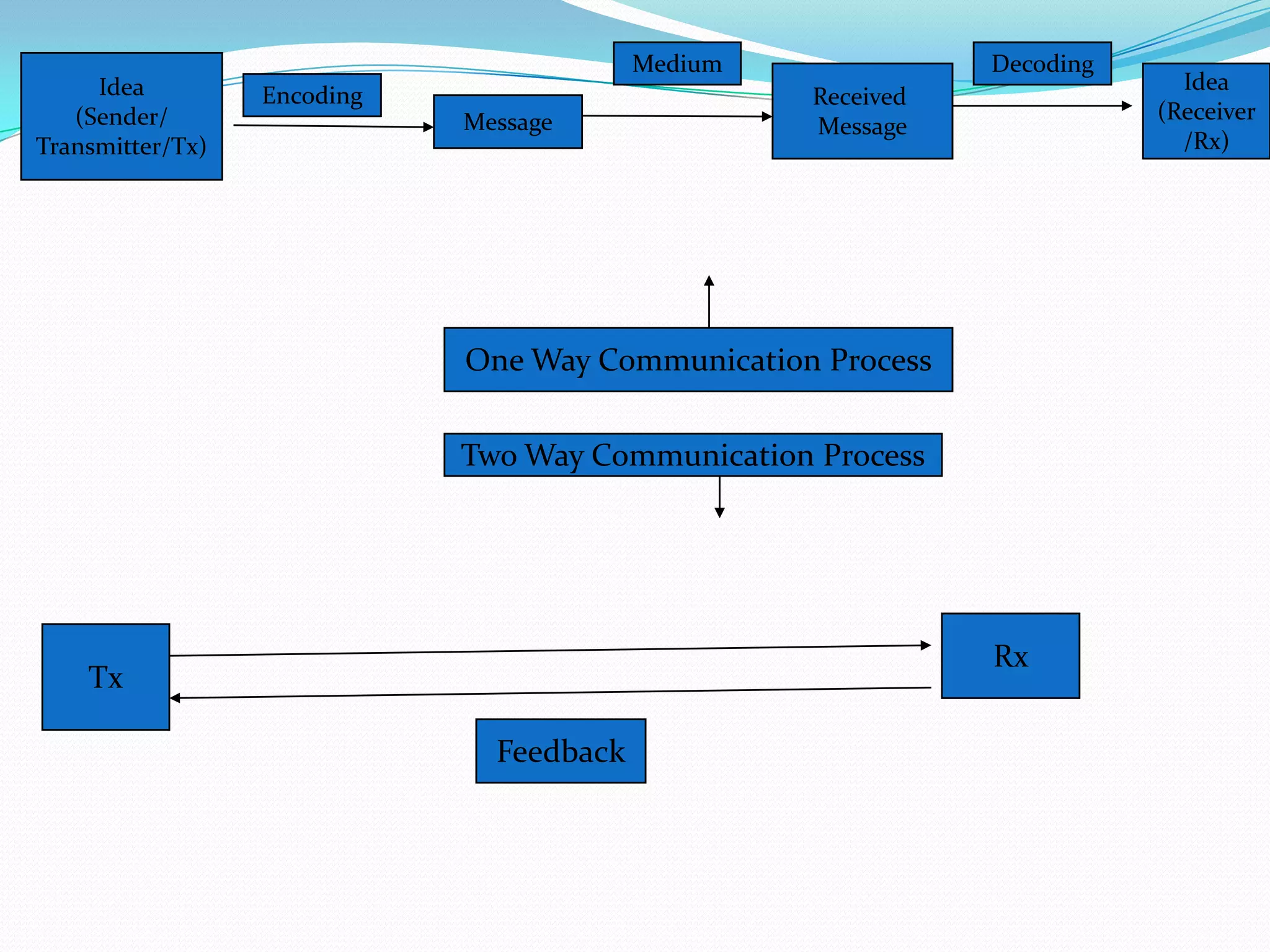
* One Way Communication Process
* Two Way Communication Process
Idea
(Sender/
Transmitter/Tx)

Medium
Encoding
Message

Decoding
Received
Message

One Way Communication Process
Two Way Communication Process

Rx

Tx

Feedback

Idea
(Receiver
/Rx)
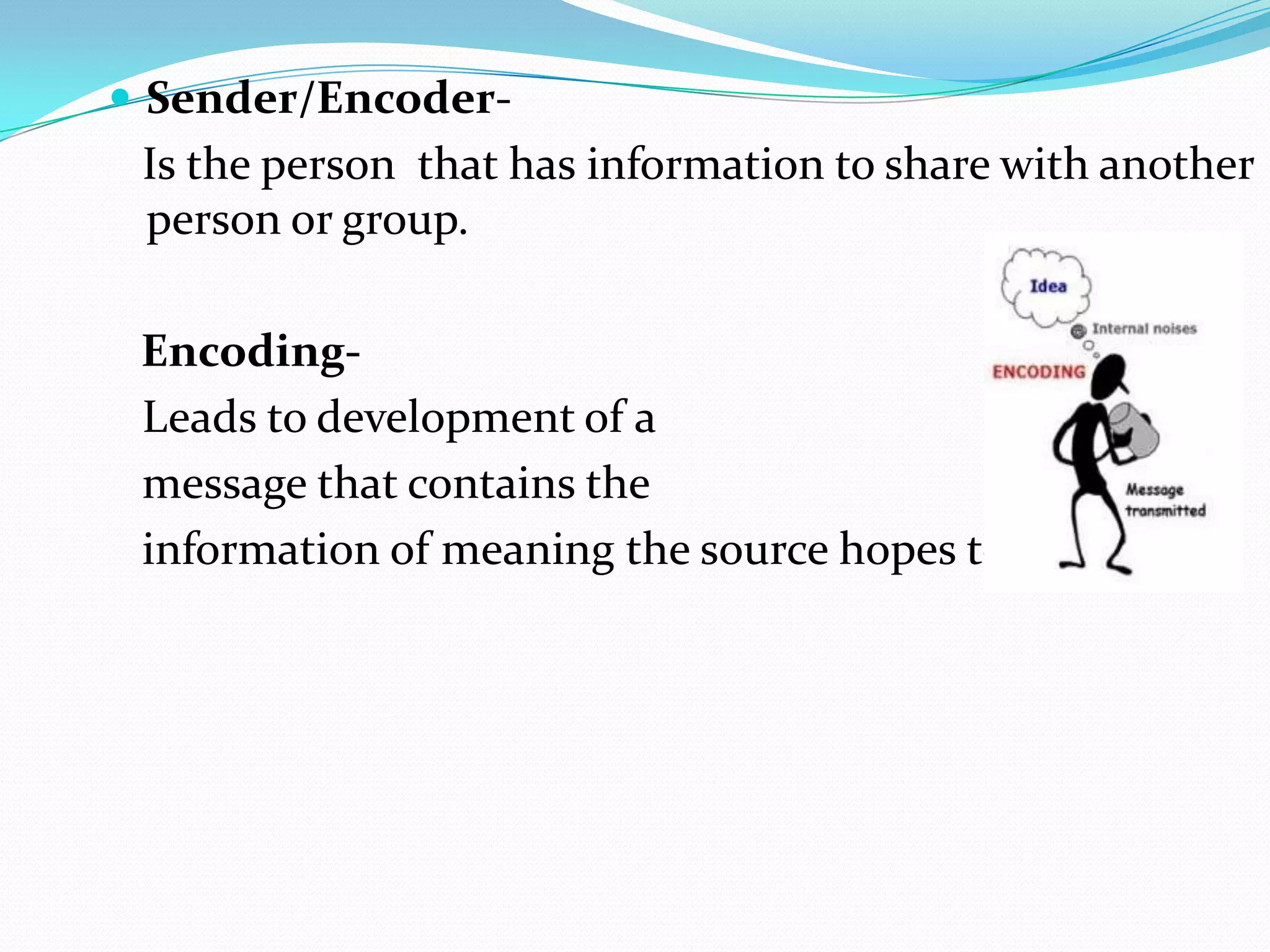
 Sender/Encoder-

Is the person that has information to share with another
person or group.

EncodingLeads to development of a
message that contains the
information of meaning the source hopes to convey.
 Message-

The set of symbols that the sender transmits.
 Medium-

The communication channels thought which the
Message moves from sender to receiver.
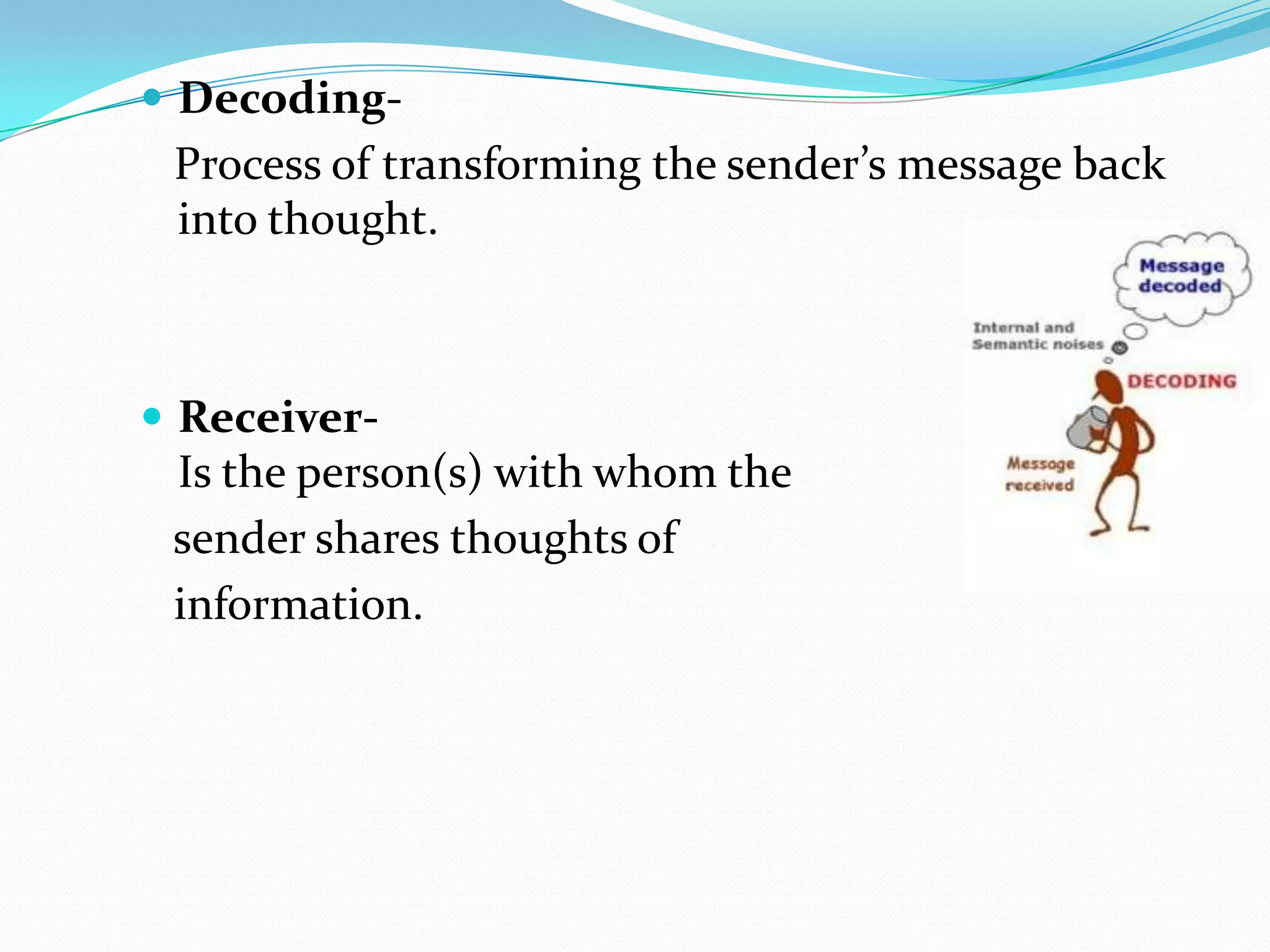
 Decoding-

Process of transforming the sender’s message back
into thought.

 Receiver-

Is the person(s) with whom the
sender shares thoughts of
information.
 Noise- Unplanned static or distortion during the

communication process, resulting in the receiver's
receiving a different message than the sender sent.
 Feedback- Receivers respond by hearing, seeing or

reading. Feedback is sent back to the sender.
Models of Communication
 Shannon Weaver model of Communication.
 Berlo’s model of Communication.
 Aristotle model of Communication.
Shannon-Weaver Model

• This model developed in 1949 which is based on the idea that

communication occur only when the message has been received
and that it should be received unchanged as per as possible.
• This model simply proposes that a message actually originates
from the person who gets the thought or has the information.
The sender is also called the Source of information or the
Information Source. The information then gets transmitted
from the brain to the mouth and comes out as a signal which
then reaches the recipient after joining hands with several
noises and other disturbances. The recipient then further passes
on the message to its final destination or other minds of other
individuals.
• In this model feedback was not considered to be an integral
component. Because the model conceived the communication
process as a linear act and feedback another new act of
communication.
Shannon-Weaver Model
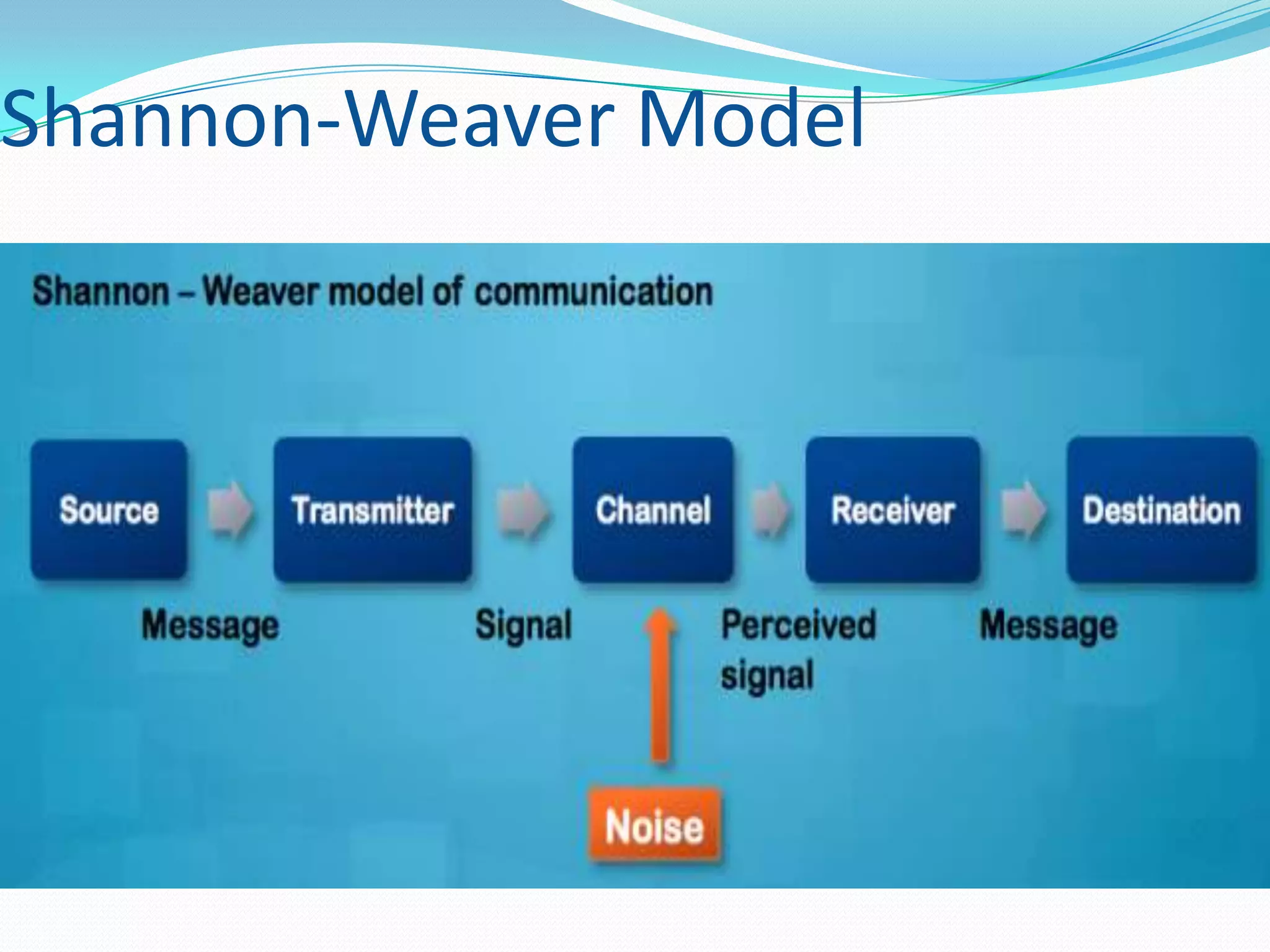
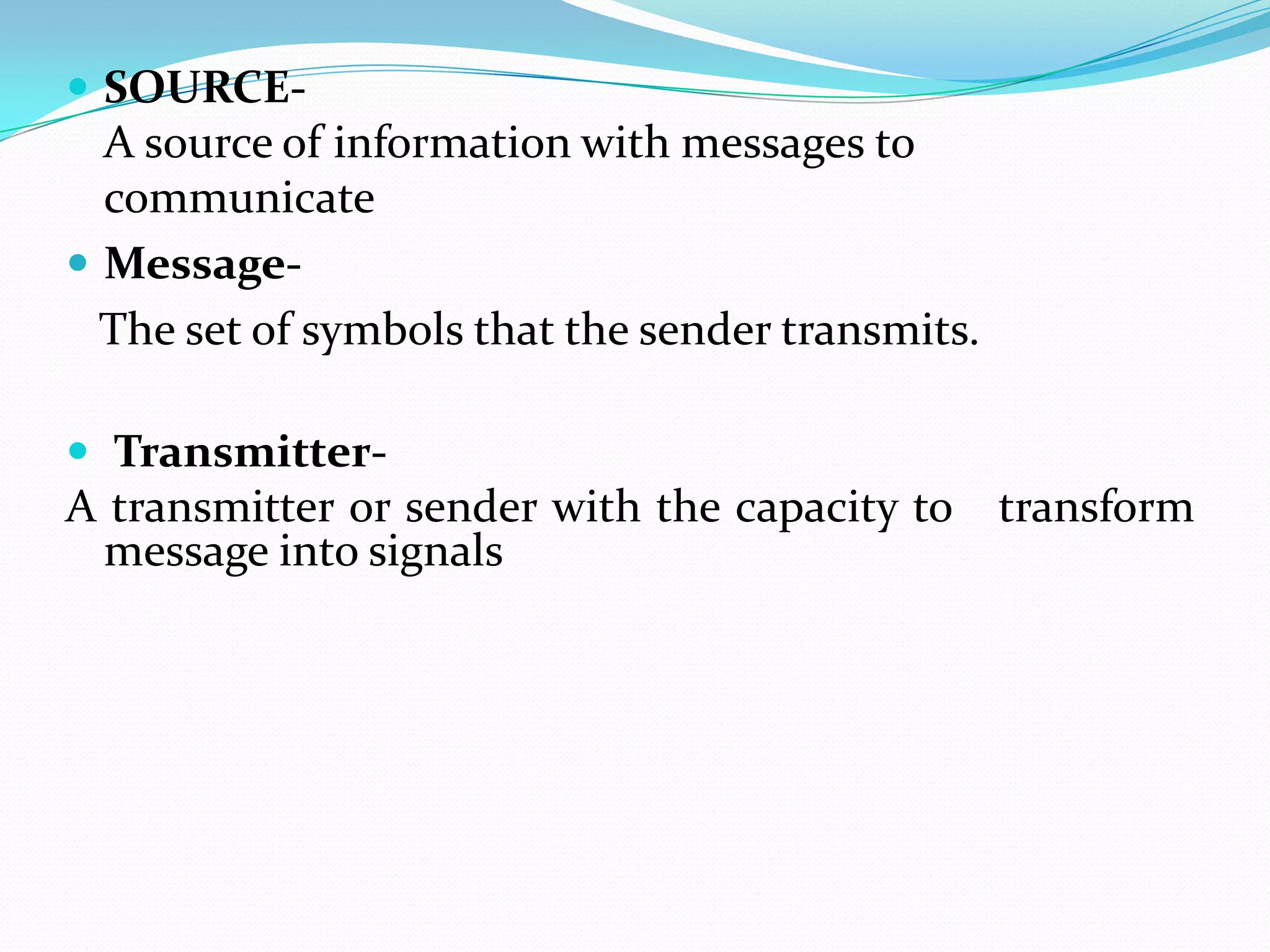
 SOURCE-

A source of information with messages to
communicate
 MessageThe set of symbols that the sender transmits.
 Transmitter-

A transmitter or sender with the capacity to transform
message into signals
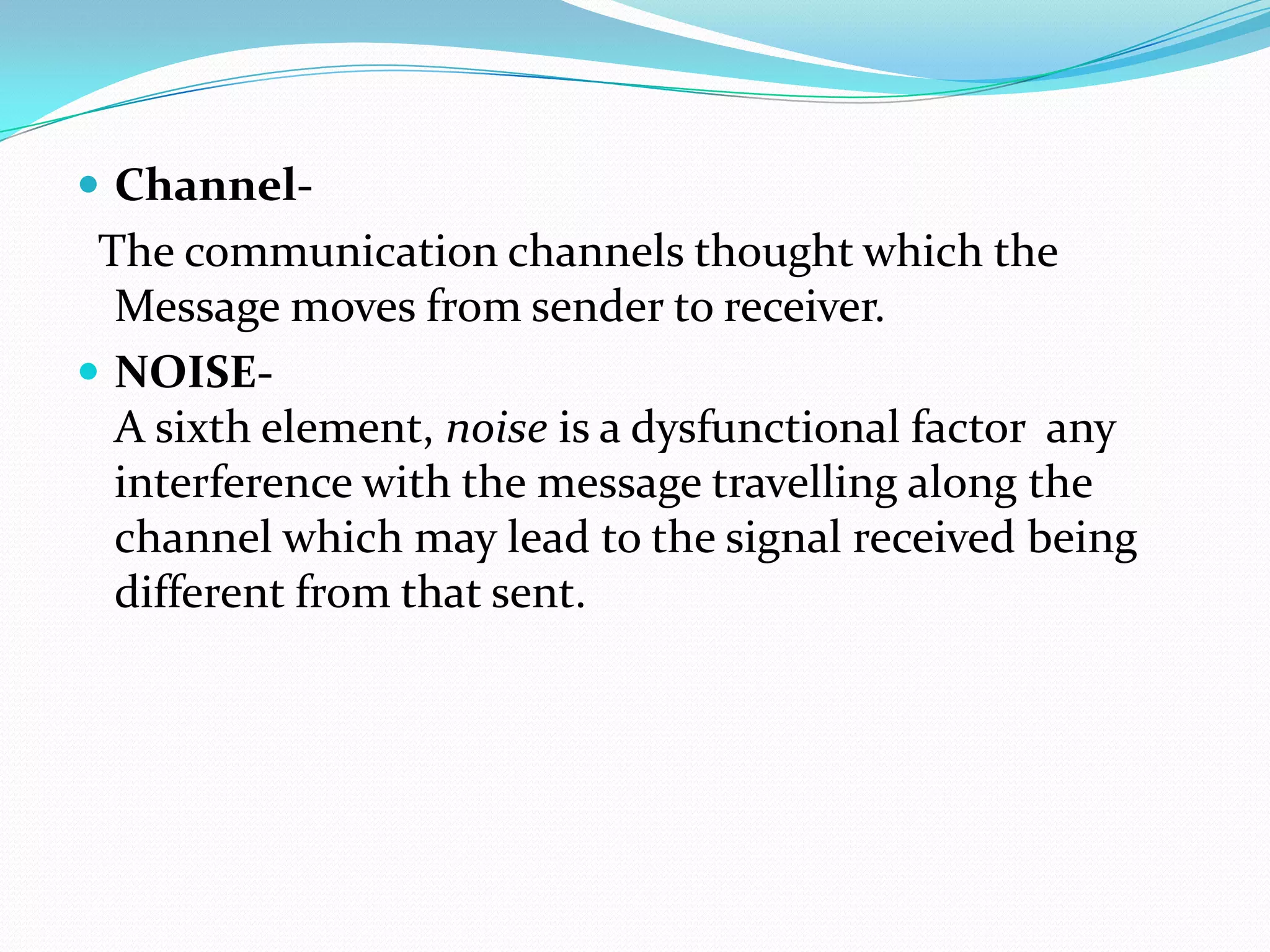
 Channel-

The communication channels thought which the
Message moves from sender to receiver.
 NOISEA sixth element, noise is a dysfunctional factor any
interference with the message travelling along the
channel which may lead to the signal received being
different from that sent.
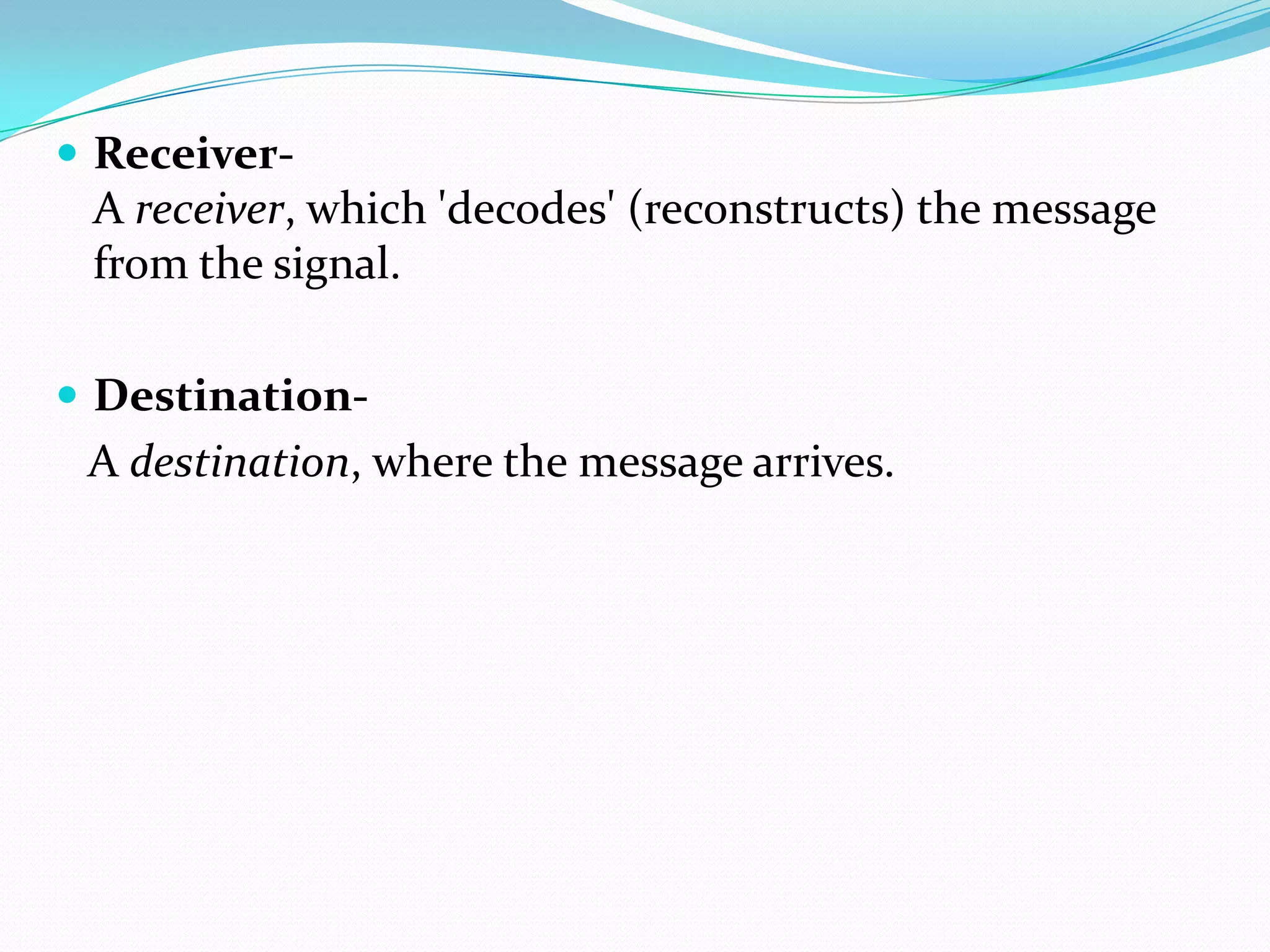
 Receiver-

A receiver, which 'decodes' (reconstructs) the message
from the signal.
 Destination-

A destination, where the message arrives.
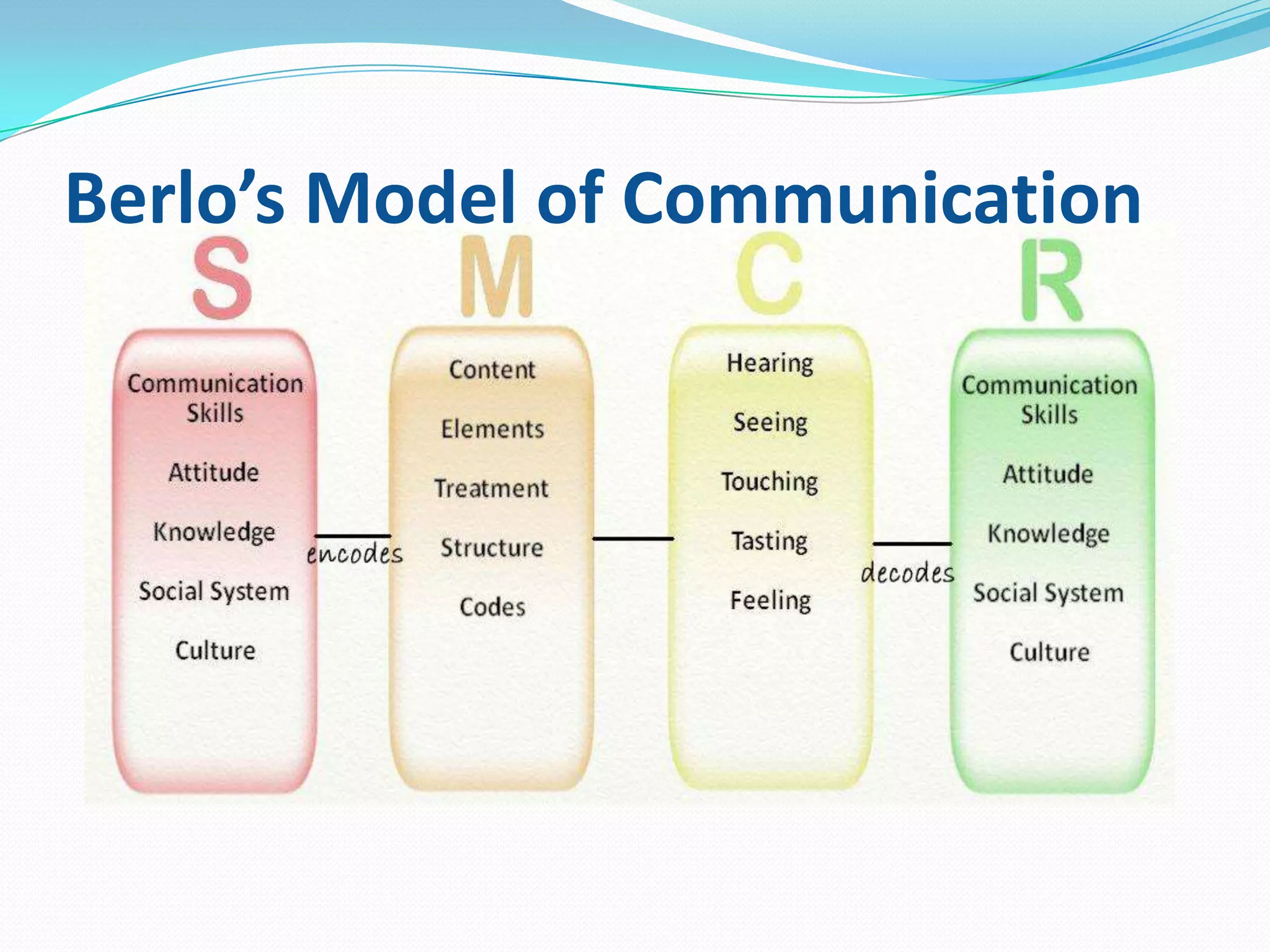
Berlo’s Model of Communication
Role of Berlo’s Model
• The idea of “source” was flexible enough to include

oral, written, electronic.
• “Message” was made the central element, stressing the
transmission of ideas.
• The model recognized that receivers were important to
communication, for they were the targets.
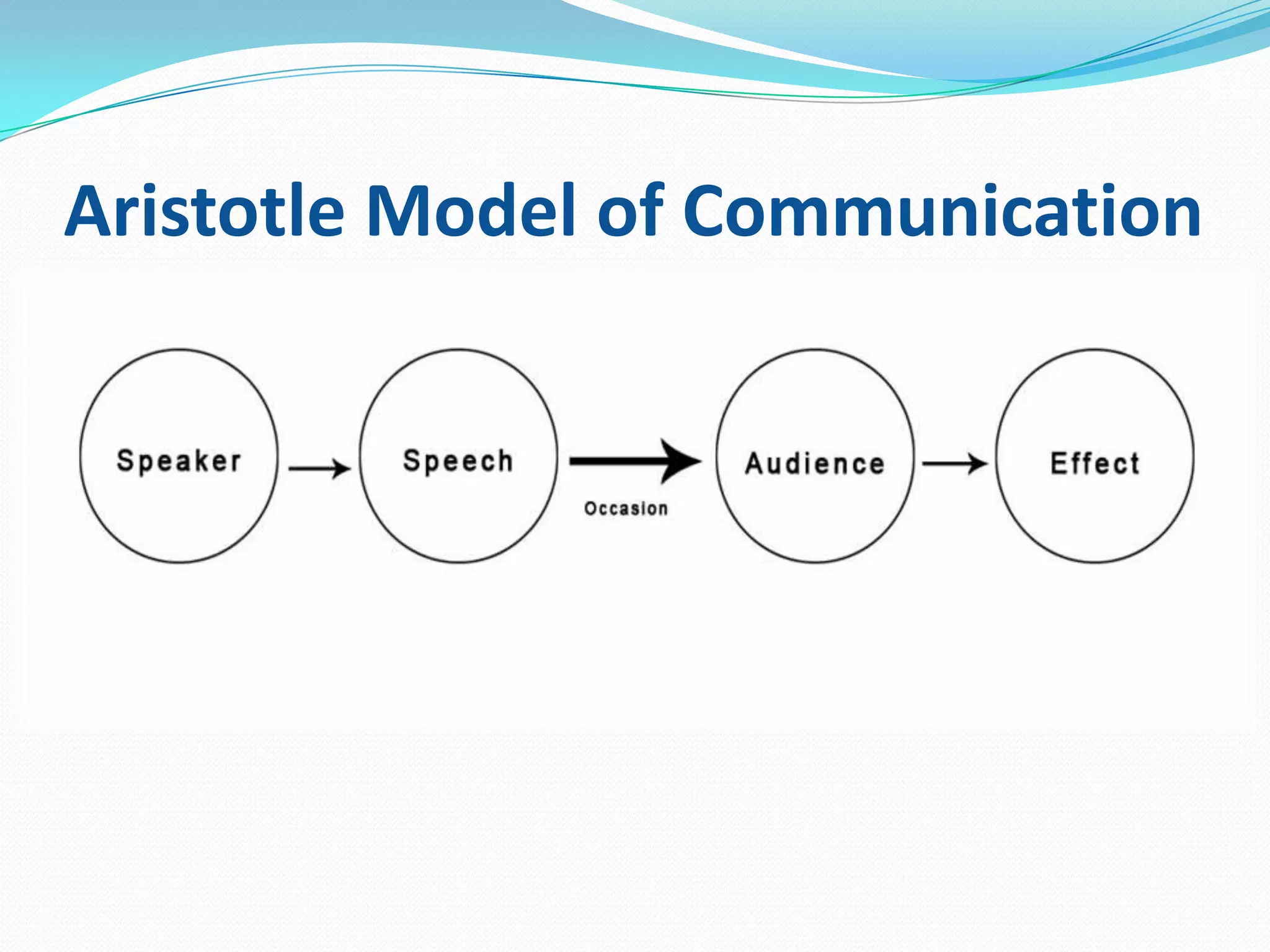
Aristotle Model of Communication
Role of Aristotle Model
 Provided an explanation of Oral Communication.
 Recognize the importance of audience at the end of

communication chain.
 This model helped in developing public relationships.
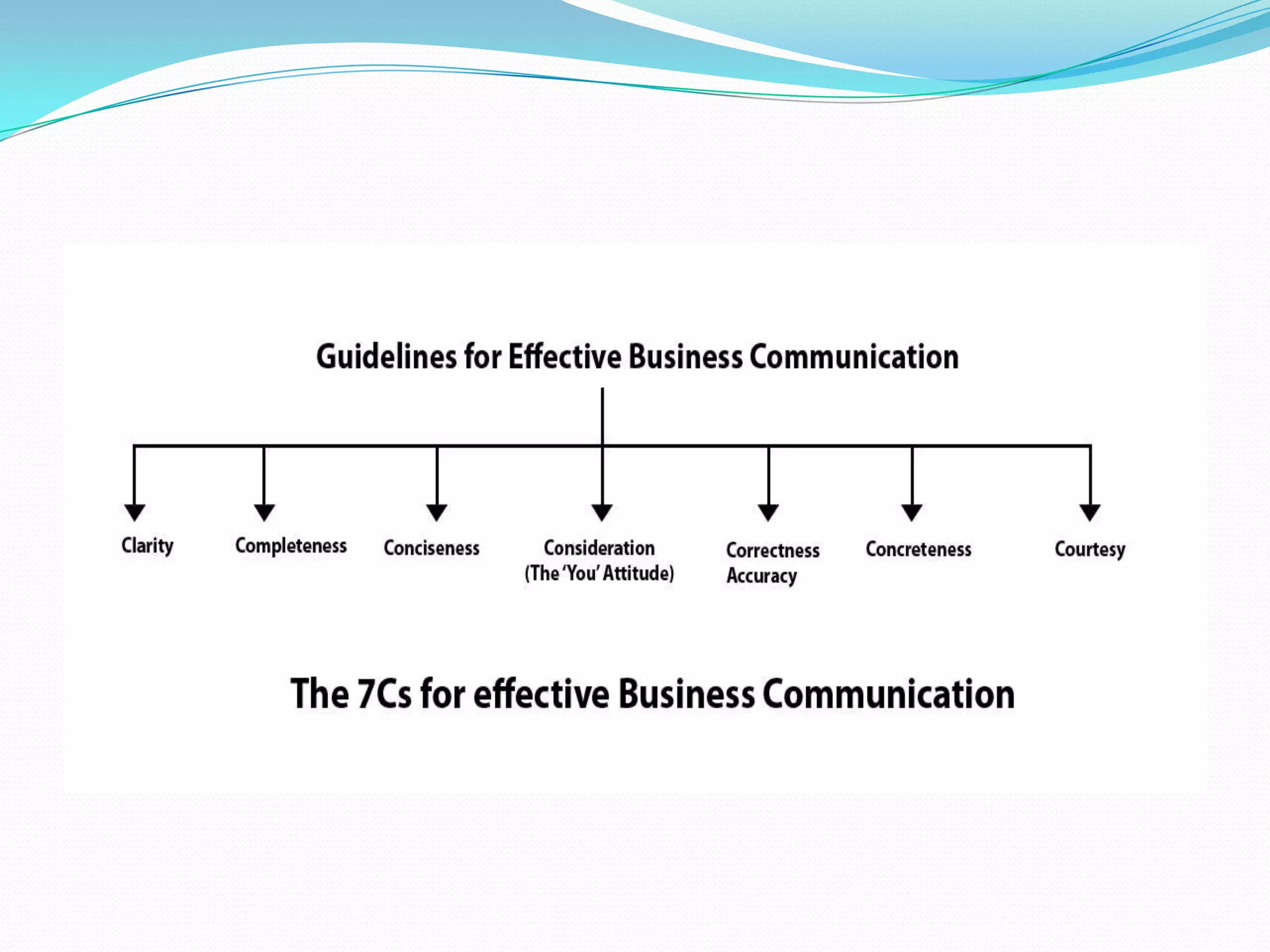
Completeness
The message must be complete. It should convey all the
facts required by the audience. The sender of the
message must take into consideration the receiver and
should communicate all the facts and figures related to
the message.
Consideration
Consideration implies “stepping into the shoes of
others”. Effective communication must take the
audience into consideration, i.e, the audience’s
view points, background, mind-set, education
level, etc. Make an attempt to envisage your
audience, their requirements, emotions as well as
problems. Ensure that the self-respect of the
audience is maintained and their emotions are not
at harm.
Conciseness
 Conciseness means communicating what you
want to convey in least possible words.
Conciseness is a necessity for effective
communication. Concise communication has
following features:
 It is both time-saving as well as cost-saving.
 It underlines and highlights the main message.
 Concise communication provides short and essential

message in limited words to the audience.
 Concise message is more appealing and comprehensible
to the audience.
Clarity
 Clarity implies emphasizing on a specific message
or goal at a time, rather than trying to achieve too
much at once. Clarity in communication has
following features:
 It makes understanding easier.
 Complete clarity of thoughts and ideas enhances

the meaning of message.
 Clear message makes use of exact, appropriate and
concrete words
Concreteness
 Concrete communication implies being particular
and clear rather than fuzzy and general.
Concreteness strengthens the confidence.
Concrete message has following features:
 It is supported with specific facts and figures.
 It makes use of words that are clear and that

build the reputation.
 Concrete messages are not misinterpreted
Courtesy
 Courtesy in message implies the message should show

the sender’s expression as well as should respect the
receiver. The sender of the message should be sincerely
polite, judicious, reflective and enthusiastic.
Courteous message has following features:
 Courtesy implies taking into consideration both viewpoints as

well as feelings of the receiver of the message.
 Courteous message is positive and focused at the audience.
 It makes use of terms showing respect for the receiver of
message.

 It is not at all biased
Correctness
 Correctness in communication implies that there are no

grammatical errors in communication. Correct
communication has following features:

 The message is exact, correct and well-timed.
 If the communication is correct, it boosts up the

confidence level.
 Correct message has greater impact on the
audience/ readers.
 It checks for the precision and accurateness of facts
and figures used in the message.
 It makes use of appropriate and correct language in
the message.
Important of business
communication
 For a business, the communication is said to be the life

blood, no business can develop in the absence of
effective communication , communication skills of the
employees are given high weightage at the time of their
appointment as well as promotion,
 For smooth working of a large businessLarge business organizations have many braches
in country and even . for smooth working, it s
essential that the head office should have up-todate knowledge of the various activities of the
branches. It is possible only through an effective
network of communication.
 For Promoting co-operation and

understandingEffective communication help to bring
about an atmosphere of mutual trust and
confidence. The management knows to
utilize the potential of employees.
 Communication skill is must for some jobs:-

there are some areas like marketing sales, public
relations and labour relations where communication
skills are compulsory. Editors, writers, teachers and
advocates need a highly developed ability to
communicate.
 Helpful in decision makingSufficient information must be collected before
making a prompt decision. Communication is a prerequisite for sufficient information
 Basic of managerial function-

communication is the base for discharging various function
of management. Planning requires extensive
communication among the executives. An efficient system
of communication enables management to change the
attitude of subordinates and to motivate them. Without
effective communication, co-ordination and cintrol is
impossible,
 To maintain relations with outsiders:-

the business organizations are required to deal with
various agencies like Bank, income tax and sales tax
authorities, Custom authorities and transporters, custom
authorities is required etc.
Importance of feed back
1.It completes the whole process of
communication and makes it continuous.
2. It makes one know if one is really communication
or making sense.
3. It is a basis for measuring the effectiveness of
communication.
4. It is a good basis for planning.
5. Feedback paves way for new idea generation.
Activity…
Thank you…

communication process and models

  • 1.
    SUBJECT :- “BUSINESS COMMUNICATION” PRSENTED BYAMAN TRIVEDI CHETAN BIRLA GOURAV CHAUDHARY NARENDRA PATEL PANKAJ PRASAD
  • 2.
    Communication  Communication isthe art and the process of sharing ideas.  It includes exchanging of information, signals, or messages as by talk, gestures, or writing.
  • 3.
    Communication Definitions  Communication isthe process of meaningful interaction among human beings. (D.E. McFarland)  Communication is an exchange of facts, ideas, opinions or emotions by two or more persons.  (Newman and C.F. Summer Jr.)  Communication is any behavior that results in an exchange of meaning. (The American Management Association)  Communication is a process of passing information and understanding from one person to another (Keith Davis)
  • 4.
    Process of Communication Communication is a process that involves some steps .The transmission of the sener’s ideas to the receiver and the receiver’s feedback or reaction to the sender completes the communication cycle. such process is called Process of Communication. * One Way Communication Process * Two Way Communication Process
  • 5.
    Idea (Sender/ Transmitter/Tx) Medium Encoding Message Decoding Received Message One Way CommunicationProcess Two Way Communication Process Rx Tx Feedback Idea (Receiver /Rx)
  • 6.
     Sender/Encoder- Is theperson that has information to share with another person or group. EncodingLeads to development of a message that contains the information of meaning the source hopes to convey.
  • 7.
     Message- The setof symbols that the sender transmits.  Medium- The communication channels thought which the Message moves from sender to receiver.
  • 8.
     Decoding- Process oftransforming the sender’s message back into thought.  Receiver- Is the person(s) with whom the sender shares thoughts of information.
  • 9.
     Noise- Unplannedstatic or distortion during the communication process, resulting in the receiver's receiving a different message than the sender sent.  Feedback- Receivers respond by hearing, seeing or reading. Feedback is sent back to the sender.
  • 10.
    Models of Communication Shannon Weaver model of Communication.  Berlo’s model of Communication.  Aristotle model of Communication.
  • 11.
    Shannon-Weaver Model • Thismodel developed in 1949 which is based on the idea that communication occur only when the message has been received and that it should be received unchanged as per as possible. • This model simply proposes that a message actually originates from the person who gets the thought or has the information. The sender is also called the Source of information or the Information Source. The information then gets transmitted from the brain to the mouth and comes out as a signal which then reaches the recipient after joining hands with several noises and other disturbances. The recipient then further passes on the message to its final destination or other minds of other individuals. • In this model feedback was not considered to be an integral component. Because the model conceived the communication process as a linear act and feedback another new act of communication.
  • 12.
  • 13.
     SOURCE- A sourceof information with messages to communicate  MessageThe set of symbols that the sender transmits.  Transmitter- A transmitter or sender with the capacity to transform message into signals
  • 14.
     Channel- The communicationchannels thought which the Message moves from sender to receiver.  NOISEA sixth element, noise is a dysfunctional factor any interference with the message travelling along the channel which may lead to the signal received being different from that sent.
  • 15.
     Receiver- A receiver,which 'decodes' (reconstructs) the message from the signal.  Destination- A destination, where the message arrives.
  • 16.
    Berlo’s Model ofCommunication
  • 17.
    Role of Berlo’sModel • The idea of “source” was flexible enough to include oral, written, electronic. • “Message” was made the central element, stressing the transmission of ideas. • The model recognized that receivers were important to communication, for they were the targets.
  • 18.
    Aristotle Model ofCommunication
  • 19.
    Role of AristotleModel  Provided an explanation of Oral Communication.  Recognize the importance of audience at the end of communication chain.  This model helped in developing public relationships.
  • 22.
    Completeness The message mustbe complete. It should convey all the facts required by the audience. The sender of the message must take into consideration the receiver and should communicate all the facts and figures related to the message.
  • 23.
    Consideration Consideration implies “steppinginto the shoes of others”. Effective communication must take the audience into consideration, i.e, the audience’s view points, background, mind-set, education level, etc. Make an attempt to envisage your audience, their requirements, emotions as well as problems. Ensure that the self-respect of the audience is maintained and their emotions are not at harm.
  • 24.
    Conciseness  Conciseness meanscommunicating what you want to convey in least possible words. Conciseness is a necessity for effective communication. Concise communication has following features:  It is both time-saving as well as cost-saving.  It underlines and highlights the main message.  Concise communication provides short and essential message in limited words to the audience.  Concise message is more appealing and comprehensible to the audience.
  • 25.
    Clarity  Clarity impliesemphasizing on a specific message or goal at a time, rather than trying to achieve too much at once. Clarity in communication has following features:  It makes understanding easier.  Complete clarity of thoughts and ideas enhances the meaning of message.  Clear message makes use of exact, appropriate and concrete words
  • 26.
    Concreteness  Concrete communicationimplies being particular and clear rather than fuzzy and general. Concreteness strengthens the confidence. Concrete message has following features:  It is supported with specific facts and figures.  It makes use of words that are clear and that build the reputation.  Concrete messages are not misinterpreted
  • 27.
    Courtesy  Courtesy inmessage implies the message should show the sender’s expression as well as should respect the receiver. The sender of the message should be sincerely polite, judicious, reflective and enthusiastic. Courteous message has following features:  Courtesy implies taking into consideration both viewpoints as well as feelings of the receiver of the message.  Courteous message is positive and focused at the audience.  It makes use of terms showing respect for the receiver of message.  It is not at all biased
  • 28.
    Correctness  Correctness incommunication implies that there are no grammatical errors in communication. Correct communication has following features:  The message is exact, correct and well-timed.  If the communication is correct, it boosts up the confidence level.  Correct message has greater impact on the audience/ readers.  It checks for the precision and accurateness of facts and figures used in the message.  It makes use of appropriate and correct language in the message.
  • 29.
    Important of business communication For a business, the communication is said to be the life blood, no business can develop in the absence of effective communication , communication skills of the employees are given high weightage at the time of their appointment as well as promotion,
  • 30.
     For smoothworking of a large businessLarge business organizations have many braches in country and even . for smooth working, it s essential that the head office should have up-todate knowledge of the various activities of the branches. It is possible only through an effective network of communication.  For Promoting co-operation and understandingEffective communication help to bring about an atmosphere of mutual trust and confidence. The management knows to utilize the potential of employees.
  • 31.
     Communication skillis must for some jobs:- there are some areas like marketing sales, public relations and labour relations where communication skills are compulsory. Editors, writers, teachers and advocates need a highly developed ability to communicate.  Helpful in decision makingSufficient information must be collected before making a prompt decision. Communication is a prerequisite for sufficient information
  • 32.
     Basic ofmanagerial function- communication is the base for discharging various function of management. Planning requires extensive communication among the executives. An efficient system of communication enables management to change the attitude of subordinates and to motivate them. Without effective communication, co-ordination and cintrol is impossible,  To maintain relations with outsiders:- the business organizations are required to deal with various agencies like Bank, income tax and sales tax authorities, Custom authorities and transporters, custom authorities is required etc.
  • 33.
    Importance of feedback 1.It completes the whole process of communication and makes it continuous. 2. It makes one know if one is really communication or making sense. 3. It is a basis for measuring the effectiveness of communication. 4. It is a good basis for planning. 5. Feedback paves way for new idea generation.
  • 34.
  • 35.