City & Guilds Construction
© 2013 City and Guilds of London Institute. All rights reserved. 1 of 16
PowerPointpresentation
Communication on site
Unit 202: Principles of building construction,
information and communication
City & Guilds Construction
© 2013 City and Guilds of London Institute. All rights reserved. 2 of 16
Aims and objectives
Aim:
• Introduce learners to communication on site.
Objectives:
• State the categories and methods of communication used on
construction sites.
• Explain the importance of communication.
• Explain key personnel involved in day-to-day communication.
• Explain how the key personnel involved in day-to-day communication
on site communicate.
City & Guilds Construction
© 2013 City and Guilds of London Institute. All rights reserved. 3 of 16
What is communication?
What is communication and how is it achieved?
Communication is the process or tool which people use to exchange or
pass on information.
How do we exchange or pass on information?
There are many ways to communicate.
City & Guilds Construction
© 2013 City and Guilds of London Institute. All rights reserved. 4 of 16
Communication methods
There are many ways to communicate.
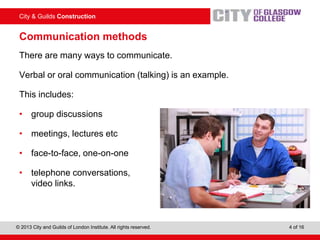
Verbal or oral communication (talking) is an example.
This includes:
• group discussions
• meetings, lectures etc
• face-to-face, one-on-one
• telephone conversations,
video links.
City & Guilds Construction
© 2013 City and Guilds of London Institute. All rights reserved. 5 of 16
Communication methods continued
Verbal communication is the quickest and most common method of
communicating, although it can easily be forgotten.
We use speech in two ways:
• informal – general conversations with your friends and relatives etc;
chatting to people
• Formal – at work, during interviews, on the telephone to customers.
City & Guilds Construction
© 2013 City and Guilds of London Institute. All rights reserved. 6 of 16
Communication methods continued
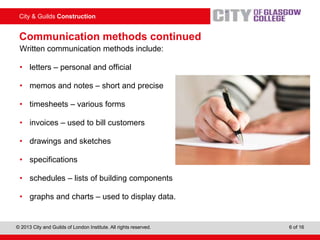
Written communication methods include:
• letters – personal and official
• memos and notes – short and precise
• timesheets – various forms
• invoices – used to bill customers
• drawings and sketches
• specifications
• schedules – lists of building components
• graphs and charts – used to display data.
City & Guilds Construction
© 2013 City and Guilds of London Institute. All rights reserved. 7 of 16
Communication methods continued
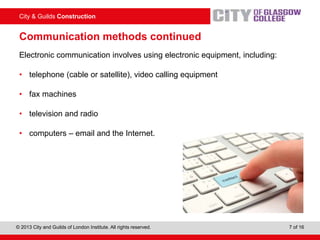
Electronic communication involves using electronic equipment, including:
• telephone (cable or satellite), video calling equipment
• fax machines
• television and radio
• computers – email and the Internet.
City & Guilds Construction
© 2013 City and Guilds of London Institute. All rights reserved. 8 of 16
Communication you will use
As far as you and your job within the construction industry are
concerned, you are most likely to use the following methods of verbal
communication:
• informal conversations
• formal conversations
• receiving instructions
• telephone calls
• taking part in meetings
• oral presentations.
City & Guilds Construction
© 2013 City and Guilds of London Institute. All rights reserved. 9 of 16
Communication
When speaking, you should remember to:
• speak clearly without shouting
• vary the tone and pitch of your voice
• pronounce words correctly
• never speak too quickly
• make use of humour when speaking.
City & Guilds Construction
© 2013 City and Guilds of London Institute. All rights reserved. 10 of 16
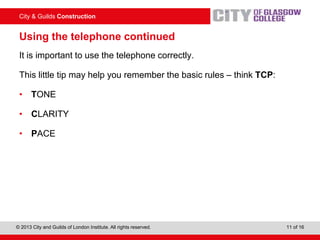
Using the telephone
Using the telephone has many advantages:
• It is accessible and can be used by people of all abilities and employment
statuses.
• You receive a rapid response.
• It is used by every firm, company or
organisation throughout the world.
• It has a global network.
• The equipment is both simple and
easy to use.
City & Guilds Construction
© 2013 City and Guilds of London Institute. All rights reserved. 11 of 16
Using the telephone continued
It is important to use the telephone correctly.
This little tip may help you remember the basic rules – think TCP:
• TONE
• CLARITY
• PACE
City & Guilds Construction
© 2013 City and Guilds of London Institute. All rights reserved. 12 of 16
Importance of communication
Construction sites are information-intensive environments. Various
construction personnel in the field need large amounts of information,
ranging from project design drawings to personal diaries to support
their ongoing work. The efficiency and effectiveness of the construction
process strongly depends on the quality of communication.
Communication is important and can be positive if handled well. It can
also be hurtful, depending on how it is done and the words that are
used. Communication needs to be open and sensitive, as well as
appropriate to the situation. The amount of information required by an
individual can change according to the circumstances.
City & Guilds Construction
© 2013 City and Guilds of London Institute. All rights reserved. 13 of 16
Importance of communication continued
Good communication is important, as it can help to:
• increase work productivity
• ensure smooth day-to-day running of the site
• reduce unseen costs – storage, damage, returned deliveries,
slow work progress
• enhance morale and friendship among the workforce
• encourage quick relaying of information between members
of the workforce.
City & Guilds Construction
© 2013 City and Guilds of London Institute. All rights reserved. 14 of 16
Key personnel
On site there are key personnel who communicate with each other on a
day-to-day basis:
• Architects
• Directors
• Clerks of works
• Site managers
• Builders’ merchants
• Charge hands
• Tradespeople
• Operatives
• Delivery drivers
City & Guilds Construction
© 2013 City and Guilds of London Institute. All rights reserved. 15 of 16
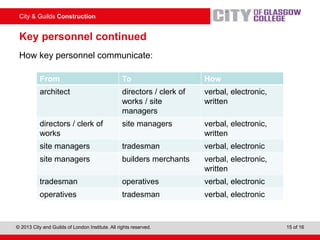
Key personnel continued
How key personnel communicate:
From To How
architect directors / clerk of
works / site
managers
verbal, electronic,
written
directors / clerk of
works
site managers verbal, electronic,
written
site managers tradesman verbal, electronic
site managers builders merchants verbal, electronic,
written
tradesman operatives verbal, electronic
operatives tradesman verbal, electronic
City & Guilds Construction
© 2013 City and Guilds of London Institute. All rights reserved. 16 of 16
Any questions?
City & Guilds Construction
© 2013 City and Guilds of London Institute. All rights reserved. 17 of 16
Student to work on
Please go and work on activities:
17,18,19,20
And worksheet:
5

Communication on site 5

  • 1.
    City & GuildsConstruction © 2013 City and Guilds of London Institute. All rights reserved. 1 of 16 PowerPointpresentation Communication on site Unit 202: Principles of building construction, information and communication
  • 2.
    City & GuildsConstruction © 2013 City and Guilds of London Institute. All rights reserved. 2 of 16 Aims and objectives Aim: • Introduce learners to communication on site. Objectives: • State the categories and methods of communication used on construction sites. • Explain the importance of communication. • Explain key personnel involved in day-to-day communication. • Explain how the key personnel involved in day-to-day communication on site communicate.
  • 3.
    City & GuildsConstruction © 2013 City and Guilds of London Institute. All rights reserved. 3 of 16 What is communication? What is communication and how is it achieved? Communication is the process or tool which people use to exchange or pass on information. How do we exchange or pass on information? There are many ways to communicate.
  • 4.
    City & GuildsConstruction © 2013 City and Guilds of London Institute. All rights reserved. 4 of 16 Communication methods There are many ways to communicate. Verbal or oral communication (talking) is an example. This includes: • group discussions • meetings, lectures etc • face-to-face, one-on-one • telephone conversations, video links.
  • 5.
    City & GuildsConstruction © 2013 City and Guilds of London Institute. All rights reserved. 5 of 16 Communication methods continued Verbal communication is the quickest and most common method of communicating, although it can easily be forgotten. We use speech in two ways: • informal – general conversations with your friends and relatives etc; chatting to people • Formal – at work, during interviews, on the telephone to customers.
  • 6.
    City & GuildsConstruction © 2013 City and Guilds of London Institute. All rights reserved. 6 of 16 Communication methods continued Written communication methods include: • letters – personal and official • memos and notes – short and precise • timesheets – various forms • invoices – used to bill customers • drawings and sketches • specifications • schedules – lists of building components • graphs and charts – used to display data.
  • 7.
    City & GuildsConstruction © 2013 City and Guilds of London Institute. All rights reserved. 7 of 16 Communication methods continued Electronic communication involves using electronic equipment, including: • telephone (cable or satellite), video calling equipment • fax machines • television and radio • computers – email and the Internet.
  • 8.
    City & GuildsConstruction © 2013 City and Guilds of London Institute. All rights reserved. 8 of 16 Communication you will use As far as you and your job within the construction industry are concerned, you are most likely to use the following methods of verbal communication: • informal conversations • formal conversations • receiving instructions • telephone calls • taking part in meetings • oral presentations.
  • 9.
    City & GuildsConstruction © 2013 City and Guilds of London Institute. All rights reserved. 9 of 16 Communication When speaking, you should remember to: • speak clearly without shouting • vary the tone and pitch of your voice • pronounce words correctly • never speak too quickly • make use of humour when speaking.
  • 10.
    City & GuildsConstruction © 2013 City and Guilds of London Institute. All rights reserved. 10 of 16 Using the telephone Using the telephone has many advantages: • It is accessible and can be used by people of all abilities and employment statuses. • You receive a rapid response. • It is used by every firm, company or organisation throughout the world. • It has a global network. • The equipment is both simple and easy to use.
  • 11.
    City & GuildsConstruction © 2013 City and Guilds of London Institute. All rights reserved. 11 of 16 Using the telephone continued It is important to use the telephone correctly. This little tip may help you remember the basic rules – think TCP: • TONE • CLARITY • PACE
  • 12.
    City & GuildsConstruction © 2013 City and Guilds of London Institute. All rights reserved. 12 of 16 Importance of communication Construction sites are information-intensive environments. Various construction personnel in the field need large amounts of information, ranging from project design drawings to personal diaries to support their ongoing work. The efficiency and effectiveness of the construction process strongly depends on the quality of communication. Communication is important and can be positive if handled well. It can also be hurtful, depending on how it is done and the words that are used. Communication needs to be open and sensitive, as well as appropriate to the situation. The amount of information required by an individual can change according to the circumstances.
  • 13.
    City & GuildsConstruction © 2013 City and Guilds of London Institute. All rights reserved. 13 of 16 Importance of communication continued Good communication is important, as it can help to: • increase work productivity • ensure smooth day-to-day running of the site • reduce unseen costs – storage, damage, returned deliveries, slow work progress • enhance morale and friendship among the workforce • encourage quick relaying of information between members of the workforce.
  • 14.
    City & GuildsConstruction © 2013 City and Guilds of London Institute. All rights reserved. 14 of 16 Key personnel On site there are key personnel who communicate with each other on a day-to-day basis: • Architects • Directors • Clerks of works • Site managers • Builders’ merchants • Charge hands • Tradespeople • Operatives • Delivery drivers
  • 15.
    City & GuildsConstruction © 2013 City and Guilds of London Institute. All rights reserved. 15 of 16 Key personnel continued How key personnel communicate: From To How architect directors / clerk of works / site managers verbal, electronic, written directors / clerk of works site managers verbal, electronic, written site managers tradesman verbal, electronic site managers builders merchants verbal, electronic, written tradesman operatives verbal, electronic operatives tradesman verbal, electronic
  • 16.
    City & GuildsConstruction © 2013 City and Guilds of London Institute. All rights reserved. 16 of 16 Any questions?
  • 17.
    City & GuildsConstruction © 2013 City and Guilds of London Institute. All rights reserved. 17 of 16 Student to work on Please go and work on activities: 17,18,19,20 And worksheet: 5