
“Making their spirits soar”
Staff Morale and Motivation
Kishwar Sayeed 29tn November 2012
“Making their spirits soar”
Staff Morale and Motivation
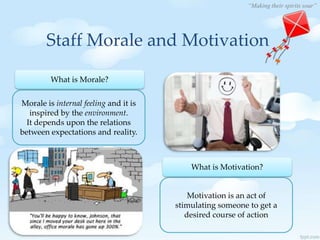
What is Morale?
Morale is internal feeling and it is
inspired by the environment.
It depends upon the relations
between expectations and reality.
What is Motivation?
Motivation is an act of
stimulating someone to get a
desired course of action
“Making their spirits soar”
Difference between Morale and Motivation
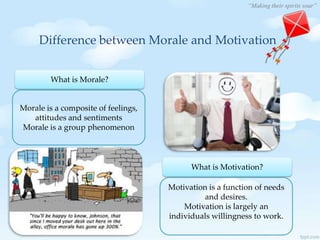
What is Morale?
Morale is a composite of feelings,
attitudes and sentiments
Morale is a group phenomenon
What is Motivation?
Motivation is a function of needs
and desires.
Motivation is largely an
individuals willingness to work.
“Making their spirits soar”
Why is Morale Important?
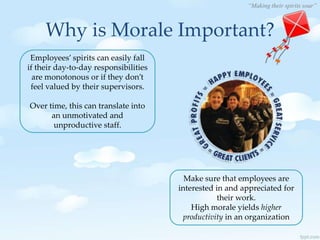
Make sure that employees are
interested in and appreciated for
their work.
High morale yields higher
productivity in an organization
Employees’ spirits can easily fall
if their day-to-day responsibilities
are monotonous or if they don’t
feel valued by their supervisors.
Over time, this can translate into
an unmotivated and
unproductive staff.
“Making their spirits soar”
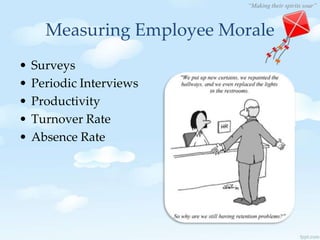
Measuring Employee Morale
• Surveys
• Periodic Interviews
• Productivity
• Turnover Rate
• Absence Rate
“Making their spirits soar”
Morale in the workplace
Good Morale
• Evidenced by:
– Employee enthusiasm
– Voluntary conformance with
regulations and orders
– Willingness to co-operate
Poor Morale
• Evidenced by:
– Surliness
– Insubordination
– Feeling of discouragement
– Dislike of the job, company
and associates.
“Making their spirits soar”
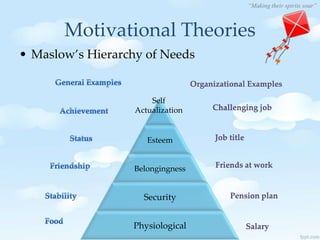
Esteem
Belongingness
Security
Physiological
Motivational Theories
• Maslow’s Hierarchy of Needs
Job title
Friends at work
Pension plan
Organizational Examples
Challenging job
Salary
Self
Actualization
“Making their spirits soar”
Equity Theory
Employees evaluate their treatment relative to the
treatment of others
Employee contributions to their jobs
What employees receive in return
The perceived ratio of contribution to return
determines perceived equity
“Making their spirits soar”
4 Steps Towards Motivation
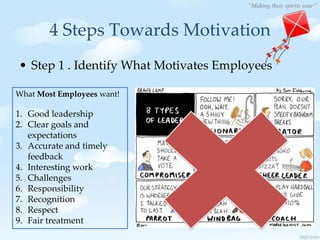
• Step 1 . Identify What Motivates Employees
What Most Employees want!
1. Good leadership
2. Clear goals and
expectations
3. Accurate and timely
feedback
4. Interesting work
5. Challenges
6. Responsibility
7. Recognition
8. Respect
9. Fair treatment
“Making their spirits soar”
4 Steps Towards Motivation
• Step 2—Identify and Address Barriers to Employee
Motivation
The Negative Outlook
You may often get negative responses
if asked what motivates a worker, you
make get some negative responses
like:
“If you want to motivate me, give me a
raise.”
“Don't ask my opinion if you don't want to
hear it.”
“Promotion means more headaches. Who
needs it?”
There are positive ways to counter these
negative responses.
Lack of Knowledge, and Fear
For example, fear stifles motivation
when a new worker refuses to ask
questions lest he or she seem incapable
of doing the job. Supervisors can
remind new workers again and again
that their questions are valued and
important and encourage them to ask
“Making their spirits soar”
4 Steps Towards Motivation
• Step 3—Develop an Employee Motivation Program
Motivation Program Composition
•Explain what the employee needs to do to meet
expectations
•Correction works best when it is perceived as a
partnership.
•Monitor the employee's progress with care
•Meet frequently to review the plan and the
employee's conduct.
•Provide encouragement, praise, and recognition
•Disciplinary measures (must be justified and
removed upon improvement in performance)
“Making their spirits soar”
4 Steps Towards Motivation
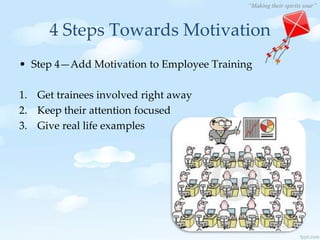
• Step 4—Add Motivation to Employee Training
1. Get trainees involved right away
2. Keep their attention focused
3. Give real life examples
“Making their spirits soar”
Motivating an Aging Workforce
Middle-aged and older workers need training and
motivation to keep performing at their best just as
much as the younger ones.
Do not ignore or sideline them. You could be
wasting some of your best workers.
• Are generally experienced and knowledgeable.
• Tend to have a strong work ethic and take pride in their work.
• Often have superior judgment.
• Tend to make fewer mistakes than their younger co-workers.
• Are among the most loyal to the organization.
• Are usually committed to quality and productivity standards.
• Often are more reliable and have better attendance records
• Tend to have better workplace safety records.
“Making their spirits soar”
Strategies for Enhancing Job Satisfaction
and Morale
Reinforcement/behavior modification
Management by objectives
Participative management and empowerment
Job enrichment and job redesign
Modified work schedules
“Making their spirits soar”
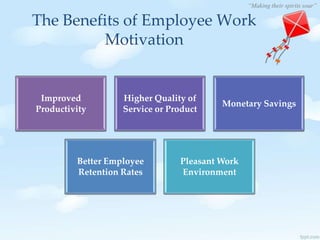
The Benefits of Employee Work
Motivation
Improved
Productivity
Higher Quality of
Service or Product
Monetary Savings
Better Employee
Retention Rates
Pleasant Work
Environment
“Making their spirits soar”
THANK YOU

Staff morale and motivation

  • 1.
    “Making their spiritssoar” Staff Morale and Motivation Kishwar Sayeed 29tn November 2012 “Making their spirits soar”
  • 2.
    “Making their spiritssoar” Staff Morale and Motivation What is Morale? Morale is internal feeling and it is inspired by the environment. It depends upon the relations between expectations and reality. What is Motivation? Motivation is an act of stimulating someone to get a desired course of action
  • 3.
    “Making their spiritssoar” Difference between Morale and Motivation What is Morale? Morale is a composite of feelings, attitudes and sentiments Morale is a group phenomenon What is Motivation? Motivation is a function of needs and desires. Motivation is largely an individuals willingness to work.
  • 4.
    “Making their spiritssoar” Why is Morale Important? Make sure that employees are interested in and appreciated for their work. High morale yields higher productivity in an organization Employees’ spirits can easily fall if their day-to-day responsibilities are monotonous or if they don’t feel valued by their supervisors. Over time, this can translate into an unmotivated and unproductive staff.
  • 5.
    “Making their spiritssoar” Measuring Employee Morale • Surveys • Periodic Interviews • Productivity • Turnover Rate • Absence Rate
  • 6.
    “Making their spiritssoar” Morale in the workplace Good Morale • Evidenced by: – Employee enthusiasm – Voluntary conformance with regulations and orders – Willingness to co-operate Poor Morale • Evidenced by: – Surliness – Insubordination – Feeling of discouragement – Dislike of the job, company and associates.
  • 7.
    “Making their spiritssoar” Esteem Belongingness Security Physiological Motivational Theories • Maslow’s Hierarchy of Needs Job title Friends at work Pension plan Organizational Examples Challenging job Salary Self Actualization
  • 8.
    “Making their spiritssoar” Equity Theory Employees evaluate their treatment relative to the treatment of others Employee contributions to their jobs What employees receive in return The perceived ratio of contribution to return determines perceived equity
  • 9.
    “Making their spiritssoar” 4 Steps Towards Motivation • Step 1 . Identify What Motivates Employees What Most Employees want! 1. Good leadership 2. Clear goals and expectations 3. Accurate and timely feedback 4. Interesting work 5. Challenges 6. Responsibility 7. Recognition 8. Respect 9. Fair treatment
  • 10.
    “Making their spiritssoar” 4 Steps Towards Motivation • Step 2—Identify and Address Barriers to Employee Motivation The Negative Outlook You may often get negative responses if asked what motivates a worker, you make get some negative responses like: “If you want to motivate me, give me a raise.” “Don't ask my opinion if you don't want to hear it.” “Promotion means more headaches. Who needs it?” There are positive ways to counter these negative responses. Lack of Knowledge, and Fear For example, fear stifles motivation when a new worker refuses to ask questions lest he or she seem incapable of doing the job. Supervisors can remind new workers again and again that their questions are valued and important and encourage them to ask
  • 11.
    “Making their spiritssoar” 4 Steps Towards Motivation • Step 3—Develop an Employee Motivation Program Motivation Program Composition •Explain what the employee needs to do to meet expectations •Correction works best when it is perceived as a partnership. •Monitor the employee's progress with care •Meet frequently to review the plan and the employee's conduct. •Provide encouragement, praise, and recognition •Disciplinary measures (must be justified and removed upon improvement in performance)
  • 12.
    “Making their spiritssoar” 4 Steps Towards Motivation • Step 4—Add Motivation to Employee Training 1. Get trainees involved right away 2. Keep their attention focused 3. Give real life examples
  • 13.
    “Making their spiritssoar” Motivating an Aging Workforce Middle-aged and older workers need training and motivation to keep performing at their best just as much as the younger ones. Do not ignore or sideline them. You could be wasting some of your best workers. • Are generally experienced and knowledgeable. • Tend to have a strong work ethic and take pride in their work. • Often have superior judgment. • Tend to make fewer mistakes than their younger co-workers. • Are among the most loyal to the organization. • Are usually committed to quality and productivity standards. • Often are more reliable and have better attendance records • Tend to have better workplace safety records.
  • 14.
    “Making their spiritssoar” Strategies for Enhancing Job Satisfaction and Morale Reinforcement/behavior modification Management by objectives Participative management and empowerment Job enrichment and job redesign Modified work schedules
  • 15.
    “Making their spiritssoar” The Benefits of Employee Work Motivation Improved Productivity Higher Quality of Service or Product Monetary Savings Better Employee Retention Rates Pleasant Work Environment
  • 16.
    “Making their spiritssoar” THANK YOU