COMMUNICATION
Studies tell 70 % of mistakes in the workplace are a
direct result of poor communication…..
Communication
Communication is simply a two
way process of exchanging
ideas, information or
transmitting verbal and
non-verbal messages.
Effective Communication
EFFECTIVE
COMMUNICATION
PRODUCTIVE
RELATIONSHIP
We communicate to…
• Get information
• Get feedback
• Motivate
• Praise
• Greet
• Sell
• Etc.
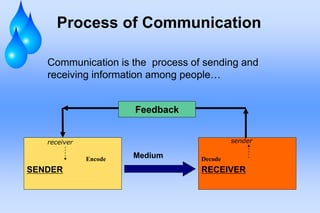
Process of Communication
Communication is the process of sending and
receiving information among people…
SENDER RECEIVER
Feedback
receiver sender
Medium
Encode Decode
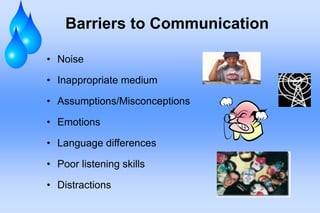
Barriers to Communication
• Noise
• Inappropriate medium
• Assumptions/Misconceptions
• Emotions
• Language differences
• Poor listening skills
• Distractions
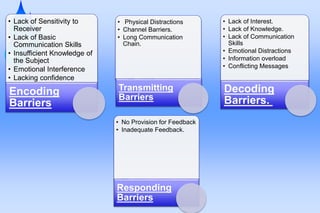
• Lack of Sensitivity to
Receiver
• Lack of Basic
Communication Skills
• Insufficient Knowledge of
the Subject
• Emotional Interference
• Lacking confidence
Encoding
Barriers
• Physical Distractions
• Channel Barriers.
• Long Communication
Chain.
Transmitting
Barriers
• Lack of Interest.
• Lack of Knowledge.
• Lack of Communication
Skills
• Emotional Distractions
• Information overload
• Conflicting Messages
Decoding
Barriers.
• No Provision for Feedback
• Inadequate Feedback.
Responding
Barriers
Overcoming the barriers of effective
communication
Effective
Communication skills
Body language
(Smile, Eye contact,
Gestures, tone)
Cultural
Sensitivity
Checking
for understanding
Summarizing
what has been said
Seeking
Participation
Effective Questions
Simple
Words
Connecting with
The audience
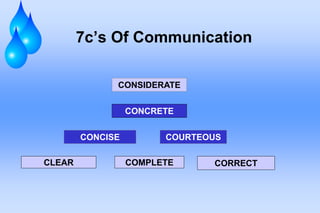
7c’s Of Communication
CLEAR COMPLETE CORRECT
CONCISE COURTEOUS
CONCRETE
CONSIDERATE
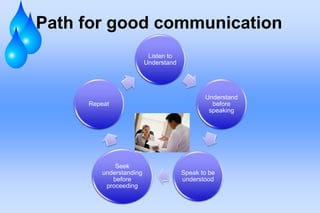
Path for good communication
Listen to
Understand
Understand
before
speaking
Speak to be
understood
Seek
understanding
before
proceeding
Repeat
 Always think ahead about what you are going to say.
 Use simple words and phrases that are understood by every body.
 Increase your knowledge on all subjects you are required to speak.
 Speak clearly and audibly.
 Check twice with the listener whether you have been understood accurately or not
 In case of an interruption, always do a little recap of what has been already said.
ESSENTIALS OF COMMUNICATION
Dos
ESSENTIALS OF COMMUNICATION
Dos
 Always pay undivided attention to the speaker while listening.
 Always ask for clarification if you have failed to grasp other’s point of view.
 Repeat what the speaker has said to check whether you have understood
accurately
ESSENTIALS OF COMMUNICATION
DONTS
 Do not use technical terms and terminologies not understood by majority of
people
 Do not speak too fast or too slow
 Do not speak in inaudible surroundings as you wont be heard
 Do not assume that everybody understands you
 Do not interrupt the speaker.
 Do not jump to the conclusion that you have understood every thing.
 Do not instantly react and mutter something in anger.
 While listening do not glance here and there as it might distract the speaker.
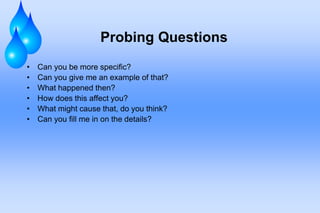
Probing Questions
• Can you be more specific?
• Can you give me an example of that?
• What happened then?
• How does this affect you?
• What might cause that, do you think?
• Can you fill me in on the details?
Before communicating
Ask yourself…
 What is the main purpose/aim?
 Who will receive it?
 What is the likely attitude of the listener?
 How much does he need to know?
 Is my timing right?
 What is the main subject?
 Are the major points clear?
 Is there any ambiguity?
Importance of listening
“If we were supposed to talk more than listen, we would have been
given two mouths and one ear.”
Mark Twain
What is listening ?
 Listening is the absorption
of the meanings of words
and sentences by the
brain. Listening leads to the
understanding of facts and
ideas.
Various stages to listening
 Hearing
 Focusing on the message not the person
 Comprehending and interpreting
 Analyzing and Evaluating
 Responding
 Remembering
Value Of Listening
 Listening to others is an elegant art.
 Good listening reflects courtesy and good manners.
 The result of poor listening skill could be disastrous in business, employment and
social relations.
 Good listening can eliminate a number of imaginary grievances of employees.
 Good listening skill can improve social relations and conversation.
 Listening is a positive activity rather than a passive or negative activity.
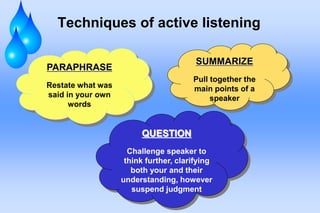
Techniques of active listening
PARAPHRASE
Restate what was
said in your own
words
SUMMARIZE
Pull together the
main points of a
speaker
QUESTION
Challenge speaker to
think further, clarifying
both your and their
understanding, however
suspend judgment
How to improve your listening
skills?
• Maintain eye contact with the instructor
• Focus on content than on the way that it is being said.
• Avoid selective listening
• Avoid distractions
• Ask questions to stay active and interested.
• Face the speaker
• Maintain eye contact
• Respond appropriately – say yes, nod, etc.
• Do not be preoccupied with your own thoughts.
Improving Body Language -
Tips
• Keep appropriate distance
• Touch only when appropriate
• Take care of your appearance
• Be aware - people may give false cues
• Maintain eye contact
• Smile genuinely
…in the new global and diverse
workplace requires
excellent communication skills!
Success for YOU…
Questions

250455473-EFFECTIVE-COMMUNICATION-SKILLS-ppt.ppt

  • 1.
  • 2.
    Studies tell 70% of mistakes in the workplace are a direct result of poor communication…..
  • 3.
    Communication Communication is simplya two way process of exchanging ideas, information or transmitting verbal and non-verbal messages.
  • 4.
    Effective Communication EFFECTIVE COMMUNICATION PRODUCTIVE RELATIONSHIP We communicateto… • Get information • Get feedback • Motivate • Praise • Greet • Sell • Etc.
  • 5.
    Process of Communication Communicationis the process of sending and receiving information among people… SENDER RECEIVER Feedback receiver sender Medium Encode Decode
  • 6.
    Barriers to Communication •Noise • Inappropriate medium • Assumptions/Misconceptions • Emotions • Language differences • Poor listening skills • Distractions
  • 7.
    • Lack ofSensitivity to Receiver • Lack of Basic Communication Skills • Insufficient Knowledge of the Subject • Emotional Interference • Lacking confidence Encoding Barriers • Physical Distractions • Channel Barriers. • Long Communication Chain. Transmitting Barriers • Lack of Interest. • Lack of Knowledge. • Lack of Communication Skills • Emotional Distractions • Information overload • Conflicting Messages Decoding Barriers. • No Provision for Feedback • Inadequate Feedback. Responding Barriers
  • 8.
    Overcoming the barriersof effective communication Effective Communication skills Body language (Smile, Eye contact, Gestures, tone) Cultural Sensitivity Checking for understanding Summarizing what has been said Seeking Participation Effective Questions Simple Words Connecting with The audience
  • 9.
    7c’s Of Communication CLEARCOMPLETE CORRECT CONCISE COURTEOUS CONCRETE CONSIDERATE
  • 10.
    Path for goodcommunication Listen to Understand Understand before speaking Speak to be understood Seek understanding before proceeding Repeat
  • 11.
     Always thinkahead about what you are going to say.  Use simple words and phrases that are understood by every body.  Increase your knowledge on all subjects you are required to speak.  Speak clearly and audibly.  Check twice with the listener whether you have been understood accurately or not  In case of an interruption, always do a little recap of what has been already said. ESSENTIALS OF COMMUNICATION Dos
  • 12.
    ESSENTIALS OF COMMUNICATION Dos Always pay undivided attention to the speaker while listening.  Always ask for clarification if you have failed to grasp other’s point of view.  Repeat what the speaker has said to check whether you have understood accurately
  • 13.
    ESSENTIALS OF COMMUNICATION DONTS Do not use technical terms and terminologies not understood by majority of people  Do not speak too fast or too slow  Do not speak in inaudible surroundings as you wont be heard  Do not assume that everybody understands you  Do not interrupt the speaker.  Do not jump to the conclusion that you have understood every thing.  Do not instantly react and mutter something in anger.  While listening do not glance here and there as it might distract the speaker.
  • 14.
    Probing Questions • Canyou be more specific? • Can you give me an example of that? • What happened then? • How does this affect you? • What might cause that, do you think? • Can you fill me in on the details?
  • 15.
    Before communicating Ask yourself… What is the main purpose/aim?  Who will receive it?  What is the likely attitude of the listener?  How much does he need to know?  Is my timing right?  What is the main subject?  Are the major points clear?  Is there any ambiguity?
  • 16.
    Importance of listening “Ifwe were supposed to talk more than listen, we would have been given two mouths and one ear.” Mark Twain
  • 17.
    What is listening?  Listening is the absorption of the meanings of words and sentences by the brain. Listening leads to the understanding of facts and ideas.
  • 18.
    Various stages tolistening  Hearing  Focusing on the message not the person  Comprehending and interpreting  Analyzing and Evaluating  Responding  Remembering
  • 19.
    Value Of Listening Listening to others is an elegant art.  Good listening reflects courtesy and good manners.  The result of poor listening skill could be disastrous in business, employment and social relations.  Good listening can eliminate a number of imaginary grievances of employees.  Good listening skill can improve social relations and conversation.  Listening is a positive activity rather than a passive or negative activity.
  • 20.
    Techniques of activelistening PARAPHRASE Restate what was said in your own words SUMMARIZE Pull together the main points of a speaker QUESTION Challenge speaker to think further, clarifying both your and their understanding, however suspend judgment
  • 21.
    How to improveyour listening skills? • Maintain eye contact with the instructor • Focus on content than on the way that it is being said. • Avoid selective listening • Avoid distractions • Ask questions to stay active and interested. • Face the speaker • Maintain eye contact • Respond appropriately – say yes, nod, etc. • Do not be preoccupied with your own thoughts.
  • 22.
    Improving Body Language- Tips • Keep appropriate distance • Touch only when appropriate • Take care of your appearance • Be aware - people may give false cues • Maintain eye contact • Smile genuinely
  • 23.
    …in the newglobal and diverse workplace requires excellent communication skills! Success for YOU…
  • 24.

Editor's Notes