Define and understand communication and the communication process List and overcome the filters/ barriers in a communication  process Practice active listening Tips to improve verbal and non verbal communication
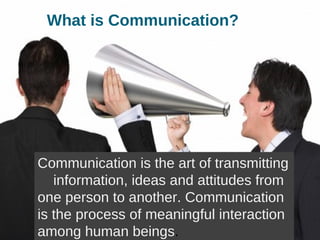
What is Communication? Communication is the art of transmitting  information, ideas and attitudes from one person to another. Communication is the process of meaningful interaction among human beings .
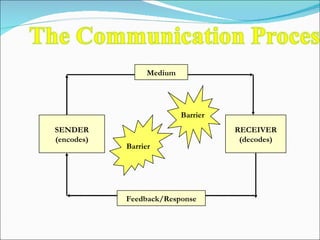
SENDER (encodes) RECEIVER (decodes) Barrier Barrier Medium Feedback/Response
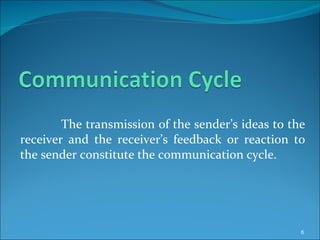
The transmission of the sender’s ideas to the receiver and the receiver’s feedback or reaction to the sender constitute the communication cycle.
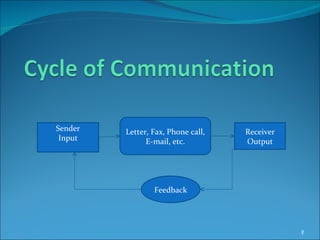
Sender Input Letter, Fax, Phone call, E-mail, etc. Receiver Output Feedback
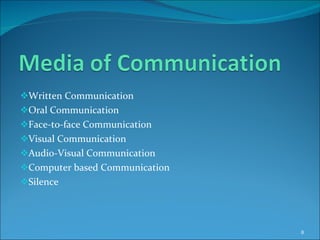
Written Communication Oral Communication Face-to-face Communication Visual Communication Audio-Visual Communication Computer based Communication Silence
Includes letters, circulars, memos, reports, forms and manuals, etc. Everything that has to be written and transmitted in the written form falls in the area of written communication.
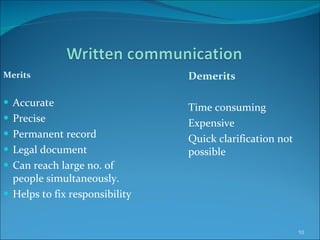
Demerits Time consuming Expensive  Quick clarification not possible Merits Accurate Precise Permanent record Legal document Can reach large no. of people simultaneously. Helps to fix responsibility
Includes face-to-face conversation, Conversation over phone, radio, interviews, group discussion, meetings, conferences, seminars, etc.
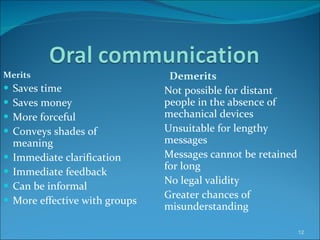
Demerits Not possible for distant people in the absence of mechanical devices Unsuitable for lengthy messages Messages cannot be retained for long  No legal validity Greater chances of misunderstanding Merits Saves time Saves money More forceful Conveys shades of meaning Immediate clarification Immediate feedback Can be informal More effective with groups
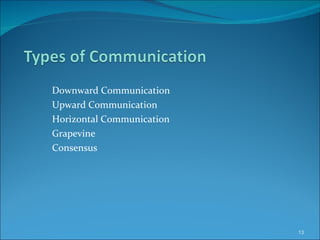
Downward Communication Upward Communication Horizontal Communication Grapevine Consensus
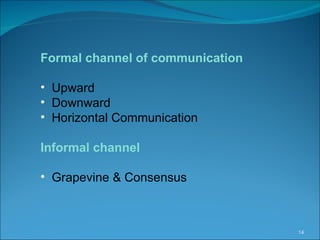
Formal channel of communication Upward  Downward  Horizontal Communication Informal channel Grapevine & Consensus
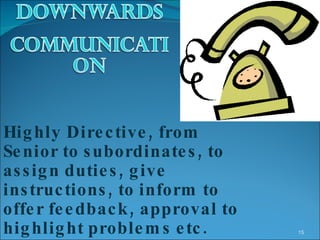
Highly Directive, from Senior to subordinates, to assign duties, give instructions, to inform to offer feedback, approval to highlight problems etc.
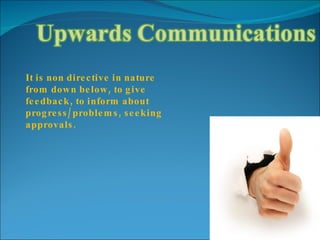
It is non directive in nature from down below, to give feedback, to inform about progress/problems, seeking approvals.
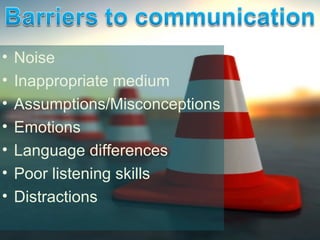
Noise Inappropriate medium Assumptions/Misconceptions Emotions Language differences Poor listening skills Distractions
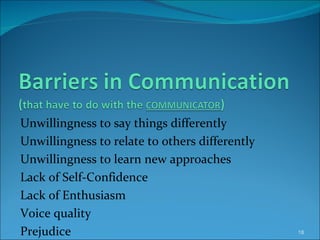
Unwillingness to say things differently Unwillingness to relate to others differently Unwillingness to learn new approaches Lack of Self-Confidence Lack of Enthusiasm Voice quality Prejudice
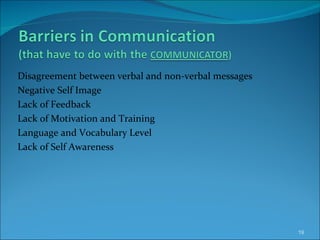
Disagreement between verbal and non-verbal messages Negative Self Image Lack of Feedback Lack of Motivation and Training Language and Vocabulary Level Lack of Self Awareness
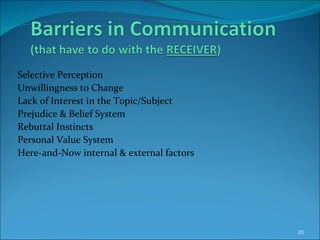
Selective Perception Unwillingness to Change Lack of Interest in the Topic/Subject Prejudice & Belief System Rebuttal Instincts Personal Value System Here-and-Now internal & external factors
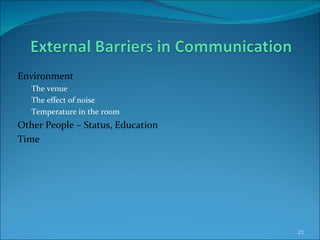
Environment  The venue The effect of noise Temperature in the room Other People – Status, Education Time
 
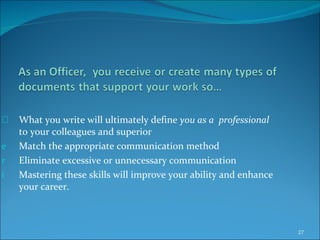
What you write will ultimately define  you as a   professional  to your colleagues and superior Match the appropriate communication method  Eliminate excessive or unnecessary communication Mastering these skills will improve your ability and enhance your career.
By not being Preoccupied Being Open Minded & Non Defensive Minimizing Interruptions Effective Listening is: Hearing, interpreting when necessary, understanding the message and relating to it. By Asking Questions
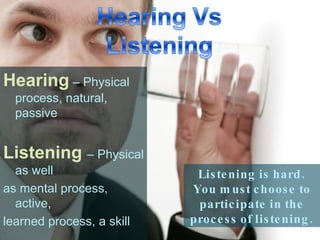
Hearing  – Physical process, natural, passive Listening   – Physical as well as mental process, active, learned process, a skill Listening is hard. You must choose to participate in the process of listening.
VALUE OF LISTENING Listening to others is an elegant art. Good listening reflects courtesy and good manners. Listening carefully to the instructions of superiors improve competence and  performance.
The result of poor listening skill could be disastrous in business,  employment and social relations. Good listening can eliminate a number of imaginary grievances of employees. Good listening skill can improve social relations and conversation. Listening is a positive activity rather than a passive or negative activity.
Always think ahead about what you are going to say. Use simple words and phrases that are understood by every body. Increase your knowledge on all subjects you are required to speak. Speak clearly and audibly. . ESSENTIALS OF COMMUNICATION Dos
Check twice with the listener whether you have been understood accurately or not In case of an interruption, always do a little recap of what has been already said. Always pay undivided attention to the speaker while listening.
While listening, always make notes of important points. Always ask for clarification if you have failed to grasp other’s point of view. Repeat what the speaker has said to check whether you have understood accurately
ESSENTIALS OF COMMUNICATION DON’Ts Do not instantly react and mutter something in anger. Do not use technical terms & terminologies not understood by majority of people. Do not speak too fast or too slow. Do not speak in inaudible surroundings, as you won’t be heard.
Do not assume that every body understands you. While listening do not glance here and there as it might distract the speaker. Do not interrupt the speaker. Do not jump to the conclusion that you have understood every thing.
How to Improve Existing Level of COMMUNICATION? IMPROVE LANGUAGE. IMPROVE PRONUNCIATIOON. WORK ON VOICE MODULATION. WORK ON BODY LANGUAGE. READ MORE LISTEN MORE
Avoid   reading or watching or listening unwanted literature, gossip, media presentation etc. Interact  with qualitative people. Improve  on you topic of discussion, Practice  meditation & good thoughts.
THINK AND SPEAK. DO NOT SPEAK TOO FAST. USE SIMPLE VOCABULARY. DO NOT SPEAK ONLY TO IMPRESS SOMEONE. LOOK PRESENTABLE AND CONFIDENT.
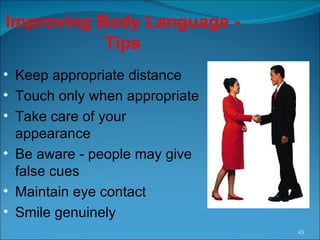
Improving Body Language - Tips Keep appropriate distance Touch only when appropriate Take care of your appearance Be aware - people may give false cues  Maintain eye contact Smile genuinely
-  You have over 630 muscles in your body. - Eye muscles are the busiest muscles in the body. Scientists estimate they may move more than 100,000 times a day. - You have over 30 muscles in your face to help you smile or frown. It takes 17 muscles to smile and 43 to frown. SO SMILE EVERYTIME YOU SEE SOMEONE. - The strongest muscle in your body is your tongue. USE IT EFFECTIVELY. - It takes the interaction of 72 different muscles to produce human speech.  FEW FACTS
Communication23
Communication23

Communication23

  • 2.
  • 3.
    Define and understandcommunication and the communication process List and overcome the filters/ barriers in a communication process Practice active listening Tips to improve verbal and non verbal communication
  • 4.
    What is Communication?Communication is the art of transmitting information, ideas and attitudes from one person to another. Communication is the process of meaningful interaction among human beings .
  • 5.
    SENDER (encodes) RECEIVER(decodes) Barrier Barrier Medium Feedback/Response
  • 6.
    The transmission ofthe sender’s ideas to the receiver and the receiver’s feedback or reaction to the sender constitute the communication cycle.
  • 7.
    Sender Input Letter,Fax, Phone call, E-mail, etc. Receiver Output Feedback
  • 8.
    Written Communication OralCommunication Face-to-face Communication Visual Communication Audio-Visual Communication Computer based Communication Silence
  • 9.
    Includes letters, circulars,memos, reports, forms and manuals, etc. Everything that has to be written and transmitted in the written form falls in the area of written communication.
  • 10.
    Demerits Time consumingExpensive Quick clarification not possible Merits Accurate Precise Permanent record Legal document Can reach large no. of people simultaneously. Helps to fix responsibility
  • 11.
    Includes face-to-face conversation,Conversation over phone, radio, interviews, group discussion, meetings, conferences, seminars, etc.
  • 12.
    Demerits Not possiblefor distant people in the absence of mechanical devices Unsuitable for lengthy messages Messages cannot be retained for long No legal validity Greater chances of misunderstanding Merits Saves time Saves money More forceful Conveys shades of meaning Immediate clarification Immediate feedback Can be informal More effective with groups
  • 13.
    Downward Communication UpwardCommunication Horizontal Communication Grapevine Consensus
  • 14.
    Formal channel ofcommunication Upward Downward Horizontal Communication Informal channel Grapevine & Consensus
  • 15.
    Highly Directive, fromSenior to subordinates, to assign duties, give instructions, to inform to offer feedback, approval to highlight problems etc.
  • 16.
    It is nondirective in nature from down below, to give feedback, to inform about progress/problems, seeking approvals.
  • 17.
    Noise Inappropriate mediumAssumptions/Misconceptions Emotions Language differences Poor listening skills Distractions
  • 18.
    Unwillingness to saythings differently Unwillingness to relate to others differently Unwillingness to learn new approaches Lack of Self-Confidence Lack of Enthusiasm Voice quality Prejudice
  • 19.
    Disagreement between verbaland non-verbal messages Negative Self Image Lack of Feedback Lack of Motivation and Training Language and Vocabulary Level Lack of Self Awareness
  • 20.
    Selective Perception Unwillingnessto Change Lack of Interest in the Topic/Subject Prejudice & Belief System Rebuttal Instincts Personal Value System Here-and-Now internal & external factors
  • 21.
    Environment Thevenue The effect of noise Temperature in the room Other People – Status, Education Time
  • 22.
  • 27.
    What you writewill ultimately define you as a professional to your colleagues and superior Match the appropriate communication method Eliminate excessive or unnecessary communication Mastering these skills will improve your ability and enhance your career.
  • 31.
    By not beingPreoccupied Being Open Minded & Non Defensive Minimizing Interruptions Effective Listening is: Hearing, interpreting when necessary, understanding the message and relating to it. By Asking Questions
  • 32.
    Hearing –Physical process, natural, passive Listening – Physical as well as mental process, active, learned process, a skill Listening is hard. You must choose to participate in the process of listening.
  • 33.
    VALUE OF LISTENINGListening to others is an elegant art. Good listening reflects courtesy and good manners. Listening carefully to the instructions of superiors improve competence and performance.
  • 34.
    The result ofpoor listening skill could be disastrous in business, employment and social relations. Good listening can eliminate a number of imaginary grievances of employees. Good listening skill can improve social relations and conversation. Listening is a positive activity rather than a passive or negative activity.
  • 35.
    Always think aheadabout what you are going to say. Use simple words and phrases that are understood by every body. Increase your knowledge on all subjects you are required to speak. Speak clearly and audibly. . ESSENTIALS OF COMMUNICATION Dos
  • 36.
    Check twice withthe listener whether you have been understood accurately or not In case of an interruption, always do a little recap of what has been already said. Always pay undivided attention to the speaker while listening.
  • 37.
    While listening, alwaysmake notes of important points. Always ask for clarification if you have failed to grasp other’s point of view. Repeat what the speaker has said to check whether you have understood accurately
  • 38.
    ESSENTIALS OF COMMUNICATIONDON’Ts Do not instantly react and mutter something in anger. Do not use technical terms & terminologies not understood by majority of people. Do not speak too fast or too slow. Do not speak in inaudible surroundings, as you won’t be heard.
  • 39.
    Do not assumethat every body understands you. While listening do not glance here and there as it might distract the speaker. Do not interrupt the speaker. Do not jump to the conclusion that you have understood every thing.
  • 40.
    How to ImproveExisting Level of COMMUNICATION? IMPROVE LANGUAGE. IMPROVE PRONUNCIATIOON. WORK ON VOICE MODULATION. WORK ON BODY LANGUAGE. READ MORE LISTEN MORE
  • 41.
    Avoid reading or watching or listening unwanted literature, gossip, media presentation etc. Interact with qualitative people. Improve on you topic of discussion, Practice meditation & good thoughts.
  • 42.
    THINK AND SPEAK.DO NOT SPEAK TOO FAST. USE SIMPLE VOCABULARY. DO NOT SPEAK ONLY TO IMPRESS SOMEONE. LOOK PRESENTABLE AND CONFIDENT.
  • 43.
    Improving Body Language- Tips Keep appropriate distance Touch only when appropriate Take care of your appearance Be aware - people may give false cues Maintain eye contact Smile genuinely
  • 44.
    - Youhave over 630 muscles in your body. - Eye muscles are the busiest muscles in the body. Scientists estimate they may move more than 100,000 times a day. - You have over 30 muscles in your face to help you smile or frown. It takes 17 muscles to smile and 43 to frown. SO SMILE EVERYTIME YOU SEE SOMEONE. - The strongest muscle in your body is your tongue. USE IT EFFECTIVELY. - It takes the interaction of 72 different muscles to produce human speech. FEW FACTS