Welcome!
BRAC Institute of Governance and Development
Workshop
on
Policy Communications Strategy Development
BIGD Communications Team
Part 1
What is Communication?
‘Communication is a process of transferring information from one
entity to another’ ... Wikipedia
‘...... a Process by which information is exchanged between individuals
through common system of symbols, signs, behavior....’ ...Oxford
Dictionary
‘Communication is the 2-way exchange of opinions, news and
information by writing, speech or gestures including body language and
facial reactions.’ .... Your Dictionary
Communication requires a sender, message, a medium and recipient
Communication
The word Communication came from Old
French communicacion, from Latin
commūnicātiōnem, accusative singular of
commūnicātiō (“imparting, communicating”),
from commūnicō (“I share, I impart”).
What is Communications?
The art and technique of using words effectively to impart information
or ideas.
The field of study concerned with the transmission of information by
various means, such as print or broadcasting.
Any of various professions involved with the transmission of
information, such as advertising, broadcasting, or journalism.
A system, such as mail, telephone, or television, for sending and
receiving messages.
A network of routes for sending messages and transporting troops and
supplies.
It is a key function of management
An organization cannot operate without communication between
levels, departments and employees
Communication Model
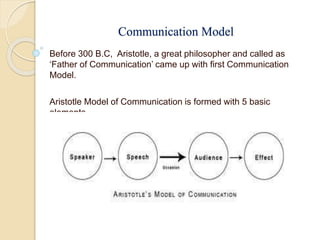
Before 300 B.C, Aristotle, a great philosopher and called as
‘Father of Communication’ came up with first Communication
Model.
Aristotle Model of Communication is formed with 5 basic
elements
(i) Speaker, (ii) Speech, (iii) Occasion, (iv) Audience and (v)
Effect.
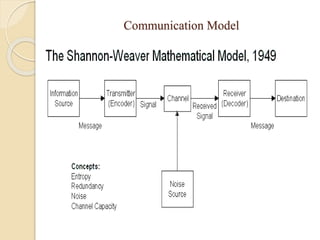
Communication Model
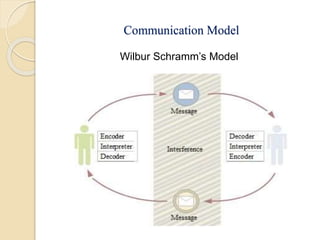
Wilbur Schramm’s Model
Communication Model
Communication Process Model
Receiver
Decode
message
Encode
feedback
Form
feedback
Sender
Form
message
Encode
message
Decode
feedback
Transmit
Message
Transmit
Feedback
Receive
encoded
message
Receive
feedback
Noise
Functions of Communication
According to Berlo (1960), the sole purpose of communication is to
influence people. Persuasive function of communication i.e. to induce
people is extremely important for extension in changing their
behaviour in the desirable direction.
The Functions
Information
Persuade
Motivation
Emotional Expression/ Feedback
which require and result into
Knowledge management
Decision making
Coordinating work activities
Fulfils relatedness needs
Why Communications?
We communicate to persuade
We communicate in order to give or provide
information
We communicate seeking information
We communicate to express our emotions
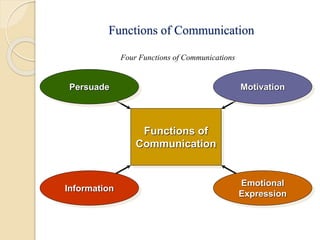
Functions of Communication
Four Functions of Communications
Functions of
Communication
Persuade Motivation
Emotional
Expression
Information
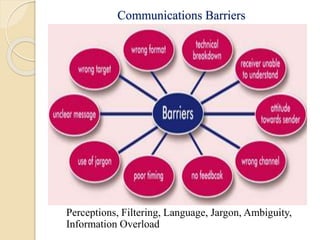
Communications Barriers
Perceptions, Filtering, Language, Jargon, Ambiguity,
Information Overload
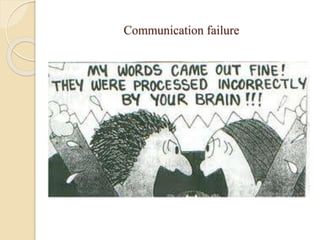
Communication Failure
Communication failure
Types of Communications
Fundamentally, there are four Types of Communication.
1. Inter-personal Communications
2. Intra Personal Communication
3. Small group Communication
4. Public Communication
Different institutions practice different type of
communications based on organisational nature, size,
goals etc.
For example,
Communications of a Think Tank institution
Communications of a University
Communications of Car company, pharmaceuticals etc.
Think Tank Communications
Communications department/division of a Think
Tank can support through the following:
Policy Engagement Communications
Lobbying to Public and Private officials to influence
Lobbying with Policy makers, Lawmakers, Public
Officials, Donor agencies, NGOs and INGOs
Converting Research outcomes into Communicative
Materials
Design/Develop a Plan based on Think Tanks
mission and vision
Think Tank Communications
Engagement with Media (Both Mainstream and
Social )
Train Media Workers/Public Officials/
Internal and External Branding
Finalize communications Channels (Events,
Publications, Media, Digital), tools (Report,
Press release, Launching ceremony, Facebook,
Twitter etc)
set up rules with mix
Testing and continue monitoring and evaluation
Part 2
An Introduction
to
Communications Channels and Tools
In this Session
• Identifying different tools available
• Identifying different channels for communications
• How to choose the right mix of tools and channels
for your organisation
• Group exercise
- Putting together an universe of Channels and Tools
- Discussion
Tools of Communications
Imagine some most common tools we
use for everyday communications.
Identify some tools that we use for our
organisation, e.g. communicating with
stakeholders.
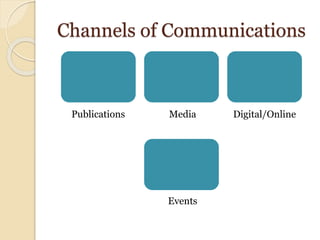
Channels of Communications
Publications Media Digital/Online
Events
PUBLICATIONS
Digital/Social Media
EVENTS
MEDIA
How to choose the right mix of tools
for an organisation?
Not all the tools are appropriate for all
organisations. Each organisation must
choose the most appropriate mix.
Communications as an orchestra
To follow this approach…
Think tanks need to:
• Identify the universe of channel and tools
• Define which are applicable to them: that is,
what is appropriate for the think tank’s context,
what it has the resources to deliver, etc.
• Develop ‘rules’ to know when to combine them
for maximum impact:
• Assign responsibilities –for each channel and
for ‘conducting’
• Test and learn by doing to improve each tool,
the rules and the ‘mix’
Group Exercise
Think of a past project/event of your
organisation and the tools used for
that project.
How would you use the tools
differently after having the knowledge
of channels and tools of
communications?
Communication tools for research communication

Communication tools for research communication

  • 1.
    Welcome! BRAC Institute ofGovernance and Development Workshop on Policy Communications Strategy Development BIGD Communications Team
  • 2.
    Part 1 What isCommunication? ‘Communication is a process of transferring information from one entity to another’ ... Wikipedia ‘...... a Process by which information is exchanged between individuals through common system of symbols, signs, behavior....’ ...Oxford Dictionary ‘Communication is the 2-way exchange of opinions, news and information by writing, speech or gestures including body language and facial reactions.’ .... Your Dictionary Communication requires a sender, message, a medium and recipient
  • 3.
    Communication The word Communicationcame from Old French communicacion, from Latin commūnicātiōnem, accusative singular of commūnicātiō (“imparting, communicating”), from commūnicō (“I share, I impart”).
  • 4.
    What is Communications? Theart and technique of using words effectively to impart information or ideas. The field of study concerned with the transmission of information by various means, such as print or broadcasting. Any of various professions involved with the transmission of information, such as advertising, broadcasting, or journalism. A system, such as mail, telephone, or television, for sending and receiving messages. A network of routes for sending messages and transporting troops and supplies. It is a key function of management An organization cannot operate without communication between levels, departments and employees
  • 5.
    Communication Model Before 300B.C, Aristotle, a great philosopher and called as ‘Father of Communication’ came up with first Communication Model. Aristotle Model of Communication is formed with 5 basic elements (i) Speaker, (ii) Speech, (iii) Occasion, (iv) Audience and (v) Effect.
  • 6.
  • 7.
  • 8.
  • 9.
    Functions of Communication Accordingto Berlo (1960), the sole purpose of communication is to influence people. Persuasive function of communication i.e. to induce people is extremely important for extension in changing their behaviour in the desirable direction. The Functions Information Persuade Motivation Emotional Expression/ Feedback which require and result into Knowledge management Decision making Coordinating work activities Fulfils relatedness needs
  • 10.
    Why Communications? We communicateto persuade We communicate in order to give or provide information We communicate seeking information We communicate to express our emotions
  • 11.
    Functions of Communication FourFunctions of Communications Functions of Communication Persuade Motivation Emotional Expression Information
  • 12.
    Communications Barriers Perceptions, Filtering,Language, Jargon, Ambiguity, Information Overload
  • 13.
  • 14.
  • 15.
  • 16.
    Types of Communications Fundamentally,there are four Types of Communication. 1. Inter-personal Communications 2. Intra Personal Communication 3. Small group Communication 4. Public Communication Different institutions practice different type of communications based on organisational nature, size, goals etc. For example, Communications of a Think Tank institution Communications of a University Communications of Car company, pharmaceuticals etc.
  • 17.
    Think Tank Communications Communicationsdepartment/division of a Think Tank can support through the following: Policy Engagement Communications Lobbying to Public and Private officials to influence Lobbying with Policy makers, Lawmakers, Public Officials, Donor agencies, NGOs and INGOs Converting Research outcomes into Communicative Materials Design/Develop a Plan based on Think Tanks mission and vision
  • 18.
    Think Tank Communications Engagementwith Media (Both Mainstream and Social ) Train Media Workers/Public Officials/ Internal and External Branding Finalize communications Channels (Events, Publications, Media, Digital), tools (Report, Press release, Launching ceremony, Facebook, Twitter etc) set up rules with mix Testing and continue monitoring and evaluation
  • 20.
  • 21.
    In this Session •Identifying different tools available • Identifying different channels for communications • How to choose the right mix of tools and channels for your organisation • Group exercise - Putting together an universe of Channels and Tools - Discussion
  • 22.
    Tools of Communications Imaginesome most common tools we use for everyday communications. Identify some tools that we use for our organisation, e.g. communicating with stakeholders.
  • 23.
    Channels of Communications PublicationsMedia Digital/Online Events
  • 24.
  • 25.
  • 26.
  • 27.
  • 28.
    How to choosethe right mix of tools for an organisation? Not all the tools are appropriate for all organisations. Each organisation must choose the most appropriate mix. Communications as an orchestra
  • 29.
    To follow thisapproach… Think tanks need to: • Identify the universe of channel and tools • Define which are applicable to them: that is, what is appropriate for the think tank’s context, what it has the resources to deliver, etc. • Develop ‘rules’ to know when to combine them for maximum impact: • Assign responsibilities –for each channel and for ‘conducting’ • Test and learn by doing to improve each tool, the rules and the ‘mix’
  • 30.
    Group Exercise Think ofa past project/event of your organisation and the tools used for that project. How would you use the tools differently after having the knowledge of channels and tools of communications?