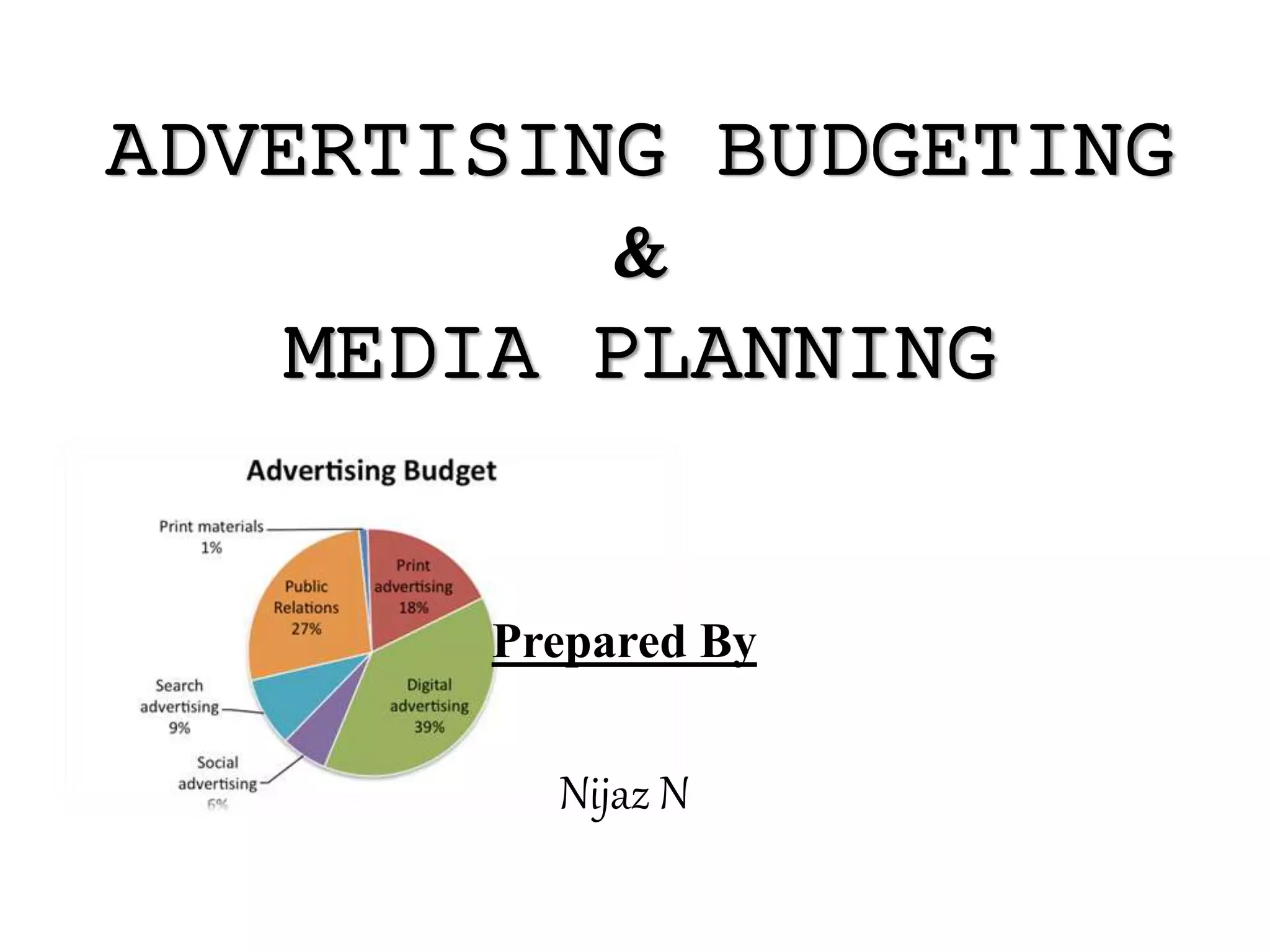
ADVERTISING BUDGETING
&
MEDIA PLANNING
Prepared By
Nijaz N
Advertising Budget
2
• An advertising budget is the money a company is
willing to set aside to accomplish its marketing
objectives.
• A subset of the larger sales budget .
answering several important questions?
3
• Who is the target consumer?
• What media type will be most useful in reaching the
target consumer?
• What is required to get the target consumer to
purchase the product?
• How much profit is likely to be earned for each dollar
spent on advertising?
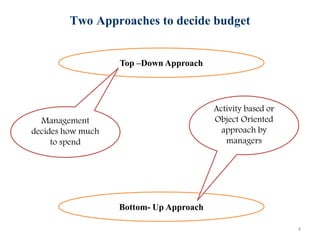
Two Approaches to decide budget
4
Top –Down Approach
Bottom- Up Approach
Management
decides how much
to spend
Activity based or
Object Oriented
approach by
managers
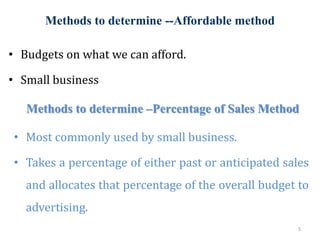
Methods to determine --Affordable method
5
• Budgets on what we can afford.
• Small business
Methods to determine –Percentage of Sales Method
• Most commonly used by small business.
• Takes a percentage of either past or anticipated sales
and allocates that percentage of the overall budget to
advertising.
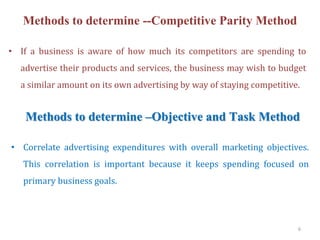
Methods to determine --Competitive Parity Method
6
• If a business is aware of how much its competitors are spending to
advertise their products and services, the business may wish to budget
a similar amount on its own advertising by way of staying competitive.
Methods to determine –Objective and Task Method
• Correlate advertising expenditures with overall marketing objectives.
This correlation is important because it keeps spending focused on
primary business goals.
MEDIA PLANNING
7
Media Planning
8
• Media planning is generally the task of a media
agency and entails finding media platforms for a
client's brand or product.
• The job of media planning involves determining the
best combination of media to achieve the marketing
campaign objectives.
• Media Planning = Selection + Scheduling
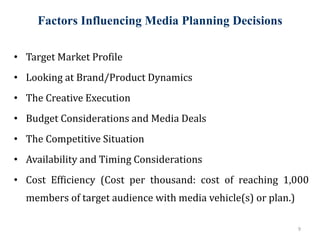
Factors Influencing Media Planning Decisions
9
• Target Market Profile
• Looking at Brand/Product Dynamics
• The Creative Execution
• Budget Considerations and Media Deals
• The Competitive Situation
• Availability and Timing Considerations
• Cost Efficiency (Cost per thousand: cost of reaching 1,000
members of target audience with media vehicle(s) or plan.)
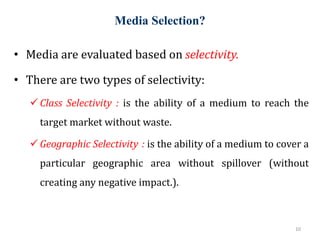
Media Selection?
10
• Media are evaluated based on selectivity.
• There are two types of selectivity:
 Class Selectivity : is the ability of a medium to reach the
target market without waste.
 Geographic Selectivity : is the ability of a medium to cover a
particular geographic area without spillover (without
creating any negative impact.).
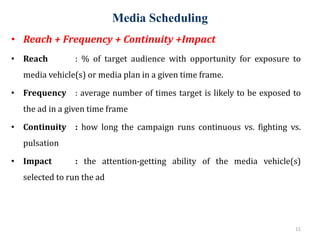
Media Scheduling
11
• Reach + Frequency + Continuity +Impact
• Reach : % of target audience with opportunity for exposure to
media vehicle(s) or media plan in a given time frame.
• Frequency : average number of times target is likely to be exposed to
the ad in a given time frame
• Continuity : how long the campaign runs continuous vs. fighting vs.
pulsation
• Impact : the attention-getting ability of the media vehicle(s)
selected to run the ad
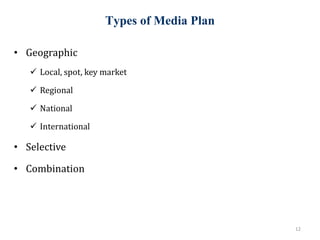
Types of Media Plan
12
• Geographic
 Local, spot, key market
 Regional
 National
 International
• Selective
• Combination
Media Research
13
• Research that is centred on issues of media selection and
efficiency
• Survey conducted to investigate what segment of consumers
read which periodicals and/or listen to or watch which radio
or television programs.

Advertisement budgeting & media planning

  • 1.
  • 2.
    Advertising Budget 2 • Anadvertising budget is the money a company is willing to set aside to accomplish its marketing objectives. • A subset of the larger sales budget .
  • 3.
    answering several importantquestions? 3 • Who is the target consumer? • What media type will be most useful in reaching the target consumer? • What is required to get the target consumer to purchase the product? • How much profit is likely to be earned for each dollar spent on advertising?
  • 4.
    Two Approaches todecide budget 4 Top –Down Approach Bottom- Up Approach Management decides how much to spend Activity based or Object Oriented approach by managers
  • 5.
    Methods to determine--Affordable method 5 • Budgets on what we can afford. • Small business Methods to determine –Percentage of Sales Method • Most commonly used by small business. • Takes a percentage of either past or anticipated sales and allocates that percentage of the overall budget to advertising.
  • 6.
    Methods to determine--Competitive Parity Method 6 • If a business is aware of how much its competitors are spending to advertise their products and services, the business may wish to budget a similar amount on its own advertising by way of staying competitive. Methods to determine –Objective and Task Method • Correlate advertising expenditures with overall marketing objectives. This correlation is important because it keeps spending focused on primary business goals.
  • 7.
  • 8.
    Media Planning 8 • Mediaplanning is generally the task of a media agency and entails finding media platforms for a client's brand or product. • The job of media planning involves determining the best combination of media to achieve the marketing campaign objectives. • Media Planning = Selection + Scheduling
  • 9.
    Factors Influencing MediaPlanning Decisions 9 • Target Market Profile • Looking at Brand/Product Dynamics • The Creative Execution • Budget Considerations and Media Deals • The Competitive Situation • Availability and Timing Considerations • Cost Efficiency (Cost per thousand: cost of reaching 1,000 members of target audience with media vehicle(s) or plan.)
  • 10.
    Media Selection? 10 • Mediaare evaluated based on selectivity. • There are two types of selectivity:  Class Selectivity : is the ability of a medium to reach the target market without waste.  Geographic Selectivity : is the ability of a medium to cover a particular geographic area without spillover (without creating any negative impact.).
  • 11.
    Media Scheduling 11 • Reach+ Frequency + Continuity +Impact • Reach : % of target audience with opportunity for exposure to media vehicle(s) or media plan in a given time frame. • Frequency : average number of times target is likely to be exposed to the ad in a given time frame • Continuity : how long the campaign runs continuous vs. fighting vs. pulsation • Impact : the attention-getting ability of the media vehicle(s) selected to run the ad
  • 12.
    Types of MediaPlan 12 • Geographic  Local, spot, key market  Regional  National  International • Selective • Combination
  • 13.
    Media Research 13 • Researchthat is centred on issues of media selection and efficiency • Survey conducted to investigate what segment of consumers read which periodicals and/or listen to or watch which radio or television programs.