MARKET DEMAND AND IT'S
MEASUREMENT
BY SANDHYA DEVKOTA
BBA,III SEM(DAY)
Market demand
It is the aggregate volume of a
product or service that would be
bought by a defined customer
group in a defined geographical
area in a defined time under
defined marketing environment
and program.
In short, Market demand =
function of ( market area, time
period, marketing environment
and marketing mix)
.
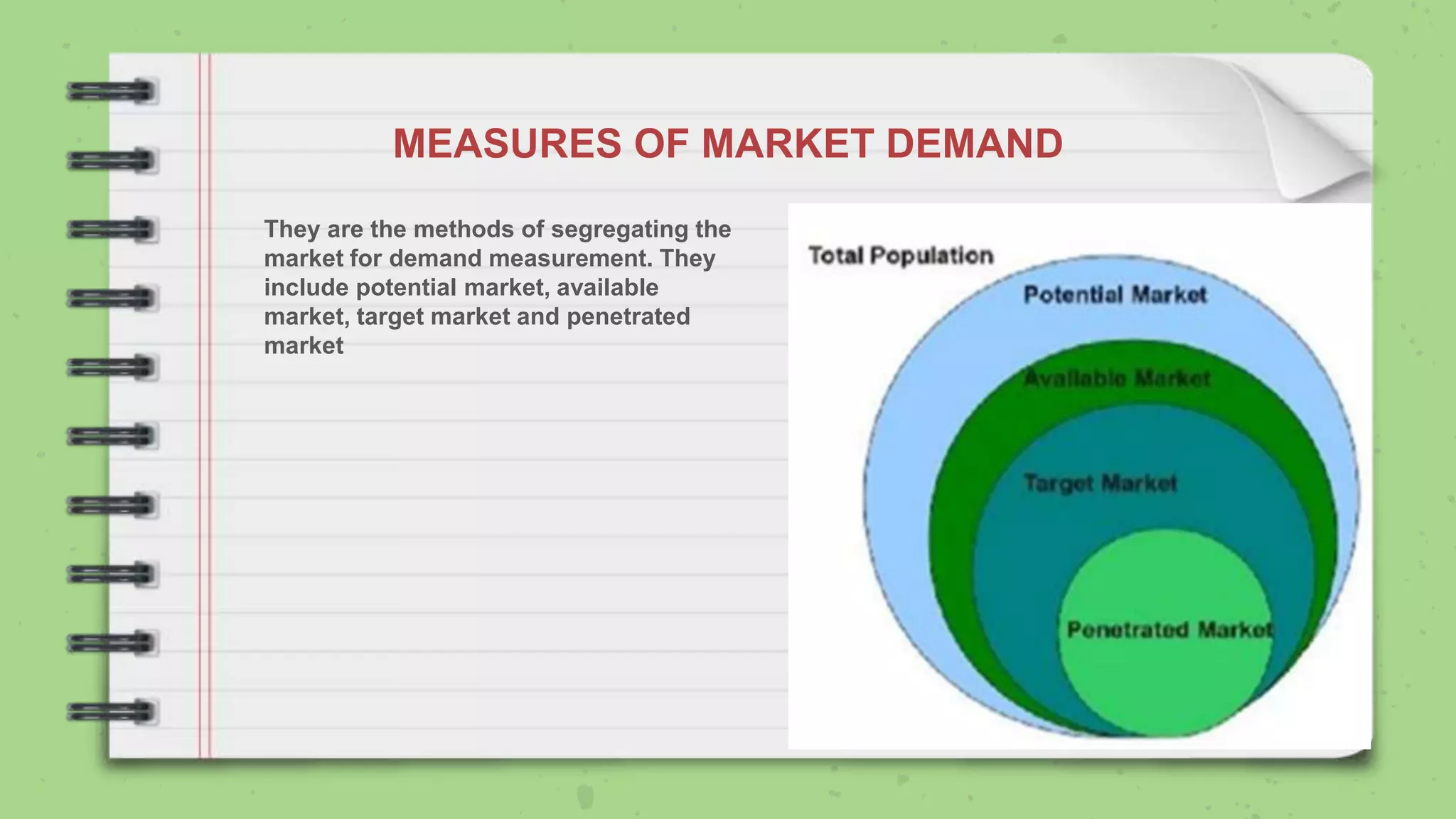
MEASURES OF MARKET DEMAND
They are the methods of segregating the
market for demand measurement. They
include potential market, available
market, target market and penetrated
market
POTENTIAL MARKET
It consists of a group of potential buyers who have
ample interest in the product and are willing to buy
it although they may or may not be able to afford to
purchase it.
TARGET MARKET
It is a part of available market that consists of
market segments in which the company has
decided to enter and serve.
AVAILABLE MARKET
It is a part of potential market that consists of a
group of customers who have sufficient funds,
interest and access to the offer.
PENERATED MARKET
It is a part of target market that consists of a
group of customers who regularly buy and
consume the company's products.
MEASURES OF
MARKET DEMAND
Estimation of Market Demand:
It is conducted at three levels, which
are minimal, maximum and market
sensitivity:
1) Market minimal demand: Minimum
level of market demand that takes
place without any demand stimulation.
2) Market maximum demand:
Maximum level of demand that is
achieved through demand stimulation.
3) Market sensitivity of demand:
Gap between market minimal and
market maximum.
Company sales forecasts: The
amount of sales a firm expects to
generate with a chosen marketing plan
in a given marketing environment.
Estimation of Company
demand:
Company demand can be defined as
the company's estimated share of
market demand at alternative levels of
marketing efforts and expenditures in a
defined time period.
It can be estimated on the basis of:
1) Company sales forecasts
2) Sales quota and sales budget
Sales quota and sales budget: The target
that has been set for a particular marketing
parameter or the minimal level of market
demand is known as sales quota. Sales
budget is the analysis of a company's sales
target for a particular period
Estimation of Current Demand
Most of the marketing firms estimate market demand for two periods: Current period and Future.
Current demands are estimated to design the marketing mix. It can be estimated using
environmental factors such as total market potential, area market potential, total industry sales
etc.
Total market potential
It is the availability of maximum sales for all
the companies in an industry over a certain
time period. The total market potential can
be estimated by the following two
approaches:
1) Population Indicator Method
2) Chain Ratio Method
Population Indicator Method : One of the simplest
method that takes total population of a market and
then deducts the number of people who are not
likely to be the current buyers.
In short, Total market potential = Prospects *
Average quantity of purchase* price
Chain Ratio Method : This method can simply be
implemented by multiplying a base number, such
as total population of the country, by a variety of
adjusting percentages. It requires adequate market
research.
Area market potential:
It is calculated to find out potential sales of a particular geographical area, city, region or a
country. The area market demand is estimated through two alternative methods: market build up
and multiple factor indexes.
Market build up:
Very simple method that calls for identifying all potential buyers in each market segments and
estimating their size of purchase. Then, all figures from different segments are added together to
get a precise estimate of area market potential.
Multiple factor index:
This method works best if your business is B2C. Here, factors that influence buying behavior can
be estimated, given specific weights and then rated. It includes a large number of customers.
Industry sales and
market share
The total industry
sale is the
combined sales of
all companies
operating in the
market
Once the industry sales figure is available, the firm can
estimate its market share by using the formula :
Market share of a firm =
Total sales of firm/Total sales of industry
For example,
Total sales of noodle in Nepal = 1500 million
Total sales of 2PM in Nepal = 300 million
Now, Market share of 2PM =
Total sales of firm/Total sales of industry
= 300/1500
= 0.2 or 20%
Therefore market share of 2PM is 20%
ESTIMATING FUTURE MARKET
DEMAND:
Also known as demand forecasting, it is an art of making
prediction of what customers are likely to do under given
circumstances. It is more difficult and complex process
as it is affected by several unstable variables operating in
micro and macro environment of marketing. Future
demand can be forecasted through following
approaches:
1) Opinion based forecasts
​2) Past sales trend
​3) Market test
ESTIMATING FUTURE DEMAND
Forecast
method
Description Use
Survey of
buyers
intentions
Research customers through
surveys about purchase
probability, present and future
finances and expectations
about the economy
The demand for industrial
products, consumer durables,
purchases that need planning
beforehand, and new products
can be predicated.
Composite of
sales force
opinions
Predicting their future sales by
asking the sales
representatives.
To understand developing trends
and gather detailed estimated by
product, territory, customer and
sales representatives.
Expert opinion Collect forecasts from experts,
including dealers, distributors,
suppliers, consultants and
trade associations or buy from
economic-forecasting firms.
To gather estimates from well
informed experts who may offer
internal perception.
Forecast
method
Description Use
Past-sales
analysis
Use time-series analysis,
exponential smoothing, statistical
demand analysis, or econometric
analysis to assess past sales as
the foundation of sales forecasts.
To predict future demand
based on analysis of past
demand.
Market test
method
Conduct a direct-market test to
understand customer response
and gauge future sales.
To forecast sales of new
products or sales of an
established and acclaimed
product in a new channel
or area.
THANK YOU FOR YOUR
ATTENTION
I’m happy to answer any
question you might have

Market Demand and it's measurement

  • 1.
    MARKET DEMAND ANDIT'S MEASUREMENT BY SANDHYA DEVKOTA BBA,III SEM(DAY)
  • 2.
    Market demand It isthe aggregate volume of a product or service that would be bought by a defined customer group in a defined geographical area in a defined time under defined marketing environment and program. In short, Market demand = function of ( market area, time period, marketing environment and marketing mix) .
  • 3.
    MEASURES OF MARKETDEMAND They are the methods of segregating the market for demand measurement. They include potential market, available market, target market and penetrated market
  • 4.
    POTENTIAL MARKET It consistsof a group of potential buyers who have ample interest in the product and are willing to buy it although they may or may not be able to afford to purchase it. TARGET MARKET It is a part of available market that consists of market segments in which the company has decided to enter and serve. AVAILABLE MARKET It is a part of potential market that consists of a group of customers who have sufficient funds, interest and access to the offer. PENERATED MARKET It is a part of target market that consists of a group of customers who regularly buy and consume the company's products. MEASURES OF MARKET DEMAND
  • 5.
    Estimation of MarketDemand: It is conducted at three levels, which are minimal, maximum and market sensitivity: 1) Market minimal demand: Minimum level of market demand that takes place without any demand stimulation. 2) Market maximum demand: Maximum level of demand that is achieved through demand stimulation. 3) Market sensitivity of demand: Gap between market minimal and market maximum.
  • 6.
    Company sales forecasts:The amount of sales a firm expects to generate with a chosen marketing plan in a given marketing environment. Estimation of Company demand: Company demand can be defined as the company's estimated share of market demand at alternative levels of marketing efforts and expenditures in a defined time period. It can be estimated on the basis of: 1) Company sales forecasts 2) Sales quota and sales budget Sales quota and sales budget: The target that has been set for a particular marketing parameter or the minimal level of market demand is known as sales quota. Sales budget is the analysis of a company's sales target for a particular period
  • 7.
    Estimation of CurrentDemand Most of the marketing firms estimate market demand for two periods: Current period and Future. Current demands are estimated to design the marketing mix. It can be estimated using environmental factors such as total market potential, area market potential, total industry sales etc.
  • 8.
    Total market potential Itis the availability of maximum sales for all the companies in an industry over a certain time period. The total market potential can be estimated by the following two approaches: 1) Population Indicator Method 2) Chain Ratio Method Population Indicator Method : One of the simplest method that takes total population of a market and then deducts the number of people who are not likely to be the current buyers. In short, Total market potential = Prospects * Average quantity of purchase* price Chain Ratio Method : This method can simply be implemented by multiplying a base number, such as total population of the country, by a variety of adjusting percentages. It requires adequate market research.
  • 9.
    Area market potential: Itis calculated to find out potential sales of a particular geographical area, city, region or a country. The area market demand is estimated through two alternative methods: market build up and multiple factor indexes. Market build up: Very simple method that calls for identifying all potential buyers in each market segments and estimating their size of purchase. Then, all figures from different segments are added together to get a precise estimate of area market potential. Multiple factor index: This method works best if your business is B2C. Here, factors that influence buying behavior can be estimated, given specific weights and then rated. It includes a large number of customers.
  • 10.
    Industry sales and marketshare The total industry sale is the combined sales of all companies operating in the market Once the industry sales figure is available, the firm can estimate its market share by using the formula : Market share of a firm = Total sales of firm/Total sales of industry For example, Total sales of noodle in Nepal = 1500 million Total sales of 2PM in Nepal = 300 million Now, Market share of 2PM = Total sales of firm/Total sales of industry = 300/1500 = 0.2 or 20% Therefore market share of 2PM is 20%
  • 11.
    ESTIMATING FUTURE MARKET DEMAND: Alsoknown as demand forecasting, it is an art of making prediction of what customers are likely to do under given circumstances. It is more difficult and complex process as it is affected by several unstable variables operating in micro and macro environment of marketing. Future demand can be forecasted through following approaches: 1) Opinion based forecasts ​2) Past sales trend ​3) Market test
  • 12.
    ESTIMATING FUTURE DEMAND Forecast method DescriptionUse Survey of buyers intentions Research customers through surveys about purchase probability, present and future finances and expectations about the economy The demand for industrial products, consumer durables, purchases that need planning beforehand, and new products can be predicated. Composite of sales force opinions Predicting their future sales by asking the sales representatives. To understand developing trends and gather detailed estimated by product, territory, customer and sales representatives. Expert opinion Collect forecasts from experts, including dealers, distributors, suppliers, consultants and trade associations or buy from economic-forecasting firms. To gather estimates from well informed experts who may offer internal perception.
  • 13.
    Forecast method Description Use Past-sales analysis Use time-seriesanalysis, exponential smoothing, statistical demand analysis, or econometric analysis to assess past sales as the foundation of sales forecasts. To predict future demand based on analysis of past demand. Market test method Conduct a direct-market test to understand customer response and gauge future sales. To forecast sales of new products or sales of an established and acclaimed product in a new channel or area.
  • 14.
    THANK YOU FORYOUR ATTENTION I’m happy to answer any question you might have