Module Learning Outcomes
Describetypical business communication, and explain barriers to effective
communication
14.1: Recognize the role of communication in the management function
14.2: Differentiate between typical communication flows within an organization
14.3: Explain barriers to effective communication
14.4: Differentiate between typical channels of business communication
Learning Outcomes: Communicationand
Management
14.1: Recognize the role of communication in the management
function
14.1.1: Describe the components of the communication-process model
14.1.2: Recognize common missteps in communication
14.1.3: Differentiate between formal and informal communication networks
5.
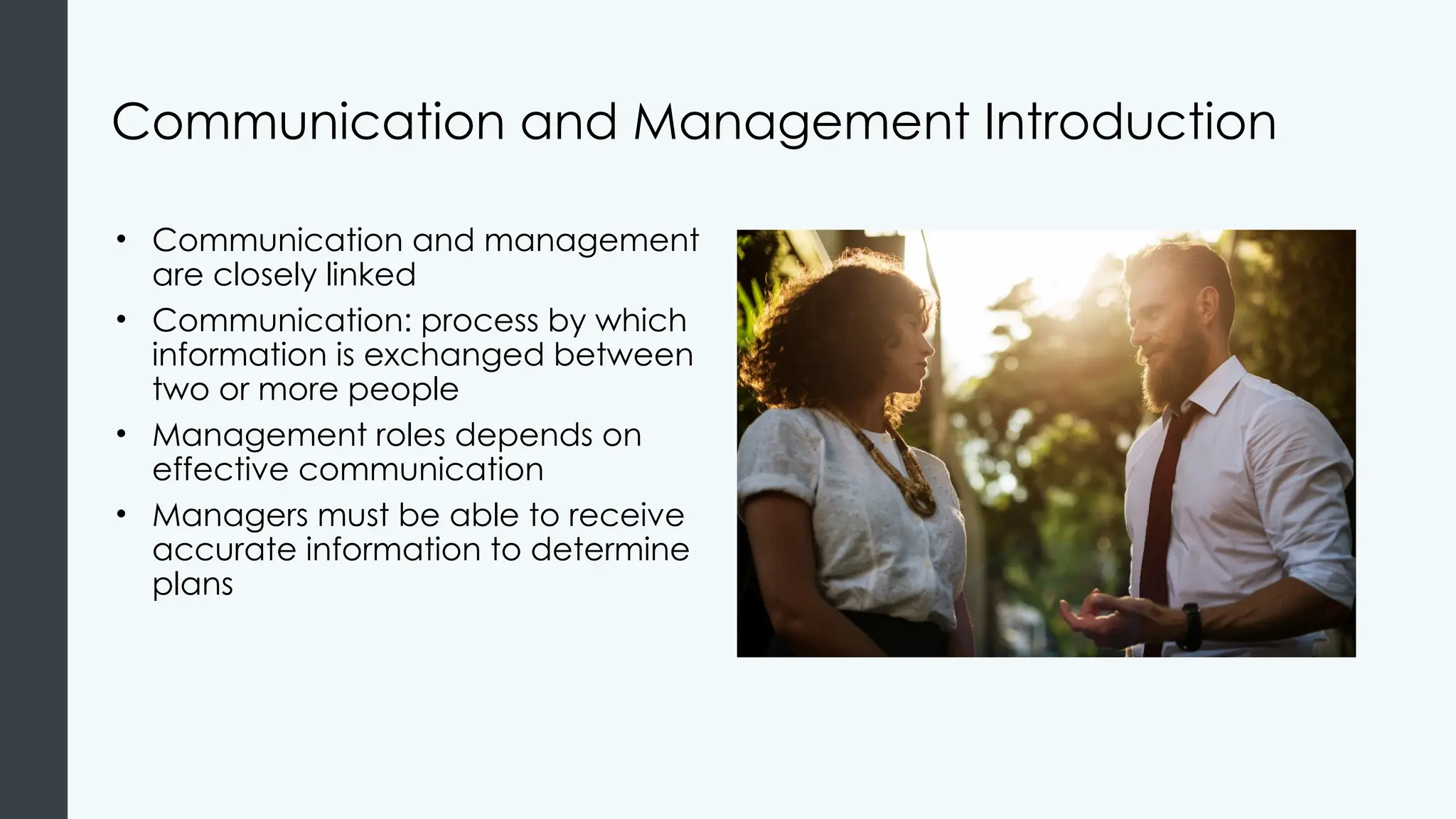
Communication and ManagementIntroduction
• Communication and management
are closely linked
• Communication: process by which
information is exchanged between
two or more people
• Management roles depends on
effective communication
• Managers must be able to receive
accurate information to determine
plans
6.
The Role ofCommunication in Management
• Role is to accomplish the goals of an organization- managers create plan
that defines what needs to be done, when, and how
• Benefits:
• Provides clarity- confusion makes people uncooperative
• Builds relationships- reduces tension between hierarchical levels
• Creates commitment- everyone feels like they are valued
• Defines expectations- people who are uncertain don’t perform jobs well
7.
Practice Question 1
Thefive defined roles of management in business are: planning, organizing,
staffing, leading, and controlling. What important role is left off of this list?
1. Communicating.
2. Hiring/firing.
3. Authorizing checks.
4. Selecting vendors.
8.
The Communication ProcessModel and Missteps
• Alt text: graphic that lists process of Sender to Encoding to Channel to
Decoding to Receiver with Feedback running between Sender and Receiver
• Caption: communication-process model shows how information is received
and sent
• Easiest to understand when one person is communicating with another
• Receiver receives encoded message and decodes it- converts
• When information to be communicated isn’t encoded correctly
• When the receiver interprets message differently than sender intended
• All problems can occur during feedback- often not needed or wanted
9.
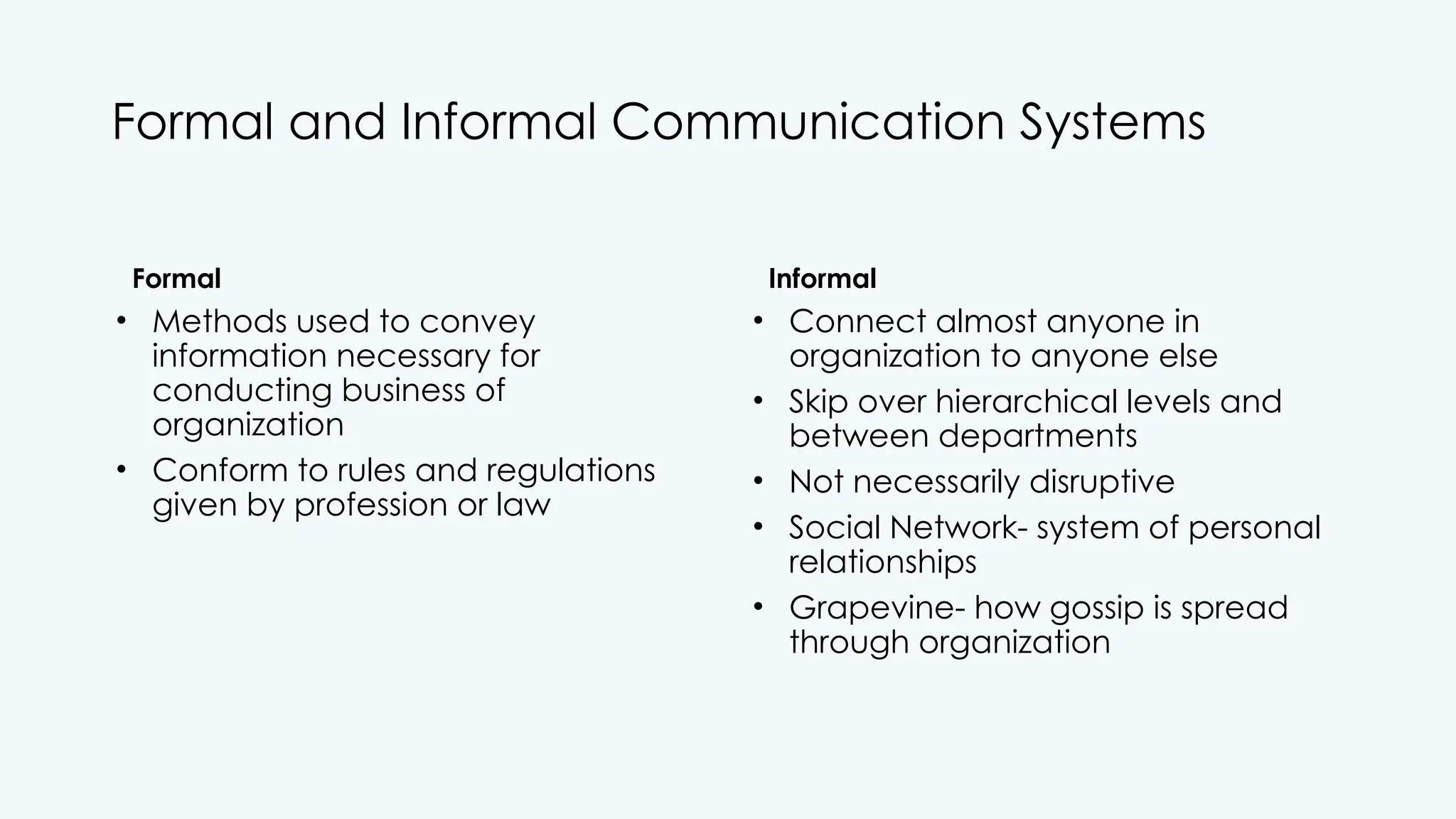
Formal and InformalCommunication Systems
Formal
• Methods used to convey
information necessary for
conducting business of
organization
• Conform to rules and regulations
given by profession or law
Informal
• Connect almost anyone in
organization to anyone else
• Skip over hierarchical levels and
between departments
• Not necessarily disruptive
• Social Network- system of personal
relationships
• Grapevine- how gossip is spread
through organization
Learning Outcomes: TypicalCommunication Flows
14.2: Differentiate between typical communication flows within an
organization
14.2.1: Differentiate between downward, upward, horizontal, diagonal, and
external communication flows
12.
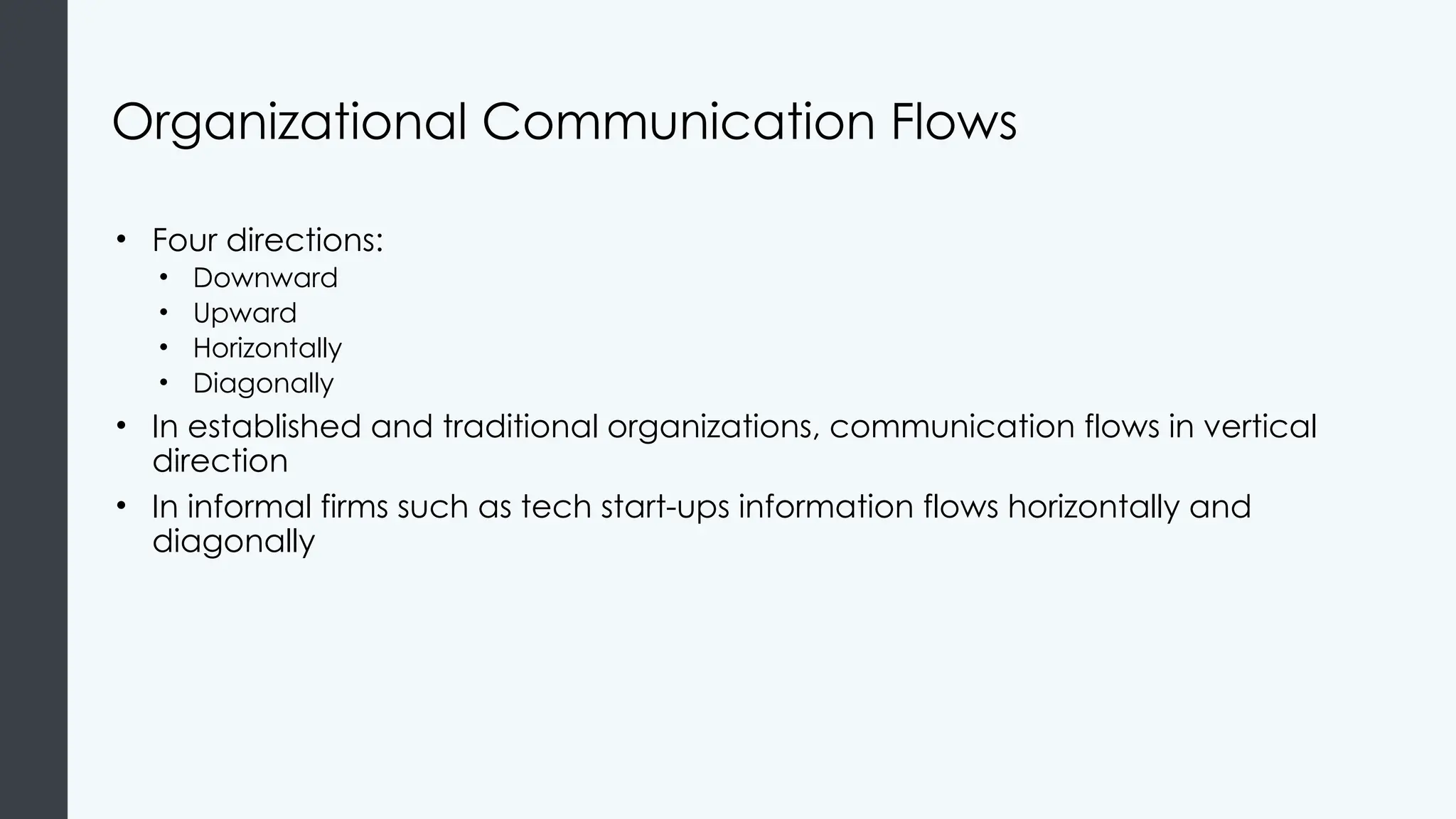
Organizational Communication Flows
•Four directions:
• Downward
• Upward
• Horizontally
• Diagonally
• In established and traditional organizations, communication flows in vertical
direction
• In informal firms such as tech start-ups information flows horizontally and
diagonally
13.
Upward vs DownwardCommunication
Upward Communication
• Information from lower-level to
high-level employees
• when workers report to supervisor or
team leaders
• Examples: progress reports, proposals
for projects, budget estimates, etc.
• Important goal of many managers
is to encourage spontaneous or
voluntary upward communication
• Must trust that management will
recognize their contributions
Downward Communication
• Company leaders and managers share
information with lower-level employees
• Senders don’t usually expect to get a
response
• Forms include speeches, blogs,
podcasts, and videos
• Most common types are everyday
directives of department managers
• Delivers information that helps to
understand workforce about key
changes, new goals, or strategies, etc.
14.
Horizontal and DiagonalCommunication
Horizontal Communication
• Exchange of information across
departments at same level
• Purpose is to request support and
coordinate activities
• Can work together to solve problems
or issues
• Problems can arise if one manager is
unwilling to share information
Diagonal Communication
• Cross-functional communication
between employees at different
levels of the organization
• Advantages:
• Building relationships between senior-
level and lower-level employees
• Encouraging informal flow of
information in organization
• Reducing chance of a message being
distorted by going through additional
filters
• Reducing workloads of senior-level
managers
15.
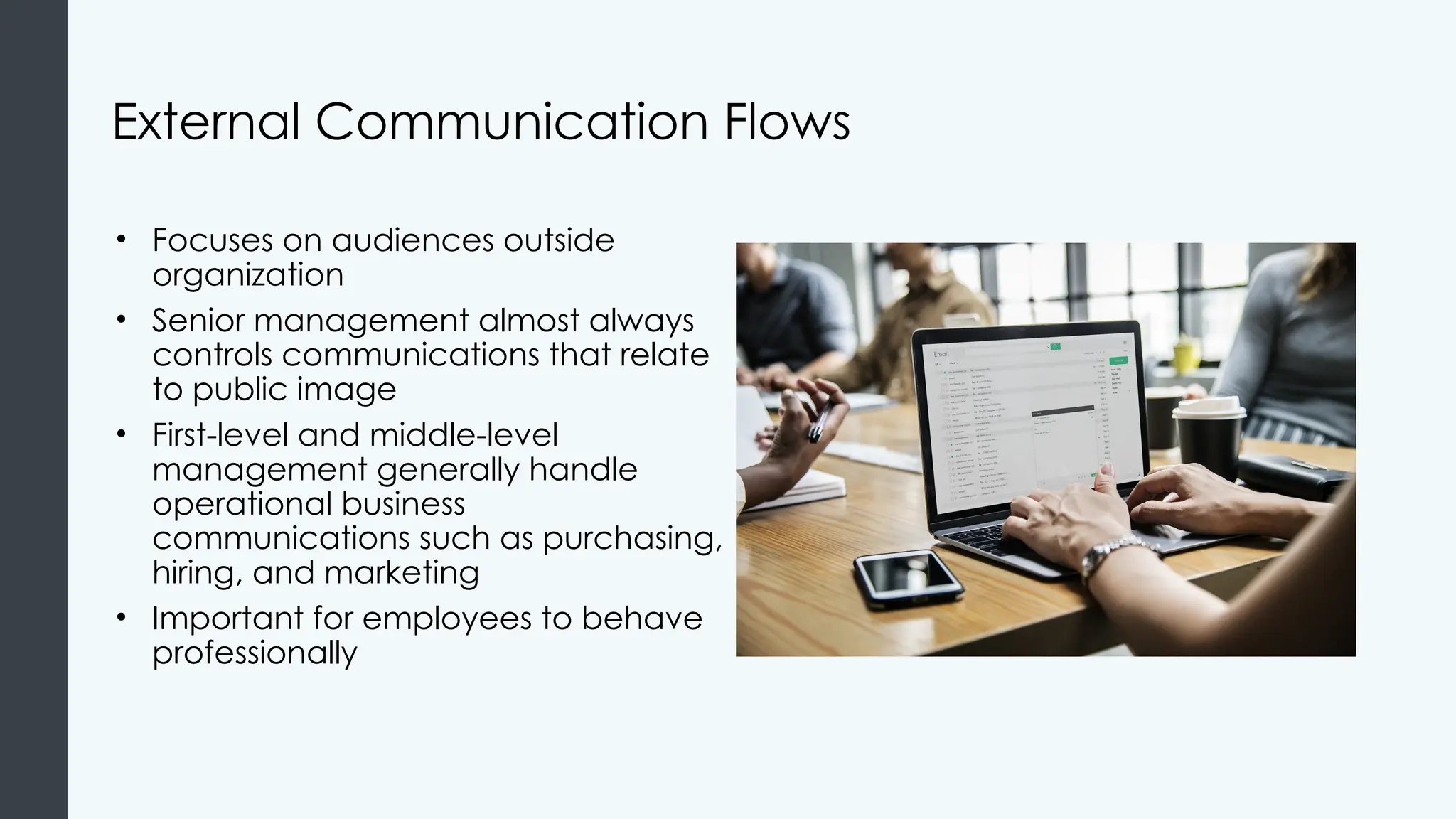
External Communication Flows
•Focuses on audiences outside
organization
• Senior management almost always
controls communications that relate
to public image
• First-level and middle-level
management generally handle
operational business
communications such as purchasing,
hiring, and marketing
• Important for employees to behave
professionally
16.
Practice Question 2
Whatcommunication flow do you think is most effective in developing
meaningful feedback?
1. Downward.
2. Upward.
3. Sideways.
4. Diagonal.
Learning Outcomes: Barriersto Effective
Communication
14.3: Explain barriers to effective communication
14.3.1: Differentiate between filtering, selective perception, and information
overload
14.3.2: Differentiate between emotional disconnects, lack of source credibility,
and semantics
14.3.3: Explain active listening
19.
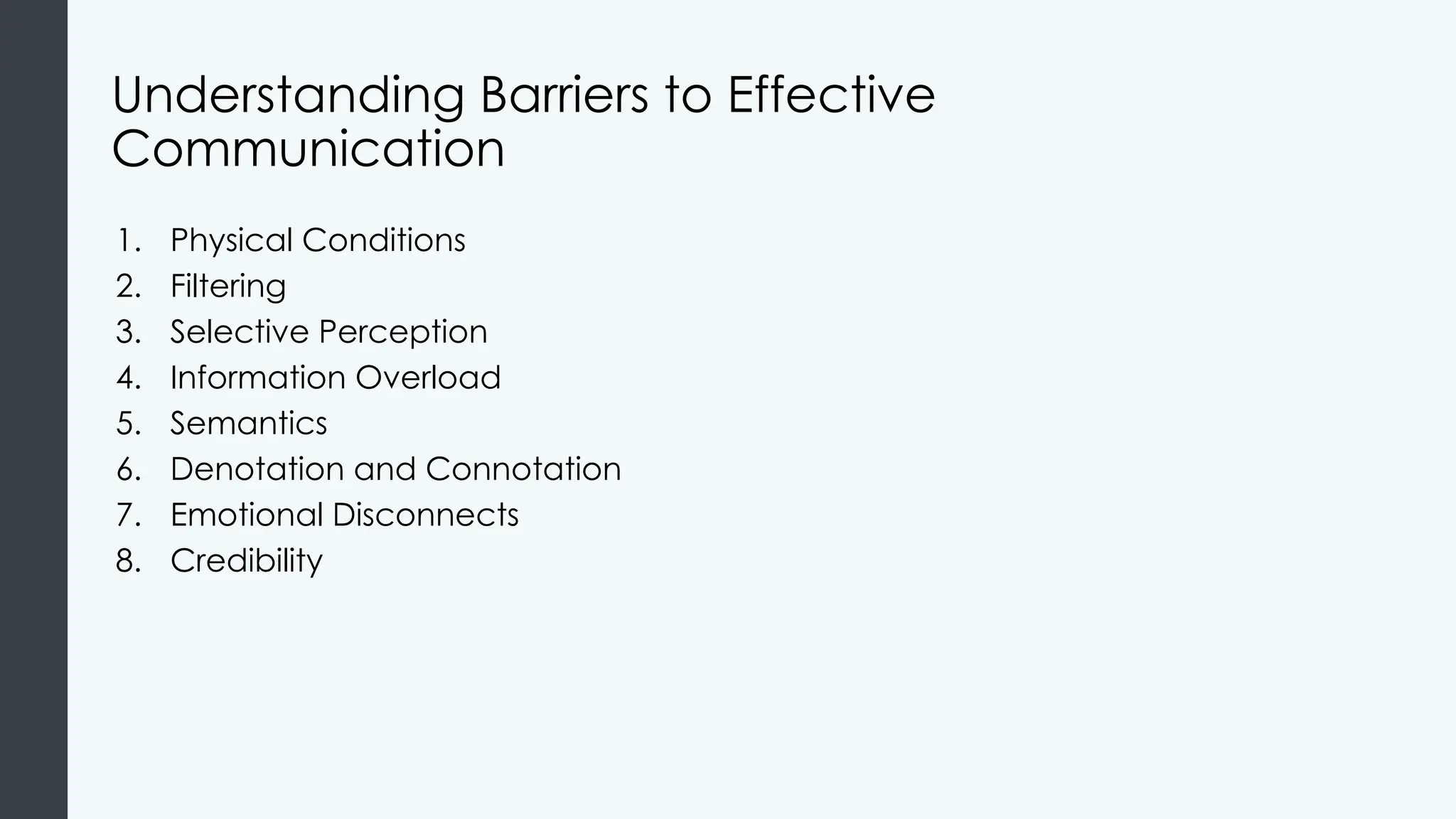
Understanding Barriers toEffective
Communication
1. Physical Conditions
2. Filtering
3. Selective Perception
4. Information Overload
5. Semantics
6. Denotation and Connotation
7. Emotional Disconnects
8. Credibility
20.
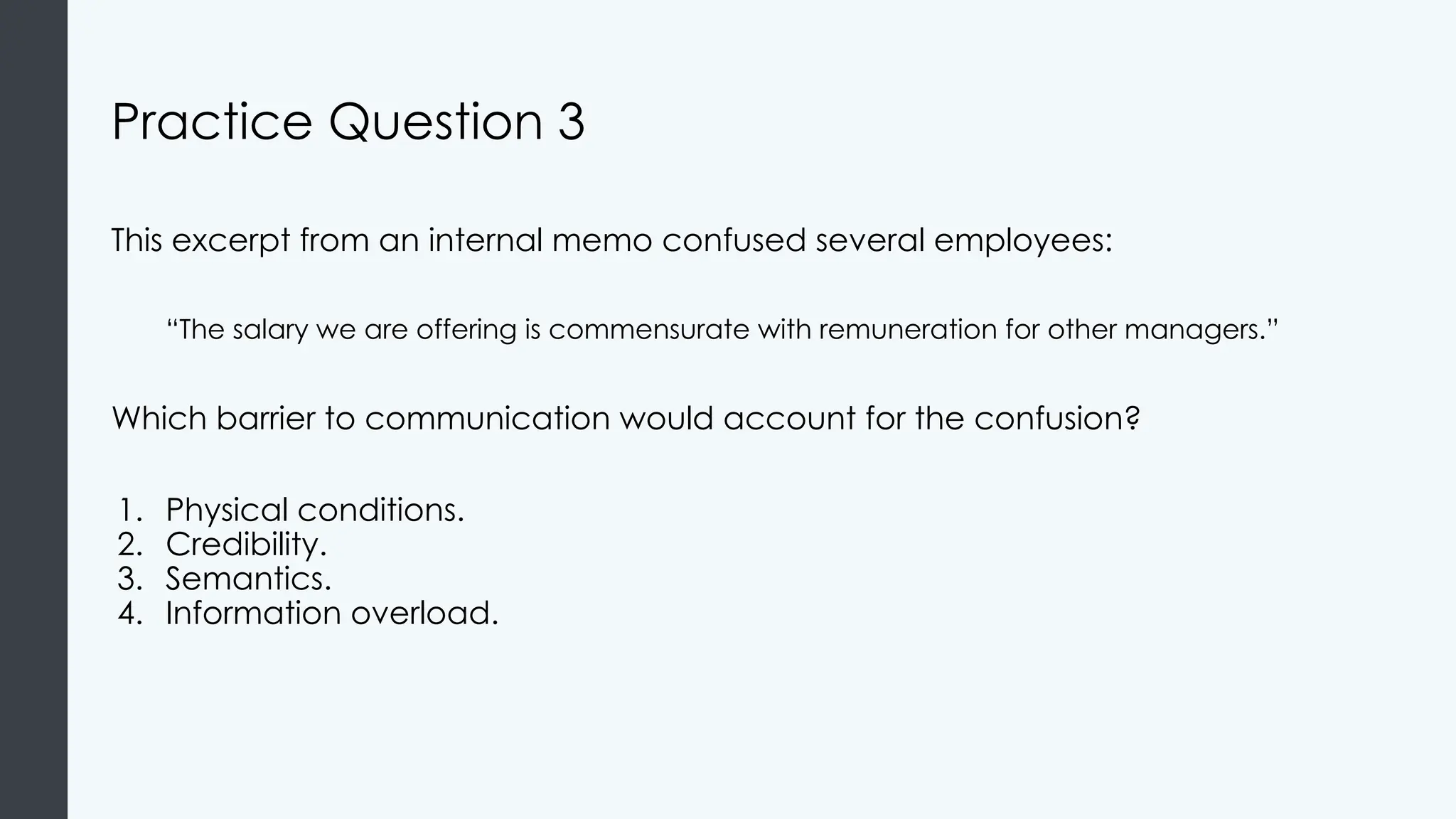
Practice Question 3
Thisexcerpt from an internal memo confused several employees:
“The salary we are offering is commensurate with remuneration for other managers.”
Which barrier to communication would account for the confusion?
1. Physical conditions.
2. Credibility.
3. Semantics.
4. Information overload.
21.
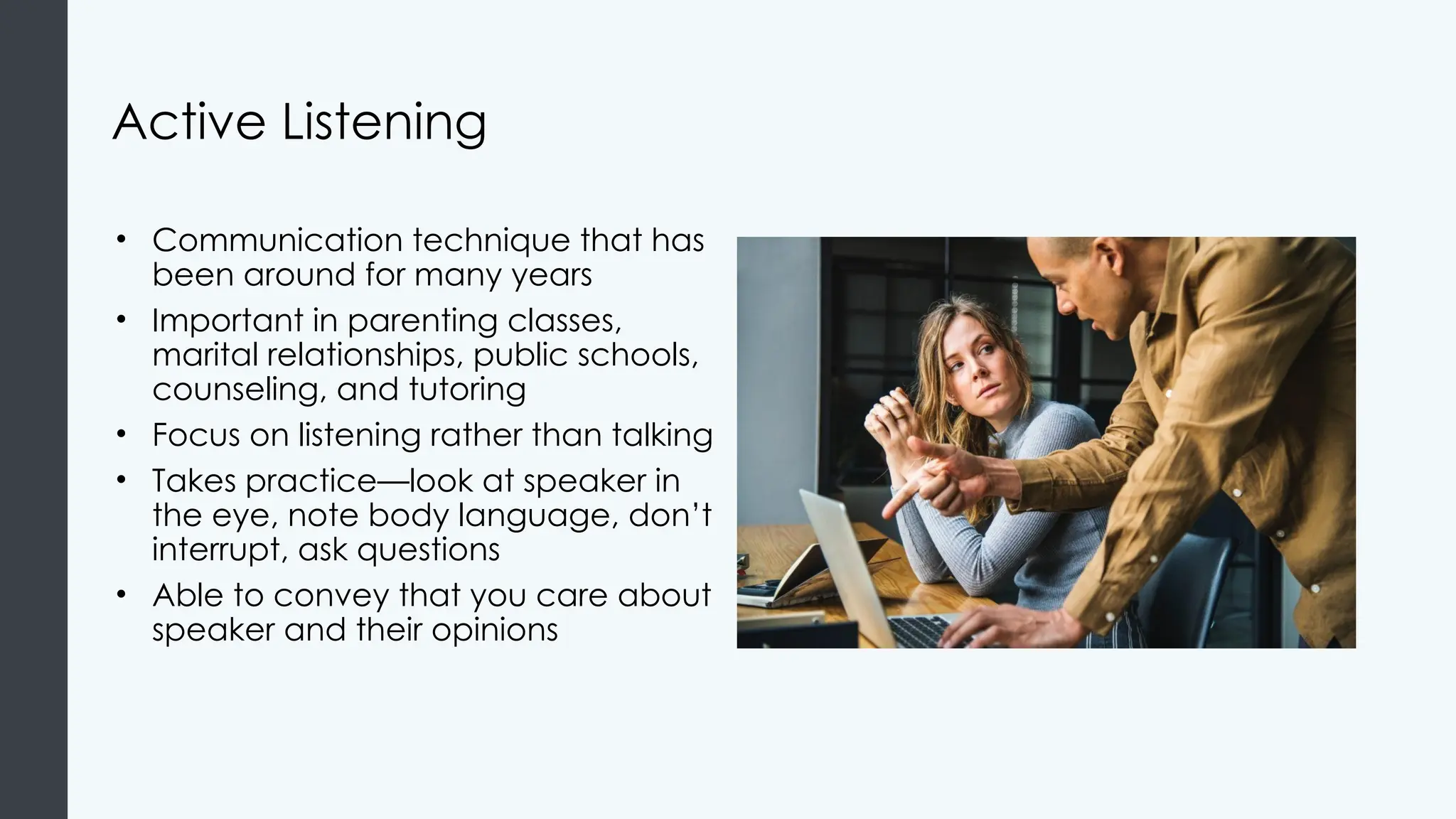
Active Listening
• Communicationtechnique that has
been around for many years
• Important in parenting classes,
marital relationships, public schools,
counseling, and tutoring
• Focus on listening rather than talking
• Takes practice—look at speaker in
the eye, note body language, don’t
interrupt, ask questions
• Able to convey that you care about
speaker and their opinions
Learning Outcomes: Channelsof Business
Communication
14.4: Differentiate between typical channels of business
communication
14.4.1: Differentiate between face-to-face, written oral, web-based, and other
typical channels of business communication
14.4.2: Explain the importance of tailoring the message to the audience
24.
Understanding Channels ofBusiness
Communication
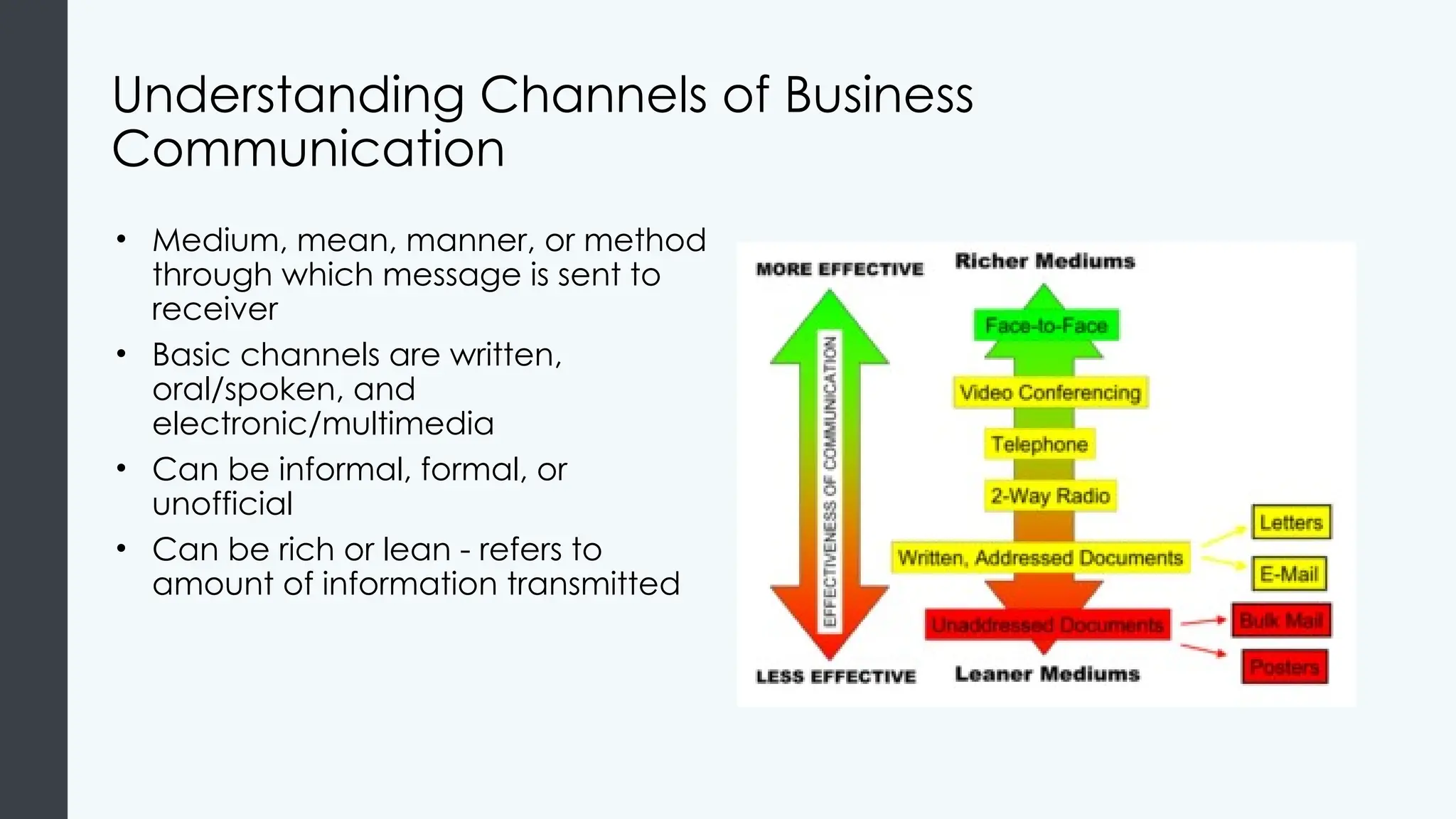
• Medium, mean, manner, or method
through which message is sent to
receiver
• Basic channels are written,
oral/spoken, and
electronic/multimedia
• Can be informal, formal, or
unofficial
• Can be rich or lean - refers to
amount of information transmitted
25.
Oral Communications
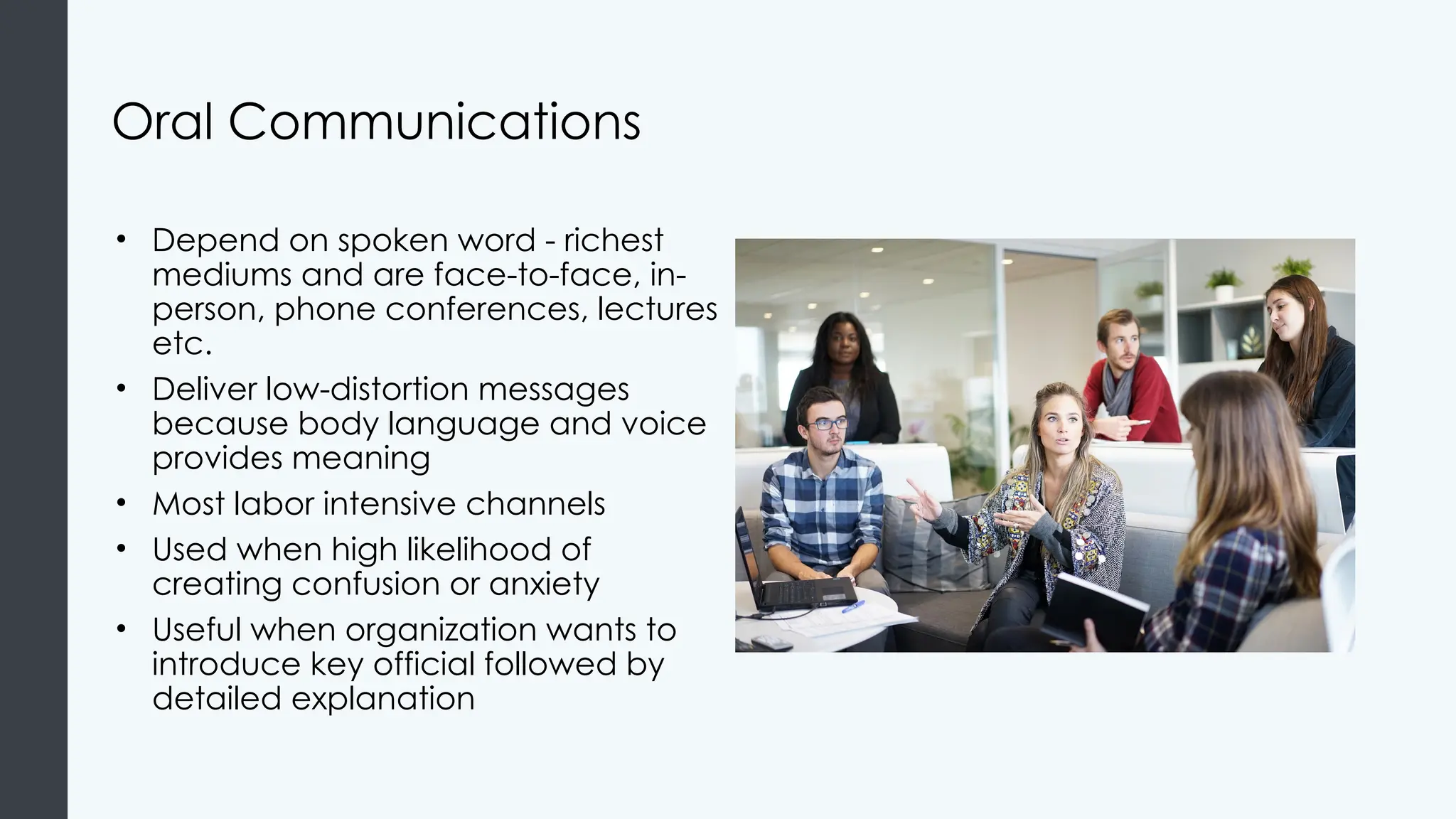
• Dependon spoken word - richest
mediums and are face-to-face, in-
person, phone conferences, lectures
etc.
• Deliver low-distortion messages
because body language and voice
provides meaning
• Most labor intensive channels
• Used when high likelihood of
creating confusion or anxiety
• Useful when organization wants to
introduce key official followed by
detailed explanation
26.
Written Communications
• E-mails,texts, memos, letters, reports,
spreadsheets, etc.
• Leaner business communications-
writer must provide enough context
for message to make sense
• Receiver should be alert of confusion
and ask for clarification if needed
• Effective in transmitting large
messages and can be studied
overtime
27.
Electronic (Multimedia) Communications
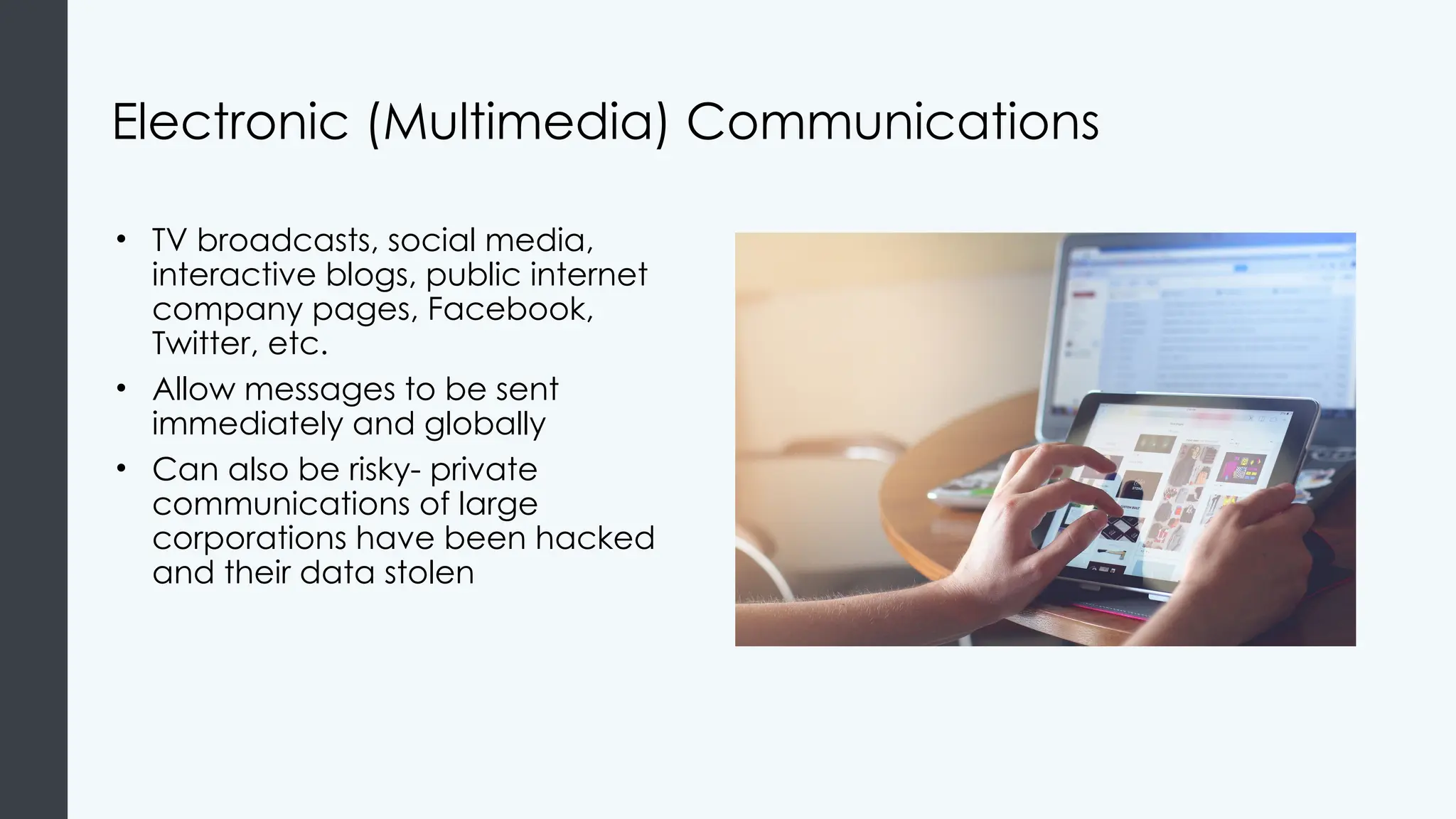
•TV broadcasts, social media,
interactive blogs, public internet
company pages, Facebook,
Twitter, etc.
• Allow messages to be sent
immediately and globally
• Can also be risky- private
communications of large
corporations have been hacked
and their data stolen
28.
Putting Together theTypes of Communications
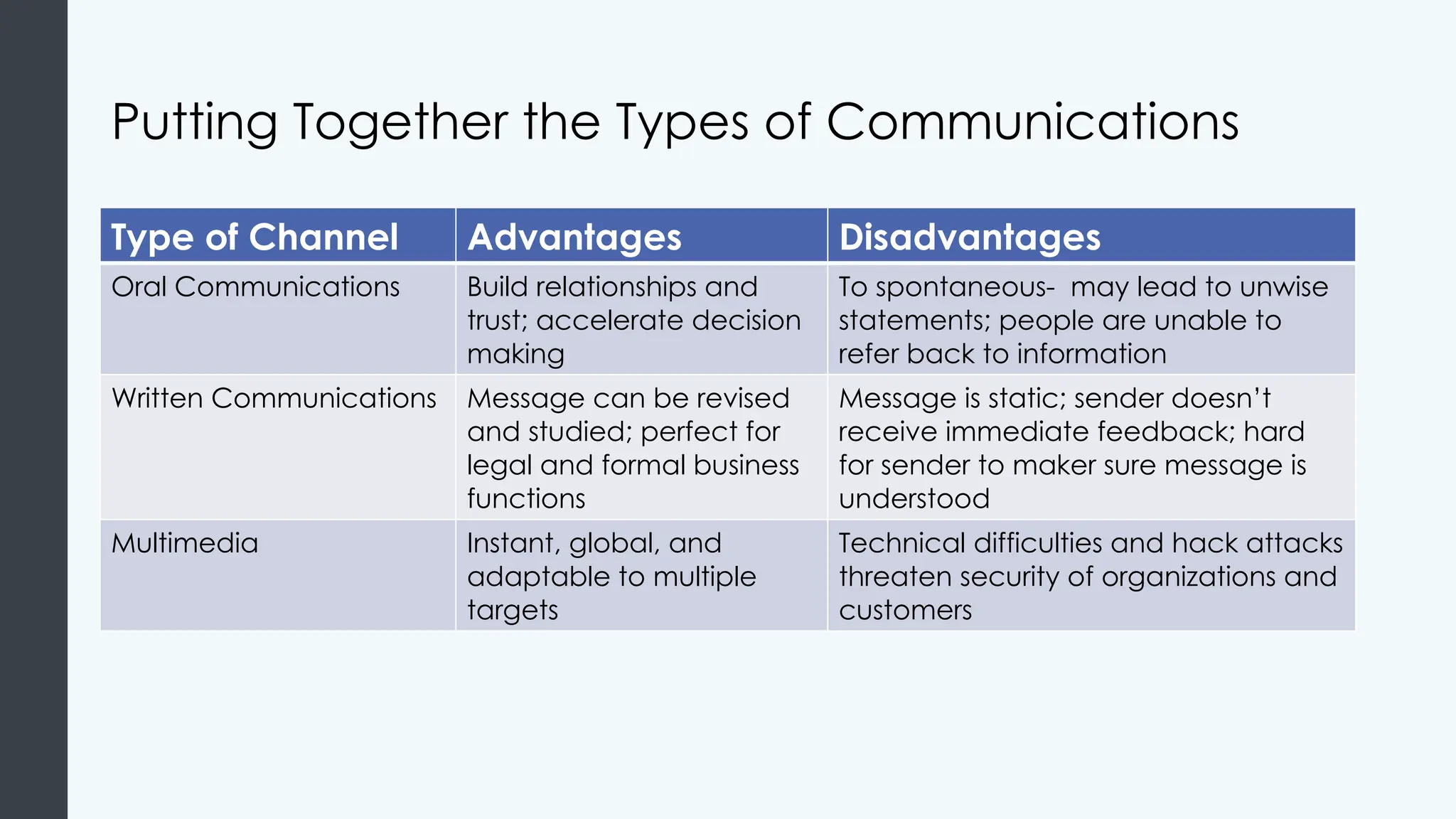
Type of Channel Advantages Disadvantages
Oral Communications Build relationships and
trust; accelerate decision
making
To spontaneous- may lead to unwise
statements; people are unable to
refer back to information
Written Communications Message can be revised
and studied; perfect for
legal and formal business
functions
Message is static; sender doesn’t
receive immediate feedback; hard
for sender to maker sure message is
understood
Multimedia Instant, global, and
adaptable to multiple
targets
Technical difficulties and hack attacks
threaten security of organizations and
customers
29.
Which Channel isBest?
• Best channel is one that most
effectively delivers the message so
that it is understood as sender
wanted
• Nuanced or emotional messages
require rich medium while simple
messages don’t
• The more emotional the context,
the richer the medium should be
30.
Tailoring a Messageto an Audience
• Which channel suits the content best?
• What do you want to achieve by sending the message?
• Does the message require interaction from the audience or is it more of
throwing out information?
• Will visual aids help the message or distract from it?
• Do you have to establish your credibility?
• Ask yourself why the audience should care about topic
31.
Know the Audience
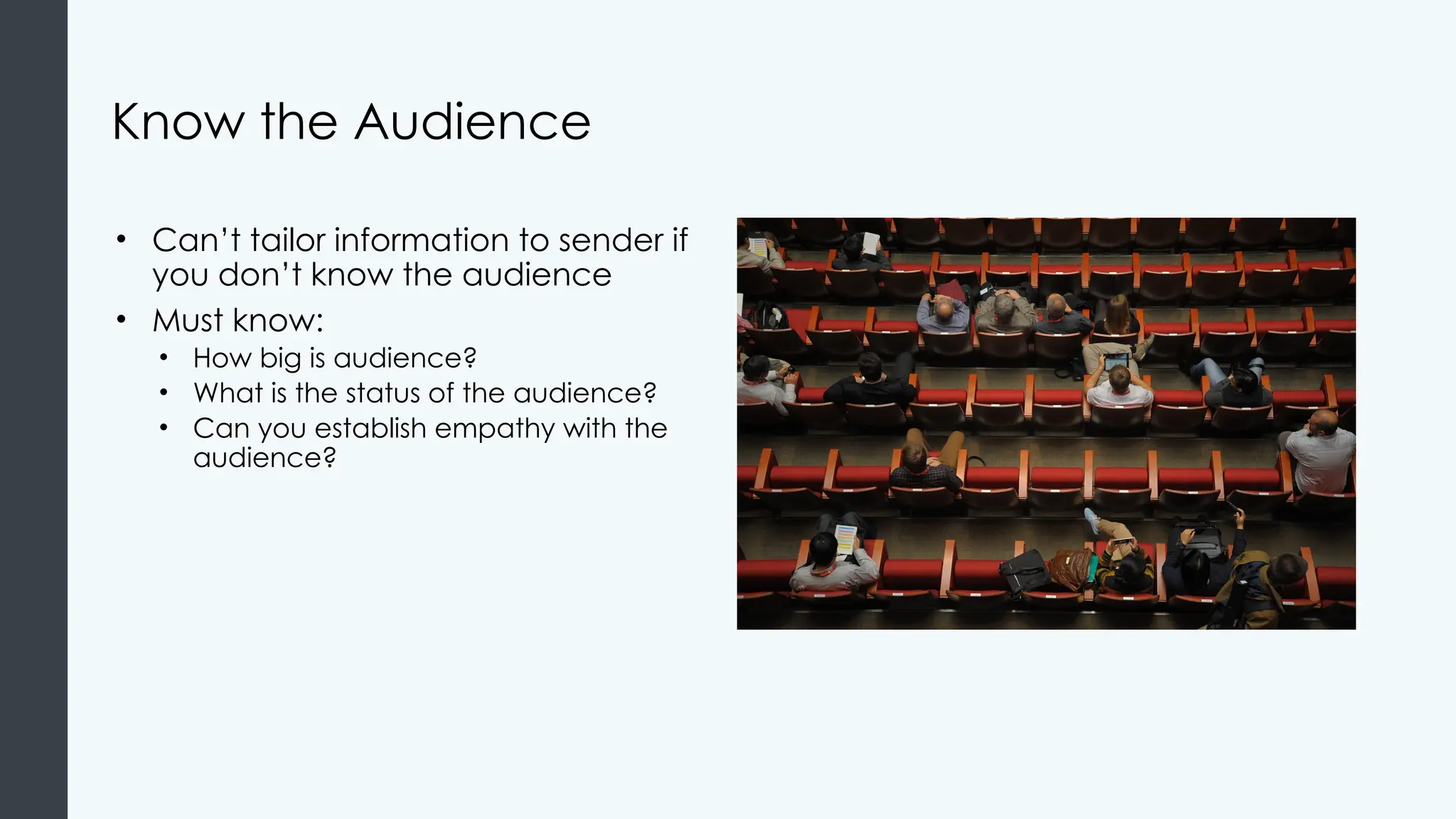
•Can’t tailor information to sender if
you don’t know the audience
• Must know:
• How big is audience?
• What is the status of the audience?
• Can you establish empathy with the
audience?
32.
Class Discussion: TheRight Channel
A good rule of thumb regarding communication channel is to select the richest
channel available for the job. Which channel would you choose to send the
following communication?
1. You are an event planner and need to let management know the site of
the celebrity tennis tournament you have selected.
2. You are a sales manager and need to know if you field reps are available
for a quick conference call.
3. You need to convince your manager to give you a raise.
4. You need to know if Jolene in the mail room can add additional copies for
the end-of-week stand up.
5. You are the CEO who needs to respond to the IRS for an underpayment
penalty.
33.
Practice Question 4
Whatis the most important factor leading to effective communication?
1. Selecting the right channel.
2. Crafting the message.
3. Listening for feedback.
4. Tailoring to the audience.
34.
Quick Review
• Canyou describe the components of the communication-process model?
• Can you recognize common missteps in communication?
• Are you able to differentiate between formal and informal communication
networks?
• Are you able to differentiate between downward, upward, horizontal,
diagonal, and external communication flows?
• Can you differentiate between face-to-face, written, oral, web-based, and
other typical channels of business communication
• Please explain the importance of tailoring the message to the audience
Editor's Notes
#1 Cover Image: "wocintech stock -64." Authored by: WOCinTech Chat. Located at: https://flic.kr/p/F81mTm. Content Type: CC Licensed Content, Shared Previously. License: CC BY: Attribution.
All text in these slides is taken from https://courses.lumenlearning.com/wmopen-principlesofmanagement/ where it is published under one or more open licenses.
All images in these slides are attributed in the notes of the slide on which they appear and licensed as indicated.
#16 The correct answer is 4. Diagonal communication is the backbone of social media, as well as, business communication platforms such as Slack, Hubspot, etc.
#21 Woman, teamwork image. Authored by: rawpixel. Provided by: Unsplash. Located at: https://unsplash.com/photos/g8bqFDerlLA. License: Unsplash License: All photos published on Unsplash can be used for free. You can use them for commercial and noncommercial purposes. You do not need to ask permission from or provide credit to the photographer or Unsplash, although it is appreciated when possible.
#24 Media Richness Theory Diagram Authored by: Tntdj Provided by: Wikipedia Located at: https://en.wikipedia.org/wiki/File:Media_Richness_Theory_Diagram_PNG.png License: CC-BY
#32 Probably a face-to-face meeting with the management team so you can see body language and receive live feedback.
A text or IM would probably work.
Definitely a face-to-face one-on-one meet.
An email would be a good choice.
A registered letter would be required at the very least.
#33 The correct answer is 4. Tailoring to the audience. The audience should dictate the message and the channel in order to be most effective.