Submitted by:-Mohammad Hassan
Introduction
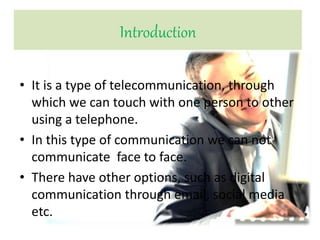
• It is a type of telecommunication, through
which we can touch with one person to other
using a telephone.
• In this type of communication we can not
communicate face to face.
• There have other options, such as digital
communication through email, social media
etc.
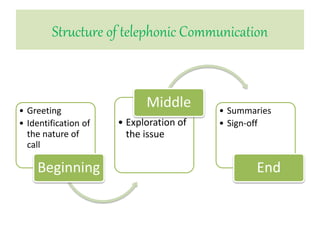
Structure of telephonic Communication
• Greeting
• Identification of
the nature of
call
Beginning
• Exploration of
the issue
Middle • Summaries
• Sign-off
End
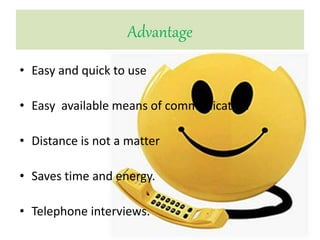
Advantage
• Easy and quick to use
• Easy available means of communication
• Distance is not a matter
• Saves time and energy.
• Telephone interviews.
DIFFERENT PHONE
CALL
SITUATIONS
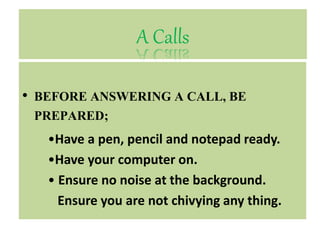
A Calls
• BEFORE ANSWERING A CALL, BE
PREPARED;
•Have a pen, pencil and notepad ready.
•Have your computer on.
• Ensure no noise at the background.
Ensure you are not chivying any thing.
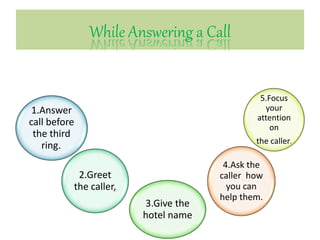
While Answering a Call
1.Answer
call before
the third
ring..
2.Greet
the caller,
3.Give the
hotel name
5.Focus
your
attention
on
the caller.
4.Ask the
caller how
you can
help them.
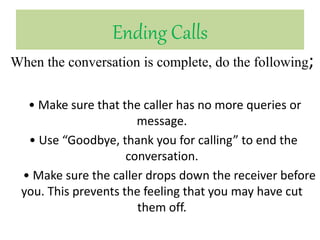
Ending Calls
When the conversation is complete, do the following;
• Make sure that the caller has no more queries or
message.
• Use “Goodbye, thank you for calling” to end the
conversation.
• Make sure the caller drops down the receiver before
you. This prevents the feeling that you may have cut
them off.
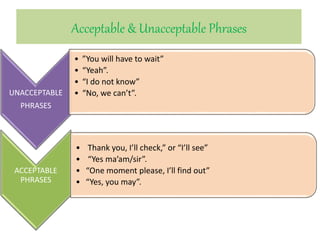
Acceptable & Unacceptable Phrases
ACCEPTABLE
PHRASES
• Thank you, I’ll check,” or “I’ll see”
• “Yes ma’am/sir”.
• “One moment please, I’ll find out”
• “Yes, you may”.
UNACCEPTABLE
PHRASES
• ”You will have to wait”
• “Yeah”.
• “I do not know”
• “No, we can’t”.
Telephonic communication

Telephonic communication

  • 1.
  • 2.
    Introduction • It isa type of telecommunication, through which we can touch with one person to other using a telephone. • In this type of communication we can not communicate face to face. • There have other options, such as digital communication through email, social media etc.
  • 3.
    Structure of telephonicCommunication • Greeting • Identification of the nature of call Beginning • Exploration of the issue Middle • Summaries • Sign-off End
  • 4.
    Advantage • Easy andquick to use • Easy available means of communication • Distance is not a matter • Saves time and energy. • Telephone interviews.
  • 5.
  • 6.
    A Calls • BEFOREANSWERING A CALL, BE PREPARED; •Have a pen, pencil and notepad ready. •Have your computer on. • Ensure no noise at the background. Ensure you are not chivying any thing.
  • 7.
    While Answering aCall 1.Answer call before the third ring.. 2.Greet the caller, 3.Give the hotel name 5.Focus your attention on the caller. 4.Ask the caller how you can help them.
  • 8.
    Ending Calls When theconversation is complete, do the following; • Make sure that the caller has no more queries or message. • Use “Goodbye, thank you for calling” to end the conversation. • Make sure the caller drops down the receiver before you. This prevents the feeling that you may have cut them off.
  • 9.
    Acceptable & UnacceptablePhrases ACCEPTABLE PHRASES • Thank you, I’ll check,” or “I’ll see” • “Yes ma’am/sir”. • “One moment please, I’ll find out” • “Yes, you may”. UNACCEPTABLE PHRASES • ”You will have to wait” • “Yeah”. • “I do not know” • “No, we can’t”.