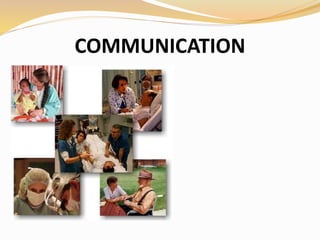
COMMUNICATION
Contents:
 Definition
 Communication principles.
 Communication process.
 Types of communication.
Definition of verbal communication.
Benefits of verbal communication.
 Limitation of oral communication
 Definition of non verbal communication.
 Benefits of non verbal communication.
 Definition of written communication.
 Advantages and disadvantages of written
communication.
 Channels of communication
 Factors influencing communication.
 Barriers of communication.
 Guidelines for effective communication.
Definition
Communication is the transmission and receiving
information, feelings, attitudes with the overall
purpose of having understood producing the
response.
-John M Brion
It is the pillar of all human relationship and means to
develop and expand our store of knowledge, our
technology and our culture.
Communication Principles
-Understand your own ideas before you try to pass
them on.
-Use the right words, in the right time, to the right
person.
-Donot forget to feedback.
-Allow other to express their ideas.
-Seek not only to be understand but also to
understand.
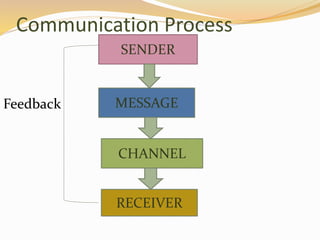
Communication Process
Feedback
SENDER
MESSAGE
CHANNEL
RECEIVER
Types of communication
a. Verbal communication
b. Non verbal communication
c. Written Communication
a. Verbal communication
 Information is sent or shared directly, either face
to face or through telephone.
 Words are tools or symbols used to express the
ideas or feelings.
This form is used generally in meetings,
lectures, conferences etc.
Techniques for effective verbal communication
 Clarity and brevity
Vocabulary
Denotative and connotative meaning
Pacing
Timing and relevance
Humor
Benefits of oral communication
 It is simple to employ and least expensive
form of the communication
 Less chances of message distortion
 Fosters the warm inter personal
relationship.
 Allows the emergence of the spontaneous
ideas and information.
Limitation of the oral communication:
 No formal record of the information.
 When used informally create a conflict
situation.
 Could be misunderstood because of the
perception and other barriers.
 more time consuming.
Non Verbal Communication
 It is the transmission of the message
without the use of the words, neither
verbally nor in the writings.
 Much of the non verbal communication is
expressed through body language-body
position, movements, facial expression, eye
contact, gestures, body postures, vocal
clues, outward appearance etc.
Benefits:
 If the message sender has the pleasant and open
expression receiver will perceive him or as
approchable.
 Eye contact constitute an invitation or readyness
to interact.
 Appropriate gestures accentuate the message.
 Body posture
 Vocal clues such as the tone ,volume add to
the message being transmitted.
 Outer appearance has impact on the role
perception and power.
c. Written communication:
It can take the form of the statement, letter,
circular, memorandum, handbook, manaul,
report etc.
.
Advantages:
 Accuracy of the message is more secured.
 most suitable form for conveying the lengthy
message.
 Can be kept as the permanent record and
used at times as evidence.
 It saves time as people can be reached widely.
Disadvantages:
 Inhibits the face to face interaction.
 Time consuming in terms of preparing the
message.
 Ignores the spontaneity in feedback.
 Might be difficult to maintain the secrecy of the
information.
 Communication might not be effective if the
message are written poorly.
Level of communication
Intrapersonal communication
Inter personal communication
Transpersonal communication
Small group Communication
Public Communication
Channels of organizational
communication
a. Downward communication:
 Traditional channels of the communication
 Relays the information to the subordinates
through the formal lines of the authority.
b. Upward communication:
Subordinates transmit their expectations,
problems, suggestion to their superiors.
Diagonal communication:(cross way )
 Interact with the other managers and employees
from the other departments who are not at the
same hierarchical level.
Grapevine Channel:
 Information flows haphazardly between people
of all the hierarchical levels
 Involves three or more people at a time.
Guideline for speaking writing
 Get the fact ( mastery of the fact is essential)
 Organize the fact
 out line of sequence and important
 Have a good introduction
 Eliminate the unnecessary details
 Put yourself in the position
 Do not assume that what you known to you is known
to everyone
 Use precise, and simple sentences
 Be concise
 Be relevant
 Maintain eye contact
Barriers to communication
Robert Kreitner (2000) has classified the barriers to
communication in the following groups.
1. Process barriers
2. Physical barriers
3. Semantic barriers
4. Psychosocial barriers
5. Technological Barriers
Process barriers
1. Encoding and decoding
2. Filtering
3. Conflicting signals
4. Fear and mistrust
5. Noises
6. Poor listening skills
7. Feedback
Physical barriers
1. Physical distance
2. Hierarchical structure
3. Office designs
4. Distortion
Semantic barriers
1. Semantic
2. Long and complex sentence structure
3. Jargons
Psychosocial
1. Lack of interest
2. Reference groups
3. Perception
4. Value judgments
5. Status differences
6. Social barriers
Technological Barriers
1. Information overlload
2. Poortiming
3. Critical information is not received in time
4. Ommission
Transaction in Nursing and health care
 In nursing, communication is a sharing of health-
related information between a patient and a nurse,
with both participants as sources and receivers.
 Information may be verbal or nonverbal, written
Why Communication is Important in Nursing
 A critical component of nursing practice
 Good communication
 Generate trust between nurse and clients.
 Client safety
 Provides professional satisfaction.
 Is a means for bringing about change, i.e. nurse listens,
speaks and acts to negotiate changes that promotes client’s
well-being.
 Is the foundation of the relationship between the nurse
and other members of the health team.
Why Communication is Important in
Nursing? Cont….
 Helps to promote managerial efficiency.
 Provides basis for leadership action.
 Provides means of co-ordination.
Collaboration with diverse team challenged
by
 Current health care environment
 Professional communication and collaboration
 Cultural gaps
 Available resources and technology
Physical
 Are their senses intact? Are they able to hear
satisfactorily? Do they require any hearing aids? Are these
functioning?
 Do they have any diseases affecting their sensory organs
(eg. laryngeal palsy, tinnitus, CVA)?
 How does the individual normally communicate: lip read,
sign or Braille?
 Vision satisfactory or have/need glasses / contact lenses?
 Can they read and/or write? Is their cognitive ability
impaired?
Assessing the Communication Needs of the
Clients
Assessing the Communication Needs of the
Clients
Socio-cultural
 What is their first language or mother tongue?
 Do they possess a second or third language and if so how
fluent are they?
 Are there any cultural issues surrounding communication
and body language, for example social status, eye contact,
proximity or touch?
 Do they use any unfamiliar jargon or abbreviations?
 Do they need an interpreter?
Assessing the Communication Needs of the
Clients
Psychological
 Are they worried, nervous or frightened?
 Are they depressed, anxious or excitable?
 What is their level of intelligence?
 Can they understand complex language?
 What is their range of vocabulary?
 Are they self-confident
 Do they seem angry or upset? Are there any signs
of actual or potential aggression or violence?
Assessing the Communication Needs of the
Clients
Environmental
 Is the environment too hot, too cold or poorly ventilated?
 Is it too light or too dark?
 Does the client prefer a quiet environment or do they
prefer background noise?
 Do they wish to communicate in a more private place or
are they happy to discuss issues at the bedside in hearing
distance of others?
 Are there any physical barriers to communication, for
example furniture arrangement, size or type of room?
 Is the environment safe for client, self and others should
the client become aggressive or violent?
Personal Space during communication
 Intimate distance frequently used by
nurses
 Personal distance  less overwhelming
 Social distance  increased eye contact
 Out of reach for touch
 Public distance
Which is comfortable?
OR
Best Approach to nonverbal Behaviour
 Sit squarely in relation to the client
 Open posture,
 Lean in towards the client slightly, maintain
comfortable
 Eye contact and
 Relax
Best Approach to nonverbal Behaviour
 S=Smile
 O=Open manner
 F=Forward lean
 T=Touch
 E=Eye contact
 N=Node
NOT
THANK YOU!!THANK YOU
THANK
YOU !!

communication (2) SS.pptx

  • 1.
  • 2.
    Contents:  Definition  Communicationprinciples.  Communication process.  Types of communication. Definition of verbal communication. Benefits of verbal communication.  Limitation of oral communication
  • 3.
     Definition ofnon verbal communication.  Benefits of non verbal communication.  Definition of written communication.  Advantages and disadvantages of written communication.  Channels of communication  Factors influencing communication.  Barriers of communication.  Guidelines for effective communication.
  • 4.
    Definition Communication is thetransmission and receiving information, feelings, attitudes with the overall purpose of having understood producing the response. -John M Brion It is the pillar of all human relationship and means to develop and expand our store of knowledge, our technology and our culture.
  • 5.
    Communication Principles -Understand yourown ideas before you try to pass them on. -Use the right words, in the right time, to the right person. -Donot forget to feedback. -Allow other to express their ideas. -Seek not only to be understand but also to understand.
  • 6.
  • 7.
    Types of communication a.Verbal communication b. Non verbal communication c. Written Communication
  • 8.
    a. Verbal communication Information is sent or shared directly, either face to face or through telephone.  Words are tools or symbols used to express the ideas or feelings. This form is used generally in meetings, lectures, conferences etc.
  • 9.
    Techniques for effectiveverbal communication  Clarity and brevity Vocabulary Denotative and connotative meaning Pacing Timing and relevance Humor
  • 10.
    Benefits of oralcommunication  It is simple to employ and least expensive form of the communication  Less chances of message distortion  Fosters the warm inter personal relationship.  Allows the emergence of the spontaneous ideas and information.
  • 11.
    Limitation of theoral communication:  No formal record of the information.  When used informally create a conflict situation.  Could be misunderstood because of the perception and other barriers.  more time consuming.
  • 12.
    Non Verbal Communication It is the transmission of the message without the use of the words, neither verbally nor in the writings.  Much of the non verbal communication is expressed through body language-body position, movements, facial expression, eye contact, gestures, body postures, vocal clues, outward appearance etc.
  • 13.
    Benefits:  If themessage sender has the pleasant and open expression receiver will perceive him or as approchable.  Eye contact constitute an invitation or readyness to interact.  Appropriate gestures accentuate the message.
  • 14.
     Body posture Vocal clues such as the tone ,volume add to the message being transmitted.  Outer appearance has impact on the role perception and power.
  • 15.
    c. Written communication: Itcan take the form of the statement, letter, circular, memorandum, handbook, manaul, report etc. .
  • 16.
    Advantages:  Accuracy ofthe message is more secured.  most suitable form for conveying the lengthy message.  Can be kept as the permanent record and used at times as evidence.  It saves time as people can be reached widely.
  • 17.
    Disadvantages:  Inhibits theface to face interaction.  Time consuming in terms of preparing the message.  Ignores the spontaneity in feedback.  Might be difficult to maintain the secrecy of the information.  Communication might not be effective if the message are written poorly.
  • 18.
    Level of communication Intrapersonalcommunication Inter personal communication Transpersonal communication Small group Communication Public Communication
  • 19.
    Channels of organizational communication a.Downward communication:  Traditional channels of the communication  Relays the information to the subordinates through the formal lines of the authority. b. Upward communication: Subordinates transmit their expectations, problems, suggestion to their superiors.
  • 20.
    Diagonal communication:(cross way)  Interact with the other managers and employees from the other departments who are not at the same hierarchical level. Grapevine Channel:  Information flows haphazardly between people of all the hierarchical levels  Involves three or more people at a time.
  • 21.
    Guideline for speakingwriting  Get the fact ( mastery of the fact is essential)  Organize the fact  out line of sequence and important  Have a good introduction  Eliminate the unnecessary details  Put yourself in the position  Do not assume that what you known to you is known to everyone
  • 22.
     Use precise,and simple sentences  Be concise  Be relevant  Maintain eye contact
  • 23.
    Barriers to communication RobertKreitner (2000) has classified the barriers to communication in the following groups. 1. Process barriers 2. Physical barriers 3. Semantic barriers 4. Psychosocial barriers 5. Technological Barriers
  • 24.
    Process barriers 1. Encodingand decoding 2. Filtering 3. Conflicting signals 4. Fear and mistrust 5. Noises 6. Poor listening skills 7. Feedback
  • 25.
    Physical barriers 1. Physicaldistance 2. Hierarchical structure 3. Office designs 4. Distortion
  • 26.
    Semantic barriers 1. Semantic 2.Long and complex sentence structure 3. Jargons
  • 27.
    Psychosocial 1. Lack ofinterest 2. Reference groups 3. Perception 4. Value judgments 5. Status differences 6. Social barriers
  • 28.
    Technological Barriers 1. Informationoverlload 2. Poortiming 3. Critical information is not received in time 4. Ommission
  • 29.
    Transaction in Nursingand health care  In nursing, communication is a sharing of health- related information between a patient and a nurse, with both participants as sources and receivers.  Information may be verbal or nonverbal, written
  • 30.
    Why Communication isImportant in Nursing  A critical component of nursing practice  Good communication  Generate trust between nurse and clients.  Client safety  Provides professional satisfaction.  Is a means for bringing about change, i.e. nurse listens, speaks and acts to negotiate changes that promotes client’s well-being.  Is the foundation of the relationship between the nurse and other members of the health team.
  • 31.
    Why Communication isImportant in Nursing? Cont….  Helps to promote managerial efficiency.  Provides basis for leadership action.  Provides means of co-ordination. Collaboration with diverse team challenged by  Current health care environment  Professional communication and collaboration  Cultural gaps  Available resources and technology
  • 32.
    Physical  Are theirsenses intact? Are they able to hear satisfactorily? Do they require any hearing aids? Are these functioning?  Do they have any diseases affecting their sensory organs (eg. laryngeal palsy, tinnitus, CVA)?  How does the individual normally communicate: lip read, sign or Braille?  Vision satisfactory or have/need glasses / contact lenses?  Can they read and/or write? Is their cognitive ability impaired? Assessing the Communication Needs of the Clients
  • 33.
    Assessing the CommunicationNeeds of the Clients Socio-cultural  What is their first language or mother tongue?  Do they possess a second or third language and if so how fluent are they?  Are there any cultural issues surrounding communication and body language, for example social status, eye contact, proximity or touch?  Do they use any unfamiliar jargon or abbreviations?  Do they need an interpreter?
  • 34.
    Assessing the CommunicationNeeds of the Clients Psychological  Are they worried, nervous or frightened?  Are they depressed, anxious or excitable?  What is their level of intelligence?  Can they understand complex language?  What is their range of vocabulary?  Are they self-confident  Do they seem angry or upset? Are there any signs of actual or potential aggression or violence?
  • 35.
    Assessing the CommunicationNeeds of the Clients Environmental  Is the environment too hot, too cold or poorly ventilated?  Is it too light or too dark?  Does the client prefer a quiet environment or do they prefer background noise?  Do they wish to communicate in a more private place or are they happy to discuss issues at the bedside in hearing distance of others?  Are there any physical barriers to communication, for example furniture arrangement, size or type of room?  Is the environment safe for client, self and others should the client become aggressive or violent?
  • 36.
    Personal Space duringcommunication
  • 37.
    Personal Space duringcommunication  Intimate distance frequently used by nurses  Personal distance  less overwhelming  Social distance  increased eye contact  Out of reach for touch  Public distance
  • 38.
  • 39.
    Best Approach tononverbal Behaviour  Sit squarely in relation to the client  Open posture,  Lean in towards the client slightly, maintain comfortable  Eye contact and  Relax
  • 40.
    Best Approach tononverbal Behaviour  S=Smile  O=Open manner  F=Forward lean  T=Touch  E=Eye contact  N=Node NOT
  • 41.