

Effective
Communication
GEMMA B. ESPADERO, MAELT
Education Program SupervisorEducation Program Supervisor
Effective
communication:
skills that make
leaders stand out
from the crowd
Effective communication:
Effective communication involves
many elements!
It is not just about being a good
speaker or being knowledgeable
about the resources available to
families within the unit and the
community.
Effective communication:
Effective communication is as
much about listening as it is about
talking. Without good listening
skills you can not be an effective
communicator. Listening
transforms a conversation.
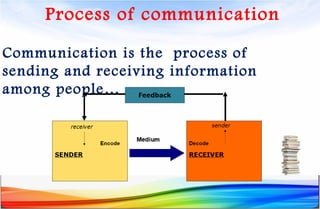
Process of communication
Communication is the process of
sending and receiving information
among people…
Uses of effective communication
Effective communication helps to understand a
person or situation in a better way.
It enables us to solve the differences, build trust
and respect in the organization.
Effective communication helps us to connect well
with kids, spouse, boss, colleagues, etc.
Sometimes our message is misunderstood or
we misunderstand the received message,
effective communication helps us to resolve
problems with both’s point of view.
It helps us in decision making.
Uses of effective communication
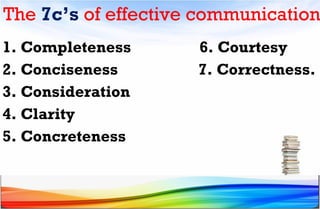
The 7c’s of effective communication
1. Completeness 6. Courtesy
2. Conciseness 7. Correctness.
3. Consideration
4. Clarity
5. Concreteness
Whose responsibility is
communication?
Effective communication should pulse in
all directions through an organization like a
heartbeat.
But it doesn't just happen. Nor is it solely
the responsibility of communication
functions.
Whose responsibility is
communication?
To achieve this level of
permeation, responsibility for the
communication process must rest
with management at all levels
across the organization.
Poor communication is repeatedly
cited as a key contributor in the
failure of major change efforts.
Not surprisingly, communication
skills are increasingly regarded as a
critical skill set for leaders,
particularly in situations where the
leader is an instrumental driver of
change.
Leaders play three roles as
communicators
Effective Communication
Skills for Leaders
1.Active Listening Skills
2.Interpersonal
Engagement
Effective Communication
Skills for Leaders
3.Intuition and Alertness
4.Articulation, Clarity, and
Conciseness
1. Active Listening Skills
Great leaders listen first to
understand a situation, key
factors and challenges in a
given situation.
2. Interpersonal
Engagement
Face-to-face interaction
remains one of the most
effective ways to ensure
accurate message delivery.
3. Intuition and Alertness
Reading body language
is a key communication
ability for great leaders.
4. Articulation, Clarity and
Conciseness
When presenting information or
attempting to persuade or motivate,
good communicators are articulate,
clear and concise. They speak with a
crisp but relaxed pace and emphasize
important words and phrases.
Importance of Effective
Communication in Leadership
1.Provide Direction
2.Create Security
3.Empower Members
1. Provide Direction
Provide direction to the members
of the organization by maintaining
a consistent vision at the forefront
of every decision. Orally
communicate the vision or the
purpose statement to each
member.
2. Create Security
Create security by effectively
laying out the organization's
guidelines and boundaries. Have
very clearly defined do’s and
don’ts that members can see and
understand.
3. Empower Members3. Empower Members
Empower employees by
creating an effective
reward system and a
feedback forum.
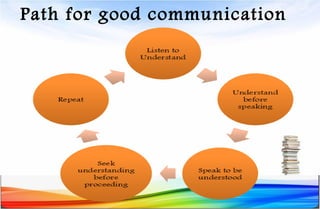
Path for good communication
The End
ThankThank

Effective communication for leaders