Faculty of applied medical science
Faculty of Nursing
Undersupervison :
Dr :- Sayda
Dr :- Triza.
Student :
Mostafa shakshak.
COMMUNICATION
Outline:-
• Introduction
• Definition of communication
• Communication process
• Types of communication
• Principles of communication
• Importance of Communication in Nursing
• THERAPEUTIC NURSE-CLIENT RELATIONSHIP
• CONTEXT OF THERAPEUTIC COMMUNICATION
• THERAPEUTIC COMMUNICATION TECHNIQUES
• Non THERAPEUTIC COMMUNICATION TECHNIQUES
Introduction
Communication in mental health nursing is an essential
component of all therapeutic interventions. The
knowledge and interpersonal skills that a nurses uses
to communicate are essential aspects of helping the
person who is experiencing mental health problems or
distress, as well as facilitating the development of a
positive nurse–client relationship.
Communication
• "Communication is a means of persuasion to
influence the other so that the desired effect
is achieved. 'Aristotle
• Communication is “a process by which two or
more people exchange ideas, facts, feelings or
impressions in ways that each gains a
‘common understanding’ of meaning, intent
and use of a message.” Paul Leagens
The communication process
It has the following main components:
• Sender (source)
• Message (content)
• Channel (s) (medium)
• Receiver (audience)
• Feedback (effect)
1. Sender
• The sender (communicator) is the originator
of the message.
• Sender formulates, encodes and transmits the
information which he/she wants to
communicate.
• The impact of the message will depend on
sender's communication skill, social status
(authority), knowledge, attitude and prestige
in the community.
2. Message
• A message is the information/desired
behaviour in physical form which the
communicator transmits to his audience to
receive, understand, accept and act upon.
• The message may be in the form of words,
pictures or signs.
Components of message are:
• Message code-any group of symbols that can
be structured in a way that is meaningful to
same person, eg., language.
• Message content the material in the message
i.e., selected by the source to express his
purpose.
• Message treatment i.e, decisions which the
communication source makes in selecting,
arranging both codes and contents.
A good message must be:
• In line with the objectives
• Meaningful
• Based on felt needs
• Clear and understandable
• Specific and accurate
• Timely and adequate
• Fitting the audience
• Interesting
• Culturally and socially appropriate
3. Channels of Communication
• By channel is implied the “physical bridge” or the
media of communication between sender and
the receiver.
• Channels can be:
– Interpersonal (face to face communication) may be
verbal or non-verbal, or
– Mass media TV, radio, printed media etc.
• Every channel of communication has its
advantages and limitations.
• The proper selection and use of channels results
in successful communication.
4. Receiver
• Who receives messages from the sender,
decoding, interprets the meaning and giving
feedback.
5. Feedback
• It is the flow of information from receiver to
the sender, the reaction to the message.
Mode of Communication
• Verbal communication
• Non-verbal communication
Verbal Communication
• the traditional way of communication by mouth.
• Language is the chief vehicle of communication.
• "Effective verbal communication techniques" include
– Clarity and brevity
– Vocabulary
– Denotative and connotative meaning
– Pacing
– Timing and relevance
• Verbal communication also involves written words.
Non-verbal communication
• communication occur other than words.
• facial expression, gesture, touch and vocal
tone
Principles of communication:
• Communication should have objective and purpose.
• Should be appropriate to situation.
• Systematic analysis of the message, i.e., the idea, the thought to be
communicated, so that one is clear about it.
• Selection and determination of appropriate language and medium
of communication according to its purpose.
• Organizational climate, including appropriate timing and physical
setting to convey the desired meaning of the communication.
• Consultation with others for planning of communication; involves
special preparation.
Principles of communication,cont..
• Message should convey something of value to the receiver in the light of
his needs and interests.
• The communication action following a communication is important in
effective communication as this speaks more than his/her words.
• The sender has to understand the receivers attitude and reaction by
careful, alert and proper listening to ensure that the desired meaning of
the message has been comprehended by the receiver.
• Communication programe should make use of existing facilities to the
great extent possible and should avoid challenging them unnecessarily.
Factors influencing communication:
• Perceptions
• Values
• Emotions
• Socio-cultural background
• Knowledge
• Role and relationships
• Environment
• Space and territoriality
Barriers of communication:
• Physical/environmental barriers
• Personal barriers
• Physiological barriers
• Psychological barriers
• Cultural barriers
• Background barriers
Importance of Communication in
Nursing
• A critical component of nursing practice
• Good communication
– Generate trust between nurse and clients.
– Provides professional satisfaction.
– Is a means for bringing about change, i.e. nurse listens,
speaks and acts to negotiate changes that promotes
client’s well-being.
– Is the foundation of the relationship between the nurse
and other members of the health team.
– Helps to promote managerial efficiency.
– Provides basis for leadership action.
– Provides means of co-ordination.
THERAPEUTIC NURSE-CLIENT
RELATIONSHIP
• Therapeutic relationships are goal- oriented
and directed at learning and growth
promotion.
• Definition - ability to use one’s personality
consciously and in full awareness in an
attempt to establish relatedness and to
structure nursing interventions.
Requirements for Therapeutic
Relationship
• Rapport
• Trust
• Respect
• Genuineness
• Empathy
Phases of a Therapeutic Nurse-Client
Relationship
• Pre-interaction phase
• Orientation/Introductory Period
• Working
• Termination
INTERPERSONAL COMMUNICATION
• Interpersonal communication is a transaction
between the sender and the receiver. Both
persons participate simultaneously.
CONTEXT OF THERAPEUTIC
COMMUNICATION
Values, attitudes, and beliefs.
• Example: attitudes of prejudice are expressed through
negative stereotyping.
Culture or religion
• Cultural mores, norms, ideas, and customs provide the
basis for ways of thinking.
Social status
• High-status persons often convey their high-power
position with gestures of hands on hips, power
dressing, greater height, and more distance when
communicating with individuals considered to be of
lower social status.
Gender
• Masculine and feminine gestures influence
messages conveyed in communication with
others.
Age or developmental level
• Example: The influence of developmental
level on communication is especially evident
during adolescence, with words such as
“cool,” “awesome,” and others.
CONTEXT OF THERAPEUTIC COMMUNICATION
Proxemics: Use of Space
• Intimate distance - the closest distance that
individuals allow between themselves and other
• Personal distance -the distance for interactions
that are personal in
nature, such as close conversation with friends
• Social distanc - the distance for conversation with
strangers or acquaintances
• Public distance - the distance for speaking in
public or yelling to someone some distance away
Nonverbal Communication: Body
Language
• Components of nonverbal communication
• Physical appearance and dress
• Body movement and posture
• Touch
• Facial expressions
• Eye behavior
THERAPEUTIC COMMUNICATION
TECHNIQUES
• Using silence - allows client to take control of the discussion, if he
or she so desires
• Accepting - conveys positive regard
• Giving recognition - acknowledging, indicating awareness
• Offering self - making oneself available
• Giving broad openings - allows client to select the topic
• Offering general leads - encourages client to continue
• Placing the event in time or sequence - clarifies the relationship of
events in time
• Making observations - verbalizing what is observed or perceived
THERAPEUTIC COMMUNICATION TECHNIQUES,cont …
• Encouraging description of perceptions - asking client to verbalize
what is being perceived
• Encouraging comparison - asking client to compare similarities and
differences in ideas, experiences, or interpersonal relationships
• Restating - lets client know whether an expressed statement has or
has not been understood
• Reflecting - directs questions or feelings back to client so that they
may be recognized and accepted
• Focusing - taking notice of a single idea or even a single word
THERAPEUTIC COMMUNICATION TECHNIQUES,cont …
• Exploring - delving further into a subject, idea, experience, or relationship
• Seeking clarification and validation - striving to explain what is vague and
searching for mutual understanding
• Presenting reality - clarifying misconceptions that client may be
expressing
• Voicing doubt - expressing uncertainty as to the reality of client’s
perception
• Verbalizing the implied - putting into words what client has only implied
• Attempting to translate words into feelings - putting into words the
feelings the client has expressed only indirectly
• Formulating plan of action - striving to prevent anger or anxiety escalating
to unmanageable level when stressor recurs
THERAPEUTIC COMMUNICATION AND
PROBLEM-SOLVING
Goals are often achieved through use of the problem-solving model:
• Identify the client’s problem.
• Promote discussion of desired changes.
• Discuss aspects that cannot realistically be changed and ways to cope with them more
adaptively.
• Discuss alternative strategies for creating changes the client desires to make.
• Weigh benefits and consequences of each alternative.
• Help client select an alternative.
• Encourage client to implement the change.
• Provide positive feedback for client’s attempts to create change.
• Help client evaluate outcomes of the change and make modifications as required.

LISTENING TO THE PATIENT
• To listen actively is to be attentive to what client
is saying, both verbally and nonverbally.
Several nonverbal behaviors have been designed
to facilitate attentive listening.
• S – Sit squarely facing the client.
• O – Observe an open posture.
• L – Lean forward toward the client.
• E – Establish eye contact.
• R – Relax.
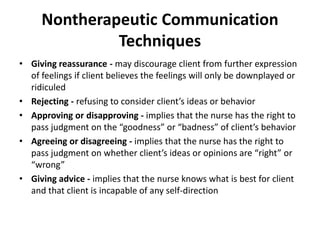
Nontherapeutic Communication
Techniques
• Giving reassurance - may discourage client from further expression
of feelings if client believes the feelings will only be downplayed or
ridiculed
• Rejecting - refusing to consider client’s ideas or behavior
• Approving or disapproving - implies that the nurse has the right to
pass judgment on the “goodness” or “badness” of client’s behavior
• Agreeing or disagreeing - implies that the nurse has the right to
pass judgment on whether client’s ideas or opinions are “right” or
“wrong”
• Giving advice - implies that the nurse knows what is best for client
and that client is incapable of any self-direction
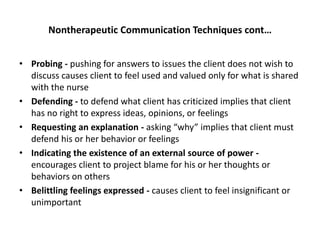
Nontherapeutic Communication Techniques cont…
• Probing - pushing for answers to issues the client does not wish to
discuss causes client to feel used and valued only for what is shared
with the nurse
• Defending - to defend what client has criticized implies that client
has no right to express ideas, opinions, or feelings
• Requesting an explanation - asking “why” implies that client must
defend his or her behavior or feelings
• Indicating the existence of an external source of power -
encourages client to project blame for his or her thoughts or
behaviors on others
• Belittling feelings expressed - causes client to feel insignificant or
unimportant
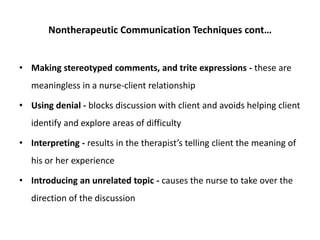
Nontherapeutic Communication Techniques cont…
• Making stereotyped comments, and trite expressions - these are
meaningless in a nurse-client relationship
• Using denial - blocks discussion with client and avoids helping client
identify and explore areas of difficulty
• Interpreting - results in the therapist’s telling client the meaning of
his or her experience
• Introducing an unrelated topic - causes the nurse to take over the
direction of the discussion
Thanks


Communication in Psychiatric patient

  • 1.
    Faculty of appliedmedical science Faculty of Nursing Undersupervison : Dr :- Sayda Dr :- Triza. Student : Mostafa shakshak. COMMUNICATION
  • 2.
    Outline:- • Introduction • Definitionof communication • Communication process • Types of communication • Principles of communication • Importance of Communication in Nursing • THERAPEUTIC NURSE-CLIENT RELATIONSHIP • CONTEXT OF THERAPEUTIC COMMUNICATION • THERAPEUTIC COMMUNICATION TECHNIQUES • Non THERAPEUTIC COMMUNICATION TECHNIQUES
  • 3.
    Introduction Communication in mentalhealth nursing is an essential component of all therapeutic interventions. The knowledge and interpersonal skills that a nurses uses to communicate are essential aspects of helping the person who is experiencing mental health problems or distress, as well as facilitating the development of a positive nurse–client relationship.
  • 4.
    Communication • "Communication isa means of persuasion to influence the other so that the desired effect is achieved. 'Aristotle • Communication is “a process by which two or more people exchange ideas, facts, feelings or impressions in ways that each gains a ‘common understanding’ of meaning, intent and use of a message.” Paul Leagens
  • 5.
    The communication process Ithas the following main components: • Sender (source) • Message (content) • Channel (s) (medium) • Receiver (audience) • Feedback (effect)
  • 6.
    1. Sender • Thesender (communicator) is the originator of the message. • Sender formulates, encodes and transmits the information which he/she wants to communicate. • The impact of the message will depend on sender's communication skill, social status (authority), knowledge, attitude and prestige in the community.
  • 7.
    2. Message • Amessage is the information/desired behaviour in physical form which the communicator transmits to his audience to receive, understand, accept and act upon. • The message may be in the form of words, pictures or signs.
  • 8.
    Components of messageare: • Message code-any group of symbols that can be structured in a way that is meaningful to same person, eg., language. • Message content the material in the message i.e., selected by the source to express his purpose. • Message treatment i.e, decisions which the communication source makes in selecting, arranging both codes and contents.
  • 9.
    A good messagemust be: • In line with the objectives • Meaningful • Based on felt needs • Clear and understandable • Specific and accurate • Timely and adequate • Fitting the audience • Interesting • Culturally and socially appropriate
  • 10.
    3. Channels ofCommunication • By channel is implied the “physical bridge” or the media of communication between sender and the receiver. • Channels can be: – Interpersonal (face to face communication) may be verbal or non-verbal, or – Mass media TV, radio, printed media etc. • Every channel of communication has its advantages and limitations. • The proper selection and use of channels results in successful communication.
  • 11.
    4. Receiver • Whoreceives messages from the sender, decoding, interprets the meaning and giving feedback. 5. Feedback • It is the flow of information from receiver to the sender, the reaction to the message.
  • 12.
    Mode of Communication •Verbal communication • Non-verbal communication
  • 13.
    Verbal Communication • thetraditional way of communication by mouth. • Language is the chief vehicle of communication. • "Effective verbal communication techniques" include – Clarity and brevity – Vocabulary – Denotative and connotative meaning – Pacing – Timing and relevance • Verbal communication also involves written words.
  • 14.
    Non-verbal communication • communicationoccur other than words. • facial expression, gesture, touch and vocal tone
  • 15.
    Principles of communication: •Communication should have objective and purpose. • Should be appropriate to situation. • Systematic analysis of the message, i.e., the idea, the thought to be communicated, so that one is clear about it. • Selection and determination of appropriate language and medium of communication according to its purpose. • Organizational climate, including appropriate timing and physical setting to convey the desired meaning of the communication. • Consultation with others for planning of communication; involves special preparation.
  • 16.
    Principles of communication,cont.. •Message should convey something of value to the receiver in the light of his needs and interests. • The communication action following a communication is important in effective communication as this speaks more than his/her words. • The sender has to understand the receivers attitude and reaction by careful, alert and proper listening to ensure that the desired meaning of the message has been comprehended by the receiver. • Communication programe should make use of existing facilities to the great extent possible and should avoid challenging them unnecessarily.
  • 17.
    Factors influencing communication: •Perceptions • Values • Emotions • Socio-cultural background • Knowledge • Role and relationships • Environment • Space and territoriality
  • 18.
    Barriers of communication: •Physical/environmental barriers • Personal barriers • Physiological barriers • Psychological barriers • Cultural barriers • Background barriers
  • 19.
    Importance of Communicationin Nursing • A critical component of nursing practice • Good communication – Generate trust between nurse and clients. – Provides professional satisfaction. – Is a means for bringing about change, i.e. nurse listens, speaks and acts to negotiate changes that promotes client’s well-being. – Is the foundation of the relationship between the nurse and other members of the health team. – Helps to promote managerial efficiency. – Provides basis for leadership action. – Provides means of co-ordination.
  • 20.
    THERAPEUTIC NURSE-CLIENT RELATIONSHIP • Therapeuticrelationships are goal- oriented and directed at learning and growth promotion. • Definition - ability to use one’s personality consciously and in full awareness in an attempt to establish relatedness and to structure nursing interventions.
  • 21.
    Requirements for Therapeutic Relationship •Rapport • Trust • Respect • Genuineness • Empathy
  • 22.
    Phases of aTherapeutic Nurse-Client Relationship • Pre-interaction phase • Orientation/Introductory Period • Working • Termination
  • 23.
    INTERPERSONAL COMMUNICATION • Interpersonalcommunication is a transaction between the sender and the receiver. Both persons participate simultaneously.
  • 24.
    CONTEXT OF THERAPEUTIC COMMUNICATION Values,attitudes, and beliefs. • Example: attitudes of prejudice are expressed through negative stereotyping. Culture or religion • Cultural mores, norms, ideas, and customs provide the basis for ways of thinking. Social status • High-status persons often convey their high-power position with gestures of hands on hips, power dressing, greater height, and more distance when communicating with individuals considered to be of lower social status.
  • 25.
    Gender • Masculine andfeminine gestures influence messages conveyed in communication with others. Age or developmental level • Example: The influence of developmental level on communication is especially evident during adolescence, with words such as “cool,” “awesome,” and others. CONTEXT OF THERAPEUTIC COMMUNICATION
  • 26.
    Proxemics: Use ofSpace • Intimate distance - the closest distance that individuals allow between themselves and other • Personal distance -the distance for interactions that are personal in nature, such as close conversation with friends • Social distanc - the distance for conversation with strangers or acquaintances • Public distance - the distance for speaking in public or yelling to someone some distance away
  • 27.
    Nonverbal Communication: Body Language •Components of nonverbal communication • Physical appearance and dress • Body movement and posture • Touch • Facial expressions • Eye behavior
  • 28.
    THERAPEUTIC COMMUNICATION TECHNIQUES • Usingsilence - allows client to take control of the discussion, if he or she so desires • Accepting - conveys positive regard • Giving recognition - acknowledging, indicating awareness • Offering self - making oneself available • Giving broad openings - allows client to select the topic • Offering general leads - encourages client to continue • Placing the event in time or sequence - clarifies the relationship of events in time • Making observations - verbalizing what is observed or perceived
  • 29.
    THERAPEUTIC COMMUNICATION TECHNIQUES,cont… • Encouraging description of perceptions - asking client to verbalize what is being perceived • Encouraging comparison - asking client to compare similarities and differences in ideas, experiences, or interpersonal relationships • Restating - lets client know whether an expressed statement has or has not been understood • Reflecting - directs questions or feelings back to client so that they may be recognized and accepted • Focusing - taking notice of a single idea or even a single word
  • 30.
    THERAPEUTIC COMMUNICATION TECHNIQUES,cont… • Exploring - delving further into a subject, idea, experience, or relationship • Seeking clarification and validation - striving to explain what is vague and searching for mutual understanding • Presenting reality - clarifying misconceptions that client may be expressing • Voicing doubt - expressing uncertainty as to the reality of client’s perception • Verbalizing the implied - putting into words what client has only implied • Attempting to translate words into feelings - putting into words the feelings the client has expressed only indirectly • Formulating plan of action - striving to prevent anger or anxiety escalating to unmanageable level when stressor recurs
  • 31.
    THERAPEUTIC COMMUNICATION AND PROBLEM-SOLVING Goalsare often achieved through use of the problem-solving model: • Identify the client’s problem. • Promote discussion of desired changes. • Discuss aspects that cannot realistically be changed and ways to cope with them more adaptively. • Discuss alternative strategies for creating changes the client desires to make. • Weigh benefits and consequences of each alternative. • Help client select an alternative. • Encourage client to implement the change. • Provide positive feedback for client’s attempts to create change. • Help client evaluate outcomes of the change and make modifications as required.
  • 32.
    LISTENING TO THEPATIENT • To listen actively is to be attentive to what client is saying, both verbally and nonverbally. Several nonverbal behaviors have been designed to facilitate attentive listening. • S – Sit squarely facing the client. • O – Observe an open posture. • L – Lean forward toward the client. • E – Establish eye contact. • R – Relax.
  • 33.
    Nontherapeutic Communication Techniques • Givingreassurance - may discourage client from further expression of feelings if client believes the feelings will only be downplayed or ridiculed • Rejecting - refusing to consider client’s ideas or behavior • Approving or disapproving - implies that the nurse has the right to pass judgment on the “goodness” or “badness” of client’s behavior • Agreeing or disagreeing - implies that the nurse has the right to pass judgment on whether client’s ideas or opinions are “right” or “wrong” • Giving advice - implies that the nurse knows what is best for client and that client is incapable of any self-direction
  • 34.
    Nontherapeutic Communication Techniquescont… • Probing - pushing for answers to issues the client does not wish to discuss causes client to feel used and valued only for what is shared with the nurse • Defending - to defend what client has criticized implies that client has no right to express ideas, opinions, or feelings • Requesting an explanation - asking “why” implies that client must defend his or her behavior or feelings • Indicating the existence of an external source of power - encourages client to project blame for his or her thoughts or behaviors on others • Belittling feelings expressed - causes client to feel insignificant or unimportant
  • 35.
    Nontherapeutic Communication Techniquescont… • Making stereotyped comments, and trite expressions - these are meaningless in a nurse-client relationship • Using denial - blocks discussion with client and avoids helping client identify and explore areas of difficulty • Interpreting - results in the therapist’s telling client the meaning of his or her experience • Introducing an unrelated topic - causes the nurse to take over the direction of the discussion
  • 36.