COMMUNICATI
ON
BY :
MAHMOUD SHAKRIAMAHMOUD SHAKRIA
Outlines:
- Introduction
- Definition of communication
- Importance of Communication process.
- Element of Communication process. 
- Communication channels
- Types of communication
- Characteristics of successful communication.
- Communication barriers.
- How to overcome the barriers of communication .
- Essential elements for effective communication . 
- Levels of communication.
- Communication techniques.
 The English word ‘communication’ is derived from the
Latin noun ‘ communis ’ and the Latin verb “
communicare ’’ which means “to make common” or
“to share”.
 As a nurse, it is very important to understand the
client and being understood by the client.
5
Communication is the process of meaningful
interaction among human beings .
Communication is a two way complex process of
sharing a message (ideas, information, values,
feelings or attitudes) between two or more persons
to achieve the desired effect .
 It is ongoing process where by exchange of ideas,
information, values, feelings or attitudes occur between
nurse and client in which the client needs are identified
and met.
Definition
Therapeutic communication
Importance of Communication process
1. Help in feeling expression.
2. Help in identifying and solving problems.
3. Other people form impressions of a person through the
way he communicates.
4. The way one express him self to others.
5. Human need to communicate because we are social
creatures by nature.
6. It is impossible to live in our everyday world without
communicating with other.
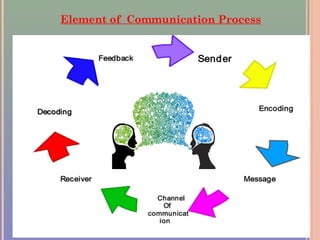
Element of Communication Process
1. The sender: It is the person or group who is generated and delivers
information.
2. Encoding: The sender generates and delivers information in the
form of a code.
3. The message/ input: It is the information, thoughts, feelings or
ideas that sent from the sender to receiver through channel of
communication either verbal or non verbal
4. Receiver: It is the person who is Receive the message
5. Channel: The message is sent via a channel, which can be
made of a variety of materials.
6. Decoding/ output: It is the process by which the receiver
accepts and interprets the message.
7. Feedback: The messages received in response to information
conveyed , it may take the form of verbal or nonverbal clues and
may be positive or negative
Element of Communication Process
COMMUNICATION CHANNELS 
1-Visual channel.
Vision is one of the most important senses used for
communication. Observation of a person's eyes, lips, facial
expressions, body movements.
2-Auditory channel:
Listening is another important component of
communication.
Messages sent verbally must be accurately received or
heard before true meaning is assigned; True meaning is
that which is congruent with the sender's meaning.
3-Kinesthetic channel:
Significant information can be obtained and
communicated through touch; Touch is an important
aspect of nursing practice.
4-Output:
Messages received through each of the channels are
processed in specific areas of the brain.
 
A - Verbal communication
B - Non-verbal communication
VERBAL COMMUNICATION
1- Oral communication:
In oral communication spoken words are used.
It includes face to face conversations, speech ,
telephonic conversation , voice over internet.
Advantages :
It brings quick feedback
In a face-to-face conversation , by reading facial
expression and body language one can guess whether
he/she should trust what is being said or not .
Disadvantages :
In face-to-face discussion , user is unable to deeply
think about what he is delivered.
2 - Written communication :
In written communication ,written signs or symbols are used to
communicate , message can be transmitted via email , letter ,
report ,..etc
Written communication is most common form of communication
being used in business.
Advantages :
Message can be edited and revised
It provide record and backup.
It enables receiver to fully understand it
and send appropriate feedback.
Disavantages :
It does not bring instant feed back .
It take more time in composing a written message .
Non Verbal communication
☺ All ways by which ideas encoded without words.
☺ It constitutes 93% of communication that we can say "what
said isn't as important as how it is said“.
☺Non-verbal communications much reliable than verbal.
* If the verbal message is not reinforced or is in fact contracted by
the Non-verbal behavior, the message is confusing.
1-Verbal words just convey 7% of message
2-Tone of voice convey 38%
3-Non-verbal clues are 55%
* Non-verbal communication have the following
three elements:
1.Appearance :
* Speaker ( clothing ,hairstyle , neatness , use of cosmetics) .
* Surrounding: ( room -, size , lighting , decorations , furnishings ).
2.Body language:
* ( facial expression , gestures , postures ).
3.Sounds :
* ( voice tone , volume , speech rate ) .
Characteristics of successful communication
- Clearness and integrity of message to be conveyed.
- Adequate briefing of the recipient.
- Accurate plan of objectives.
- Reliability and uniformity of the message.
- know the main purpose of the message.
- Proper response or feedback.
- Correct timing.
- Use of proper medium to convey the message properly.
- Use of informal communication.
COMMUNICATION BARRIERS
How to overcome barriers of communication..
 Taking the receiver more seriously .
 Crystal clear message .
 Delivering message skillfully .
 Focusing on the receiver.
 Using multiple channels to communicate in steed of relying
on one channel .
 Ensuring appropriate feedback.
 Be aware of own state of mind / emotion / attitude .
1-Trust
2-Active listening
3-Empathy
4-Touch
5-Confidentiality
6-Self disclosure
7-Keeping privacy and respecting boundaries
Essential elements for effective communication
1. Intrapersonal communication .
2. Interpersonal communication .
3. Small groups communication .
4. One-to-group communication .
5. Mass communication .
Levels of Communication
1. Intrapersonal communication: occurs in your own
mind , when people communicate within themselves.
2. Interpersonal communication: takes place between
two persons and in small groups but can involve more
informal conversation .
3. Small groups communication :is communication
within formal or informal groups or teams , it is group
interaction that results in decision making , problem
solving and discussion within an organization .
1. One-to-group communication : involves a speaker who seeks to
inform , persuade or motivate an audience .
2. Mass communication : is the electronic or print transmission of
messages to the general public , include things like radio ,
television , film , and printed materials designed to reach large
audiences.
♥ Using silence : it is the period during which both
sender and receiver are silent and think about the
same topic, it help to arrange ideas, to improve
communication.
♥ Active listening : this entail four main aspects
(observation, acceptance, focusing, and interpretation)
COMMUNICATION
TECHNIQUES
♥ Broad opening : open a broad topic and allow
him to speak e.g. “ What are you doing today“
♥ Focusing : make stress on important points, it is
useful when person jump from topic to another
♥ Paraphrasing : repeating the spoken words in the same meaning
using another words e.g. patient : "I cannot sleep, I stay awake all
the night“ nurse : " You have difficulty in sleeping“
♥ Reflection : reflect what he said e.g. " my money stolen
yesterday“ Nurse "This causes you to feel anger“
♥ Open ended questions : It is good method because it is open
field for communication.
♥ Restatement : repeating the spoken words in the
same words as it is.
♥ Clarification : used to clarify vague communication
e.g. "Tell me more about that" or "What do you mean“
♥ Summarizing : summarize important points e.g. "Do
you mean that…“
♥ General leading: This allow other person to take direction in
discussion and show interest in what comes next e.g. "Go on" or "
And then“
♥ Offering self: When patient unable to communicate, the nurse
come and offer presence and desire to communicate e.g. "I am
available to speak with you at any time you need" or " I will sit
beside you for awhile“
♥ Giving recognition: Which indicates awareness of change,
doesn't imply good, bad or right or wrong e.g. "I noticed that you
shaved this morning" or " you have combed your hair today“
Communication

Communication

  • 1.
  • 2.
  • 3.
    Outlines: - Introduction - Definitionof communication - Importance of Communication process. - Element of Communication process.  - Communication channels - Types of communication
  • 4.
    - Characteristics ofsuccessful communication. - Communication barriers. - How to overcome the barriers of communication . - Essential elements for effective communication .  - Levels of communication. - Communication techniques.
  • 5.
     The Englishword ‘communication’ is derived from the Latin noun ‘ communis ’ and the Latin verb “ communicare ’’ which means “to make common” or “to share”.  As a nurse, it is very important to understand the client and being understood by the client. 5
  • 6.
    Communication is theprocess of meaningful interaction among human beings . Communication is a two way complex process of sharing a message (ideas, information, values, feelings or attitudes) between two or more persons to achieve the desired effect .
  • 7.
     It isongoing process where by exchange of ideas, information, values, feelings or attitudes occur between nurse and client in which the client needs are identified and met. Definition Therapeutic communication
  • 8.
    Importance of Communicationprocess 1. Help in feeling expression. 2. Help in identifying and solving problems. 3. Other people form impressions of a person through the way he communicates. 4. The way one express him self to others. 5. Human need to communicate because we are social creatures by nature. 6. It is impossible to live in our everyday world without communicating with other.
  • 9.
    Element of CommunicationProcess 1. The sender: It is the person or group who is generated and delivers information. 2. Encoding: The sender generates and delivers information in the form of a code. 3. The message/ input: It is the information, thoughts, feelings or ideas that sent from the sender to receiver through channel of communication either verbal or non verbal 4. Receiver: It is the person who is Receive the message
  • 10.
    5. Channel: Themessage is sent via a channel, which can be made of a variety of materials. 6. Decoding/ output: It is the process by which the receiver accepts and interprets the message. 7. Feedback: The messages received in response to information conveyed , it may take the form of verbal or nonverbal clues and may be positive or negative
  • 11.
  • 12.
    COMMUNICATION CHANNELS  1-Visual channel. Visionis one of the most important senses used for communication. Observation of a person's eyes, lips, facial expressions, body movements. 2-Auditory channel: Listening is another important component of communication. Messages sent verbally must be accurately received or heard before true meaning is assigned; True meaning is that which is congruent with the sender's meaning.
  • 13.
    3-Kinesthetic channel: Significant informationcan be obtained and communicated through touch; Touch is an important aspect of nursing practice. 4-Output: Messages received through each of the channels are processed in specific areas of the brain.  
  • 14.
    A - Verbalcommunication B - Non-verbal communication
  • 15.
    VERBAL COMMUNICATION 1- Oralcommunication: In oral communication spoken words are used. It includes face to face conversations, speech , telephonic conversation , voice over internet.
  • 16.
    Advantages : It bringsquick feedback In a face-to-face conversation , by reading facial expression and body language one can guess whether he/she should trust what is being said or not . Disadvantages : In face-to-face discussion , user is unable to deeply think about what he is delivered.
  • 17.
    2 - Writtencommunication : In written communication ,written signs or symbols are used to communicate , message can be transmitted via email , letter , report ,..etc Written communication is most common form of communication being used in business.
  • 18.
    Advantages : Message canbe edited and revised It provide record and backup. It enables receiver to fully understand it and send appropriate feedback. Disavantages : It does not bring instant feed back . It take more time in composing a written message .
  • 19.
    Non Verbal communication ☺All ways by which ideas encoded without words. ☺ It constitutes 93% of communication that we can say "what said isn't as important as how it is said“. ☺Non-verbal communications much reliable than verbal.
  • 20.
    * If theverbal message is not reinforced or is in fact contracted by the Non-verbal behavior, the message is confusing. 1-Verbal words just convey 7% of message 2-Tone of voice convey 38% 3-Non-verbal clues are 55%
  • 21.
    * Non-verbal communicationhave the following three elements: 1.Appearance : * Speaker ( clothing ,hairstyle , neatness , use of cosmetics) . * Surrounding: ( room -, size , lighting , decorations , furnishings ). 2.Body language: * ( facial expression , gestures , postures ). 3.Sounds : * ( voice tone , volume , speech rate ) .
  • 22.
    Characteristics of successfulcommunication - Clearness and integrity of message to be conveyed. - Adequate briefing of the recipient. - Accurate plan of objectives. - Reliability and uniformity of the message. - know the main purpose of the message. - Proper response or feedback. - Correct timing. - Use of proper medium to convey the message properly. - Use of informal communication.
  • 23.
  • 24.
    How to overcomebarriers of communication..  Taking the receiver more seriously .  Crystal clear message .  Delivering message skillfully .  Focusing on the receiver.  Using multiple channels to communicate in steed of relying on one channel .  Ensuring appropriate feedback.  Be aware of own state of mind / emotion / attitude .
  • 25.
    1-Trust 2-Active listening 3-Empathy 4-Touch 5-Confidentiality 6-Self disclosure 7-Keepingprivacy and respecting boundaries Essential elements for effective communication
  • 26.
    1. Intrapersonal communication. 2. Interpersonal communication . 3. Small groups communication . 4. One-to-group communication . 5. Mass communication . Levels of Communication
  • 27.
    1. Intrapersonal communication:occurs in your own mind , when people communicate within themselves. 2. Interpersonal communication: takes place between two persons and in small groups but can involve more informal conversation . 3. Small groups communication :is communication within formal or informal groups or teams , it is group interaction that results in decision making , problem solving and discussion within an organization .
  • 28.
    1. One-to-group communication: involves a speaker who seeks to inform , persuade or motivate an audience . 2. Mass communication : is the electronic or print transmission of messages to the general public , include things like radio , television , film , and printed materials designed to reach large audiences.
  • 29.
    ♥ Using silence: it is the period during which both sender and receiver are silent and think about the same topic, it help to arrange ideas, to improve communication. ♥ Active listening : this entail four main aspects (observation, acceptance, focusing, and interpretation) COMMUNICATION TECHNIQUES
  • 30.
    ♥ Broad opening: open a broad topic and allow him to speak e.g. “ What are you doing today“ ♥ Focusing : make stress on important points, it is useful when person jump from topic to another
  • 31.
    ♥ Paraphrasing :repeating the spoken words in the same meaning using another words e.g. patient : "I cannot sleep, I stay awake all the night“ nurse : " You have difficulty in sleeping“ ♥ Reflection : reflect what he said e.g. " my money stolen yesterday“ Nurse "This causes you to feel anger“ ♥ Open ended questions : It is good method because it is open field for communication.
  • 32.
    ♥ Restatement :repeating the spoken words in the same words as it is. ♥ Clarification : used to clarify vague communication e.g. "Tell me more about that" or "What do you mean“ ♥ Summarizing : summarize important points e.g. "Do you mean that…“
  • 33.
    ♥ General leading:This allow other person to take direction in discussion and show interest in what comes next e.g. "Go on" or " And then“ ♥ Offering self: When patient unable to communicate, the nurse come and offer presence and desire to communicate e.g. "I am available to speak with you at any time you need" or " I will sit beside you for awhile“ ♥ Giving recognition: Which indicates awareness of change, doesn't imply good, bad or right or wrong e.g. "I noticed that you shaved this morning" or " you have combed your hair today“