The Basics of Effective
Interpersonal Communication
BY SUSHILA BAHL
Have you ever met
someone with whom you
just could not
communicate?
A person who, for some
reason, seems to bristle upon
our approach, leaving
communication as we know it
completely out of the
question?
Have you ever been
misunderstood by
someone?
Have you ever said or did
something, with pure motives
and good intentions, which
was misinterpreted?
Which is more important
in social interactions and
interpersonal
relationships?
The actual behavior or the
motivation behind the
behavior?
No matter how important
our motives are, people
read us by what they see
and hear
not by what we want
them to see and hear
Our ability to understand
how people see and hear
us is critical to effective
communications
English is a crazy language
 There is no egg in eggplant; neither apple nor pine in
pineapple.
 English muffins weren't invented in England or
French fries in France.
 If the plural of tooth is teeth, why isn't the plural of
booth beeth?
 One goose, 2 geese. So one moose, 2 meese?
 Doesn't it seem crazy that you can make amends but
not one amend
Communication
 Efficient communication is ESSENTIAL
to being successful in life.
 The biggest source of interpersonal
problems is poor communications.
 The key to the communication process
is to be UNDERSTOOD.
Communication
 ‘Among personal qualities
possessed by college graduates the
ability to communicate effectively
was ranked first by employers.’
Before you begin…
 What do I already know about
interpersonal communication?
 What are my learning goals for this
program?
 How do I think I will be able to apply my
learning on the job?
Course Content
 This program will cover:
 What communication is
 Why and how we communicate
 Barriers to communication
 Sharing ideas
 Getting information from others
 Giving constructive feedback
 Body language
Course Objectives
 The objectives of this program are to:
 provide a basic overview of verbal and
non-verbal interpersonal communication
processes
 identify personal obstacles to effective
interpersonal communication
 define some strategies for improving
individual and group communications
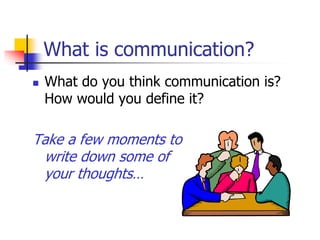
What is communication?
 What do you think communication is?
How would you define it?
Take a few moments to
write down some of
your thoughts…
Communication
 Communication is defined as the interchange
of thoughts or opinions through shared
symbols; e.g. language, words, phrases
 Communication is a process of coding &
decoding messages.
 Derived from the Latin word “communis”
which means to share i.e sharing of ideas ,
concepts, feelings & emotions.
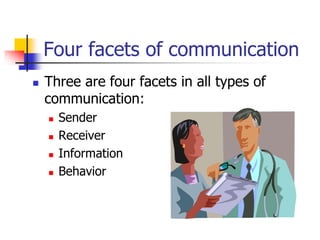
Four facets of communication
 Three are four facets in all types of
communication:
 Sender
 Receiver
 Information
 Behavior
Basic Elements Of
Communication
 Sender / Encoder / Speaker
 Receiver/ Decoder / Listener
 Message
 Medium / Channel
 Feedback
Four facets of communication
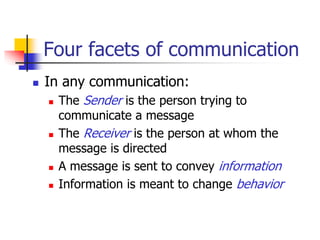
 In any communication:
 The Sender is the person trying to
communicate a message
 The Receiver is the person at whom the
message is directed
 A message is sent to convey information
 Information is meant to change behavior
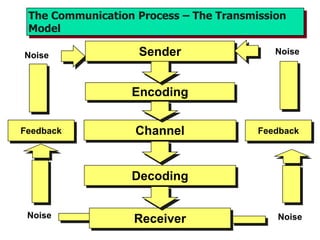
The Communication Process – The Transmission
Model
Noise
Feedback
Noise
Sender
Encoding
Channel
Decoding
Receiver
Noise
Noise
Feedback
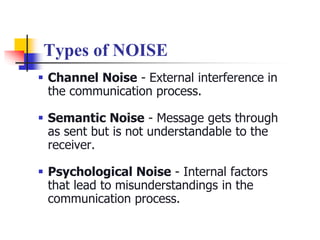
Types of NOISE
 Channel Noise - External interference in
the communication process.
 Semantic Noise - Message gets through
as sent but is not understandable to the
receiver.
 Psychological Noise - Internal factors
that lead to misunderstandings in the
communication process.
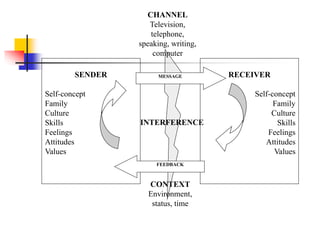
SENDER
Self-concept
Family
Culture
Skills
Feelings
Attitudes
Values
RECEIVER
Self-concept
Family
Culture
Skills
Feelings
Attitudes
Values
CHANNEL
Television,
telephone,
speaking, writing,
computer
MESSAGE
FEEDBACK
INTERFERENCE
CONTEXT
Environment,
status, time
Shared symbols
 Sometimes when we communicate we
assume we are using shared symbols
when we might not be
 Think about the term “asap”, “as soon as
possible”. What does it really mean?
 Think about how the meaning might change
in the situations on the next slide…
Shared symbols
 How might your meaning of “asap” change in
these situations?…
 Someone from another department calls. He
needs some detailed information asap; but you
are already rather busy.
 A coworker comes to you for help with an
assignment. She needs you asap; but you have
another job to finish before lunch.
 Your immediate supervisor, whom you like to
please, asks you to type a memo for her asap; but
you already have a stack of other jobs to finish.
Shared symbols
 Someone from another department calls.
He needs some detailed information asap;
but you are already rather busy.
 In this situation, you might interpret “asap”
as “when I have finished all of my own
work and have a chance to get to it. It
might be tomorrow or the next day.”
Shared symbols
 A coworker comes to you for help with an
assignment. She needs you asap; but you
have another job to finish before lunch.
 In this situation, you might interpret “asap”
as “after I have finished my own work, I
will help out after lunch”.
Shared symbols
 Your immediate supervisor, whom you like
to please, asks you to type a memo for her
asap; but you already have a stack of
other jobs to finish.
 In this situation, you might interpret “asap”
as “I’ll do this now and finish my other
work afterwards”.
Shared symbols
 In the previous examples, we’ve seen the
meaning of “asap” change from “in a few
days” to “immediately”.
 Many other words and phrases are also
vague and have different meanings for
different people.
 Shared symbols are not always completely
shared. The message intended is not always
the message received.
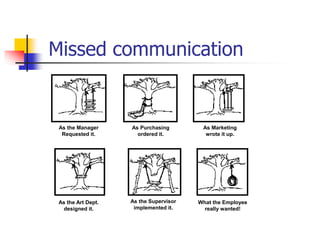
Missed communication
As Purchasing
ordered it.
As the Art Dept.
designed it.
As the Supervisor
implemented it.
As the Manager
Requested it.
As Marketing
wrote it up.
What the Employee
really wanted!
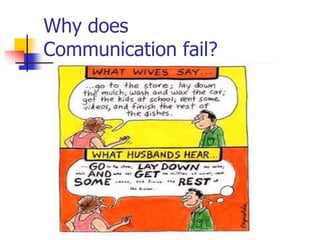
Why does
Communication fail?
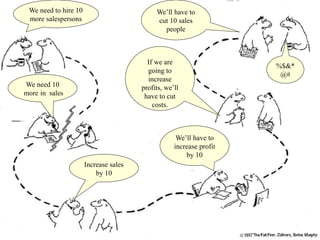
Why does
Communication fail?
We need to hire 10
more salespersons
We need 10
more in sales
Increase sales
by 10
We’ll have to
increase profit
by 10
If we are
going to
increase
profits, we’ll
have to cut
costs.
We’ll have to
cut 10 sales
people
%$&*
@#
Why do we communicate?
 What do you think?
Take a few moments to
write down some of
your thoughts…
Why we communicate
• We communicate to:
• Share our ideas and opinions
• Provide feedback to others
• Get information from others
• Gain power and influence
• Develop social relationships
• Maintain self-expression and our culture
• and other ideas you may have thought of
How do we communicate?
 Think of the many ways in which you
communicate…
Take a few moments to
write down some of
your thoughts…
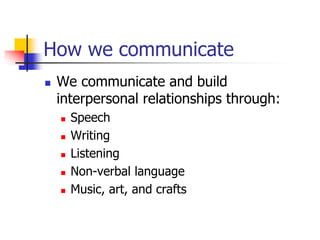
How we communicate
 We communicate and build
interpersonal relationships through:
 Speech
 Writing
 Listening
 Non-verbal language
 Music, art, and crafts
Choosing your medium
 Depending upon the situation, one method
of communication may be better than
another.
 In person: one-to-one
 In person: meetings, small groups
 In person: presentations, large groups
 Letter
 Memo
 Note
 Email
 Voice mail
Choosing your medium
 To determine the best medium for your
message determine:
 What you as the sender need to achieve
 What the receiver needs to know. What
the receiver wants to know
 How detailed, important, and or personal
the information in the message is
 Which behavior you want to influence and
how
Choosing your medium
 How would you communicate…
 an organizational change in your unit
 the introduction of a new employee
 a change in someone’s job duties
 a reprimand
 notice of a meeting
Take a few moments to write down some of
your thoughts…
Choosing your medium
 The best way to communicate…
 an organizational change in your unit by
memo and small group meetings
 the introduction of a new employee by
group and one-on-one meetings
 a change in someone’s job duties by
memo and one-on-one meeting
 a reprimand in a one-on-one private meeting
 notice of a meeting by memo and email
Difference between oral and
written communication
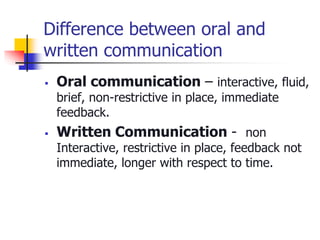
 Oral communication – interactive, fluid,
brief, non-restrictive in place, immediate
feedback.
 Written Communication - non
Interactive, restrictive in place, feedback not
immediate, longer with respect to time.
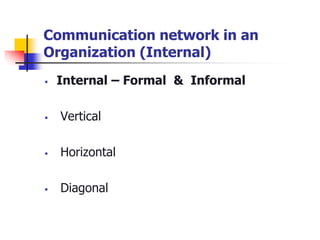
Communication network in an
Organization (Internal)
 Internal – Formal & Informal
 Vertical
 Horizontal
 Diagonal
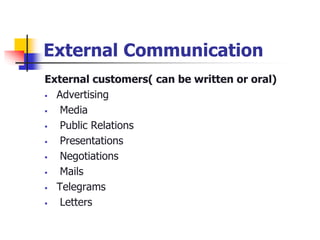
External Communication
External customers( can be written or oral)
 Advertising
 Media
 Public Relations
 Presentations
 Negotiations
 Mails
 Telegrams
 Letters
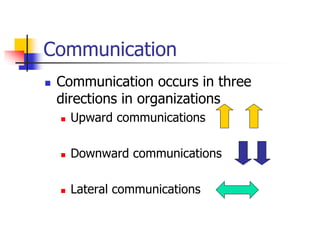
Communication
 Communication occurs in three
directions in organizations
 Upward communications
 Downward communications
 Lateral communications
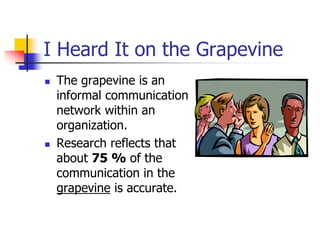
I Heard It on the Grapevine
 The grapevine is an
informal communication
network within an
organization.
 Research reflects that
about 75 % of the
communication in the
grapevine is accurate.
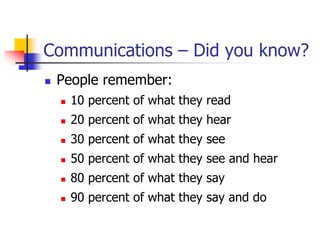
Communications – Did you know?
 People remember:
 10 percent of what they read
 20 percent of what they hear
 30 percent of what they see
 50 percent of what they see and hear
 80 percent of what they say
 90 percent of what they say and do
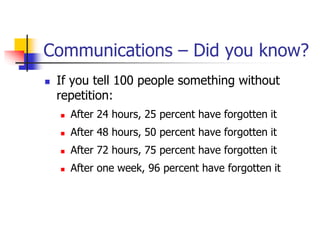
Communications – Did you know?
 If you tell 100 people something without
repetition:
 After 24 hours, 25 percent have forgotten it
 After 48 hours, 50 percent have forgotten it
 After 72 hours, 75 percent have forgotten it
 After one week, 96 percent have forgotten it
Barriers to communication
 What are barriers to communication
that exist in any work setting?
Take a few moments to
write down some of
your thoughts…
Barriers to communication
 Some common barriers to interpersonal
communication include:
 Unclear process: The receiver and sender may not share
the same language, slang, jargon, vocabulary, symbols
 Chain of command: There may be too many layers that a
message passes through between sender and receiver
 Large size of an organization, geographic
distance: Large numbers of receivers require good message
sending methods
 Personal limitations: Physical and mental disabilities,
and differences in intelligence and education may interfere with
mutual understanding
Barriers to communication
 Additional common barriers to interpersonal communication include:
 Human nature: Peoples’ egos, prejudices, and traditions can get in
the way
 Conflicting feelings, goals, opinions: If people feel on opposite
sides of an issue they may not share
 Power: The idea that knowledge is power can lead to information
hoarding
 Improper timing – Is the boss distracted today?
 Selective Perception – receiver hears message based on his/her
interests, needs, motivations, experience, background and other
personal characteristics.
 Defensiveness – response when receiver interprets message as
threatening
 and other ideas you may have thought of
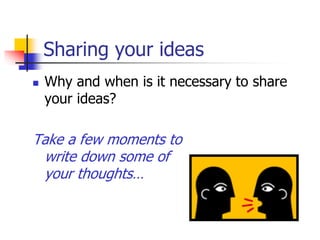
Sharing your ideas
 Why and when is it necessary to share
your ideas?
Take a few moments to
write down some of
your thoughts…
Share your ideas to…
 State an opinion or position
 Give instructions or directions
 Announce a change
 Make presentations
 Participate in meetings
 Give information in emergencies
 Communicate the organizational mission,
vision, and values
Obstacles to sharing ideas
 What can make sharing ideas difficult?
Take a few moments to
write down some of
your thoughts…
Obstacles to sharing ideas…
 Your own shyness
 Fear of rejection
 Peer pressure
 Unorganized thinking
 Others possibly becoming defensive
 Physical disabilities (impaired sight, hearing, speech)
 Having to deal with aggressive people
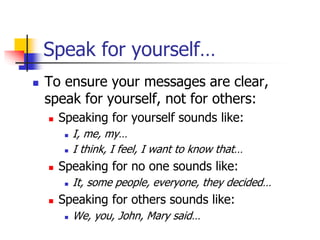
Speak for yourself…
 To ensure your messages are clear,
speak for yourself, not for others:
 Speaking for yourself sounds like:
 I, me, my…
 I think, I feel, I want to know that…
 Speaking for no one sounds like:
 It, some people, everyone, they decided…
 Speaking for others sounds like:
 We, you, John, Mary said…
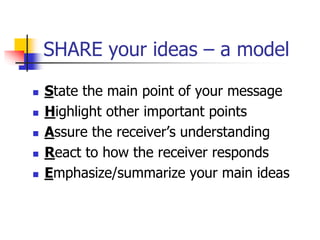
SHARE your ideas – a model
 State the main point of your message
 Highlight other important points
 Assure the receiver’s understanding
 React to how the receiver responds
 Emphasize/summarize your main ideas
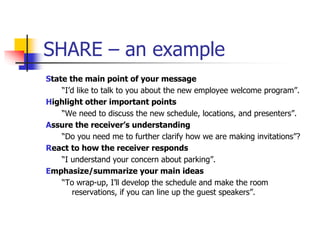
SHARE – an example
State the main point of your message
“I’d like to talk to you about the new employee welcome program”.
Highlight other important points
“We need to discuss the new schedule, locations, and presenters”.
Assure the receiver’s understanding
“Do you need me to further clarify how we are making invitations”?
React to how the receiver responds
“I understand your concern about parking”.
Emphasize/summarize your main ideas
“To wrap-up, I’ll develop the schedule and make the room
reservations, if you can line up the guest speakers”.
Getting good information
 Why is it necessary to get good
information from others?
Take a few moments to
write down some of
your thoughts…
Get good information to…
 Find out facts and details
 Get directions or instructions
 Try to understand another’s point of view
 Help someone solve a problem
 Resolve a team conflict
 Solve work problems
Obstacles to getting good
information
 What can make getting good
information difficult?
Take a few moments to
write down some of
your thoughts…
Obstacles to getting good
information
 Lack of trust
 Assuming you already know it all
 Jumping to conclusions
 Not valuing diverse opinions
 Weak reading skills
 Weak listening skills
 Weak questioning skills
 and other ideas you may have thought of
The power of listening
The philosopher Epictetus stressed the
power of listening in this quote:
“Nature gave us one tongue and two
ears so we could hear twice as much
as we speak.”
Listen actively
 Prepare to listen by focusing on the speaker
 Control and eliminate distractions so that you
can focus on the message. Don’t do anything else
(writing, reading, email) but listen
 Establish appropriate eye contact to show
interest
 See listening as an opportunity to get
information, share another’s views, and broaden
your own knowledge
Listen actively
 Create a need to listen by thinking about what
you can learn from the speaker
 Set aside the time to listen so that you won’t feel
rushed or become distracted by other responsibilities
 Don’t prejudge the message based on who is
delivering it. Focus instead on the content of the
message.
 Monitor the way you listen by asking yourself
questions such as “Did I really pay attention or was I
thinking about what I was going to say next”? “Was
there information I missed because I allowed myself
to become distracted”?
That’s a good question!
 Close end questions limit the answer to yes or no
 Open end questions allow the responder total
freedom in answering
 Direct questions ask for specific information; limit
answers to brief fact statements
 Probing questions follow up other questions to
solicit additional information
 Hypothetical questions present a theoretical
situation to which receiver responds
See examples of each on the next slide…
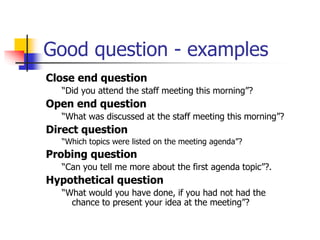
Good question - examples
Close end question
“Did you attend the staff meeting this morning”?
Open end question
“What was discussed at the staff meeting this morning”?
Direct question
“Which topics were listed on the meeting agenda”?
Probing question
“Can you tell me more about the first agenda topic”?.
Hypothetical question
“What would you have done, if you had not had the
chance to present your idea at the meeting”?
Exercise - Listening
Who are the people it’s easiest to listen to
What is it about these people that makes it easier to listen to
them?
Who are the people you listen to least? What is it about them that
makes it difficult to listen to them?
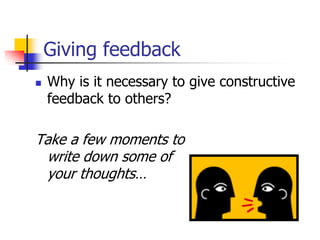
Giving feedback
 Why is it necessary to give constructive
feedback to others?
Take a few moments to
write down some of
your thoughts…
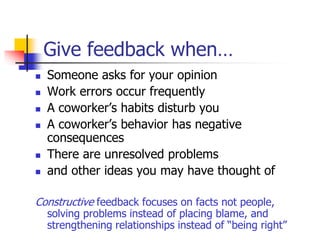
Give feedback when…
 Someone asks for your opinion
 Work errors occur frequently
 A coworker’s habits disturb you
 A coworker’s behavior has negative
consequences
 There are unresolved problems
 and other ideas you may have thought of
Constructive feedback focuses on facts not people,
solving problems instead of placing blame, and
strengthening relationships instead of “being right”
Obstacles to giving
constructive feedback
 What makes it hard to give
constructive feedback?
Take a few moments to
write down some of
your thoughts…
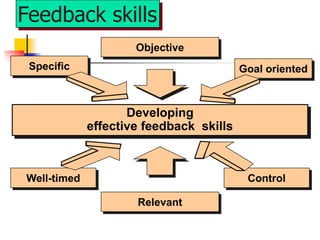
Feedback skills
Developing
effective feedback skills
Objective
Specific Goal oriented
Relevant
Well-timed Control
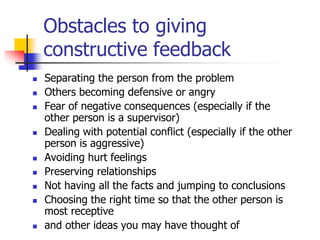
Obstacles to giving
constructive feedback
 Separating the person from the problem
 Others becoming defensive or angry
 Fear of negative consequences (especially if the
other person is a supervisor)
 Dealing with potential conflict (especially if the other
person is aggressive)
 Avoiding hurt feelings
 Preserving relationships
 Not having all the facts and jumping to conclusions
 Choosing the right time so that the other person is
most receptive
 and other ideas you may have thought of
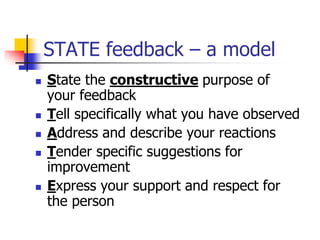
STATE feedback – a model
 State the constructive purpose of
your feedback
 Tell specifically what you have observed
 Address and describe your reactions
 Tender specific suggestions for
improvement
 Express your support and respect for
the person
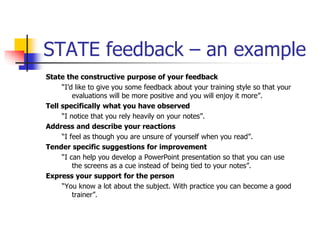
STATE feedback – an example
State the constructive purpose of your feedback
“I’d like to give you some feedback about your training style so that your
evaluations will be more positive and you will enjoy it more”.
Tell specifically what you have observed
“I notice that you rely heavily on your notes”.
Address and describe your reactions
“I feel as though you are unsure of yourself when you read”.
Tender specific suggestions for improvement
“I can help you develop a PowerPoint presentation so that you can use
the screens as a cue instead of being tied to your notes”.
Express your support for the person
“You know a lot about the subject. With practice you can become a good
trainer”.
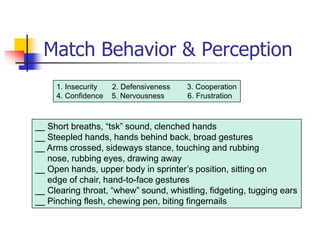
Match Behavior & Perception
1. Insecurity 2. Defensiveness 3. Cooperation
4. Confidence 5. Nervousness 6. Frustration
Short breaths, “tsk” sound, clenched hands
Steepled hands, hands behind back, broad gestures
Arms crossed, sideways stance, touching and rubbing
nose, rubbing eyes, drawing away
Open hands, upper body in sprinter’s position, sitting on
edge of chair, hand-to-face gestures
Clearing throat, “whew” sound, whistling, fidgeting, tugging ears
Pinching flesh, chewing pen, biting fingernails
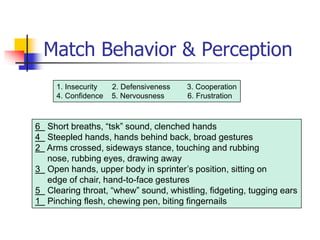
Match Behavior & Perception
1. Insecurity 2. Defensiveness 3. Cooperation
4. Confidence 5. Nervousness 6. Frustration
6 Short breaths, “tsk” sound, clenched hands
4 Steepled hands, hands behind back, broad gestures
2 Arms crossed, sideways stance, touching and rubbing
nose, rubbing eyes, drawing away
3 Open hands, upper body in sprinter’s position, sitting on
edge of chair, hand-to-face gestures
5 Clearing throat, “whew” sound, whistling, fidgeting, tugging ears
1 Pinching flesh, chewing pen, biting fingernails
BODY LANGUAGE
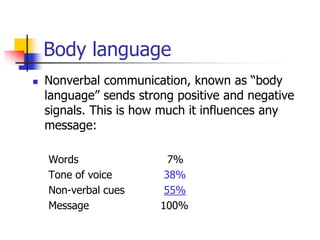
Body language
 Nonverbal communication, known as “body
language” sends strong positive and negative
signals. This is how much it influences any
message:
Words 7%
Tone of voice 38%
Non-verbal cues 55%
Message 100%
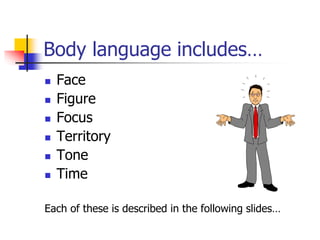
Body language includes…
 Face
 Figure
 Focus
 Territory
 Tone
 Time
Each of these is described in the following slides…
Body language - face
 Face includes:
 Your expressions
 Your smile or lack thereof
 Tilt of the head; e.g., if your head is tilted
to one side, it usually indicates you are
interested in what someone is saying
What message are you sending if someone is
presenting a new idea and you are frowning?
Body language - figure
 Figure includes:
 Your posture
 Your demeanor and gestures
 Your clothes and accessories such as
jewelry
What message are you sending if you are dressed
casually at an important meeting?
Body language - focus
 Focus is your eye contact with others
 The perception of eye contact differs by
culture. For most Americans…
 Staring makes other people uncomfortable
 Lack of eye contact can make you appear weak or
not trustworthy
 Glasses may interfere or enhance eye contact
What message are you sending if you are looking at
other things and people in a room when someone
is speaking to you?
Body language - territory
 Territory focuses on how you use
space. It is also called proxemics.
 The perception of territory differs by culture.
Most Americans are comfortable with an
individual space that is about an arm’s length
in diameter
What message are you sending if you keep moving
closer to a person who is backing away from you?
Body language - tone
 Tone is a factor of your voice
 Pitch is the highness or lowness of voice
 Volume is how loud your voice is
 Emphasis is your inflection
What message are you sending if during a
disagreement you start speaking very loudly?
Body language - time
 Time focuses on how you use time.
It is also called chronemics.
 Pace is how quickly you speak
 Response is how quickly you move
 Punctuality is your timeliness
What message are you sending if you are
consistently late for meetings?
Ideas to walk away with…
 People are always communicating
 The meaning intended by the sender is
never exactly the message gotten by
the receiver
 We can help to overcome barriers to
communication by being aware of them
 Verbal and non-verbal communication is
important in sending our messages
Test yourself…
1. Communication is defined as the interchange of thoughts or
opinions through shared symbols.
True___ False___
2. The four facets of interpersonal communication are sender,
receiver, information, and behavior.
True___ False___
3. Unclear process; chain of command; large size of an
organization or geographic distance; personal limitations;
human nature; conflicting feelings, goals, opinions; and
power are examples of barriers to communication.
True___ False___
Test yourself
4. Describe the steps of the SHARE model for giving good
information – share, highlight, assure, react, emphasize:
5. Describe the steps of the FOCUS model for getting good
information – focus, open end, close end, use, summarize:
6. Describe the steps of the STATE model for giving constructive
feedback – state, tell, address, tender, express:
7. Describe the the six aspects of non-verbal communication (body
language):
Test yourself… - answers
1. Communication is defined as the interchange of thoughts or
opinions through shared symbols.
True
2. The four facets of interpersonal communication are sender,
receiver, information, and behavior.
True
3. Unclear process; chain of command; large size of an
organization or geographic distance; personal limitations;
human nature; conflicting feelings, goals, opinions; power are
examples of barriers to communication.
True
Test yourself… - answers
4. The steps of the SHARE model for giving good information are:
 State the main point of your message
 Highlight other important points
 Assure the receiver’s understanding
 React to how the receiver responds
 Emphasize/summarize your main ideas
5. The steps of the FOCUS model for getting good information are:
 Focus the discussion on the specific information you need
 Open-end question to expand the discussion
 Close-end question to get specifics
 Use active listening skills to understand what you are hearing
 Summarize and close the discussion
Test yourself… - answers
6. The steps of the STATE model for constructive feedback are:
 State the constructive purpose of your feedback
 Tell specifically what you have observed
 Address and describe your reactions
 Tender specific suggestions for improvement
 Express your support for the person
7. The the six aspects of non-verbal communication (body language):
 Face – expressions, smile, tilt of head
 Figure – posture, demeanor, gestures, dress
 Focus – eye contact
 Territory – use of space
 Tone – voice pitch, volume, emphasis
 Time – the use time
Apply what you’ve learned
 When you started this program we asked you
to consider some questions. Let’s wrap up:
 What new things did you learn about interpersonal
communication?
 Did you meet your learning goals for this
program?
 Did you meet your supervisor’s expectations, if
any, for participation in this training?
 How will you be able to apply your learning on the
job?
What’s next?
 We hope you have enjoyed this program as an
overview of the basic verbal and non-verbal
communication skills needed in the workplace.
 The Professional Development Program offers
classroom sessions on this and other topics which
include numerous individual and group exercises to
enhance your learning.
 Please visit our web site http://uhr.rutgers.edu/profdev
to enroll or obtain more information.
THANK YOU

Effec_Comm_for_web11111111111111111111111111111111.ppt

  • 1.
    The Basics ofEffective Interpersonal Communication BY SUSHILA BAHL
  • 2.
    Have you evermet someone with whom you just could not communicate? A person who, for some reason, seems to bristle upon our approach, leaving communication as we know it completely out of the question?
  • 3.
    Have you everbeen misunderstood by someone? Have you ever said or did something, with pure motives and good intentions, which was misinterpreted?
  • 4.
    Which is moreimportant in social interactions and interpersonal relationships? The actual behavior or the motivation behind the behavior?
  • 5.
    No matter howimportant our motives are, people read us by what they see and hear not by what we want them to see and hear
  • 6.
    Our ability tounderstand how people see and hear us is critical to effective communications
  • 7.
    English is acrazy language  There is no egg in eggplant; neither apple nor pine in pineapple.  English muffins weren't invented in England or French fries in France.  If the plural of tooth is teeth, why isn't the plural of booth beeth?  One goose, 2 geese. So one moose, 2 meese?  Doesn't it seem crazy that you can make amends but not one amend
  • 8.
    Communication  Efficient communicationis ESSENTIAL to being successful in life.  The biggest source of interpersonal problems is poor communications.  The key to the communication process is to be UNDERSTOOD.
  • 9.
    Communication  ‘Among personalqualities possessed by college graduates the ability to communicate effectively was ranked first by employers.’
  • 10.
    Before you begin… What do I already know about interpersonal communication?  What are my learning goals for this program?  How do I think I will be able to apply my learning on the job?
  • 11.
    Course Content  Thisprogram will cover:  What communication is  Why and how we communicate  Barriers to communication  Sharing ideas  Getting information from others  Giving constructive feedback  Body language
  • 12.
    Course Objectives  Theobjectives of this program are to:  provide a basic overview of verbal and non-verbal interpersonal communication processes  identify personal obstacles to effective interpersonal communication  define some strategies for improving individual and group communications
  • 13.
    What is communication? What do you think communication is? How would you define it? Take a few moments to write down some of your thoughts…
  • 14.
    Communication  Communication isdefined as the interchange of thoughts or opinions through shared symbols; e.g. language, words, phrases  Communication is a process of coding & decoding messages.  Derived from the Latin word “communis” which means to share i.e sharing of ideas , concepts, feelings & emotions.
  • 15.
    Four facets ofcommunication  Three are four facets in all types of communication:  Sender  Receiver  Information  Behavior
  • 16.
    Basic Elements Of Communication Sender / Encoder / Speaker  Receiver/ Decoder / Listener  Message  Medium / Channel  Feedback
  • 17.
    Four facets ofcommunication  In any communication:  The Sender is the person trying to communicate a message  The Receiver is the person at whom the message is directed  A message is sent to convey information  Information is meant to change behavior
  • 18.
    The Communication Process– The Transmission Model Noise Feedback Noise Sender Encoding Channel Decoding Receiver Noise Noise Feedback
  • 19.
    Types of NOISE Channel Noise - External interference in the communication process.  Semantic Noise - Message gets through as sent but is not understandable to the receiver.  Psychological Noise - Internal factors that lead to misunderstandings in the communication process.
  • 20.
  • 21.
    Shared symbols  Sometimeswhen we communicate we assume we are using shared symbols when we might not be  Think about the term “asap”, “as soon as possible”. What does it really mean?  Think about how the meaning might change in the situations on the next slide…
  • 22.
    Shared symbols  Howmight your meaning of “asap” change in these situations?…  Someone from another department calls. He needs some detailed information asap; but you are already rather busy.  A coworker comes to you for help with an assignment. She needs you asap; but you have another job to finish before lunch.  Your immediate supervisor, whom you like to please, asks you to type a memo for her asap; but you already have a stack of other jobs to finish.
  • 23.
    Shared symbols  Someonefrom another department calls. He needs some detailed information asap; but you are already rather busy.  In this situation, you might interpret “asap” as “when I have finished all of my own work and have a chance to get to it. It might be tomorrow or the next day.”
  • 24.
    Shared symbols  Acoworker comes to you for help with an assignment. She needs you asap; but you have another job to finish before lunch.  In this situation, you might interpret “asap” as “after I have finished my own work, I will help out after lunch”.
  • 25.
    Shared symbols  Yourimmediate supervisor, whom you like to please, asks you to type a memo for her asap; but you already have a stack of other jobs to finish.  In this situation, you might interpret “asap” as “I’ll do this now and finish my other work afterwards”.
  • 26.
    Shared symbols  Inthe previous examples, we’ve seen the meaning of “asap” change from “in a few days” to “immediately”.  Many other words and phrases are also vague and have different meanings for different people.  Shared symbols are not always completely shared. The message intended is not always the message received.
  • 27.
    Missed communication As Purchasing orderedit. As the Art Dept. designed it. As the Supervisor implemented it. As the Manager Requested it. As Marketing wrote it up. What the Employee really wanted!
  • 28.
  • 29.
    Why does Communication fail? Weneed to hire 10 more salespersons We need 10 more in sales Increase sales by 10 We’ll have to increase profit by 10 If we are going to increase profits, we’ll have to cut costs. We’ll have to cut 10 sales people %$&* @#
  • 30.
    Why do wecommunicate?  What do you think? Take a few moments to write down some of your thoughts…
  • 31.
    Why we communicate •We communicate to: • Share our ideas and opinions • Provide feedback to others • Get information from others • Gain power and influence • Develop social relationships • Maintain self-expression and our culture • and other ideas you may have thought of
  • 32.
    How do wecommunicate?  Think of the many ways in which you communicate… Take a few moments to write down some of your thoughts…
  • 33.
    How we communicate We communicate and build interpersonal relationships through:  Speech  Writing  Listening  Non-verbal language  Music, art, and crafts
  • 34.
    Choosing your medium Depending upon the situation, one method of communication may be better than another.  In person: one-to-one  In person: meetings, small groups  In person: presentations, large groups  Letter  Memo  Note  Email  Voice mail
  • 35.
    Choosing your medium To determine the best medium for your message determine:  What you as the sender need to achieve  What the receiver needs to know. What the receiver wants to know  How detailed, important, and or personal the information in the message is  Which behavior you want to influence and how
  • 36.
    Choosing your medium How would you communicate…  an organizational change in your unit  the introduction of a new employee  a change in someone’s job duties  a reprimand  notice of a meeting Take a few moments to write down some of your thoughts…
  • 37.
    Choosing your medium The best way to communicate…  an organizational change in your unit by memo and small group meetings  the introduction of a new employee by group and one-on-one meetings  a change in someone’s job duties by memo and one-on-one meeting  a reprimand in a one-on-one private meeting  notice of a meeting by memo and email
  • 38.
    Difference between oraland written communication  Oral communication – interactive, fluid, brief, non-restrictive in place, immediate feedback.  Written Communication - non Interactive, restrictive in place, feedback not immediate, longer with respect to time.
  • 39.
    Communication network inan Organization (Internal)  Internal – Formal & Informal  Vertical  Horizontal  Diagonal
  • 40.
    External Communication External customers(can be written or oral)  Advertising  Media  Public Relations  Presentations  Negotiations  Mails  Telegrams  Letters
  • 41.
    Communication  Communication occursin three directions in organizations  Upward communications  Downward communications  Lateral communications
  • 42.
    I Heard Iton the Grapevine  The grapevine is an informal communication network within an organization.  Research reflects that about 75 % of the communication in the grapevine is accurate.
  • 43.
    Communications – Didyou know?  People remember:  10 percent of what they read  20 percent of what they hear  30 percent of what they see  50 percent of what they see and hear  80 percent of what they say  90 percent of what they say and do
  • 44.
    Communications – Didyou know?  If you tell 100 people something without repetition:  After 24 hours, 25 percent have forgotten it  After 48 hours, 50 percent have forgotten it  After 72 hours, 75 percent have forgotten it  After one week, 96 percent have forgotten it
  • 45.
    Barriers to communication What are barriers to communication that exist in any work setting? Take a few moments to write down some of your thoughts…
  • 46.
    Barriers to communication Some common barriers to interpersonal communication include:  Unclear process: The receiver and sender may not share the same language, slang, jargon, vocabulary, symbols  Chain of command: There may be too many layers that a message passes through between sender and receiver  Large size of an organization, geographic distance: Large numbers of receivers require good message sending methods  Personal limitations: Physical and mental disabilities, and differences in intelligence and education may interfere with mutual understanding
  • 47.
    Barriers to communication Additional common barriers to interpersonal communication include:  Human nature: Peoples’ egos, prejudices, and traditions can get in the way  Conflicting feelings, goals, opinions: If people feel on opposite sides of an issue they may not share  Power: The idea that knowledge is power can lead to information hoarding  Improper timing – Is the boss distracted today?  Selective Perception – receiver hears message based on his/her interests, needs, motivations, experience, background and other personal characteristics.  Defensiveness – response when receiver interprets message as threatening  and other ideas you may have thought of
  • 48.
    Sharing your ideas Why and when is it necessary to share your ideas? Take a few moments to write down some of your thoughts…
  • 49.
    Share your ideasto…  State an opinion or position  Give instructions or directions  Announce a change  Make presentations  Participate in meetings  Give information in emergencies  Communicate the organizational mission, vision, and values
  • 50.
    Obstacles to sharingideas  What can make sharing ideas difficult? Take a few moments to write down some of your thoughts…
  • 51.
    Obstacles to sharingideas…  Your own shyness  Fear of rejection  Peer pressure  Unorganized thinking  Others possibly becoming defensive  Physical disabilities (impaired sight, hearing, speech)  Having to deal with aggressive people
  • 52.
    Speak for yourself… To ensure your messages are clear, speak for yourself, not for others:  Speaking for yourself sounds like:  I, me, my…  I think, I feel, I want to know that…  Speaking for no one sounds like:  It, some people, everyone, they decided…  Speaking for others sounds like:  We, you, John, Mary said…
  • 53.
    SHARE your ideas– a model  State the main point of your message  Highlight other important points  Assure the receiver’s understanding  React to how the receiver responds  Emphasize/summarize your main ideas
  • 54.
    SHARE – anexample State the main point of your message “I’d like to talk to you about the new employee welcome program”. Highlight other important points “We need to discuss the new schedule, locations, and presenters”. Assure the receiver’s understanding “Do you need me to further clarify how we are making invitations”? React to how the receiver responds “I understand your concern about parking”. Emphasize/summarize your main ideas “To wrap-up, I’ll develop the schedule and make the room reservations, if you can line up the guest speakers”.
  • 55.
    Getting good information Why is it necessary to get good information from others? Take a few moments to write down some of your thoughts…
  • 56.
    Get good informationto…  Find out facts and details  Get directions or instructions  Try to understand another’s point of view  Help someone solve a problem  Resolve a team conflict  Solve work problems
  • 57.
    Obstacles to gettinggood information  What can make getting good information difficult? Take a few moments to write down some of your thoughts…
  • 58.
    Obstacles to gettinggood information  Lack of trust  Assuming you already know it all  Jumping to conclusions  Not valuing diverse opinions  Weak reading skills  Weak listening skills  Weak questioning skills  and other ideas you may have thought of
  • 59.
    The power oflistening The philosopher Epictetus stressed the power of listening in this quote: “Nature gave us one tongue and two ears so we could hear twice as much as we speak.”
  • 60.
    Listen actively  Prepareto listen by focusing on the speaker  Control and eliminate distractions so that you can focus on the message. Don’t do anything else (writing, reading, email) but listen  Establish appropriate eye contact to show interest  See listening as an opportunity to get information, share another’s views, and broaden your own knowledge
  • 61.
    Listen actively  Createa need to listen by thinking about what you can learn from the speaker  Set aside the time to listen so that you won’t feel rushed or become distracted by other responsibilities  Don’t prejudge the message based on who is delivering it. Focus instead on the content of the message.  Monitor the way you listen by asking yourself questions such as “Did I really pay attention or was I thinking about what I was going to say next”? “Was there information I missed because I allowed myself to become distracted”?
  • 62.
    That’s a goodquestion!  Close end questions limit the answer to yes or no  Open end questions allow the responder total freedom in answering  Direct questions ask for specific information; limit answers to brief fact statements  Probing questions follow up other questions to solicit additional information  Hypothetical questions present a theoretical situation to which receiver responds See examples of each on the next slide…
  • 63.
    Good question -examples Close end question “Did you attend the staff meeting this morning”? Open end question “What was discussed at the staff meeting this morning”? Direct question “Which topics were listed on the meeting agenda”? Probing question “Can you tell me more about the first agenda topic”?. Hypothetical question “What would you have done, if you had not had the chance to present your idea at the meeting”?
  • 64.
    Exercise - Listening Whoare the people it’s easiest to listen to What is it about these people that makes it easier to listen to them? Who are the people you listen to least? What is it about them that makes it difficult to listen to them?
  • 65.
    Giving feedback  Whyis it necessary to give constructive feedback to others? Take a few moments to write down some of your thoughts…
  • 66.
    Give feedback when… Someone asks for your opinion  Work errors occur frequently  A coworker’s habits disturb you  A coworker’s behavior has negative consequences  There are unresolved problems  and other ideas you may have thought of Constructive feedback focuses on facts not people, solving problems instead of placing blame, and strengthening relationships instead of “being right”
  • 67.
    Obstacles to giving constructivefeedback  What makes it hard to give constructive feedback? Take a few moments to write down some of your thoughts…
  • 68.
    Feedback skills Developing effective feedbackskills Objective Specific Goal oriented Relevant Well-timed Control
  • 69.
    Obstacles to giving constructivefeedback  Separating the person from the problem  Others becoming defensive or angry  Fear of negative consequences (especially if the other person is a supervisor)  Dealing with potential conflict (especially if the other person is aggressive)  Avoiding hurt feelings  Preserving relationships  Not having all the facts and jumping to conclusions  Choosing the right time so that the other person is most receptive  and other ideas you may have thought of
  • 70.
    STATE feedback –a model  State the constructive purpose of your feedback  Tell specifically what you have observed  Address and describe your reactions  Tender specific suggestions for improvement  Express your support and respect for the person
  • 71.
    STATE feedback –an example State the constructive purpose of your feedback “I’d like to give you some feedback about your training style so that your evaluations will be more positive and you will enjoy it more”. Tell specifically what you have observed “I notice that you rely heavily on your notes”. Address and describe your reactions “I feel as though you are unsure of yourself when you read”. Tender specific suggestions for improvement “I can help you develop a PowerPoint presentation so that you can use the screens as a cue instead of being tied to your notes”. Express your support for the person “You know a lot about the subject. With practice you can become a good trainer”.
  • 72.
    Match Behavior &Perception 1. Insecurity 2. Defensiveness 3. Cooperation 4. Confidence 5. Nervousness 6. Frustration Short breaths, “tsk” sound, clenched hands Steepled hands, hands behind back, broad gestures Arms crossed, sideways stance, touching and rubbing nose, rubbing eyes, drawing away Open hands, upper body in sprinter’s position, sitting on edge of chair, hand-to-face gestures Clearing throat, “whew” sound, whistling, fidgeting, tugging ears Pinching flesh, chewing pen, biting fingernails
  • 73.
    Match Behavior &Perception 1. Insecurity 2. Defensiveness 3. Cooperation 4. Confidence 5. Nervousness 6. Frustration 6 Short breaths, “tsk” sound, clenched hands 4 Steepled hands, hands behind back, broad gestures 2 Arms crossed, sideways stance, touching and rubbing nose, rubbing eyes, drawing away 3 Open hands, upper body in sprinter’s position, sitting on edge of chair, hand-to-face gestures 5 Clearing throat, “whew” sound, whistling, fidgeting, tugging ears 1 Pinching flesh, chewing pen, biting fingernails
  • 74.
  • 75.
    Body language  Nonverbalcommunication, known as “body language” sends strong positive and negative signals. This is how much it influences any message: Words 7% Tone of voice 38% Non-verbal cues 55% Message 100%
  • 76.
    Body language includes… Face  Figure  Focus  Territory  Tone  Time Each of these is described in the following slides…
  • 77.
    Body language -face  Face includes:  Your expressions  Your smile or lack thereof  Tilt of the head; e.g., if your head is tilted to one side, it usually indicates you are interested in what someone is saying What message are you sending if someone is presenting a new idea and you are frowning?
  • 78.
    Body language -figure  Figure includes:  Your posture  Your demeanor and gestures  Your clothes and accessories such as jewelry What message are you sending if you are dressed casually at an important meeting?
  • 79.
    Body language -focus  Focus is your eye contact with others  The perception of eye contact differs by culture. For most Americans…  Staring makes other people uncomfortable  Lack of eye contact can make you appear weak or not trustworthy  Glasses may interfere or enhance eye contact What message are you sending if you are looking at other things and people in a room when someone is speaking to you?
  • 80.
    Body language -territory  Territory focuses on how you use space. It is also called proxemics.  The perception of territory differs by culture. Most Americans are comfortable with an individual space that is about an arm’s length in diameter What message are you sending if you keep moving closer to a person who is backing away from you?
  • 81.
    Body language -tone  Tone is a factor of your voice  Pitch is the highness or lowness of voice  Volume is how loud your voice is  Emphasis is your inflection What message are you sending if during a disagreement you start speaking very loudly?
  • 82.
    Body language -time  Time focuses on how you use time. It is also called chronemics.  Pace is how quickly you speak  Response is how quickly you move  Punctuality is your timeliness What message are you sending if you are consistently late for meetings?
  • 83.
    Ideas to walkaway with…  People are always communicating  The meaning intended by the sender is never exactly the message gotten by the receiver  We can help to overcome barriers to communication by being aware of them  Verbal and non-verbal communication is important in sending our messages
  • 84.
    Test yourself… 1. Communicationis defined as the interchange of thoughts or opinions through shared symbols. True___ False___ 2. The four facets of interpersonal communication are sender, receiver, information, and behavior. True___ False___ 3. Unclear process; chain of command; large size of an organization or geographic distance; personal limitations; human nature; conflicting feelings, goals, opinions; and power are examples of barriers to communication. True___ False___
  • 85.
    Test yourself 4. Describethe steps of the SHARE model for giving good information – share, highlight, assure, react, emphasize: 5. Describe the steps of the FOCUS model for getting good information – focus, open end, close end, use, summarize: 6. Describe the steps of the STATE model for giving constructive feedback – state, tell, address, tender, express: 7. Describe the the six aspects of non-verbal communication (body language):
  • 86.
    Test yourself… -answers 1. Communication is defined as the interchange of thoughts or opinions through shared symbols. True 2. The four facets of interpersonal communication are sender, receiver, information, and behavior. True 3. Unclear process; chain of command; large size of an organization or geographic distance; personal limitations; human nature; conflicting feelings, goals, opinions; power are examples of barriers to communication. True
  • 87.
    Test yourself… -answers 4. The steps of the SHARE model for giving good information are:  State the main point of your message  Highlight other important points  Assure the receiver’s understanding  React to how the receiver responds  Emphasize/summarize your main ideas 5. The steps of the FOCUS model for getting good information are:  Focus the discussion on the specific information you need  Open-end question to expand the discussion  Close-end question to get specifics  Use active listening skills to understand what you are hearing  Summarize and close the discussion
  • 88.
    Test yourself… -answers 6. The steps of the STATE model for constructive feedback are:  State the constructive purpose of your feedback  Tell specifically what you have observed  Address and describe your reactions  Tender specific suggestions for improvement  Express your support for the person 7. The the six aspects of non-verbal communication (body language):  Face – expressions, smile, tilt of head  Figure – posture, demeanor, gestures, dress  Focus – eye contact  Territory – use of space  Tone – voice pitch, volume, emphasis  Time – the use time
  • 89.
    Apply what you’velearned  When you started this program we asked you to consider some questions. Let’s wrap up:  What new things did you learn about interpersonal communication?  Did you meet your learning goals for this program?  Did you meet your supervisor’s expectations, if any, for participation in this training?  How will you be able to apply your learning on the job?
  • 90.
    What’s next?  Wehope you have enjoyed this program as an overview of the basic verbal and non-verbal communication skills needed in the workplace.  The Professional Development Program offers classroom sessions on this and other topics which include numerous individual and group exercises to enhance your learning.  Please visit our web site http://uhr.rutgers.edu/profdev to enroll or obtain more information.
  • 91.