BUSINESS
COMMUNICATION
BY:-KISHAN CHAUHAN
“You can have all the great
ideas in the world and if
you can’t communicate,
nobody will hear them.” -
Kara Blackburn
COMMUNICATION DEFINITION
• Derived from the Latin word "communis,"
meaning to share. Communication is the
exchange of thoughts, messages, or
information by speech, visuals, signals,
writing, or behaviour.
• “Communication is a process involving
the selection, production and
transmission of signs in such a way as to
help a receiver perceive a meaning similar
to that in the mind of the communicator.”
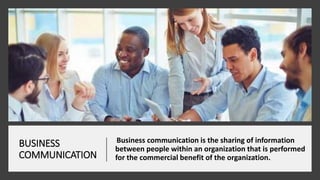
BUSINESS
COMMUNICATION
Business communication is the sharing of information
between people within an organization that is performed
for the commercial benefit of the organization.
IMPORTANCE
• In the professional world, communication and related skills decide a
person’s career curve - better the communication skills, higher are the
chances of touching the zenith of success.
• The new global and diverse workplace requires excellent spoken and
written communication skills!
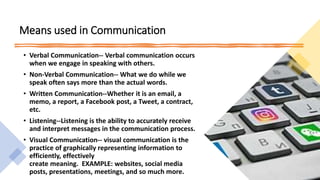
Means used in Communication
• Verbal Communication-- Verbal communication occurs
when we engage in speaking with others.
• Non-Verbal Communication-- What we do while we
speak often says more than the actual words.
• Written Communication--Whether it is an email, a
memo, a report, a Facebook post, a Tweet, a contract,
etc.
• Listening--Listening is the ability to accurately receive
and interpret messages in the communication process.
• Visual Communication-- visual communication is the
practice of graphically representing information to
efficiently, effectively
create meaning. EXAMPLE: websites, social media
posts, presentations, meetings, and so much more.
TYPES OF
COMMUNICATION
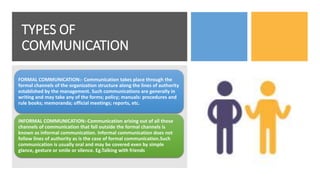
FORMAL COMMUNICATION:- Communication takes place through the
formal channels of the organization structure along the lines of authority
established by the management. Such communications are generally in
writing and may take any of the forms; policy; manuals: procedures and
rule books; memoranda; official meetings; reports, etc.
INFORMAL COMMUNICATION:-Communication arising out of all those
channels of communication that fall outside the formal channels is
known as informal communication. Informal communication does not
follow lines of authority as is the case of formal communication.Such
communication is usually oral and may be covered even by simple
glance, gesture or smile or silence. Eg.Talking with friends
FORMS OF
COMMUNICATION
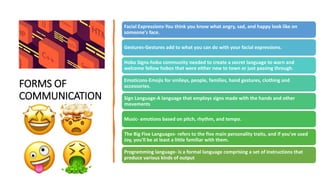
Facial Expressions-You think you know what angry, sad, and happy look like on
someone's face.
Gestures-Gestures add to what you can do with your facial expressions.
Hobo Signs-hobo community needed to create a secret language to warn and
welcome fellow hobos that were either new to town or just passing through.
Emoticons-Emojis for smileys, people, families, hand gestures, clothing and
accessories.
Sign Language-A language that employs signs made with the hands and other
movements
Music- emotions based on pitch, rhythm, and tempo.
The Big Five Languages- refers to the five main personality traits, and if you've used
Joy, you'll be at least a little familiar with them.
Programming language- is a formal language comprising a set of instructions that
produce various kinds of output
NETWORK OF
COMMUNICATION
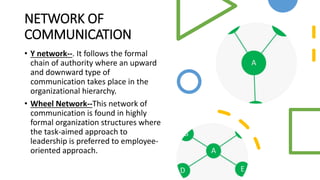
• Y network--. It follows the formal
chain of authority where an upward
and downward type of
communication takes place in the
organizational hierarchy.
• Wheel Network--This network of
communication is found in highly
formal organization structures where
the task-aimed approach to
leadership is preferred to employee-
oriented approach.
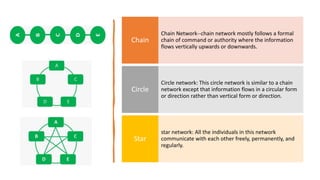
Chain Network--chain network mostly follows a formal
chain of command or authority where the information
flows vertically upwards or downwards.
Chain
Circle network: This circle network is similar to a chain
network except that information flows in a circular form
or direction rather than vertical form or direction.
Circle
star network: All the individuals in this network
communicate with each other freely, permanently, and
regularly.
Star
BARRIERS IN COMMUNICATION
1.Physical barriers--These are structural obstacles in natural or
manmade environments that prevent or block mobility (moving
around in the environment) or access.
2. Psychological barriers--These barriers are perception, homeostasis,
conformity and commitment, and personality factors. There are
different variations to perception. There is selective perception.
3. Semantic blocks—It refers to the misunderstanding between the
sender and receiver arising due to the different meanings of words,
and other symbols used in the communication.
4. Organizational Barriers—It refers to the hindrances in the flow of
information among the employees that might result in a commercial
failure of an organization.
ROLE IN BUSINESS WORLD
Improves employee engagement
Eliminates email overload
Increases employee productivity
Improves interdepartmental communications
Improves communication with remote workers
Reduces employee turnover
Improves knowledge sharing efforts
Improves customer satisfaction and retention
Builds a better company culture
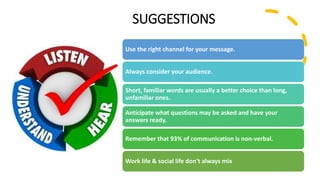
SUGGESTIONS
Use the right channel for your message.
Always consider your audience.
Short, familiar words are usually a better choice than long,
unfamiliar ones.
Anticipate what questions may be asked and have your
answers ready.
Remember that 93% of communication is non-verbal.
Work life & social life don’t always mix
BY:--KISHANCHAUHAN
(19/1072)
B.COM(H)
SEC-B

Business Communication

  • 1.
  • 2.
    “You can haveall the great ideas in the world and if you can’t communicate, nobody will hear them.” - Kara Blackburn
  • 3.
    COMMUNICATION DEFINITION • Derivedfrom the Latin word "communis," meaning to share. Communication is the exchange of thoughts, messages, or information by speech, visuals, signals, writing, or behaviour. • “Communication is a process involving the selection, production and transmission of signs in such a way as to help a receiver perceive a meaning similar to that in the mind of the communicator.”
  • 4.
    BUSINESS COMMUNICATION Business communication isthe sharing of information between people within an organization that is performed for the commercial benefit of the organization.
  • 5.
    IMPORTANCE • In theprofessional world, communication and related skills decide a person’s career curve - better the communication skills, higher are the chances of touching the zenith of success. • The new global and diverse workplace requires excellent spoken and written communication skills!
  • 6.
    Means used inCommunication • Verbal Communication-- Verbal communication occurs when we engage in speaking with others. • Non-Verbal Communication-- What we do while we speak often says more than the actual words. • Written Communication--Whether it is an email, a memo, a report, a Facebook post, a Tweet, a contract, etc. • Listening--Listening is the ability to accurately receive and interpret messages in the communication process. • Visual Communication-- visual communication is the practice of graphically representing information to efficiently, effectively create meaning. EXAMPLE: websites, social media posts, presentations, meetings, and so much more.
  • 7.
    TYPES OF COMMUNICATION FORMAL COMMUNICATION:-Communication takes place through the formal channels of the organization structure along the lines of authority established by the management. Such communications are generally in writing and may take any of the forms; policy; manuals: procedures and rule books; memoranda; official meetings; reports, etc. INFORMAL COMMUNICATION:-Communication arising out of all those channels of communication that fall outside the formal channels is known as informal communication. Informal communication does not follow lines of authority as is the case of formal communication.Such communication is usually oral and may be covered even by simple glance, gesture or smile or silence. Eg.Talking with friends
  • 8.
    FORMS OF COMMUNICATION Facial Expressions-Youthink you know what angry, sad, and happy look like on someone's face. Gestures-Gestures add to what you can do with your facial expressions. Hobo Signs-hobo community needed to create a secret language to warn and welcome fellow hobos that were either new to town or just passing through. Emoticons-Emojis for smileys, people, families, hand gestures, clothing and accessories. Sign Language-A language that employs signs made with the hands and other movements Music- emotions based on pitch, rhythm, and tempo. The Big Five Languages- refers to the five main personality traits, and if you've used Joy, you'll be at least a little familiar with them. Programming language- is a formal language comprising a set of instructions that produce various kinds of output
  • 9.
    NETWORK OF COMMUNICATION • Ynetwork--. It follows the formal chain of authority where an upward and downward type of communication takes place in the organizational hierarchy. • Wheel Network--This network of communication is found in highly formal organization structures where the task-aimed approach to leadership is preferred to employee- oriented approach.
  • 10.
    Chain Network--chain networkmostly follows a formal chain of command or authority where the information flows vertically upwards or downwards. Chain Circle network: This circle network is similar to a chain network except that information flows in a circular form or direction rather than vertical form or direction. Circle star network: All the individuals in this network communicate with each other freely, permanently, and regularly. Star
  • 11.
    BARRIERS IN COMMUNICATION 1.Physicalbarriers--These are structural obstacles in natural or manmade environments that prevent or block mobility (moving around in the environment) or access. 2. Psychological barriers--These barriers are perception, homeostasis, conformity and commitment, and personality factors. There are different variations to perception. There is selective perception. 3. Semantic blocks—It refers to the misunderstanding between the sender and receiver arising due to the different meanings of words, and other symbols used in the communication. 4. Organizational Barriers—It refers to the hindrances in the flow of information among the employees that might result in a commercial failure of an organization.
  • 12.
    ROLE IN BUSINESSWORLD Improves employee engagement Eliminates email overload Increases employee productivity Improves interdepartmental communications Improves communication with remote workers Reduces employee turnover Improves knowledge sharing efforts Improves customer satisfaction and retention Builds a better company culture
  • 13.
    SUGGESTIONS Use the rightchannel for your message. Always consider your audience. Short, familiar words are usually a better choice than long, unfamiliar ones. Anticipate what questions may be asked and have your answers ready. Remember that 93% of communication is non-verbal. Work life & social life don’t always mix
  • 14.