Setting Expectations

How to set performance expectations
with your team to achieve your goals!


          *Step 1 in the Managing
           Performance program
Learning Objectives
Take a look at the objectives for this module to see
what you will learn:

Define “performance management” and the
 supervisor’s role within it
Discuss how to set performance expectations with
 staff
Performance Management? What’s that?

Think for a moment about what this term might mean. What
are the elements of performance management? Click for a
definition.
So what? Why is performance management
 important for people and organizations?
Take a moment to think about the benefits, then click:
 Builds communication between the manager and
  employee—strengthens their relationship
 Provides opportunity to examine employee’s progress
  towards career goals—supports employee’s progress
 Helps employees understand how their performance
  contributes to our mission—produces meaningful
  measurements
 Develops future leaders of the organization
Performance Management is Everyone’s Responsibility

 It is a major responsibility of management to see that all of the
 people in the organization are successful. The company
 invested a considerable amount of time, money and resources
 in recruiting the employee.
Case study
Rebecca is having a hard time supervising Joe, a newly hired employee,
who said in his interview that he was very interested in learning more about
working with local governments and delivering technical services to
community members. Rebecca was excited to hear this because the
organization really needs help organizing and running the meetings and
workshops with local government officials and other stakeholders.
Unfortunately, whenever Rebecca requests his help with a workshop or
meeting, Joe is nowhere to be found or he says he will help but never
seems to complete the task. Instead of finishing the work he tells Rebecca
he will do, he seems too busy with other opportunities like researching the
latest technical innovations or improving his IT skills by working with the
organization’s systems.

What’s the issue here? What should Rebecca have done? What does she
need to do?
Setting Expectations
If you said that Rebecca needs to make sure that she clearly set
expectations with Joe, then that’s a very good idea. People do
better when they know exactly what results are needed and the
ways to get there. Mismatched performance expectations often
cause problems in our professional relationships, and require a
lot of time and resources to fix. Setting expectations is the very
first step in performance management. Rebecca can’t tell if Joe
has performance issues with the meetings and workshops if
she’s not sure he clearly understands what the organization
expects from him.
How to Set Expectations
     The 6 steps below are a process for setting expectations with your
     supervisees and other colleagues. If your own performance expectations
     aren’t clear, you can use this as a guide with your supervisor to better
     understand what the organization needs from you. Each step will be
     described in more detail in the rest of this module.
1.   Describe the job in terms of major outcomes and the link to the
     organization’s needs. (what is required of the job)
2.   Share expectations in terms of work style (how employees need to work
     with others to do what is required of the job)
3.   Identify what the employee needs/what the supervisor needs to do to
     maximize performance
4.   Establish priorities
5.   Check for understanding
6.   Establish progress checks
Describing the Job
The first step in setting expectations is to describe the job to the employee.
We need to feel that there is a greater value to what we do. We need to feel
that individual performance has an impact on the organization’s mission.
How does my role affect change? How does my supervisor’s role affect
change? And my team’s role? Sometimes that’s really hard to see when
you’re doing discrete tasks.

Answer this question: My work is key to ensuring the organization’s
success because… (get help from your supervisor and other colleagues to
answer) Consider the following to discuss with your supervisor/colleagues
how you contribute:
  Job description
  Team’s and organizations’ needs
  Performance Criteria: Respond to requests within 24 hours, offer
    visitors a cup of coffee, or keep complete files and update weekly
Sharing Work Styles
When setting expectations, it’s not only important to talk about the what we
do, but also how we expect to do it. What are the ground rules for
communication at the organization? What is your own/your
supervisor’s/your colleagues’ work styles?

Sample ground rules:
  Always let your team know if there is a problem, even if you have a
   solution, no one likes surprises
  Share concerns openly and look for solutions
  If you see your team member doing something well, tell them; if you
   see them doing something that isn’t helping them or the organization,
   tell them
 Sample work style questions:
  Do you have more energy in the morning or the evening?
  Do you like to think about issues by discussing in meetings or having
   quiet time alone?
  How do you prefer to plan your day?
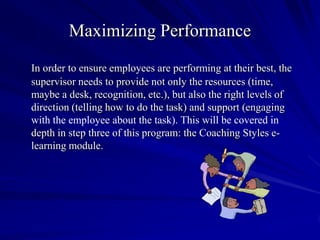
Maximizing Performance
In order to ensure employees are performing at their best, the
supervisor needs to provide not only the resources (time,
maybe a desk, recognition, etc.), but also the right levels of
direction (telling how to do the task) and support (engaging
with the employee about the task). This will be covered in
depth in step three of this program: the Coaching Styles e-
learning module.
Establishing Priorities
We all need to know when the organization’s or team’s
priorities shift. It can lead to confusion. What tasks need to be
done first? What situations come up that become priority #1?

To help you understand, speak with your supervisor and list
the major tasks and activities you are required to do then rank
them in terms of:
 Importance (1 = critical, 2 = required, 3 = when possible)
 Deadlines (1 = cannot miss, 2 = slight shift, 3 = flexible)

   Also consider the difficulty of the task and how it
   contributes to an employee’s professional development
Checking for Understanding
  When you’re having a conversation about expectations with
  your supervisor or supervisee, you’re covering a lot of details
  so you’ll need to review to make sure you both have a
  common understanding of the commitments you have made.
  Supervisors can ask open-ended questions (what, how, etc.) to
  see if the supervisee understands and closed-ended questions
  to make sure details are clear (Are you going to…?, etc.)

Examples:
    How do you plan to get started?
    Can you tell me the steps in the process to make sure you do it to our
     standards?
    What are your priorities and what can change them?
Reviewing Progress
No matter how careful you have been in setting expectations,
you’ll want to follow up since there will be questions as work
progresses.

Schedule an early progress check to get things started the right
way, and agree on scheduled/unscheduled further checks.
Acknowledge good performance and point out ways to
improve.
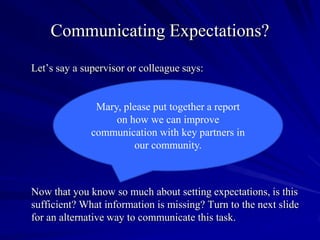
Communicating Expectations?
Let’s say a supervisor or colleague says:


               Mary, please put together a report
                   on how we can improve
              communication with key partners in
                       our community.


Now that you know so much about setting expectations, is this
sufficient? What information is missing? Turn to the next slide
for an alternative way to communicate this task.
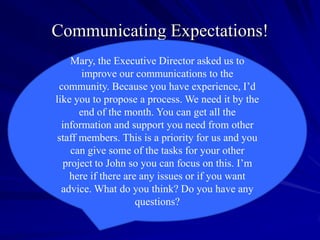
Communicating Expectations!
     Mary, the Executive Director asked us to
        improve our communications to the
 community. Because you have experience, I’d
like you to propose a process. We need it by the
       end of the month. You can get all the
  information and support you need from other
 staff members. This is a priority for us and you
     can give some of the tasks for your other
   project to John so you can focus on this. I’m
    here if there are any issues or if you want
  advice. What do you think? Do you have any
                     questions?
Now let’s have some fun…
To check what you have learned, let’s play
“What is the truth?” In each of the following
pages, you’ll get four statements. Choose the
one that is true! For the game, you need to use
the mouse to link on answers and instructions,
rather than turning the page.
WHAT IS THE TRUTH?
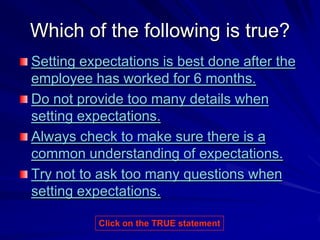
Which of the following is true?
Setting expectations is best done after the
employee has worked for 6 months.
Do not provide too many details when
setting expectations.
Always check to make sure there is a
common understanding of expectations.
Try not to ask too many questions when
setting expectations.

          Click on the TRUE statement
This Statement is NOT TRUE!

         Try Again
This Statement is TRUE!


           Click for next question
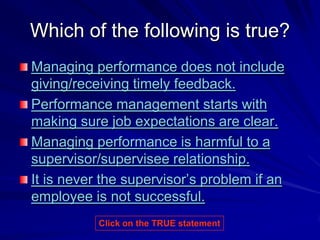
Which of the following is true?
Managing performance does not include
giving/receiving timely feedback.
Performance management starts with
making sure job expectations are clear.
Managing performance is harmful to a
supervisor/supervisee relationship.
It is never the supervisor’s problem if an
employee is not successful.
           Click on the TRUE statement
This Statement is NOT TRUE!

         Try Again
This Statement is TRUE!


           Click for next question
Which of the following is true?
 Employees need to know what tasks to do and
  how to communicate, appreciating work styles.
 Employees do not need to know how their work
  contributes to the organization’s results.
 Employees need to know what their team
  members’ performance problems are.
 Employees who have a work style different from
  the boss should try to change.


             Click on the TRUE statement
This Statement is NOT TRUE!

         Try Again
This Statement is TRUE!


           Click for next question
Which of the following is true?
 Conduct spontaneous progress checks.
 Set priorities primarily on an annual basis.
 Always check to make sure you and your
  supervisor/supervisee have a common
  understanding of expectations.
 We use only closed questions when checking for
  mutual understanding of expectations.


               Click on the TRUE statement
This Statement is NOT TRUE!

         Try Again
This Statement is TRUE!


           Click here next
Congratulations!
You have completed the e-learning module on
Setting Performance Expectations!

Setting expectations

  • 1.
    Setting Expectations How toset performance expectations with your team to achieve your goals! *Step 1 in the Managing Performance program
  • 2.
    Learning Objectives Take alook at the objectives for this module to see what you will learn: Define “performance management” and the supervisor’s role within it Discuss how to set performance expectations with staff
  • 3.
    Performance Management? What’sthat? Think for a moment about what this term might mean. What are the elements of performance management? Click for a definition.
  • 4.
    So what? Whyis performance management important for people and organizations? Take a moment to think about the benefits, then click:  Builds communication between the manager and employee—strengthens their relationship  Provides opportunity to examine employee’s progress towards career goals—supports employee’s progress  Helps employees understand how their performance contributes to our mission—produces meaningful measurements  Develops future leaders of the organization
  • 5.
    Performance Management isEveryone’s Responsibility It is a major responsibility of management to see that all of the people in the organization are successful. The company invested a considerable amount of time, money and resources in recruiting the employee.
  • 6.
    Case study Rebecca ishaving a hard time supervising Joe, a newly hired employee, who said in his interview that he was very interested in learning more about working with local governments and delivering technical services to community members. Rebecca was excited to hear this because the organization really needs help organizing and running the meetings and workshops with local government officials and other stakeholders. Unfortunately, whenever Rebecca requests his help with a workshop or meeting, Joe is nowhere to be found or he says he will help but never seems to complete the task. Instead of finishing the work he tells Rebecca he will do, he seems too busy with other opportunities like researching the latest technical innovations or improving his IT skills by working with the organization’s systems. What’s the issue here? What should Rebecca have done? What does she need to do?
  • 7.
    Setting Expectations If yousaid that Rebecca needs to make sure that she clearly set expectations with Joe, then that’s a very good idea. People do better when they know exactly what results are needed and the ways to get there. Mismatched performance expectations often cause problems in our professional relationships, and require a lot of time and resources to fix. Setting expectations is the very first step in performance management. Rebecca can’t tell if Joe has performance issues with the meetings and workshops if she’s not sure he clearly understands what the organization expects from him.
  • 8.
    How to SetExpectations The 6 steps below are a process for setting expectations with your supervisees and other colleagues. If your own performance expectations aren’t clear, you can use this as a guide with your supervisor to better understand what the organization needs from you. Each step will be described in more detail in the rest of this module. 1. Describe the job in terms of major outcomes and the link to the organization’s needs. (what is required of the job) 2. Share expectations in terms of work style (how employees need to work with others to do what is required of the job) 3. Identify what the employee needs/what the supervisor needs to do to maximize performance 4. Establish priorities 5. Check for understanding 6. Establish progress checks
  • 9.
    Describing the Job Thefirst step in setting expectations is to describe the job to the employee. We need to feel that there is a greater value to what we do. We need to feel that individual performance has an impact on the organization’s mission. How does my role affect change? How does my supervisor’s role affect change? And my team’s role? Sometimes that’s really hard to see when you’re doing discrete tasks. Answer this question: My work is key to ensuring the organization’s success because… (get help from your supervisor and other colleagues to answer) Consider the following to discuss with your supervisor/colleagues how you contribute:  Job description  Team’s and organizations’ needs  Performance Criteria: Respond to requests within 24 hours, offer visitors a cup of coffee, or keep complete files and update weekly
  • 10.
    Sharing Work Styles Whensetting expectations, it’s not only important to talk about the what we do, but also how we expect to do it. What are the ground rules for communication at the organization? What is your own/your supervisor’s/your colleagues’ work styles? Sample ground rules:  Always let your team know if there is a problem, even if you have a solution, no one likes surprises  Share concerns openly and look for solutions  If you see your team member doing something well, tell them; if you see them doing something that isn’t helping them or the organization, tell them Sample work style questions:  Do you have more energy in the morning or the evening?  Do you like to think about issues by discussing in meetings or having quiet time alone?  How do you prefer to plan your day?
  • 11.
    Maximizing Performance In orderto ensure employees are performing at their best, the supervisor needs to provide not only the resources (time, maybe a desk, recognition, etc.), but also the right levels of direction (telling how to do the task) and support (engaging with the employee about the task). This will be covered in depth in step three of this program: the Coaching Styles e- learning module.
  • 12.
    Establishing Priorities We allneed to know when the organization’s or team’s priorities shift. It can lead to confusion. What tasks need to be done first? What situations come up that become priority #1? To help you understand, speak with your supervisor and list the major tasks and activities you are required to do then rank them in terms of: Importance (1 = critical, 2 = required, 3 = when possible) Deadlines (1 = cannot miss, 2 = slight shift, 3 = flexible) Also consider the difficulty of the task and how it contributes to an employee’s professional development
  • 13.
    Checking for Understanding When you’re having a conversation about expectations with your supervisor or supervisee, you’re covering a lot of details so you’ll need to review to make sure you both have a common understanding of the commitments you have made. Supervisors can ask open-ended questions (what, how, etc.) to see if the supervisee understands and closed-ended questions to make sure details are clear (Are you going to…?, etc.) Examples:  How do you plan to get started?  Can you tell me the steps in the process to make sure you do it to our standards?  What are your priorities and what can change them?
  • 14.
    Reviewing Progress No matterhow careful you have been in setting expectations, you’ll want to follow up since there will be questions as work progresses. Schedule an early progress check to get things started the right way, and agree on scheduled/unscheduled further checks. Acknowledge good performance and point out ways to improve.
  • 15.
    Communicating Expectations? Let’s saya supervisor or colleague says: Mary, please put together a report on how we can improve communication with key partners in our community. Now that you know so much about setting expectations, is this sufficient? What information is missing? Turn to the next slide for an alternative way to communicate this task.
  • 16.
    Communicating Expectations! Mary, the Executive Director asked us to improve our communications to the community. Because you have experience, I’d like you to propose a process. We need it by the end of the month. You can get all the information and support you need from other staff members. This is a priority for us and you can give some of the tasks for your other project to John so you can focus on this. I’m here if there are any issues or if you want advice. What do you think? Do you have any questions?
  • 17.
    Now let’s havesome fun… To check what you have learned, let’s play “What is the truth?” In each of the following pages, you’ll get four statements. Choose the one that is true! For the game, you need to use the mouse to link on answers and instructions, rather than turning the page.
  • 18.
  • 19.
    Which of thefollowing is true? Setting expectations is best done after the employee has worked for 6 months. Do not provide too many details when setting expectations. Always check to make sure there is a common understanding of expectations. Try not to ask too many questions when setting expectations. Click on the TRUE statement
  • 20.
    This Statement isNOT TRUE! Try Again
  • 21.
    This Statement isTRUE! Click for next question
  • 22.
    Which of thefollowing is true? Managing performance does not include giving/receiving timely feedback. Performance management starts with making sure job expectations are clear. Managing performance is harmful to a supervisor/supervisee relationship. It is never the supervisor’s problem if an employee is not successful. Click on the TRUE statement
  • 23.
    This Statement isNOT TRUE! Try Again
  • 24.
    This Statement isTRUE! Click for next question
  • 25.
    Which of thefollowing is true?  Employees need to know what tasks to do and how to communicate, appreciating work styles.  Employees do not need to know how their work contributes to the organization’s results.  Employees need to know what their team members’ performance problems are.  Employees who have a work style different from the boss should try to change. Click on the TRUE statement
  • 26.
    This Statement isNOT TRUE! Try Again
  • 27.
    This Statement isTRUE! Click for next question
  • 28.
    Which of thefollowing is true?  Conduct spontaneous progress checks.  Set priorities primarily on an annual basis.  Always check to make sure you and your supervisor/supervisee have a common understanding of expectations.  We use only closed questions when checking for mutual understanding of expectations. Click on the TRUE statement
  • 29.
    This Statement isNOT TRUE! Try Again
  • 30.
    This Statement isTRUE! Click here next
  • 31.
    Congratulations! You have completedthe e-learning module on Setting Performance Expectations!