Human Health and Disease

What is health?

        ‘The state of complete physical, mental and social well-being’

 To sustain a healthy lifestyle person needs:

•A balanced and varied diet
∀• Take exercise
∀• Proper shelter
∀• Enough sleep


    Good hygiene will reduce the likelihood of infection
What is disease?


Disease is a disorder or malfunction of the mind
      or body, which leads to a departure from good health.

Can be a disorder of a specific tissue or organ due to a
single cause. E.g. malaria.

May have many causes.
Often referred to as multifactorial. E.g. heart disease.


Disease diagnosed by a doctor analyzing
the symptoms (physical and mental signs).
Acute disease

Sudden and rapid onset

     Symptoms disappear quickly

                   E.g. influenza


 Chronic disease
 Long term
        Symptoms lasting months or years

                     E.g. Tuberculosis
Categories of diseases
Physical disease

Results from permanent or temporary damage
                to the body

It could be acute or chronic

Examples: Acute
Bronchitis Cold Sores Common
ColdInfluenza

Examples: Chronic
AsthmaAutoimmune disease
Diabetes
Eczema
Infectious diseases
 Organisms that invade the body
 and cause disease inside are
 called pathogens
Bacteria and Viruses are the best
know pathogens. They grow &
reproduce within the body of
their host.

 Fungi, protists and parasites
 can also cause disease.
 Sometimes worms.

Diseases are said to be
infectious or communicable if
pathogens can be passed from
one person to another.
• Some examples to
  follow
• For a list of more
  with details see pages
  250-251 in your book
                     7
Influenza ('flu)
Influenza is a virus which causes a severe form of respiratory tract infection with generalized bodily
symptoms. It spreads around the world in epidemics and is responsible for much ill health as well as
many deaths.
Symptoms
If you start to develop cold symptoms but starting more rapidly and rather more violently, with higher
fever and severe aches and pains, often in the back and muscles, then you may well be developing
influenza. This may be associated with severe headache, cough, and, as a result of the fever,
intermittent sweating and shivering. Sometimes there is a gastrointestinal element, with vomiting
and/or diarrhea.
Many people think they have had "flu" when all that they have suffered is a bad cold. When you have
influenza you will know the difference. Most people will find it impossible to leave their bed and feel
terrible.
The worst symptoms usually last for three to five days, and then should begin to improve. It is
common to need two to three weeks off work as there is considerable debility left after the feverish
illness is over. Do not be surprised to be quite depressed, this is a natural after-effect of the condition.
Influenza makes everyone feel terrible, but most people recover. It does however have a small, but
significant mortality, especially in the very young, the very old, and those with poor immunity.
Causes
Influenza is caused by a virus which attacks our body cells resulting in various manifestations
depending on the strain of the virus.
New mutations of the virus arise all the time and unfortunately immunity against one strain (which is
conferred by exposure or immunization) does not protect against other strains. In the era of rapid air
transport the world wide spread of a new type of influenza can be extremely fast.
Salmonella
Salmonellosis is an infection with a bacteria called Salmonella. Most persons infected with Salmonella
develop diarrhea, fever, and abdominal cramps 12 to 72 hours after infection. The illness usually lasts 4 to
7 days, and most persons recover without treatment. However, in some persons the diarrhea may be so
severe that the patient needs to be hospitalized. In these patients, the Salmonella infection may spread from
the intestines to the blood stream, and then to other body sites and can cause death unless the person is
treated promptly with antibiotics. The elderly, infants, and those with impaired immune systems are more
likely to have a severe illness
Cholera is an acute, diarrheal illness caused by infection of the
intestine with the bacterium Vibrio cholerae. The infection is often
mild or without symptoms, but sometimes it can be severe.
Approximately one in 20 infected persons has severe disease
characterized by profuse watery diarrhea, vomiting, and leg cramps.
In these persons, rapid loss of body fluids leads to dehydration and
shock. Without treatment, death can occur within hours.
Zimbabwe's cholera epidemic hits 10,000


                                                          10
Typhoid fever is contracted when people eat food or drink water that has been infected with
Salmonella typhi. It is recognized by the sudden onset of sustained fever, severe headache,
nausea and severe loss of appetite. It is sometimes accompanied by hoarse cough and
constipation or diarrhea. Case-fatality rates of 10% can be reduced to less than 1% with
appropriate antibiotic therapy. Paratyphoid fever shows similar symptoms, but tends to be milder
and the case-fatality rate is much lower.


                                                                                11
•   Clinical Tetanus sometimes known as “lock jaw”
-Spores deposited in tissue
- wound, burn, ulcer, compound fracture, operative wounds, drug
injection
- tetanus neonatorum: infection of umbilical stump
- necrotic tissue (poor blood supply, anoxia)
- mixed infections, foreign bodies also contribute
-Toxins affect the central nervous system by causing continual
impulses to be sent to the muscles. They contract and become
remain rigid.
-If not treated the person often dies a painful death as more and
more of the muscles are affected.
Malaria
Malaria infects an estimated 300 million people, and is spread by mosquitoes,
transfusions, and shared hypodermic needles. Control of mosquito populations has led to
declines in malaria in many areas. Infected individuals can be treayted with a variety of
medicines. However, some of the sporozoans that cause malaria heve developed
immunity to some of the more commonly employed medicines.
Global Statistics
            •         40% of the world's population is at risk
                 •         300-500 million new cases/year
                      •         1.5-2.7 million deaths/year
•         Malaria is endemic to over 100 countries and territories
 •         More than 90% of all cases are in sub-Saharan Africa
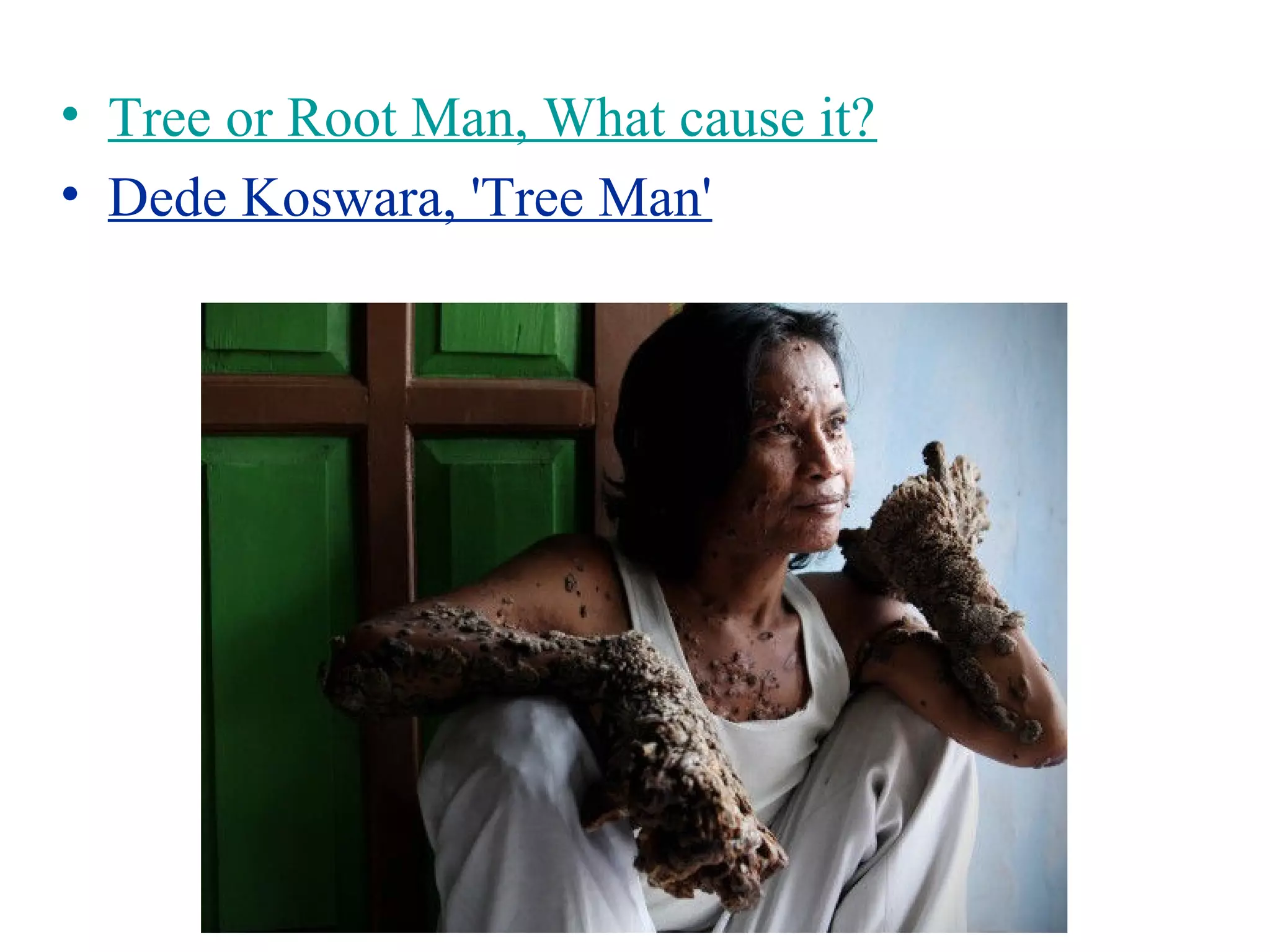
• Tree or Root Man, What cause it?
• Dede Koswara, 'Tree Man'


                                     15
•How diseases are 
 spread #4, p. 248

                 16
                 16
Droplet Infection
• Transmitted by pathogens 
  suspended in water 
  droplets that humans 
  cough or sneeze into the 
  air. 
• Airborne infections 
  generally affect the 
  respiratory tract, though 
  some of them affect other 
  parts of the body as well.
• The spread of these 
  diseases is curtailed by 
  practicing sanitary 
  precautions.                 17
Contact Infections

• Some diseases are spread by direct contact 
  with a sore or lesion on the skin or mucous 
  membrane of an infected person. 
• Scarlet fever, colds, influenza, and measles 
  can be transmitted by touch.


                                           18
                                           18
Contamination Infection
              • Pathogens enter
                the body by way
                of contaminated
                food or water
                often afflict the
                digestive system.
              • The intestinal
                wastes of a person
                who has this
                disease are highly
                contagious.19
                           19
Wound Infections
• Some pathogens
  enter the body
  through wounds.
• Even small cuts can
  be serious if they
  are not properly
  treated.
• Enters through the
  bloodstream and
  spreads to other             20

  parts of the body.
Vector-carried Infection
• Insects or other arthropods
  that carry pathogens to
  other host organisms are
  are vectors.
• Either mechanically, as
  with food contamination
  by pathogens carried on
  the bodies of flies or
  roaches or...
• By the bites of such
  organisms as mosquitoes,
  flies, or ticks, which inject
  the pathogen into the
  bloodstream of the host.        21
Immune Carriers

• Diseases are also spread by people, and
  occasionally animals, who spread pathogens to
  others without suffering from the disease
  themselves
• They might have had the disease before and have
  developed an immunity to it.


                                        22
                                        22

Human health and disease

  • 1.
    Human Health andDisease What is health? ‘The state of complete physical, mental and social well-being’ To sustain a healthy lifestyle person needs: •A balanced and varied diet ∀• Take exercise ∀• Proper shelter ∀• Enough sleep Good hygiene will reduce the likelihood of infection
  • 2.
    What is disease? Diseaseis a disorder or malfunction of the mind or body, which leads to a departure from good health. Can be a disorder of a specific tissue or organ due to a single cause. E.g. malaria. May have many causes. Often referred to as multifactorial. E.g. heart disease. Disease diagnosed by a doctor analyzing the symptoms (physical and mental signs).
  • 3.
    Acute disease Sudden andrapid onset Symptoms disappear quickly E.g. influenza Chronic disease Long term Symptoms lasting months or years E.g. Tuberculosis
  • 4.
  • 5.
    Physical disease Results frompermanent or temporary damage to the body It could be acute or chronic Examples: Acute Bronchitis Cold Sores Common ColdInfluenza Examples: Chronic AsthmaAutoimmune disease Diabetes Eczema
  • 6.
    Infectious diseases Organismsthat invade the body and cause disease inside are called pathogens Bacteria and Viruses are the best know pathogens. They grow & reproduce within the body of their host. Fungi, protists and parasites can also cause disease. Sometimes worms. Diseases are said to be infectious or communicable if pathogens can be passed from one person to another.
  • 7.
    • Some examplesto follow • For a list of more with details see pages 250-251 in your book 7
  • 8.
    Influenza ('flu) Influenza isa virus which causes a severe form of respiratory tract infection with generalized bodily symptoms. It spreads around the world in epidemics and is responsible for much ill health as well as many deaths. Symptoms If you start to develop cold symptoms but starting more rapidly and rather more violently, with higher fever and severe aches and pains, often in the back and muscles, then you may well be developing influenza. This may be associated with severe headache, cough, and, as a result of the fever, intermittent sweating and shivering. Sometimes there is a gastrointestinal element, with vomiting and/or diarrhea. Many people think they have had "flu" when all that they have suffered is a bad cold. When you have influenza you will know the difference. Most people will find it impossible to leave their bed and feel terrible. The worst symptoms usually last for three to five days, and then should begin to improve. It is common to need two to three weeks off work as there is considerable debility left after the feverish illness is over. Do not be surprised to be quite depressed, this is a natural after-effect of the condition. Influenza makes everyone feel terrible, but most people recover. It does however have a small, but significant mortality, especially in the very young, the very old, and those with poor immunity. Causes Influenza is caused by a virus which attacks our body cells resulting in various manifestations depending on the strain of the virus. New mutations of the virus arise all the time and unfortunately immunity against one strain (which is conferred by exposure or immunization) does not protect against other strains. In the era of rapid air transport the world wide spread of a new type of influenza can be extremely fast.
  • 9.
    Salmonella Salmonellosis is aninfection with a bacteria called Salmonella. Most persons infected with Salmonella develop diarrhea, fever, and abdominal cramps 12 to 72 hours after infection. The illness usually lasts 4 to 7 days, and most persons recover without treatment. However, in some persons the diarrhea may be so severe that the patient needs to be hospitalized. In these patients, the Salmonella infection may spread from the intestines to the blood stream, and then to other body sites and can cause death unless the person is treated promptly with antibiotics. The elderly, infants, and those with impaired immune systems are more likely to have a severe illness
  • 10.
    Cholera is anacute, diarrheal illness caused by infection of the intestine with the bacterium Vibrio cholerae. The infection is often mild or without symptoms, but sometimes it can be severe. Approximately one in 20 infected persons has severe disease characterized by profuse watery diarrhea, vomiting, and leg cramps. In these persons, rapid loss of body fluids leads to dehydration and shock. Without treatment, death can occur within hours. Zimbabwe's cholera epidemic hits 10,000 Zimbabwe's cholera epidemic hits 10,000 10
  • 11.
    Typhoid fever iscontracted when people eat food or drink water that has been infected with Salmonella typhi. It is recognized by the sudden onset of sustained fever, severe headache, nausea and severe loss of appetite. It is sometimes accompanied by hoarse cough and constipation or diarrhea. Case-fatality rates of 10% can be reduced to less than 1% with appropriate antibiotic therapy. Paratyphoid fever shows similar symptoms, but tends to be milder and the case-fatality rate is much lower. 11
  • 12.
    Clinical Tetanus sometimes known as “lock jaw” -Spores deposited in tissue - wound, burn, ulcer, compound fracture, operative wounds, drug injection - tetanus neonatorum: infection of umbilical stump - necrotic tissue (poor blood supply, anoxia) - mixed infections, foreign bodies also contribute -Toxins affect the central nervous system by causing continual impulses to be sent to the muscles. They contract and become remain rigid. -If not treated the person often dies a painful death as more and more of the muscles are affected.
  • 13.
    Malaria Malaria infects anestimated 300 million people, and is spread by mosquitoes, transfusions, and shared hypodermic needles. Control of mosquito populations has led to declines in malaria in many areas. Infected individuals can be treayted with a variety of medicines. However, some of the sporozoans that cause malaria heve developed immunity to some of the more commonly employed medicines.
  • 14.
    Global Statistics •         40% of the world's population is at risk •         300-500 million new cases/year •         1.5-2.7 million deaths/year •         Malaria is endemic to over 100 countries and territories •         More than 90% of all cases are in sub-Saharan Africa
  • 15.
  • 16.
  • 17.
    Droplet Infection • Transmitted by pathogens  suspended in water  droplets that humans  cough or sneeze into the  air.  • Airborne infections  generally affect the  respiratory tract, though  some of them affect other  parts of the body as well. • The spread of these  diseases is curtailed by  practicing sanitary  precautions. 17
  • 18.
    Contact Infections • Some diseases are spread by direct contact  with a sore or lesion on the skin or mucous  membrane of an infected person.  • Scarlet fever, colds, influenza, and measles  can be transmitted by touch. 18 18
  • 19.
    Contamination Infection • Pathogens enter the body by way of contaminated food or water often afflict the digestive system. • The intestinal wastes of a person who has this disease are highly contagious.19 19
  • 20.
    Wound Infections • Somepathogens enter the body through wounds. • Even small cuts can be serious if they are not properly treated. • Enters through the bloodstream and spreads to other 20 parts of the body.
  • 21.
    Vector-carried Infection • Insectsor other arthropods that carry pathogens to other host organisms are are vectors. • Either mechanically, as with food contamination by pathogens carried on the bodies of flies or roaches or... • By the bites of such organisms as mosquitoes, flies, or ticks, which inject the pathogen into the bloodstream of the host. 21
  • 22.
    Immune Carriers • Diseasesare also spread by people, and occasionally animals, who spread pathogens to others without suffering from the disease themselves • They might have had the disease before and have developed an immunity to it. 22 22