1
Communicable Diseases
Definition of Communicable diseases
โ€ข A communicable disease is an illness due to a
specific infectious (biological) agent or its toxic
products capable of being directly or indirectly
transmitted from man to man, from animal to man,
from animal to animal, or from the environment
(through air, water, food, etc..) to man.
2
Another Definitionโ€ฆ
โ€ข Communicable disease: a disease that can be
spread to a person from another person, an animal
or object. Ex: common cold, flu, tuberculosis, etc.
Non-communicable disease
โ€ข Is a medical condition or disease that is non-
infectious or non-transmissible.
โ€ข A disease that can NOT be spread from person to
person. Ex: cancer, heart disease, cirrhosis, etc.
โ€ข NCDs can refer to chronic diseases which last
for long periods of time and progress slowly.
4
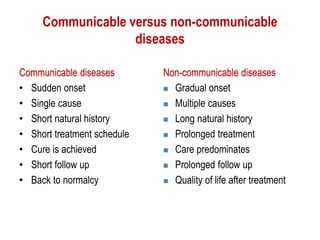
Communicable versus non-communicable
diseases
Communicable diseases
โ€ข Sudden onset
โ€ข Single cause
โ€ข Short natural history
โ€ข Short treatment schedule
โ€ข Cure is achieved
โ€ข Short follow up
โ€ข Back to normalcy
Non-communicable diseases
๏ฎ Gradual onset
๏ฎ Multiple causes
๏ฎ Long natural history
๏ฎ Prolonged treatment
๏ฎ Care predominates
๏ฎ Prolonged follow up
๏ฎ Quality of life after treatment
Usuallyโ€ฆ
โ€ข The poor hygiene behaviors promote the transmission of
infectious diseases
โ€ข The fecal-oral and respiratory routes are the most common
sources of transmission
โ€ข Young children and adults may not wash their hands after
using toilets and before eating/preparing food.
CD- Modes of transmission
โ€ข Direct
โ€ข Blood-borne or sexual โ€“ HIV, Hepatitis B,C
โ€ข Inhalation โ€“ Tuberculosis, influenza, anthrax
โ€ข Food-borne โ€“ E.coli, Salmonella,
โ€ข Contaminated water- Cholera, rotavirus, Hepatitis A
โ€ข Indirect
โ€ข Vector-borne- malaria, trypanosomiasis
โ€ข Fomites- objects like clothes, remotes, door handles
โ€ข Zoonotic diseases โ€“ animal handling and feeding practices
(Mad cow disease, Avian Influenza)
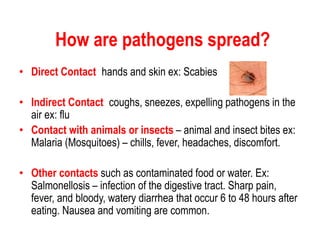
How are pathogens spread?
โ€ข Direct Contact: hands and skin ex: Scabies
โ€ข Indirect Contact: coughs, sneezes, expelling pathogens in the
air ex: flu
โ€ข Contact with animals or insects โ€“ animal and insect bites ex:
Malaria (Mosquitoes) โ€“ chills, fever, headaches, discomfort.
โ€ข Other contacts such as contaminated food or water. Ex:
Salmonellosis โ€“ infection of the digestive tract. Sharp pain,
fever, and bloody, watery diarrhea that occur 6 to 48 hours after
eating. Nausea and vomiting are common.
Infection
โ€ข Infection is the entry and development or multiplication of
an infectious agent in the body of man or animals. An
infection does not always cause illness.
โ€ข There are several levels of infection (Gradients of
infection):
โ€“ Colonization (S. aureus in skin and normal nasopharynx)
โ€“ Subclinical or inapparent infection (polio)
โ€“ Latent infection (virus of herpes simplex)
โ€“ Manifest or clinical infection
contamination
โ€ข The presence of an infectious agent on a body
surface, on or in clothes, beddings, toys, surgical
instruments or dressings, or other articles or
substances including water and food
Infestation
โ€ข It is the lodgment, development and reproduction of
arthropods on the surface of the body or in the
clothing, e.g. lice, itch mite. This term could be also
used to describe the invasion of the gut by parasitic
worms, e.g. ascariasis.
Contagious disease
โ€ข A contagious disease is the one that is transmitted
through contact. Examples include scabies,
trachoma, STD and leprosy.
Vector of infection
โ€ข An insect or any living carrier that transports
an infectious agent from an infected individual
or its wastes to a susceptible individual or its
food or immediate surroundings.
Reservoir
โ€ข Any person, animal, arthropod, plant, soil, or
substance, or a combination of these, in which an
infectious agent normally lives and multiplies, on
which it depends primarily for survival, and where it
reproduces itself in such a manner that it can be
transmitted to a susceptible host. It is the natural
habitat of the infectious agent.
Pandemic and Exotic
โ€ข Pandemic is an epidemic usually affecting a large
proportion of the population, occuring over a wide
geographic area such as a section of a nation, the
entire nation, a continent or the world, e.g. Influenza
pandemics.
โ€ข Exotic diseases are those which are imported into
a country in which they do not otherwise occur.
Sporadic
โ€ข The word sporadic means โ€œscattered aboutโ€. The
cases occur irregularly, haphazardly from time to
time, and generally infrequently. The cases are few
and separated widely in time and place that they
show no or little connection with each other, nor a
recognizable common source of infection.
โ€ข However, a sporadic disease could be the starting
point of an epidemic when the conditions are
favorable for its spread.
Nosocomial infections
โ€ข Nosocomial (hospital acquired) infection is an
infection originating in a patient while in a hospital
or another health care facility. It has to be a new
disorder unrelated to the patientโ€™s primary condition.
Examples include infection of surgical wounds,
hepatitis B and urinary tract infections.
Opportunistic infection
โ€ข This is infection by organisms that take the
opportunity provided by a defect in host defense
(e.g. immunity) to infect the host and thus cause
disease. For example, opportunistic infections are
very common in AIDS. Organisms include Herpes
simplex, cytomegalovirus,
โ€ข M. tuberculosisโ€ฆ.
Incubation
โ€ข Incubation period: time from exposure to
development of disease. In other words, the time
interval between invasion by an infectious agent
and the appearance of the first sign or symptom of
the disease in question.
Carriers
โ€ข It occurs either due to inadequate treatment or
immune response, the disease agent is not
completely eliminated, leading to a carrier state.
Cases
โ€ข A case is defined as โ€œa person in the population or
study group identified as having the particular
disease, health disorder, or condition under
investigationโ€
Latent period
โ€ข The period between exposure and the onset of
infectiousness (this may be shorter or longer than
the incubation period).
22
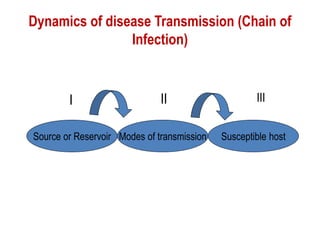
Dynamics of disease Transmission (Chain of
Infection)
Source or Reservoir Modes of transmission Susceptible host
I II III
(I): Source or Reservoir
โ€ข A reservoir is any animate or inanimate
substance in which an infectious agent
multiplies or develops and upon which it
depends as a species for its survival in nature.
โ€ข Sources of Infections
โ€“ Cases - actually suffering from a disease and shed
pathogens.
โ€“ Carriers - infected and shedding pathogens
without showing any clinical signs.
24
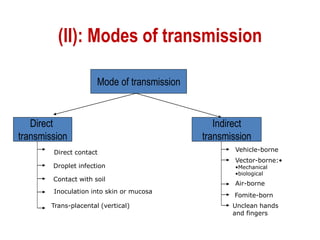
(II): Modes of transmission
Mode of transmission
Direct
transmission
Indirect
transmission
Direct contact
Droplet infection
Contact with soil
Inoculation into skin or mucosa
Trans-placental (vertical)
Vehicle-borne
โ€ข
Vector-borne:
โ€ขMechanical
โ€ขbiological
Air-borne
Fomite-born
Unclean hands
and fingers
(III): Susceptible host
โ€ข An infectious agent seeks a susceptible host
aiming โ€œsuccessful parasitismโ€.
โ€ข Four stages are required for successful
parasitism:
1. Portal of entry
2. Site of election inside the body
3. Portal of exit
4. Survival in external environment
Importance of Communicable Diseases
โ€ข Significant burden of disease especially in low
and middle income countries
โ€ข Social impact
โ€ข Economic impact
โ€ข Potential for rapid spread
โ€ข Human security concerns
โ€ข Intentional use
CDs have a significant economic impact in
affected countries
โ€ข At the macro level
โ€“ Reduction in revenue for the country (e.g. tourism)
โ€ข Estimated cost of AIDS is very high in African Countries.
โ€ข Drop in international travel to affected countries by 50-70%
โ€ข Malaria causes an average loss of 1.3% annual GDP in countries with
intense transmission
โ€ข The plague outbreak in India cost the economy over $1 billion from travel
restrictions and embargoes
โ€ข At the household level
โ€“ Poorer households are disproportionately affected
โ€“ Substantial loss in productivity and income for the infirmed and
caregiver
โ€“ Catastrophic costs of treating illness
International boundaries are disappearing
โ€ข Borders are not very effective at stopping communicable
diseases.
โ€ข With increasing globalization
โ€ข interdependence of countries โ€“ more trade and human/animal interactions
โ€ข The rise in international traffic and commerce makes
challenges even more daunting
โ€ข Other global issues affect or are affected by communicable
diseases.
โ€ข climate change
โ€ข migration
โ€ข Change in biodiversity
Examples of communicable diseases
โ€ข Influenza
โ€ข Polio
โ€ข Tuberculosis
โ€ข Chicken pox
โ€ข AIDS
โ€ข Hepatitis
โ€ข Malaria
โ€ข Gonorrhea
โ€ข etc
30

Communicable diseases pharmacy practice.ppt

  • 1.
  • 2.
    Definition of Communicablediseases โ€ข A communicable disease is an illness due to a specific infectious (biological) agent or its toxic products capable of being directly or indirectly transmitted from man to man, from animal to man, from animal to animal, or from the environment (through air, water, food, etc..) to man. 2
  • 3.
    Another Definitionโ€ฆ โ€ข Communicabledisease: a disease that can be spread to a person from another person, an animal or object. Ex: common cold, flu, tuberculosis, etc.
  • 4.
    Non-communicable disease โ€ข Isa medical condition or disease that is non- infectious or non-transmissible. โ€ข A disease that can NOT be spread from person to person. Ex: cancer, heart disease, cirrhosis, etc. โ€ข NCDs can refer to chronic diseases which last for long periods of time and progress slowly. 4
  • 5.
    Communicable versus non-communicable diseases Communicablediseases โ€ข Sudden onset โ€ข Single cause โ€ข Short natural history โ€ข Short treatment schedule โ€ข Cure is achieved โ€ข Short follow up โ€ข Back to normalcy Non-communicable diseases ๏ฎ Gradual onset ๏ฎ Multiple causes ๏ฎ Long natural history ๏ฎ Prolonged treatment ๏ฎ Care predominates ๏ฎ Prolonged follow up ๏ฎ Quality of life after treatment
  • 6.
    Usuallyโ€ฆ โ€ข The poorhygiene behaviors promote the transmission of infectious diseases โ€ข The fecal-oral and respiratory routes are the most common sources of transmission โ€ข Young children and adults may not wash their hands after using toilets and before eating/preparing food.
  • 7.
    CD- Modes oftransmission โ€ข Direct โ€ข Blood-borne or sexual โ€“ HIV, Hepatitis B,C โ€ข Inhalation โ€“ Tuberculosis, influenza, anthrax โ€ข Food-borne โ€“ E.coli, Salmonella, โ€ข Contaminated water- Cholera, rotavirus, Hepatitis A โ€ข Indirect โ€ข Vector-borne- malaria, trypanosomiasis โ€ข Fomites- objects like clothes, remotes, door handles โ€ข Zoonotic diseases โ€“ animal handling and feeding practices (Mad cow disease, Avian Influenza)
  • 8.
    How are pathogensspread? โ€ข Direct Contact: hands and skin ex: Scabies โ€ข Indirect Contact: coughs, sneezes, expelling pathogens in the air ex: flu โ€ข Contact with animals or insects โ€“ animal and insect bites ex: Malaria (Mosquitoes) โ€“ chills, fever, headaches, discomfort. โ€ข Other contacts such as contaminated food or water. Ex: Salmonellosis โ€“ infection of the digestive tract. Sharp pain, fever, and bloody, watery diarrhea that occur 6 to 48 hours after eating. Nausea and vomiting are common.
  • 9.
    Infection โ€ข Infection isthe entry and development or multiplication of an infectious agent in the body of man or animals. An infection does not always cause illness. โ€ข There are several levels of infection (Gradients of infection): โ€“ Colonization (S. aureus in skin and normal nasopharynx) โ€“ Subclinical or inapparent infection (polio) โ€“ Latent infection (virus of herpes simplex) โ€“ Manifest or clinical infection
  • 10.
    contamination โ€ข The presenceof an infectious agent on a body surface, on or in clothes, beddings, toys, surgical instruments or dressings, or other articles or substances including water and food
  • 11.
    Infestation โ€ข It isthe lodgment, development and reproduction of arthropods on the surface of the body or in the clothing, e.g. lice, itch mite. This term could be also used to describe the invasion of the gut by parasitic worms, e.g. ascariasis.
  • 12.
    Contagious disease โ€ข Acontagious disease is the one that is transmitted through contact. Examples include scabies, trachoma, STD and leprosy.
  • 13.
    Vector of infection โ€ขAn insect or any living carrier that transports an infectious agent from an infected individual or its wastes to a susceptible individual or its food or immediate surroundings.
  • 14.
    Reservoir โ€ข Any person,animal, arthropod, plant, soil, or substance, or a combination of these, in which an infectious agent normally lives and multiplies, on which it depends primarily for survival, and where it reproduces itself in such a manner that it can be transmitted to a susceptible host. It is the natural habitat of the infectious agent.
  • 15.
    Pandemic and Exotic โ€ขPandemic is an epidemic usually affecting a large proportion of the population, occuring over a wide geographic area such as a section of a nation, the entire nation, a continent or the world, e.g. Influenza pandemics. โ€ข Exotic diseases are those which are imported into a country in which they do not otherwise occur.
  • 16.
    Sporadic โ€ข The wordsporadic means โ€œscattered aboutโ€. The cases occur irregularly, haphazardly from time to time, and generally infrequently. The cases are few and separated widely in time and place that they show no or little connection with each other, nor a recognizable common source of infection. โ€ข However, a sporadic disease could be the starting point of an epidemic when the conditions are favorable for its spread.
  • 17.
    Nosocomial infections โ€ข Nosocomial(hospital acquired) infection is an infection originating in a patient while in a hospital or another health care facility. It has to be a new disorder unrelated to the patientโ€™s primary condition. Examples include infection of surgical wounds, hepatitis B and urinary tract infections.
  • 18.
    Opportunistic infection โ€ข Thisis infection by organisms that take the opportunity provided by a defect in host defense (e.g. immunity) to infect the host and thus cause disease. For example, opportunistic infections are very common in AIDS. Organisms include Herpes simplex, cytomegalovirus, โ€ข M. tuberculosisโ€ฆ.
  • 19.
    Incubation โ€ข Incubation period:time from exposure to development of disease. In other words, the time interval between invasion by an infectious agent and the appearance of the first sign or symptom of the disease in question.
  • 20.
    Carriers โ€ข It occurseither due to inadequate treatment or immune response, the disease agent is not completely eliminated, leading to a carrier state.
  • 21.
    Cases โ€ข A caseis defined as โ€œa person in the population or study group identified as having the particular disease, health disorder, or condition under investigationโ€
  • 22.
    Latent period โ€ข Theperiod between exposure and the onset of infectiousness (this may be shorter or longer than the incubation period). 22
  • 23.
    Dynamics of diseaseTransmission (Chain of Infection) Source or Reservoir Modes of transmission Susceptible host I II III
  • 24.
    (I): Source orReservoir โ€ข A reservoir is any animate or inanimate substance in which an infectious agent multiplies or develops and upon which it depends as a species for its survival in nature. โ€ข Sources of Infections โ€“ Cases - actually suffering from a disease and shed pathogens. โ€“ Carriers - infected and shedding pathogens without showing any clinical signs. 24
  • 25.
    (II): Modes oftransmission Mode of transmission Direct transmission Indirect transmission Direct contact Droplet infection Contact with soil Inoculation into skin or mucosa Trans-placental (vertical) Vehicle-borne โ€ข Vector-borne: โ€ขMechanical โ€ขbiological Air-borne Fomite-born Unclean hands and fingers
  • 26.
    (III): Susceptible host โ€ขAn infectious agent seeks a susceptible host aiming โ€œsuccessful parasitismโ€. โ€ข Four stages are required for successful parasitism: 1. Portal of entry 2. Site of election inside the body 3. Portal of exit 4. Survival in external environment
  • 27.
    Importance of CommunicableDiseases โ€ข Significant burden of disease especially in low and middle income countries โ€ข Social impact โ€ข Economic impact โ€ข Potential for rapid spread โ€ข Human security concerns โ€ข Intentional use
  • 28.
    CDs have asignificant economic impact in affected countries โ€ข At the macro level โ€“ Reduction in revenue for the country (e.g. tourism) โ€ข Estimated cost of AIDS is very high in African Countries. โ€ข Drop in international travel to affected countries by 50-70% โ€ข Malaria causes an average loss of 1.3% annual GDP in countries with intense transmission โ€ข The plague outbreak in India cost the economy over $1 billion from travel restrictions and embargoes โ€ข At the household level โ€“ Poorer households are disproportionately affected โ€“ Substantial loss in productivity and income for the infirmed and caregiver โ€“ Catastrophic costs of treating illness
  • 29.
    International boundaries aredisappearing โ€ข Borders are not very effective at stopping communicable diseases. โ€ข With increasing globalization โ€ข interdependence of countries โ€“ more trade and human/animal interactions โ€ข The rise in international traffic and commerce makes challenges even more daunting โ€ข Other global issues affect or are affected by communicable diseases. โ€ข climate change โ€ข migration โ€ข Change in biodiversity
  • 30.
    Examples of communicablediseases โ€ข Influenza โ€ข Polio โ€ข Tuberculosis โ€ข Chicken pox โ€ข AIDS โ€ข Hepatitis โ€ข Malaria โ€ข Gonorrhea โ€ข etc 30