WHY DO WE FALL
ILL?
Introduction :
1. Health
2. Ways to get healthy
3. Disease : Causes & Types
4. Principles of Treatment
5. Principles of prevention
6. Immunization and Vaccination
In Human Bodies, new cells are being
made. In our organs or tissues, there
are various specialised activities
going on– the heart is beating, the
lungs are breathing, the kidney is
filtering urine, the brain is thinking.
All these activities are interconnected.
For all these interconnected activities,
energy and raw material are needed.
Food is a necessity for cell and tissue
functions.
Anything that prevents proper
functioning of cells and tissues will
lead to a lack of proper activity of the
body.
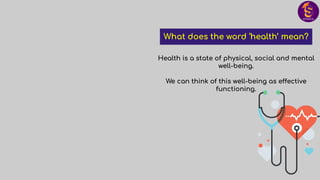
Health is a state of physical, social and mental
well-being.
We can think of this well-being as effective
functioning.
What does the word ‘health’ mean?
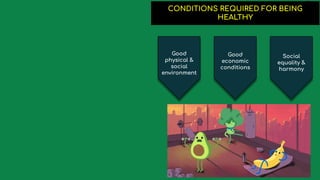
CONDITIONS REQUIRED FOR BEING
HEALTHY
Good
physical &
social
environment
Good
economic
conditions
Social
equality &
harmony
PERSONAL AND COMMUNITY ISSUES
BOTH MATTER FOR HEALTH
Health is something that each one of us cannot
achieve entirely on our own.
Activities which people do in group or individually for
development of the society, constitute community
health.
Personal & community health are supplementary to
each other.
PERSONAL AND COMMUNITY ISSUES
BOTH MATTER FOR HEALTH
The health of all organisms will depend on their
surroundings or their environment. This includes
both :
1. Physical Environment
2. Social Environment
How can we achieve an overall
healthy state?
● Proper balanced and nutritious
diet.
● Personal hygiene.
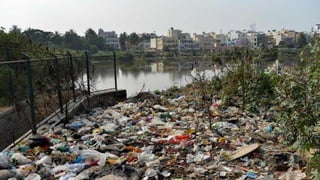
● Clean environment and
surroundings.
● Healthy air, no pollution in the
surrounding.
● Regular exercise.
● Proper rest.
● Good standard of living and
economic status
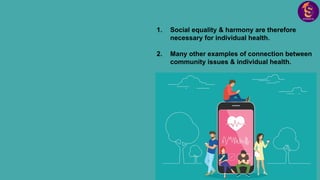
1. Social equality & harmony are therefore
necessary for individual health.
2. Many other examples of connection between
community issues & individual health.
DISTINCTION
BETWEEN
‘HEALTHY’ AND
‘DISEASE-FREE’
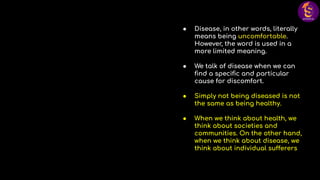
● Disease, in other words, literally
means being uncomfortable.
However, the word is used in a
more limited meaning.
● We talk of disease when we can
find a specific and particular
cause for discomfort.
● Simply not being diseased is not
the same as being healthy.
● When we think about health, we
think about societies and
communities. On the other hand,
when we think about disease, we
think about individual sufferers
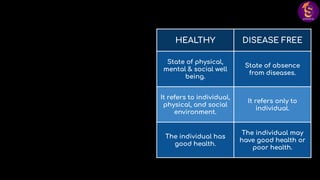
HEALTHY DISEASE FREE
State of physical,
mental & social well
being.
State of absence
from diseases.
It refers to individual,
physical, and social
environment.
It refers only to
individual.
The individual has
good health.
The individual may
have good health or
poor health.
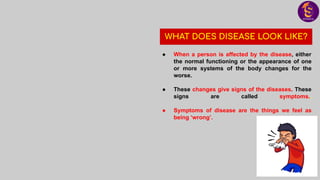
WHAT DOES DISEASE LOOK LIKE?
● When a person is affected by the disease, either
the normal functioning or the appearance of one
or more systems of the body changes for the
worse.
● These changes give signs of the diseases. These
signs are called symptoms..
● Symptoms of disease are the things we feel as
being ‘wrong’.
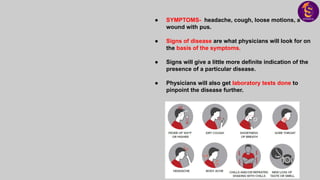
● SYMPTOMS- headache, cough, loose motions, a
wound with pus.
● Signs of disease are what physicians will look for on
the basis of the symptoms.
● Signs will give a little more definite indication of the
presence of a particular disease.
● Physicians will also get laboratory tests done to
pinpoint the disease further.
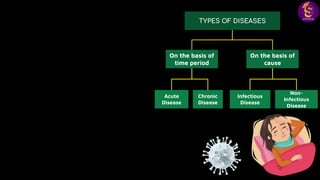
TYPES OF DISEASES
On the basis of
time period
On the basis of
cause
Infectious
Disease
Chronic
Disease
Acute
Disease
Non-
Infectious
Disease
ACUTE & CHRONIC
DISEASE
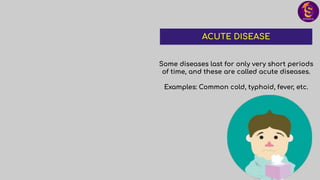
Some diseases last for only very short periods
of time, and these are called acute diseases.
Examples: Common cold, typhoid, fever, etc.
ACUTE DISEASE
ACUTE DISEASE
Last for short period
of time, e.g., common
cold.
Cause major effects
on general health in
a very short time.
Weight loss does not
occur usually.
No long-term effect.
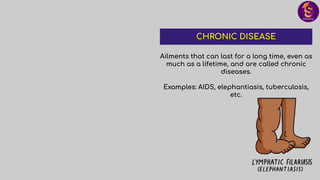
Ailments that can last for a long time, even as
much as a lifetime, and are called chronic
diseases.
Examples: AIDS, elephantiasis, tuberculosis,
etc.
CHRONIC DISEASE
CHRONIC DISEASE
Last for long period
of time, even lifetime
e.g., elephantiasis.
Takes long time to
cause major effect
on general health.
Feeling of tiredness
all the time.
Weight loss occur &
one become short of
breath.
Have long-term
effect.
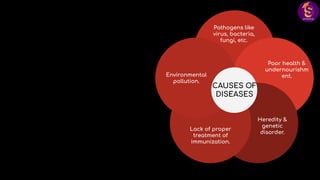
Pathogens like
virus, bacteria,
fungi, etc.
Poor health &
undernourishm
ent.
Heredity &
genetic
disorder.
Lack of proper
treatment of
immunization.
Environmental
pollution.
CAUSES OF
DISEASES
INFECTIOUS AND
NON-INFECTIOUS
CAUSES
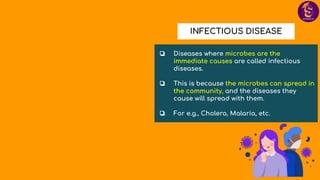
❏ Diseases where microbes are the
immediate causes are called infectious
diseases.
❏ This is because the microbes can spread in
the community, and the diseases they
cause will spread with them.
❏ For e.g., Cholera, Malaria, etc.
INFECTIOUS DISEASE
INFECTIOUS DISEASE
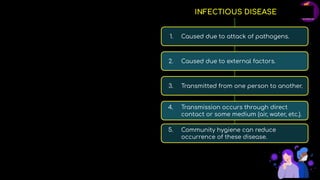
1. Caused due to attack of pathogens.
2. Caused due to external factors.
3. Transmitted from one person to another.
4. Transmission occurs through direct
contact or some medium (air, water, etc.).
5. Community hygiene can reduce
occurrence of these disease.
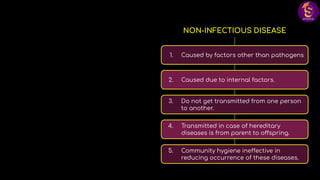
NON-INFECTIOUS DISEASE
1. Caused by factors other than pathogens
2. Caused due to internal factors.
3. Do not get transmitted from one person
to another.
4. Transmitted in case of hereditary
diseases is from parent to offspring.
5. Community hygiene ineffective in
reducing occurrence of these diseases.
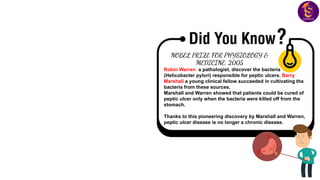
NOBEL PRIZE FOR PHYSIOLOGY &
MEDICINE, 2005
Robin Warren a pathologist, discover the bacteria
(Helicobacter pylori) responsible for peptic ulcers. Barry
Marshall a young clinical fellow succeeded in cultivating the
bacteria from these sources.
Marshall and Warren showed that patients could be cured of
peptic ulcer only when the bacteria were killed off from the
stomach.
Thanks to this pioneering discovery by Marshall and Warren,
peptic ulcer disease is no longer a chronic disease.
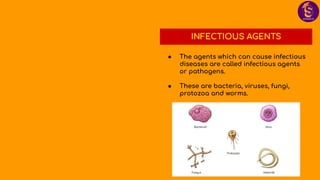
INFECTIOUS AGENTS
● The agents which can cause infectious
diseases are called infectious agents
or pathogens.
● These are bacteria, viruses, fungi,
protozoa and worms.
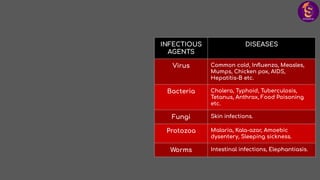
INFECTIOUS
AGENTS
DISEASES
Virus Common cold, Influenza, Measles,
Mumps, Chicken pox, AIDS,
Hepatitis-B etc.
Bacteria Cholera, Typhoid, Tuberculosis,
Tetanus, Anthrax, Food Poisoning
etc.
Fungi Skin infections.
Protozoa Malaria, Kala-azar, Amoebic
dysentery, Sleeping sickness.
Worms Intestinal infections, Elephantiasis.
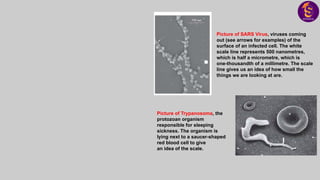
Picture of SARS Virus, viruses coming
out (see arrows for examples) of the
surface of an infected cell. The white
scale line represents 500 nanometres,
which is half a micrometre, which is
one-thousandth of a millimetre. The scale
line gives us an idea of how small the
things we are looking at are.
Picture of Trypanosoma, the
protozoan organism
responsible for sleeping
sickness. The organism is
lying next to a saucer-shaped
red blood cell to give
an idea of the scale.
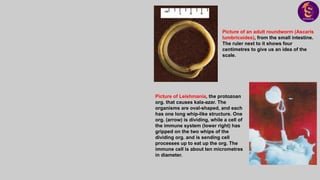
Picture of an adult roundworm (Ascaris
lumbricoides), from the small intestine.
The ruler next to it shows four
centimetres to give us an idea of the
scale.
Picture of Leishmania, the protozoan
org. that causes kala-azar. The
organisms are oval-shaped, and each
has one long whip-like structure. One
org. (arrow) is dividing, while a cell of
the immune system (lower right) has
gripped on the two whips of the
dividing org. and is sending cell
processes up to eat up the org. The
immune cell is about ten micrometres
in diameter.
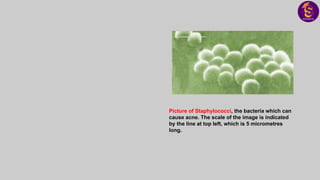
Picture of Staphylococci, the bacteria which can
cause acne. The scale of the image is indicated
by the line at top left, which is 5 micrometres
long.
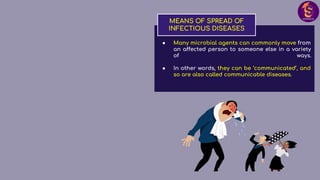
● Many microbial agents can commonly move from
an affected person to someone else in a variety
of ways.
● In other words, they can be ‘communicated’, and
so are also called communicable diseases.
MEANS OF SPREAD OF
INFECTIOUS DISEASES
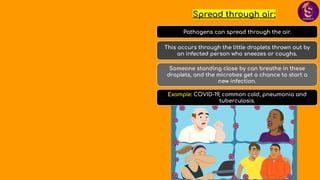
Spread through air:
Pathogens can spread through the air.
This occurs through the little droplets thrown out by
an infected person who sneezes or coughs.
Someone standing close by can breathe in these
droplets, and the microbes get a chance to start a
new infection.
Example: COVID-19, common cold, pneumonia and
tuberculosis.
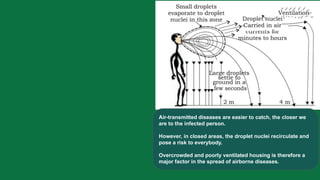
Air-transmitted diseases are easier to catch, the closer we
are to the infected person.
However, in closed areas, the droplet nuclei recirculate and
pose a risk to everybody.
Overcrowded and poorly ventilated housing is therefore a
major factor in the spread of airborne diseases.
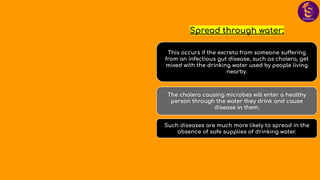
Spread through water:
This occurs if the excreta from someone suffering
from an infectious gut disease, such as cholera, get
mixed with the drinking water used by people living
nearby.
The cholera causing microbes will enter a healthy
person through the water they drink and cause
disease in them.
Such diseases are much more likely to spread in the
absence of safe supplies of drinking water.
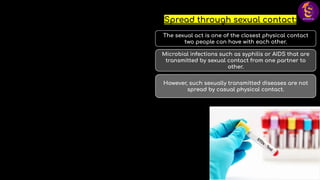
Spread through sexual contact:
The sexual act is one of the closest physical contact
two people can have with each other.
Microbial infections such as syphilis or AIDS that are
transmitted by sexual contact from one partner to
other.
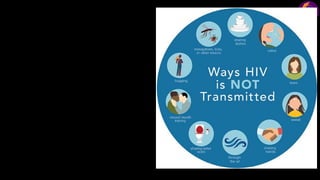
However, such sexually transmitted diseases are not
spread by casual physical contact.
Casual physical contacts include handshakes or hugs
or sports, like wrestling, or by any of the other ways in
which we touch each other socially.
Other than the sexual contact, the virus causing
AIDS (HIV) can also spread through blood-to-blood
contact with infected people or from an infected
mother to her baby during pregnancy or through
breast feeding.
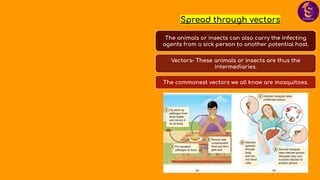
Spread through vectors
The animals or insects can also carry the infecting
agents from a sick person to another potential host.
Vectors- These animals or insects are thus the
intermediaries.
The commonest vectors we all know are mosquitoes.
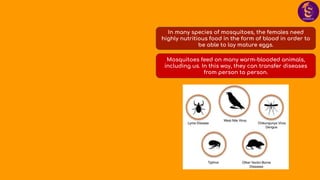
In many species of mosquitoes, the females need
highly nutritious food in the form of blood in order to
be able to lay mature eggs.
Mosquitoes feed on many warm-blooded animals,
including us. In this way, they can transfer diseases
from person to person.
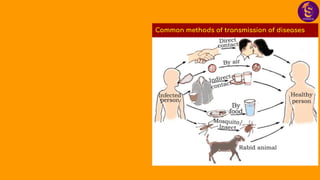
Common methods of transmission of diseases
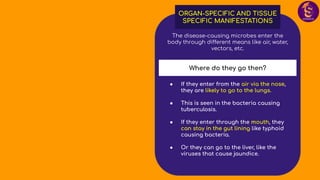
The disease-causing microbes enter the
body through different means like air, water,
vectors, etc.
● If they enter from the air via the nose,
they are likely to go to the lungs.
● This is seen in the bacteria causing
tuberculosis.
● If they enter through the mouth, they
can stay in the gut lining like typhoid
causing bacteria.
● Or they can go to the liver, like the
viruses that cause jaundice.
ORGAN-SPECIFIC AND TISSUE
SPECIFIC MANIFESTATIONS
Where do they go then?
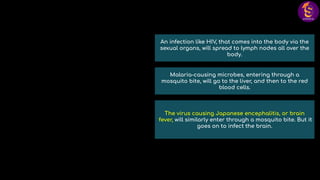
An infection like HIV, that comes into the body via the
sexual organs, will spread to lymph nodes all over the
body.
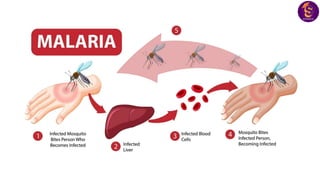
Malaria-causing microbes, entering through a
mosquito bite, will go to the liver, and then to the red
blood cells.
The virus causing Japanese encephalitis, or brain
fever, will similarly enter through a mosquito bite. But it
goes on to infect the brain.
Tissue-specificity of the
infection leads to very
general-seeming effects.
SOME CASES
It is these other
infections that kill
people suffering
from HIV-AIDS.
ULTIMATELY
Body unable to fight
many minor infections.
Instead every common
cold can become
pneumonia.
EFFECT OF HIV
A minor gut infection
can produce major
diarrhoea with blood
loss
SIMILARLY
HIV infection, the
virus goes to the
immune system and
damages its
function.
EXAMPLE
EFFECT
ON
TISSUES
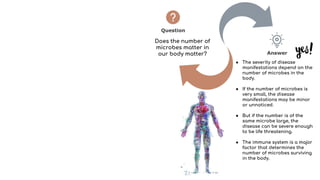
Does the number of
microbes matter in
our body matter?
● The severity of disease
manifestations depend on the
number of microbes in the
body.
● If the number of microbes is
very small, the disease
manifestations may be minor
or unnoticed.
● But if the number is of the
same microbe large, the
disease can be severe enough
to be life threatening.
● The immune system is a major
factor that determines the
number of microbes surviving
in the body.
PRINCIPLES OF
TREATMENT
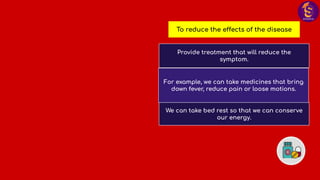
To reduce the effects of the disease
Provide treatment that will reduce the
symptom.
For example, we can take medicines that bring
down fever, reduce pain or loose motions.
We can take bed rest so that we can conserve
our energy.
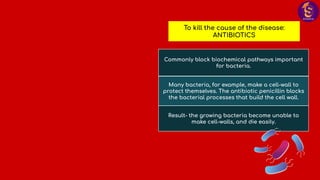
Commonly block biochemical pathways important
for bacteria.
Many bacteria, for example, make a cell-wall to
protect themselves. The antibiotic penicillin blocks
the bacterial processes that build the cell wall.
Result- the growing bacteria become unable to
make cell-walls, and die easily.
To kill the cause of the disease:
ANTIBIOTICS
❏ Human cells don’t make a cell-wall
anyway, so no effect of penicillin on
us.
❏ Penicillin will have this effect on any
bacteria that use such processes for
making cell-walls.
❏ Similarly, many antibiotics work
against many species of bacteria
rather than simply working against
one.
Are antibiotics
effective against
viruses?
Even then, the antibiotic will work only against the
bacterial part of the infection, not the viral infection.
However, if we also get a bacterial infection along
with the viral cold, taking antibiotics will help.
If we have a common cold, taking antibiotics does not
reduce the severity or the duration of the disease.
Viruses do not use these pathways
at all, and that is the reason why
antibiotics do not work against viral
infections.
Why is it difficult to make medicines
to kill viruses?
● We all are seeing the ongoing global
efforts to make medicines or
vaccines to cure the ongoing
COVID-19 disease.
● But it is being very difficult to make
one vaccine against the coronavirus
that causes COVID-19.
● This is true for various different
types of viral diseases like AIDS,
Hepatitis, etc.
REASON
1. Viruses have few biochemical
mechanisms of their own.
2. They enter our cells and use our
machinery for their life processes.
3. This means that there are relatively few
virus-specific targets to aim at.
4. Despite this limitation, there are now
effective anti-viral drugs.
5. Example: the drugs that keep HIV
infection under control
PRINCIPLES OF
PREVENTION OF
DISEASES
It mostly relate to preventing exposure.
For airborne microbes, we can prevent
exposure by providing living conditions that
are not overcrowded.
For water-borne microbes, we can prevent
exposure by providing safe drinking water.
This can be done by treating the water to
kill any microbial contamination.
For vector-borne infections, we can provide
clean environments. This would not, for
example, allow mosquito breeding.
General ways of
prevention
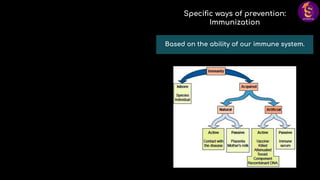
Specific ways of prevention:
Immunization
Based on the ability of our immune system.
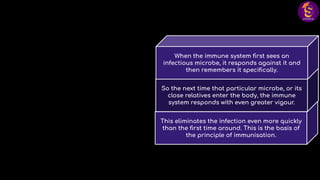
This eliminates the infection even more quickly
than the first time around. This is the basis of
the principle of immunisation.
So the next time that particular microbe, or its
close relatives enter the body, the immune
system responds with even greater vigour.
When the immune system first sees an
infectious microbe, it responds against it and
then remembers it specifically.
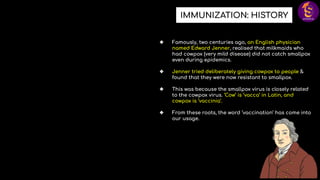
IMMUNIZATION: HISTORY
❖ Famously, two centuries ago, an English physician
named Edward Jenner, realised that milkmaids who
had cowpox (very mild disease) did not catch smallpox
even during epidemics.
❖ Jenner tried deliberately giving cowpox to people &
found that they were now resistant to smallpox.
❖ This was because the smallpox virus is closely related
to the cowpox virus. ‘Cow’ is ‘vacca’ in Latin, and
cowpox is ‘vaccinia’.
❖ From these roots, the word ‘vaccination’ has come into
our usage.
Immunization is the process
by which an animal or a
person stays protected from
diseases.
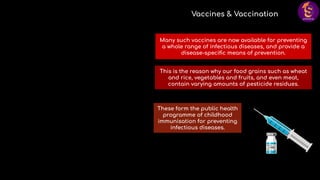
Vaccines & Vaccination
A vaccine is an antigenic substance that develops
immunity against a disease which can be delivered
through needle injections or by mouth or by aerosol.
Vaccination is the injection of a dead or weakened
organism that forms immunity against that organism
in the body.
These form the public health
programme of childhood
immunisation for preventing
infectious diseases.
Vaccines & Vaccination
Many such vaccines are now available for preventing
a whole range of infectious diseases, and provide a
disease-specific means of prevention.
This is the reason why our food grains such as wheat
and rice, vegetables and fruits, and even meat,
contain varying amounts of pesticide residues.
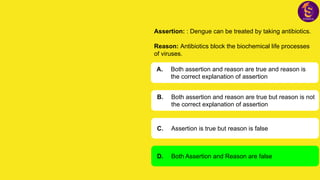
Assertion: : Dengue can be treated by taking antibiotics.
Reason: Antibiotics block the biochemical life processes
of viruses.
A. Both assertion and reason are true and reason is
the correct explanation of assertion
B. Both assertion and reason are true but reason is not
the correct explanation of assertion
C. Assertion is true but reason is false
D. Both Assertion and Reason are false
Assertion: : Dengue can be treated by taking antibiotics.
Reason: Antibiotics block the biochemical life processes
of viruses.
A. Both assertion and reason are true and reason is
the correct explanation of assertion
B. Both assertion and reason are true but reason is not
the correct explanation of assertion
C. Assertion is true but reason is false
D. Both Assertion and Reason are false
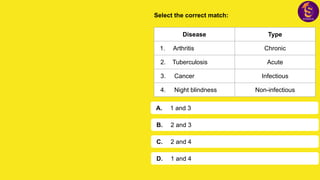
Select the correct match:
Disease Type
1. Arthritis Chronic
2. Tuberculosis Acute
3. Cancer Infectious
4. Night blindness Non-infectious
A. 1 and 3
B. 2 and 3
C. 2 and 4
D. 1 and 4
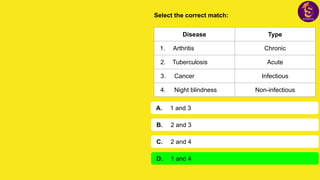
Select the correct match:
Disease Type
1. Arthritis Chronic
2. Tuberculosis Acute
3. Cancer Infectious
4. Night blindness Non-infectious
A. 1 and 3
B. 2 and 3
C. 2 and 4
D. 1 and 4
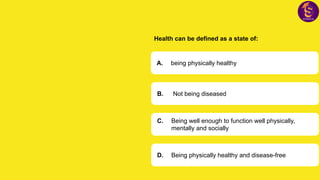
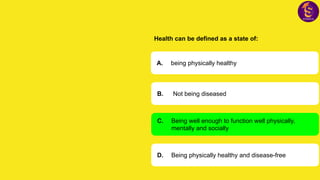
Health can be defined as a state of:
A. being physically healthy
B. Not being diseased
C. Being well enough to function well physically,
mentally and socially
D. Being physically healthy and disease-free
Health can be defined as a state of:
A. being physically healthy
B. Not being diseased
C. Being well enough to function well physically,
mentally and socially
D. Being physically healthy and disease-free
Who were awarded Nobel prize for discovering the
causative organism of peptic ulcer?
A. Barry Marshall and Robin Warren
B. Alexander Fleming and Darwin
C. Barry Marshall and Leeuwenhoek
D. Fleming and Edward Jenner
Who were awarded Nobel prize for discovering the
causative organism of peptic ulcer?
A. Barry Marshall and Robin Warren
B. Alexander Fleming and Darwin
C. Barry Marshall and Leeuwenhoek
D. Fleming and Edward Jenner
YT- Why do we fall ill_ .pdf by saba khan

YT- Why do we fall ill_ .pdf by saba khan

  • 1.
    WHY DO WEFALL ILL?
  • 2.
    Introduction : 1. Health 2.Ways to get healthy 3. Disease : Causes & Types 4. Principles of Treatment 5. Principles of prevention 6. Immunization and Vaccination
  • 3.
    In Human Bodies,new cells are being made. In our organs or tissues, there are various specialised activities going on– the heart is beating, the lungs are breathing, the kidney is filtering urine, the brain is thinking. All these activities are interconnected. For all these interconnected activities, energy and raw material are needed. Food is a necessity for cell and tissue functions. Anything that prevents proper functioning of cells and tissues will lead to a lack of proper activity of the body.
  • 4.
    Health is astate of physical, social and mental well-being. We can think of this well-being as effective functioning. What does the word ‘health’ mean?
  • 5.
    CONDITIONS REQUIRED FORBEING HEALTHY Good physical & social environment Good economic conditions Social equality & harmony
  • 6.
    PERSONAL AND COMMUNITYISSUES BOTH MATTER FOR HEALTH Health is something that each one of us cannot achieve entirely on our own. Activities which people do in group or individually for development of the society, constitute community health. Personal & community health are supplementary to each other.
  • 7.
    PERSONAL AND COMMUNITYISSUES BOTH MATTER FOR HEALTH The health of all organisms will depend on their surroundings or their environment. This includes both : 1. Physical Environment 2. Social Environment
  • 9.
    How can weachieve an overall healthy state? ● Proper balanced and nutritious diet. ● Personal hygiene. ● Clean environment and surroundings. ● Healthy air, no pollution in the surrounding. ● Regular exercise. ● Proper rest. ● Good standard of living and economic status
  • 10.
    1. Social equality& harmony are therefore necessary for individual health. 2. Many other examples of connection between community issues & individual health.
  • 12.
  • 13.
    ● Disease, inother words, literally means being uncomfortable. However, the word is used in a more limited meaning. ● We talk of disease when we can find a specific and particular cause for discomfort. ● Simply not being diseased is not the same as being healthy. ● When we think about health, we think about societies and communities. On the other hand, when we think about disease, we think about individual sufferers
  • 14.
    HEALTHY DISEASE FREE Stateof physical, mental & social well being. State of absence from diseases. It refers to individual, physical, and social environment. It refers only to individual. The individual has good health. The individual may have good health or poor health.
  • 15.
    WHAT DOES DISEASELOOK LIKE? ● When a person is affected by the disease, either the normal functioning or the appearance of one or more systems of the body changes for the worse. ● These changes give signs of the diseases. These signs are called symptoms.. ● Symptoms of disease are the things we feel as being ‘wrong’.
  • 16.
    ● SYMPTOMS- headache,cough, loose motions, a wound with pus. ● Signs of disease are what physicians will look for on the basis of the symptoms. ● Signs will give a little more definite indication of the presence of a particular disease. ● Physicians will also get laboratory tests done to pinpoint the disease further.
  • 17.
    TYPES OF DISEASES Onthe basis of time period On the basis of cause Infectious Disease Chronic Disease Acute Disease Non- Infectious Disease
  • 18.
  • 19.
    Some diseases lastfor only very short periods of time, and these are called acute diseases. Examples: Common cold, typhoid, fever, etc. ACUTE DISEASE
  • 20.
    ACUTE DISEASE Last forshort period of time, e.g., common cold. Cause major effects on general health in a very short time. Weight loss does not occur usually. No long-term effect.
  • 21.
    Ailments that canlast for a long time, even as much as a lifetime, and are called chronic diseases. Examples: AIDS, elephantiasis, tuberculosis, etc. CHRONIC DISEASE
  • 22.
    CHRONIC DISEASE Last forlong period of time, even lifetime e.g., elephantiasis. Takes long time to cause major effect on general health. Feeling of tiredness all the time. Weight loss occur & one become short of breath. Have long-term effect.
  • 23.
    Pathogens like virus, bacteria, fungi,etc. Poor health & undernourishm ent. Heredity & genetic disorder. Lack of proper treatment of immunization. Environmental pollution. CAUSES OF DISEASES
  • 25.
  • 26.
    ❏ Diseases wheremicrobes are the immediate causes are called infectious diseases. ❏ This is because the microbes can spread in the community, and the diseases they cause will spread with them. ❏ For e.g., Cholera, Malaria, etc. INFECTIOUS DISEASE
  • 27.
    INFECTIOUS DISEASE 1. Causeddue to attack of pathogens. 2. Caused due to external factors. 3. Transmitted from one person to another. 4. Transmission occurs through direct contact or some medium (air, water, etc.). 5. Community hygiene can reduce occurrence of these disease.
  • 28.
    NON-INFECTIOUS DISEASE 1. Causedby factors other than pathogens 2. Caused due to internal factors. 3. Do not get transmitted from one person to another. 4. Transmitted in case of hereditary diseases is from parent to offspring. 5. Community hygiene ineffective in reducing occurrence of these diseases.
  • 29.
    NOBEL PRIZE FORPHYSIOLOGY & MEDICINE, 2005 Robin Warren a pathologist, discover the bacteria (Helicobacter pylori) responsible for peptic ulcers. Barry Marshall a young clinical fellow succeeded in cultivating the bacteria from these sources. Marshall and Warren showed that patients could be cured of peptic ulcer only when the bacteria were killed off from the stomach. Thanks to this pioneering discovery by Marshall and Warren, peptic ulcer disease is no longer a chronic disease.
  • 30.
    INFECTIOUS AGENTS ● Theagents which can cause infectious diseases are called infectious agents or pathogens. ● These are bacteria, viruses, fungi, protozoa and worms.
  • 31.
    INFECTIOUS AGENTS DISEASES Virus Common cold,Influenza, Measles, Mumps, Chicken pox, AIDS, Hepatitis-B etc. Bacteria Cholera, Typhoid, Tuberculosis, Tetanus, Anthrax, Food Poisoning etc. Fungi Skin infections. Protozoa Malaria, Kala-azar, Amoebic dysentery, Sleeping sickness. Worms Intestinal infections, Elephantiasis.
  • 32.
    Picture of SARSVirus, viruses coming out (see arrows for examples) of the surface of an infected cell. The white scale line represents 500 nanometres, which is half a micrometre, which is one-thousandth of a millimetre. The scale line gives us an idea of how small the things we are looking at are. Picture of Trypanosoma, the protozoan organism responsible for sleeping sickness. The organism is lying next to a saucer-shaped red blood cell to give an idea of the scale.
  • 33.
    Picture of anadult roundworm (Ascaris lumbricoides), from the small intestine. The ruler next to it shows four centimetres to give us an idea of the scale. Picture of Leishmania, the protozoan org. that causes kala-azar. The organisms are oval-shaped, and each has one long whip-like structure. One org. (arrow) is dividing, while a cell of the immune system (lower right) has gripped on the two whips of the dividing org. and is sending cell processes up to eat up the org. The immune cell is about ten micrometres in diameter.
  • 34.
    Picture of Staphylococci,the bacteria which can cause acne. The scale of the image is indicated by the line at top left, which is 5 micrometres long.
  • 35.
    ● Many microbialagents can commonly move from an affected person to someone else in a variety of ways. ● In other words, they can be ‘communicated’, and so are also called communicable diseases. MEANS OF SPREAD OF INFECTIOUS DISEASES
  • 36.
    Spread through air: Pathogenscan spread through the air. This occurs through the little droplets thrown out by an infected person who sneezes or coughs. Someone standing close by can breathe in these droplets, and the microbes get a chance to start a new infection. Example: COVID-19, common cold, pneumonia and tuberculosis.
  • 37.
    Air-transmitted diseases areeasier to catch, the closer we are to the infected person. However, in closed areas, the droplet nuclei recirculate and pose a risk to everybody. Overcrowded and poorly ventilated housing is therefore a major factor in the spread of airborne diseases.
  • 38.
    Spread through water: Thisoccurs if the excreta from someone suffering from an infectious gut disease, such as cholera, get mixed with the drinking water used by people living nearby. The cholera causing microbes will enter a healthy person through the water they drink and cause disease in them. Such diseases are much more likely to spread in the absence of safe supplies of drinking water.
  • 39.
    Spread through sexualcontact: The sexual act is one of the closest physical contact two people can have with each other. Microbial infections such as syphilis or AIDS that are transmitted by sexual contact from one partner to other. However, such sexually transmitted diseases are not spread by casual physical contact.
  • 40.
    Casual physical contactsinclude handshakes or hugs or sports, like wrestling, or by any of the other ways in which we touch each other socially. Other than the sexual contact, the virus causing AIDS (HIV) can also spread through blood-to-blood contact with infected people or from an infected mother to her baby during pregnancy or through breast feeding.
  • 42.
    Spread through vectors Theanimals or insects can also carry the infecting agents from a sick person to another potential host. Vectors- These animals or insects are thus the intermediaries. The commonest vectors we all know are mosquitoes.
  • 43.
    In many speciesof mosquitoes, the females need highly nutritious food in the form of blood in order to be able to lay mature eggs. Mosquitoes feed on many warm-blooded animals, including us. In this way, they can transfer diseases from person to person.
  • 45.
    Common methods oftransmission of diseases
  • 46.
    The disease-causing microbesenter the body through different means like air, water, vectors, etc. ● If they enter from the air via the nose, they are likely to go to the lungs. ● This is seen in the bacteria causing tuberculosis. ● If they enter through the mouth, they can stay in the gut lining like typhoid causing bacteria. ● Or they can go to the liver, like the viruses that cause jaundice. ORGAN-SPECIFIC AND TISSUE SPECIFIC MANIFESTATIONS Where do they go then?
  • 47.
    An infection likeHIV, that comes into the body via the sexual organs, will spread to lymph nodes all over the body. Malaria-causing microbes, entering through a mosquito bite, will go to the liver, and then to the red blood cells. The virus causing Japanese encephalitis, or brain fever, will similarly enter through a mosquito bite. But it goes on to infect the brain.
  • 48.
    Tissue-specificity of the infectionleads to very general-seeming effects. SOME CASES It is these other infections that kill people suffering from HIV-AIDS. ULTIMATELY Body unable to fight many minor infections. Instead every common cold can become pneumonia. EFFECT OF HIV A minor gut infection can produce major diarrhoea with blood loss SIMILARLY HIV infection, the virus goes to the immune system and damages its function. EXAMPLE EFFECT ON TISSUES
  • 49.
    Does the numberof microbes matter in our body matter? ● The severity of disease manifestations depend on the number of microbes in the body. ● If the number of microbes is very small, the disease manifestations may be minor or unnoticed. ● But if the number is of the same microbe large, the disease can be severe enough to be life threatening. ● The immune system is a major factor that determines the number of microbes surviving in the body.
  • 50.
  • 51.
    To reduce theeffects of the disease Provide treatment that will reduce the symptom. For example, we can take medicines that bring down fever, reduce pain or loose motions. We can take bed rest so that we can conserve our energy.
  • 52.
    Commonly block biochemicalpathways important for bacteria. Many bacteria, for example, make a cell-wall to protect themselves. The antibiotic penicillin blocks the bacterial processes that build the cell wall. Result- the growing bacteria become unable to make cell-walls, and die easily. To kill the cause of the disease: ANTIBIOTICS
  • 53.
    ❏ Human cellsdon’t make a cell-wall anyway, so no effect of penicillin on us. ❏ Penicillin will have this effect on any bacteria that use such processes for making cell-walls. ❏ Similarly, many antibiotics work against many species of bacteria rather than simply working against one.
  • 54.
  • 55.
    Even then, theantibiotic will work only against the bacterial part of the infection, not the viral infection. However, if we also get a bacterial infection along with the viral cold, taking antibiotics will help. If we have a common cold, taking antibiotics does not reduce the severity or the duration of the disease. Viruses do not use these pathways at all, and that is the reason why antibiotics do not work against viral infections.
  • 56.
    Why is itdifficult to make medicines to kill viruses? ● We all are seeing the ongoing global efforts to make medicines or vaccines to cure the ongoing COVID-19 disease. ● But it is being very difficult to make one vaccine against the coronavirus that causes COVID-19. ● This is true for various different types of viral diseases like AIDS, Hepatitis, etc.
  • 57.
    REASON 1. Viruses havefew biochemical mechanisms of their own. 2. They enter our cells and use our machinery for their life processes. 3. This means that there are relatively few virus-specific targets to aim at. 4. Despite this limitation, there are now effective anti-viral drugs. 5. Example: the drugs that keep HIV infection under control
  • 59.
  • 60.
    It mostly relateto preventing exposure. For airborne microbes, we can prevent exposure by providing living conditions that are not overcrowded. For water-borne microbes, we can prevent exposure by providing safe drinking water. This can be done by treating the water to kill any microbial contamination. For vector-borne infections, we can provide clean environments. This would not, for example, allow mosquito breeding. General ways of prevention
  • 61.
    Specific ways ofprevention: Immunization Based on the ability of our immune system.
  • 62.
    This eliminates theinfection even more quickly than the first time around. This is the basis of the principle of immunisation. So the next time that particular microbe, or its close relatives enter the body, the immune system responds with even greater vigour. When the immune system first sees an infectious microbe, it responds against it and then remembers it specifically.
  • 63.
    IMMUNIZATION: HISTORY ❖ Famously,two centuries ago, an English physician named Edward Jenner, realised that milkmaids who had cowpox (very mild disease) did not catch smallpox even during epidemics. ❖ Jenner tried deliberately giving cowpox to people & found that they were now resistant to smallpox. ❖ This was because the smallpox virus is closely related to the cowpox virus. ‘Cow’ is ‘vacca’ in Latin, and cowpox is ‘vaccinia’. ❖ From these roots, the word ‘vaccination’ has come into our usage.
  • 64.
    Immunization is theprocess by which an animal or a person stays protected from diseases. Vaccines & Vaccination A vaccine is an antigenic substance that develops immunity against a disease which can be delivered through needle injections or by mouth or by aerosol. Vaccination is the injection of a dead or weakened organism that forms immunity against that organism in the body.
  • 65.
    These form thepublic health programme of childhood immunisation for preventing infectious diseases. Vaccines & Vaccination Many such vaccines are now available for preventing a whole range of infectious diseases, and provide a disease-specific means of prevention. This is the reason why our food grains such as wheat and rice, vegetables and fruits, and even meat, contain varying amounts of pesticide residues.
  • 66.
    Assertion: : Denguecan be treated by taking antibiotics. Reason: Antibiotics block the biochemical life processes of viruses. A. Both assertion and reason are true and reason is the correct explanation of assertion B. Both assertion and reason are true but reason is not the correct explanation of assertion C. Assertion is true but reason is false D. Both Assertion and Reason are false
  • 67.
    Assertion: : Denguecan be treated by taking antibiotics. Reason: Antibiotics block the biochemical life processes of viruses. A. Both assertion and reason are true and reason is the correct explanation of assertion B. Both assertion and reason are true but reason is not the correct explanation of assertion C. Assertion is true but reason is false D. Both Assertion and Reason are false
  • 68.
    Select the correctmatch: Disease Type 1. Arthritis Chronic 2. Tuberculosis Acute 3. Cancer Infectious 4. Night blindness Non-infectious A. 1 and 3 B. 2 and 3 C. 2 and 4 D. 1 and 4
  • 69.
    Select the correctmatch: Disease Type 1. Arthritis Chronic 2. Tuberculosis Acute 3. Cancer Infectious 4. Night blindness Non-infectious A. 1 and 3 B. 2 and 3 C. 2 and 4 D. 1 and 4
  • 70.
    Health can bedefined as a state of: A. being physically healthy B. Not being diseased C. Being well enough to function well physically, mentally and socially D. Being physically healthy and disease-free
  • 71.
    Health can bedefined as a state of: A. being physically healthy B. Not being diseased C. Being well enough to function well physically, mentally and socially D. Being physically healthy and disease-free
  • 72.
    Who were awardedNobel prize for discovering the causative organism of peptic ulcer? A. Barry Marshall and Robin Warren B. Alexander Fleming and Darwin C. Barry Marshall and Leeuwenhoek D. Fleming and Edward Jenner
  • 73.
    Who were awardedNobel prize for discovering the causative organism of peptic ulcer? A. Barry Marshall and Robin Warren B. Alexander Fleming and Darwin C. Barry Marshall and Leeuwenhoek D. Fleming and Edward Jenner