Common-size Income
Statement and Balance
Sheet
What is income statement and
balance sheet?
An income statement or profit and loss account (also
referred to as a profit and loss statement (P&L), statement of
profit or loss, revenue statement, statement of financial
performance, earnings statement, operating statement, or
statement of operations) is one of the financial statements of
a company and shows the company’s revenues and expenses
during a particular period.”
A balance sheet is a financial statement that shows a
company's assets, liabilities and shareholders' equity at a
specific point in time.
Common-size statement
 The Common-size statement is the statements in which
amounts of individual items of the income statement and
balance sheet are recorded and are further converted into
a percentage to a common base
 The Common-size income statement is an income
statement in which each amount is expressed as a
percentage of the revenue. It also allows determining how
the various components of the income statement affect a
company's profit.
 A Common-size balance sheet is a balance sheet in which
each amount is expressed as a relative percentage of total
assets, total liabilities, and equity accounts. It is generally
provided as a comparison against previous time periods.
Advantages of common-size
statement
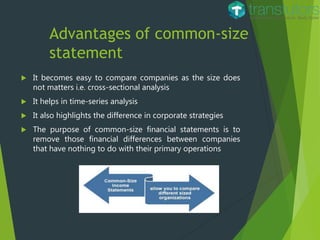
 It becomes easy to compare companies as the size does
not matters i.e. cross-sectional analysis
 It helps in time-series analysis
 It also highlights the difference in corporate strategies
 The purpose of common-size financial statements is to
remove those financial differences between companies
that have nothing to do with their primary operations
Disadvantages of common-
size statement
 Common-size becomes useless if consistency is not
maintained in accounting policies, concepts, and
conventions.
 A Common-size is based on historical data, therefore, it
does not recognize changes in price level.
 Window dressing is very common in the financial
statement. The Common-size statement does not address
the issue of window dressing.
 The Common-size statement does not give importance to
qualitative elements of the firm.
 The Common-size statement does not ascertain the
Current Ratio, Liquid Ratio, Debt-Equity Capital Ratio,
Capital Gearing Ratio etc. which are very useful in testing
liquidity and solvency position of a firm.
Financial statement analysis
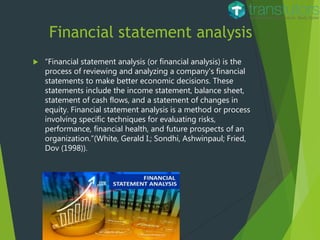
 “Financial statement analysis (or financial analysis) is the
process of reviewing and analyzing a company's financial
statements to make better economic decisions. These
statements include the income statement, balance sheet,
statement of cash flows, and a statement of changes in
equity. Financial statement analysis is a method or process
involving specific techniques for evaluating risks,
performance, financial health, and future prospects of an
organization.”(White, Gerald I.; Sondhi, Ashwinpaul; Fried,
Dov (1998)).
Process of Financial
Statement Analysis
 Articulate the purpose and context of the analysis.
 Collect input data.
 Process data.
 Analyze/interpret the processed data
 Develop and communicate conclusions and
recommendations (e.g., with an analysis report).
 Follow-up”
Tools of Financial statement
analysis
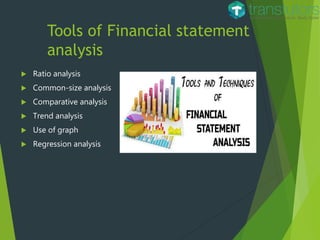
 Ratio analysis
 Common-size analysis
 Comparative analysis
 Trend analysis
 Use of graph
 Regression analysis
Hey Friends,
This was just a summary on Common-size
Income Statement and Balance Sheet. For
more detailed information on this topic, please
type the link given below or copy it from the
description of this PPT and open it in a new
browser window.
http://www.transtutors.com/homework-
help/accounting/common-size-income-
statement-and-balance-sheet.aspx

Common Size Income Statement and Balance Sheet | Accounting

  • 1.
  • 2.
    What is incomestatement and balance sheet? An income statement or profit and loss account (also referred to as a profit and loss statement (P&L), statement of profit or loss, revenue statement, statement of financial performance, earnings statement, operating statement, or statement of operations) is one of the financial statements of a company and shows the company’s revenues and expenses during a particular period.” A balance sheet is a financial statement that shows a company's assets, liabilities and shareholders' equity at a specific point in time.
  • 3.
    Common-size statement  TheCommon-size statement is the statements in which amounts of individual items of the income statement and balance sheet are recorded and are further converted into a percentage to a common base  The Common-size income statement is an income statement in which each amount is expressed as a percentage of the revenue. It also allows determining how the various components of the income statement affect a company's profit.  A Common-size balance sheet is a balance sheet in which each amount is expressed as a relative percentage of total assets, total liabilities, and equity accounts. It is generally provided as a comparison against previous time periods.
  • 4.
    Advantages of common-size statement It becomes easy to compare companies as the size does not matters i.e. cross-sectional analysis  It helps in time-series analysis  It also highlights the difference in corporate strategies  The purpose of common-size financial statements is to remove those financial differences between companies that have nothing to do with their primary operations
  • 5.
    Disadvantages of common- sizestatement  Common-size becomes useless if consistency is not maintained in accounting policies, concepts, and conventions.  A Common-size is based on historical data, therefore, it does not recognize changes in price level.  Window dressing is very common in the financial statement. The Common-size statement does not address the issue of window dressing.  The Common-size statement does not give importance to qualitative elements of the firm.  The Common-size statement does not ascertain the Current Ratio, Liquid Ratio, Debt-Equity Capital Ratio, Capital Gearing Ratio etc. which are very useful in testing liquidity and solvency position of a firm.
  • 6.
    Financial statement analysis “Financial statement analysis (or financial analysis) is the process of reviewing and analyzing a company's financial statements to make better economic decisions. These statements include the income statement, balance sheet, statement of cash flows, and a statement of changes in equity. Financial statement analysis is a method or process involving specific techniques for evaluating risks, performance, financial health, and future prospects of an organization.”(White, Gerald I.; Sondhi, Ashwinpaul; Fried, Dov (1998)).
  • 7.
    Process of Financial StatementAnalysis  Articulate the purpose and context of the analysis.  Collect input data.  Process data.  Analyze/interpret the processed data  Develop and communicate conclusions and recommendations (e.g., with an analysis report).  Follow-up”
  • 8.
    Tools of Financialstatement analysis  Ratio analysis  Common-size analysis  Comparative analysis  Trend analysis  Use of graph  Regression analysis
  • 9.
    Hey Friends, This wasjust a summary on Common-size Income Statement and Balance Sheet. For more detailed information on this topic, please type the link given below or copy it from the description of this PPT and open it in a new browser window. http://www.transtutors.com/homework- help/accounting/common-size-income- statement-and-balance-sheet.aspx