Income Statement Gaurav Taranekar 09PR001012B067
What is Income Statement Evaluate the past performance of the enterprise. Provide a basis for predicting future performance. Help assess the risk or uncertainty of achieving future cash flows.
Limitations of the Income Statement Items that cannot be measured reliably are not reported in the income statement. Income numbers are affected by the accounting methods employed. Income measurement involves judgment.
The Single Step Income Statement This statement presents information in broad categories. Major sections are Revenues and Expenses.  The Earnings per Share amount is shown at the bottom of the statement.  There is no distinction between  operating and non-operating  activities.
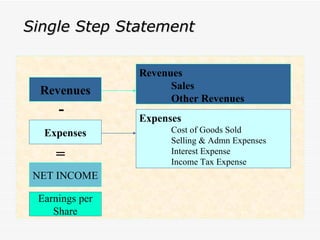
Single Step Statement Earnings per Share NET INCOME - = Revenues Revenues Sales Other Revenues Expenses Cost of Goods Sold Selling & Admn Expenses Interest Expense Income Tax Expense Expenses
The Multiple Step Income Statement The presentation divides information into major sections on the statement. The statement distinguishes operating from non-operating activities. Continuing operations are shown separately from irregular items. The income tax effects are shown separately as well.
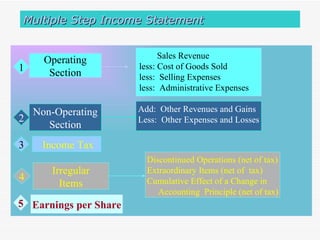
Multiple Step Income Statement Operating Section Sales Revenue less: Cost of Goods Sold less:  Selling Expenses less:  Administrative Expenses 1 Non-Operating Section Add:  Other Revenues and Gains Less:  Other Expenses and Losses 2 Income Tax 3 Irregular Items Discontinued Operations (net of tax) Extraordinary Items (net of  tax) Cumulative Effect of a Change in  Accounting  Principle (net of tax) 4 Earnings per Share 5
Irregular Items:  Discontinued Operations
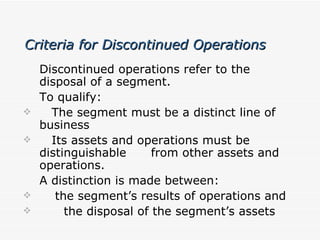
Criteria for Discontinued Operations Discontinued operations refer to the disposal of a segment. To qualify: The segment must be a distinct line of business Its assets and operations must be distinguishable  from other assets and operations. A distinction is made between: the segment’s results of operations and the disposal of the segment’s assets
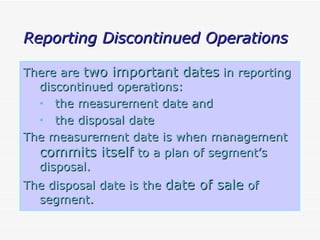
Reporting Discontinued Operations There are  two important dates  in reporting discontinued operations: the measurement date and the disposal date The measurement date is when management  commits itself  to a plan of segment’s disposal. The disposal date is the  date of sale  of segment.
Irregular Items: Extraordinary Items
Extraordinary Items Extraordinary  items are: nonrecurring  material  items that differ  significantly  from typical activities Extraordinary items must meet  two tests : they must be unusual  and they must be infrequent   The  environment  in which the business operates is of primary importance
Extraordinary Items: what they  are not Losses from write-down or write-off of receivables, inventories, etc.  Gains and losses from exchange or translation of foreign currency Gains and losses from the abandonment of  property used in business Effects of strike Adjustments or accruals on long term contracts.
Unusual Gains & Losses Items that are unusual OR infrequent, but not both. If material, disclose separately. Do not disclose, net of taxes .
Irregular Items: Cumulative Effect of a Change in Accounting Principle
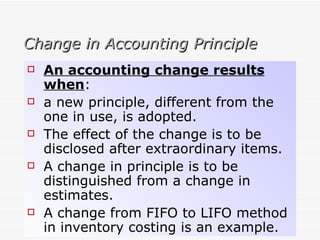
Change in Accounting Principle An accounting change results when : a new principle, different from the one in use, is adopted. The effect of the change is to be disclosed after extraordinary items. A change in principle is to be distinguished from a change in estimates. A change from FIFO to LIFO method in inventory costing is an example.
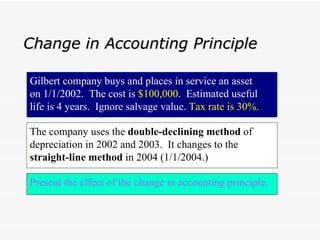
Change in Accounting Principle Gilbert company buys and places in service an asset on 1/1/2002.  The cost is  $100,000 .  Estimated useful life is 4 years.  Ignore salvage value.  Tax rate is 30%. The company uses the  double-declining method  of  depreciation in 2002 and 2003.  It changes to the  straight-line method  in 2004 (1/1/2004.)  Present the effect of the change in accounting principle.
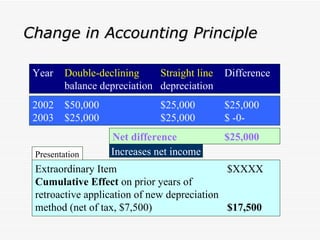
Change in Accounting Principle Year Double-declining Straight line Difference balance depreciation depreciation 2002 $50,000 $25,000 $25,000 2003 $25,000 $25,000 $ -0- Extraordinary Item $XXXX Cumulative Effect  on prior years of retroactive application of new depreciation method (net of tax, $7,500) $17,500 Presentation Net difference   $25,000 Increases net income
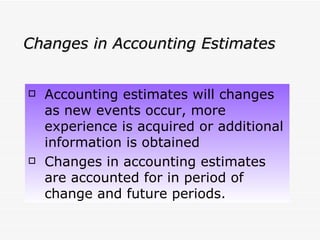
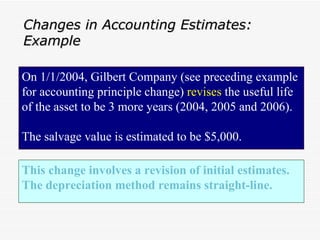
Changes in Accounting Estimates Accounting estimates will changes as new events occur, more experience is acquired or additional information is obtained Changes in accounting estimates are accounted for in period of change and future periods.
Changes in Accounting Estimates: Example On 1/1/2004, Gilbert Company (see preceding example  for accounting principle change)  revises  the useful life of the asset to be 3 more years (2004, 2005 and 2006). The salvage value is estimated to be $5,000. This change involves a revision of initial estimates. The depreciation method remains straight-line.
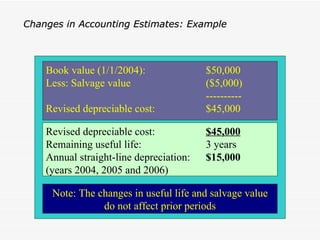
Changes in Accounting Estimates: Example Book value (1/1/2004): $50,000 Less: Salvage value ($5,000) ---------- Revised depreciable cost: $45,000 Revised depreciable cost: $45,000 Remaining useful life: 3 years Annual straight-line depreciation: $15,000 (years 2004, 2005 and 2006) Note: The changes in useful life and salvage value do not affect prior periods
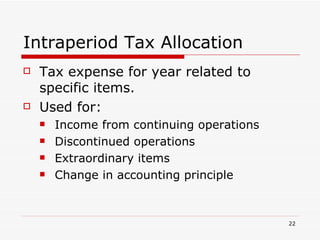
Intraperiod Tax Allocation Tax expense for year related to specific items. Used for: Income from continuing operations Discontinued operations Extraordinary items Change in accounting principle
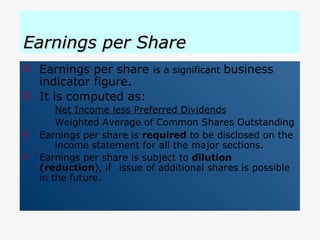
Earnings per Share Earnings per share  is a significant  business indicator figure. It is computed as: Net Income less Preferred Dividends Weighted Average of Common Shares Outstanding Earnings per share is  required  to be disclosed on the  income statement for all the major sections. Earnings per share is subject to  dilution (reduction ), if  issue of additional shares is possible in the future.
Retained Earnings Statement Retained earnings are increased by net income and decreased by net loss and dividends for the year. Corrections of errors in prior period financial statements are shown as prior period adjustments to the beginning balance in retained earnings. Any part of retained earnings, appropriated for a specific purpose, is shown as restricted earnings.
Other Comprehensive Income – all changes in equity during a period, except those resulting from investments by or distributions to owners.
Other Comprehensive Income must be displayed as: A separate statement of comprehensive income  OR Combined income statement and comprehensive income statement OR Part of statement of stockholders equity

Income statement

  • 1.
    Income Statement GauravTaranekar 09PR001012B067
  • 2.
    What is IncomeStatement Evaluate the past performance of the enterprise. Provide a basis for predicting future performance. Help assess the risk or uncertainty of achieving future cash flows.
  • 3.
    Limitations of theIncome Statement Items that cannot be measured reliably are not reported in the income statement. Income numbers are affected by the accounting methods employed. Income measurement involves judgment.
  • 4.
    The Single StepIncome Statement This statement presents information in broad categories. Major sections are Revenues and Expenses. The Earnings per Share amount is shown at the bottom of the statement. There is no distinction between operating and non-operating activities.
  • 5.
    Single Step StatementEarnings per Share NET INCOME - = Revenues Revenues Sales Other Revenues Expenses Cost of Goods Sold Selling & Admn Expenses Interest Expense Income Tax Expense Expenses
  • 6.
    The Multiple StepIncome Statement The presentation divides information into major sections on the statement. The statement distinguishes operating from non-operating activities. Continuing operations are shown separately from irregular items. The income tax effects are shown separately as well.
  • 7.
    Multiple Step IncomeStatement Operating Section Sales Revenue less: Cost of Goods Sold less: Selling Expenses less: Administrative Expenses 1 Non-Operating Section Add: Other Revenues and Gains Less: Other Expenses and Losses 2 Income Tax 3 Irregular Items Discontinued Operations (net of tax) Extraordinary Items (net of tax) Cumulative Effect of a Change in Accounting Principle (net of tax) 4 Earnings per Share 5
  • 8.
    Irregular Items: Discontinued Operations
  • 9.
    Criteria for DiscontinuedOperations Discontinued operations refer to the disposal of a segment. To qualify: The segment must be a distinct line of business Its assets and operations must be distinguishable from other assets and operations. A distinction is made between: the segment’s results of operations and the disposal of the segment’s assets
  • 10.
    Reporting Discontinued OperationsThere are two important dates in reporting discontinued operations: the measurement date and the disposal date The measurement date is when management commits itself to a plan of segment’s disposal. The disposal date is the date of sale of segment.
  • 11.
  • 12.
    Extraordinary Items Extraordinary items are: nonrecurring material items that differ significantly from typical activities Extraordinary items must meet two tests : they must be unusual and they must be infrequent The environment in which the business operates is of primary importance
  • 13.
    Extraordinary Items: whatthey are not Losses from write-down or write-off of receivables, inventories, etc. Gains and losses from exchange or translation of foreign currency Gains and losses from the abandonment of property used in business Effects of strike Adjustments or accruals on long term contracts.
  • 14.
    Unusual Gains &Losses Items that are unusual OR infrequent, but not both. If material, disclose separately. Do not disclose, net of taxes .
  • 15.
    Irregular Items: CumulativeEffect of a Change in Accounting Principle
  • 16.
    Change in AccountingPrinciple An accounting change results when : a new principle, different from the one in use, is adopted. The effect of the change is to be disclosed after extraordinary items. A change in principle is to be distinguished from a change in estimates. A change from FIFO to LIFO method in inventory costing is an example.
  • 17.
    Change in AccountingPrinciple Gilbert company buys and places in service an asset on 1/1/2002. The cost is $100,000 . Estimated useful life is 4 years. Ignore salvage value. Tax rate is 30%. The company uses the double-declining method of depreciation in 2002 and 2003. It changes to the straight-line method in 2004 (1/1/2004.) Present the effect of the change in accounting principle.
  • 18.
    Change in AccountingPrinciple Year Double-declining Straight line Difference balance depreciation depreciation 2002 $50,000 $25,000 $25,000 2003 $25,000 $25,000 $ -0- Extraordinary Item $XXXX Cumulative Effect on prior years of retroactive application of new depreciation method (net of tax, $7,500) $17,500 Presentation Net difference $25,000 Increases net income
  • 19.
    Changes in AccountingEstimates Accounting estimates will changes as new events occur, more experience is acquired or additional information is obtained Changes in accounting estimates are accounted for in period of change and future periods.
  • 20.
    Changes in AccountingEstimates: Example On 1/1/2004, Gilbert Company (see preceding example for accounting principle change) revises the useful life of the asset to be 3 more years (2004, 2005 and 2006). The salvage value is estimated to be $5,000. This change involves a revision of initial estimates. The depreciation method remains straight-line.
  • 21.
    Changes in AccountingEstimates: Example Book value (1/1/2004): $50,000 Less: Salvage value ($5,000) ---------- Revised depreciable cost: $45,000 Revised depreciable cost: $45,000 Remaining useful life: 3 years Annual straight-line depreciation: $15,000 (years 2004, 2005 and 2006) Note: The changes in useful life and salvage value do not affect prior periods
  • 22.
    Intraperiod Tax AllocationTax expense for year related to specific items. Used for: Income from continuing operations Discontinued operations Extraordinary items Change in accounting principle
  • 23.
    Earnings per ShareEarnings per share is a significant business indicator figure. It is computed as: Net Income less Preferred Dividends Weighted Average of Common Shares Outstanding Earnings per share is required to be disclosed on the income statement for all the major sections. Earnings per share is subject to dilution (reduction ), if issue of additional shares is possible in the future.
  • 24.
    Retained Earnings StatementRetained earnings are increased by net income and decreased by net loss and dividends for the year. Corrections of errors in prior period financial statements are shown as prior period adjustments to the beginning balance in retained earnings. Any part of retained earnings, appropriated for a specific purpose, is shown as restricted earnings.
  • 25.
    Other Comprehensive Income– all changes in equity during a period, except those resulting from investments by or distributions to owners.
  • 26.
    Other Comprehensive Incomemust be displayed as: A separate statement of comprehensive income OR Combined income statement and comprehensive income statement OR Part of statement of stockholders equity

Editor's Notes