Dr.E.RAMAPRABA,
ASSISTANT PROFESSOR OF COMMERCE
BON SECOURS COLLEGE FOR WOMEN,
THANJAVUR.
COMMON – SIZE STATEMENT
Meaning
1. In financial statement, namely common-size income statement (i.e. common –
size profit and loss account) and common – size position statement (i.e. common
– size balance sheet) certain items are taken as common items and every
component item is exposed as a percentage of that common item.
2. For example, in the case of common- size income statement, the total sales is
taken as 100 and all other component items of such income statement are
expressed as a percentage to sales.
3. Further, in the case of common – size position statement, the total assets is taken
as 100 and all other component items of assets side of the balance sheet are
expressed as a percentage to that total.
4. So also each individual item of capital and liabilities is expressed as a percentage
to the total liabilities which is taken as 100 in common- size statements.
5. As the total sales the total assets and the total liabilities are taken as 100
percentage and every other individual item is expressed as a percentage to the
total sales, total assets and total liabilities, common – size statements are also
known as 100 percent statements.
6. Further, as every component item is expressed as a percentage to total (i.e) total
sales, total assets and total liabilities, common-size statements are also called
component percentage statements.
NOTE:
The two common- size statements are:
(i) Common – size income statement (common – size profit and loss account)
(ii) Common – size position statement (Balance sheet)
Common –Size Income Statement
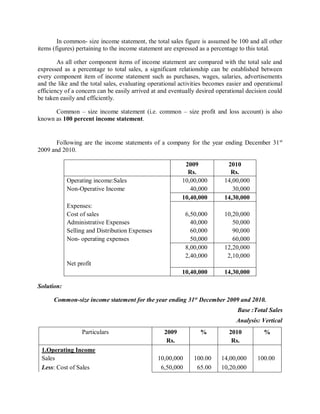
In common- size income statement, the total sales figure is assumed be 100 and all other
items (figures) pertaining to the income statement are expressed as a percentage to this total.
As all other component items of income statement are compared with the total sale and
expressed as a percentage to total sales, a significant relationship can be established between
every component item of income statement such as purchases, wages, salaries, advertisements
and the like and the total sales, evaluating operational activities becomes easier and operational
efficiency of a concern can be easily arrived at and eventually desired operational decision could
be taken easily and efficiently.
Common – size income statement (i.e. common – size profit and loss account) is also
known as 100 percent income statement.
Following are the income statements of a company for the year ending December 31st
2009 and 2010.
2009
Rs.
2010
Rs.
Operating income:Sales 10,00,000 14,00,000
Non-Operative Income 40,000 30,000
10,40,000 14,30,000
Expenses:
Cost of sales 6,50,000 10,20,000
Administrative Expenses 40,000 50,000
Selling and Distribution Expenses 60,000 90,000
Non- operating expenses 50,000 60,000
8,00,000 12,20,000
Net profit
2,40,000 2,10,000
10,40,000 14,30,000
Solution:
Common-size income statement for the year ending 31st
December 2009 and 2010.
Base :Total Sales
Analysis: Vertical
Particulars 2009
Rs.
% 2010
Rs.
%
1.Operating Income
Sales 10,00,000 100.00 14,00,000 100.00
Less: Cost of Sales 6,50,000 65.00 10,20,000
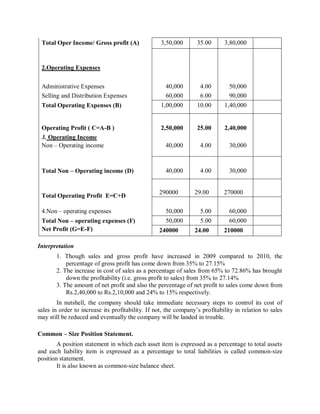
Total Oper Income/ Gross profit (A)
2.Operating Expenses
3,50,000 35.00 3,80,000
Administrative Expenses 40,000 4.00 50,000
Selling and Distribution Expenses 60,000 6.00 90,000
Total Operating Expenses (B) 1,00,000 10.00 1,40,000
Operating Profit ( C=A-B ) 2,50,000 25.00 2,40,000
3. Operating Income
Non – Operating income 40,000 4.00 30,000
Total Non – Operating income (D)
Total Operating Profit E=C+D
40,000 4.00 30,000
290000 29.00 270000
4.Non – operating expenses 50,000 5.00 60,000
Total Non – operating expenses (F)
Net Profit (G=E-F)
50,000 5.00 60,000
240000 24.00 210000
Interpretation
1. Though sales and gross profit have increased in 2009 compared to 2010, the
percentage of gross profit has come down from 35% to 27.15%
2. The increase in cost of sales as a percentage of sales from 65% to 72.86% has brought
down the profitability (i.e. gross profit to sales) from 35% to 27.14%
3. The amount of net profit and also the percentage of net profit to sales come down from
Rs.2,40,000 to Rs.2,10,000 and 24% to 15% respectively.
In nutshell, the company should take immediate necessary steps to control its cost of
sales in order to increase its profitability. If not, the company’s profitability in relation to sales
may still be reduced and eventually the company will be landed in trouble.
Common – Size Position Statement.
A position statement in which each asset item is expressed as a percentage to total assets
and each liability item is expressed as a percentage to total liabilities is called common-size
position statement.
It is also known as common-size balance sheet.
Illustration
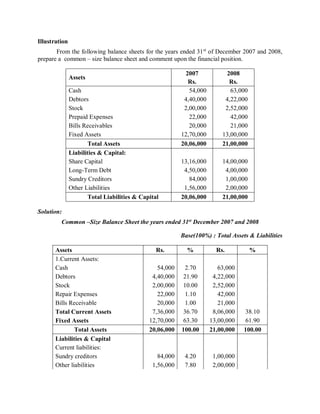
From the following balance sheets for the years ended 31st
of December 2007 and 2008,
prepare a common – size balance sheet and comment upon the financial position.
Assets
2007
Rs.
2008
Rs.
Cash 54,000 63,000
Debtors 4,40,000 4,22,000
Stock 2,00,000 2,52,000
Prepaid Expenses 22,000 42,000
Bills Receivables 20,000 21,000
Fixed Assets 12,70,000 13,00,000
Total Assets 20,06,000 21,00,000
Liabilities & Capital:
Share Capital 13,16,000 14,00,000
Long-Term Debt 4,50,000 4,00,000
Sundry Creditors 84,000 1,00,000
Other Liabilities 1,56,000 2,00,000
Total Liabilities & Capital 20,06,000 21,00,000
Solution:
Common –Size Balance Sheet the years ended 31st
December 2007 and 2008
Base(100%) : Total Assets & Liabilities
Assets Rs. % Rs. %
1.Current Assets:
Cash 54,000 2.70 63,000
Debtors 4,40,000 21.90 4,22,000
Stock 2,00,000 10.00 2,52,000
Repair Expenses 22,000 1.10 42,000
Bills Receivable 20,000 1.00 21,000
Total Current Assets 7,36,000 36.70 8,06,000 38.10
Fixed Assets 12,70,000 63.30 13,00,000 61.90
Total Assets 20,06,000 100.00 21,00,000 100.00
Liabilities & Capital
Current liabilities:
Sundry creditors 84,000 4.20 1,00,000
Other liabilities 1,56,000 7.80 2,00,000
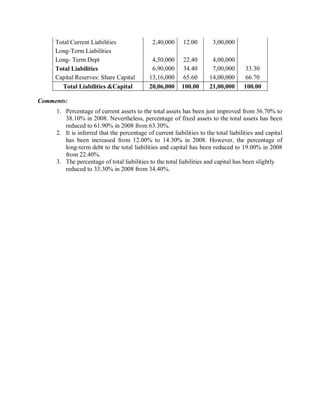
Total Current Liabilities 2,40,000 12.00 3,00,000
Long-Term Liabilities
Long- Term Dept 4,50,000 22.40 4,00,000
Total Liabilities 6,90,000 34.40 7,00,000 33.30
Capital Reserves: Share Capital 13,16,000 65.60 14,00,000 66.70
Total Liabilities &Capital 20,06,000 100.00 21,00,000 100.00
Comments:
1. Percentage of current assets to the total assets has been just improved from 36.70% to
38.10% in 2008. Nevertheless, percentage of fixed assets to the total assets has been
reduced to 61.90% in 2008 from 63.30%.
2. It is inferred that the percentage of current liabilities to the total liabilities and capital
has been increased from 12.00% to 14.30% in 2008. However, the percentage of
long-term debt to the total liabilities and capital has been reduced to 19.00% in 2008
from 22.40%.
3. The percentage of total liabilities to the total liabilities and capital has been slightly
reduced to 33.30% in 2008 from 34.40%.

Common size statement

  • 1.
    Dr.E.RAMAPRABA, ASSISTANT PROFESSOR OFCOMMERCE BON SECOURS COLLEGE FOR WOMEN, THANJAVUR. COMMON – SIZE STATEMENT Meaning 1. In financial statement, namely common-size income statement (i.e. common – size profit and loss account) and common – size position statement (i.e. common – size balance sheet) certain items are taken as common items and every component item is exposed as a percentage of that common item. 2. For example, in the case of common- size income statement, the total sales is taken as 100 and all other component items of such income statement are expressed as a percentage to sales. 3. Further, in the case of common – size position statement, the total assets is taken as 100 and all other component items of assets side of the balance sheet are expressed as a percentage to that total. 4. So also each individual item of capital and liabilities is expressed as a percentage to the total liabilities which is taken as 100 in common- size statements. 5. As the total sales the total assets and the total liabilities are taken as 100 percentage and every other individual item is expressed as a percentage to the total sales, total assets and total liabilities, common – size statements are also known as 100 percent statements. 6. Further, as every component item is expressed as a percentage to total (i.e) total sales, total assets and total liabilities, common-size statements are also called component percentage statements. NOTE: The two common- size statements are: (i) Common – size income statement (common – size profit and loss account) (ii) Common – size position statement (Balance sheet) Common –Size Income Statement
  • 2.
    In common- sizeincome statement, the total sales figure is assumed be 100 and all other items (figures) pertaining to the income statement are expressed as a percentage to this total. As all other component items of income statement are compared with the total sale and expressed as a percentage to total sales, a significant relationship can be established between every component item of income statement such as purchases, wages, salaries, advertisements and the like and the total sales, evaluating operational activities becomes easier and operational efficiency of a concern can be easily arrived at and eventually desired operational decision could be taken easily and efficiently. Common – size income statement (i.e. common – size profit and loss account) is also known as 100 percent income statement. Following are the income statements of a company for the year ending December 31st 2009 and 2010. 2009 Rs. 2010 Rs. Operating income:Sales 10,00,000 14,00,000 Non-Operative Income 40,000 30,000 10,40,000 14,30,000 Expenses: Cost of sales 6,50,000 10,20,000 Administrative Expenses 40,000 50,000 Selling and Distribution Expenses 60,000 90,000 Non- operating expenses 50,000 60,000 8,00,000 12,20,000 Net profit 2,40,000 2,10,000 10,40,000 14,30,000 Solution: Common-size income statement for the year ending 31st December 2009 and 2010. Base :Total Sales Analysis: Vertical Particulars 2009 Rs. % 2010 Rs. % 1.Operating Income Sales 10,00,000 100.00 14,00,000 100.00 Less: Cost of Sales 6,50,000 65.00 10,20,000
  • 3.
    Total Oper Income/Gross profit (A) 2.Operating Expenses 3,50,000 35.00 3,80,000 Administrative Expenses 40,000 4.00 50,000 Selling and Distribution Expenses 60,000 6.00 90,000 Total Operating Expenses (B) 1,00,000 10.00 1,40,000 Operating Profit ( C=A-B ) 2,50,000 25.00 2,40,000 3. Operating Income Non – Operating income 40,000 4.00 30,000 Total Non – Operating income (D) Total Operating Profit E=C+D 40,000 4.00 30,000 290000 29.00 270000 4.Non – operating expenses 50,000 5.00 60,000 Total Non – operating expenses (F) Net Profit (G=E-F) 50,000 5.00 60,000 240000 24.00 210000 Interpretation 1. Though sales and gross profit have increased in 2009 compared to 2010, the percentage of gross profit has come down from 35% to 27.15% 2. The increase in cost of sales as a percentage of sales from 65% to 72.86% has brought down the profitability (i.e. gross profit to sales) from 35% to 27.14% 3. The amount of net profit and also the percentage of net profit to sales come down from Rs.2,40,000 to Rs.2,10,000 and 24% to 15% respectively. In nutshell, the company should take immediate necessary steps to control its cost of sales in order to increase its profitability. If not, the company’s profitability in relation to sales may still be reduced and eventually the company will be landed in trouble. Common – Size Position Statement. A position statement in which each asset item is expressed as a percentage to total assets and each liability item is expressed as a percentage to total liabilities is called common-size position statement. It is also known as common-size balance sheet.
  • 4.
    Illustration From the followingbalance sheets for the years ended 31st of December 2007 and 2008, prepare a common – size balance sheet and comment upon the financial position. Assets 2007 Rs. 2008 Rs. Cash 54,000 63,000 Debtors 4,40,000 4,22,000 Stock 2,00,000 2,52,000 Prepaid Expenses 22,000 42,000 Bills Receivables 20,000 21,000 Fixed Assets 12,70,000 13,00,000 Total Assets 20,06,000 21,00,000 Liabilities & Capital: Share Capital 13,16,000 14,00,000 Long-Term Debt 4,50,000 4,00,000 Sundry Creditors 84,000 1,00,000 Other Liabilities 1,56,000 2,00,000 Total Liabilities & Capital 20,06,000 21,00,000 Solution: Common –Size Balance Sheet the years ended 31st December 2007 and 2008 Base(100%) : Total Assets & Liabilities Assets Rs. % Rs. % 1.Current Assets: Cash 54,000 2.70 63,000 Debtors 4,40,000 21.90 4,22,000 Stock 2,00,000 10.00 2,52,000 Repair Expenses 22,000 1.10 42,000 Bills Receivable 20,000 1.00 21,000 Total Current Assets 7,36,000 36.70 8,06,000 38.10 Fixed Assets 12,70,000 63.30 13,00,000 61.90 Total Assets 20,06,000 100.00 21,00,000 100.00 Liabilities & Capital Current liabilities: Sundry creditors 84,000 4.20 1,00,000 Other liabilities 1,56,000 7.80 2,00,000
  • 5.
    Total Current Liabilities2,40,000 12.00 3,00,000 Long-Term Liabilities Long- Term Dept 4,50,000 22.40 4,00,000 Total Liabilities 6,90,000 34.40 7,00,000 33.30 Capital Reserves: Share Capital 13,16,000 65.60 14,00,000 66.70 Total Liabilities &Capital 20,06,000 100.00 21,00,000 100.00 Comments: 1. Percentage of current assets to the total assets has been just improved from 36.70% to 38.10% in 2008. Nevertheless, percentage of fixed assets to the total assets has been reduced to 61.90% in 2008 from 63.30%. 2. It is inferred that the percentage of current liabilities to the total liabilities and capital has been increased from 12.00% to 14.30% in 2008. However, the percentage of long-term debt to the total liabilities and capital has been reduced to 19.00% in 2008 from 22.40%. 3. The percentage of total liabilities to the total liabilities and capital has been slightly reduced to 33.30% in 2008 from 34.40%.