FINANCIAL
STATEMENTS
Prepared by:
“General-
Purpose”
U B L D
M
J
R
E
T L E
S
E
T
Bring out your pen
and paper.
R R E O
P
T
1
R R E O
P
T
REPORT
S
2
C I E N D O I
S C I E N D O I
DECISION
O D E I
P
R
3
O D E I
P
R
PERIOD
Y N T I
T
E
4
Y N T I
T
E
ENTITY
R E S
S
U
5
R E S
S
U
USERS
FINANCIAL
STATEMENTS
“General-
Purpose”
Learning Outcomes
After studying this topic, students are expected to be able to:
● Define financial statements;
● List the types of financial statements and their corresponding elements;
● Explain the purpose, underlying concepts, and format of financial statements; and
● Build a pro forma financial statement.
01
FINANCIAL STATEMENT
OVERVIEW
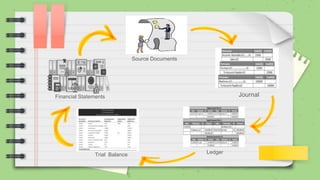
- are collection of summary-level
reports about an entity’s financial
results, financial position, and
cash flows that are periodically
communicated to the users.
- are the end product or main
output of the financial accounting
process.
Financial Statements
Trial Balance Ledger
Journal
Source Documents
Financial Statements
02
FINANCIAL STATEMENT
OBJECTIVE
“To provide information about the
financial position, financial
performance, and cash flows of an
entity that is useful to a wide range
of users in making economic
decisions.”
General Purpose Financial Statement
03
FINANCIAL STATEMENT
USERS
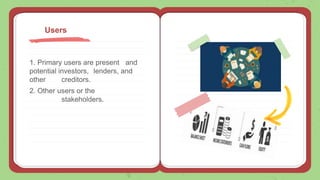
1. Primary users are present and
potential investors, lenders, and
other creditors.
2. Other users or the
stakeholders.
Users
QUALITATIVE
CHARACTERISTIC
04
FINANCIAL STATEMENT
1.Fundamental Qualities:
A.Relevance
- Predictive Value
- Confirmatory Value
- Materiality
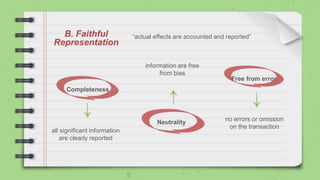
B.Faithful Representation
- Completeness
- Neutrality
- Free from error
Qualitative Characteristic
Predictive
Value
Confirmatory
Value
Materiality
used as an input to
predict future outcome of
events
nature and magnitude
of items which it
relates
provides feedback of
previous
expectations
A. Relevance “making difference in decisions made”
B. Faithful
Representation
Completeness
Neutrality
Free from error
all significant information
are clearly reported
no errors or omission
on the transaction
information are free
from bias
“actual effects are accounted and reported”
2. Enhancing Qualities:
- Comparability
- Verifiability
- Timeliness
- Understandability
Qualitative Characteristic
Enhancing Qualities
Timeliness
Understandability
noting points of
likeliness and
difference
presented clearly
and concisely
reaching concensus
available to influence
decisions
Comparability
Verifiability
COMPONENTS
05
FINANCIAL STATEMENT
Components:
Elements
Types
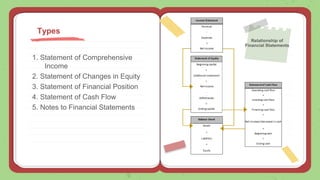
1. Statement of Comprehensive
Income
2. Statement of Changes in Equity
3. Statement of Financial Position
4. Statement of Cash Flow
5. Notes to Financial Statements
Types
Relationship of
Financial Statements
- assets
- liabilities
- equity
- income and expenses, including
gains and losses
- contributions by owners
- distribution to owners
- cash flows
Elements
Chart of Accounts
Assets (100-199)
Liabilities (200-299)
Equity (300-399)
Income (400-499)
Expenses (500-599)
Normal Balances
Assets Debit
Contra Asset Credit
Liability Credit
Contra Liability Debit
Equity Credit
Withdrawal Debit
Dvidends Debit
Income Credit
Expenses Debit
Gains Credit
Losses Debit
- is a formal statement showing the financial
performance of an entity for a given period of time.
Statement of Comprehensive Income
Presentation
Profit or
Loss
Other
Comprehensive
Income
Two
Statement
Income
Statement
Statement of
Comprehensive
Income
Single
Statement
Statement of Financial
Performance
1. Service - perform services for a fee.
2. Merchandising - selling of finished product by other
businesses.
3. Manufacturing - involved in conversion of raw
materials into some tangible, physical
product.
Statement of Comprehensive Income
Elements of Income Statement
Income
Revenue
Expenses
- expenses that arise
in the course of
ordinary regular
activities.
Gains
Includes:
- Sales
- Fees
- Interest Income
- Dividends
- Royalties
- Rent Income
Losses
Essence:
REGULARITY
Statement of Comprehensive Income
Functional Presentation
Expenses:
Distribution cost
Administrative cost
Other costs
Finance cost
Natural Presentation
Expenses:
Increase/ decrease in
inventory
Net purchases
Employee benefit costs
Sales commission
Advertising
Supplies expense
Delivery expense
Depreciation
Taxes and licenses
Doubtful accounts
Other expenses
Natural
Functional
Statement of Comprehensive Income
[Company Name]
Income Statement
For the Year Ended
Revenue
Less: Operating Expenses
Earnings before interest and tax
Less: Interest expense
Less: Tax Expense
Net income after tax
[Company Name]
Income Statement
For the Year Ended
Sales
Less: Cost of goods sold
Gross profit
Less: Operating expenses
Earnings before interest and tax
Less: Interest expense
Less: Tax Expense
Net income after tax
Service Business
Merchandising and
Manufacturing
Business
Statement of Comprehensive Income
Merchandising
business
Cost of Goods Sold
Beginninginventory
Net purchases
Goods available for sale
Endinginventory
Cost of goods sold
Cost of Goods Manufactured
Beginning raw materials
Net purchases
Raw materials available for use
Less: Ending raw materials
Raw materials used
Direct labor
Factory overhead
Total manufacturing cost
Beginning goods in process
Total cost of goods in process
Less: Ending goods in process
Cost of goods manufactured
Cost of Goods Sold
Cost of goods manufactured
Beginning finiished goods
Goods available for sale
Less: Ending finished goods
Cost of goods sold
Manufacturing
Business
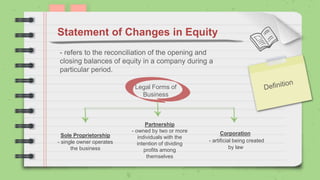
- refers to the reconciliation of the opening and
closing balances of equity in a company during a
particular period.
Statement of Changes in Equity
Sole Proprietorship
- single owner operates
the business
Legal Forms of
Business
Corporation
- artificial being created
by law
Partnership
- owned by two or more
individuals with the
intention of dividing
profits among
themselves
Elements of Changes in Equity
Contribution
by Owners
increase to equity
resulting from asset
investment
Distribution
to Owners
decrease to equity
resulting from
distribution of asset
Statement of Changes in Equity
[Company Name]
Statement of Changes in
Owner's Equity
For the Year Ended
[Name], Capital, beginning
Net income
Less: Withdawals
[Name], Capital, ending
[Company Name]
Statement of Changes in Partners' Equity
For the Year Ended
[Name],
Capital
[Name],
Capital
Capital balances, beginning
Additional investments
Net income
Less: Withdrawals
Capital balances, ending
Sole proprietorship
Partnership
Statement of Changes in Equity
[Company Name]
Statement of Changes in Shareholders' Equity
For the Year Ended
Common
stock
Paid-in
capital
Retained
earnings
Treasury
Stock
Total
Beginning balance
Issued shares
Net income
Less: Dividends
Ending balance
Corporation
- is a formal statement showing three elements
comprising financial position, namely assets,
liabilities, and equity.
- users analyze the statement of financial position
to evaluate such factors as liquidity, solvency,
and the need of the entity for additional
financing.
Statement of Financial Position
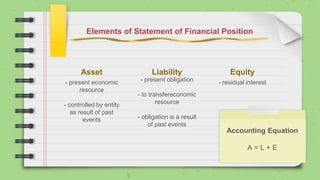
Elements of Statement of Financial Position
Asset
- present economic
resource
- controlled by entity
as result of past
events
Liability
- present obligation
- to transfereconomic
resource
- obligation is a result
of past events
Equity
- residual interest
Accounting Equation
A = L + E
Statement of Financial Position
Current Assets
Cash and cash equivalents
Trade and other receivables
Marketable securities
Prepaid expenses
Inventories
Noncurrent Assets
Propert, plant and equipment
Long-term investments
Intangible assets
Deferred tax assets
Other noncurrent assets
Current Liabilities
Trade and other payables
Current provisions
Short-term borrowing
Current portion of long-term
debt
Current tax liability
Noncurrent Liabilities
Noncurrent portion of long-term
debt
Finance lease liability
Deferred tax liability
Long-termobligations to company
officers
Long-term deferred revenue
Statement of Financial Position
Sole Proprietorship
[Name], Capital Partnership
[Name], Capital
[Name], Capital Corporation
Share Capital
Reserves/ Additional Paid-in
Capital
Accumulated profit/ loss
Less: Treasury shares
Statement of Financial Position
[Company Name]
Statement of Financial Position
As of the period
Assets
=
Liabilities
+
Equity
[Company Name]
Statement of Financial Position
As of the period
Assets
Liabilities
Equity
Report Form Account Form
- is a component of financial statements
summarizing the operating, investing, and financing
activities of an entity.
Statement of Cash Flow
cash payments
cash receipts
Cash
Flow
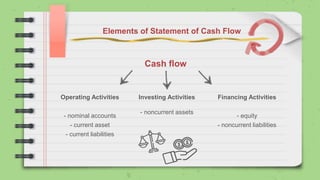
Elements of Statement of Cash Flow
Cash flow
Operating Activities
- nominal accounts
- current asset
- current liabilities
Financing Activities
- equity
- noncurrent liabilities
Investing Activities
- noncurrent assets
Statement of Cash Flow
[Company name]
Statement of Casf Flow
Year Ended
Cash flow for operating activties
Cash from customers
Cash from suppliers
Cash for opeerating expenses
Cash for interest
Cash for taxes
Net cash provided for operating activities
Cash flow for investing activties
Cash flow for financing activties
Increase (decrease) in cash and cash equivalents
Cash and cash equivalents, beginning
Cash and cash equivalents, ending
[Company name]
Statement of Casf Flow
Year Ended
Cash flow for operating activties
Net income
Amortization expense
(Increase) decrease adjustments in net income
Increase (decrease) in current asset and liability
Net cash provided for operating activities
Cash flow for investing activties
Cash flow for financing activties
Increase (decrease) in cash and cash equivalents
Cash and cash equivalents, beginning
Cash and cash equivalents, ending
- provide narrative description or disaggregation of items
presented in the financial statements and information
about items that do not qualify for recognition.
Notes to Financial Statements
financial
informations
non-financial
information
Presents
Necessary disclosures:
a. Summary of compliance with PFRS
b. Summary of significant accounting policy used
c. Supporting information or computation for line items
presented in the financial statements.
d. Other disclosures
Notes to Financial Statements
Note 1. Cash and cash equivalents
Cash on hand
Cash in bank
Treasury bill
Total cash and cash equivalents
Note 2. Trade and other receivables
Accounts receivable
Allowance for doubtful accounts
Notes receivable
Accrued interest on notes receivable
Advances to emplyees, collectible
currently
Total trade and other receivables
Note 3. Inventories
Finished goods
Goods in process
Raw materials
Manufacturing supplies
Total inventories
Note 4. Prepaid expenses
Office supplies unused
Prepaid insurance
Total prepaid expenses
Notes to Financial Statements
Note 5. Property, plant and equipment
Land
Building
Machinery and equipment
Furniture and fixtures
Total
Less: Accumulated depreciation, net
Carrying amount
Note 6. Long-term investments
Plant expansion fund
Investment in bonds
Cash surrender value
Total long-term investments
Note 7. Intangible assets
Patent
Franchise
Total intangible assets
Note 8. Other noncurrent assets
Long-term refundable deposit
Long-term advances to officers
Total other noncurrent assets
Notes to Financial Statements
Note 9. Trade and other payables
Accounts payable
Notes payable
Accrued interest on note payable
Income tax payable
Dividends payable
Accrued expenses
Total trade and other payables
Note 10. Reserves
Share premium
Retained earnings appropriated
for contingencies
Total reserves
End of
discussion
Thank you!
Assignment
Study:
- Limitations of financial reporting
- Responsibility of financial statements
- General feature of financial statements
- Identification of financial statement
Announcement

General-Purpose Financial Statements

  • 1.
  • 2.
    U B LD M J R E T L E S E T Bring out your pen and paper.
  • 3.
    R R EO P T 1
  • 4.
    R R EO P T REPORT
  • 5.
    S 2 C I EN D O I
  • 6.
    S C IE N D O I DECISION
  • 7.
    O D EI P R 3
  • 8.
    O D EI P R PERIOD
  • 9.
    Y N TI T E 4
  • 10.
    Y N TI T E ENTITY
  • 11.
  • 12.
  • 13.
  • 14.
    Learning Outcomes After studyingthis topic, students are expected to be able to: ● Define financial statements; ● List the types of financial statements and their corresponding elements; ● Explain the purpose, underlying concepts, and format of financial statements; and ● Build a pro forma financial statement.
  • 15.
  • 16.
    - are collectionof summary-level reports about an entity’s financial results, financial position, and cash flows that are periodically communicated to the users. - are the end product or main output of the financial accounting process. Financial Statements
  • 17.
    Trial Balance Ledger Journal SourceDocuments Financial Statements
  • 18.
  • 19.
    “To provide informationabout the financial position, financial performance, and cash flows of an entity that is useful to a wide range of users in making economic decisions.” General Purpose Financial Statement
  • 20.
  • 21.
    1. Primary usersare present and potential investors, lenders, and other creditors. 2. Other users or the stakeholders. Users
  • 22.
  • 23.
    1.Fundamental Qualities: A.Relevance - PredictiveValue - Confirmatory Value - Materiality B.Faithful Representation - Completeness - Neutrality - Free from error Qualitative Characteristic
  • 24.
    Predictive Value Confirmatory Value Materiality used as aninput to predict future outcome of events nature and magnitude of items which it relates provides feedback of previous expectations A. Relevance “making difference in decisions made”
  • 25.
    B. Faithful Representation Completeness Neutrality Free fromerror all significant information are clearly reported no errors or omission on the transaction information are free from bias “actual effects are accounted and reported”
  • 26.
    2. Enhancing Qualities: -Comparability - Verifiability - Timeliness - Understandability Qualitative Characteristic
  • 27.
    Enhancing Qualities Timeliness Understandability noting pointsof likeliness and difference presented clearly and concisely reaching concensus available to influence decisions Comparability Verifiability
  • 28.
  • 29.
  • 30.
    1. Statement ofComprehensive Income 2. Statement of Changes in Equity 3. Statement of Financial Position 4. Statement of Cash Flow 5. Notes to Financial Statements Types Relationship of Financial Statements
  • 31.
    - assets - liabilities -equity - income and expenses, including gains and losses - contributions by owners - distribution to owners - cash flows Elements Chart of Accounts Assets (100-199) Liabilities (200-299) Equity (300-399) Income (400-499) Expenses (500-599) Normal Balances Assets Debit Contra Asset Credit Liability Credit Contra Liability Debit Equity Credit Withdrawal Debit Dvidends Debit Income Credit Expenses Debit Gains Credit Losses Debit
  • 32.
    - is aformal statement showing the financial performance of an entity for a given period of time. Statement of Comprehensive Income Presentation Profit or Loss Other Comprehensive Income Two Statement Income Statement Statement of Comprehensive Income Single Statement Statement of Financial Performance
  • 33.
    1. Service -perform services for a fee. 2. Merchandising - selling of finished product by other businesses. 3. Manufacturing - involved in conversion of raw materials into some tangible, physical product. Statement of Comprehensive Income
  • 34.
    Elements of IncomeStatement Income Revenue Expenses - expenses that arise in the course of ordinary regular activities. Gains Includes: - Sales - Fees - Interest Income - Dividends - Royalties - Rent Income Losses Essence: REGULARITY
  • 35.
    Statement of ComprehensiveIncome Functional Presentation Expenses: Distribution cost Administrative cost Other costs Finance cost Natural Presentation Expenses: Increase/ decrease in inventory Net purchases Employee benefit costs Sales commission Advertising Supplies expense Delivery expense Depreciation Taxes and licenses Doubtful accounts Other expenses Natural Functional
  • 36.
    Statement of ComprehensiveIncome [Company Name] Income Statement For the Year Ended Revenue Less: Operating Expenses Earnings before interest and tax Less: Interest expense Less: Tax Expense Net income after tax [Company Name] Income Statement For the Year Ended Sales Less: Cost of goods sold Gross profit Less: Operating expenses Earnings before interest and tax Less: Interest expense Less: Tax Expense Net income after tax Service Business Merchandising and Manufacturing Business
  • 37.
    Statement of ComprehensiveIncome Merchandising business Cost of Goods Sold Beginninginventory Net purchases Goods available for sale Endinginventory Cost of goods sold Cost of Goods Manufactured Beginning raw materials Net purchases Raw materials available for use Less: Ending raw materials Raw materials used Direct labor Factory overhead Total manufacturing cost Beginning goods in process Total cost of goods in process Less: Ending goods in process Cost of goods manufactured Cost of Goods Sold Cost of goods manufactured Beginning finiished goods Goods available for sale Less: Ending finished goods Cost of goods sold Manufacturing Business
  • 38.
    - refers tothe reconciliation of the opening and closing balances of equity in a company during a particular period. Statement of Changes in Equity Sole Proprietorship - single owner operates the business Legal Forms of Business Corporation - artificial being created by law Partnership - owned by two or more individuals with the intention of dividing profits among themselves
  • 39.
    Elements of Changesin Equity Contribution by Owners increase to equity resulting from asset investment Distribution to Owners decrease to equity resulting from distribution of asset
  • 40.
    Statement of Changesin Equity [Company Name] Statement of Changes in Owner's Equity For the Year Ended [Name], Capital, beginning Net income Less: Withdawals [Name], Capital, ending [Company Name] Statement of Changes in Partners' Equity For the Year Ended [Name], Capital [Name], Capital Capital balances, beginning Additional investments Net income Less: Withdrawals Capital balances, ending Sole proprietorship Partnership
  • 41.
    Statement of Changesin Equity [Company Name] Statement of Changes in Shareholders' Equity For the Year Ended Common stock Paid-in capital Retained earnings Treasury Stock Total Beginning balance Issued shares Net income Less: Dividends Ending balance Corporation
  • 42.
    - is aformal statement showing three elements comprising financial position, namely assets, liabilities, and equity. - users analyze the statement of financial position to evaluate such factors as liquidity, solvency, and the need of the entity for additional financing. Statement of Financial Position
  • 43.
    Elements of Statementof Financial Position Asset - present economic resource - controlled by entity as result of past events Liability - present obligation - to transfereconomic resource - obligation is a result of past events Equity - residual interest Accounting Equation A = L + E
  • 44.
    Statement of FinancialPosition Current Assets Cash and cash equivalents Trade and other receivables Marketable securities Prepaid expenses Inventories Noncurrent Assets Propert, plant and equipment Long-term investments Intangible assets Deferred tax assets Other noncurrent assets Current Liabilities Trade and other payables Current provisions Short-term borrowing Current portion of long-term debt Current tax liability Noncurrent Liabilities Noncurrent portion of long-term debt Finance lease liability Deferred tax liability Long-termobligations to company officers Long-term deferred revenue
  • 45.
    Statement of FinancialPosition Sole Proprietorship [Name], Capital Partnership [Name], Capital [Name], Capital Corporation Share Capital Reserves/ Additional Paid-in Capital Accumulated profit/ loss Less: Treasury shares
  • 46.
    Statement of FinancialPosition [Company Name] Statement of Financial Position As of the period Assets = Liabilities + Equity [Company Name] Statement of Financial Position As of the period Assets Liabilities Equity Report Form Account Form
  • 47.
    - is acomponent of financial statements summarizing the operating, investing, and financing activities of an entity. Statement of Cash Flow cash payments cash receipts Cash Flow
  • 48.
    Elements of Statementof Cash Flow Cash flow Operating Activities - nominal accounts - current asset - current liabilities Financing Activities - equity - noncurrent liabilities Investing Activities - noncurrent assets
  • 49.
    Statement of CashFlow [Company name] Statement of Casf Flow Year Ended Cash flow for operating activties Cash from customers Cash from suppliers Cash for opeerating expenses Cash for interest Cash for taxes Net cash provided for operating activities Cash flow for investing activties Cash flow for financing activties Increase (decrease) in cash and cash equivalents Cash and cash equivalents, beginning Cash and cash equivalents, ending [Company name] Statement of Casf Flow Year Ended Cash flow for operating activties Net income Amortization expense (Increase) decrease adjustments in net income Increase (decrease) in current asset and liability Net cash provided for operating activities Cash flow for investing activties Cash flow for financing activties Increase (decrease) in cash and cash equivalents Cash and cash equivalents, beginning Cash and cash equivalents, ending
  • 50.
    - provide narrativedescription or disaggregation of items presented in the financial statements and information about items that do not qualify for recognition. Notes to Financial Statements financial informations non-financial information Presents
  • 51.
    Necessary disclosures: a. Summaryof compliance with PFRS b. Summary of significant accounting policy used c. Supporting information or computation for line items presented in the financial statements. d. Other disclosures Notes to Financial Statements
  • 52.
    Notes to FinancialStatements Note 1. Cash and cash equivalents Cash on hand Cash in bank Treasury bill Total cash and cash equivalents Note 2. Trade and other receivables Accounts receivable Allowance for doubtful accounts Notes receivable Accrued interest on notes receivable Advances to emplyees, collectible currently Total trade and other receivables Note 3. Inventories Finished goods Goods in process Raw materials Manufacturing supplies Total inventories Note 4. Prepaid expenses Office supplies unused Prepaid insurance Total prepaid expenses
  • 53.
    Notes to FinancialStatements Note 5. Property, plant and equipment Land Building Machinery and equipment Furniture and fixtures Total Less: Accumulated depreciation, net Carrying amount Note 6. Long-term investments Plant expansion fund Investment in bonds Cash surrender value Total long-term investments Note 7. Intangible assets Patent Franchise Total intangible assets Note 8. Other noncurrent assets Long-term refundable deposit Long-term advances to officers Total other noncurrent assets
  • 54.
    Notes to FinancialStatements Note 9. Trade and other payables Accounts payable Notes payable Accrued interest on note payable Income tax payable Dividends payable Accrued expenses Total trade and other payables Note 10. Reserves Share premium Retained earnings appropriated for contingencies Total reserves
  • 55.
  • 56.
    Assignment Study: - Limitations offinancial reporting - Responsibility of financial statements - General feature of financial statements - Identification of financial statement
  • 57.