CYSTIC FIBROSIS
SICKLE CELL ANEMIA
PHENYLKETONURIA
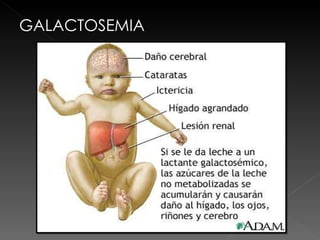
GALACTOSEMIA
WILSON’S DISEASE
ALBINISM
HEMOPHILIA
MUSCULAR DYSTROPHY
NIEMANN-PICK DISEASE
GAUCHER’S DISEASE
TAY-SACHS DISEASE
FARBER’S DISEASE
LOU GEHRIG’S DISEASE
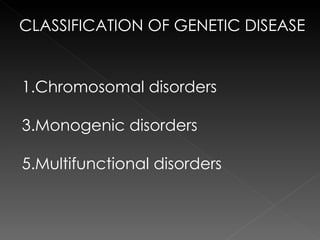
CLASSIFICATION OF GENETIC DISEASE Chromosomal disorders Monogenic disorders Multifunctional disorders
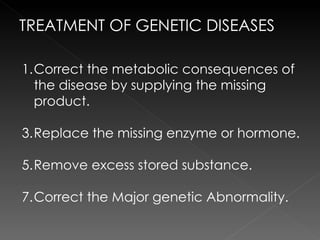
TREATMENT OF GENETIC DISEASES Correct the metabolic consequences of the disease by supplying the missing product. Replace the missing enzyme or hormone. Remove excess stored substance. Correct the Major genetic Abnormality.
RECOMBINANT DNA (Gene Splicing) Recombinant DNA is the general name for taking a piece of one DNA, and  combining it with another strand of DNA.  By combining two or more different strands of DNA, scientists are able to create a new strand of DNA.  The most common recombinant process involves combining the DNA of two  different organisms. 
GENETIC MARKERS One of the newer topics of cancer research is genetic markers, defects in one part of a chromosomes that it is believed can cause a certain disease.  A genetic marker for Alzheimer’s disease has been found on chromosome 21, the same chromosome that is associated with Down’s Syndrome. Since a chromosomes can include many, many genes, much work is yet to be done in this area.
ONCOGENES Oncogenes are the genes that appear to trigger  uncontrolled, cancerous growth. Cancerous cells exhibit three general characteristics: UNCONTROLLED GROWTH INVASION OF BODIE TISSUES SPREAD TO OTHER BODY PARTS
DNA FINGERPRINTING DNA fingerprinting is a way of identifying a specific individual, rather than simply identifying a species or some particular trait. It is also known as genetic fingerprinting or DNA profiling. 
DNA fingerprinting is very attractive because it doesn't require actual fingerprints, which may or may not be left behind, and may or may not be obscured. Because all of the DNA sections are contained in every cell, any piece of a person's body, from a strand of hair to a skin follicle to a drop of blood, may be used to identify them using DNA fingerprinting.
This is useful in the case of identifying a criminal, because even a drop of blood or skin left at the crime scene may be enough to establish innocence or guilt, and it is virtually impossible to remove all physical trace of one's presence.  DNA fingerprinting is useful in the case of identifying victims because even in cases where the body may be disfigured past identification, and teeth or other identifying features may be destroyed, all it takes is a single cell for positive identification.

Common Genetic Diseases

  • 1.
  • 2.
  • 3.
  • 4.
  • 5.
  • 6.
  • 7.
  • 8.
  • 9.
  • 10.
  • 11.
  • 12.
  • 13.
  • 14.
  • 15.
    CLASSIFICATION OF GENETICDISEASE Chromosomal disorders Monogenic disorders Multifunctional disorders
  • 16.
    TREATMENT OF GENETICDISEASES Correct the metabolic consequences of the disease by supplying the missing product. Replace the missing enzyme or hormone. Remove excess stored substance. Correct the Major genetic Abnormality.
  • 17.
    RECOMBINANT DNA (GeneSplicing) Recombinant DNA is the general name for taking a piece of one DNA, and  combining it with another strand of DNA.  By combining two or more different strands of DNA, scientists are able to create a new strand of DNA.  The most common recombinant process involves combining the DNA of two  different organisms. 
  • 18.
    GENETIC MARKERS Oneof the newer topics of cancer research is genetic markers, defects in one part of a chromosomes that it is believed can cause a certain disease. A genetic marker for Alzheimer’s disease has been found on chromosome 21, the same chromosome that is associated with Down’s Syndrome. Since a chromosomes can include many, many genes, much work is yet to be done in this area.
  • 19.
    ONCOGENES Oncogenes arethe genes that appear to trigger uncontrolled, cancerous growth. Cancerous cells exhibit three general characteristics: UNCONTROLLED GROWTH INVASION OF BODIE TISSUES SPREAD TO OTHER BODY PARTS
  • 20.
    DNA FINGERPRINTING DNA fingerprinting isa way of identifying a specific individual, rather than simply identifying a species or some particular trait. It is also known as genetic fingerprinting or DNA profiling. 
  • 21.
    DNA fingerprinting is very attractivebecause it doesn't require actual fingerprints, which may or may not be left behind, and may or may not be obscured. Because all of the DNA sections are contained in every cell, any piece of a person's body, from a strand of hair to a skin follicle to a drop of blood, may be used to identify them using DNA fingerprinting.
  • 22.
    This is usefulin the case of identifying a criminal, because even a drop of blood or skin left at the crime scene may be enough to establish innocence or guilt, and it is virtually impossible to remove all physical trace of one's presence.  DNA fingerprinting is useful in the case of identifying victims because even in cases where the body may be disfigured past identification, and teeth or other identifying features may be destroyed, all it takes is a single cell for positive identification.