Thalassemia Demographics & Statistics Year 2008
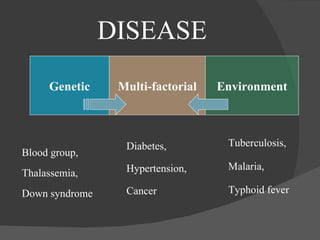
DISEASE Genetic Multi-factorial Environment Blood group, Thalassemia, Down syndrome Diabetes, Hypertension, Cancer Tuberculosis, Malaria,  Typhoid fever
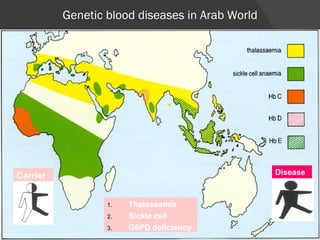
Genetic blood diseases in Arab World Thalassemia Sickle cell G6PD deficiency Carrier Disease
 
 
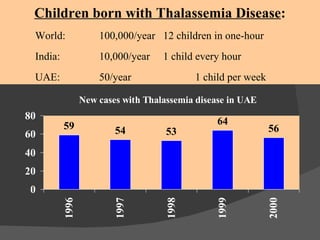
Children born with Thalassemia Disease : World:   100,000/year 12 children in one-hour India:   10,000/year 1 child every hour UAE: 50/year 1 child per week
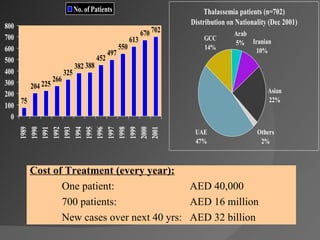
Cost of Treatment (every year): One patient: AED 40,000 700 patients: AED 16 million New cases over next 40 yrs: AED 32 billion
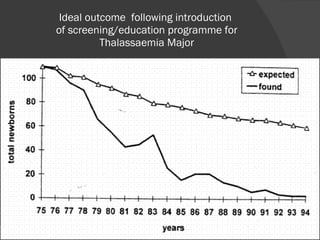
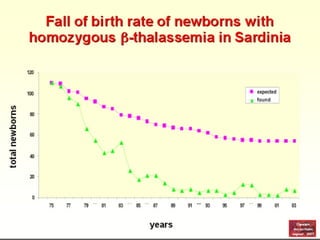
Ideal outcome  following introduction  of screening/education programme for Thalassaemia Major
 
CANADA (Am J Hum Genet 1996 Oct;59(4):793-8 ) 1972-1992  Screened 25,274 High school Students 693 were carriers  Virtually all the carriers identified  remembered their status,  had their partner tested  took up the options to prevent EARLIER STUDY When to Intervene ? College/ University  Vs  Pre-Marital
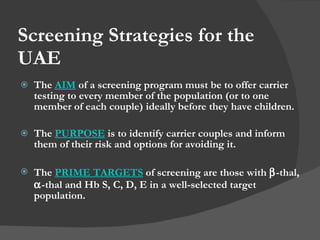
Screening Strategies for the UAE The  AIM  of a screening program must be to offer carrier testing to every member of the population (or to one member of each couple) ideally before they have children. The  PURPOSE  is to identify carrier couples and inform them of their risk and options for avoiding it. The  PRIME TARGETS  of screening are those with   -thal,   -thal and Hb S, C, D, E in a well-selected target population.
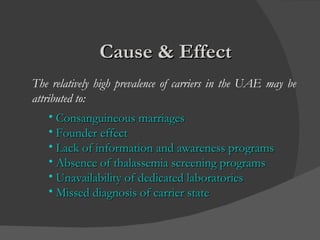
Cause & Effect   The relatively high prevalence of carriers in the UAE may be attributed to: Consanguineous marriages Founder effect Lack of information and awareness programs  Absence of thalassemia screening programs Unavailability of dedicated laboratories Missed diagnosis of carrier state
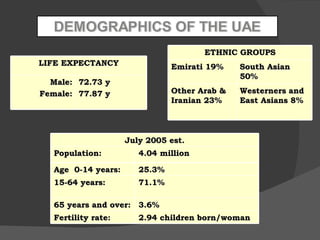
LIFE EXPECTANCY Male: Female: 72.73 y 77.87 y ETHNIC GROUPS Emirati 19% South Asian 50% Other Arab & Iranian 23% Westerners and East Asians 8% July 2005 est. Population: 4.04 million Age  0-14 years:  25.3%  15-64 years:  71.1%  65 years and over: 3.6%  Fertility rate: 2.94 children born/woman
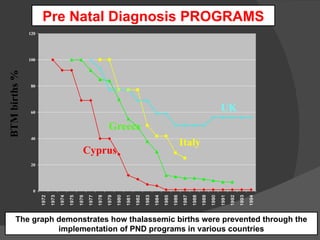
Cyprus Greece Italy UK BTM births % Pre Natal Diagnosis PROGRAMS The graph demonstrates how thalassemic births were prevented through the implementation of PND programs in various countries

Thalassemia demographics statistics

  • 1.
    Thalassemia Demographics &Statistics Year 2008
  • 2.
    DISEASE Genetic Multi-factorialEnvironment Blood group, Thalassemia, Down syndrome Diabetes, Hypertension, Cancer Tuberculosis, Malaria, Typhoid fever
  • 3.
    Genetic blood diseasesin Arab World Thalassemia Sickle cell G6PD deficiency Carrier Disease
  • 4.
  • 5.
  • 6.
    Children born withThalassemia Disease : World: 100,000/year 12 children in one-hour India: 10,000/year 1 child every hour UAE: 50/year 1 child per week
  • 7.
    Cost of Treatment(every year): One patient: AED 40,000 700 patients: AED 16 million New cases over next 40 yrs: AED 32 billion
  • 8.
    Ideal outcome following introduction of screening/education programme for Thalassaemia Major
  • 9.
  • 10.
    CANADA (Am JHum Genet 1996 Oct;59(4):793-8 ) 1972-1992 Screened 25,274 High school Students 693 were carriers Virtually all the carriers identified remembered their status, had their partner tested took up the options to prevent EARLIER STUDY When to Intervene ? College/ University Vs Pre-Marital
  • 11.
    Screening Strategies forthe UAE The AIM of a screening program must be to offer carrier testing to every member of the population (or to one member of each couple) ideally before they have children. The PURPOSE is to identify carrier couples and inform them of their risk and options for avoiding it. The PRIME TARGETS of screening are those with  -thal,  -thal and Hb S, C, D, E in a well-selected target population.
  • 12.
    Cause & Effect  The relatively high prevalence of carriers in the UAE may be attributed to: Consanguineous marriages Founder effect Lack of information and awareness programs Absence of thalassemia screening programs Unavailability of dedicated laboratories Missed diagnosis of carrier state
  • 13.
    LIFE EXPECTANCY Male:Female: 72.73 y 77.87 y ETHNIC GROUPS Emirati 19% South Asian 50% Other Arab & Iranian 23% Westerners and East Asians 8% July 2005 est. Population: 4.04 million Age 0-14 years: 25.3% 15-64 years: 71.1% 65 years and over: 3.6% Fertility rate: 2.94 children born/woman
  • 14.
    Cyprus Greece ItalyUK BTM births % Pre Natal Diagnosis PROGRAMS The graph demonstrates how thalassemic births were prevented through the implementation of PND programs in various countries