MONOGENIC
DISORDERS
Mariana Roldán Isaza
Medicine Student
Third Semester
2-2017
MEDICAL UTILITY BIBLIOGRAPHY MONOGENIC DISORDERS
By: Mariana Roldán Isaza
Molecular Biology
Teacher: Lina Martinez
Centro de Medicina Embrionaria. (2013).
Enfermedades monogénicas hereditarias:
Centro de Medicina Embrionaria. Obtenido de
Centro de Medicina Embrionaria Sitio Web:
http://www.pgdcem.com/terminologia/enfer
medades_hereditarias_monogenicas.html
Martínez Sánchez, Lina María. Biología
Molecular. 7 ed. Medellín: UPB. Fac. Medicina
University of Leicester. (s.f.). Virtual Genetics
Education Centre: University of Leicester.
Obtenido de University of Leicester Web Site:
http://www2.le.ac.uk/projects/vgec
/healthprof/topics/patterns-of-
inheritance/patterns-of-inheritance-conditions
Thanks to these new
discoveries and research,
it is getting closer and
closer to finding a possible
treatment for these
genetic diseases,
potentially life-threatening
and, until now, completely
incurable.
The medical utility it has on
muscles in DMD is that
even in the lack of
dystrophin, it will be
possible to use brain
stimulus as a treatment to
improve the conditions
and quality of life of
patients with DMD.
And on the mucous membranes, this discovery may be
one of the next ways to solve the main problem of
cystic fibrosis, which is the obstruction of different
organs covered by mucus-secreting epithelia,
This will provide patients with Cystic Fibrosis and
Duchenne Muscular Dystrophy greater life expectancy
and a better quality of life.
INTRODUCTION CYSTIC FIBROSIS ALTERS THE
STRUCTURE OF MUCUS IN AIRWAYS
RESTORING BREATHING CAPACITY
IN DUCHENNE MUSCULAR
DYSTROPHY BY ACTIVATING THE
BRAIN
When it comes to the genome, it refers to the set
of chromosomes that contain all the genetic
information that individually identifies who we
are. It is highly protected by different cellular
mechanisms for the purpose of maintaining the
DNA structure and preventing changes in its
information. Sometimes, these mechanisms fail to
correct the damage, so they remain in the cell
and manage to transmit to their descendants.
Product of these mutations can be monogenic
disorders. These involve damage or mutation in
the sequence of a single DNA gene. These are
not necessarily hereditary, but can also originate
spontaneously. Many of these are going to imply
a generally negative change for the one that
expresses that mutation, which causes different
diseases.
In an investigation conducted at
University College Cork, with the
collaboration of the University of
Calgary and Trinity College Dublin,
suggest that by stimulating breathing
at the brain level, it is possible to
decrease the respiratory insufficiency
of patients with Duchenne Muscular
Dystrophy (DMD).
DMD is a genetic neuromuscular
disease linked to the X chromosome
in which it decrements the
production of dystrophin, an
essential protein for muscular
integrity.
Experimenting with mice with
dystrophin deficiency, which had
deterioration in the respiratory
control system, obtained that the
brain compensated the deficiency
stimulating the activation of the
diaphragm (main muscle of the
respiration).
Student opinion:
Like the authors of the research, I
believe that human studies should
be done regarding this
compensation to see if this may be a
potential treatment for DMD.
In a new study published in Proceedings of the National
Academy of Sciences, they observed how mucus
structure changes in patients with cystic fibrosis.
Cystic fibrosis is an autosomal recessive disease in which
a defective chloride secretion is evidenced leading to
an imbalance of transport of water and electrolytes
causing the production of a dense mucus, difficult to
displace which contributes to recurrent infections.
The different researchers focused the shift of two
proteins, MUC5B and MUC5AC, which are important
components of mucus. When secreted by the
submucosal glands and goblet cells, respectively, they
combine what may be useful to trap and remove
particles. The change in protein structure is related to its
accumulation and viscosity.
Student opinion:
I consider this a great
discovery with which we
can understand a little
more about this disorder; as
well as being a great
opportunity to discover the
best way to treat this
deadly disease.
INTRODUCTION
When it comes to the genome, it refers to
the set of chromosomes that contain all
the genetic information that individually
identifies who we are. It is highly protected
by different cellular mechanisms for the
purpose of maintaining the DNA structure
and preventing changes in its information.
Sometimes, these mechanisms fail to
correct the damage, so they remain in the
cell and manage to transmit to their
descendants. Product of these mutations
can be monogenic disorders. These
involve damage or mutation in the
sequence of a single DNA gene. These are
not necessarily hereditary, but can also
originate spontaneously. Many of these
are going to imply a generally negative
change for the one that expresses that
mutation, which causes different diseases.
INTRODUCTION
This section discusses DNA mutations, the product of
failure in the repair mechanisms of the cells.
In the cell cycle there are 3 control points (in phase
G1, G2 and M) which check that the DNA is not
damaged, that there are no portions without
replicate, and that the chromosomes are correctly
positioned in the mitotic spindle for its later
distribution to the daughter cells.
Taking into account the definition of "monogenic
disorders", and that a gene is a DNA sequence
coding for a protein that has a specific function in
the cell, the damage in this and its subsequent
transmission would imply the malfunction of the cells
that coding for this mutation.
Monogenetic disorders can be inherited with
different patterns which can be:
• Autosomal Recessive Inheritance
• Autosomal DominantInheritance
• X-Linked Recessive Inheritance
• X-Linked Dominant Inheritance
CYSTIC FIBROSIS ALTERS THE
STRUCTURE OF MUCUS IN
AIRWAYS
In a new study published in Proceedings of
the National Academy of Sciences, they
observed how mucus structure changes in
patients with cystic fibrosis.
Cystic fibrosis is an autosomal recessive
disease in which a defective chloride
secretion is evidenced leading to an
imbalance of transport of water and
electrolytes causing the production of a
dense mucus, difficult to displace which
contributes to recurrent infections.
The different researchers focused the shift of
two proteins, MUC5B and MUC5AC, which
are important components of mucus. When
secreted by the submucosal glands and
goblet cells, respectively, they combine what
may be useful to trap and remove particles.
The change in protein structure is related to
its accumulation and viscosity.
Student opinion:
I consider this a great
discovery with which
we can understand a
little more about this
disorder; as well as
being a great
opportunity to
discover the best way
to treat this deadly
disease.
CYSTIC FIBROSIS ALTERS THE
STRUCTURE OF MUCUS IN AIRWAYS
June 28, 2017
University of Iowa
Health Care
CYSTIC FIBROSIS ALTERS THE
STRUCTURE OF MUCUS IN AIRWAYS
Cystic fibrosis is caused by a mutation in a
gene located on chromosome 7 that
codes for CFTR (Cystic Fibrosis
Transmembrane Conductance
Regulator) which, as the name implies, is
a protein that regulates the conductance
of chlorine through membranes in
epithelial cells. Since these cells are found
in various systems (airways,
gastrointestinal tract, liver, pancreas), it is
a life-threatening disease for those who
express it.
CYSTIC FIBROSIS ALTERS THE
STRUCTURE OF MUCUS IN AIRWAYS
The production of mucus is essential
for the inhaled substance entrapment,
including viruses and bacteria, which
can be harmful and can interfere with
the gas exchange. Then, thanks to the
cilia (small projections on the surface
of the airway cells) the produced
mucus is swept outwards.
CYSTIC FIBROSIS ALTERS THE
STRUCTURE OF MUCUS IN AIRWAYS
MUC5B is produced as strands, while MUC5AC is
secreted as fine threads and thin sheets. It was
shown that these two types of protein are
combined by exiting the surface of the via areas
so that the MUC5B strands are partially covered
with MUC5AC sheets. Said structure may be
useful for capturing and removing inhaled
particles. However, CF-affected animals showed
that the MUC5B strands are entangled, which
continually fill the ducts of the submucosal
glands and release them easily, and the
MUC5AC sheets are larger and plentiful.
STUDENT OPINION
I believe that this new finding may help to understand a little more about the disease
and the changes that it entails. I also find it surprising how changing a few base pairs in
our DNA can entail such serious damage to our health.
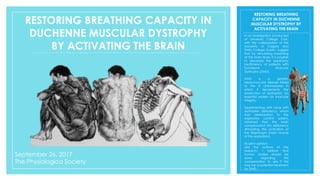
RESTORING BREATHING CAPACITY IN
DUCHENNE MUSCULAR DYSTROPHY
BY ACTIVATING THE BRAIN
September 26, 2017
The Physiologica Society
RESTORING BREATHING
CAPACITY IN DUCHENNE
MUSCULAR DYSTROPHY BY
ACTIVATING THE BRAIN
In an investigation conducted
at University College Cork,
with the collaboration of the
University of Calgary and
Trinity College Dublin, suggest
that by stimulating breathing
at the brain level, it is possible
to decrease the respiratory
insufficiency of patients with
Duchenne Muscular
Dystrophy (DMD).
DMD is a genetic
neuromuscular disease linked
to the X chromosome in
which it decrements the
production of dystrophin, an
essential protein for muscular
integrity.
Experimenting with mice with
dystrophin deficiency, which
had deterioration in the
respiratory control system,
obtained that the brain
compensated the deficiency
stimulating the activation of
the diaphragm (main muscle
of the respiration).
Student opinion:
Like the authors of the
research, I believe that
human studies should be
done regarding this
compensation to see if this
may be a potential treatment
for DMD.
RESTORING BREATHING CAPACITY IN
DUCHENNE MUSCULAR DYSTROPHY
BY ACTIVATING THE BRAIN
DMD damages the DMD gene located
at the Xp21 locus. Affected children will
be delayed in motor development,
which impedes adequate mobility.
RESTORING BREATHING CAPACITY IN
DUCHENNE MUSCULAR DYSTROPHY
BY ACTIVATING THE BRAIN
Dystrophin is a cytoskeletal protein found
on the inner face of the cell membrane.
Its function is to maintain the integrity of
muscle fibers through interactions with
other membrane proteins. Thanks to its
deficiency, muscle cells are easily
damaged and limit muscle contraction.
RESTORING BREATHING CAPACITY IN
DUCHENNE MUSCULAR DYSTROPHY
BY ACTIVATING THE BRAIN
The diaphragm is innervated by the
mainly phrenic nerves, which come from
the roots of C3, C4 and C5. The stimulus
sent by the brain to the diaphragm to
enhance its functioning as a
compensatory mechanism, should be by
these roots.
STUDENT OPINION
It is surprising to know that the change in a single protein of the muscle fibers can alter
the muscle until it leads to dysfunction. I believe that this discovery can provide a good
basis for thinking about a possible treatment of this disease.
MEDICAL UTILITY
MEDICAL UTILITY
Thanks to these
new discoveries
and research, it
is getting closer
and closer to
finding a
possible
treatment for
these genetic
diseases,
potentially life-
threatening and,
until now,
completely
incurable.
The medical utility it has on muscles in
DMD is that even in the lack of
dystrophin, it will be possible to use
brain stimulus as a treatment to
improve the conditions and quality of
life of patients with DMD.
And on the mucous membranes, this
discovery may be one of the next
ways to solve the main problem of
cystic fibrosis, which is the obstruction
of different organs covered by mucus-
secreting epithelia,
This will provide patients with Cystic
Fibrosis and Duchenne Muscular
Dystrophy greater life expectancy and
a better quality of life.
MEDICAL UTILITY
Increasing the frequency of brain stimuli for
potential muscle activation in DMD and
knowing the structure of the proteins that
comprise mucus in CF may perhaps be a
possible treatment for these two genetic
diseases.
MEDICAL UTILITY
All these studies can contribute to improve
the quality of life of patients who have
diseases that have no specific treatment
so far.
MEDICAL UTILITY
The above information can guide us to a
better understanding of monogenic
disorders, to increase our knowledge
about heredity, and to internalize the
importance of the human genome and
genetics in the study of pathologies.
BIBLIOGRAPHY
Asociación Duchenne Parent Project España. (25 de Septiembre de 2012).
¿Qué es Duchenne? : Asociación Duchenne Parent Project España. Obtenido
de Asociación Duchenne Parent Project España Web Site:
https://www.duchenne-spain.org/que-es-duchenne/
Centro de Medicina Embrionaria. (2013). Enfermedades monogénicas
hereditarias: Centro de Medicina Embrionaria. Medicina Embrionaria Web Site:
http://www.pgdcem.com/terminologia/enfermedades_hereditarias_monogen
icas.html
Escobar , H., & Sojo, A. (2010). Fibrosis Quística. En A. E. Pediatría, Protocolos
Diagnóstico-Terapéuticos de Gastroenterología, Hepatología y Nutrición
Pediatrica. Ergón S.A. Obtenido de Asociación Española de Pediatría Web
Site: http://www.aeped.es/sites/default/files/documentos/10-FQ.pdf
Martínez Sánchez, Lina María. Biología Molecular. 7 ed. Medellín: UPB. Fac.
Medicina
University of Leicester. (s.f.). Virtual Genetics Education Centre: University of
Leicester. University of Leicester Web Site: http://www2.le.ac.uk/projects/vgec
/healthprof/topics/patterns-of-inheritance/patterns-of-inheritance-conditions
Monogenic disorders

Monogenic disorders

  • 1.
  • 2.
    MEDICAL UTILITY BIBLIOGRAPHYMONOGENIC DISORDERS By: Mariana Roldán Isaza Molecular Biology Teacher: Lina Martinez Centro de Medicina Embrionaria. (2013). Enfermedades monogénicas hereditarias: Centro de Medicina Embrionaria. Obtenido de Centro de Medicina Embrionaria Sitio Web: http://www.pgdcem.com/terminologia/enfer medades_hereditarias_monogenicas.html Martínez Sánchez, Lina María. Biología Molecular. 7 ed. Medellín: UPB. Fac. Medicina University of Leicester. (s.f.). Virtual Genetics Education Centre: University of Leicester. Obtenido de University of Leicester Web Site: http://www2.le.ac.uk/projects/vgec /healthprof/topics/patterns-of- inheritance/patterns-of-inheritance-conditions Thanks to these new discoveries and research, it is getting closer and closer to finding a possible treatment for these genetic diseases, potentially life-threatening and, until now, completely incurable. The medical utility it has on muscles in DMD is that even in the lack of dystrophin, it will be possible to use brain stimulus as a treatment to improve the conditions and quality of life of patients with DMD. And on the mucous membranes, this discovery may be one of the next ways to solve the main problem of cystic fibrosis, which is the obstruction of different organs covered by mucus-secreting epithelia, This will provide patients with Cystic Fibrosis and Duchenne Muscular Dystrophy greater life expectancy and a better quality of life.
  • 3.
    INTRODUCTION CYSTIC FIBROSISALTERS THE STRUCTURE OF MUCUS IN AIRWAYS RESTORING BREATHING CAPACITY IN DUCHENNE MUSCULAR DYSTROPHY BY ACTIVATING THE BRAIN When it comes to the genome, it refers to the set of chromosomes that contain all the genetic information that individually identifies who we are. It is highly protected by different cellular mechanisms for the purpose of maintaining the DNA structure and preventing changes in its information. Sometimes, these mechanisms fail to correct the damage, so they remain in the cell and manage to transmit to their descendants. Product of these mutations can be monogenic disorders. These involve damage or mutation in the sequence of a single DNA gene. These are not necessarily hereditary, but can also originate spontaneously. Many of these are going to imply a generally negative change for the one that expresses that mutation, which causes different diseases. In an investigation conducted at University College Cork, with the collaboration of the University of Calgary and Trinity College Dublin, suggest that by stimulating breathing at the brain level, it is possible to decrease the respiratory insufficiency of patients with Duchenne Muscular Dystrophy (DMD). DMD is a genetic neuromuscular disease linked to the X chromosome in which it decrements the production of dystrophin, an essential protein for muscular integrity. Experimenting with mice with dystrophin deficiency, which had deterioration in the respiratory control system, obtained that the brain compensated the deficiency stimulating the activation of the diaphragm (main muscle of the respiration). Student opinion: Like the authors of the research, I believe that human studies should be done regarding this compensation to see if this may be a potential treatment for DMD. In a new study published in Proceedings of the National Academy of Sciences, they observed how mucus structure changes in patients with cystic fibrosis. Cystic fibrosis is an autosomal recessive disease in which a defective chloride secretion is evidenced leading to an imbalance of transport of water and electrolytes causing the production of a dense mucus, difficult to displace which contributes to recurrent infections. The different researchers focused the shift of two proteins, MUC5B and MUC5AC, which are important components of mucus. When secreted by the submucosal glands and goblet cells, respectively, they combine what may be useful to trap and remove particles. The change in protein structure is related to its accumulation and viscosity. Student opinion: I consider this a great discovery with which we can understand a little more about this disorder; as well as being a great opportunity to discover the best way to treat this deadly disease.
  • 4.
    INTRODUCTION When it comesto the genome, it refers to the set of chromosomes that contain all the genetic information that individually identifies who we are. It is highly protected by different cellular mechanisms for the purpose of maintaining the DNA structure and preventing changes in its information. Sometimes, these mechanisms fail to correct the damage, so they remain in the cell and manage to transmit to their descendants. Product of these mutations can be monogenic disorders. These involve damage or mutation in the sequence of a single DNA gene. These are not necessarily hereditary, but can also originate spontaneously. Many of these are going to imply a generally negative change for the one that expresses that mutation, which causes different diseases. INTRODUCTION This section discusses DNA mutations, the product of failure in the repair mechanisms of the cells. In the cell cycle there are 3 control points (in phase G1, G2 and M) which check that the DNA is not damaged, that there are no portions without replicate, and that the chromosomes are correctly positioned in the mitotic spindle for its later distribution to the daughter cells. Taking into account the definition of "monogenic disorders", and that a gene is a DNA sequence coding for a protein that has a specific function in the cell, the damage in this and its subsequent transmission would imply the malfunction of the cells that coding for this mutation. Monogenetic disorders can be inherited with different patterns which can be: • Autosomal Recessive Inheritance • Autosomal DominantInheritance • X-Linked Recessive Inheritance • X-Linked Dominant Inheritance
  • 5.
    CYSTIC FIBROSIS ALTERSTHE STRUCTURE OF MUCUS IN AIRWAYS In a new study published in Proceedings of the National Academy of Sciences, they observed how mucus structure changes in patients with cystic fibrosis. Cystic fibrosis is an autosomal recessive disease in which a defective chloride secretion is evidenced leading to an imbalance of transport of water and electrolytes causing the production of a dense mucus, difficult to displace which contributes to recurrent infections. The different researchers focused the shift of two proteins, MUC5B and MUC5AC, which are important components of mucus. When secreted by the submucosal glands and goblet cells, respectively, they combine what may be useful to trap and remove particles. The change in protein structure is related to its accumulation and viscosity. Student opinion: I consider this a great discovery with which we can understand a little more about this disorder; as well as being a great opportunity to discover the best way to treat this deadly disease. CYSTIC FIBROSIS ALTERS THE STRUCTURE OF MUCUS IN AIRWAYS June 28, 2017 University of Iowa Health Care
  • 6.
    CYSTIC FIBROSIS ALTERSTHE STRUCTURE OF MUCUS IN AIRWAYS Cystic fibrosis is caused by a mutation in a gene located on chromosome 7 that codes for CFTR (Cystic Fibrosis Transmembrane Conductance Regulator) which, as the name implies, is a protein that regulates the conductance of chlorine through membranes in epithelial cells. Since these cells are found in various systems (airways, gastrointestinal tract, liver, pancreas), it is a life-threatening disease for those who express it.
  • 7.
    CYSTIC FIBROSIS ALTERSTHE STRUCTURE OF MUCUS IN AIRWAYS The production of mucus is essential for the inhaled substance entrapment, including viruses and bacteria, which can be harmful and can interfere with the gas exchange. Then, thanks to the cilia (small projections on the surface of the airway cells) the produced mucus is swept outwards.
  • 8.
    CYSTIC FIBROSIS ALTERSTHE STRUCTURE OF MUCUS IN AIRWAYS MUC5B is produced as strands, while MUC5AC is secreted as fine threads and thin sheets. It was shown that these two types of protein are combined by exiting the surface of the via areas so that the MUC5B strands are partially covered with MUC5AC sheets. Said structure may be useful for capturing and removing inhaled particles. However, CF-affected animals showed that the MUC5B strands are entangled, which continually fill the ducts of the submucosal glands and release them easily, and the MUC5AC sheets are larger and plentiful.
  • 9.
    STUDENT OPINION I believethat this new finding may help to understand a little more about the disease and the changes that it entails. I also find it surprising how changing a few base pairs in our DNA can entail such serious damage to our health.
  • 10.
    RESTORING BREATHING CAPACITYIN DUCHENNE MUSCULAR DYSTROPHY BY ACTIVATING THE BRAIN September 26, 2017 The Physiologica Society RESTORING BREATHING CAPACITY IN DUCHENNE MUSCULAR DYSTROPHY BY ACTIVATING THE BRAIN In an investigation conducted at University College Cork, with the collaboration of the University of Calgary and Trinity College Dublin, suggest that by stimulating breathing at the brain level, it is possible to decrease the respiratory insufficiency of patients with Duchenne Muscular Dystrophy (DMD). DMD is a genetic neuromuscular disease linked to the X chromosome in which it decrements the production of dystrophin, an essential protein for muscular integrity. Experimenting with mice with dystrophin deficiency, which had deterioration in the respiratory control system, obtained that the brain compensated the deficiency stimulating the activation of the diaphragm (main muscle of the respiration). Student opinion: Like the authors of the research, I believe that human studies should be done regarding this compensation to see if this may be a potential treatment for DMD.
  • 11.
    RESTORING BREATHING CAPACITYIN DUCHENNE MUSCULAR DYSTROPHY BY ACTIVATING THE BRAIN DMD damages the DMD gene located at the Xp21 locus. Affected children will be delayed in motor development, which impedes adequate mobility.
  • 12.
    RESTORING BREATHING CAPACITYIN DUCHENNE MUSCULAR DYSTROPHY BY ACTIVATING THE BRAIN Dystrophin is a cytoskeletal protein found on the inner face of the cell membrane. Its function is to maintain the integrity of muscle fibers through interactions with other membrane proteins. Thanks to its deficiency, muscle cells are easily damaged and limit muscle contraction.
  • 13.
    RESTORING BREATHING CAPACITYIN DUCHENNE MUSCULAR DYSTROPHY BY ACTIVATING THE BRAIN The diaphragm is innervated by the mainly phrenic nerves, which come from the roots of C3, C4 and C5. The stimulus sent by the brain to the diaphragm to enhance its functioning as a compensatory mechanism, should be by these roots.
  • 14.
    STUDENT OPINION It issurprising to know that the change in a single protein of the muscle fibers can alter the muscle until it leads to dysfunction. I believe that this discovery can provide a good basis for thinking about a possible treatment of this disease.
  • 15.
    MEDICAL UTILITY MEDICAL UTILITY Thanksto these new discoveries and research, it is getting closer and closer to finding a possible treatment for these genetic diseases, potentially life- threatening and, until now, completely incurable. The medical utility it has on muscles in DMD is that even in the lack of dystrophin, it will be possible to use brain stimulus as a treatment to improve the conditions and quality of life of patients with DMD. And on the mucous membranes, this discovery may be one of the next ways to solve the main problem of cystic fibrosis, which is the obstruction of different organs covered by mucus- secreting epithelia, This will provide patients with Cystic Fibrosis and Duchenne Muscular Dystrophy greater life expectancy and a better quality of life.
  • 16.
    MEDICAL UTILITY Increasing thefrequency of brain stimuli for potential muscle activation in DMD and knowing the structure of the proteins that comprise mucus in CF may perhaps be a possible treatment for these two genetic diseases.
  • 17.
    MEDICAL UTILITY All thesestudies can contribute to improve the quality of life of patients who have diseases that have no specific treatment so far.
  • 18.
    MEDICAL UTILITY The aboveinformation can guide us to a better understanding of monogenic disorders, to increase our knowledge about heredity, and to internalize the importance of the human genome and genetics in the study of pathologies.
  • 19.
    BIBLIOGRAPHY Asociación Duchenne ParentProject España. (25 de Septiembre de 2012). ¿Qué es Duchenne? : Asociación Duchenne Parent Project España. Obtenido de Asociación Duchenne Parent Project España Web Site: https://www.duchenne-spain.org/que-es-duchenne/ Centro de Medicina Embrionaria. (2013). Enfermedades monogénicas hereditarias: Centro de Medicina Embrionaria. Medicina Embrionaria Web Site: http://www.pgdcem.com/terminologia/enfermedades_hereditarias_monogen icas.html Escobar , H., & Sojo, A. (2010). Fibrosis Quística. En A. E. Pediatría, Protocolos Diagnóstico-Terapéuticos de Gastroenterología, Hepatología y Nutrición Pediatrica. Ergón S.A. Obtenido de Asociación Española de Pediatría Web Site: http://www.aeped.es/sites/default/files/documentos/10-FQ.pdf Martínez Sánchez, Lina María. Biología Molecular. 7 ed. Medellín: UPB. Fac. Medicina University of Leicester. (s.f.). Virtual Genetics Education Centre: University of Leicester. University of Leicester Web Site: http://www2.le.ac.uk/projects/vgec /healthprof/topics/patterns-of-inheritance/patterns-of-inheritance-conditions